In the naval section of the Woodlands Cemetery in Gillingham, Kent, stands a headstone to a John Donoghue. The stone states that he was a Fireman on board HMS Princess Irene and that he was killed in action on 27th May 1915. He was 25 years of age.
Further research confirms that he was part of the Mercantile Marine Reserve, but there are no records to confirm his service at sea. While John was born in around 1890, with no confirmation of his place of birth, or the names of his parents, it is impossible to narrow down any further details for him.
Records of the Princess Irene’s crew do not include a John Donoghue, although this does not necessarily mean that he was not serving on board, only that records no longer exist. The fact that he was granted an individual headstone, rather than being commemorated in the mass grave that is also situated in the Woodlands Cemetery suggests that his body was able to be identified.
Sadly, however, Fireman John Donoghue’s life is destined to be lost to time, his legacy to be one of the 352 souls lost during the explosion and sinking of the ship on board which he served.
James Ward Jones was born on 17th August 1871 in the Denbighshire town of Llangollen. He was the oldest of eleven children to William and Anne Jones. William was a bricklayer’s labourer, and James followed suit when he finished school.
On 30th April 1898, James married fisherman’s daughter Mary Jones. The couple set up home in Llangollen and went on to have ten children.
When war came to Europe, James stepped up to play his part for King and Country. Sadly, little detail of his military service remains available. but it is clear that he enlisted in the Royal Welch Fusiliers and, as a Private, he was assigned to the 47th Provisional Battalion. The troop was based on home soil, and James found himself sent to Norfolk for his war work.
It is unlikely that Private Jones was in camp for long. On Christmas Day 1915 he collapsed having had a seizure, and passed away. He was 44 years of age.
James Ward Jones’ body was brought back to Wales for burial. He was laid to rest in the graveyard of St John’s Church in his home town of Llangollen.
Mary was left with ten children to bring up on her own. She married again, to a Jack Evans, in the autumn of 1916. The couple had two children of their own. Mary passed away in December 1935, aged just 58 years old.
de Courcy William Raymond was born in the summer of 1883 in the Somerset village of West Camel. He was one of six children to carpenter George Raymond and his wife, Anne. de Courcy – whose name may have had family connections – followed his father into carpentry and, by the time of the 1911 census, the family had moved to nearby South Barrow, where George had been born.
When war came to Europe, de Courcy was keen to play his part. Sadly, full details of his military service no longer survive, but what can be determined is that he had enlisted by March 1915, joining the North Somerset Yeomanry.
Private Raymond was assigned to the 2nd/1st Battalion, which was a second-line troop, and remained on home soil, moving from Somerset to Wiltshire to Kent by the autumn of 1915. He was evidently good at his job as he was soon promoted to the rank of Corporal for his efforts.
It was while he was based in Kent that de Courcy fell ill. He contracted pneumonia, and was admitted to a military hospital in Canterbury. Sadly, the condition was to prove too much, and he passed away from the condition on 9th October 1915. He was 32 years of age.
The body of de Courcy William Raymond was brought back to Somerset for burial. He was laid to rest in the family plot in the graveyard of St Peter’s Church in South Barrow.
Cyril Talbot Burney Croft was born on 28th January 1891 in Streetsville, Ontario, Canada. He was the only child of Dorset clergyman Otho Croft and his Canadian-born wife, Lucy.
Otho brought his young family back to England when Cyril was a boy. The 1901 census found him and Lucy living in South Cadbury, Somerset, where he had taken the role of the local rector. Their young son, meanwhile, was boarding at a school in St Leonard’s in East Sussex.
Education was key to Cyril’s development. He was sent to King’s College in Taunton and St Boniface College in Warminster, and enlisted in the Officer’s Training Corps for three years.
During this time, he and Lucy had travelled back to Canada, and there was an obvious draw for the young man as, in 1913, he made a move to Quebec, becoming the Assistant to the Commissioner of Harbour Works in the city.
When war broke out, Cyril was quick to step up and play his part. Joining the Canadian Expeditionary Force on 23rd September 1914, his service records show that he was 6ft 1in (1.85m) tall, with black hair, grey eyes and a dark complexion.
Cyril was initially assigned to the 12th Battalion of the Canadian Infantry, where he held the rank of Lance Corporal. On arriving in England, however, he took his leave of the Canadian force, and accepted a role in the King’s Royal Rifles. Within a few months, he transferred again, gaining the rank of Second Lieutenant in the 8th (Service) Battalion of the Somerset Light Infantry.
Details of Cyril’s actual service are vague, however, as his British Army service records are no longer available. It appears that he did not serve any time overseas, as his battalion was raised in Taunton, Somerset, and did not move to France until the end of 1915.
Second Lieutenant Croft had made a further transfer by this point, joining the Royal Flying Corps in the summer. He gained his wings on 27th October 1915 at a Military School in Birmingham.
On 8th December 1915, he was a passenger in an aircraft being piloted by a Lieutenant McDonald at Castle Bromwich.
The weather was “bumpy” but not bad… They went towards Birmingham, and then made a turn to the left. [McDonald] noticed that the engine was missing fire when he was at a height of 1,500ft [460m], and decided to land. He turned off the petrol, but did not switch off the electric ignition. He made a right-hand turn, so as to reduce the height, the machine then being at a normal angle, when, owing to the wind, the aeroplane banked. To put the machine back again he put the control lever over to the left, but finding that the machine did not answer to the control, he put on the right rudder, and Lieutenant C Black, of the Royal Flying Corps, who had instructions to watch the aeroplane, stated that shortly after eleven o’clock in the morning it ascended to a height of 1,500ft. Shortly afterwards he saw the machine coming down: it made a short spiral, then a complete circle, and while turning to make another at a height of 500ft [150m], fell straight to the ground, nose downwards. The aeroplane was in proper working order, and the witness was of the opinion that the accident was due to wind disturbances.
De Ruvigny’s Roll of Honour
Croft and McDonald were both killed. Cyril was just 24 years of age. His Colonel wrote to Otho and Lucy, noting that Cyril “did so well that it makes one feel the loss all the more of such a promising young officer. He is, indeed, a great loss to our country, especially in these times.” Cyril’s Major noted “he had a most charming, lovable character, and was thoroughly popular with all his brother officers. He was exceedingly keen at his work, and in him the service has lost a most promising and capable officer.”
Cyril Talbot Burney Croft was brought back to Somerset for burial. He was laid to rest in the graveyard of his father’s church: St Thomas a Becket’s in South Cadbury.
Second Lieutenant Cyril Croft (from ancestry.co.uk)
Charles Grigsby was born in Boughton Monchelsea, a village to the south of Maidstone, Kent, in the summer of 1878. His parents were farm labourer William Grigsby and his wife, Elizabeth, and he was one of four children. Charles’ mother passed away when he was just three years old, and William married again – to another Elizabeth. They had six children – half-siblings to Charles.
Charles falls off the radar for a few years – his First World War service records suggest that he had enlisted with the East Kent Regiment, and so may have been serving abroad at the time of the 1891 and 1901 censuses.
In 1904 he was back in Kent, however, where he married Henrietta Harpum. The daughter of a soldier, Henrietta had been born in Shoeburyness, Essex, but the family had moved to Frindsbury, Kent, not long afterwards.
The 1911 census found the Grigsbys living in the village of Eccles, near Aylesford. Charles was working as a blacksmith’s striker at the local cement works, and they had their Henrietta’s nephew, George, living with them at the time the record was taken.
When war was declared, Charles stepped up again to play his part. He enlisted on 24th August 1914, and was assigned to the Queen’s Own (Royal West Kent Regiment). Private Grigsby’s service records confirm that he was 5ft 6.5ins (1.69m) tall, and weighed 129lbs (58.5kg). He had brown hair, blue eyes and tattoos on both arms.
Tragically, Henrietta died not long after her husband joined up, although the exact date and cause of her passing is lost to time. Assigned to the 6th (Service) Battalion, Charles was, by this time, based in Hythe, on the Kent coast.
Private Grigsby’s time back in the army was to be a short one, however. He was admitted to Shorncliffe Military Hospital in January 1915, suffering from bronchial pneumonia, and is was this lung condition that was to take his life just weeks later. He passed away on 22nd February 1915, at the age of 35 years old.
Charles Grigsby was brought back to Aylesford by his siblings. He was laid to rest in the graveyard of St Peter & St Paul’s Churchyard. It is likely that he was buried alongside Henrietta, although the exact location of his grave is not longer known. Instead, he is commemorated on a joint headstone in the First World War section of the graveyard.
Frederick John Cudby – who was known by his middle name – was born in the summer of 1884 in Farnham, Surrey. The fourth of six children, his parents were William and Caroline Cudby. William was a bricklayer from Essex, while his wife was from Ramsgate in Kent. The family went where his work was, and by the mid-1890s, they had moved to Blaenavon in Monmouthshire.
When he left school, John found employment as a mechanic, working as an engine oiler at a local works. William passed away in 1901, and by the time of the next census, in 1911, John was working as a mason’s labourer. The family were all still living in Blaenavon, helping Caroline by keeping money coming in .
When war came to Europe, John was quick to serve King and Country. He enlisted in the Monmouthshire Regiment and, as a Private, was assigned to the 2nd Battalion. His troop was soon sent to France and, by November 1914, he was entrenched at Ypres, near Ploegsteert Wood.
Promoted to Corporal, little of John’s service information survives. It is clear that he was wounded during a skirmish and that he was medically evacuated back to Britain. It seems likely that he was admitted to the Preston Hall Military Hospital in Aylesford, Kent, and that this is where he subsequently succumbed to his injuries.
Corporal Frederick John Cudby died on 6th June 1915, at the age of just 30 years old. He was laid to rest in the graveyard of St Peter and St Paul’s Church in Aylesford, Kent.
While buried in the churchyard, the location of John’s grave is not known. Instead, he is commemorated on a joint headstone in the First World War section of the graveyard.
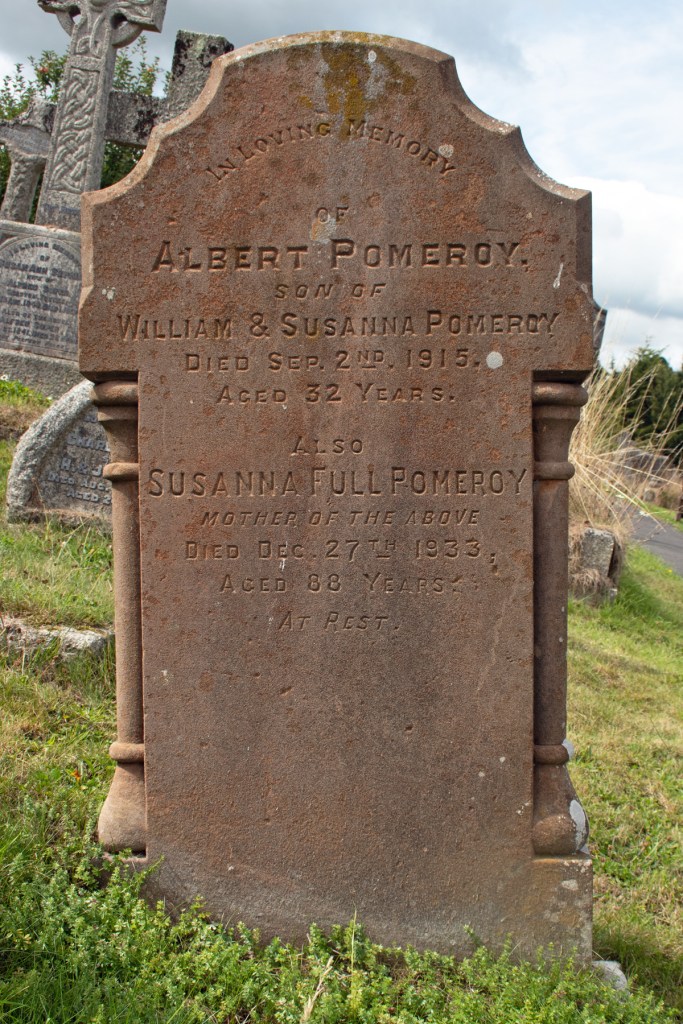
Albert Pomeroy was born on 22nd May 1882 in Totnes, Devon. The tenth of thirteen children, his parents were William and Susanna Pomeroy. William was a labourer at a cider store, and his son found work as a page when he left school. However, it is clear that he lusted after a life of adventure.
On 2nd September 1897, Albert enlisted in the Royal Navy. Aged just 15 years old, he was initially given the rank of Boy 2nd Class, and sent to HMS Impregnable, a training ship based in Devonport. He remained on board for just over a year, rising to Boy 1st Class in the process.
Boy Pomeroy moved to HMS Vivid, the Royal Naval Dockyard in Plymouth, in December 1898, and remained there until he was given his first formal sea-faring post nine months later. The cruiser HMS Terrible was to be his home from September 1899 until the spring of 1902.
On 22nd May 1900, during his time on board Terrible, Albert came of age, and he was formally enrolled into the Royal Navy. His service records confirm that he was 5ft 3in (1.60m) tall, had dark brown hair, grey eyes and a fresh complexion.
Albert was given the rank of Ordinary Seaman, but seems to have been well thought of as, just over a year later he was promoted to Able Seaman. Over the next eleven years, he served on a further ten ships, returning to HMS Vivid between voyages. On 21st May 1912, having completed the twelve years of his naval contract, Able Seaman Pomeroy was formally stood down to reserve status.
Albert’s trail goes cold for a few years. His father had passed away in 1910, so it seems likely that Albert returned home to Totnes to support his mother.
His time on reserve was not to be long, however, and, in August 1914, he was called back into duty. He received a promotion – to Leading Signalman – and assigned to the troop ship HMS Tamar. He moved to another troop ship – HMS Hardinge – in March 1915, but returned to Devonport a couple of months later.
In September, Leading Seaman Pomeroy was back in Totnes, possibly on leave, but had fallen ill. He contracted meningitis, and this was to prove fatal. Albert passed away at his mother’s home on 2nd September 1915, at the age of 33 years old.
Albert… was one of six brothers serving King and country, while another brother, who died some years ago, was in the 20th Hussars, and his late father was a naval pensioner. Albert Pomeroy saw service with Sit Percy Scott in South Africa, went to Pekin [sic] with the Naval Brigade, was engaged in operations in Somaliland, and until a few weeks ago was on active service with the British fleet.
Western Times: Tuesday 7th September 1915
Albert Pomeroy was laid to rest in the cemetery of his home town, Totnes, Devon.
Susanna went on to live into her eighties. Remaining in Totnes, when she passed away, on 27th December 1933, at the age of 88, she was reunited with her son in Totnes Cemetery.
Albert Edward Headington was born on 5th December 1876 in Keynsham, near Bristol, in Somerset. The ninth of eleven children, his parents were Joseph and Jemima Headington. Joseph was a stonemason and, while he seems not to have had his father’s talents, Albert worked with the same material, becoming a bricklayer’s labourer when he left school.
On 29th May 1899, Albert married Ellen Gray. She was a mason’s daughter from Semley in Wiltshire, and it seems that he was either working there or had some connection with the family through his father’s work. The couple settled down in Keynsham, and went on to have two children, Harold, who was born in 1900, and Edith, who was born in 1912.
By the time of the 1911 census, the family had settled in a small house in the middle of Keynsham. Albert had, by this point, found other employment, and was working for Great Western Railways as a packer.
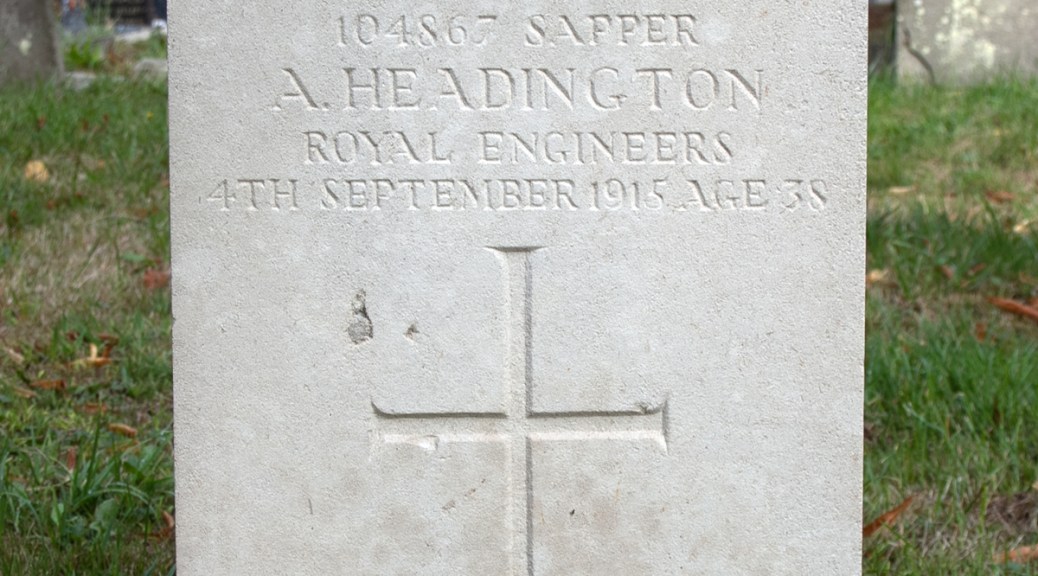
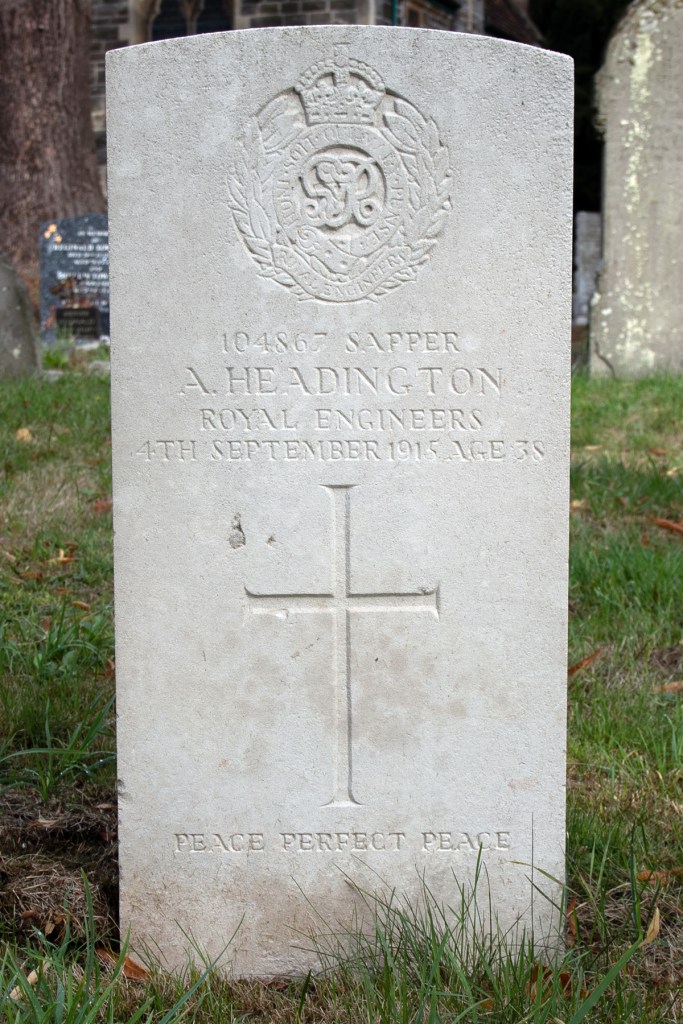
When war broke out, Albert stepped up to play his part. He enlisted on 22nd June 1915, joining the Royal Engineers as a Sapper. Sent for initial training in Chatham, Kent, he returned home on leave at the end of August. Tragically, he had fallen ill by this point, and died at home on 4th September 1915, having contracted cerebrospinal meningitis. He was 38 years of age.
Albert Edward Headington was laid to rest in the quiet cemetery of his home town of Keynsham.
Ellen went on to live a full life. She and Edith emigrated to Canada in 1921, following Harold, who had made the same move a year earlier. They all settled in the town of Welland, Ontario, not far from Niagara Falls.
Both of Albert and Ellen’s children married and had children of their own. Ellen never remarried, and passed away on 4th November 1956, at the age of 80 years old. She was laid to rest in the Holy Trinity Anglican Cemetery in Welland.
Rendle Anthony Pike was born on 9th May 1895 in Newfoundland. He was one of nine children to Lewis and Mary Pike, but there is little additional information about his early life.
Lewis was a fisherman, and it seems likely that Rendle would have had experience of seafaring when he was growing up. When war broke out, therefore, it made sense that he enlisted in the Royal Naval Reserve.
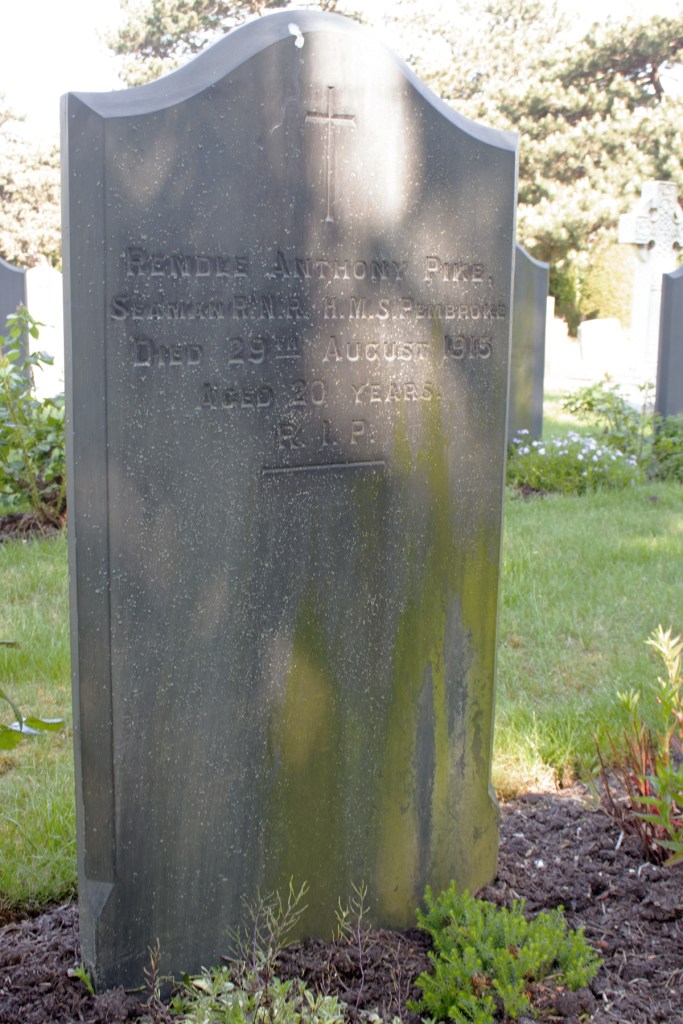
Again, full details of his service was unavailable, but Seaman Pike joined up within the first year of the war and, by the summer of 1915, he was based at HMS Pembroke, the Royal Naval Dockyard in Chatham, Kent.
Tragically, Rendle’s time in the navy was to be a short one. The next record available for him is that of his passing. According to his service documents, he died ‘of disease‘ on 29th August 1915. He was just 20 years of age.
Rendle Anthony Pike was laid to rest in Woodlands Cemetery in Gillingham, Kent, not far from the dockyard at which he had been based.
Alexander Maguire was born on 28th March 1880 in Glenarm, County Antrim, Northern Ireland. Little is known about his early life, apart from his parents’ names – James and Ellen.
Glenarm is a coastal village, and it is likely that Alexander would have had experience of seafaring from an early age. This seems to have spurred him into building a career and, on 16th December 1903, he enlisted in the Royal Naval Reserve as a Stoker.
With war getting closer, Stoker Maguire was called into formal service, and was assigned to the steamer SS Rathlin Head. He sailed the Atlantic in March 1914, and disembarked an New Orleans. It seems, however, that he missed his passage back home, although at this point, his whereabouts become a bit hazy.
Alexander was back in Britain by 13th January 1915, as his service papers record him in Liverpool. He then travelled to HMS Pembroke, the Royal Naval Dockyard in Chatham, Kent. This looks to have been his last move, however, as he passed away just two days later. The cause of death is simply recorded as ‘disease’: he was 34 years of age.
Alexander Maguire was laid to rest in the Roman Catholic section of Woodlands Cemetery in Gillingham, Kent, not far from the dockyard to which he had been assigned.






 Death and Service