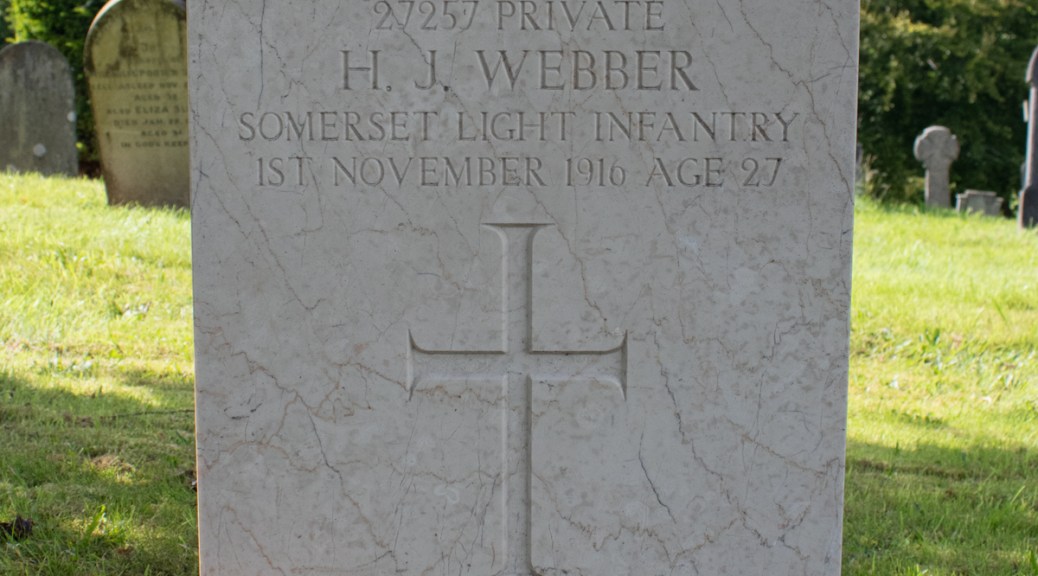
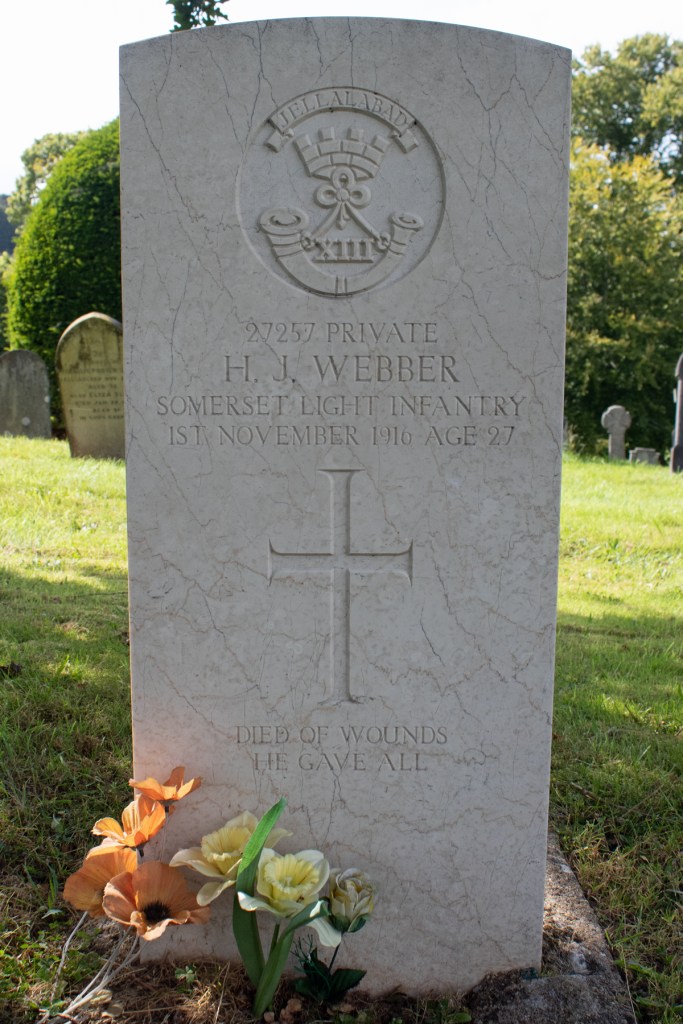
Henry James Webber was born in Plaistow, Essex, in 1889. One of ten children, his parents were Frederick and Etty Webber. Frederick hailed from Somerset, but worked as a sergeant in the Metropolitan Police. By the time of the 1901 census, he had been promoted to Inspector: the family moved to Somerset when he retired in around 1905, settling in Minehead.
Of Henry, there is little information documented. He does not appear on the 1911 census, and there are no military records to confirm his service in the army. He had certainly enlisted by the summer of 1916, joining the Somerset Light Infantry.
Private Webber was attached to the 7th (Service) Battalion and certainly saw action overseas. His troop was heavily involved in the Battles of the Somme in 1916, and it was here that he was injured. Again, full details are not available, but his wounds were severe enough for him to be medically evacuated to Britain for treatment.
Henry was admitted to the 1st Southern General Hospital in Birmingham, but his injuries proved too severe. He died on 1st November 1916, at the age of 27 years old.
Henry James Webber’s body was taken back to Somerset for burial. He was laid to rest in Minehead Cemetery, not far from where his grieving family were living in Cher Street.
Henry Edward Rowell was born on 22nd May 1898 in Southwark, Surrey. One of five siblings, of whom only three survived childhood, his parents were Henry and Jane Rowell. Henry Sr was a bricklayer’s labourer from Southwark, and the family were brought up in a small terraced house on Brandon Street, Walworth.
When he finished his schooling, Henry Jr found work as a turner’s improver but, when war came to Europe, he was called upon to play his part. He enlisted on 29th May 1915, and, as a Private, was attached to the 12th (Service) Battalion (Bermondsey) of the East Surrey Regiment. His service records tell a little of the man he was, confirming that he stood 5ft 3.5ins (1.61m) tall, and suggesting that he gave his age a 19 years old (he was just 16 at the time).
Henry seemed to have made an impression on his superiors as, in early October, he was promoted to Lance Corporal. His early service was based on home soil, primarily in Witney, Surrey.
In December 1915, Henry was temporarily released from military duty for munitions work. Sent to work for the engineering company Peter Hooker Ltd, in Walthamstow, Essex, Lance Corporal Rowell was to remain here for the next four months. On 25th March 1916, however, he was called back to service, as his battalion readied itself to move from its base, by that point in Aldershot, Hampshire, to Northern France.
Lance Corporal Rowell found himself in the thick of things very quickly. From 1st July, the 12th Battalion was caught up in the Battle of the Somme, and he remained entrenched there for the next couple of months.
On 15th September 1916, the British launched an attack on the German front line at Flers-Courcelette, mid-way between Albert and Bapaume. Lance Corporal Rowell was involved in the battle, which lasted until the end of the month, and was cut down on the very first day. He was just 18 years of age.
Henry Edward Rowell was laid to rest in the Bulls Road Cemetery in Flers, Picardie.
Henry Edward Rowell was my paternal grandmother’s first cousin.
Thomas Wood was born in Bristol, Gloucestershire, in the summer of 1862. The third of ten children, he was the oldest son to Thomas and Emma Wood. Thomas Sr was a cabinet maker, but his son was not to follow in his father’s footsteps, seeking a life of adventure instead.
Thomas enlisted in the army and, while documents relating to his early life are not readily available, the 1891 census recorded him as being billeted at the Cambridge Barracks in Portsmouth, Hampshire. A member of the Royal Artillery, he seems to have been enlisted for a while, as he had risen to the rank of Corporal.
In 1894, Thomas married Leah Barrett, who was born in Oxfordshire. The army life underscored where the family would settle. They had four children and, according to their ages, the Woods were in Liverpool by 1895, Gosport, Hampshire, in 1896 and Cork in Ireland by 1899. The 1901 census found the family living in Wicklow, with Thomas having now achieved the rank of Company Sergeant Major.
Ten years later, and Thomas had stepped away from the army life. Now 48 years of age, he and Leah had been married for 17 years. The couple had settled in the Worle, on the outskirts of Weston-super-Mare, Somerset, where Thomas had set himself up as a butcher, with Leah assisting him.
War came to Europe in 1914, and it seems that Thomas felt drawn to play his part once more. He joined the Royal Defence Corps as a Serjeant when it was formed in the spring of 1916, and was assigned to the regiment’s 263rd Company.
Little information is available about Serjeant Wood’s army service, but by the autumn he had been admitted to the Shell Shock Hospital (now the Maudsley Hospital) in Denmark Hill, London. His entry to the hospital, however, was actually due to kidney disease, and this was what would claim his life. Thomas died from a combination of nephritis and uraemia on 21st November 1916. He was 54 years of age.
Thomas Wood was brought back to Somerset for burial. He was laid to rest in the graveyard of St Martin’s Church in Worle.
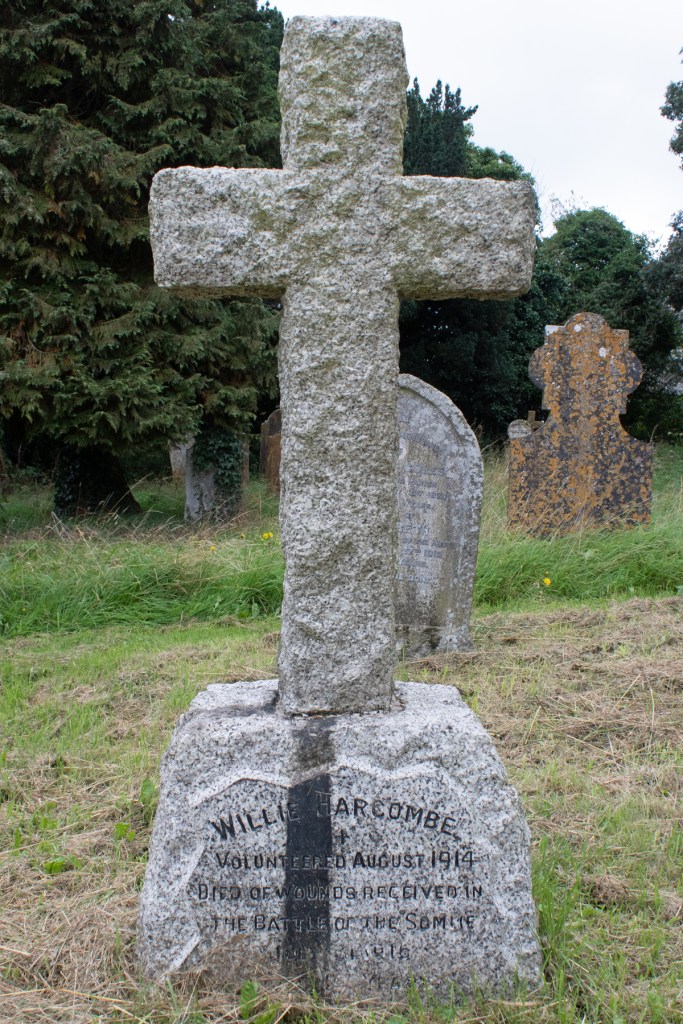
William Harold Harcombe was born on 25th September 1897 in Sampford Arundel, Somerset. One of twelve children, his parents were William and Jane Harcombe. William was an agricultural engine driver who, by the time of the 1911 census, had moved the family five miles north west to Ashbrittle.
When war came to Europe, William was one of the first to enlist, joining the Devonshire Regiment in August 1914. He was assigned to the 8th Battalion, and after nine months’ training, he found himself in Northern France.
Private Harcombe’s troop was involved in some of the fiercest skirmishes of the conflict, at Loos in the autumn of 1915, and at the Somme the following year. It was during this battle – probably at Delville or High Wood – that he was injured.
William was medically evacuated to Britain for treatment, and was admitted to a military hospital in Mile End, London. His injuries were to prove too severe, however, and he succumbed to them on 31st July 1916: he was just 18 years of age.
The body of William Harold Harcombe was brought back to Somerset for burial. He was laid to rest in the tranquil graveyard of St John the Baptist Church in Ashbrittle.
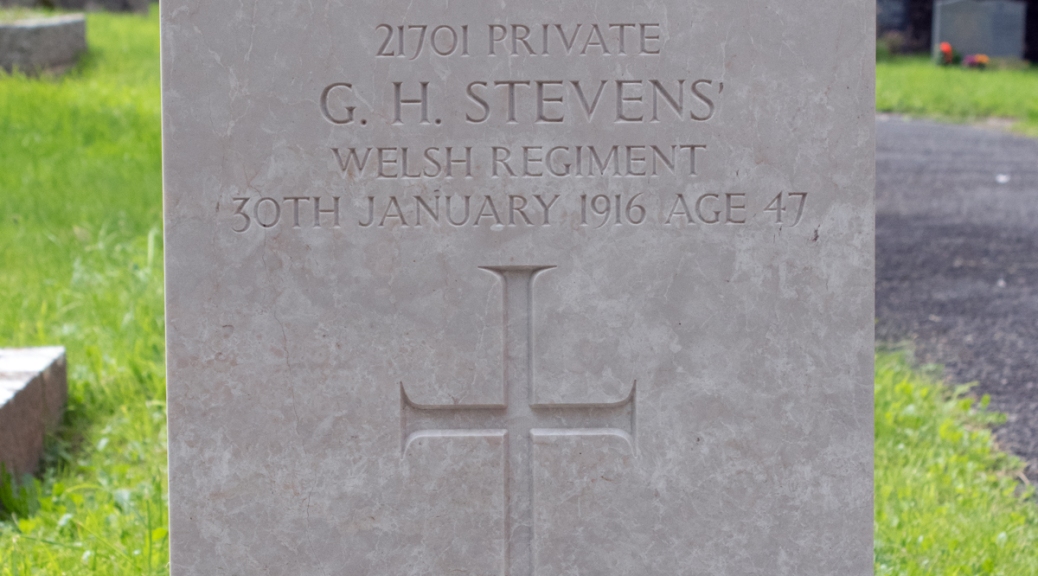
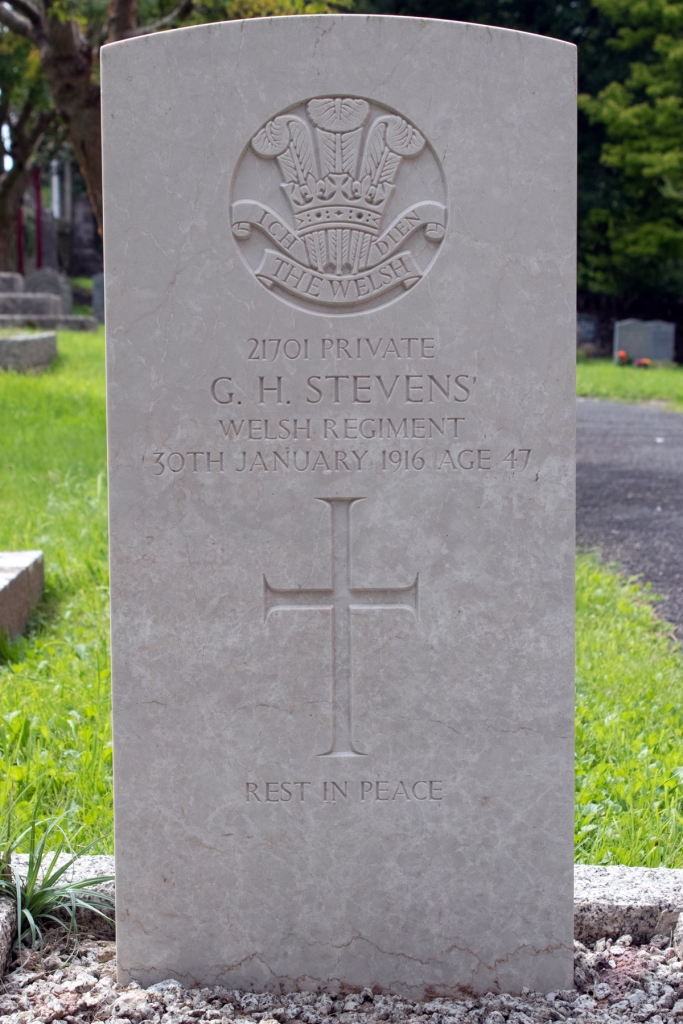
George Henry Stevens was born in Winscombe, Somerset, in the spring of 1869. The oldest of four children, his parents were blacksmith Joseph (or John) Stevens and his wife, Eliza.
When he finished his schooling, George found work as a collier. In 1893, he married a woman called Maria, and went on to have three children: Edward, Mary and Charlie. By 1900 the family had moved to South Wales for his work. They settled in Llanwonno, Glamorganshire, and went on to have three more children: John, Cyril and George Jr.
By 1911, George and Maria had been married for eighteen years. George was working as a repairer for the colliery, while Edward had followed his father into the mines.
When war came to Europe’s shores, George stepped up to play his part. He enlisted in the Welch Regiment, and was assigned to the 1st/5th Battalion. While his full service records no longer exist, his troop served in Gallipoli during 1915, so it is possible that he spent times overseas.
By January 1916, however, Private Stevens was back in Britain, and had become unwell. Again, little specific information remains, but he passed away on 30th January 1916, having fallen into a diabetic coma. He was 47 years of age.
George Henry Stevens was brought back to Somerset for burial. He was laid to rest in the graveyard of Holy Trinity Church in Cleeve, where Maria had moved back to with the family when her husband went to war.
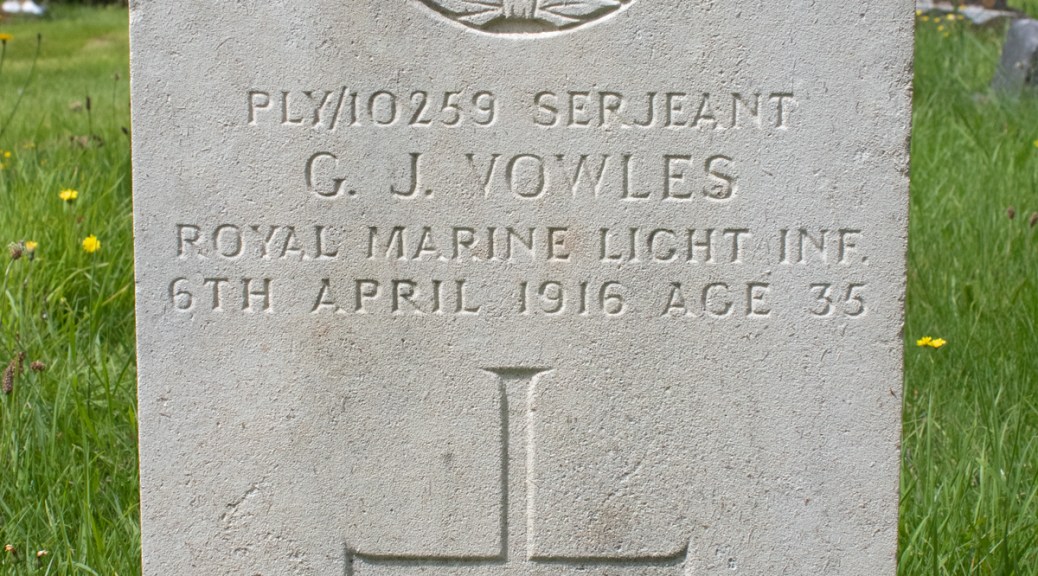
George Joseph Vowles was born in Winsley, Wiltshire, on 18th September 1881. The older of two children, his parents were Joseph and Sophia Vowles. Joseph was an agricultural labourer from Bedminster, who was 46 when his son was born, and twenty years older than his wife. By the time George’s sister was born, in 1890, the family had moved west, and had settled in Wraxall, near Nailsea in Somerset.
George found work as a gardener when he finished his schooling, but he had his sights set on bigger and better things. Sophia had died in 1894 and on 21st March 1900, he enlisted in the Royal Marine Light Infantry. His service records show that he was 5ft 6ins (1.68m) tall, with light brown hair, brown eyes and a fresh complexion. He was also noted as having a scar on the back of his neck.
For the next ten years, George seemed to flourish, serving on a number of ships, including HMS Niobe and HMS Andromeda. In between voyages, he was based at the RMLI depot in Plymouth. During this time he was promoted twice, to the rank of Corporal in September 1902 and Serjeant five years later.
Serjeant Vowles’ contract of service ended in 1911, but with his father now also having passed, he was re-engaged. He continued to make great strides, and, as war broke out, served on HMS Medea and HMS Theseus.
George’s service was cut short in the spring of 1916. Based back at the Plymouth Depot at the time, he fell ill with pulmonary tuberculosis. Sadly, the condition was to get the better of him, and he passed away on 6th April 1916, at the age of 35 years old.
George Joseph Vowles’ body was brought back to Somerset for burial. He was laid to rest in the graveyard of All Saints’ Church in Wraxall, alongside his parents, and not far from where his now-married sister, Dorothy now lived.
Stanley William Parry was born in the spring of 1890 in St George’s on the outskirts of Bristol, Gloucestershire. One of four children to Herbert and Susannah Parry, Stanley was a twin to brother Roland. Herbert was a commercial clerk for a chemical manufacturer, and this afforded the Parry boys a level of education, with both Roland and Stanley attended the Colston Endowed School in Bristol.
Tragically, Susannah had died when Stanley and Roland were just 3 years old: their younger brother, Wilfred, had died the year before, when just a babe-in-arms. By the time of the 1911 census, Herbert had moved the family to Portishead. He was still working as a clerk, while both of the twins were employed as insurance clerks. Their older brother, Edwin, was also a clerk, in the docks at Bristol, and Herbert had employed a live-in housekeeper, Mary Govier, to look after him and his sons.
When war came to Europe, both Stanley and Roland enlisted. The two of them joined the Royal Field Artillery as Gunners. While full service records are not available, Stanley was assigned to the 40th Trench Mortar Battery, while Roland became attached to A Battery of the 240th Brigade.
Stanley was serving in France in the summer of 1916, when he became ill.
The funeral took place on Saturday afternoon, at Portishead Cemetery, of Gunner Stanley Wm Parry, who… died at Mile End Hospital, London, on September 19th. The deceased, who was 27 years of age, was always somewhat delicate in health, but was anxious to serve his King and country, and joined the [Royal Field Artillery]. He was brought to London from France on the previous Saturday suffering from enteritis, and although he lived until his father reached him, he died shortly after. He was the third son of Mr HC Parry… whose two other sons are also serving, one in France and the other in Egypt.
Bristol Times and Mirror: Monday 25th September 1916
Gunner Stanley William Parry was laid to rest in Portishead Cemetery, just a short distance from the family home.
Gunner Stanley Parry (from findagrave.com)
Roland continued to serve his country in France, but tragedy was to strike the family once more.
Mr HC Parry… has received the sad intelligence that his son, Rowland G Parry [sic], of the [Royal Field Artillery], was killed in action on the 17th September. A letter from deceased’s officer stated that Gunner Parry was returning to the battery when a shell burst on the track, killing deceased instantaneously, death being absolutely painless. The letter further states that Gunner Parry had been a very valuable member of the battery, and will be missed by them all. Gunner Parry was the second of Mr Parry’s three sons to lay down his life in the great fight, a twin brother having died in a military hospital in London last year. The other son, the eldest, is serving in Palestine.
Bristol Times and Mirror: Saturday 29th September 1917
Roland George Parry was 28 years of age when he died. He was laid to rest in the Vlamertinghe New Military Semetery, in Ypres.
Gunner Roland Parry (from findgrave.com)
Herbert Parry passed away in the summer of 1920, at the age of 62. He had outlived three of his sons, as well as being a widower for 27 years. He was laid to rest in Portishead Cemetery with his son Stanley.
Edwin Parry, Stanley and Roland’s older brother, had returned from the First World War by the summer of 1919. He resumed his work as a clerk at the docks in Bristol, and married schoolteacher Annie Homewood in August 1919. They went on to have three children, Barbara, Gwladys and Roland. Edwin died in September 1959, at the age of 71 years old.
Tauntonians will learn with deep regret of the death of Private W Haines, of the No. 5 Supernumerary Company, 4th Battalion Somerset Light Infantry, which took place at the Portishead Red Cross Hospital, at the age of 64. The funeral took place at the Portishead Cemetery on Friday of last week, the deceased being buried with full military honours… The late Private Haines… came up with the last Company of the National Reserves, about 14 months ago… and during that time did his duty to the satisfaction of the office commanding and all other officers concerned. Corporal Jarman, who is a well-known Tauntonian of the same Company writes: “Private Haines was a fine old soldier, doing his duty in a manner with would be a credit to any youngster, and his death came as a surprise to all of us. There are still with us half-a-dozen of the old ‘sixties’, and I hope when some of these conscientious objectors see this they will alter their mind, and do their little bit for their King and country like he did.”
Taunton Courier and Western Advertiser: Wednesday 29th March 1916
William Haines was born in the spring of 1850 in Hinton St George, Somerset. The younger of two children, his parents were William and Sophia Haines. William Sr died when his son was a teenager, leaving Sophia to raise the family. She found work as a nurse to bring in some income and, by the time of the 1871 census, the family were living together, William Jr working as a stonemason and his older sister earned money through glovemaking.
On 23rd December 1871, William married Jane Shuter, a sawyer’s daughter from Stoke-sub-Hamdon. The couple set up home in South Petherton, and had a son called William Jr the following year. The family remained together through the next three census returns, William Sr continuing as a mason, while his son found work as a plumber. By 1911 they family had moved again, this time to Taunton, where Jane was now working as a dealer in wardrobes.
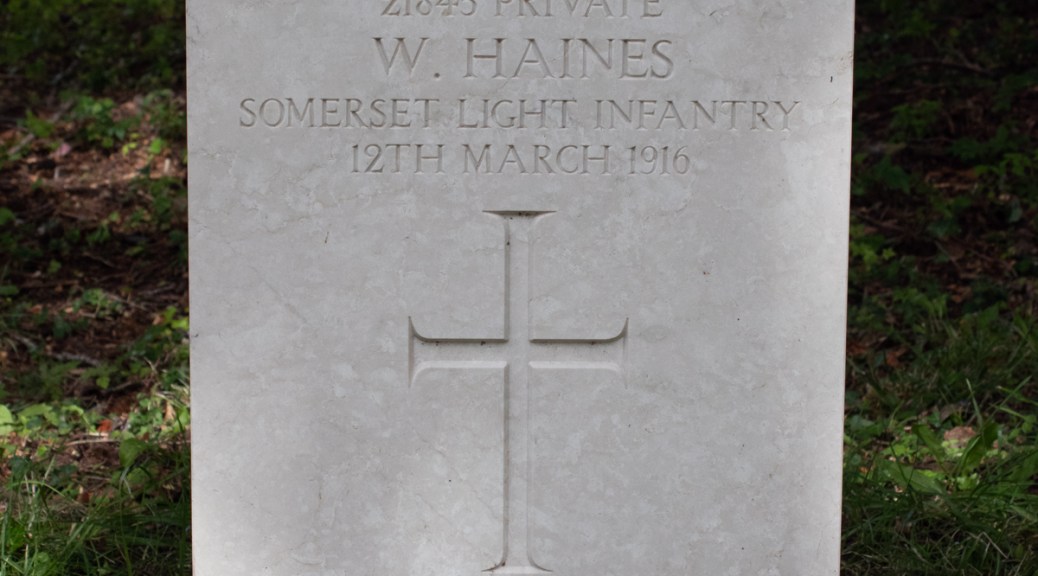
When war broke out, William Sr stepped up to play his part, as the report suggests. He enlisted at the start of 1915, volunteering his services, despite having reached 64 years of age. Assigned to the 4th Battalion of the Somerset Light Infantry, and attached to the 5th Supernumerary Company – a territorial reserve force – Private Haines he remained in Somerset.
William suffered a heart attack on 12th March 1916. He was rushed to the Red Cross Hospital in Portishead, but passed away soon after being admitted. He was 66 years of age (the newspaper report giving the incorrect age).
William Haines did not travel far to be laid to rest. He was buried in Portishead Cemetery, on the southern outskirts of the town.
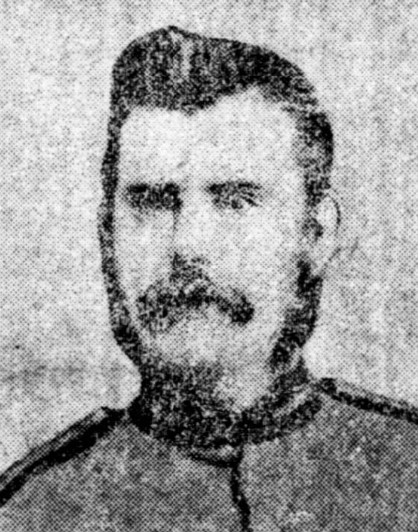
Private William Haines (from britishnewspaperarchive.co.uk)
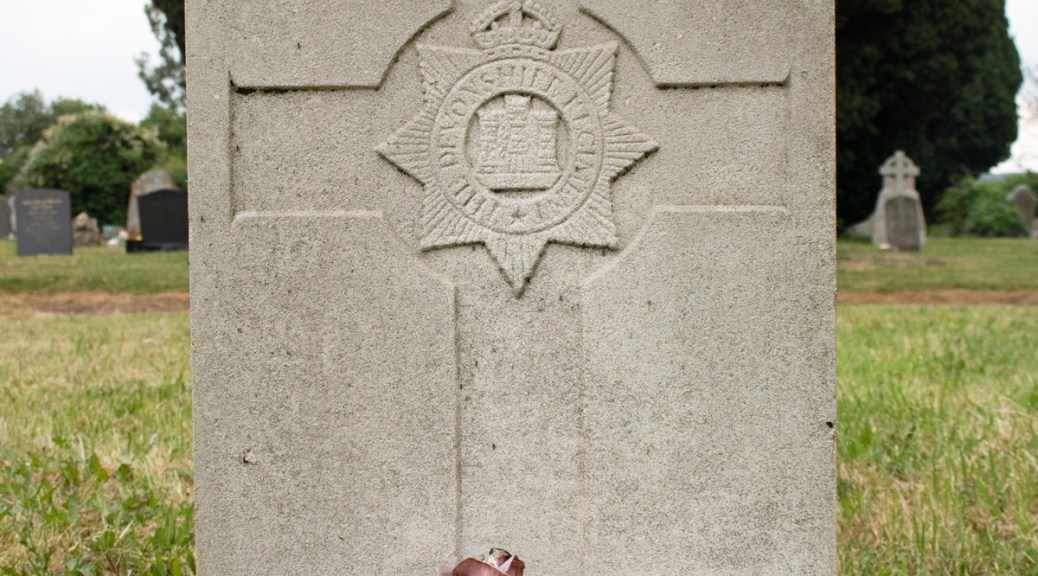
In a quiet spot in North Petherton Cemetery, Somerset, is a headstone dedicated to Private J Mahaffey of the Devonshire Regiment. He died on 5th February 1916, but there is little further information available for him.
Private Mahaffey’s service number leads you to one military record, his army pension ledger card. This confirms a little more information: his first name was John, he had two children noted (underage, and therefore eligible for part of his pension) – Elsie and Thomas – and a guardian is also given – Mrs Elizabeth Broom, who lived in Kentisbeare, Devon. The pension card also confirms the cause of John’s death: heart failure due to disease contracted on active service.
An unusual surname made searching contemporary newspapers easier, and a mystery was unveiled:
Private John Mahaffey, a native of Devonport.. was found dead in the Great Western Railway train at Durston on Saturday.
Deceased, who was in the Devon Regiment (86th Battalion Provisional Territorial Force), was 49 years of age, and had served twelve years in the Army. At the outbreak of war he re-enlisted, and latterly had been quartered at Blythe. It appears that he had been on a visit to his children at Devonport, and was upon his return journey when his death occurred. At Taunton he conversed with the guard of the train by while he travelled, and was then apparently in good health.
PS Hill, North Petherton, state that on Saturday, he… saw the body of the deceased… He examined the body, and found a bruise above the left eye and a scar on the nose. He found upon him his regimental pass and the return railway ticket. There was also money in his pockets.
George William Grinnett, a guard on the GWR, said… he was approached by deceased, who asked as to the train service to Newcastle. Witness understood that he had travelled from Exeter… He advised him to… change at Bristol. He then appeared to be all right, and in good health. On arrival at Durston [George] walked the train, and when passing the compartment that deceased entered at Taunton he noticed a man on the floor in the corridor. He went inside and found that the man was dead. He then communicated with three soldiers, who said they had not travelled with deceased. They had merely opened the door, and, seeing a man there, had walked away without telling anybody.
Dr William C Ghent… said her was called to see deceased. He was quite unable to form an opinion as to the cause of death. There was a good deal of blood on the face, and a slight wound on the nose. From a post-mortem examination he found that one of the valves of the heart was incompetent, and in his opinion death was due to heart failure. The blood on the nose might have been caused by a fall. There was no serious injury from the blow which would cause death.
Taunton Courier and Western Advertiser: Wednesday 9th February 1916
John’s previous twelve years in the army may relate to a Royal Marine Light Infantry service document for a John Mahaffoy. Born on 24th May 1864 in Newcastle-upon-Tyne, he enlisted in Bristol as a Private on 24th April 1888. Primarily based out of Plymouth, he served until the summer of 1900, and was assigned to the Royal Fleet Reserve for a further seven years.
Further complexity is added to John’s story, with a marriage record for 6th April 1896. This confirms his wife’s name as Elizabeth Brown, the couple marrying in Devon. The 1901 census confirms two older children for the couple, Kathleen (mentioned in the newspaper report, who was born in 1897) and Margaret, who came along two years later.
The next census, however, shows a divided family. John was recorded as being one of 1200 patients in the Devon County Lunatic Asylum in Exminster. Elizabeth was living in Portsmouth, with their son, Thomas. She also had a boarder, Bertram Bound, an Able Seaman in the Merchant Navy. Kathleen was a patient in the Sanatorium for Devon and Cornwall Consumptive Patients in South Brent, Devon. Elsie, meanwhile, was recorded as living in Kentisbeare with her grandparents, Edmund and Elizabeth Broom.
This would suggest that John’s wife Elizabeth had died by the time of his death, and that guardianship of his children passed to his mother-in-law when he too passed away.
The last sad element of this tale is that John Mahaffey was not to be reunited with his children. There may have been a financial element, with the Brooms possibly unable to cover the cost of bringing him down to Devon. John was laid to rest in North Petherton Cemetery, a few miles from Durston Station, where his body had been discovered.
Frederick Sloley was born on 7th April 1897 in Kingston St Mary, Somerset, and was the fourth of nine children to Walter and Mary Jane Sloley. The family were farm workers and were living with Walter’s parents – also agricultural labourers – in the 1901 census.
After he finished his schooling, Frederick found began working with the horses on the farm. When war broke out, however, he saw an opportunity to serve his King and Empire, and enlisted in the Royal Marine Light Infantry. He joined up on 5th October 1914, and his service records show that he was 5ft 4ins (1.63m) tall, with black hair, grey eyes and a fresh complexion.
Private Sloley was initially sent to the Reserve Depot in Deal, Kent, for training, before moving to the Plymouth Division in Devon in March 1915. He records do not make it clear where he served specifically, but by 1916 he has fought in the Dardanelles and Mesopotamia.
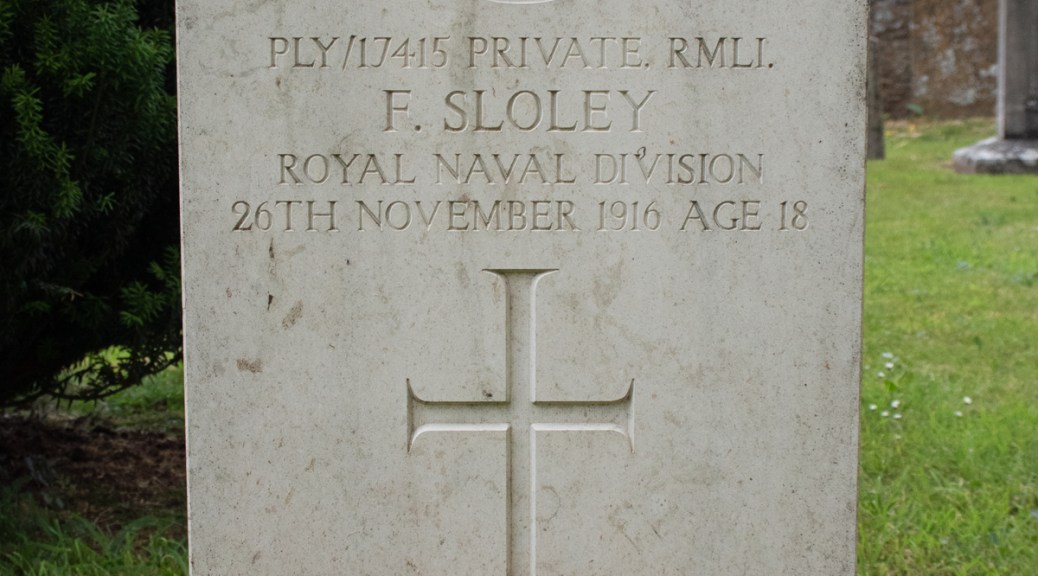
It was while he was in the Eastern Mediterranean that Frederick was injured. Wounded in the spine by enemy gunfire, he was medically evacuated to Britain for treatment. Admitted to King George’s Hospital in London, surgery proved too late. Private Sloley passed away on 26th November 1916, at the age of just 19 years old. His mother, Mary, had managed to see him before he died.
The body of Frederick Sloley was brought back to Somerset for burial. He was laid to rest in the peaceful graveyard of St Mary’s Church in his home village of Kingston.









 Death and Service