Tag Archives: 1917

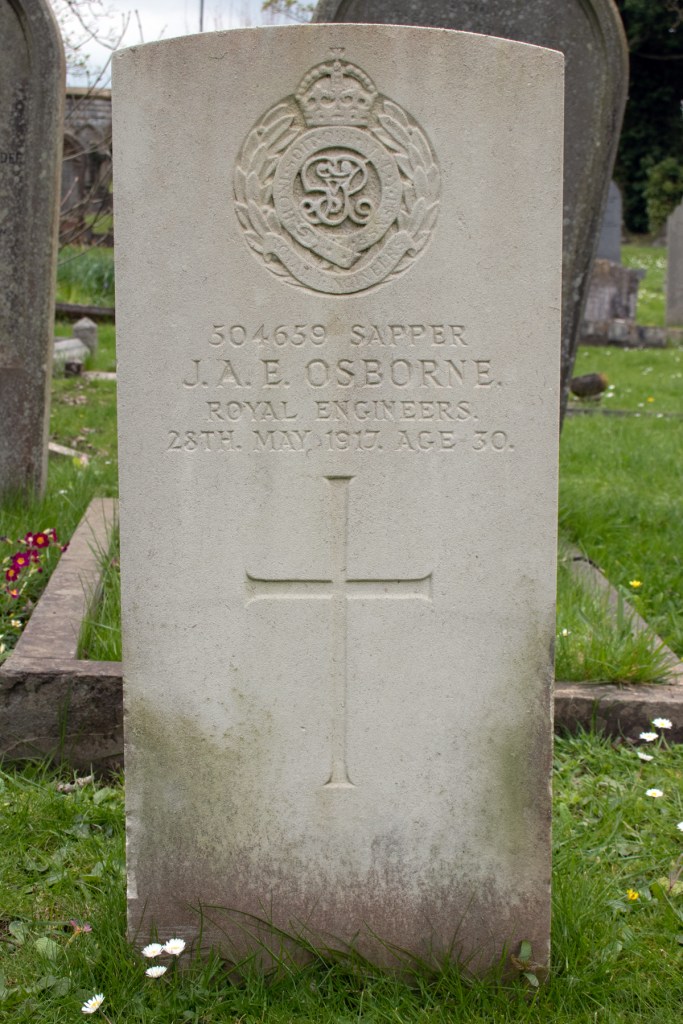
Sapper James Osborne

Sapper James Osborne

James Albert Edward Osborne was born early in 1887, in Weston, on the northern outskirts of Bath, Somerset. One of eight siblings, his parents were road labourer James and launderess Emily Osborne.

When he completed his schooling, James Jr found work as an ‘under brewer’, but soon took up woodwork. By the time of the 1911 census, he was employed as a jobbing carpenter, bringing in one of four wages into the family home.

On 25th May 1915, James married Frances Kettlety. Born in Twerton, near Bath, she was the daughter of a nurseryman. At the time of the wedding, she was working as a tailor’s machinist. The couple set up home in a terraced house in Locksbrook Road, Bath, and had a daughter, Joyce, who was born in May 1916.

War was closing in on Europe and, in December 1915, James enlisted. His trade made him ideal to join the Royal Engineers, and he signed up as a Sapper. His service records show that he was 5ft 4.5ins (1.64m) tall, weighed 144lbs (65.3kg) and note that his lower molars were absent.

Initially placed on Reserve, Sapper Osborne was mobilised on 8th May 1916, and sent to a camp near Whitchurch, Hampshire. Over the next year he served in the area and was billeted with a Mr and Mrs Carpenter. While details of the work he did are lost to time, there is nothing in his records to suggest that he was anything other than committed to what he was doing.

In the spring of 1917, Sapper Osborne began to suffer from headaches. He visited the camp doctor a couple of times for them, but, again, there is no detail about the outcome of these appointments. By the end of May, the pains were becoming severe, and James took drastic action.

On Sunday 27th May, he spent the morning with colleagues Sapper Trott and Private Sutcliffe, both of whom said he was in good form, and was talking as normal. They saw him again the following morning, but only in passing. James’ landlord said that he had not seen him on the Monday, and so set out to look for him.

[Mr Carpenter] found Osborne in a field about two miles away from his home; he was in the middle of a big double hedge and must have crawled through. [He] thought at first he was asleep, but when he went round to the other side of the hedge he could see that Osborne’s throat had been cut, but he did not touch him; he could see that he was dead… His hands, coat and trousers were covered with blood… Near his right hand was a blood-stained razor, this throat was cut and his windpipe severed He searched the deceased and in his tunic pocket found a letter… addressed to his wife, his mother, Lance-Corpl. Macey, two other mates and Mr and Mrs Carpenter…

Andover Advertiser: 1st June 1917

The inquest into Sapper Osborne’s dead returned a verdict of suicide while temporarily insane: he was 30 years of age.

James Albert Edward Osborne was brought back to Somerset for burial. He was laid to rest in Twerton Cemetery, not far from where his widow and daughter lived.


Private Thomas Parsons

Private Thomas Parsons

Thomas Alfred Parsons was born in the summer of 1885 in Twerton, Somerset. One of six children, his parents were railway engine driver William Parsons and his wife, Mary. When Thomas finished his schooling, he found work at a labourer at a mineral water supplier, something he continued doing through to the outbreak of war.

On 27th May 1912, Thomas married Lily Howell, a labourer’s daughter, the couple tying the knot in Twerton parish church. They were living in Charlton Buildings, next to the river and now student accommodation for Bath’s universities. Lily had had a son, in November 1905: young Ronald was either Thomas’, or he was accepted as his own.

When war came to Europe, Thomas stepped up to play his part. He enlisted on 11th December 1915, although he was not formally mobilised until six months later. Private Parsons initially joined the Devonshire Regiment, but by early 1917, he became attached to the 169th Labour Corps.

Sent to France in February that year, Private Parsons only remained overseas for a matter of six months. By early September Thomas had fallen ill, contracting a combination of bronchitis and phthisis (or tuberculosis). Medically evacuated back to Britain, he was admitted to a hospital in Plymouth, Devon, but grew weaker until, on 2nd October 1917, he passed away. He was 32 years of age.

The body of Thomas Alfred Parsons was taken back to Somerset for burial. He was laid to rest in Twerton Cemetery, not far from his widow’s home.


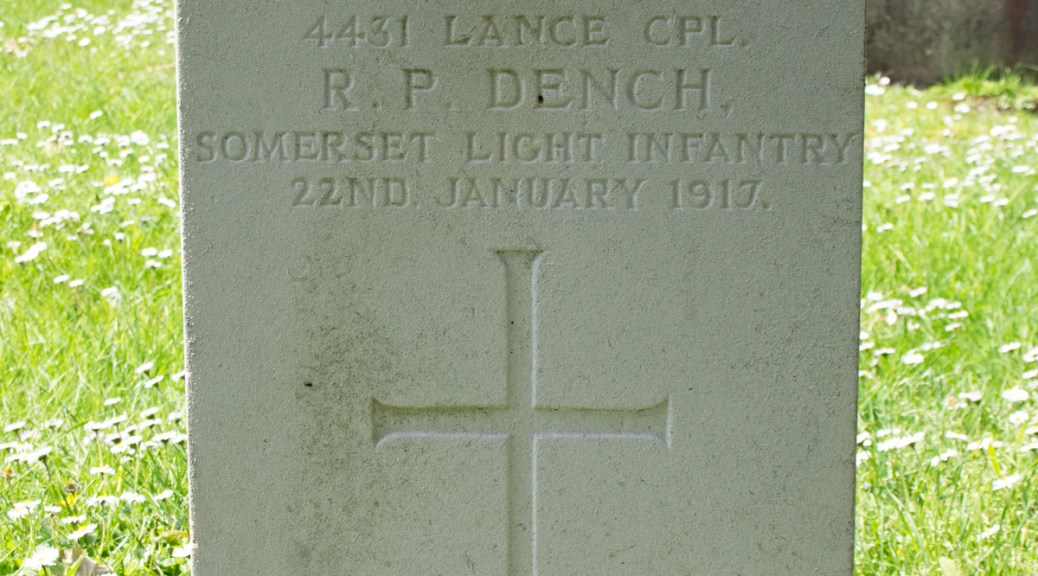
Lance Corporal Reginald Dench

Lance Corporal Reginald Dench

Reginald Percy Dench was born in the spring of 1884 in Twerton, Somerset. He was one of seven children to Henry and Jane – known as Lily – Dench. Henry was a shoe maker turned cloth dyer, but Reginald found work as a stone mason when he finished his schooling.

War came to Europe in 1914, and Reginald stepped up to play his part. His full service details are no longer available, but from what remains it is clear that he had enlisted in the Somerset Light Infantry by the summer of 1916. He was attached to the 5th Battalion, which spent of the conflict in India and Egypt, but there is nothing to confirm that Private Dench served overseas.

Reginald earned a promotion during his military career, and, by the end of 1916 was a Lance Corporal. By this point, however, he had fallen ill, contracting pleurisy. He was, by this point, back in Somerset, and it is likely that he was admitted to the Bath War Hospital. The condition was to get the better of him, and he passed away on 22nd January 1917. He was 32 years of age.

Reginald Percy Dench was laid to rest in Twerton Cemetery, a short walk from the family home in Mill Lane, and close to his two brothers, Edmund and Edward, who had died some twenty years before, while still children.


Tragedy was to strike again for the Dench family when, just six weeks after Reginald’s passing, Henry also died. He was laid in the same cemetery, not far from his sons. When Lily passed away in 1924, she was also buried in Twerton Cemetery, reunited with her family once more.


Private Herbert Webber

Private Herbert Webber

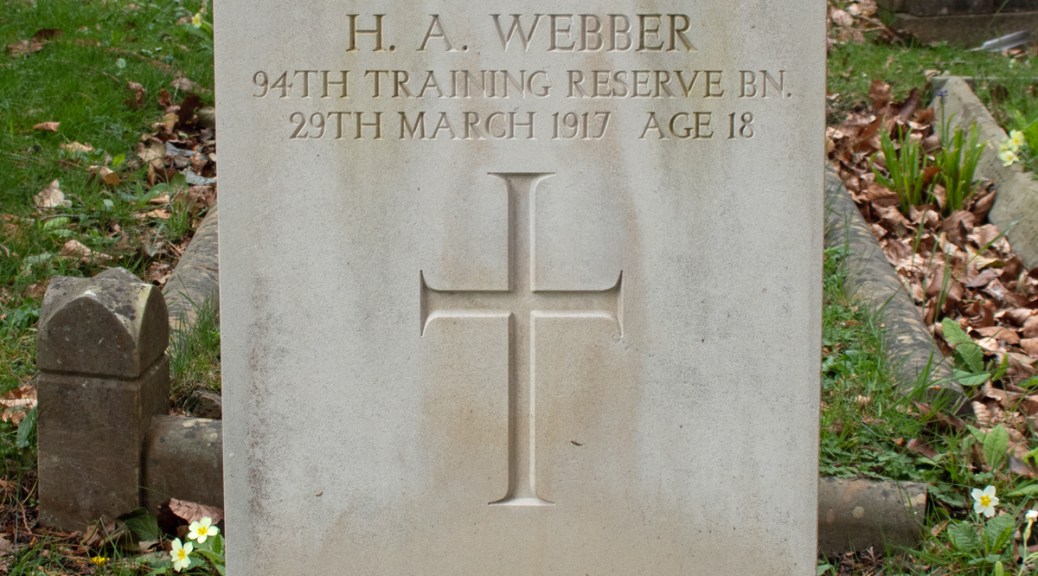
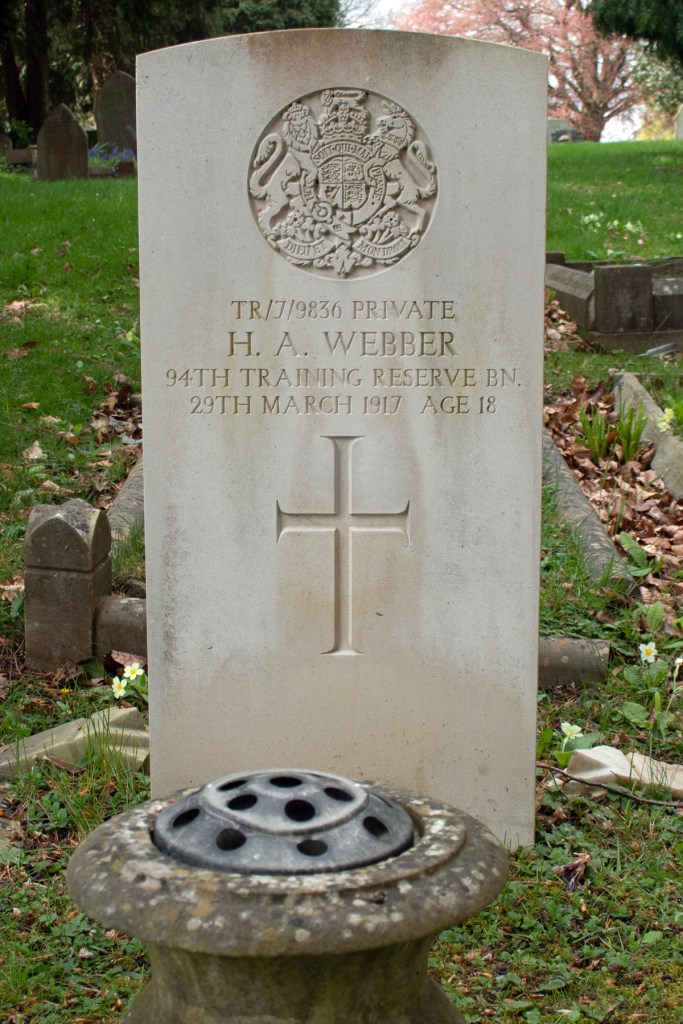
Herbert Alfred Webber was born on 22nd October 1898 in Yatton, Somerset. The younger of two children, his parents were Ernest and Ada. Ernest was a platelayer for the Great Western Railway and, by the time of the 1911 census, the family had moved to Keynsham, near Bristol. With Herbert and his sister still at school, they had taken in two boarders – railway porters Walter Prince and Victor Coombs – to help bring in a little money.

When Herbert left school, he found work at a local chemist, but as soon as he turned 18, he signed up to serve his King an Country. Assigned to the 94th Training Battalion, Private Webber was sent to the Chiseldon Camp in Wiltshire to begin his career.

Tragically, Herbert’s was not to be a long service. Within a month of arriving at camp near Swindon, he fell ill, and was admitted to an Isolation Hospital in the town. While the condition he had contracted is unclear, it was one to which he would succumb. He passed away on 29th March 1917, aged just 18 years old.

Herbert Alfred Webber was brought back to Somerset for burial. With the family having moved to Bath with Ernest’s work, he was laid to rest in the city’s Twerton Cemetery.


Private Herbert Webber
(from britishnewspaperarchive.co.uk)

Driver William Stitch

Driver William Stitch

William Ephraim Stitch was born in Biddisham, Somerset, on 6th August 1879. The oldest of seven children, his parents were James and Mary Stitch. James was a farmer, and this was a trade into which William followed.

The 1901 census found William boarding with a farmer in nearby Badgworth. His employer was George Burrow, who had a live-in housekeeper, Ellen Norris. Ten years later, William was boarding with another family in the village – Benjamin and Bertha Wall and their two children – and, at 32 years old, he was still employed as a farm labourer.

When war came to Europe, William stepped up to play his part for King and Country. He enlisted in the Royal Army Service Corps on 3rd December 1915, and was assigned to the 530th Horse Transport Company. His service records note that he was 5ft 4ins (1.63m) tall and weighed 126lbs (57.2kg).

Driver Stitch was based in Northumberland, and remained on home soil throughout his time in the army. He returned to Somerset a couple of times, most noticeably in September 1917, when he married Bertha Wall, who he had been boarding with according to the 1911 census. There is no evidence of the passing of Bertha’s husband, Benjamin, but William’s service records note that he classed Bertha’s two children as his own.

Driver Stitch went back to Somerset on leave over Christmas 1917, arriving back in Blyth, Northumberland, on 28th December. He was billeted at Link View Villa in the town, and looked after the horses stabled there.

William was last seen in the Orderly Room that evening, by a Corporal John Kearton, his senior officer who was based in the same digs. He disappeared, and, despite a lengthy search, it was only on 1st February 1918 that his body was found in the brickyard pond, close to where the horses were stabled.

At the subsequent inquest, the doctor who carried out the postmortem confirmed that there was no sign of violence. Corporal Kearton suggested that, as William was getting water from the pond, he might have slipped into the water accidentally. With no evidence of any deliberate intention to end his life, the jury returned a verdict of drowning, but that there was no evidence to show how Driver Stitch had gotten into the water. William was recorded as having died on 28th December 1918, at the age of 39 years of age.

The body of William Ephraim Stitch was brought back to Somerset for burial. He was laid to rest in the quiet graveyard of St Congar’s Church in Badgworth.


Private Ivan Day

Private Ivan Day

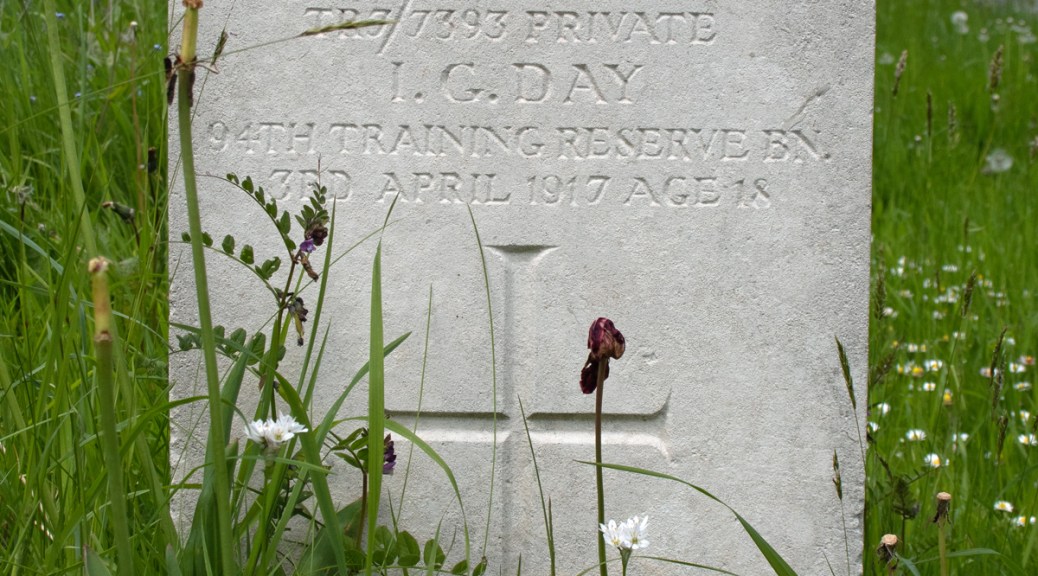
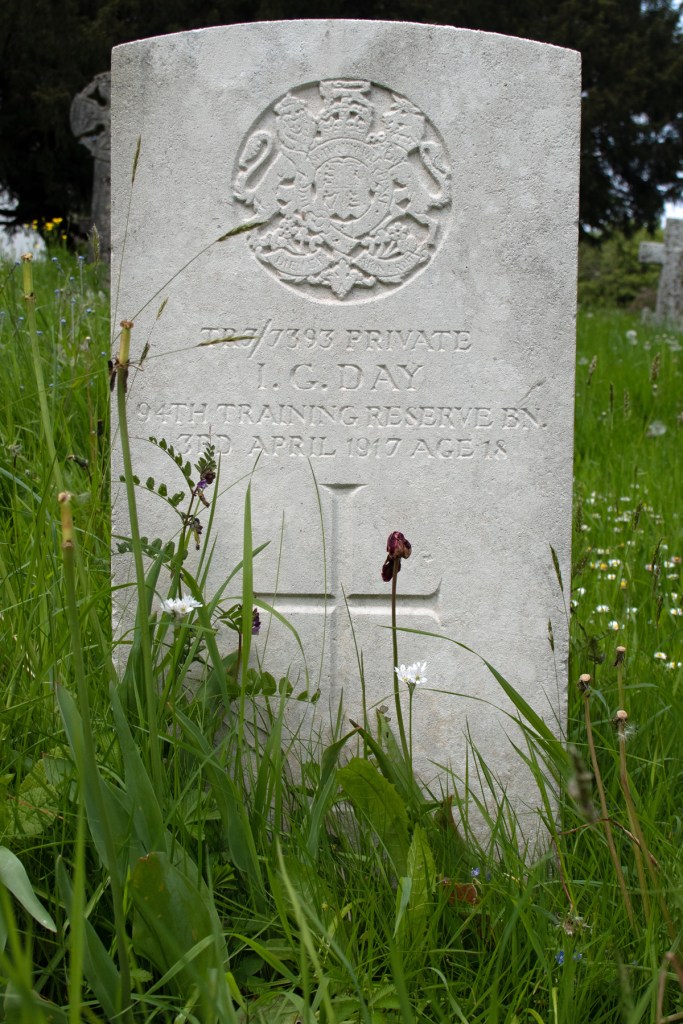
Ivan George Day was born in the summer of 1898, the oldest of three children to George and Emma Day. George was a brick and tile maker from Weare in Somerset and it was here that he and Emma raised their young family.

When Ivan finished his schooling, he found work as a postman, but, with war raging across Europe, he seemed keen to play his part. In February 1917, he enlisted in the army and was assigned to the 93rd Training Reserve Battalion. His service records show that he was just 5ft 3ins (1.6m) tall and weighed 121lbs (54.9kg).

Private Day was sent to Chiseldon Camp, to the south of Swindon in Wiltshire and, tragically, this move to cramped army barracks was to prove his undoing. Within four weeks of arriving, Ivan was admitted to the camp’s hospital, having contracted measles and pneumonia. Less than a week later, the conditions had gotten the better of him. He passed away on 3rd April 1917, at just eighteen years of age.

Ivan George Day’s body was brought back to Somerset for burial. He was laid to rest in the peaceful graveyard of St Gregory’s Church in his home village of Weare.


Tragedy was to strike the Day family again when, George died eighteen months later, aged 51 years old. Emma lived until 89 years old, passing away in Weston-super-Mare in the summer of 1955.


Ivan was not the only Somerset soldier to succumb to pneumonia at Chiseldon Camp that spring. Private Charles Oborne, died from the same condition a few days before Ivan was admitted to the hospital. Private Everett Ferriday, of the 94th Training Battalion, passed away in the same hospital on the same day as Ivan, also from pneumonia.

You can read their stories by following the links above.


Private Charlie Tucker

Private Charlie Tucker

Charlie Tucker was born early in 1877 in the village of Mark, Somerset. The fifth of six children, his parents were Thomas and Caroline. Charlie’s mother died when he was only a toddler, probably during, or shortly after, the birth of his younger sister, Elizabeth. This left farm labourer Thomas to raise his family alone.

The 1881 census found the Tuckers living in Wedmore, five miles to the east of Mark, where Thomas was supported by his parents, George and Elizabeth. Both died in 1890, but by this point, Thomas had married again, to a widow, Ann Harding. She had a daughter, Mary Ann, who was welcomed into the family, but then Thomas and Ann had their own child, a son called Walter.

The next census, returned in 1891, recorded the family – Thomas, Ann, Charles, Mary Ann and Walter – living in Wedmore. Charles had finished his schooling by this point, and was employed as a general labourer and the family also had a boarder, Ralph Godney, who was just 9 years of age.

The family setup continued, and the 1901 census document found Thomas and Ann living with Charlie and Walter, all of whom were doing farm work. They still seemed to be open to supporting others, however, and had another boarder, a schoolgirl called Elizabeth Grant.

In the spring of 1904, Charlie married Lily Brown. Born in Wedmore, she was the daughter, and only child, of a labourer who was employed as a servant to an Axbridge famer at the time the couple wed. Charlie and Lily set up home in Blackford, near Wedmore, and went on to have four children: Thomas, Walter, William and Kathleen.

When war broke out in 1914, Charlie stepped up to play his part. Full details of his military career are lost to time, but it is clear from what remains that he had enlisted in the Devonshire Regiment by the autumn of 1916. Private Tucker joined the 13th (Works) Battalion, and remained stationed on home soil for the duration of his service.

Little further information about Charlie’s life is evident. Over the next couple of years his health began to fail, and in the spring of 1917 he had been admitted to Bath War Hospital with carcinoma of the stomach. This was to take his life: he passed away on 11th March 1917. He was 40 years of age.

Charlie Tucker’s body was brought back to Blackford for burial. He was laid to rest in the graveyard of Holy Trinity Church.


Lily, now widowed, was left with four young children to raise on her own. Whether for a new life and new opportunities, or to escape the painful memories that Somerset brought, she made the decision to emigrate. In April 1924, she and the children arrived in Canada, and settled in Ontario.

Further information for Lily is not readily available, but her two oldest children, Thomas and Walter, made lives for themselves, and died in 1975 and 1979, respectively.


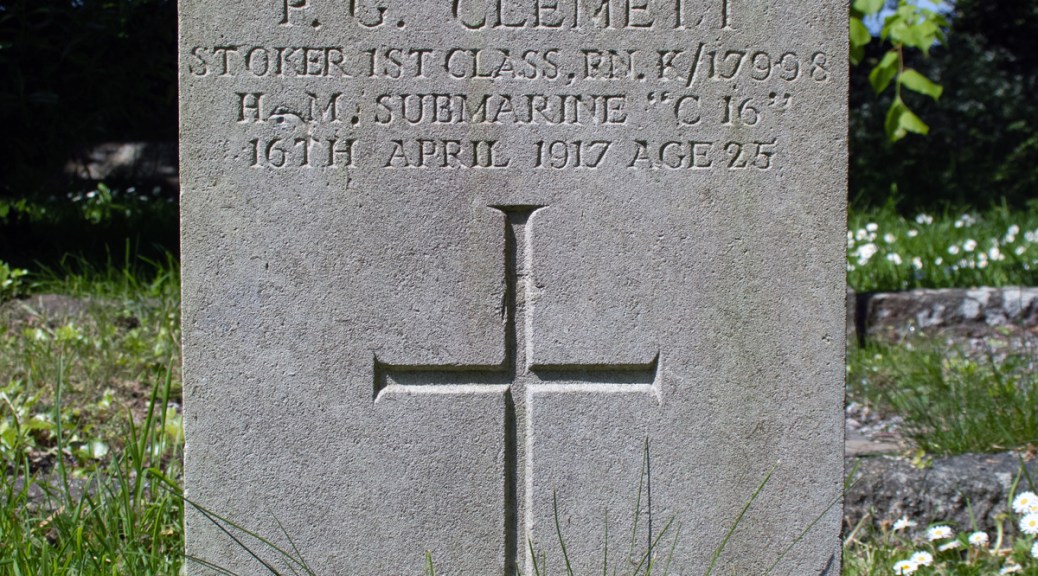
Stoker 1st Class Phillip Clemett

Stoker 1st Class Phillip Clemett

Phillip George Clemett was born on 5th December 1891, one of eight children to Albert and Mary Jane Clemett. Albert was a carpenter from Devon, Mary Jane came from Somerset, but by the time Phillip was born, the family had moved to Fulham in Middlesex.

The 1911 census records the family as having moved back to Somerset. Mary Jane had been born in the village of Huntspill, and it was here that the Clemetts returned. Albert was now working as a farmer, so it is possible that they had moved to work on the family farm.

Labouring was not a job to satisfy Phillip, though, and he sought a career on the high seas. On 3rd February 1913, he enlisted in the Royal Navy as a Stoker 2nd Class. His service records show that he was 5ft 4ins (1.63m) tall, with brown hair, brown eyes and a fresh complexion.

Stoker Clemett’s was initially sent to HMS Vivid, the Royal Naval Dockyard in Plymouth, Devon. Here he received a few months’ training, before being given his first posting, on board the battleship HMS Indefatigable. He remained on board for the next fifteen months, gaining a promotion to Stoker 1st Class in the process.

Over the next couple of years, Phillip served on a couple more vessels, but on 11th February 1917 he was assigned to the submarine HMS C16. Stoker Clemetts was on board for a couple of months, as she was patrolling off the Essex coast. On 16th April 1917, the C16 was accidentally rammed by the destroyer HMS Melampus. She sank to the bottom and a couple of attempts were made for the crew to escape, but they became trapped and all perished, including Stoker 1st Class Clemetts. He was 25 years of age.

Contemporary newspaper reports give little detail about the accident – stating simply that Phillip ‘perished at sea’ [Western Daily Press – Tuesday 01 May 1917] His service documents are equally cagy about the incident, confirming jus that he ‘lost his life on duty.’ The records, however, show that on each of his five annual reviews, his character was noted as ‘very good’, while his ability was ‘superior’.

When the submarine was salvaged, Phillip George Clemett’s body was brought back to Somerset for burial. He was laid to rest in the peaceful graveyard of St Peter’s Church in Huntspill.


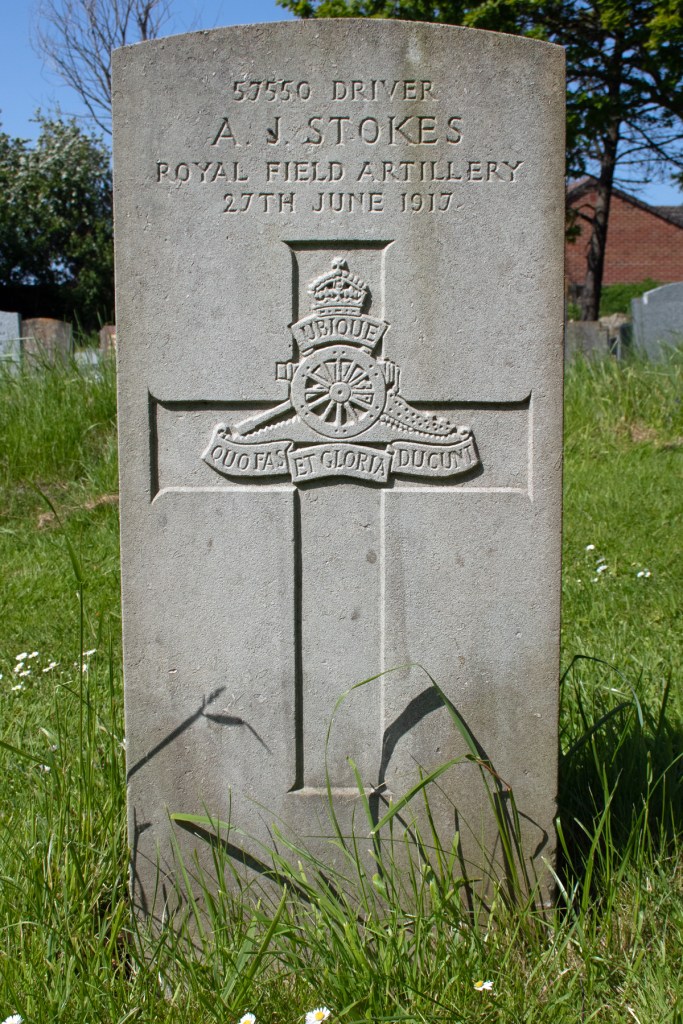
Driver Albert Stokes

Driver Albert Stokes

Albert John Stokes was born in the autumn of 1878, the fourth of seven children to John and Mary Ann Stokes. John was a cord winder from Puriton in Somerset, and it was in the village, in the house next to his parents, that he and Mary Ann raised their young family.

By the 1890s, John had turned his hand to boot making. When he finished his schooling, however, Albert found more manual work, and by the time he got married in 1903, he was working as a quarry labourer.

Albert’s wife was Minnie Nichols, a cooper’s daughter, who lived just up the road from the Stokes family. They married in Bridgwater Registry Office on Christmas Eve 1903. The newlyweds set up home in a small cottage in Puriton, and went on to have six children, although only four survived childhood.

When war came to Europe, Albert was one of the first to join up. He enlisted on 7th December 1914, and was assigned to the Royal Field Artillery as a Driver. His service records give an insight into the man he had become: he was 5ft 7ins (1.7m) tall, weighed in at 136lbs (61.7kg) and was of good physical development.

Driver Stokes spent the next eight months on home soil. He was sent to France on 21st July 1915, and was involved in the fighting at Loos. It was here, that he developed a persistent cough and, by October, he was back on home soil. That winter Albert contracted influenza, which then developed into haemoptysis.

While Driver Stokes did recover, he was admitted to the Voluntary Aid Detachment Hospital in Bishops Stortford in May 1916, having come down with influenza once more. He was transferred to the 1st Eastern General Hospital in Cambridge for a medical assessment, and this led to an eventual discharge from the army in August.

Albert returned to Somerset after leaving the Royal Field Artillery, although his trail does go cold. He was at home when he passed away on 27th June 1917, at the age of 39 years old. The cause of his passing is not recorded, but it is likely to have been as a result of a repeat of the conditions that had led to him leaving the military.

Albert John Stokes was laid to rest in the peaceful graveyard of St Michael’s Church in his home village of Puriton.


Private Frederick Chilcott

Private Frederick Chilcott

Frederick Chilcott was born in Bridgwater, Somerset, early in 1867. He was the fifth of thirteen children to labourer and kiln worker Henry Chilcott and his wife, Ellen.

When he finished his schooling, Frederick also found labouring work. He wanted bigger and better things, however, and the opportunity for a career in the army offered him just that. On 14th January 1888 he enlisted in the Royal Artillery. His service records confirm he was 5ft 6ins (1.68m) tall, and weighed 119lbs (54kg). He was noted as having dark brown hair, dark hazel eyes and a fresh complexion. He also had a scar on his forehead and a tattooed dot on his right forearm.

Frederick was initially given the rank of Driver and was assigned to the regiment’s 3rd Brigade Depot. He was sent to India in February 1889, and remained there until November the following year, when his troop returned to Britain.

Back on home soil Frederick’s role changed and he was given the rank of Gunner. On 1st January 1892, he was promoted to Acting Bombardier, but, on his own request, he reverted to his previous rank just three months later. On 15th January 1895, Gunner Chilcott was stood down to reserve status, having completed seven years’ service.

On 16th April 1895, Frederick married Eliza Stockham. She was a labourer’s daughter from the village of Puriton, to the north of Bridgwater, and it was here that the couple settled. Living in a small cottage, they went on to have six children between 1898 and 1911.

Frederick’s time in the army, however, wasn’t quite done. With the Second Boer War breaking out, he was recalled to the now Royal Field Artillery in January 1900. Sent to South Africa, Gunner Chilcott remained overseas for a year and was recognised for his commitment in the campaign.

Frederick returned to Britain on 3rd January 1901, and was finally stood down from the army in March that year, having fulfilled his twelve years’ contract. He returned home to Puriton, his service records noting that his character was ‘very good’.

The 1911 census found Frederick employed as a labourer in the local cement works. He and Eliza living in a small cottage in Puriton with four of the children (their oldest son was with Eliza’s parents, while she was pregnant with their youngest).

Conflict was knocking on England’s shore by this point, and when conflict broke out, Frederick appears to have stepped up to play his part once more. He was 47 years old when war was declared and, as such, would not have been required to enlist. Full details of his service are no longer available, but he had certainly joined the Army Veterinary Corps by the summer of 1917.

Private Chilcott is likely to have remained on home soil, but towards the end of his service was based in Curragh, County Kildare, Ireland. It was while here, on 23rd December 1917, that he suffered an aneurysm, passing away in the town’s military hospital as a result. He was 50 years of age.

Frederick Chilcott’s body was brought back to Somerset for burial. He was laid to rest in the quiet graveyard of St Michael’s Church in his home village, Puriton.