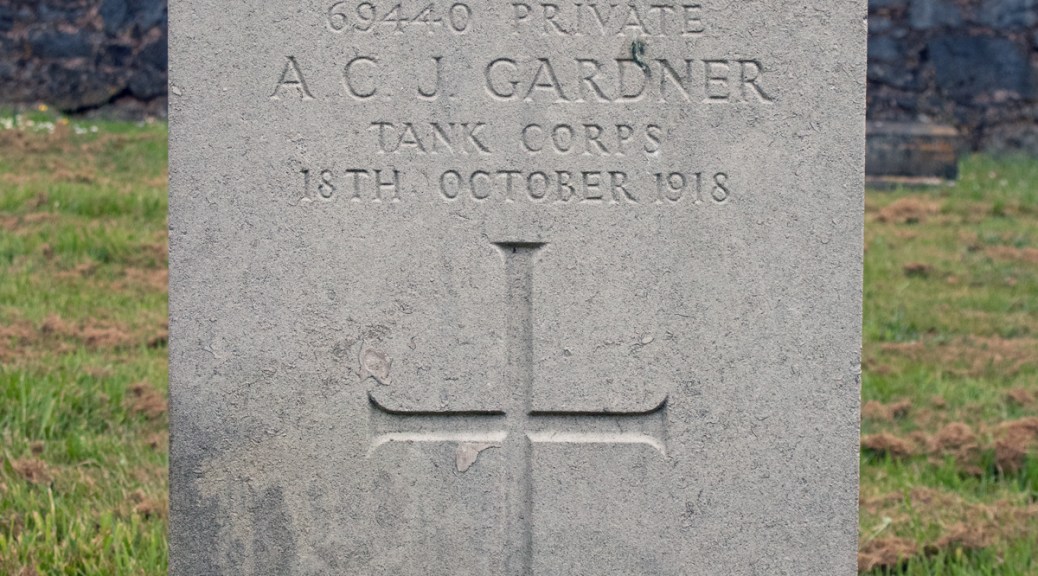
In a quiet spot in Cannington Cemetery, Somerset, is the burial plot for Anthony Charles James Gardner. His headstone confirms that he was a Private in the Tank Corps, and that he died on 18th October 1918.
Private Gardner’s service number provides only one army document: the British Army Register of Soldiers’ Effects. Sadly, this sheds little more light onto his life, confirming only that he died in the Military Hospital in Wool, the village connected to Bovington Camp in Dorset. No next of kin is evident.
Another record suggests that he may have served in the Somerset Light Infantry before transferring to the Tank Corps, but no records remain to confirm this stage of his military career.
There are no census birth or baptism records for an Anthony Gardner. While there are numerous Somerset documents connected to Charles and James Gardners, without any confirmation of his age, or whether he actually came from the county, it is impossible to identify ones relating to the soldier buried in Cannington.
Parish details confirm that Anthony worked at the Blue Anchor Inn in Cannington. The 1911 census recorded him as working there under Charles and Ann West. It confirms that Anthony was 24 years of age, and was born in Gloucester. Tantalising though this fact is, there are no earlier documents to confirm his upbringing in Gloucestershire.
There are no reports in contemporary newspapers about Anthony’s passing or his funeral, so no light can be shed down that route either.
The life of Alfred Charles James Gardner, therefore, is destined to remain lost in the mists of time. His story hidden in the cemetery in Cannington, Somerset.
My thanks to Tina at Cannington Parish Council for her help in uncovering a little of Anthony’s life.
Percy Kitch was born in the spring of 1897 in Northmoor Green, to the south east of Bridgwater, Somerset. His parents were Francis and Mary Jane Kitch, and he was the youngest of their eight children. Francis – who was better known as Frank – was a farm labourer, and this is something that Percy and his siblings went into when they finished their schooling.
When war broke out, Percy was called upon to play his part, and enlisted in the Royal Army Service Corps as a Private. Unfortunately, little information still exists about his life at this time and, in fact, only one document – his pension ledger card – remains to confirm details of his service.
The card confirms that Private Kitch was attached to the Remount Service, and that he passed away on 31st October 1918, having contracted influenza. He was just 21 years of age. The document gives his mother, Mary Jane, as a dependent, and details the army pension she was awarded after his passing: 5 shillings per week, for life.
Percy Kitch was laid to rest in the peaceful graveyard of St Peter & St John’s Church in his home village of Northmoor Green.
News has been received at Bathpool, Taunton, that Lieutenant HB Redler, MC (RAF), was killed while flying at Turnberry, near Ayr. Lieutenant Redler, who was 21 years of age, was the eldest son of Mr and Mrs DB Redler, of Moorreesbury [sic], South Africa, and formerly of Bathpool, Taunton, and he sailed from South Africa with a schoolfellow at the end of 1915, at the age of 18, in order to join the Royal Flying Corps. On arrival in England they found no vacancies, and entered the Artists’ Rifles OTC, from which they joined the RFC. After obtaining his commission, Lieut. Redler spent a few months in France last year, and was then sent to Ayr as a fighting instructor. In March of this year he was sent to France for a six weeks’ course, during which he won the Military Cross, and it is believed that his record will show a total of nearly twenty enemy machines brought down.
Taunton Courier and Western Advertiser: Wednesday 3rd July 1918
Harold Bolton Redler was born in Worcester, Worcestershire, on 27th January 1897. The oldest of five children, his parents were Daniel and Annie. Daniel was a flour miller from Devon, and the family had moved to Worcester the year before Harold was born.
In 1903, the Redlers emigrated to South Africa. Initially settling in King William’s Town (now Qonce), they moved to Moorreesburg after the birth of Harold’s youngest sibling, Norman, in 1906.
Harold was educated at the Bishops Diocesan College in Rondebosch, Cape Town, and it was from here that he and his friend decided to step up and serve their King and Empire. Sadly, his service records have been consigned to history, and only the newspaper report remains to piece together his time in service.
Lieutenant Redler’s awarding of the Military Cross, however, is documented:
For conspicuous gallantry and devotion to duty. He encountered four enemy two-seater machines and attacking the lowest drove it to the ground with its engine damaged. Later he attacked one of five enemy two-seater machines and drove it down out of control. He has destroyed in all three enemy machines and driven three others down out of control. He continually attacked enemy troops and transport from a low altitude during operations and showed splendid qualities of courage and determination throughout.
London Gazette: 22nd June 1918
On the morning of 21st June 1918, Lieutenant Redler was flying a de Havilland DH9 aircraft, accompanied by Captain Ian Henderson. The plane was fitted with a Lewis gun, which the pair were testing. At 10am, the aircraft crashed, and both were killed. No immediate cause was identified, and their RAF cards record an open verdict. Harold was just 21 years of age.
With his parents and siblings in South Africa, Harold Bolton Redler’s body was taken to Somerset for burial. He was laid to rest with his paternal grandparents in the peaceful St Augustine’s Churchyard in West Monkton.
Charles Herbert Dyer was born in the Somerset village of West Monkton in the spring of 1890. One of eight children, his parents were farm labourer Charles Dyer and his wife Mary.
By the time of the 1911 census, Charles Jr had set out on his own, settling in Briton Ferry, near Port Talbot, Glamorganshire. He found work as a gardener and, from this point on, he went by his middle name, Herbert.
Over the next few years, Herbert continued his employment in Wales, although he did make a move to Newport, Monmouthshire. When war came to Britain, Herbert stepped up to serve King and Country, enlisting in the South Wales Borderers on 10th January 1916. Less than two weeks later, he married Ethel May Andrews, in All Saints’ Church, Newport.
Private Dyer was formally mobilised on 2nd March 1916. His service records show that he was 5ft 10ins (1.78m) tall and weighed 141lbs (64kg). Details of his service are a little scrambled, but it appears that Herbert was initially assigned to the 3rd (Reserve) Battalion, and remained on home soil throughout the conflict.
Herbert was based in Bottesford, Leicestershire, in December 1916, where he was put on report and docked 14 days’ pay for being absent from his post, and refusing to obey a superior’s order. Six months later, he had moved camp, and was confined to barracks for two weeks, and docked two days’ pay for being absent without leave for a day and ten hours.
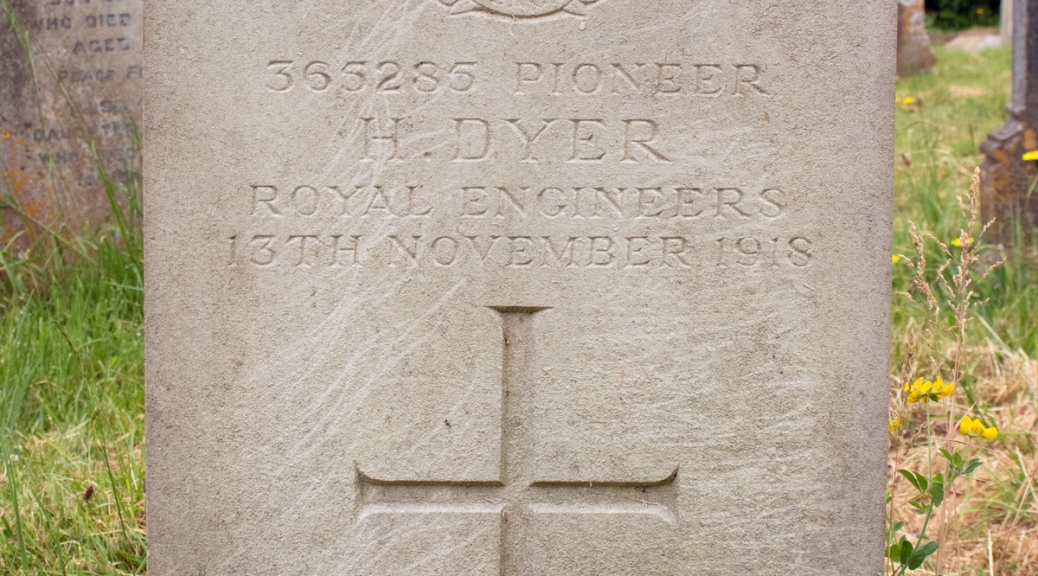
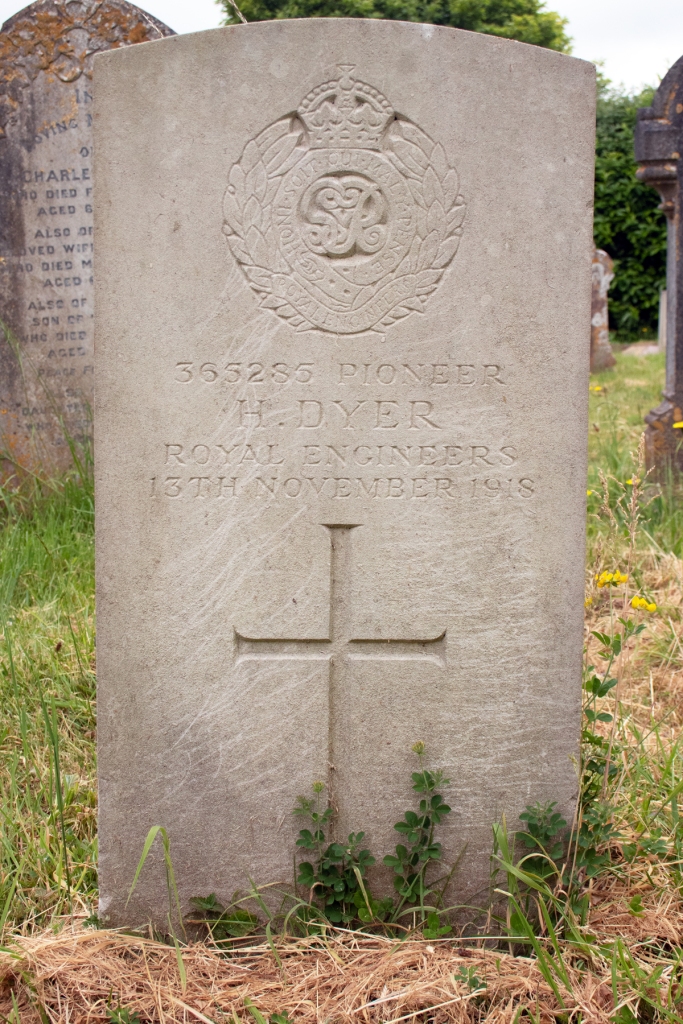
By the summer of 1918, Herbert had transferred across to the Royal Engineers where, with the rank of Pioneer, he was assigned to the 15th Anti-Aircraft Company. Full details of his time in his new regiment have been lost, but he was certainly based in Essex as the war came to a close.
Pioneer Dyer’s health was, however, beginning to suffer by this point. He had a bout of influenza, which developed into pneumonia. He was admitted to the Warley Military Hospital in Brentwood, on 10th November 1918, but, by this point, his body had seemingly had enough. He passed away at 11:20am on 13th November 1918, at the age of 28 years old.
The body of Herbert Dyer was brought back to Somerset for burial. Ethel had moved in with her in-laws in West Monkton by this point, and was a couple of months’ pregnant. Herbert was laid to rest in the peaceful graveyard of St Augustine’s Church. His son – who Ethel named Herbert – was born on 6th June 1919, never to know his father.
Gilbert Henry Hurford was born in the spring of 1896, the second of five children to George and Elizabeth. George was a farmer from North Petherton, Somerset, but it was on Parsonage Farm, in nearby Kingston St Mary, that the family were raised.
Gilbert was helping his father on the farm when war broke out. At the time he was also a volunteer in the West Somerset Yeomanry, and in May 1916, he stepped up to play a full part in the conflict. His service records confirm that he was assigned to the 22nd (Service) Battalion of the Middlesex Regiment.
Private Hurford spent the first six months of his service on home soil, before being shipped off to Europe on 1st December 1916. He had not been in France for long when, on 10th February 1917, he was injured. His documents confirm this was a gun shot wound to his head, but, as he was treated on site, it thankfully appears not to have been too serious an injury.
Trouble struck a second time, however, on 4th September 1918, when Gilbert was injured again. This time his records confirm multiple gun shot wounds, and he was medically evacuated home for treatment. He was admitted to the 3rd Southern General Hospital in Oxford, and remained there for some three months.
This time, Private Hurford’s injuries proved too severe for his body to overcome. He passed away on 29th December 1918, at the age of just 22 years old.
Gilbert Henry Hurford’s body was brought back to Somerset for burial. He was laid to rest in the peaceful churchyard of St Mary’s Church, in his home village of Kingston St Mary.
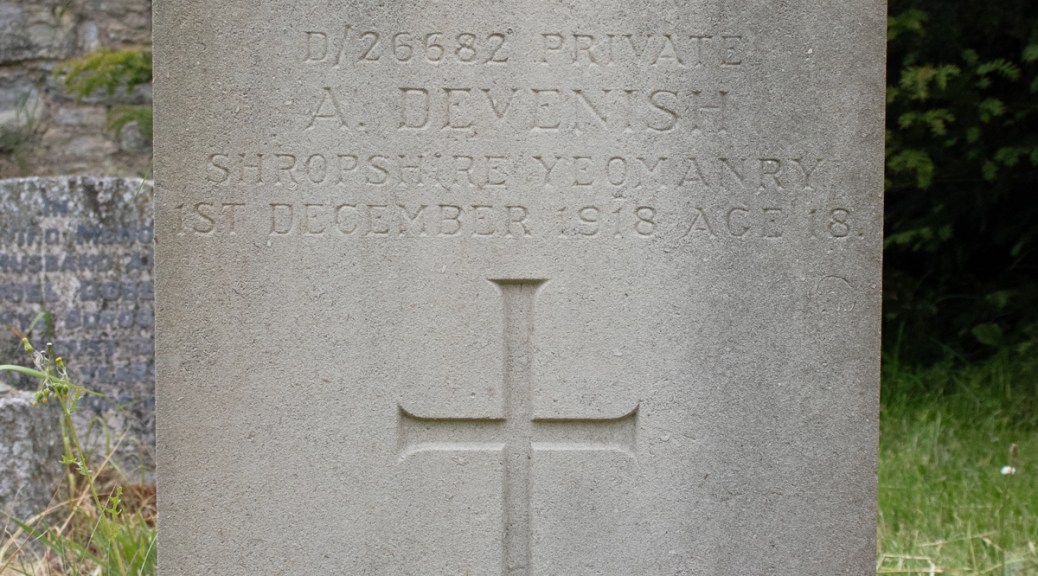
Arthur John Walderow Devenish was born in the spring of 1900, and was the oldest of ten children. His parents, John and Ada Devenish, were both born in Maiden Newton, Dorset, and this is where Arthur and his younger sibling Albert were born. By 1905, however, plumber and glazier John had moved the family thirty miles north-west, across the Somerset border to the village of Thurlbear.
There is little concrete information about young Arthur’s life. When war broke out, he was too young to enlist, but had definitely joined up by the spring of 1918, presumably as soon as he came of age. Private Devenish was assigned to the 2nd/1st Battalion of the Shropshire Yeomanry. The troop remained on home soil, and, by the time Arthur enlisted, was a cyclist unit, based in Northumberland.
Early in 1918, Private Devenish’s battalion moved to County Kildare, Southern Ireland. He was billeted in barracks in Curragh Camp, and remained there for the rest of the conflict. Tightly packed accommodation was a breeding ground for a range of illnesses and, by November 1918, Arthur had contracted pneumonia. He was admitted to the camp hospital for treatment, but the condition was to get the better of him, and he passed away there on 1st December 1918, aged just 18 years of age.
The body of Arthur John Walderow Devenish was brought back to Somerset for burial. He was laid to rest in the quiet graveyard of St Michael’s Church, in Orchard Portman, not far from where the family lived in neighbouring Thurlbear.
Claude John Howard Rawlings was born on 5th November 1896 in the Monmouthshire village of Aberbeeg. One of three children, his parents were Sidney and Alice Rawlings. Sidney was a brewer from Bath, Somerset, while Alice was born in the Welsh village and this is where the couple raised their family.
By the time of the 1911 census, Claude had been sent to Weston-super-Mare, Somerset, and was a boarding student at the Brynmalyn Private School to the north of the town centre. His heritage would not have been out of place, though, as nine of the 25 live-in students were from Wales. Claude’s parents seemed to have taken the opportunity to visit Sidney’s mother in Bath, a possible prequel to them moving back to Somerset permanently.
Claude completed his schooling at Brynmalyn the following year, and took up a place as an agricultural student in Broadstone, Dorset. When war broke out, however, he was called upon to play his part.
Details of Claude’s military service are sketchy, but he initially enlisted in the Gloucestershire Regiment and was assigned to the 4th (City of Bristol) Battalion. The regiment service in France and Italy from 1915 onwards, but there is no evidence of Private Rawlings serving anywhere other than on home soil.
Claude wanted greater things, and was drawn to a life in the sky. In the spring of 1918, he transferred to the Royal Air Force, and was attached to 125 Squadron. Sent to Fowlmere Airfield near Royston, Hertfordshire, Flight Cadet Rawlings began his training. Over the next couple of months, he learnt to fly a Royal Aircraft Factory R.E.8 biplane.
Flight Cadet Rawlings was dong a routine practice flight on 12th August 1918, when, during a left hand turn, the aircraft’s side slipped and nose dived. The plane crashed to the ground, and Claude was killed instantly. He was just 21 years of age.
The body of Claude John Howard Rawlings was brought back to Somerset for burial. He was laid to rest in Bath Abbey Cemetery.
Flight Cadet Claude Rawlings (from britishnewspaperarchive.co.uk)
Claude’s grave was a family plot, and he was reunited with his parents when Alice and Sidney died in 1933 and 1945 respectively.
The inscription on the family headstone gives Claude’s date of death as October 1918. All other records confirm the crash took place on 12th August, and that he died at the scene.
Much of the life of William Charles Taylor is destined to remain lost to time. His Commonwealth War Grave Commission and military records give his father as Henry Taylor, while another document suggests his mother’s initial was E, but no birth, baptism or census records match the three names given.
The document that can be directly attributed to William is his military service records. They confirm that he enlisted in Bath, Somerset, on 18th February 1916, joining the Somerset Light Infantry. The document notes that he was 21 years and 7 months old when he enlisted, and stood 5ft 7ins (1.7m) tall.
Initially assigned to the 10th Battalion of the Somerset Light Infantry, within a couple of months, Private Taylor was transferred across to the Durham Light Infantry in July 1917. He remained on home soil for the duration of his time in service, and was moved across to the Labour Corps in March 1918.
By May that year, William had become unwell. He was based in Essex at this point, and was admitted to the Warley Military Hospital in Brentwood, suffering from tuberculosis. He spent six weeks in hospital, before finally being discharged from the army as he was no fit for military service.
At this point, William’s trail goes cold once more. He seems to have returned home to Bath, finally succumbing to tuberculosis on 15th September 1918. He was just 24 years of age.
William Charles Taylor was laid to rest in Bath’s Twerton Cemetery.
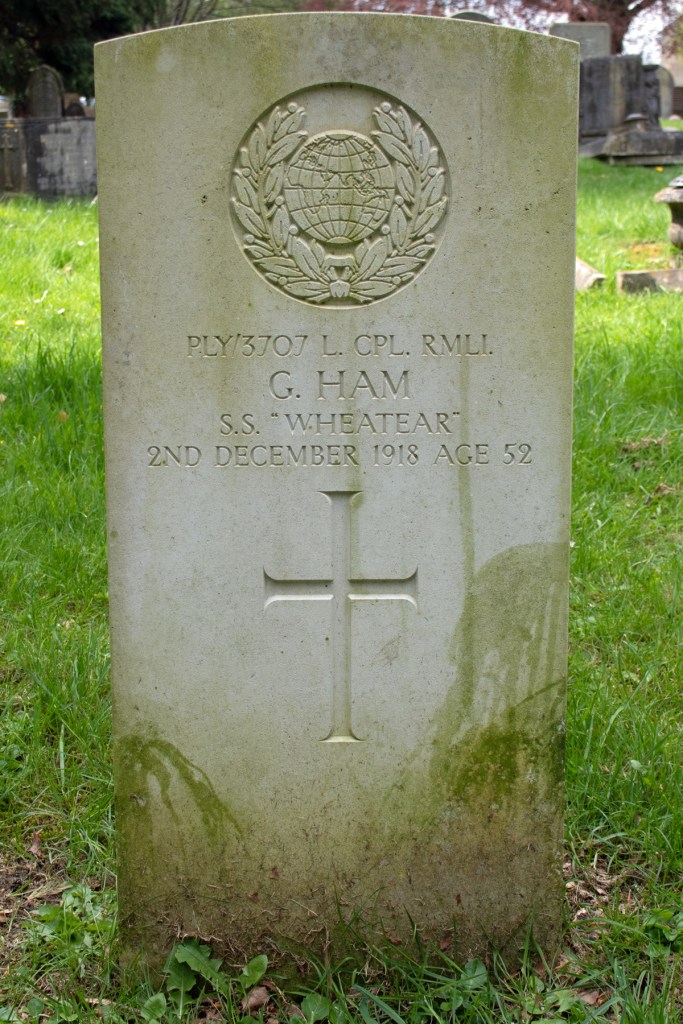
George Ham was born on 19th December 1867 in Twerton, Somerset. His parents were George and Emily Ham, and he was the oldest of their nine children. George Sr was a mason, and initially his first born followed suit, but he was pulled towards something bigger and better and, on 19th January 1886, he enlisted in the Royal Marine Light Infantry.
George’s service records note that he was 5ft 6ins (1.68m) tall, with brown hair, grey eyes and a fresh complexion. He was initially sent to the barracks at Walmer in Kent, and it was from here that Private Ham began a 21 year career in the Royal Marines. Over that time, he served on seven separate ships, and, between voyages, he was based in barracks in Plymouth, Devon. Both his character and ability were consistently noted as being very good.
Private Ham’s career took him around the world and, in 1887, he found himself on the gunboat HMS Banterer, on which he served for three years. His tour of duty included a period of time in Galway, Ireland, and it was here that he met Mary Ann Goode. On 5th July 1889, the couple married in city’s St Nicholas’ Church. The church’s records suggest that the couple went on to have four children – Frederick George; Emily, who died just after her first birthday; Albert; and Katherine.
George’s records from this point become a little disjointed. In October 1890, he returned to his Plymouth base, and the following year’s census recorded him as living in the East Stonehouse Barracks, although his marital status was noted as single.
The next census, in 1901, presents a different picture. George and Mary were, by this time, living in family barracks in East Stonehouse, with two children, (Frederick) George and Albert. Katherine, the couple’s youngest child, was born the following year.
In January 1907, after more than two decades’ service, George was stood down from active service in the Royal Marines. He was placed on reserve status, and took up work as a mason once more. At this point, however, the family seemed to have hit more troubled times, underlined by four separate 1911 census documents.
George, who was 44 by this point, was recorded as being an inmate in the Bath Union Workhouse and Infirmary in Lyncombe, Somerset. Mary and Katherine, meanwhile, were in two rooms in a house in Stonehouse, Devon. Frederick, who was now better known as George, had followed his father into military service, and was a Private in the Royal Marine Light Infantry, serving on HMS Colossus. Albert, who was 13 years old, was one of 946 students boarding at the Royal Hospital School for Sons of Seamen in Greenwich, London.
George spent nine years in the reserves, and, in 1914, was called up again for war service, this time as a Lance Corporal. According to a contemporary newspaper:
[He was] engaged on naval patrol work against submarines off the Canadian coast and elsewhere, and was in charge of a gun on an armed merchant ship. Once the boat he was on was torpedoed, and on another occasion he had a long running fight with a submarine in the Irish Channel. The ship, however, reached Portrush (Ireland), and the inhabitants gave Lance-Corporal Ham a testimonial, and he was also rewarded in other ways, the Cardiff owners of the vessel recognising his skill and gallantry.
Bath Chronicle and Weekly Gazette: Saturday 7th December 1918
Tragedy was to strike in the end, however, and George was to meet a sad end to a distinguished career.
While at Cork [George] fell, either from a boat or the dock, and sustained an injury to the side of his head. It did not appear very serious, and it is understood that he made a trip to Cardiff and back to Londonderry, [where] he became so seriously ill as to necessitate his going to a military hospital in Londonderry. Hemorrhage [sic] of the brain set in, and he died on Monday [2nd December 1918] before his brother, Mr Albert Ham, who had been telegraphed for, could reach him.
Bath Chronicle and Weekly Gazette: Saturday 7th December 1918
Lance Corporal George Ham was days short of his 51st birthday when he died. His body was brought back to Somerset for burial, and he was laid to rest in Twerton Cemetery. The newspaper report give no indication as to whether Mary or their children were in attendance and, in fact, does not mention his wife and family at all.
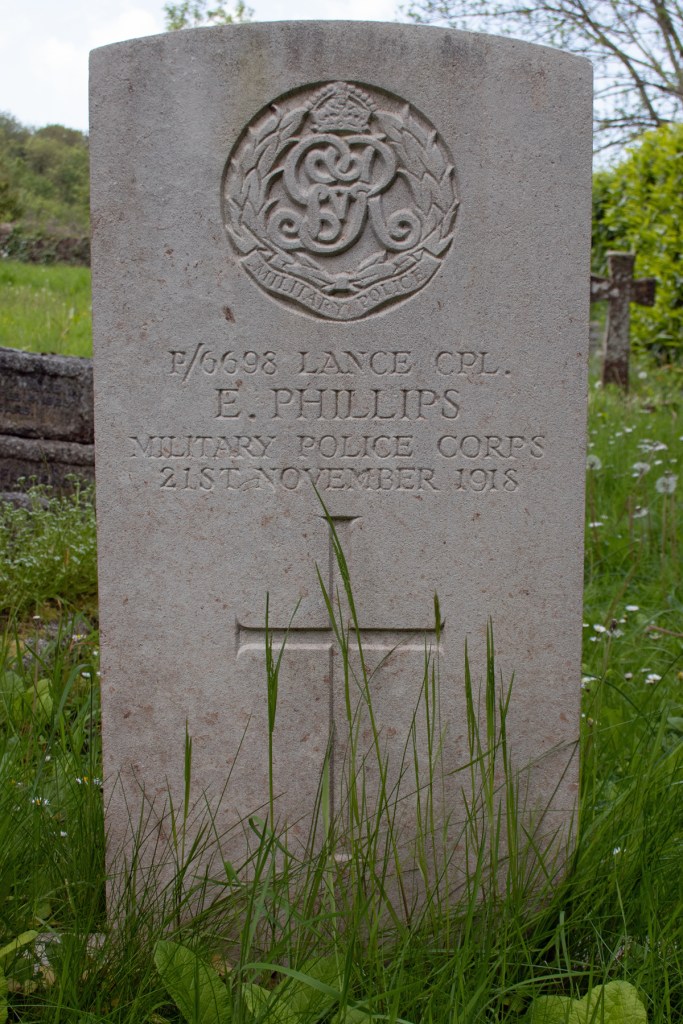
Ernest Algernon Phillips was born at the start of 1879 in the Somerset village of Winscombe. One of nine children, his parents were Arthur and Elizabeth Phillips. Arthur was a gardener, and Ernest followed suit when he finished his schooling.
By the time of the 1911 census, he was boarding with his younger sister Rose and her family – brother-in-law Leonard and nephew Leslie. Just a couple of weeks later, on 11th May 1911, Ernest married Winifred Carey. She was a coachman’s daughter from Winscombe, and the couple set up home in a cottage on the outskirts of the village.
When war broke out, Ernest felt a need to play his part. He enlisted in Bristol on 8th December 1915, but was not formally mobilised until the following June. Initially assigned to the Devonshire Regiment, he was transferred to the Worcestershire Regiment and attached to the 6th Battalion.
Private Phillips’ troop was based on home soil, and he was barracked in the garrison in Harwich, Essex, for the next six months. On 31st January 1917, he was transferred to the Military Police Corps, and given the rank of Acting Lance Corporal. Full details of his service from this point on are lost to time, but it is clear that he remained on home soil until the end of the war.
By November 1918, Ernest had fallen ill. He was admitted to the Queen Alexandra Military Hospital in London on 20th November, suffering from pneumonia. Within a matter of hours, while this seemed to have cleared, his pulse was ‘rapid, irregular and compressible.’ He was medicated, but did not respond to treatment, and passed away the following day. His death was noted as apparently being caused by clots of blood in the heart, but, at the request of his family, no postmortem examination was carried out. He was 39 years of age.
Ernest Algernon Phillips was brought back to Somerset for burial. He was laid to rest in the quiet graveyard of St James the Great Church in Winscombe.







 Death and Service