Tag Archives: 1918

Private Samuel Troake

Private Samuel Troake

Samuel Troake was born in Wellington, Somerset, on 24th August 1890. His parents were Samuel and Mary Troake and he was one of seven children to the couple. Mary had been married before, and had a daughter of her own. Samuel Sr was a shepherd turned labourer: when Mary died in around 1894, he married again, to widow Sarah Carter. She also had children of her own, something that is noted in the 1901 census, which records husband and wife sharing the house (from his perspective) with six of his children and five step-children.

By the time of the next census, ten years later, the Troake family home was a lot less crowded. Road contractor Samuel Sr and Sarah were recorded living with Samuel Jr and his younger brother, Charlie – both of whom were wool spinners , and the couple’s grandson, Percy.

Working at the wool factory came with benefits for Samuel Jr. It was there that he met Alice Slade, and the couple married on 10th December 1914, at the local parish church. The couple set up home not far from his parents, but war was soon to take him away from his new bride.

Full details of Samuel’s military service are not available: he enlisted in the Somerset Light Infantry, and was assigned to the 8th (Service) Battalion. He served on the Western Front, and remained there until almost the end of of the conflict.

Private Troake was recorded as being caught up in the conflict, and was medically evacuated to England for treatment to a bullet wound. Sadly, the injuries to his abdomen and bladder were to prove too severe – he passed away in a Portsmouth hospital on 30th October 1918. He was 28 years of age.

Samuel Troake was brought back to Somerset for burial. He was laid to rest in Wellington Cemetery, not far from where his widow and father still lived.

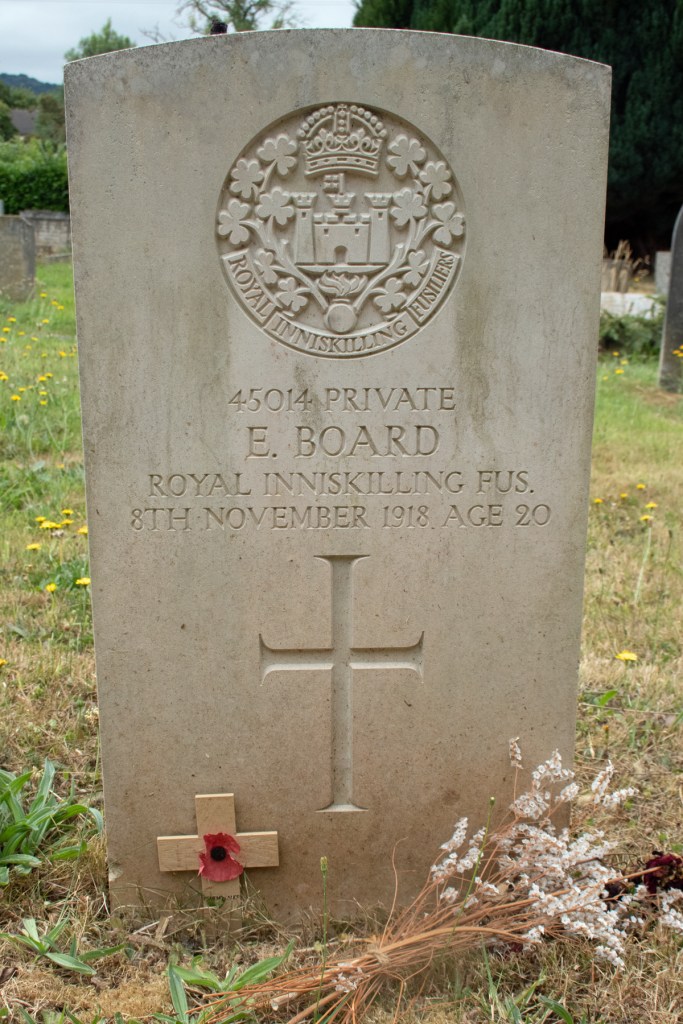
Private Ernest Board

Private Ernest Board

Ernest Board was born in Taunton, Somerset, on 20th September 1898 and was one of at least six children to Walter and Mary Board. Walter was a carter for the town’s gasworks, but, when Mary passed away in 1910, things changed dramatically for the family.

The 1911 census found Walter working as a cowman on a farm in Milverton, Somerset. All but two of his children are missing from that year’s national record, but Ernest and his older brother Arthur are noted as being ‘inmates’ at the National Nautical School in Portishead, near Bristol.

This was an establishment set up in 1869 for the destitute and neglected boys of the area. Ernest and Arthur were two of more than 320 students at the school which, at that time, was under the control of Commander Willoughby Still. School life was very strongly based on the running of a ship, with hammocks instead of beds, and a parade ground in front of the building.

There is no information about how long the brothers remained at the school, but, when war came to Europe, it would seem that they were keen to play their part. Sadly little detail remains of Ernest’s military life.

What can be determined, however, is that he enlisted in the Royal Inniskilling Fusiliers, and was assigned to the 1st Battalion as a Private. His battalion fought at, and were evacuated from, Gallipoli, before moving to France. There is no record where Private Board was involved, sadly, although his Medal Roll Card shows that he was assigned the Victory and British Medals, although may not have actually seen time overseas.

Private Board’s passing is also lost to time. All that can be confirmed is that he died on 8th November 1918, and was just 20 years of age.

Ernest Board was laid to rest in Wellington Cemetery, Somerset: as this is not far from where his father was recorded on the census seven years earlier, it is likely that his place of burial was due to family connections in the area.


Private Herbert Towell

Private Herbert Towell

Herbert William Towell was born in the autumn of 1899, the oldest of six children to James and Prudence. James was a wool sorter in a factory, who had been born in Rockwell Green, on the outskirts of Wellington, Somerset, and this is where he and Prudence raised their children.

The Towell family were locals to Rockwell Green. James’ brother Charles lived just a few doors away from him and the 1911 census recorded James and Prudence living at 105 Rockwell Green Road, while Herbert, aged eleven, was living with his paternal grandparents, William and Charlotte, at 131 Rockwell Green Road.

When he left school, Herbert found work as an engine cleaner. War, however, was imminent and he was keen to play his part, but was initially too young do so. His time came, though, and on 30th June 1917 he was enlisted into the 34th Training Reserve Battalion.

At seventeen years and nine months, Private Towell’s service record gives his height as 5ft 11ins (1.80m), his weight as 144lbs (65.3kg) and confirms that he had a mole on his right cheek. He was initially assigned to the 53rd (Young Soldier) Battalion of the Hampshire Regiment, and posted to the army base at Durrington, close to Stonehenge.

In November 1917, Private Towell was admitted to the camp hospital with diarrhoea. Sadly, he had also contracted tuberculosis and it was recommended that he spend some time in a sanatorium. On 6th February 1918, he was discharged from service on medical grounds, and ordered to present himself for review the following year.

Herbert was not to get the chance to do so: within a month of his discharge he succumbed to the lung condition, breathing his last on 5th March 1918. He was just 18 years of age.

Herbert William Towell was brought back to Somerset for burial. He was laid to rest in Wellington Cemetery, within sight of his parents’ home.


Tragedy was to strike James and Prudence again less than a year later, when Herbert’s younger sister, Florence, passed away, aged just ten years old. No further information about her passing is available, so she may also have succumbed to one of the lung conditions running rampant across Europe in the aftermath of the war.


Private Frederick Best

Private Frederick Best

Frederick William Best was born in Wellington, Somerset, early in 1898 and was the middle of three children to factory worker Frederick Best and his wife, Bessie. When he left school, he found work as a delivery boy for a local baker, unlike his father, who was a long-time working in the local woollen factory.

War was closing in on Europe, however, and Frederick Jr was soon keen to play his part. Full details of his military service are not available, but it appears that he enlisted in the Worcestershire Regiment as soon as he was able, Private Best was assigned to the 15th (Transport Workers) Battalion, and served on home soil, initially in Swindon, and then in Southampton.

It was while he was billeted in Hampshire that Frederick contracted meningitis. He was admitted to a hospital in the city, but the condition was to get the better of him, and he passed away on 2nd January 1918, aged just 19 years old.

Frederick William Best’s body was brought back to Somerset for burial. He was laid to rest in the cemetery in his home town, Wellington, where his parents were both buried in the 1930s.


Sapper John Spry

Sapper John Spry

Details of John George Spry’s life remain tantalisingly out of reach. He was born in around 1874 in the Devon village of Woolfardisworthy, and was one of eight children to John and Ann Spry. John Sr was a general labourer who died in 1891. By this point the family were living at 14 Honestone Lane, Bideford, and John Jr was working as a stone mason.

John married Emily Langford. She was a blacksmith’s daughter from Taunton, Somerset, but the couple set up home in nearby Wellington, before moving to Twerton, Bath. The went on to have three children: Ivy, Ruby and Frederick. Interestingly, Ivy seems to have been taken in by Emily’s mother, Emma, while Ruby and Frederick remained with their parents.

The 1911 census found Emily, Ruby and Frederick living with John’s mother in Bideford. Ivy was in Wellington with Emma, but John is missing from the records.

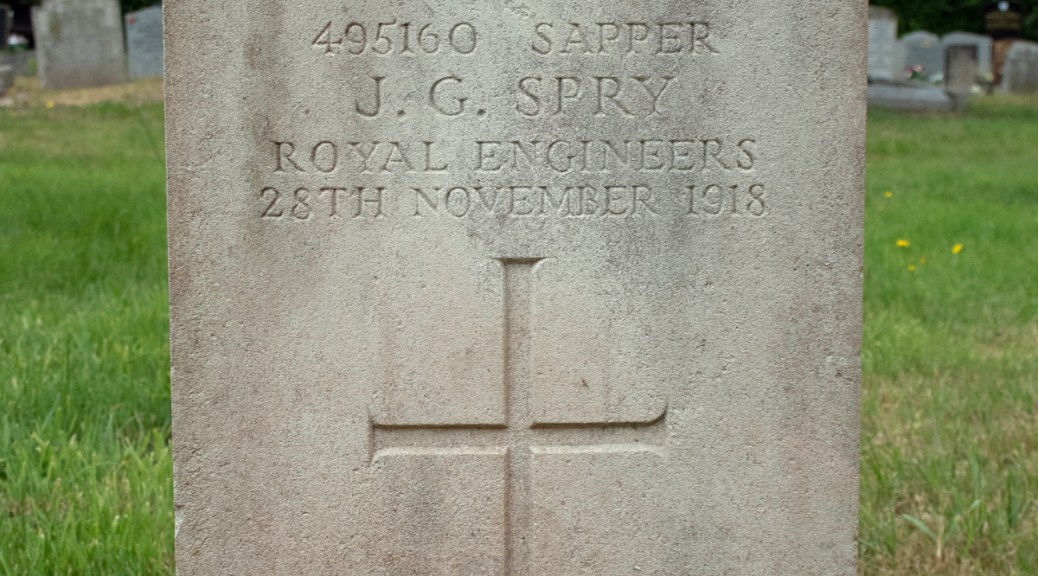
When war broke out, John joined up. He enlisted in the Royal Engineers, and was assigned the rank of Sapper. Dates for his service – and where that service was carried out – are lost to time, but by the autumn of 1918, John was based in barracks in Fovant, Wiltshire.

By this time, Sapper Spry had fallen ill. Suffering from influenza and bronchial pneumonia, he was to succumb to the lung diseases, as so many other returning servicemen did. John passed away on 28th November 1918, aged 45 years of age.

John George Spry was brought back to Somerset for burial. He was laid to rest in Wellington Cemetery, not far from where his widow had relocated.


What became of the Spry family after John’s death is unclear. Emily cannot be tracked down in the 1921 census, nor can her middle child, Ruby.

Ivy was boarding at 55 Harrow Road, Paddington, Middlesex, where she was working as a Lieutenant in the Salvation Army. Frederick, meanwhile, had found work as a steersman on a steamroller, and, according to the census, was living with his maternal uncle, Charles, in Bideford.

The 1939 Register picks up Emily once more, living in a small end-of-terrace cottage on the outskirts of Wellington. Now 70 years of age, she was noted as being incapacitated, no doubt being tended to by Ruby, who was also living there, employed as a puttee machinist.


Armourer’s Crew William Edwards

Armourer’s Crew William Edwards

William Robert John Edwards was born on 10th July 1899, one of fourteen children to engine fitter William Edwards and his wife Bertha. Both of William Jr’s parents had been born in Devon, but, by the time of his birth, they had moved to the Somerset town of Wellington.

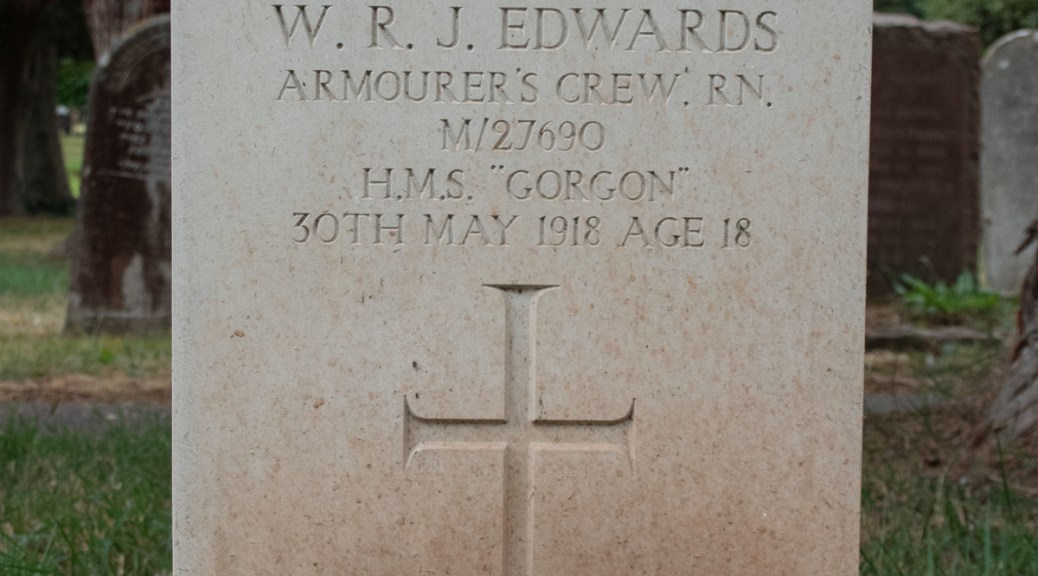
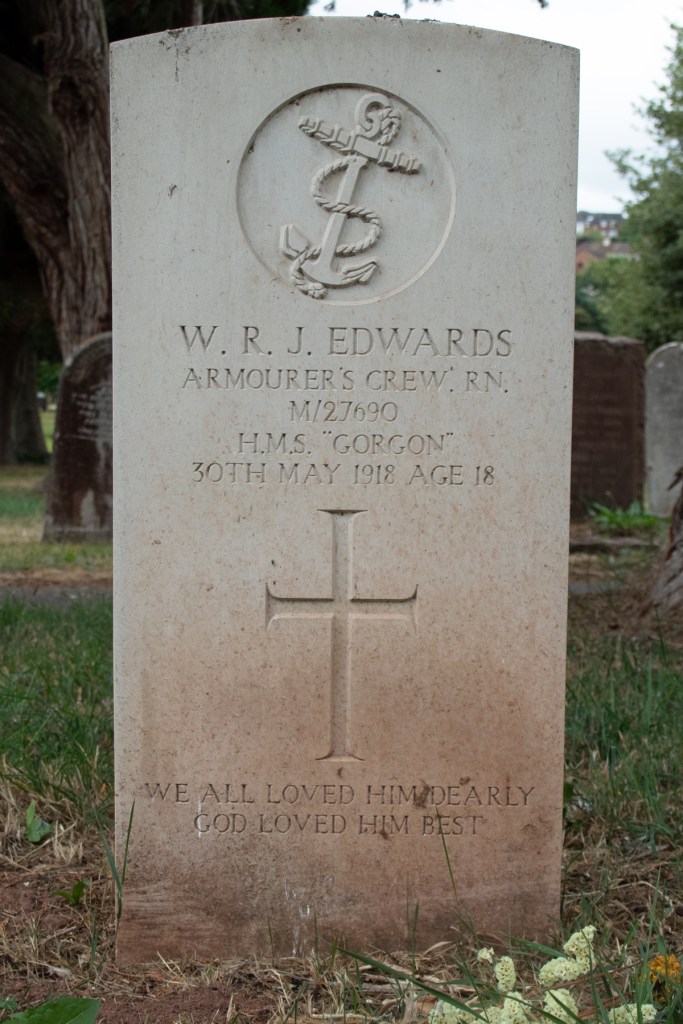
William followed in his father’s footsteps when he left school, but with war raging across Europe, he was keen to play his part as soon as he was able to do so. He enlisted in the Royal Navy on 7th September 1917, his engineering background making him perfect for a member of the Armourer’s Crew.

William’s service record show that he was 5ft 5ins (1.65m) tall, had brown hair, hazel eyes and a fresh complexion. He was initially sent to HMS Vivid – the Royal Naval Dockyard at Devonport – for training, and was given a posting on board HMS Gorgon, a coastal defence ship on 1st May 1918.

Tragically, this first assignment was to be Armourer’s Crew Edwards’ last. Within a matter of weeks, he was taken back to HMS Vivid, suffering from tubercular meningitis. Back at base, the condition proved too much for the young man: he passed away on 30th May 1918, days shy of his 19th birthday.

Brought back to Somerset for burial, William Robert John Edwards was laid to rest in the cemetery of his home town, Wellington.


Corporal Herbert Lyon

Corporal Herbert Lyon

Herbert Woodley Lyon was born in Lincoln early in 1897, one of five children to Walter and Emma Lyon. Walter was a cashier for an engineering company, and the family grew up in some comfort, employing a housekeeper, sick nurse and servant by the time of the 1911 census.

When he finished school, Herbert found work as a draper’s assistant, but with war closing in things were to change. Initially joining the Lincolnshire Regiment, by February 1918, he had transferred across to the Royal Flying Corps, moving to the Royal Air Force when it was founded that April.

Corporal Lyon was based with 112 Squadron at RAF Throwley, just to the south of Faversham, Kent. Details of his service are scarce, but it seems that he trained and qualified as a fitter, helping with the maintenance of the aircraft. His service records show that he stood 5ft (1.52m) tall.

Herbert’s time in the Royal Air Force was limited. His records show that he died of natural causes on 1st November 1918. He was just 21 years of age.

Corporal Herbert Woodley Lyon’s family had relocated to Wells in Somerset by this point. He was laid to rest in Faversham Borough Cemetery, not far from the airfield at which he had been based.


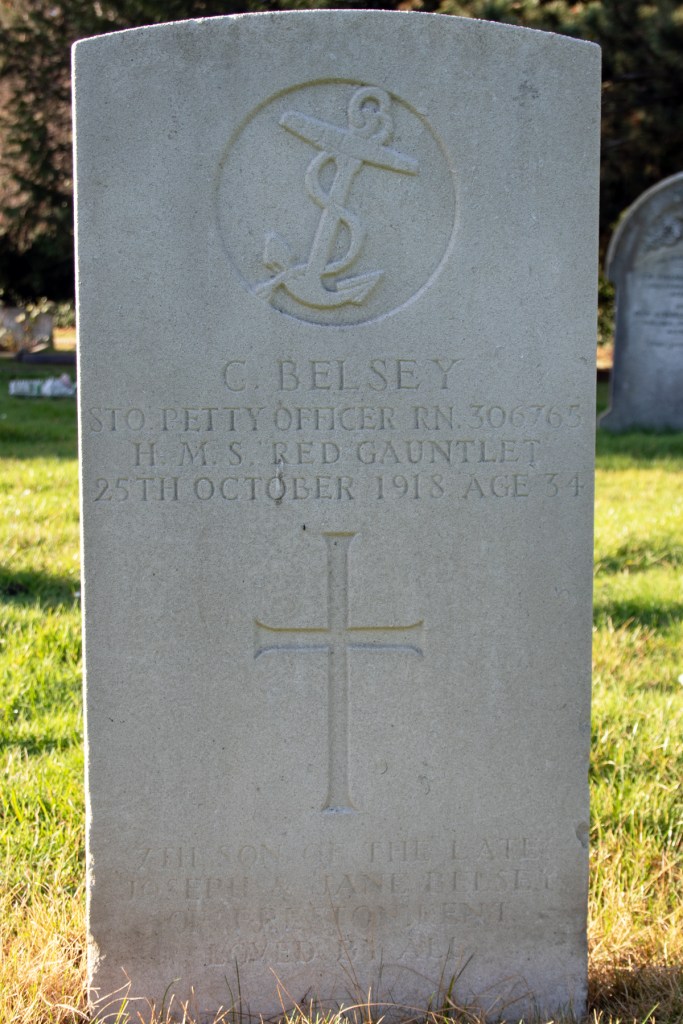
Stoker Petty Officer Christian Belsey

Stoker Petty Officer Christian Belsey

Christian Belsey was born on 12th February 1884 in the village of Preston, Kent. He was one of fourteen children to Joseph and Jane Belsey. Joseph was a farm labourer, and Christian followed suit on leaving school.

He wanted bigger and better things, however, and after his older brother Charles had sought out a life in the Royal Navy, he followed suit. Christian enlisted on 28th June 1904; his service records show that he was 6ft (1.83m) tall, had brown hair, brown eyes and a fresh complexion.

Stoker 2nd Class Belsey was based out of HMS Pembroke, the Royal aval Dockyard in Chatham, Kent, and this is where he returned to in between voyages. His first posting was on board the destroyer HMS Acheron, on board which he spent six months.

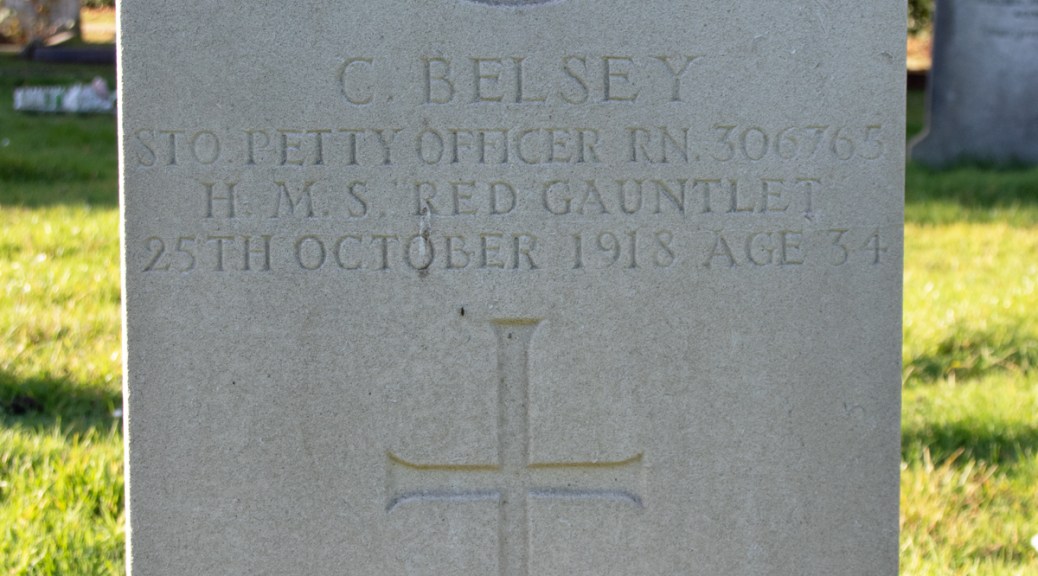
Over the twelve years of his initial service he was assigned to six different ships, rising through the ranks to Stoker 1st Class (in 1906), Leading Stoker (1911) and Stoker Petty Officer (1912).

When war broke out in August 1914, Christian was back in Chatham; he was soon assigned to HMS Laertes, a destroyer based out of Harwich, which patrolled the North Sea. She was involved in the attempt to head off the German attack on Yarmouth and Lowestoft in April 1916, during which, two of Christian’s colleagues, Stoker Ernest Clarke and Stoker Petty Officer Stephen Pritchard, were awarded the Distinguished Service Medal for their bravery under fire.

After three years on board Laertes, Christian was transferred to HMS Redgauntlet. He served on board for eighteen months until, in October 1918, he fell ill.

Admitted to a hospital in Samford, near Ipswich, Suffolk, Stoker Petty Officer Belsey was suffering from pneumonia. Sadly, the lung condition was to get the better of him, and he passed away on 25th October 1918, at the age of 34 years old,

Christian Belsey was brought back to Kent for burial. He was laid to rest in Faversham Borough Cemetery.


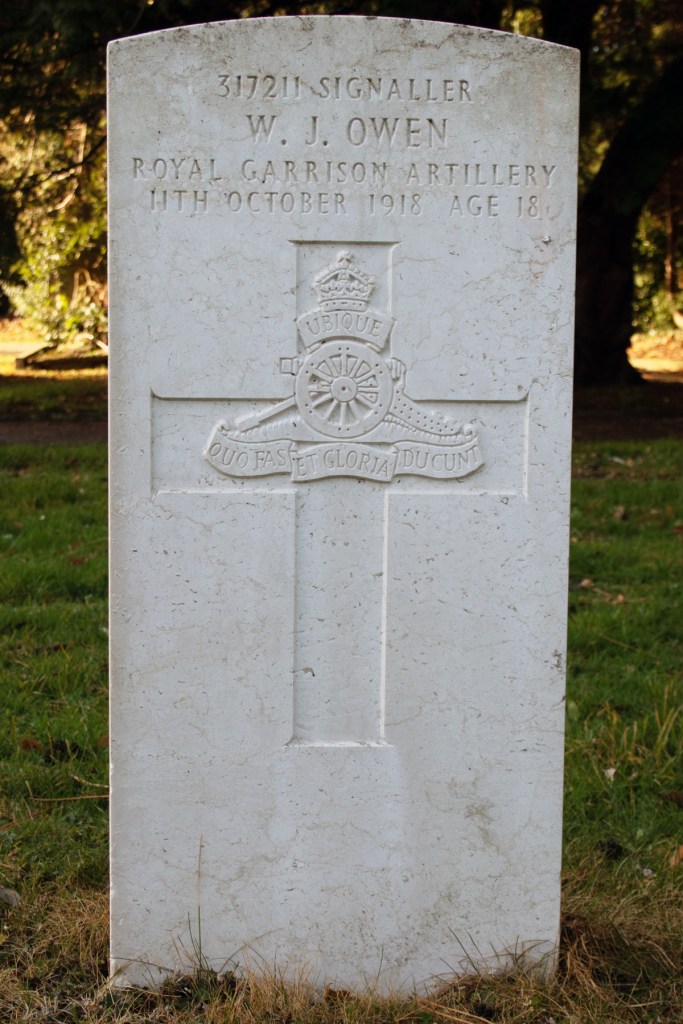
Signaller William Owen

Signaller William Owen

William John Owen was born in the spring of 1900, and was one of thirteen children to Henry and Emma Owen. Henry was an oyster dredger turned coal porter from Faversham in Kent, and this is where the family were born and raised.

There is little concrete information about William’s life, but it is clear that, by April 1918, he had joined the Royal Garrison Artillery, and was assigned to the 2/1st Kent Heavy Battery. Signaller Owen was sent to Larkhill Camp in Wiltshire for training.

The only further information is that William was admitted to the Fargo Military Hospital on Salisbury Plain, suffering from pneumonia. Sadly the lung condition was to get the better of him: he passed away on 11nd October 1918, aged just 18 years old.

William John Owen was brought back to Kent for burial. He was laid to rest in Faversham Borough Cemetery, just a few minutes’ walk from his family home.


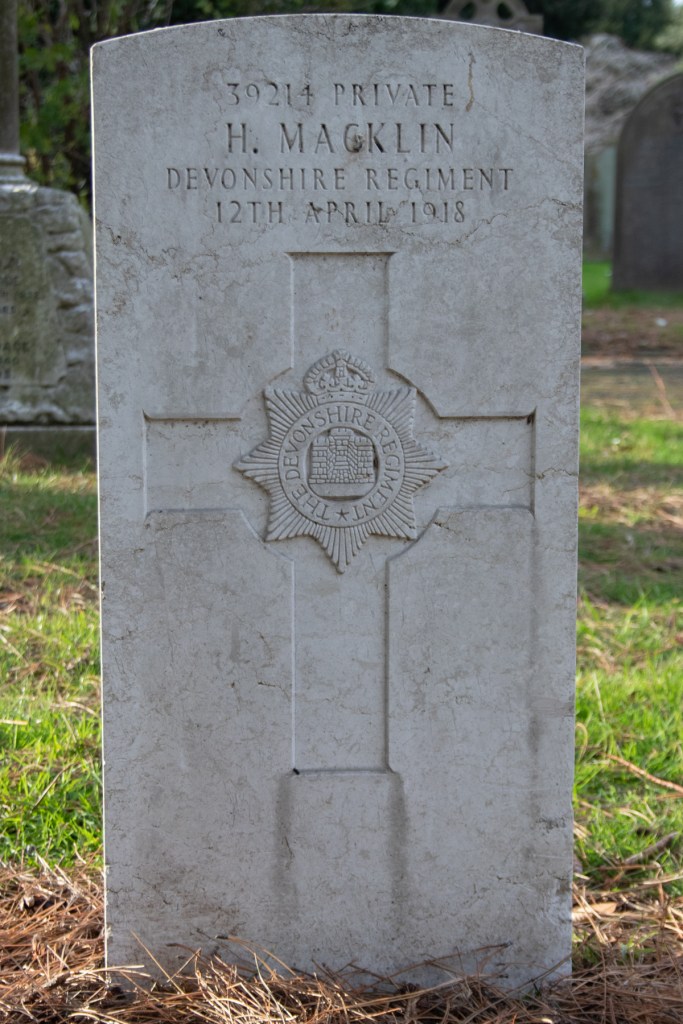
Private Herbert Macklin

Private Herbert Macklin

Herbert Macklin was born in Lambeth, Surrey, on 14th August 1897, the youngest of six children to Enos and Sarah Macklin. Enos was a general labourer and, after his mother died in 1909, Herbert worked around his school as a baker’s errand boy, to bring in a little more money for his family.

After Enos passed away in 1912, and with his older sisters all having families of their own, Herbert and his older brother William did what they could to survive, getting some support from the local poor school.

The outbreak of war gave the brothers a sense of purpose, and both enlisted. William joined the Royal Field Artillery, and was sent to France in September 1915.

Herbert, being six years younger than his brother, enlisted later than his sibling. He joined the Middlesex Regiment, on 10th May 1916, and his service records show that he was 5ft 4.5ins (1.64m) tall, 126lbs (57.2kg) in weight and had a fair physical development. While Herbert had a fair physical development, he was also recorded as having flat feet, which somewhat limited his army service.

Private Macklin transferred across to the Devonshire Regiment a few months after enlisting. He was then assigned to the regiment’s Labour Corps in the summer of 1917, and remained with them for the rest of his service.

While William was serving abroad, Herbert remained on home soil for the duration. By the spring of 1918, he was working in Kent, but was admitted to hospital in Faversham, suffering from acute tonsillitis. Sadly, this was to prove too much for Private Macklin’s body to take: he suffered cardiac failure, and died on 12th April 1918. He was 21 years of age.

Herbert Macklin was laid to rest in the Borough Cemetery of the town in which he passed, Faversham.


Tragedy was to strike again for the Macklin brothers: as the war moved into its closing months, Driver William Macklin was based in Salonika, Greece. He was not to see England’s shores again, sadly: he passed away on 23rd November 1918, aged just 27 years old.