Tag Archives: accident

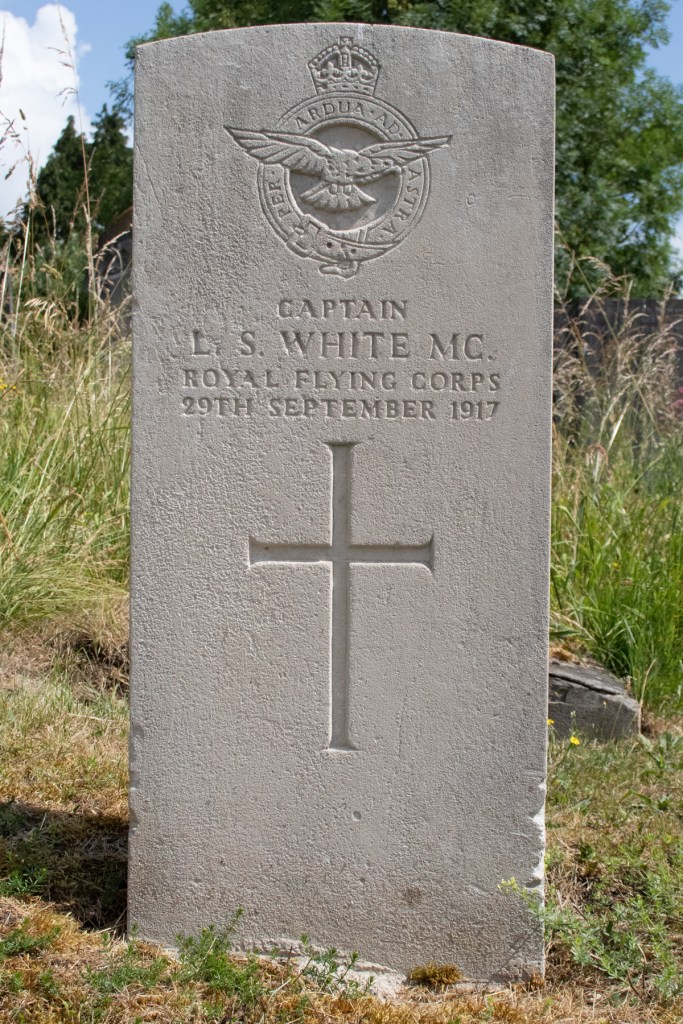
Captain Lewis White

Captain Lewis White

Lewis Scott White was born at the start of 1896 in Bath, Somerset. The youngest of four children, his parents were surgeon Edward White and his wife, Fanny. The 1911 census recorded the family living in a substantial property in Green Park: the now medical practitioner Edward, Fanny and Lewis sharing the 12-room house with a servant, Ellen Fry.

As befitting of his station in life, Lewis’ education was a well rounded one: “[he] was educated at Bath College and Kelly College, Tavistock, and was coached for his matriculation examination by Mr Samuel Edwards, of Grosvenor College. He exhibited a fondness for aeronautics when quite a lad. While at Victoria College he evinced much enthusiasm for the art of flying, and made models of flying machines. One of these miniature planes he flew successfully on Lansdown, and we believe showed at an exhibition in London. He was one of the leading spirits in the Bath Aerial Club, which used to meet at the Church Institute.” [Bath Chronicle and Weekly Gazette – Saturday 06 October 1917]

Lewis’s mechanical mind was put to good use in his working life as well. He found employment as a motor fitter, and this is what he was doing when war broke out in the summer of 1914. He felt duty bound to service his King and his Country, and, on 20th October, he enlisted in the Royal Flying Corps as an Air Mechanic. His service records confirm the man he had become: at 18 years of age, he was 5ft 4ins (1.63m) tall and weighed 117lbs (53kg). He had dark brown hair, brown eyes and a fresh complexion.

His skill and daring earned promotion, and he was given a commission… He accomplished many fine feats in actual aerial warfare on the Western Front, and for one of these some months ago he was awarded the Military Cross. He was acting as an observer when the flight occurred; the pilot in the same machine was given the DSO.

While wearing only one wing he came home to England to train as a pilot. He rapidly passed all the tests for this, and obtained the two wings, and was gazetted Captain of the RFC on May 5th last. It was only on Wednesday last week that Captain White attended an investiture at Buckingham Palace and was decorated by the King with the MC. So complete was his mastery of flying machines and so great his initiative that Captain White was appointed Flight Instructor, and for the last two months he had been Flight Commander quartered in Wiltshire.

[Bath Chronicle and Weekly Gazette – Saturday 06 October 1917]

On 29th September 1917, Captain White was piloting a Sopwith Camel from RAF Yatesbury, Wiltshire, when the aircraft failed to pull up from a dive. It crashed into the ground and Lewis was killed instantly. He was just 21 years of age.

It is no secret that the aeronaut whose intrepid feats in the air above Bath of late had caused much notice was Captain White. He would loop the loop with the greatest ease, and his nose-diving was most daring. When questioned why he performed these dangerous acts in the air Captain White would declare that there was no risk from engine trouble unless a man ‘lost his head,’ and apparently he had no idea that is was possible for him to get into difficulties from that cause. It is to be surmised therefore that in the accident which had cost his life, so especially valuable to the country now, something beyond engine trouble must have happened.

To stay-at-home and peacefully minded citizens some of the manoeuvring by aeroplanes in flight savours too much of the sensational, and they are apt to think that it is unnecessarily throwing away chances. But such an impression is as unjust as it is unkind. The strange evolutions described by machines in mid-air are just the kind that have to be executed in actual aerial warfare when seeking to gain an advantage over the foe, and unless this preliminary training were carefully and systematically gone through it would be hopeless to seek to acquire the necessary skill in the moment of crisis. Captain White was absolutely fearless, and his death will be deeply deplored by by many comrades who knew his worth.

[Bath Chronicle and Weekly Gazette – Saturday 06 October 1917]

A subsequent inquest found no immediate cause for the crash, but suggested that Captain White may have misjudged the distance whilst diving and flew into ground.

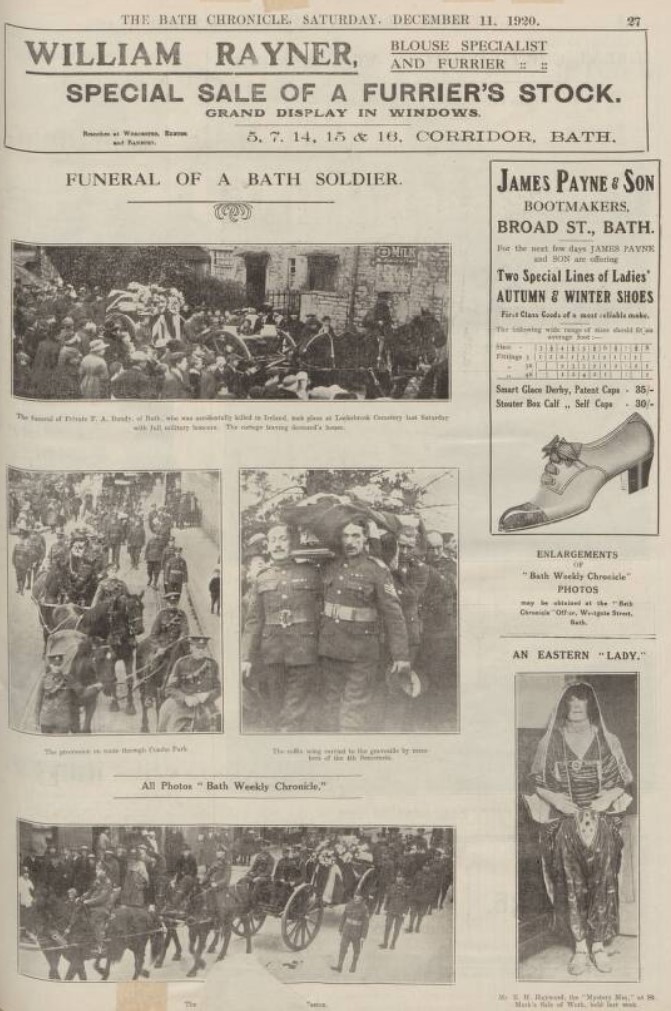
The body of Lewis Scott White was brought back to Somerset for burial He was laid to rest in the majestic Locksbook Cemetery in Bath, his funeral attracting a full page report in the city’s Chronicle and Weekly Gazette.


Captain Lewis White
(from findagrave.com)

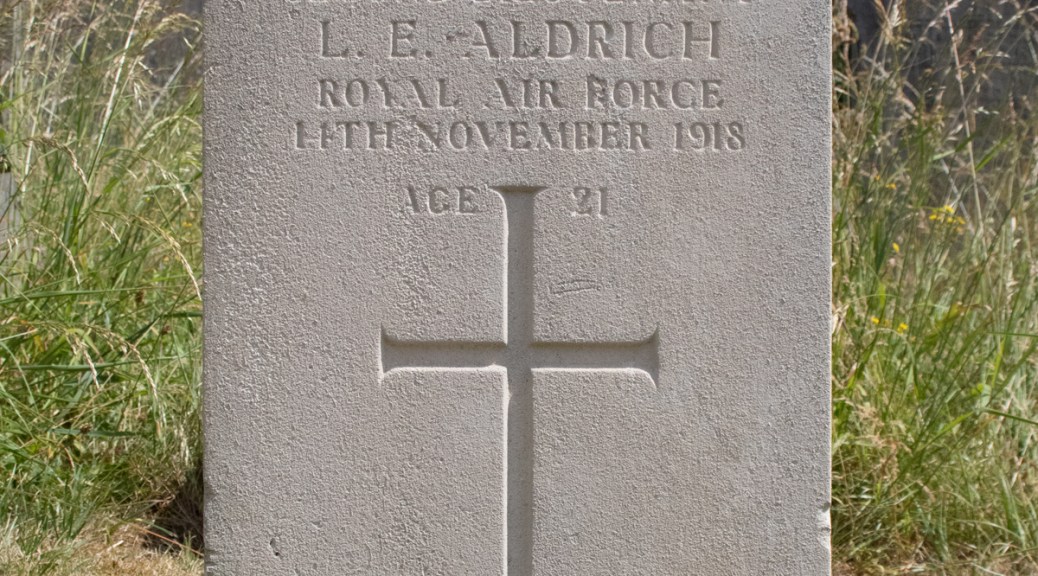
Second Lieutenant Leo Aldrich

Second Lieutenant Leo Aldrich

Leo Edwin Aldrich was born on 14th July 1897 in the Ohio city of Elyria, and was the only child to Hiram and Agnes Aldrich. Hiram was a machinist from New York and, by the time of the 1910 census, he had found work as a toolmaker for a motor company, and the family has moved to Detroit, Michigan, 150 miles (240km) along Lake Erie’s coastline.

When war came to Europe, Leo seemed keen to get involved. Full details of his military service are lost to time, but it seems that he enlisted in the Canadian Royal Engineers. By the summer of 1918, Leo was in Britain, and had transferred to the Royal Air Force. He had reached the rank of Second Lieutenant and was based at Yatesbury Airfield in Wiltshire.

On 14th November 1918, just three days after the Armistice was signed, he was flying in a Bristol F2b fighter aircraft, when it nosedived into the ground. Both Second Lieutant Aldrich and his passenger Second Lieutenant McDougall were seriously injured, and were taken to Bath War Hospital for treatment.

Sadly, Leo’s injuries were to prove to be too severe. He passed away the same day: he was just 21 years of age.

Leo Edwin Aldrich was laid to rest in Locksbrook Cemetery, not far from the hospital in which he passed.


Leo’s service records suggest that his next of kin was his wife, Mrs Leo Aldrich of 480 East 112th Street, Cleveland, Ohio. There are no identifiable marriage records for him although, intriguingly another one does exist.

This confirms the wedding of a George L Aldrich to a Helen J Seymour on 6th August 1918 in Cuyahoga, Ohio. As the names do not match, the record would normally be dismissed, but the parents’ names – Hiram and Agnes – match Leo’s, as does the place of birth – Elyria – and his occupation – Second Lieutenant.

Further details for Helen Seymour, and why Leo may have given the name George, are lost to time.


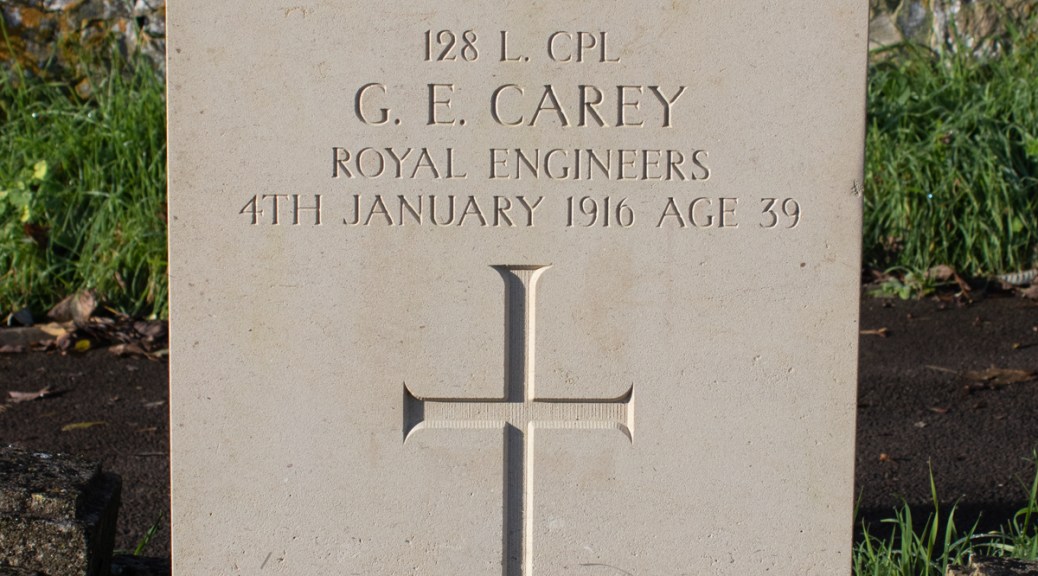
Lance Corporal George Carey

Lance Corporal George Carey

George Edward Carey was born at the start of 1877 and was the oldest of eight children to Samuel and Hester Carey. Samuel was a solicitor’s clerk from Clevedon in Somerset, and this is where the family were born and raised. Samuel was not one to sit on his laurels, however, and the 1891 census recorded his occupations as law clerk, innkeeper and insurance agent.

George followed a different path to his father, and found work as a printer’s apprentice when he finished his schooling. He worked up to being a full compositor quite quickly, and was employed as such when, on 30th January 1899, he married Lizzie Taylor. A civil engineer’s daughter, she was working as a teacher when the couple wed: they set up home in Clevedon, and went on to have four children.

By 1911, the Carey family were living in a seven-room house on Strode Road, Clevedon. George was still working as a compositor, but was employed by the local sanitary works. His widowed brother, Albert, who was lodging with his brother and sister-in-law also did the same job.

With storm clouds brewing over Europe, George stepped up to play his part. He enlisted in the Royal Engineers in the autumn of 1914 and was attached to the 503rd Field Company in Exeter. Little information is available about his time in the army, and he only comes to light again a year or so later.

Lance-Corporal Carey, 2nd Wessex RE, who has been employed at the office in Colleton-crescent, Exeter, was found dead, with his neck broken, at the bottom of a flight of stairs at the Grapes Inn, South-street, on Thursday morning. The discovery was made by Mrs Dorothy, wife of the licensee of the inn. Information was given to the police, and Dr Pereira visited the scene, and subsequently the body was removed to the mortuary by PCs Wise and Barrett. Carey was fully dressed. He was about 48 years of age, and leaves a widow and four children. For about fourteen months he had been engaged on the Wessex RE staff, and was billeted at a house in the Friars. His home is at Clevedon, Somerset, where he was engaged as a compositor before mobilisation with the Territorials. He was under orders for transfer to another station.

Taunton Courier and Western Advertiser: Wednesday 12th January 1916

George Edward Carey died on 4th January 1916: he was, in fact, not quite 39 years of age. His body was brought back to Somerset for burial and was laid to rest in the stunning graveyard of St Andrew’s Church in his home town of Clevedon.


Private Samuel Smith

Private Samuel Smith

Samuel Herbert Smith was born on 15th March 1886 in Liverpool, Lancashire. He was one of six children to parents Henry – a road labourer for the local council – and Elizabeth.

There is little concrete information about Samuel’s early life. While the 1901 census confirms he was employed as an apprentice, the writing is not legible enough to identify the trade he was in. A later record suggests he spent two years in the Royal Engineers, although, again, no supporting documents evidences this.

Samuel married a woman from South Wales. Her details are lost, but his war pension record gives the name Mrs SH Smith, and gives her address as 34 Albany Street, Newport, Monmouthshire.

It would seem that Samuel was keen to build a bigger and better life for the couple, and left Britain to find work overseas. By 1914 he was living in Valcartier, Quebec, and working as a bartender. War was declared in the summer of that year, however, and he immediately stepped up to serve his country.

Samuel enlisted in the Canadian Expeditionary Force on 23rd September, and was assigned to the 13th Battalion of the Canadian Infantry. His service records suggest he cut a striking figure: he stood 6ft 1in (1.85m) tall and weighed 168lbs (76.2kg). He had light brown hair, hazel eyes and a medium complexion, and his records note that he had a crossed hands tattoo on his right arm.

His unit set sail for England and, by the end of October, Private Smith was installed at Bustard Camp on Salisbury Plain, Wiltshire.

An enquiry was led into the death of Samuel Herbert Smith… Private Smith was travelling… in a motor car, and while the car was passing over uneven ground he fell into the road and was almost instantaneously killed.

George William Hincks, a private in the Canadian Force… was driving from Salisbury… in a motor car, which was meant to carry a machine gun, and was, therefore, open at the sides. Private Smith was seated next to [him] and was inclined to be rather sleepy. He had travelled in the train from Liverpool on the previous day. hey had gone some distance on their journey when deceased said “I want to get out of this.” [Hincks] said “Sit still, Bert. We will be soon be there,” Smith smiled and said “Oh, all right.” Almost immediately the car jolted on a rough piece of road, and Smith pitched on his head in the road. The car was immediately stopped, and [Hincks] went back to him and found him lying with his knees up, on his back, with wounds in his head. He was dead. [Hincks] returned to Salisbury and reported the occurrence to superior officers. The road on which fatality happened was rough and had been badly cut up, more especially at the place where deceased fell from the car.

Salisbury and Winchester Journal: Saturday 31st October 1914

The accident occurred on 29th October, Private Smith was just 28 years of age.

Samuel Herbert Smith’s widow was unable to cover the cost of bringing her husband back to Wales for burial. Instead, he was laid to rest in Amesbury Cemetery, not car from Bustard Camp.


Pioneer Patrick Craven

Pioneer Patrick Craven

Patrick Craven was born in the summer of 1898 in Drogheda, County Louth. The oldest of three children, his parents were Francis (or Frank) and Mary Craven. Mary died in 1909, and the following year Patrick’s father remarried, to widow Kate Devin. The 1911 census found the extended family living in a cottage on North Road, Frank, Kate and their seven children.

Frank was a farm labourer, and this is work that Patrick also went into when he finished his schooling. War came to Europe in 1914, and he was to be called upon to play his part.

Patrick enlisted in the Royal Engineers on 6th June 1917. His service records confirm that he was 5ft 6ins (1.68m) tall, and weighed 127lbs (57.6kg). Pioneer Craven was assigned to the Inland Waterways Transport Division, and sent to Henbury, on the outskirts of Bristol, Gloucestershire, for training.

There was one blip on Patrick’s otherwise spotless service when, on 1st October 1917, he was confined to barracks for two days for ‘conduct to the prejudice of good order and military discipline, leaving the ranks without permission‘. Shortly after this, Pioneer Craven was assigned to a unit in Portbury, Somerset.

The wet summer of 1917 had given way to a cold, harsh winter, and the conditions were to lead to Pioneer Craven’s tragic demise on 27th December. The detailed report from the Medical Officer explained what had happened:

This man was found dead… in a small harness room at the Lodway Brewery, Pill, a room occupied by the IW&D, Portbury. I was called in to see him and pronounced him dead, the body was quite stiff and cold and death had probably taken place several hours before. When first discovered the body was fully pronated, with the mouth flattened against the floor, the hands were gripping the Army greatcoat which he had pulled over himself.

The harness room was heated by a coke stove the flue of which passed through the room to the ceiling and was cracked, allowing the fumes of the burning coke to emanate into the room. There was no ventilation except through a door communicating with the stables, which was found shut at the time the cadavre [sic] was found. The stove was situate[d] between the position where the body lay and the door, in a cul-de-sac.

One other man slept in the same room the same night, the deceased man having evidently entered the place after the former had fallen asleep. The second man was not affected by the fumes to any degree, but was lying between the stove and the door under which there was a certain amount of draught.

Sheltering himself from the cold winter night, Private Craven had passed away in his sleep from carbon monoxide poisoning. He was just 19 years of age.

Patrick Craven’s family were unable to afford to bring him back to Ireland for burial. Instead, he was laid to rest in the peaceful graveyard of St George’s Church in Easton-in-Gordano, not far from the brewery stables where he had passed.


Sapper Walter Stone

Sapper Walter Stone

Walter Stone was born at the start of 1880 in Lympsham, Somerset. The middle of three children, his parents were coal merchant George Stone and his wife, Ellen.

When he finished his schooling, Walter found work as a painter and plumber. In January 1902 he married Alice Charman. Eighteen years older than Walter, she was the widow of a milkman from Bristol, and had raised her son, Edgar, since her husband had passed away a few months before. The couple settled in the village of Brent Knoll, and went on to have three children of their own: Albert, Florence and Alice.

When war came to Europe, Walter was called upon to play his part. He enlisted after June 1916, and joined the Royal Engineers as a Sapper. He was attached to the Inland Waterways and Docks division, but, as no documentation remains to confirm his service, it is not possible to confirm whether he saw any action overseas

Sapper Stone’s time in the army was not to be a long one. The next record for him is that of his admission to a military hospital in Herne Bay, Kent. He was suffering from pneumonia, and this would take his life on 18th January 1917. He was 36 years of age.

Walter Stone’s body was brought back to Somerset for burial. He was laid to rest in the tranquil graveyard of St Michael’s Church in Brent Knoll.


Further tragedy was to strike Walter’s widow, Alice. Edgar, her son from her first marriage, enlisted in the Somerset Light Infantry when war broke out. Attached to the 7th (Service) Battalion, he found himself on the Front Line by the end of July 1915.

Private Stone is reported to have been accidentally killed on 1st May 1917. No other detail is given, but he was just 24 years of age when he passed. He was buried at the Thiepval Memorial at the Somme.

Alice had lost her husband and her oldest child within a matter of months.


Cadet Richard Whitting

Cadet Richard Whitting

Richard Harcourt Whitting was born on 21st March 1900 in the Somerset village of Uphill. The younger of two children, his parents were local landowner and Justice of the Peace Charles Whitting and his second wife, Jessie. The 1911 census records father, mother and two children residing at Uphill Grange, where they were supported by six live-in staff: a cook, parlour maid, two house maids, a kitchen maid and a nurse.

As the son of a gentleman, education was an expected prospect for young Richard. Indeed, after finishing his schooling locally, he was sent to the Royal Military College in Sandhurst.

He entered the school in 1913 and left in April 1918. He was then Head of the Modern Side, and also a good runner who achieved a fine record when he won the Junior Athletic Cup and, still more, as mentioned in a notice of him in the Meteor of October 16th, 1918… “he had very delightful manners, and a sympathetic appreciation of the difficulties of other people, which is less rare in women than in men. These qualities, combined with a great fund of common sense, made him a particularly helpful and agreeable companion in all kinds of occupations, from spraying a potato field to managing a House.

He was intended for the University and the Bar, but the War caused him to leave School early and to go to the [Royal Military College], Sandhurst. There he showed himself a most promising Cadet, and continued his athletic successes by winning the Mile and being in the winning team in the Relay Race.

Memorials of the Rugbeans Who Fell in The Great War, Volume VIII

It was while he was at the college, that Richard met his untimely end.

On Saturday [21st September 1918] a cadet of the Royal Military College, named Richard H Whitting, was killed while cycling along the Bagshot main road near St Alban’s Church. Deceased, who was accompanied by two other cadets’ names respectively Money and Shute, was holding on to the rear of a motor vehicle, when his bike swerved, and he was thrown on his head. At the inquest a verdict of “Accidental death” was returned.

Reading Mercury: Saturday 28th September 1918

Cadet Whitting was just 18 years of age when he died. His body was brought back to Somerset for burial: he was laid to rest in the family plot at St Nicholas’ Church in Uphill.


Cadet Richard Whitting
(from fold3.com)

Stoker 2nd Class Harry Gadd

Stoker 2nd Class Harry Gadd

Harry Payton Gadd was born on 3rd November 1899, one of ten children to Elijah and Ada Gadd. Elijah was a stone mason from the Somerset village of Dundry, and this is where the family were born and raised.

Harry found work as a farm hand when he finished his schooling but he seems to have been eager to play his part for King and Country. As soon as he turned 18, he enlisted in the Royal Navy. His service records show that he joined up as a Stoker 2nd Class on 6th November 1917. He was 5ft 3.5ins (1.61m) tall, with brown hair, grey eyes and a fresh complexion.

Stoker Gadd was initially sent to HMS Vivid, the Royal Naval Dockyard in Devonport, for training. On 28th January 1918, he was assigned his first ocean-going post, on board the frigate HMS Leander. He spent a couple of months on board, before transferring to the store ship HMS Tyne, then moving to HMT Wallington (also branded as HMS Sylvia), a requisitioned trawler, on 15th April 1918.

Stoker Gadd was on board Wallington for six weeks, when he was killed in an accident. No other information is available, and his service records state that “the death of this man… was caused… from an accident on board. No blame attributable to anyone.”

A contemporary newspaper echoes this, but gives no further information: “News has been received that Stoker Harry (Joe) Gadd, the 18-year-old son of Mr and Mrs E Gadd, of Dundry, has been killed by accident on one of his Majesty’s ships.” [Bristol Times and Mirror: Saturday 6th July 1918]

The body of Harry Payton Gadd was brought back to Dundry for burial. He was laid to rest in the graveyard of St Michael’s Church.


Lieutenant Harold Redler

Lieutenant Harold Redler

News has been received at Bathpool, Taunton, that Lieutenant HB Redler, MC (RAF), was killed while flying at Turnberry, near Ayr. Lieutenant Redler, who was 21 years of age, was the eldest son of Mr and Mrs DB Redler, of Moorreesbury [sic], South Africa, and formerly of Bathpool, Taunton, and he sailed from South Africa with a schoolfellow at the end of 1915, at the age of 18, in order to join the Royal Flying Corps. On arrival in England they found no vacancies, and entered the Artists’ Rifles OTC, from which they joined the RFC. After obtaining his commission, Lieut. Redler spent a few months in France last year, and was then sent to Ayr as a fighting instructor. In March of this year he was sent to France for a six weeks’ course, during which he won the Military Cross, and it is believed that his record will show a total of nearly twenty enemy machines brought down.

Taunton Courier and Western Advertiser: Wednesday 3rd July 1918

Harold Bolton Redler was born in Worcester, Worcestershire, on 27th January 1897. The oldest of five children, his parents were Daniel and Annie. Daniel was a flour miller from Devon, and the family had moved to Worcester the year before Harold was born.

In 1903, the Redlers emigrated to South Africa. Initially settling in King William’s Town (now Qonce), they moved to Moorreesburg after the birth of Harold’s youngest sibling, Norman, in 1906.

Harold was educated at the Bishops Diocesan College in Rondebosch, Cape Town, and it was from here that he and his friend decided to step up and serve their King and Empire. Sadly, his service records have been consigned to history, and only the newspaper report remains to piece together his time in service.

Lieutenant Redler’s awarding of the Military Cross, however, is documented:

For conspicuous gallantry and devotion to duty. He encountered four enemy two-seater machines and attacking the lowest drove it to the ground with its engine damaged. Later he attacked one of five enemy two-seater machines and drove it down out of control. He has destroyed in all three enemy machines and driven three others down out of control. He continually attacked enemy troops and transport from a low altitude during operations and showed splendid qualities of courage and determination throughout.

London Gazette: 22nd June 1918

On the morning of 21st June 1918, Lieutenant Redler was flying a de Havilland DH9 aircraft, accompanied by Captain Ian Henderson. The plane was fitted with a Lewis gun, which the pair were testing. At 10am, the aircraft crashed, and both were killed. No immediate cause was identified, and their RAF cards record an open verdict. Harold was just 21 years of age.

With his parents and siblings in South Africa, Harold Bolton Redler’s body was taken to Somerset for burial. He was laid to rest with his paternal grandparents in the peaceful St Augustine’s Churchyard in West Monkton.


Lieutenant Harold Redler

Private Francis Hill

Private Francis Hill

Francis Robert Hill was born in the spring of 1868, the middle of seven children to William and Mary Hill. William was a shoemaker from Wiveliscombe, Somerset, and this is where he and Mary raised their family.

When Francis finished his schooling, he found work as a baker. However, he wanted bigger and better things and, in June 1886, he enlisted in the 1st Battalion of the Oxfordshire Light Infantry. Private Hill would have cut a striking figure: at eighteen years old, he was 5ft 10ins (1.78m) tall and weighed 136lbs (62.6kg). He had light brown hair, grey eyes and a fair complexion.

Francis did not spend any time overseas, instead working in the regiment’s depot in Alverstoke, near Gosport, Hampshire. He spent seven years in the military, and was stood down on 16th June 1893.

By the end of 1895, Francis was back in Somerset as, on Boxing Day that year, he married Florence Ida Giles, a shoemaker’s daughter. The couple were both living in Milverton at the time, and Francis’ profession was noted as storekeeper. On 23rd November 1896, the couple had a son, Harold, and the family were living on Fore Street, the village’s main road.

The 1901 census shows another change in work for Francis, who was now noted as being a house painter. This was a career that seemed to stick with him, as he was still employed in the role by the time of the next census, in 1911. The Hills had moved to Staplegrove, on the outskirts of Taunton, by this point. Florence had taken in work as a glove maker, Harold, now 14 years old, was employed as an office boy, and the family had a boarder, Reginald Cave, who was a nursery foreman.

At this point Francis’ trail goes tantalisingly cold. When war broke out, he enlisted once more, this time joining the Somerset Light Infantry. The only other confirmed document gives a tragic hint as to his death, at the age of 48. His entry in the Pension Ledger reads simply “18.2.16: Accidentally killed by passing train while on military duty.” There are no other records to back this up, and no contemporary newspapers report on his passing.

However it happened, Francis Robert Hill’s body was brought back to Somerset for burial. He was laid to rest in the graveyard of St John’s Church, Staplegrove. His grave is lost to time, but he is commemorated on a special memorial, close to the entrance of the church.


Tragedy was to strike a second time for Francis’ widow, Florence, when, in October 1916, Harold was also to pass away. Read his story here.