John Scrace was born on 31st July 1892 in Chatham, Kent, the oldest of five children to John and Adelaide Scrace. John Sr was a relieving officer for the Medway Board of Guardians, a role which involved “taking charge of poor or insane persons not otherwise cared for” [census1891.com]. Adelaide worked in a similar role, as an infant protection visitor.
It is fair to say, therefore, that John Jr had a very supportive childhood. He attended King’s School in Rochester, where he obtained a scholarship to Peterhouse College, Cambridge.
When war broke out, John was keen to do his part. Initially joining The Buffs (the East Kent Regiment), he transferred across to the newly-formed Royal Air Force in June 1918. By this point he had risen to the rank of Lieutenant, and, as part of his new RAF role, was based at Driffield in Yorkshire.
On 24th August 1918, the aircraft John was flying at the base, spun into the ground, and John was killed instantly. A subsequent inquest identified that “the cause of the accident was due to the fact that, for reasons unknown, part of the top of the left-hand plane of the machine crumpled up in the air and thereby [caused] the pilot to lose control of his machine.” [rafmuseumstoryvault.org.uk] Lieutenant Scrace was just 26 years of age.
John Scrace was buried in Christ Church Churchyard in Luton, Kent; he is commemorated in Woodlands Cemetery in nearby Gillingham.
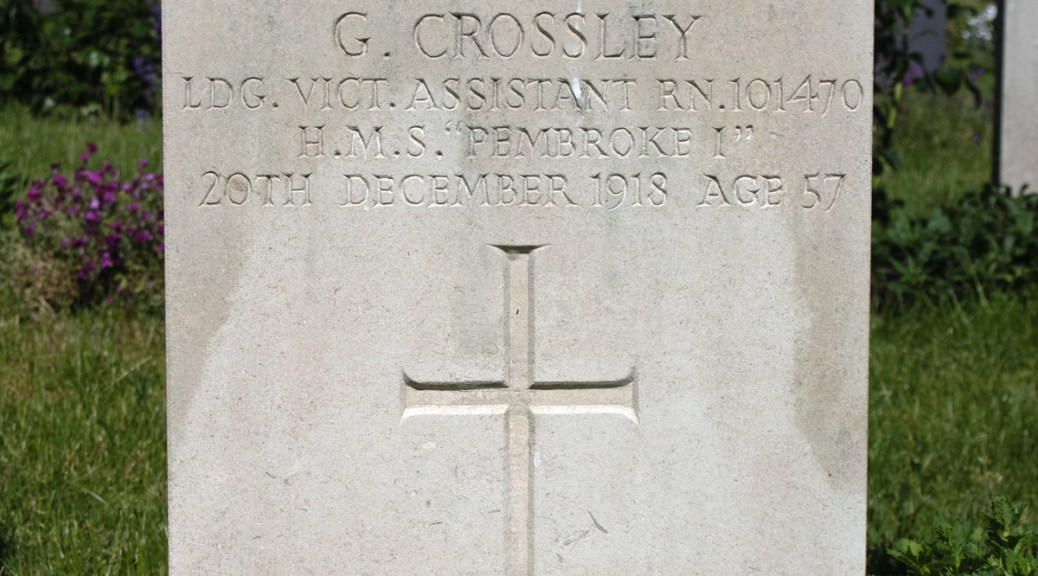
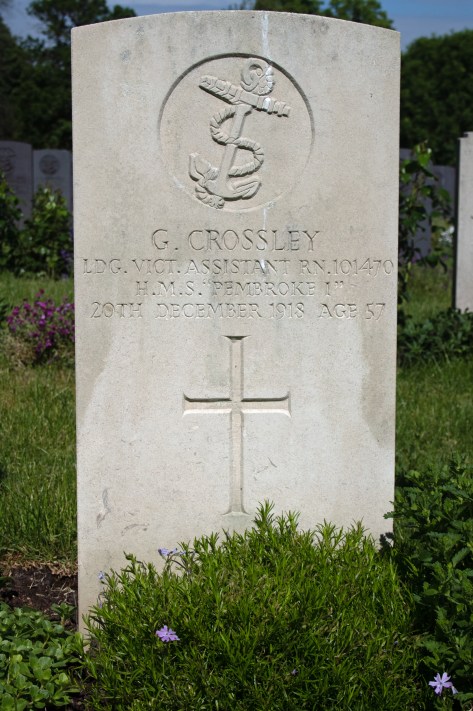
George Crossley was born on 30th December 1861 in the Stonehouse area of Plymouth, Devon. The oldest of five children, his parents were John and Charlotte. John died when George was only ten years old, leaving his widow to raise the family alone.
Left as the technical head of the family, George sought a reliable career and, in August 1877, aged just 15 years old he joined the merchant navy. After two years at the rank of Boy, he formally joined the crew, working as a Ship’s Steward’s Assistant.
Over the initial ten years of his service, George served on four ships, primarily the Royal Adelaide. In 1889, having seen the world, he signed up for a further decade. This new period of service saw him move up to Ship’s Steward, before working back in the assistant role.
In December 1899, George’s twenty years’ service came to an end. Charlotte, by this time, was in her mid-60s, and perhaps he felt it better to spend time ashore with her, rather than leaving her alone.
His experience did not count for nothing, however, and he found employment as a labourer in the Naval Dockyard in Chatham, Kent. And so another fourteen years passed, before war rose its ugly head.
George was called back into service at the start of the conflict, and resumed his role as a Ship’s Steward’s Assistant. Over the next few years, he served on a couple of ships, but the majority of his time was spent at the shore establishments in Portsmouth, Dover and Chatham. In 1917, George gained the rank of Leading Victualling Assistant, giving him some of the responsibility for the food stores at Chatham Dockyard.
Towards the end of 1918, George seems to have been in the east of the county, when he fractured and dislocated his left ankle. Little specific information is available, but it seems that he was admitted to the Royal Infirmary in Deal, but died of his wounds on 20th December. He was ten days short of his 57th birthday. An inquest later that month reached a verdict of accidental death.
Brought back to Gillingham, George Crossley was laid to rest in the Woodlands Cemetery in the town.
John George Blake was born early in 1878, and was the oldest of seven children. His father, Job, was a general labourer, and, with Eliza, John’s mother, brought the young family up in the West Sussex town of Worthing.
Job died in 1898, ages just 36 years old; Eliza found work as a housekeeper, while John was employed as a carter for the railway. By the 1901 census, the family were living in a terraced house near the centre of town, Eliza living there with her three sons, two daughters, son-in-law and granddaughter.
In October 1904, John married Alice Attwater, a labourer’s daughter from mid-Sussex. The couple moved into a house close to the station and went on to have four children; John Jr, Ernest, Bertha and Dorothy. John was by now working as a porter for the railway, a role he continued through to the outbreak of war.
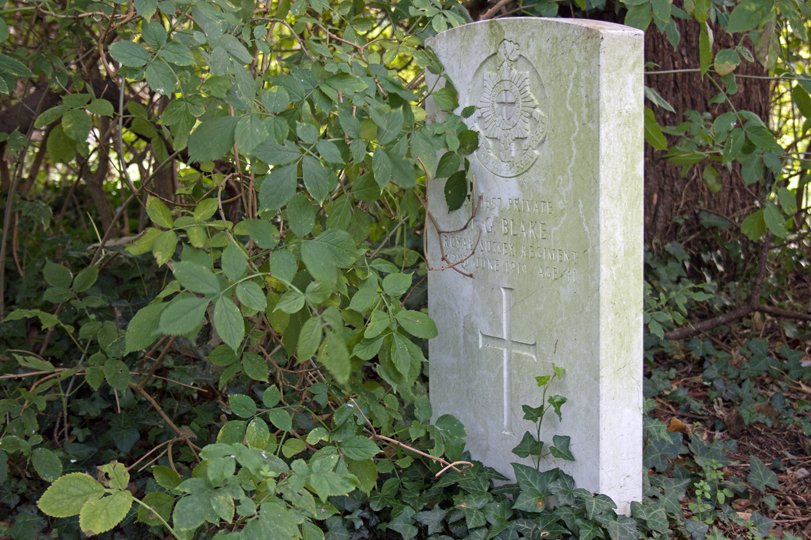
John enlisted in November 1914; he joined the Royal Sussex Regiment, working as a member of the depot staff. Private Blake was shipped overseas, arriving in France in March 1916.
Almost exactly a year after landing in France, John was injured in the line of duty. The medical report confirmed that a “scald on the left arm and neck [had] occurred while on duty on March 1st 1917, in France. He was preparing hot soup for his company in the front line at midnight. He was not to blame. Injury caused by enemy shelling the company kitchen“.
Private Blake was shipped back to England for treatment, and admitted to Netley Hospital near Southampton. While there, he contracted phthisis (tuberculosis), which left his totally incapacitated. He was medically discharged from military service in August 1917.
Further details of John’s life are scarce. He returned home to his family, although whether he took up his job again is unknown. He passed away on 22nd June 1919 at the age of 41. The cause of his death is unknown, although it seems likely to have been related to the tuberculosis.
John George Blake lies at rest in the Broadwater Cemetery of his home town, Worthing.
William Thomas Cole was born in the spring of 1897, the youngest of three children to John and Caroline Cole. John was a bank cashier from Gillingham in Dorset, while Caroline was born in Battersea, London. By the time of William’s birth, however, the young family had settled in the Dorset town of Blandford.
John was a man with ambitions for himself and his family. The 1911 census records him and Caroline living in Axbridge in Somerset, where he was now a bank manager. William, meanwhile, was a student in Wareham, Dorset, and was lodging at a boarding house in the town.
There is little documented about William’s military service. His gravestone confirms that he had originally enlisted in the Dorsetshire Regiment, but had subsequently joined the Royal Air Force, when it was formed in April 1918. By the time of his death, he had reached the rank of Lieutenant, so it would seem that his John’s ambitious nature had rubbed off on his only son.
William’s death was reported in a number of contemporary newspapers:
Lieutenant WT Cole and First Air Mechanic H Keates were killed while flying in South Essex last night. They were both in the same machine, which nose-dived and crashed into the ground. Cole’s home is at Shaftesbury, Dorset, and Keates’ at West Wood Grove, Leek, Staffordshire.
Dundee Evening Telegraph: Thursday 24th October 1918
Lieutenant Cole was flying in Hornchurch, Essex, and was in an Avro 504K bi-plane. He was just 21 years old when he died on 23rd October 1918. There is little further information about the accident, but highlighting the real danger in aviation at the time, this was one of eight fatal plane crashes across the UK that day alone.
The body of William Thomas Cole was brought back to Shaftesbury, where his parents were by then living. He was laid to rest in the Holy Trinity Churchyard in the town.
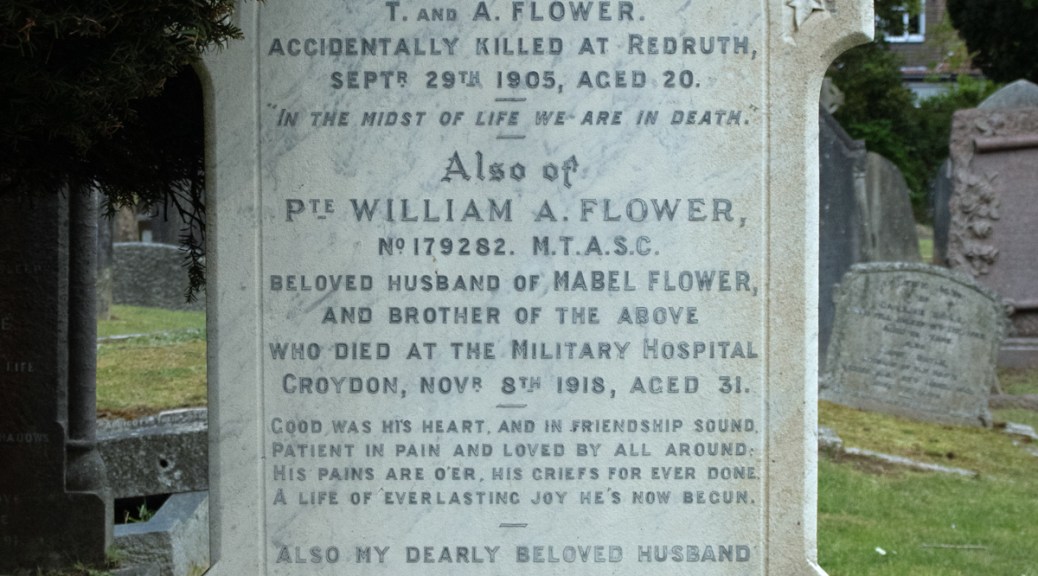
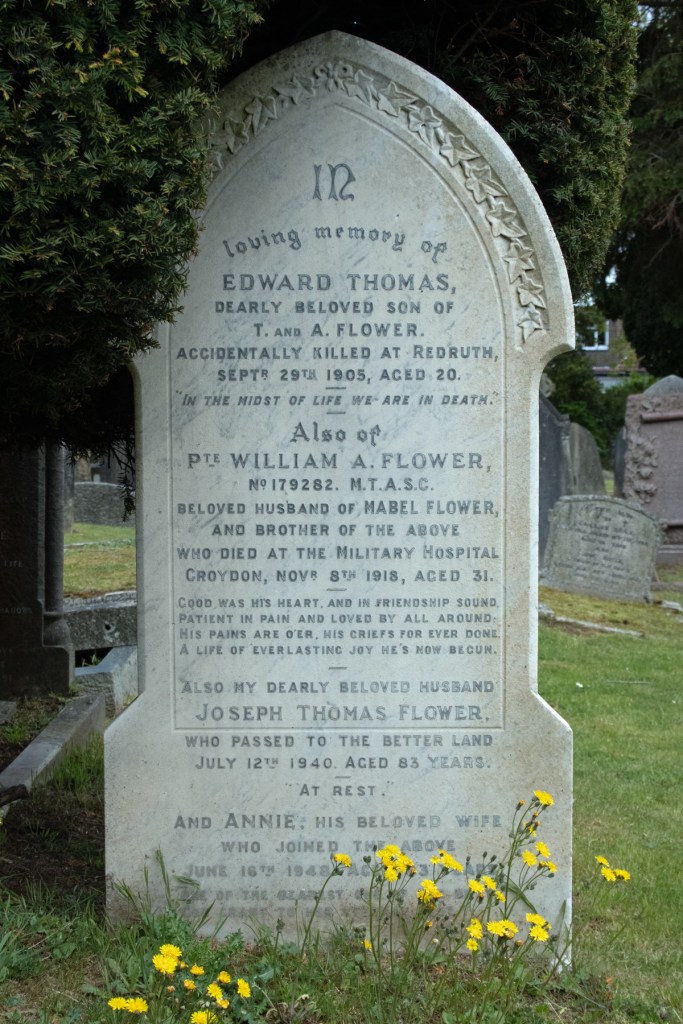
William Alister Flower was born in 1887, one of five children to Joseph and Annie Flower. Joseph was a platelayer for the local railway, and brought the family up in Weston-super-Mare, in his home county of Somerset.
When he left school, William worked as an errand boy for a local greengrocer; he stuck with it, and, by the time of the 1911 census, he was employed as a van driver for the grocer.
War was on the horizon and, while William enlisted in the army, it is difficult to get a complete handle on his military service. There are a number of servicemen with similar names, but the documentation that is available is not easy to directly connect them with the gravestone in the Weston-super-Mare cemetery.
What is clear is that William enlisted as a Private in the Army Service Corps at some point before May 1918. He was assigned to the Motor Transport division (this was likely on the back of his van-driving experience). His time seems to have been spent on home soil, although he was awarded both the Victory and British Medals for his service.
At some point, he had married a woman called Mabel. Exact details again are unclear – ancestry.com confirms the marriage of a William Flower and Mabel Richardson in December 1909, but as this took place in Northamptonshire, it is unlikely to be the Somerset Flowers researched here.
Details of Private Flower’s passing are also scarce. He died on 8th November 1918, in the Military Hospital in Croydon, Surrey, but the is no information as to the cause of his death. He was just 31 years old.
William Alister Flower’s body was brought back to Somerset; he lies at rest in the family grave, in the Milton Cemetery of his home town.
While I was researching William Flower, I was taken by the note of the accidental death of the first name on the family grave.
Edward Thomas Flower was two years William’s senior who, after leaving school, had gone on to be an errand boy for a local butcher.
Edward had decided to follow in his father’s footsteps and join the railways, leaving his home town in 1905 to work in Cornwall. After initially working as an engine cleaner, he progressed to be a fireman, helping to stoke the engine with coal. The local newspaper of the time picked up the story of the accident.
At the moment of the accident, a goods train was standing in the Redruth station, shunting having been temporarily suspended to admit the passage of the down motor rail car.
It appears that the flap of one of the cattle trucks in the goods train… had been allowed to remain down, and the folding doors above it had been insecurely fastened, with the result that as the motor rail car ran into the station the doors of the truck suddenly flew open outward and one of them struck deceased on the side of the face and head, inflicting terrible injuries.
There was a very extensive fracture of the skull, the whole of the left side of the face was driven in and there was also a formidable wound at the back of the head, death occurring within a few moments.
It appears that the rail motor was not proceeding at a greater rate than some five or six miles an hour, according to the statement made at the inquest by the driver, and the latter noticed that when the doors of the goods truck swung open they struck one of the handles on the fore part of the car. He applied the brake immediately, but did not know that Flower had been struck until afterwards.
Weston Mercury: Saturday 7th October 1905
The inquest found that there had been some neglect on the part of the porter and guard in not ensuring that the goods truck’s doors had been secured, and it seems that this was something that had been highlighted previously.
Edward had shortly been due to marry, leaving a fiancée, as well as a family, bereft. He was just 20 years old.
His body was brought back to Weston-super-Mare, and was the first to be buried in the family grave.
Wallis Rowland Henry Rochfort-Davies was born August 1895, the youngest of two children to Reverend Charles Rochfort-Davies and his wife, Ethel. Charles was, for some time, the vicar at St Leonard’s Church in Shipham, Somerset, and both Wallis and his older sister Agnes, were both at school until at least their late teens.
Details of Wallis’ military service are scant. He enlisted in the Somerset Light Infantry, and was assigned to the 3rd (Reserve) Battalion, which was based initially in Taunton and then Devonport, near Plymouth.
Sadly, the next information available for Wallis relates to his death. A contemporary local newspaper initially.
It is reported that Sec.-Lieut. Wallis Rowland Henry Rochfort-Davies, 3rd (Reserve) Batt. Somerset LI, died on March 8th. He was the only son of Rev. CH Rochfort-Davies, of Shipham Rectory, Weston-super-Mare. Aged 20, he obtained his commission in Somerset LI in August 1914.
Western Morning News: Thursday 16 March 1916
No details of the cause of Wallis’ death were announced, but a post mortem and inquest were held, and the findings came out later that month.
At the Coroner’s Court yesterday afternoon, Mr AE Baker resumed the inquiry into the circumstances surrounding the death of Wallis Roland [sic] Henry Rochfort-Davies, aged 20, a Second Lieutenant in the Somerset Light Infantry. The inquest was opened on the 9th when evidence was given to the effect that deceased was found dead at the Royal Hotel on March 8. The adjournment was rendered necessary in order that the contents of the stomach might be analysed.
Mr Russell, the City Analyst, gave evidence as to the examination of the contents of the stomach. This showed the presence of morphia.
Dr PW White said he was called to the Royal Hotel about 3:30 in the afternoon of March 8. He found the deceased lying in bed, life being extinct. Death had take place probably 8 or 9 hours previously. There were no external marks of violence. The post mortem examination showed some congestion of the internal organs, but nothing to account for death. He had no hesitation in saying that the cause of death was morphia poisoning, probably hypodermically administered.
Charles Greenslade, a plain clothes officer, said he was called to the Royal Hotel on Wednesday 8 March about 4:30pm. Witness made an examination of the room. He found on the dressing table a case containing two small bottles: one was filled with morphia tablets and the other empty. There was also a blue bottle found, which contained a lotion. Needles and a hypodermic syringe were also found…
Reginald Francis Cheese, a friend of the deceased, said he had shown him some drugs on two occasions. He identified a case of drugs produced as having been shown him by the deceased.
The jury returned a verdict of “Death from an overdose of morphia, self-administered”. The expressed sympathy with the father of the deceased and desired to severely censure the witness Cheese.
The Coroner spoke of the increased habit of drug taking among officers, and of the amount of drugs which the case that had been produced contained. Deceased, he said, could not have purchased from any chemist such a quantity of drugs, and it must have got into his hands through the medium of a friend. It was a grossly wicked act that such a large quantity of drugs was ever allowed to get into the hands of this unfortunate young man.
Western Daily Press: Friday 31st March 1916
Wallis Rowland Henry Rochfort-Davies was just 20 years old when he died. He was laid to rest in the Milton Cemetery in Weston-super-Mare, in his home county of Somerset.
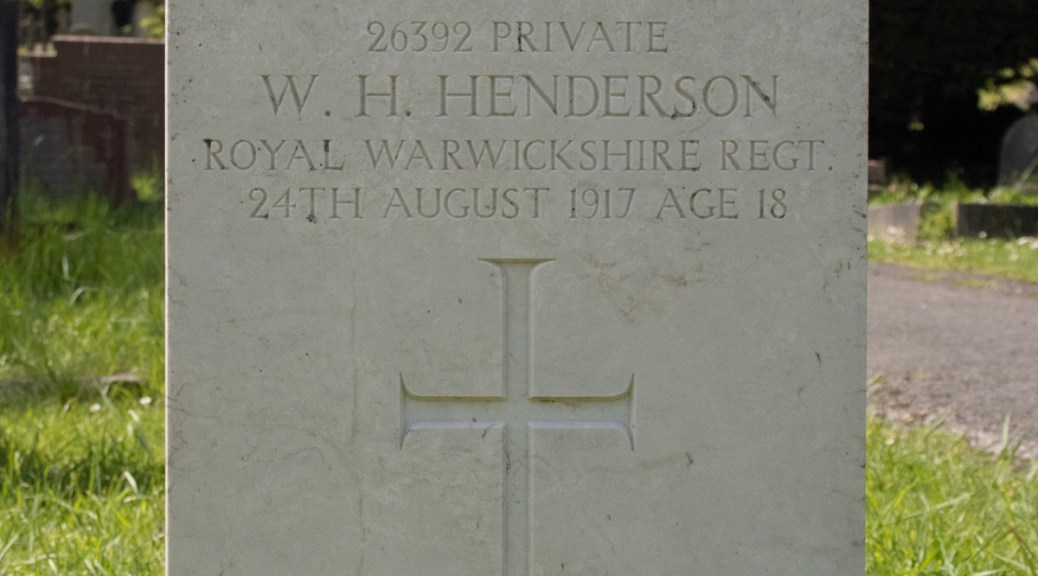
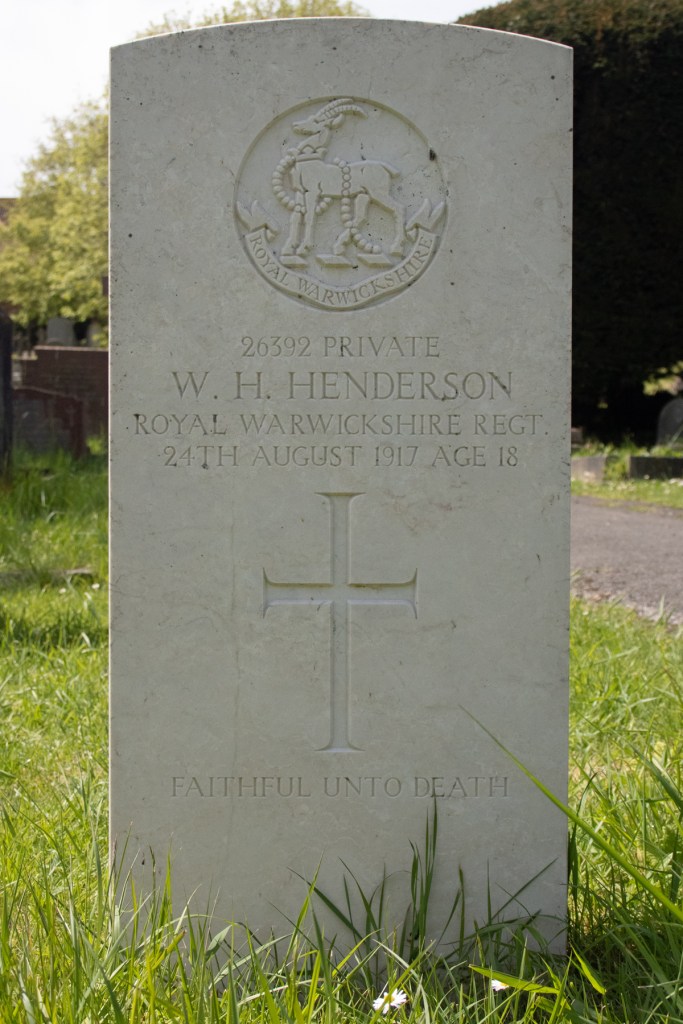
William Henry Henderson was born in Weston-super-Mare in December 1898. The oldest of four children, his parent were tailor Herbert Henderson and his wife Fanny.
As with a lot of servicemen born around 1900, there is little documentation around William’s early life. When war broke out, he was 15 years old, and seems to have been eager to do his bit. Few military records for him survive, but he joined the Royal Warwickshire Regiment and was given the role of Private in the 5th (Reserve) Battalion.
Part of William’s training seems to have taken place in Northumberland, and he was based near the coastal town of Blyth. On 24th August 1917, he was one of 600 men taken on a route march from the camp to the coast. The Somerset Standard took up the story of that day’s events:
Lieutenant Colonel Frank Martin Chatterley, the officer in command, said that he… allowed the men 20 minutes to cool, and after taking all necessary precautions gave orders for them to enter the sea.
The witness inquired from a boy the state of the tide, and was told that it was low ebb; he expected it to rise shortly. The witness undressed, bathed and came out of the water, and was dressing when he was told that some of the men were in difficulties.
Somerset Standard: Friday 31st August 1917
The Morpeth Herald added to this: “The soldiers had not been in the water long when some of them got into difficulties and were washed out seawards, in spite of their struggles. A number of comrades rushed to their assistance until at the fatal spot 13 men were seen struggling and evidently drowning. Soldiers formed a human chain by joining hands and wading as far they could into the fast-ebbing tide. They succeeded in saving 5 of their comrades, three of whom were very exhausted, when they got ashore that they were immediately rushed off by car.”
Nine soldiers, including Private Henderson, drowned that day, despite the commended attempts by Reverend Verschoyle, the Army Chaplain, to save their lives.
Some of the survivors told the inquest that they were from the Midlands; they could not swim, and one had never seen the sea before. The inquest was told that there were terrific currents and shifting sands in that particular spot that day, and the conditions seemed to have changed after the soldiers had entered the water. Chatterley said that he had had men bathing at that spot before, and had also seen civilians bathing there before.
The other eight servicemen who perished that day were Privates Thomas Forley, Henry Southern, Fred Shale, George Beavan, Gordon Noy, William Blann, Lieutenant Kenneth Brown and Sergeant Riley. Private Henderson was just 18 years old.
William’s body was brought back to Weston-super-Mare for burial. He lies at rest in the Milton Cemetery in the town.
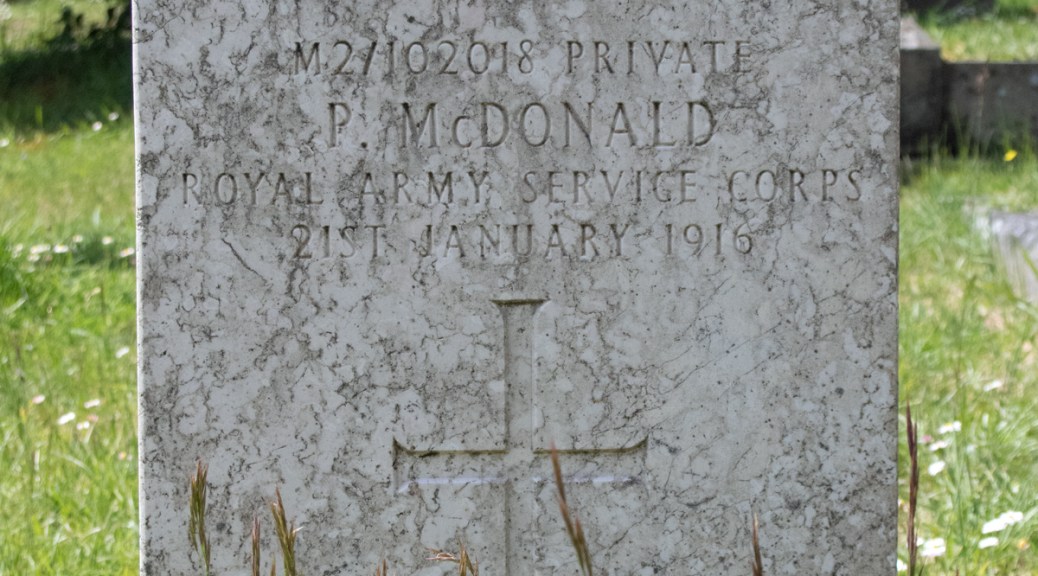
Peter McDonald was born in Tullamore, King’s County (now Offaly County), Ireland, on 28th May 1893 and was one of eight children to Michael and Mary McDonald. Michael had been in the army, and this seems to have been the route that Peter wanted to follow as well.
When he left school, however, he found work as a domestic servant at St Stanislaus College in his home town. War, by this time, was on the horizon, and so Peter was called on to other things.
Unfortunately, a lot of the documentation around Peter’s military service is no longer available. He enlisted in the Royal Army Service Corps; while an exact date for his enrolment is not available, this would appear to have been at some point in the first year of the conflict.
Private McDonald was assigned to the 341st Mechanical Transport Company. This was formed in May 1915, and was designated an Ammunition Park (which was in essence a fleet of lorries and a workshop for maintaining them). While full details of his time with the RASC is not available, Peter certainly came to be based in Weston-super-Mare, Somerset.
Considerable sensation was created at Weston-super-Mare on Friday evening, by a rumour which prevailed that a member of the Army Service Corps billeted in the town had been shot and another man wounded.
Inquiries revealed the fact that the rumour had some foundation, and it appears that some half-dozen members of the corps were attending their motor-bicycles in a shed at headquarters in Beach Road, when Lance Corporal Goldsmith produced an automatic Colt pistol, which he handed to Private McDonald for inspection.
In the course of the examination the weapon went off, and Goldsmith was shot in the leg. He at once took the revolved from McDonald, observing that he was unaware that it was loaded, and was apparently in the act of unloading it when it was again discharged, the bullet entering the lower part of McDonald’s abdomen, severing the main arteries.
Medical aid was at once procured. The unfortunate man died as the result of internal haemorrhage about an hour later.
Goldsmith was removed to hospital, but his injuries are not regarded as serious.
Somerset Standard: Friday 28th January 1916
Private Peter McDonald has passed away from a gunshot wound on 21st January 1916, at the age of just 22 years old. His body was laid to rest in the Milton Cemetery in Weston-super-Mare, where he had met his fatal accident.
Private McDonald’s pension record gives his cause of death as ‘explosion’, something of a misinterpretation of the evening’s events.
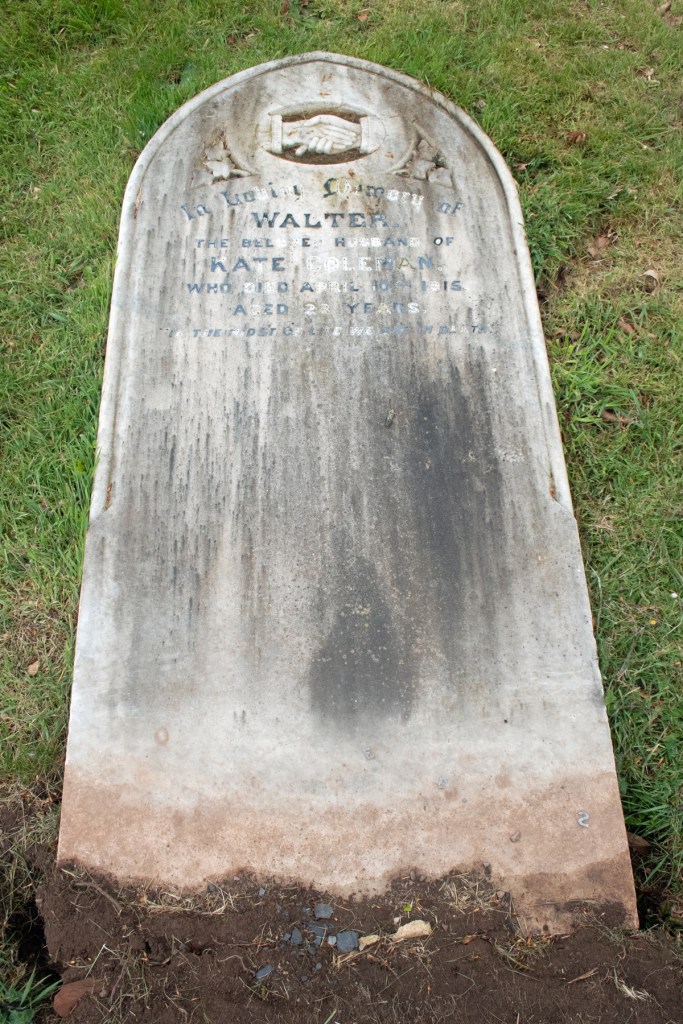
Walter Coleman was born in the spring of 1887, one of seven children to James and Emily Coleman. James was a hairdresser and the family lives in the Somerset town of Taunton.
Walter didn’t follow his father’s trade; instead, after a spell working at a collar factory when he left school, he was soon employed as a groom.
On Christmas Day 1910, he married Kate Norris, and the couple set up in a two-up, two-down in the middle of the town.
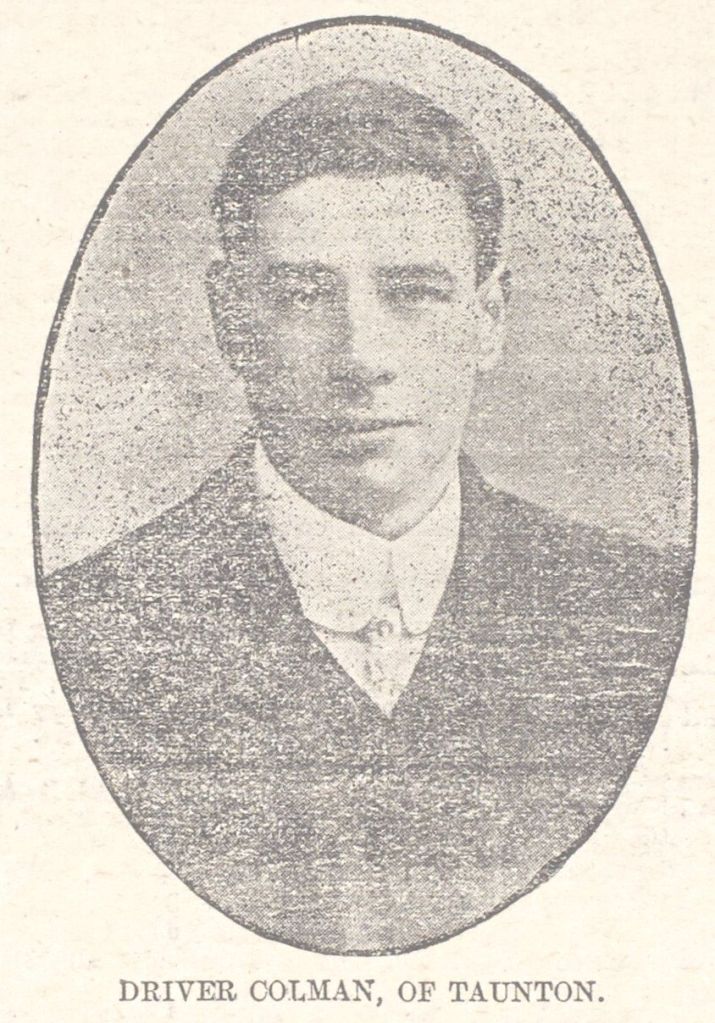
War was on the horizon, however, and when it broke out, Walter signed up straight away. He joined the 72nd Brigade of the Royal Field Artillery as a Driver and trained at the Bulford Camp on Salisbury Plain. It was while he was here on 10th April 1915 that he had an accident and fell off his horse. Sadly, Driver Coleman fractured his skull and died of his injuries that day. He was just 28 years old.
Walter Coleman lies at rest in the St James’ Cemetery in his home town of Taunton.
Walter Coleman (from findagrave.com)
Walter’s older brother Henry James Coleman also served in the Great War. Posted to France as part of the Labour Corps, he died of wounds on 12th April 1918. He was 33 years old, and left behind a widow and four children. He is buried at the Longuenesse Souvenir Cemetery in France.
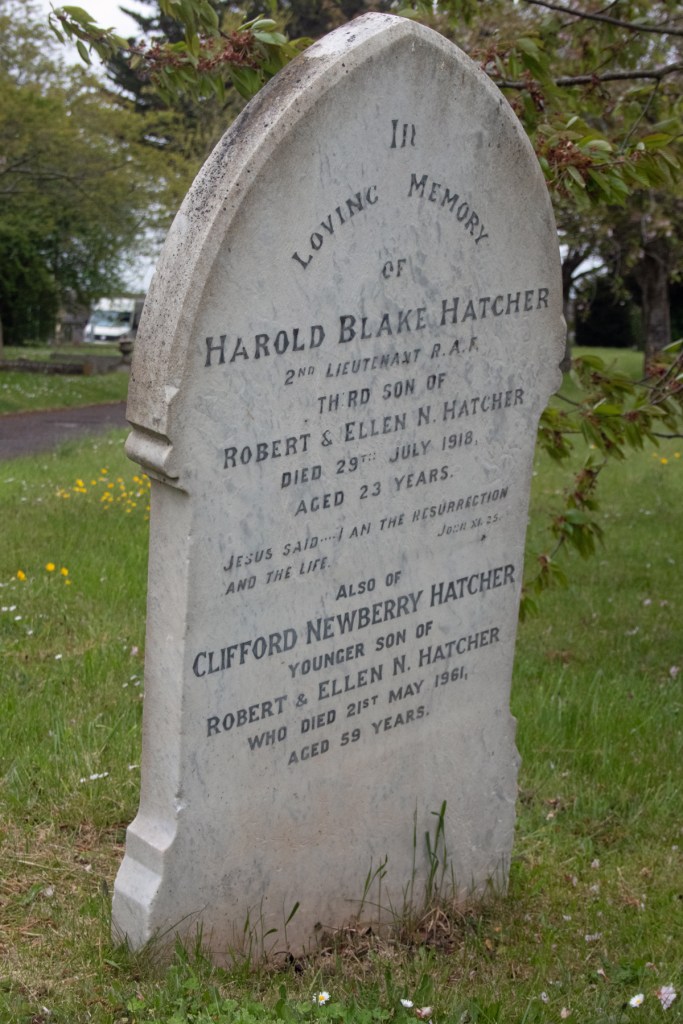
Harold Blake Hatcher was born on 11th February 1895, one of nine children to Robert Hatcher and his wife Ellen. Robert was a draper, and brought his family up in his home town of Taunton in Somerset. At least one of his children followed him into the cloth business, and, after he died in 1908, this seems to have fallen to Harold’s older brothers, Arthur and Ernest.
After leaving school, Harold became a dental student. Initially studying with Kendrick’s in his home town, he was about to begin training at Guy’s Hospital in London when war broke out.
Harold joined up in May 1915, and was initially assigned as a Lance Corporal to the 6th Battalion of the Somerset Light Infantry, before being transferred to the Middlesex Regiment.
In November 1917, he was badly injured in while fighting at Bourlon Woods, as part of the Battle of Cambrai. It was while he was recuperating that he transferred again, this time to the fledgling Royal Air Force.
Second Lieutenant Hatcher gained his wings in June 1918, and soon became a flying instructor. It was while he was working at RAF Fairlop in North West London, that an incident occurred. A local newspaper picked up the story.
Many in Taunton have learnt with sincere regret of the accidental death whilst flying of Lieutenant Harold Blake Hatcher of the Royal Air Force, third son of the late Mr Robert Hatcher of Taunton, and of Mrs Hatcher, now of Bristol.
The accident in which he met his death on Monday was a triple fatality, two other airmen being killed at the same time, Second Lieutenant Laurie Bell, of Bournemouth, and Flight Sergeant AR Bean, of Burslem.
At the inquest… it was stated in evidence that while Lieutenant Hatcher and Sergeant Bean were flying at a height of about 500ft, Second Lieutenant Bell, who w flying a single-seater, dived from a position some 700 feet higher, his machine striking and cutting clean through the double-seater, which folded its wings, hovered a few second, and then crashed to the earth. The three men were instantaneously killed.
A verdict of Accidental Death was returned.
Taunton Courier and Western Advertiser: Wednesday 7th August 1918
Further witness testimony described how the Sopwith Camel, piloted by Bell, cutting the AVRO airplane it in two. Hatcher fell out of the wrecked two-seater as the Camel’s wings slowly folded into a V and fluttered free following the fuselage to the ground. All three airmen lost their lives. Bean was found in a sitting position, still strapped in the front half of the AVRO’s fuselage, his instructor’s body was found unmarked thirty yards away in the grass where it had fallen. The wingless Camel crashed close by and Bell was found to have almost every bone in his body broken.
The accident took place on 30th July 1918. Second Lieutenant Hatcher was just 23 years old.
Harold Blake Hatcher lies at rest in St Mary’s Cemetery in his home town of Taunton, Somerset.









 Death and Service