Tag Archives: bronchitis

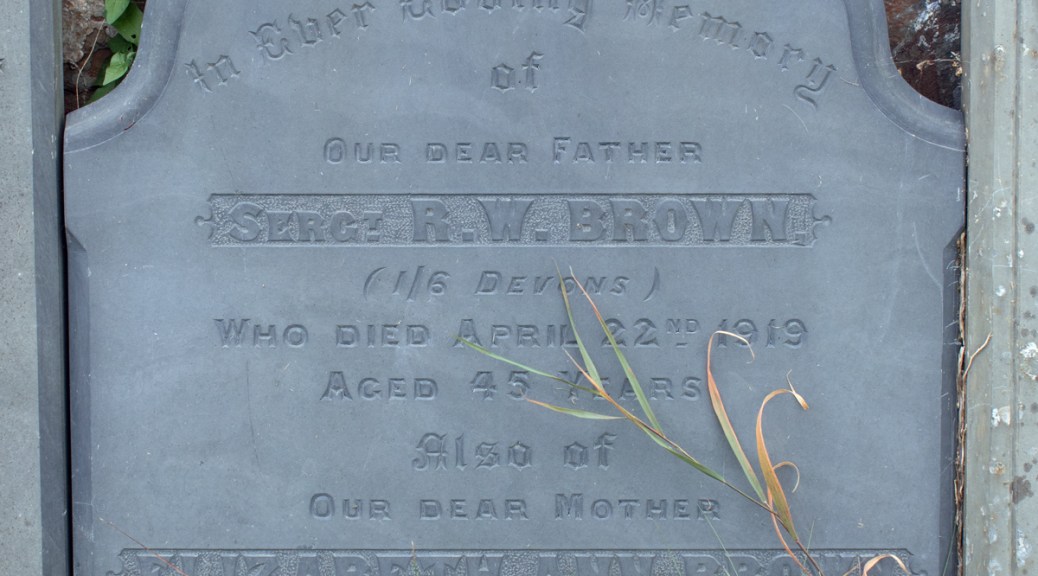
Sergeant Reginald Brown

Sergeant Reginald Brown

Reginald William Brown was born in South Molton, Devon, the summer of 1873. The second of four children – all boys – his parents were William and Mary Brown. William died when Reginald was just a child, and the 1881 census found Mary supporting her children by working as a mangler.

Details of Reginald’s early life are sparse. In the autumn of 1898 he married Elizabeth Mayne and the couple set up home at 13 Cook’s Cross. The couple went on to have six children, and Reginald supported his family with work as a gardener.

Alongside his gardening work, Reginald volunteered for army service. Again, full details are unclear, but he was attached to the Devonshire Regiment from 1908. Initially for a year’s contract, he seemed to renew this on-and-off for the next six years.

When war broke out, Reginald was formally called into service. HIs time in the army resulted in him being given the rank of Sergeant, and by October 1914, his unit – the 4th Battalion – was sent to India.

Reginald spent the next couple of years overseas, before being posted back to Britain in the spring of 1916. That November he spent six weeks admitted to the Manor County of London War Hospital in Epsom, Surrey, suffering from bronchitis. This was the result of malaria, and he would continue to suffer from lung complaints for the next few years.

In September 1917, Elizabeth passed away, and Reginald was left, at a distance at least, to raise his children. By now, his health was being severely impacted, and in April 1919, he was medically discharged from army service.

Reginald returned home, but he would quickly succumb to illness. He passed away at 43 South Street, South Molton, on 22nd April 1919. He was 45 years of age.

Reginald William Brown was laid to rest in South Molton Cemetery. His was a family plot, and he was reunited with his beloved Elizabeth.

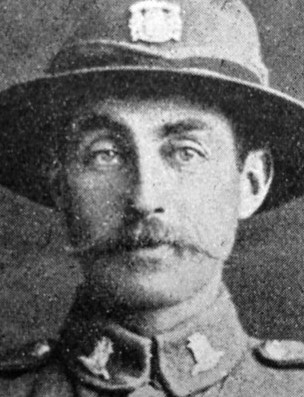
Private Charles Tombs

Private Charles Tombs

Charles Tombs was born on 26th November 1875 in Sefton, New Zealand. The seventh of eight children, his parents were Job and Elizabeth Tombs.

There is little information available about Charles’ early life. He found work as a chainman, working as a labourer in a sawmill.

On 11th December 1899, Charles married Eliza Pound, the daughter of immigrants from Somerset. The couple settled in Wairau, and went on to have six children: John, Charles, Arthur, William, Ronald and Alice.

(The Tombs and Pounds seemed to have been closely connected: Charles’ younger brother John, went on to marry Eliza’s younger sister, Elizabeth.)

Sadly, Eliza died in 1910, leaving Charles to raise four children (John and Alice having died when just babes-in-arms), alone. A later document gives Charles’ next-of-kin as Mrs R Register, who was, in fact, his younger sister, Mary (who had married Robert Register in 1907).

War was coming, and Charles would be called upon to serve his long-distant King and Empire. On 26th July 1916, he stepped up, and enlisted in the New Zealand Canterbury Regiment. His service records show that, at 40 years of age, he was 5ft 5ins (1.65m) tall, and weighed 119lbs (54kg). He had brown hair, blue eyes and a dark complexion.

Private Tombs’ unit departed from New Zealand on 15th November 1916, making the journey to Britain on the RMS Tahiti. The journey took nearly three months, and Charles arrived in Devonport, Devon, on 29th January 1917.

The ANZAC camp near Codford, Wiltshire, was to be Private Tombs ultimate destination, and he arrived there a couple of days after landing in Britain. After a lengthy journey, his health had been impacted, as had many of the men he had travelled with.

Suffering from bronchitis, Charles was admitted to the No. 3 New Zealand General Hospital on the outskirts of the camp. The condition was to prove his undoing, and he passed away on 17th February 1917. He was 41 years of age.

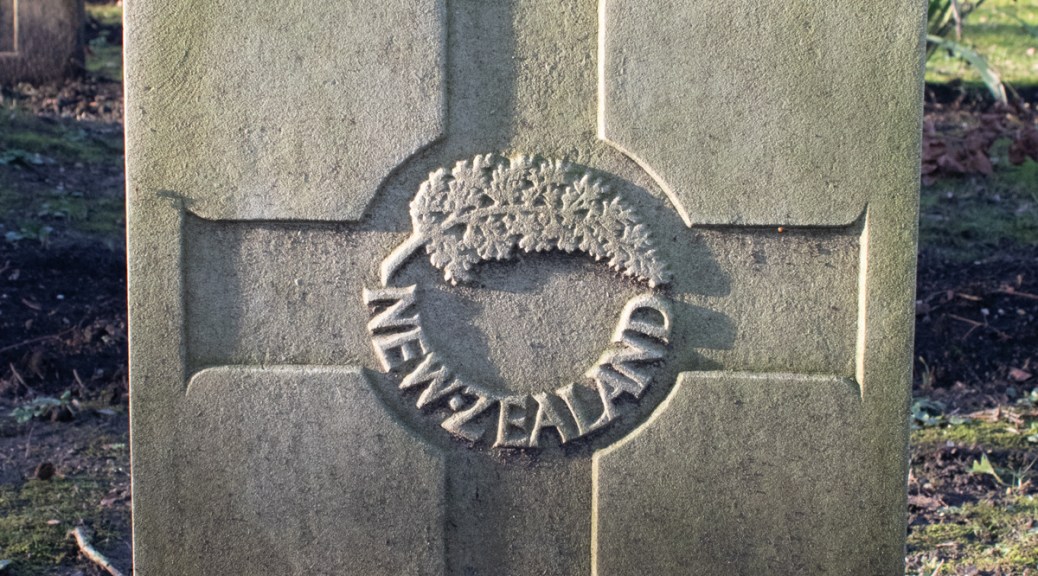
Charles Tombs was laid to rest in the ANZAC extension to St Mary’s Churchyard in Codford, Wiltshire.


Private Charles Tombs
(from findagrave.com)

Private Thomas Bickley

Private Thomas Bickley

Thomas George Bickley was born in Fremantle, Australia, in 1881, and was the second of six children to Absolom and Mary Bickley. May had been married and widowed twice before wedding Thomas’ father, and so he had eight half-siblings as well.

Thomas’ early life is a challenge to piece together, but his service records from the First World War fill in some of the detail. He confirms that he had served in the 1st Imperial Light Horse for eleven months, and that he fought in South Africa – presumably as part of the Boer War of 1899-1902.

At the time of enlisting on 13th September 1916, he was working as a carpenter, and had completed a five-year apprenticeship. He married Rose Buck in 1907, but they did not have any children.

Private Bickley was assigned to the 16th Battalion of the Australian Infantry, and his medical report confirms the man he had become. He was 5ft 10ins (1.77m) tall and weighed 170lbs (77.1kg). At 34 years of age, he had light brown hair, blue eyes and a fresh complexion.

Thomas’ unit left Fremantle on the Argyllshire. The troop ship arrived in Devonport, Devon, two months later, and his battalion was sent to their base near Codford in Wiltshire. The journey impacted a lot of soldiers, and Thomas was not to be immune from this.

On 12th February Private Bickley was sent to the camp hospital as he was suffering from bronchitis. The severity of his condition meant he was immediately transferred to an army hospital in nearby Sutton Veny, but it was to prove too late. Thomas died from the lung condition on 23rd February 1917: he was 35 years of age.

Thomas George Bickley was laid to rest in the ANZAC extension to St Mary’s Churchyard, Codford, not far from the based that had so briefly been his home.


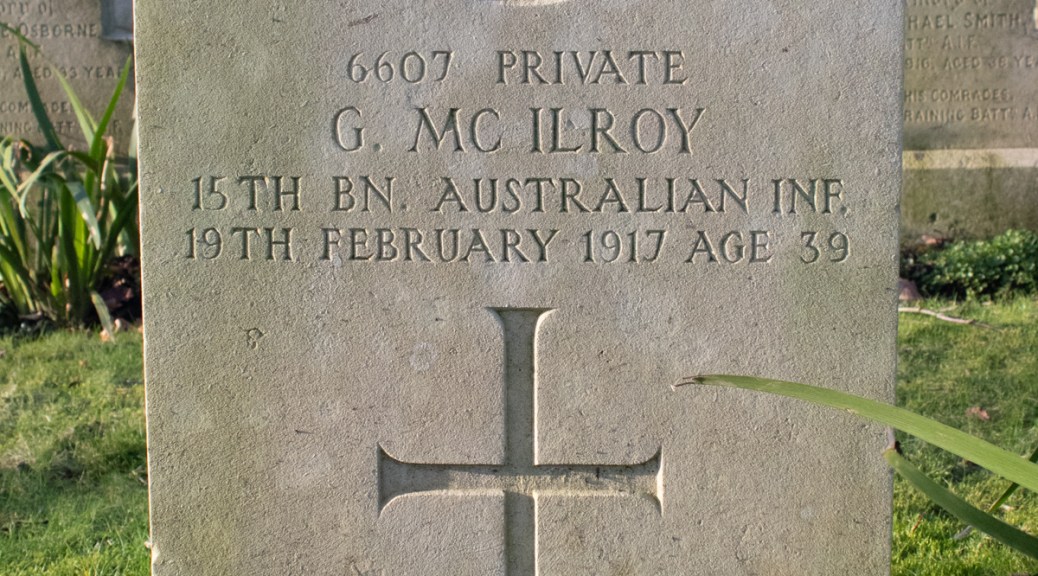
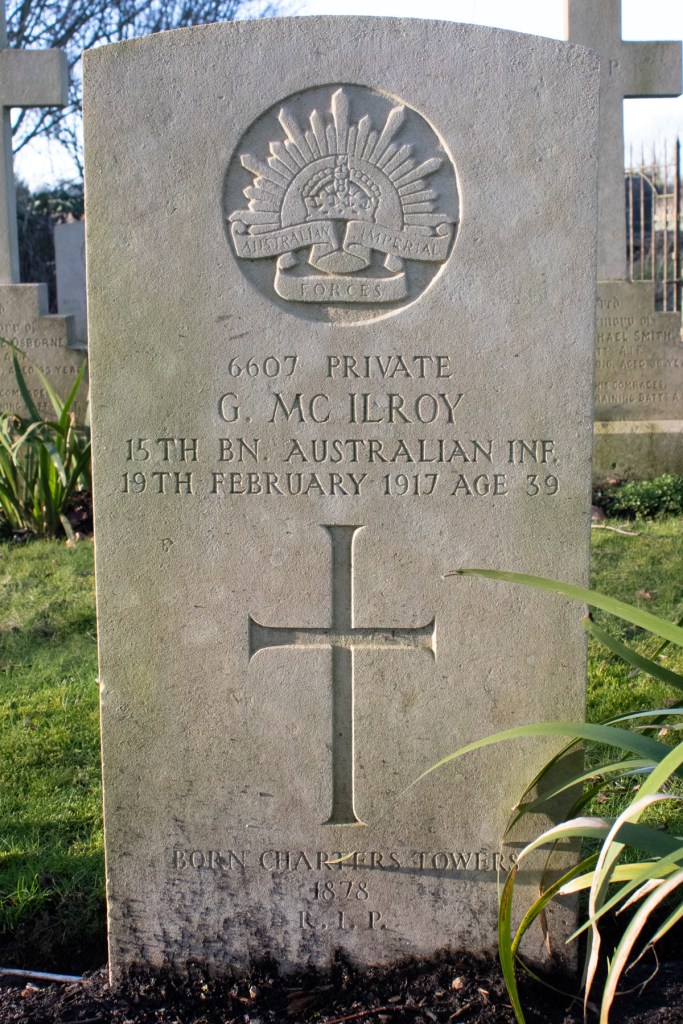
Private Gabriel McIlroy

Private Gabriel McIlroy

Gabriel McIlroy was born in the Australian town of Charters Towers in 1878. The oldest of four children, his parents were Patrick McIlroy – of whom there is little information – and his Danish-born wife, Ann.

There is little information available about Gabriel’s early life. He never married and, by time he enlisted in January 1916, he was employed as a labourer, and gave his mother as his next of kin.

Gabriel joined the Australian Imperial Force, and his service records give an insight into the man he had become. He was noted as being 5ft 3.5ins (1.61m) tall, and weighed 126lbs (57.2kg). Private McIlroy had a fair complexion, with brown hair and bluish eyes. He had a scar on his right arm, and was recorded as being Roman Catholic.

Gabriel’s unit – the 15th Battalion of the Australian Infantry – set sail from Brisbane on 21st October 1916. They sailed to Britain on the Boonah, a ship that had been built in Germany for trade with Australia. On the outbreak of way, she was docked in Sydney, and was seized by the Commonwealth authorities. Hastily converted to a troop ship, she was soon used to transport soldiers to Europe.

Private McIlroy arrives in Plymouth, Devon, on 10th January 1917. His battalion marched to Codford, in Wiltshire, where they were based before transferring to the Western Front. Sadly, he would not accompany his colleagues.

On 17th February, Gabriel was admitted to a military hospital in Sutton Veny, just a few miles from the camp. He was suffering from bronchitis, and the condition would prove fatal. Private McIlroy passed away on 19th February 1917: he was 39 years of age.

The body of Gabriel McIlroy was taken back to Codford for burial. He was laid to rest in the graveyard extension to the village’s St Mary’s Church.


The ship that had brought Gabriel to Britain would add its own footnote to the First World War. In October 1918, not long before the end of the conflict, she was one of the last vessels to leave Australia carrying troops. During the voyage, more than 300 of those on board had contracted influenza, in what became known as the Boonah Crisis.


Private John Boura

Private John Boura

John Adams Boura was born in the spring of 1868 in Kensington, Middlesex. The middle of three children, his parents were Julien and Esther Boura. Julien was the son of a French immigrant, who had built up two businesses as a dyer and cleaner (the first business having failed).

John followed in his father’s line of employment, and, by the time of the 1891 census, he was living with business partner Isabel Knight, at 3 St Mark’s Place in Wimbledon, Surrey. Work and pleasure were obviously mixing, though, and, on 3rd October that year, the couple married in the nearby Queen’s Road Chapel.

The newlyweds would go on to have a son, also called John, in March 1895. By the start of the new century, the family has moved out of the capital, relocating to Aldershot, Hampshire, where they set up a new business at 111 Victoria Road, in the town centre.

Within the next decade, however, the Bouras had moved back to the London suburbs, setting up home and business in Merton, Surrey. A new alliance was forged at 106 Kingston Road, with the three sharing their home with Henry and Adelaide Shelley. All four adults were involved in the business, while the now 16-year-old John Jr was employed as a dentistry improver.

Julien – who was also known by his middle name, Aimé – and Esther had moved to Maidenhead in Berkshire by this point, and in September 1910, it seems that their son visited them. An argument seems to have erupted, and John was arrested. Taken before the Maidenhead Petty Sessions, he was tried for unlawfully and maliciously damaging the glass of certain windows, exceeding he amount of £5 to wit £8 6s., the property of Aimé Boura. John was find a total of £10 for the damage.

When war broke out, John stepped up to serve his country. While his service documents are long since lost, other records suggest that he had enlisted by the summer of 1916, and likely volunteered, give he was in mid-40s by this point. Private Boura was assigned to the Royal Army Service Corps, and was to be based at the Supply Depot in Bath, Somerset.

It is probable that John’s dying and cleaning background meant that he was involved in uniforms in some way, although nothing concrete remains to document his time in the army. During the early part of 1917, he fell ill, coming down with bronchitis. He was admitted to Bath War Hospital, but the condition was to get the better of him. Private Boura passed away on 9th February 1917, at the age of 48.

The body of John Adams Boura was laid to rest in Bath’s majestic Locksbrook Cemetery, not far from the hospital in which he had passed.


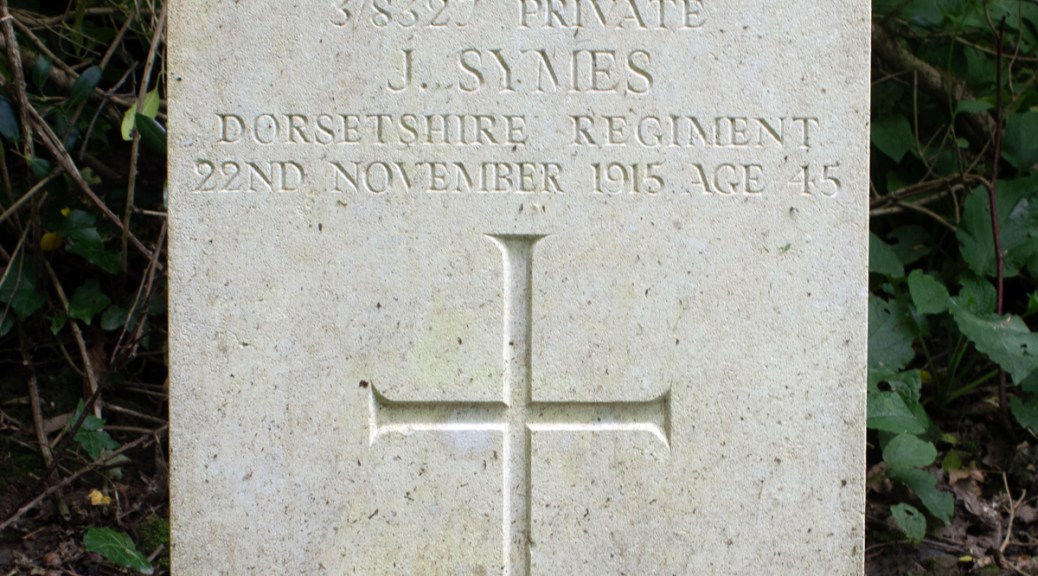
Private Joseph Symes

Private Joseph Symes

Joseph Symes was born in the spring of 1871, and was the oldest of four children to William and Sarah. William was a farm labourer from Stoke Abbot in Dorset, and it was here that the family were born and raised. They set up home with Sarah’s parents, and were recorded as living with them in the 1871 census, and with Sarah’s widowed mother in the 1881 record.

William had died by the time the 1891 census return was taken, and Sarah took up work as a mill hand. The document found her living in the village of Netherbury, a few miles to the south east of Stoke Abbott, with her three younger children, William, Alice and Mary Ann. Joseph was noticeable by his absence, but later documents confirm that he had enlisted in the Dorsetshire Regiment by this point, and was likely serving overseas.

Joseph had returned to England by the turn of the century, setting up home back in Netherbury. On 24th September 1910, he married Sarah Jane Dunsbury in Beaminster parish church. The daughter of a blacksmith, she was 13 years Joseph’s senior – 52 years old to his 39. The couple lived in Netherbury, where he was working as a mason’s labourer.

When war broke out, Joseph stepped up to play his part once more. He re-enlisted in the Dorsetshire Regiment on 1st September 1914, and was attached to the 6th Battalion. His service records confirm that he was 5ft 5.5ins (1.66m) tall and weighed 182lbs (82.6kg).

Private Symes remained on home soil during his time in the army. He switched to the 3rd (Reserve) Battalion in March 1915, which was based in and around Weymouth. In the autumn of 1915, he was admitted to the Sidney Hall Military Hospital in the town, suffering from bronchial pneumonia. The lung condition was to prove his undoing, and he passed away on 22nd November 1915, while still admitted. He was 44 years of age.

Joseph Symes was taken back to Netherbury for burial. He was laid to rest in the graveyard of St Mary’s Church in the village.


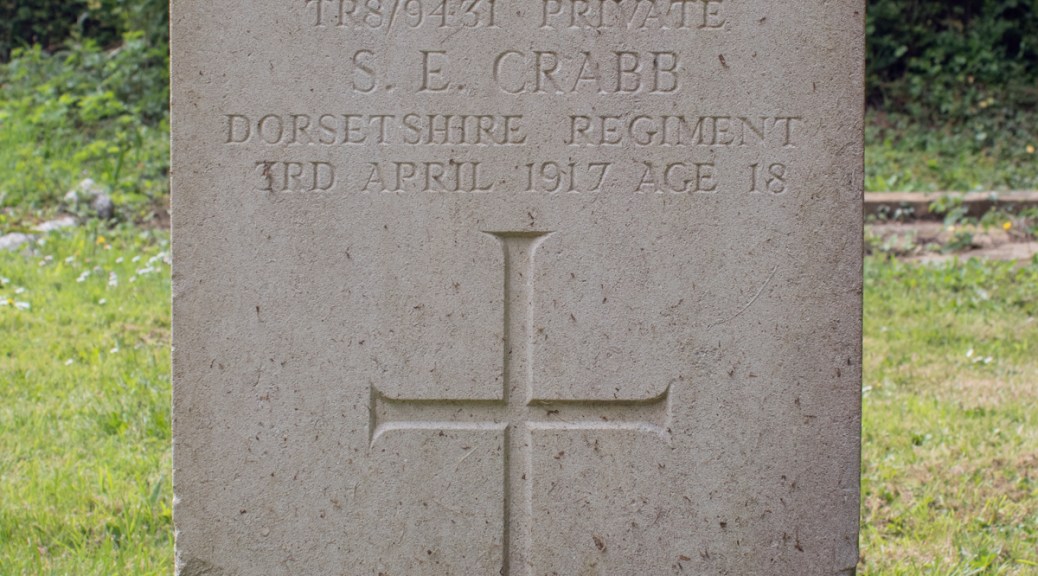
Private Sidney Crabb

Private Sidney Crabb

Sidney Edgar Crabb was born in the autumn of 1898 in the Dorset village of Chedington. One of ten children, his parents were shepherd-turned-farm labourer John Crabb and his wife, Mary.

Little information is available about young Sidney’s life. He was still at school when the 1911 census was taken, and was too young to enlist when war was declared in the summer of 1914. He enlisted in the Dorsetshire Regiment no earlier than October 1916, and was sent to Warminster for training.

The only other record for Private Crabb confirms his passing. He died from bronchial pneumonia while in hospital near his army camp in Warminster, Wiltshire, on 3rd April 1917. He was just 18 years of age.

Sidney Edgar Crabb’s body was taken back to Dorset for burial. He was laid to rest in the graveyard of St Mary’s Church, in his home village of Halstock. While only five of his siblings survived childhood, Sidney was the only one to pass away as a result of the conflict.


Gunner Simeon Powell

Gunner Simeon Powell

Simeon James Powell was born on 18th October 1882 in Wootton Fitzpaine, Dorset. The oldest of three children, his parents were Francis and Elizabeth Powell. Elizabeth died when Simeon was just 7 years of age, and his father remarried, and went on to have five children with his new wife, Annie.

Francis was a farmer, and Simeon found employment as an estate labourer. The 1911 census found the family living on Dodpin Farm in Monkton Wyld, a village to the north of Lyme Regis: Francis, Annie, Simeon and his three younger siblings.

On 12th June 1913, Simeon married Mary Hodder. There is little information about her, but it seems the couple set up home on the outskirts of Charmouth, Dorset. Mary was six years older than her new husband, and they didn’t go on to have any children.

War was declared in the summer of 1914, and by the following autumn, Simeon had signed up to play his part. His service records confirm that he was 5ft 11ins (1.8m) tall and weighed 188lbs (85.2kg).

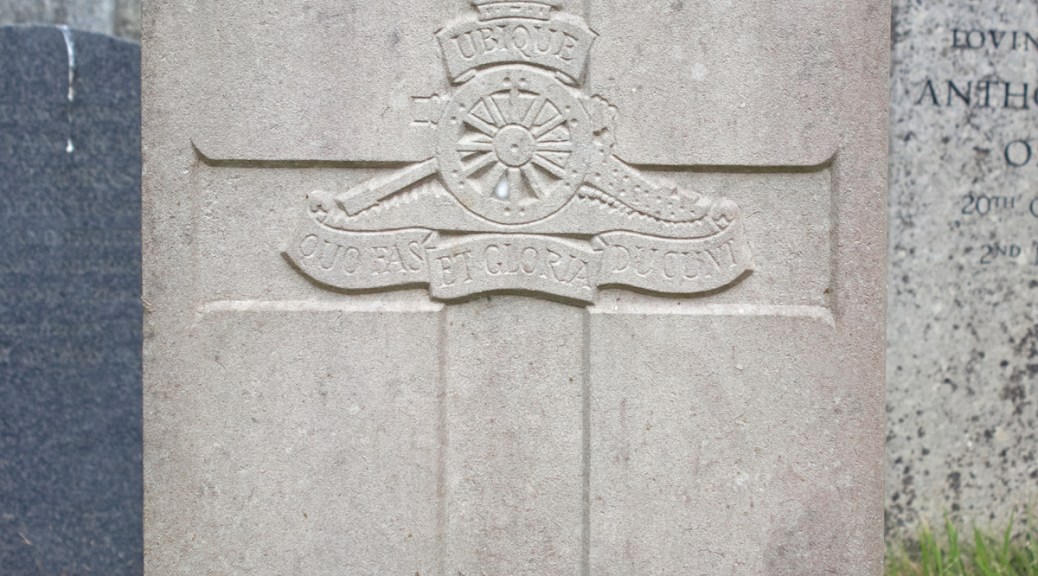
Gunner Powell joined the Royal Garrison Artillery, and was formally mobilised on 31st May 1916. By November he was sent to Malta, returning to Britain in September 1917. His new posting was in Sheerness, Kent, and he would remain there for the next nine months.

In May 1918, Simeon fell ill. He had caught influenza, and when this developed into bronchitis, he was admitted to the local war hospital. His health began to deteriorate, and, on 10th June 1918, Gunner Powell passed away from a combination of bronchitis and haemoptysis. He was 35 years of age.

The body of Simeon James Powell was taken back to Devon for burial. He was laid to rest in the graveyard of St John the Baptist Church in Hawkchurch, near the family home just across the border in Dorset.


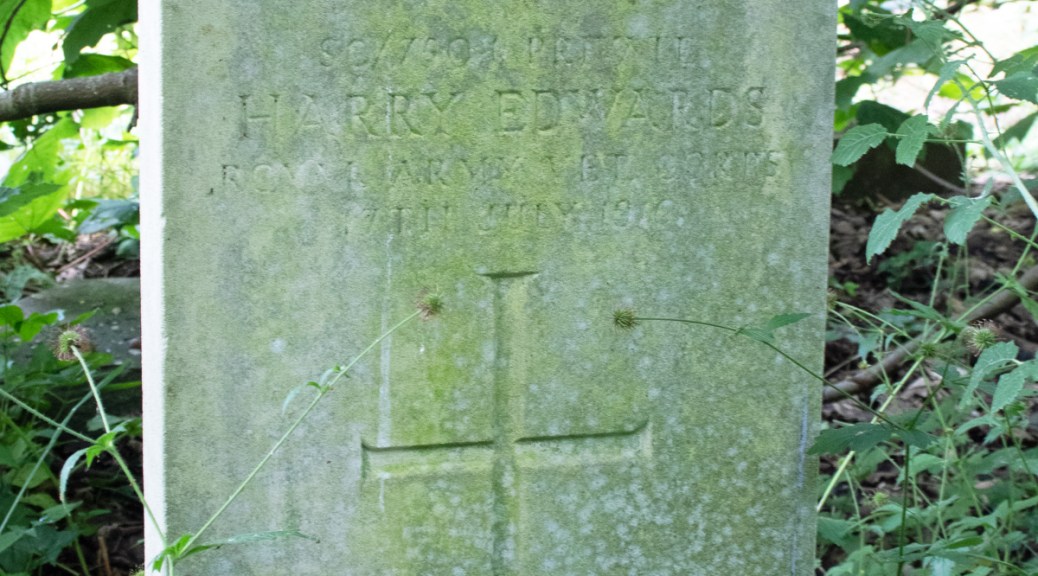
Private Harry Edwards

Private Harry Edwards

Harry Edwards was born early in 1855 in South London. One of eleven children, his parents were John and Sarah Edwards. John was a carpenter, and the family were raised in Bermondsey, first in a small terrace in Chapel Place, then sharing a slightly larger house in Grange Walk.

Much of Harry’s life is lost to time. He married Mary Ellerington on 27th July 1879: she was a tailor’s daughter from Southwark, and the couple set up home at 29 Newington Causeway. The marriage certificate confirmed that Harry was employed as a warehouseman at the time, and their daughter, Amelia, was born the following spring.

A later document suggests that Harry went on to join the army, fighting as part of the South Africa Campaign. Sadly, however, his service records are lost to time, and so it is not possible to confirm when and for how long he served. Certainly, there is no mention of the family in the census returns from 1881 to 1911, so he may well have been overseas.

The next records available for Harry are those relating to his military service during the First World War. He enlisted early in 1915, joining the Royal Army Veterinary Corps. He found himself in France by mid-April, and was awarded the British and Victory Medals and the 1915 Star for his service.

Private Edwards came down with bronchitis in the spring of 1916: he was medically evacuated to Britain for treatment, and was admitted to the Bath War Hospital in Somerset. It seems that Harry’s age was against him: he passed away from the condition on 17th July 1916, at the age of 61 years old.

Harry Edwards’ family may have been unable to afford the cost of bring him back to London for burial. Instead, he was laid to rest in the sweeping Locksbrook Cemetery, not far from the hospital in which he had breathed his last.


Private Walter Mitchell

Private Walter Mitchell

Walter Soper Mitchell was born in the summer of 1878 in Newton Abbot, Devon. The fourth of nine children, his parents were Frederick and Mary. Frederick was a house painter and handyman, and records seem to suggest that he took the family to where the work was. The 1881 census found the family living in Chelsea, West London, and it seems that they stayed in London until 1890.

By the time of the 1891 census, the Mitchells were back in Devon, living at 10 Orchard Terrace in Paignton. Frederick was now working as a plumber, while Walter’s older siblings – brothers Frederick Jr, William and Alfred – were variously employed as a sailor, a painter and a plumber.

Walter, who was 12 years old by this point, was nearing the end of his schooling. When he left, he followed the family trade, and as soon employed as a house painter. The 1901 census found him as the oldest sibling still to be living with Frederick and Mary, although his circumstances were about to change.

In September 1903, Walter married Emily Jeffery. She was a couple of years younger than her new spouse, but, sadly, there is little information about her parents. The 1891 census found her living with her grandparents, while the 1901 return noted her boarding with her aunt and uncle.

Walter and Emily went on to have three children. By the time of the 1911 census, the family were living at 25 Norton Terrace in Paignton, Walter being employed as a house painter by this point.

War came to Europe in the summer of 1914, and Walter was called upon to play his part. Full details of his military service have been lost in the mists of time, but from what remains it is clear that he enlisted in the Royal Army Ordnance Corps at some point after July 1915. He was attached to the 67th Coy., but it is unclear whether he saw any action overseas.

Private Mitchell’s time in the army was not to be a lengthy one. He seems to have been based in Essex, and a later record confirms that he contracted bronchitis and anaemia. This would prove to be his undoing: he passed away in Colchester on 17th February 1916, aged 36 years old.

The body of Walter Soper Mitchell was brought back to Devon for burial. He was laid to rest in what would become the family plot in the sweeping Paignton Cemetery.