Simeon James Powell was born on 18th October 1882 in Wootton Fitzpaine, Dorset. The oldest of three children, his parents were Francis and Elizabeth Powell. Elizabeth died when Simeon was just 7 years of age, and his father remarried, and went on to have five children with his new wife, Annie.
Francis was a farmer, and Simeon found employment as an estate labourer. The 1911 census found the family living on Dodpin Farm in Monkton Wyld, a village to the north of Lyme Regis: Francis, Annie, Simeon and his three younger siblings.
On 12th June 1913, Simeon married Mary Hodder. There is little information about her, but it seems the couple set up home on the outskirts of Charmouth, Dorset. Mary was six years older than her new husband, and they didn’t go on to have any children.
War was declared in the summer of 1914, and by the following autumn, Simeon had signed up to play his part. His service records confirm that he was 5ft 11ins (1.8m) tall and weighed 188lbs (85.2kg).
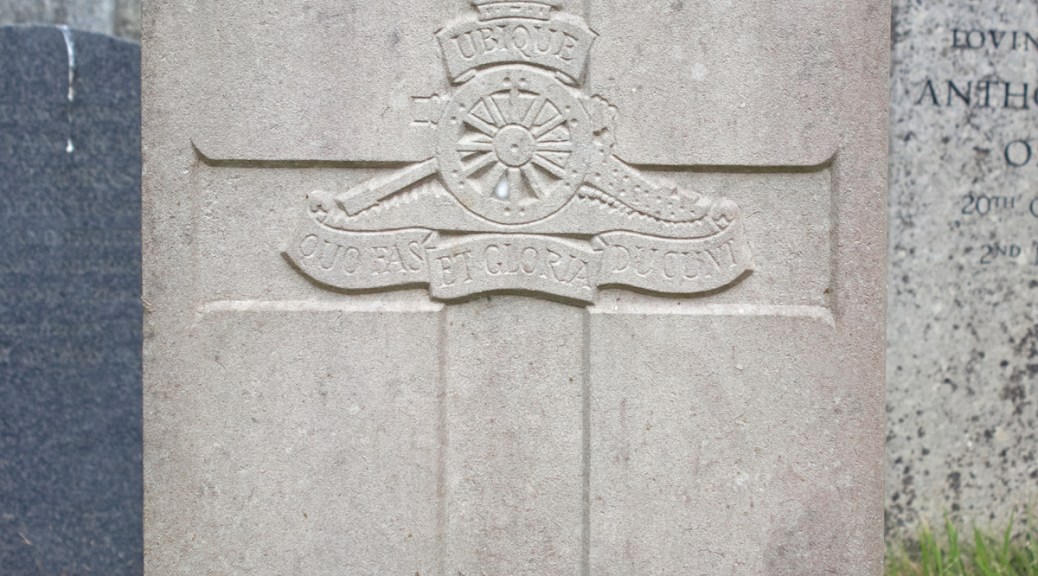
Gunner Powell joined the Royal Garrison Artillery, and was formally mobilised on 31st May 1916. By November he was sent to Malta, returning to Britain in September 1917. His new posting was in Sheerness, Kent, and he would remain there for the next nine months.
In May 1918, Simeon fell ill. He had caught influenza, and when this developed into bronchitis, he was admitted to the local war hospital. His health began to deteriorate, and, on 10th June 1918, Gunner Powell passed away from a combination of bronchitis and haemoptysis. He was 35 years of age.
The body of Simeon James Powell was taken back to Devon for burial. He was laid to rest in the graveyard of St John the Baptist Church in Hawkchurch, near the family home just across the border in Dorset.
Harry Edwards was born early in 1855 in South London. One of eleven children, his parents were John and Sarah Edwards. John was a carpenter, and the family were raised in Bermondsey, first in a small terrace in Chapel Place, then sharing a slightly larger house in Grange Walk.
Much of Harry’s life is lost to time. He married Mary Ellerington on 27th July 1879: she was a tailor’s daughter from Southwark, and the couple set up home at 29 Newington Causeway. The marriage certificate confirmed that Harry was employed as a warehouseman at the time, and their daughter, Amelia, was born the following spring.
A later document suggests that Harry went on to join the army, fighting as part of the South Africa Campaign. Sadly, however, his service records are lost to time, and so it is not possible to confirm when and for how long he served. Certainly, there is no mention of the family in the census returns from 1881 to 1911, so he may well have been overseas.
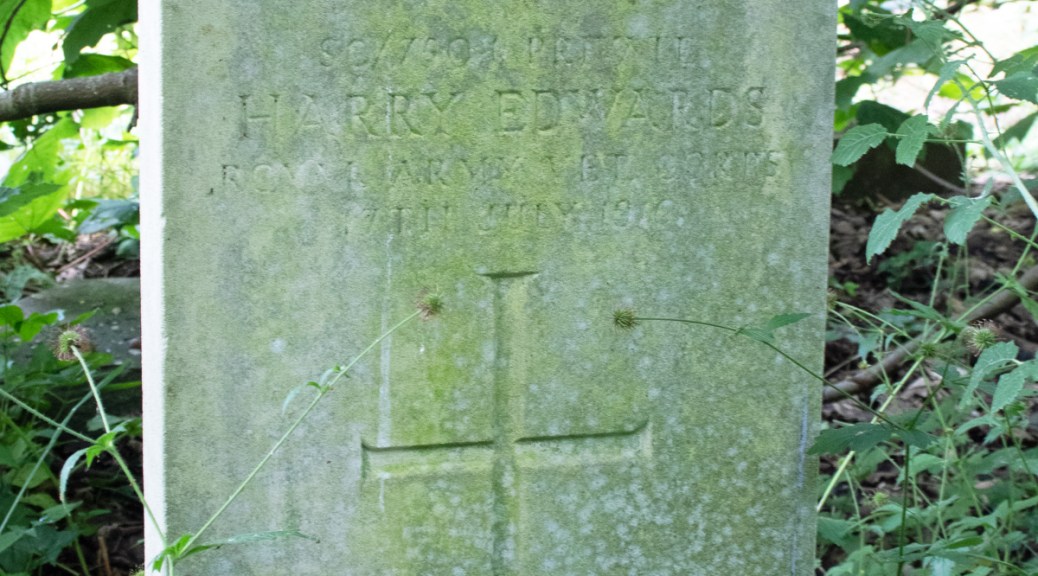
The next records available for Harry are those relating to his military service during the First World War. He enlisted early in 1915, joining the Royal Army Veterinary Corps. He found himself in France by mid-April, and was awarded the British and Victory Medals and the 1915 Star for his service.
Private Edwards came down with bronchitis in the spring of 1916: he was medically evacuated to Britain for treatment, and was admitted to the Bath War Hospital in Somerset. It seems that Harry’s age was against him: he passed away from the condition on 17th July 1916, at the age of 61 years old.
Harry Edwards’ family may have been unable to afford the cost of bring him back to London for burial. Instead, he was laid to rest in the sweeping Locksbrook Cemetery, not far from the hospital in which he had breathed his last.
Walter Soper Mitchell was born in the summer of 1878 in Newton Abbot, Devon. The fourth of nine children, his parents were Frederick and Mary. Frederick was a house painter and handyman, and records seem to suggest that he took the family to where the work was. The 1881 census found the family living in Chelsea, West London, and it seems that they stayed in London until 1890.
By the time of the 1891 census, the Mitchells were back in Devon, living at 10 Orchard Terrace in Paignton. Frederick was now working as a plumber, while Walter’s older siblings – brothers Frederick Jr, William and Alfred – were variously employed as a sailor, a painter and a plumber.
Walter, who was 12 years old by this point, was nearing the end of his schooling. When he left, he followed the family trade, and as soon employed as a house painter. The 1901 census found him as the oldest sibling still to be living with Frederick and Mary, although his circumstances were about to change.
In September 1903, Walter married Emily Jeffery. She was a couple of years younger than her new spouse, but, sadly, there is little information about her parents. The 1891 census found her living with her grandparents, while the 1901 return noted her boarding with her aunt and uncle.
Walter and Emily went on to have three children. By the time of the 1911 census, the family were living at 25 Norton Terrace in Paignton, Walter being employed as a house painter by this point.
War came to Europe in the summer of 1914, and Walter was called upon to play his part. Full details of his military service have been lost in the mists of time, but from what remains it is clear that he enlisted in the Royal Army Ordnance Corps at some point after July 1915. He was attached to the 67th Coy., but it is unclear whether he saw any action overseas.
Private Mitchell’s time in the army was not to be a lengthy one. He seems to have been based in Essex, and a later record confirms that he contracted bronchitis and anaemia. This would prove to be his undoing: he passed away in Colchester on 17th February 1916, aged 36 years old.
The body of Walter Soper Mitchell was brought back to Devon for burial. He was laid to rest in what would become the family plot in the sweeping Paignton Cemetery.
James McEwan was born towards the end of 1879 in Bury Lancashire. He was the older of two children to James and Mary McEwan. James Sr was a foundry worker, who died in the 1890s, leaving his widow to raise their two sons.
By the time of the 1901 census, all three members of the household were earning money: Mary was employed as a cotton card room hand in a mill; James was a wringing machine fitter, while his younger brother, Peter, was a printer’s apprentice.
The next census, in 1911, found James still living at home with his mother. He was now employed as a labourer in the local railway goods yard, and his maternal aunt, Annie, was living with them, working as a rover in the local mill.
When war broke out, James stepped up to serve his country. Full details are lost to time, but it is clear that he enlisted in the Lancashire Fusiliers, and was attached to the 4th/5th Battalion. This was a service and training unit, and Private McEwan did not spend any time overseas.
In the winter of 1915, James was based on Salisbury Plain, Wiltshire. While billeted there, he contracted bronchial pneumonia, and was admitted to a camp hospital. Sadly the condition was to prove too much for his body to bear, and he succumbed to it on 26th December 1915. He was 36 years of age.
It seems that Mary was unable to afford to bring her sone back to Lancashire. He was laid to rest in the peaceful St Mary’s Churchyard, in Codford, Wiltshire, not far from where he had breathed his last.
Charles Henry Edwards was born in Padstow, Cornwall, in around 1888. One of three children, his parents were Charles and Elizabeth Edwards. Charles Sr was a farm labourer, and his son, who was one of four children, followed suit when he finished his schooling.
Charles Sr passed away in 1903: the next census record found Charles and two of his sisters living with Elizabeth. She was claiming parish relief, while her daughters were doing occasional char work to bring in a little more money.
Charles married a woman called Florence Dunn in the summer of 1911: little information is available for her, other than she was born in Devon, to Joseph and Maria. The couple set up home in Leadwell Street, Padstow, and went on to have four children: Lilian, Charles, Elsie and Alfred.
When war came to Europe, Charles stepped up to play his part. He enlisted 11th December 1915, by which point, he had found work as a cowman. He joined the Devonshire Regiment as a Private and spend the next fourteen months on home soil, moving across to the 5th Labour Company in February 1917.
At this point, Private Edwards was sent to France, and he spent most of that year overseas. He returned to Britain on 8th November, having contracted bronchitis while serving at Etaples. When he had recovered, Charles returned to duties, and was attached to the 650th Labour Coy.
Alfred, Charles and Florence’s youngest child, was born on 1st April 1918, but seemed to be a sickly boy. He passed away on 27th September, aged just six months, from a combination of influenza and bronchitis. Tragically, Charles was also unwell at this point, and he passed away just four days later from pneumonia. He was just 30 years of age.
Charles Henry Edwards was laid to rest in Padstow Cemetery. The report of his funeral does not mention Alfred, but it seems likely that father and son were buried together.
Florence lived on until 1964. She passed away in Bodmin, at the age of 78, and was laid to rest with her husband, reunited after more than four decades.
Louis Theobald was born on 27th January 1898 in Soho, Middlesex. There is little information available about his early life, and the only document that can be directly connected to him is his military service records.
Louis enlisted in the Royal Navy on 7th September 1915. He had been working as a miner at the time, and the document gives an insight into the man he was. He stood 5ft 5ins (1.65m) tall, had brown hair, brown eyes and a fresh complexion. The service records also confirm that he had a tattoo on his right arm.
Stoker 2nd Class Theobald was sent to HMS Pembroke, the Royal Naval Dockyard in Chatham, Kent, for his training. He spent three months there, before being given his first posting, on board the minesweeper HMS Alyssum. He remained on board for three months, before transferring to the cruiser HMS Wallington in February 1916.
Louis’ health was starting to be impacted by this point: he had developed bronchitis, probably exacerbated by heat and dust of the confined engine room he worked in. By April 1916 he was transferred back to HMS Pembroke, and within two months, he was medically discharged from service.
Stoker 2nd Class Theobald had been admitted to the Royal Naval Hospital in Chatham by this point, and his health began to deteriorate. He passed away from a combination of bronchitis and empyema on 15th September 1916: he was just eighteen years of age.
Louis Theobald was laid to rest in the Roman Catholic section of the Woodlands Cemetery in Gillingham, Kent, not far from the dockyard where he had been based.
Herbert Griffith was born in the summer of 1883 in the Somerset village of Crowcombe. One of eight children, his parents were coachman James Griffith and his wife, Selina.
Herbert’s early life is a challenge to piece together. The 1901 census recorded him as living at Weacombe House, West Quantoxhead, where he was employed as a footman.
On 16th December 1909, Herbert married Selina May Davies. Also born in Crowcombe, she was the daughter of a tailor. The couple’s marriage certificate confirms the wedding was conducted at the village church. The couple went on to have two children, Dorothy in 1912, and Geoffrey four years later.
Herbert, at this point, was living in Farnborough, Warwickshire, where he was employed as a valet. (While no document remains to confirm this, it seems possible that this was actually Farnborough Hall, home to generations of the Holbech family.)
When war broke out, Herbert seemed keen to serve his country. He enlisted in the Royal Army Medical Corps, although his full service records no longer remain, so it is not possible to confirm whether he served on home soil or overseas.
The next record relating to Private Griffith is that of his passing. He died in Southampton, Hampshire, on 22nd February 1916, as a result of a combination of bronchitis, asthma and cardiac failure. He was 32 years of age, and would never get to meet his son, who was born two weeks later.
The body of Herbert Griffith was taken back to Somerset for burial. He was laid to rest in the peaceful surroundings of the Church of the Holy Ghost in his home village, Crowcombe.
Walter Hayes was born in Somerset in 1883. The oldest of seven children, his parents were William and Mary Hayes. William was an agricultural labourer, and the family lived and worked at Houndhill, to the south east of Stogumber.
Walter also fell into farm work and, in the spring of 1914, he married Emily Mary Tarr. The wedding took place in Tiverton, Devon, but the couple did not stay there for long as, just weeks after their wedding day, Emily gave birth to a daughter, Edith, over the Somerset border in Dulverton.
Storm clouds were brewing over European shores, and Walter was called upon to play his part. His service records are also sparse, but they confirm that he initially joined the Somerset Light Infantry, before moving across to the Devonshire Regiment.
Walter had either been in the army earlier in his life, or he worked his way up during the war, and at some point he reached the rank of Serjeant. He saw fighting overseas and, according to later documentation, was caught up in a gas attack. This was to have an impact on his health and he was discharged from army service sooner than he might otherwise have done. Officially stood down in March 1919, he returned home to his wife and family.
Emily and Walter had a second child, William, later that year, and the family were finally able to settle into a routine. Walter’s health, however, was severely impacted and, on 12th January 1921, he passed away from bronchitis. The lung condition was found to be directly attributable to his war service, and that gas attack, Walter was 38 years of age.
Walter Hayes was laid to rest in the quiet graveyard of All Saints’ Church in Dulverton.
Emily was pregnant when her husband died: she gave birth to their third child, a son she named Walter, just a few months later. She did not re-marry, and, according to the 1939 Register, she was boarding in a house in Dulverton and carrying out unpaid domestic duties.
Emily lived on until the autumn of 1973, passing away in Taunton at the age of 85.
Serjeant Walter Hayes (courtesy of Trevor Hayes)
The early life of Walter Hayes was a challenge to piece together, as his was not an uncommon name in the area at the time. My thanks go to his great nephew, Trevor Hayes, for his help in pulling together the story and for the image of his great uncle.
Much of Henry John Cordas’ early life is destined to remain a mystery. The first record for him is the 1881 census, which gives is his address as St Mary’s Orphanage in Heston, Middlesex, where he was one of 650 children.
The 1891 census recorded Henry as living in Humber Street, Grimsby, Lincolnshire, right next to the town’s docks. He is noted as being a fisherman, and is married to a woman called Mary, who was born in Deptford, Surrey.
The next available census record for Henry adds confusion to his story. The document, dating from 1911, confirms that he and Mary are now living in Hotwell Road, Bristol, Gloucestershire, again within spitting distance of the docks. Henry was employed as a marine fisherman in the merchant service. The document suggests that the couple had been married for ten years, and give Mary’s place of birth as Swansea, Glamorganshire.
While the document matches previous information for Henry, it seems unlikely that the Marys in the 1891 and 1911 censuses are one and the same. Either way, the couple were sharing their house with Mary’s niece, Ellen.
Henry seems to have joined the merchant fleet in a more official capacity in the autumn of 1900. His records show that he was 5ft 11ins (1.8m) tall, with blue eyes and a fair complexion. He served out of Bristol and, in the years leading up to the outbreak of war, he was assigned to a number of ships, travelling the Atlantic to Montreal and Jamaica, amongst other far-flung places.
When hostilities commenced, Henry was assigned to the Royal Naval Reserve. Over the next few years, he served on a number of ships, including the armoured cruisers HMS Suffolk and HMS Doris. He worked as a Stoker, but by the end of the conflict had been promoted to Stoker Petty Officer.
In December 1918, Henry’s service came to an end. He was, by now, based at HMS Vivid, the Royal Naval Dockyard in Devonport, but his health was suffering. Medically discharged with a combination of chronic bronchitis and rheumatic pain, he seems to have returned to Bristol.
On 6th December 1920, Henry was admitted to Bath War Hospital in Somerset, as he was coughing up blood. The plan was to transfer him to Greenwich Hospital in Surrey, but he suffered an aneurysm before that move could be made. He passed away on 11th December 1920, at the age of 50 years old.
The body of Henry John Cordas did not travel far for burial. He was laid to rest in the peaceful expanse of Bath’s Locksbrook Cemetery.
In a quiet corner of Portishead Cemetery, Somerset, is the grave of Private EG Davies. His headstone confirms that he was in the Duke of Cornwall’s Light Infantry, give the date of his death – 23rd March 1919 – and his age when he passed – 40 years old. The Commonwealth War Graves Commission website confirms that Private Davies transferred to the Labour Corps, but only a couple of documents remain from his time in the army.
The soldier’s pension records confirm that his full name was Edward George Davies, and that, at the time of his death, he was living with his ‘unofficial wife’, Minnie Louisa Holbrook. The records also give the cause of death: influenza and septic bronchitis.
Minnie Louisa Fido was born in the spring of 1874 in Bedminster, Bristol, one of thirteen children to farmworker David Fido and his wife, Sarah. She married Arthur Holbrook on 28th April 1895, and had Gertrude four months later.
The Somerset School Register from 1906 notes that Gertrude Fido joined the Church of England School in Weston-in-Gordano on 12th February. It gives her mother’s name as Minnie Fido, but doesn’t give a father’s name. It seems that Gertrude left the school in November 1914, as she had found work.
A search of the 1911 census records shows Edward and Minnie (whose surname is now given as Davies), living in George Street, Portishead. Edward is listed as a wagoner on a farm, and that he was born in Gloucestershire. Minnie is noted as a charwoman from Nailsea, Somerset. Making up the household is Gertrude, noted as being Edward’s stepdaughter, and who was working as a domestic servant.
Edward’s history is more of a challenge to piece together. The 1911 census gives his place of birth as Iron Acton, Gloucestershire, and census records from the years following his birth give his parents names as Henry and Charlotte Davis.
In 1896, Edward joined the Gloucestershire Regiment as a Private, his papers suggesting that his apparent age was 18 years and 3 months (he was, in fact, barely 17 years old). Despite having ‘rather flat feet’, he spent the next five years in the army, and served in South Africa. He was medically discharged in November 1901.
Returning to the 1911 census once more, the document suggests he and Minnie had been married for eight years, although later army pension documents suggest Minnie was his unofficial wife.
When war broke out, it seems that he stepped up to play his part once more, although the records give some confusion about how and where he served. The war memorial in Portishead records him as Private Edward George Davies of the Royal Horse Artillery, while the Somerset Book of Remembrance commemorates Gunner Edwards George Davies of the Royal Horse Artillery. The North Weston War Memorial suggests he was a Private in the Duke of Cornwall’s Light Infantry, and this matches the details recorded by the Commonwealth War Graves Commission.
Minnie did not marry, or co-habit, again, and she passed away on Christmas Day 1949, at the age of 75 years old. Gertrude looks to have married a man called Bessant. The 1939 England and Wales Register recorded her living in the Portishead area, and working as a supervisor in a boot factory. She was living with her maternal uncle, Herbert Fido, but was noted as being the head of the household. She died early in 1967 in Weston-super-Mare.