Tag Archives: brother

Private Sidney Alner

Private Sidney Alner

Sidney William Alner was born in Shaftesbury, Dorset, in March 1899, one of eleven children to Sidney and Ellen Alner. Sidney Sr was a grocer’s porter, and the family lived on the celebrated Gold Hill in the town.

War was to come when Sidney Jr was only young – he had just turned 15 when it broke out. He saw his older brothers go off to war and was obviously keen to do his bit as well. Until he was old enough, however, he worked as an errand boy for his father’s employers, Stratton Sons and Mead.

His time would come, of course, although dates for Sidney’s enlistment are not clear. A contemporary newspaper record confirms that he arrived in France in January 1918, so it is likely that Private Alner joined up at some point during the previous year.

He joined the Hampshire Regiment, and was assigned to the 1st Battalion. Heavily involved during most of the conflict, the battalion was seen as key to the Final Advance of the autumn of 1918. Private Alner was caught up in the fight to break the Hindenburg Line, fighting on the River Selle and capturing the town of Monchaux.

It was while his battalion was advancing on the village of Préseau on 2nd November, that Private Alner was injured. Shot in the arm, he was evacuated back to England, and admitted to the Cambridge Military Hospital in Aldershot. He would have survived his injuries, had pneumonia not set in, and it was to this that he would succumb on 19th November. He was just 19 years old.

Sidney William Alner’s body was brought back to Dorset. He lies at rest in the Holy Trinity Churchyard in Somerset, within walking distance of his family’s home.


Sidney was the second member of the Alner family to die as a result of the Great War.

His older brother Harry, who had become a chauffeur and went to live in London, joined the Royal Army Service Corps in 1915. Private H Alner had served three years in France when he was killed on the front line just three weeks before his brother. He was 32 years old, and left a widow and two children.


When researching Sidney Alner in newspaper articles, an interesting report surfaced.

An unfortunate accident has happened to a little girl, not quite four years old, the daughter of Sidney Alner, who resides in Gold Hill. Heals’ steam hobby horses visited the town on Friday and Saturday in last week, and on the evening of the former day, Alner took his little girl for a ride on the horses.

Whilst they were in motion, the bolt that kept the horse on which Alner sat with his child attached to the connecting rod came out, and he and the little girl were precipitated to the ground.

Alner escaped without injury, but his daughter had one of her legs fractured above the knee. She was taken home, and Dr Evans set the injured limb. Later in the evening she was removed to the Westminster Cottage Hospital.

Salisbury and Winchester Journal: Saturday 31st October 1891

This Sidney Alner was Private Alner’s father, and the daughter would have been his older sister Sarah. Nothing more is reported of the incident, and Sarah went on to live until 1945, when she was 57 years old.


Private William Flower

Private William Flower

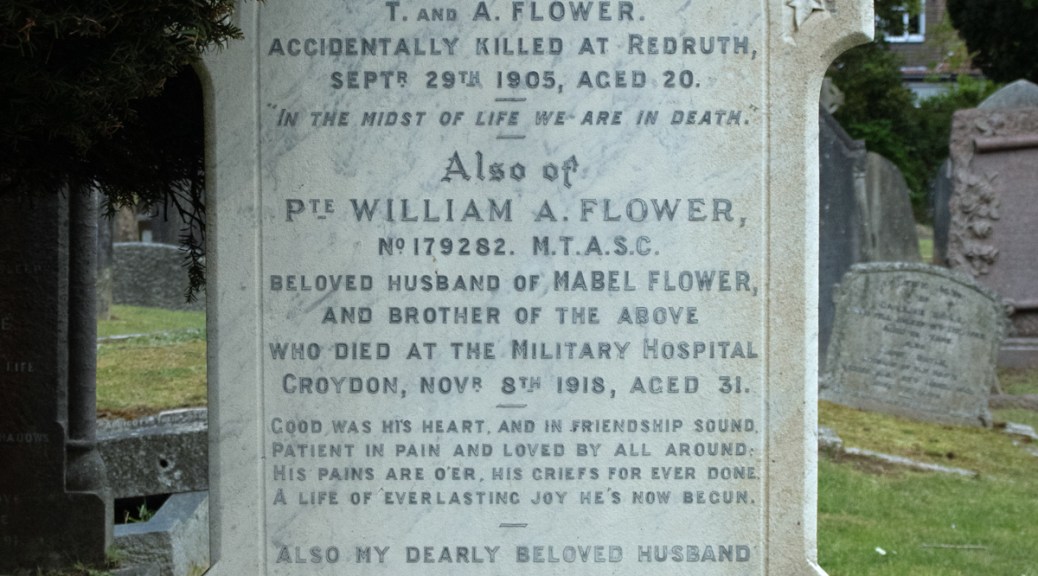
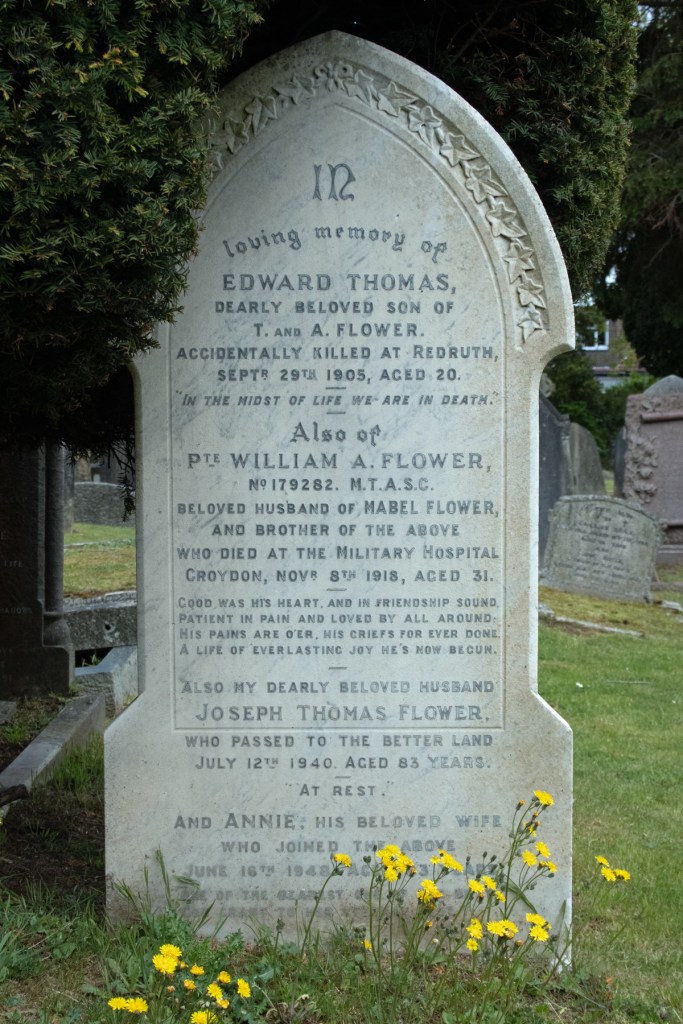
William Alister Flower was born in 1887, one of five children to Joseph and Annie Flower. Joseph was a platelayer for the local railway, and brought the family up in Weston-super-Mare, in his home county of Somerset.

When he left school, William worked as an errand boy for a local greengrocer; he stuck with it, and, by the time of the 1911 census, he was employed as a van driver for the grocer.

War was on the horizon and, while William enlisted in the army, it is difficult to get a complete handle on his military service. There are a number of servicemen with similar names, but the documentation that is available is not easy to directly connect them with the gravestone in the Weston-super-Mare cemetery.

What is clear is that William enlisted as a Private in the Army Service Corps at some point before May 1918. He was assigned to the Motor Transport division (this was likely on the back of his van-driving experience). His time seems to have been spent on home soil, although he was awarded both the Victory and British Medals for his service.

At some point, he had married a woman called Mabel. Exact details again are unclear – ancestry.com confirms the marriage of a William Flower and Mabel Richardson in December 1909, but as this took place in Northamptonshire, it is unlikely to be the Somerset Flowers researched here.

Details of Private Flower’s passing are also scarce. He died on 8th November 1918, in the Military Hospital in Croydon, Surrey, but the is no information as to the cause of his death. He was just 31 years old.

William Alister Flower’s body was brought back to Somerset; he lies at rest in the family grave, in the Milton Cemetery of his home town.


While I was researching William Flower, I was taken by the note of the accidental death of the first name on the family grave.

Edward Thomas Flower was two years William’s senior who, after leaving school, had gone on to be an errand boy for a local butcher.

Edward had decided to follow in his father’s footsteps and join the railways, leaving his home town in 1905 to work in Cornwall. After initially working as an engine cleaner, he progressed to be a fireman, helping to stoke the engine with coal. The local newspaper of the time picked up the story of the accident.

At the moment of the accident, a goods train was standing in the Redruth station, shunting having been temporarily suspended to admit the passage of the down motor rail car.

It appears that the flap of one of the cattle trucks in the goods train… had been allowed to remain down, and the folding doors above it had been insecurely fastened, with the result that as the motor rail car ran into the station the doors of the truck suddenly flew open outward and one of them struck deceased on the side of the face and head, inflicting terrible injuries.

There was a very extensive fracture of the skull, the whole of the left side of the face was driven in and there was also a formidable wound at the back of the head, death occurring within a few moments.

It appears that the rail motor was not proceeding at a greater rate than some five or six miles an hour, according to the statement made at the inquest by the driver, and the latter noticed that when the doors of the goods truck swung open they struck one of the handles on the fore part of the car. He applied the brake immediately, but did not know that Flower had been struck until afterwards.

Weston Mercury: Saturday 7th October 1905

The inquest found that there had been some neglect on the part of the porter and guard in not ensuring that the goods truck’s doors had been secured, and it seems that this was something that had been highlighted previously.

Edward had shortly been due to marry, leaving a fiancée, as well as a family, bereft. He was just 20 years old.

His body was brought back to Weston-super-Mare, and was the first to be buried in the family grave.


Gunner Walter Coleman

Gunner Walter Coleman

Walter Coleman was born in the spring of 1887, one of seven children to James and Emily Coleman. James was a hairdresser and the family lives in the Somerset town of Taunton.

Walter didn’t follow his father’s trade; instead, after a spell working at a collar factory when he left school, he was soon employed as a groom.

On Christmas Day 1910, he married Kate Norris, and the couple set up in a two-up, two-down in the middle of the town.

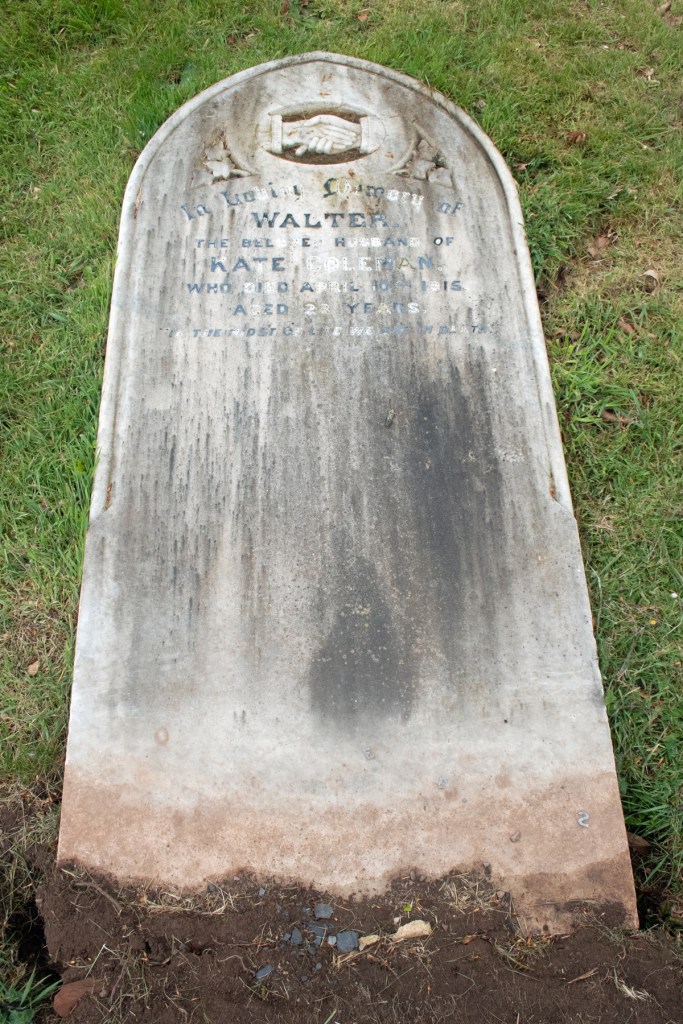
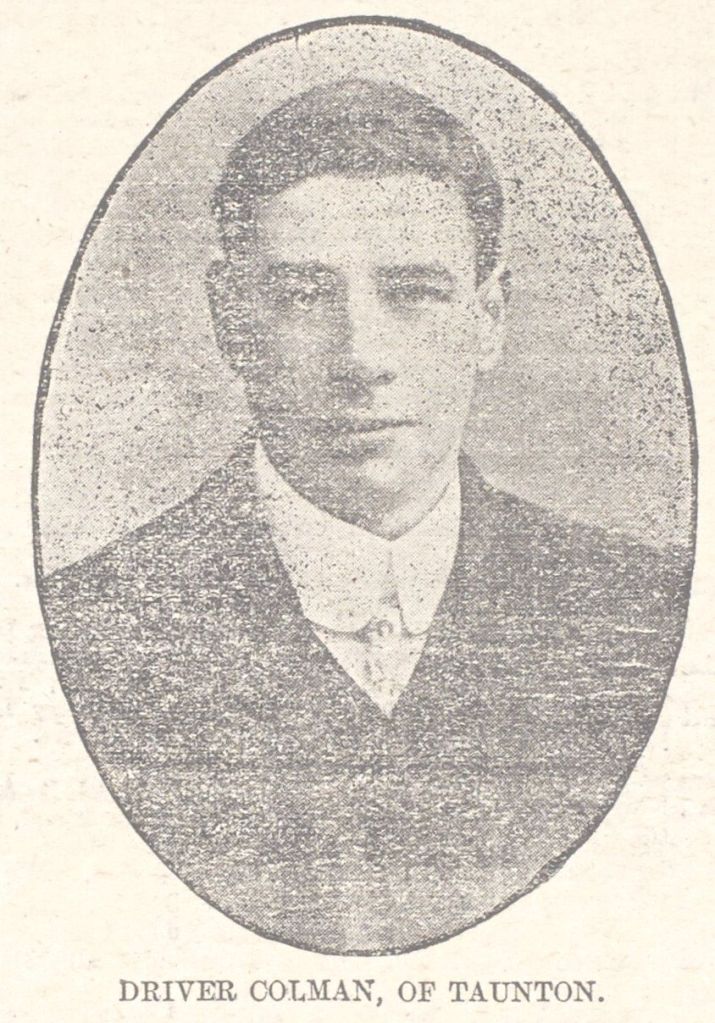
War was on the horizon, however, and when it broke out, Walter signed up straight away. He joined the 72nd Brigade of the Royal Field Artillery as a Driver and trained at the Bulford Camp on Salisbury Plain. It was while he was here on 10th April 1915 that he had an accident and fell off his horse. Sadly, Driver Coleman fractured his skull and died of his injuries that day. He was just 28 years old.

Walter Coleman lies at rest in the St James’ Cemetery in his home town of Taunton.


Walter Coleman (from findagrave.com)

Walter’s older brother Henry James Coleman also served in the Great War. Posted to France as part of the Labour Corps, he died of wounds on 12th April 1918. He was 33 years old, and left behind a widow and four children. He is buried at the Longuenesse Souvenir Cemetery in France.


Lance Corporal Ernest Hawkins

Lance Corporal Ernest Hawkins

Ernest Frederick Hawkins was born in Street, Somerset, in 1884. He was the youngest of six children to Charles Hawkins and his wife Elizabeth. Both of Ernest’s parents were shoemakers in the Clark’s Factory in the town, and this was the trade Elizabeth continued in after her husband’s death in 1887.

Ernest’s life has some mysteries about it and there is a sense that he spent time trying to escape from something. In August 1904, he enlisted in the army, joining the Scottish Rifles (also known as the Cameronians). He did this under an assumed name, preferring to be called James Fisher.

“James” gave his next of kin as his parents, listing them as George and Annie in South Acton (even though these were not his actual parents’ names, and that his father had passed away 17 years previously).

His enlistment papers give an interesting insight into the young man. He was listed as 22 years old, 5ft 4ins (1.62m) tall, with brown eyes, black hair and a sallow complexion. His arms were adorned with a number of tattoos, including Buffalo Bill on his upper right arm and a ship surrounded by flags on his upper left.

Private Fisher served for a year on home soil, before being shipped out to India. He returned to the UK in October 1907, and transferred to the Army Reserve.

Ernest returned to Somerset, and it was here that he met Sarah Jane Manning. The couple married in a registry office in Bristol, and went on to have two children, Hubert and Iris.

War broke out, and Private Fisher was remobilised. By August 1914 he was promoted to Lance Corporal, and sent to France as part of the British Expeditionary Force. Here he became caught up in a number of the key battles of the conflict.

On 24th July 1916, during the British attacks on High Wood at the Somme, he was wounded in the right arm, and invalided back to England for treatment. Admitted to the War Hospital in Guildford, Surrey, it was confirmed that he had received a gun-shot wound to his right arm, which had resulted in a compound fracture of the humerus, radius and ulna. Sadly for Ernest, the only option was a full amputation of his right arm.

After some time to recover, Ernest was transferred to the Pavilion Military Hospital in Brighton where he was fitted for an artificial limb. He spent three months in the Brighton facility, before being moved to the Queen Mary’s Convalescent Home in Roehampton to recuperate. He was eventually discharged – from the hospital and the army – on 10th March 1917, and returned to his wife and family in Somerset.

There is little further documented information about Ernest. He and Sarah went on to have a further child – Leslie – in 1917. Sadly, where Ernest had been a toddler when his father had died, Leslie was consigned to be a babe-in-arms when Ernest passed away.

Ernest Frederick Hawkins – also known as James Fisher – died in Swindon on 2nd July 1918, at the age of 34. He lies at rest in St Mary’s Cemetery in his adopted home town of Taunton, Somerset.


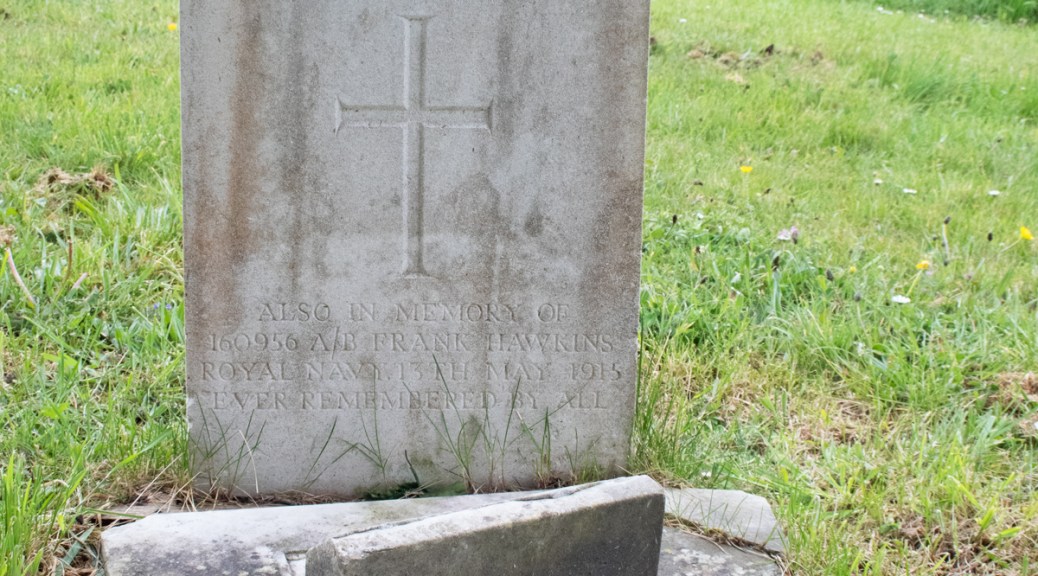
Ernest’s gravestone also commemorates his brother Frank Hawkins. Frank was nine years older than Ernest, and, like his younger brother, had decided that the military life was for him.

Frank enlisted in the Royal Navy in November 1894 and was assigned a Boy 2nd Class on HMS Impregnable – the training ship based in Chatham, Kent. Over the period of his twelve years’ service, Frank rose through the ranks to Able Seaman. When his term was up, he joined the Royal Fleet Reserve for a further five years.

When war came, Able Seaman Hawkins was immediately called back into action. He was assigned to HMS Goliath, serving off German East Africa and the Dardanelles. On the night of the 12th May 1915, the ship was guarding the water off Gallipoli, when it was struck by three Ottoman torpedoes. The resulting explosions caused the ship to sink quickly, and 570 souls – out of a total complement of 750 crew – were lost.

Able Seaman Hawkins was one of those lost, and was subsequently commemorated on his brother’s gravestone.


Serjeant Frederick Wickens

Serjeant Frederick Wickens

Frederick Albert John Wickens was born in Newbury, Berkshire, in the summer of 1889. The oldest of four children to Alfred and Emily Wickens, his father was a brewer’s labourer.

The military life proved more of a draw to Frederick, however. While his full records no longer exist, by the time of the 1911 census, he was recorded as being a Sapper with the 2nd Field Troop of the Royal Engineers. He was based at Potchefstroom, around 75 miles (120km) south east of Johannesburg in South Africa, and his trade was listed as a tailor.

Sadly, it is at this point that Frederick’s trail goes tepid, if not cold.

From a personal perspective, he married a woman called Rose, who was a year younger then him. Her details are scarce, and there is nothing to confirm when or where they married (other than the 1911 census, when Frederick was listed as ‘single’).

The couple must have had some connection to Gillingham, as this is where they lived; given the proximity of the Royal Engineers Barracks in neighbouring Chatham.

Sapper Wickens’ military service continued into the Great War. He was awarded the medaille militaire by Belgium, and achieved the rank of Serjeant during his career. Unfortunately, there are no details of the actions around either the award or his promotion.

Serjeant Wickens passed away on 27th February 1921; he died in Chatham, although the cause was not recorded. He was 31 years old.

Frederick Albert John Wickens lies at rest in the Woodlands Cemetery in Gillingham, Kent.


Frederick’s younger brother Thomas, also served in the Great War. He enlisted in the Princess Charlotte of Wales’s (Royal Berkshire) Regiment, and was involved in the battles on the Western Front. Sadly he was killed in the fighting on 24th May 1916, at the age of 19 years old.


Corporal Albert Shrubsall

Corporal Albert Shrubsall

Albert Arthur Shrubsall was born in Deptford, South London, in April 1896. He was the youngest of three children – all boys – to ironmonger George Shrubsall and his wife Jessie.

While his brothers continued to live at home after they had left school and got jobs, Albert found live-in work as a pageboy, or servant, for Wilfred Lineham, who was a professor of engineering for a London college. It was while he was working here that his mother, Jessie, passed away. She died in 1913, aged just 43.

Details of Albert’s military service are a bit scant. He enlisted in the Royal Marine Light Infantry, although I have been unable to confirm when he joined up. He was assigned to the Chatham Division, and was based at the Naval Dockyard in Kent, ultimately being promoted to Corporal.

Albert married Gertrude Spoore – affectionately known a ‘Ginty’ – in Deptford in October 1917. Sadly, the marriage was to las less than six months, as, on 9th April 1918, Albert passed away, having contracted pneumonia and septicaemia. He was just 22 years old.

Albert lies at rest in the Woodlands Cemetery in his adopted home town of Gillingham in Kent.


Albert’s two brothers George and Alfred were also involved in the First World War.


George, had gone on to become a tailor’s assistant when he left school. He married Emily Hawkes in 1911, and the couple went on to have a son, also called George, the following year.

When war broke out, he enlisted in the Machine Gun Corps, and served on the Western Front. Sadly, he was caught up in the fighting, and was killed in action on 22nd August 1917. He was buried at the Tyne Cot Memorial in Flanders.


When he left school, Alfred went on to become a butcher’s assistant. War came along, and he enlisted straight away.

Enrolling in the Royal Field Artillery, Gunner Shrubsall was assigned to the 95th Brigade. Sadly, he had recorded less than six months’ service, as he passed away on 8th January 1915, aged just 21 years old. His brigade did not go to France until the following year, so, while no cause of death is recorded, it is likely that he died from a communicable disease like influenza or pneumonia.

Alfred is buried in the family grave in Deptford, South London.


Within a period of just three years, George had lost all three of his sons to the Great War. Given the previous death of his wife, you can only imagine the heartbreak he was going through.


Corporal Richard Langley

Corporal Richard Langley

Richard Frederick Langley was born in January 1897 in Chatham, Kent. He was one of seven children to Albert Langley, who was a bricklayer, and his wife, Elizabeth.

Richard enlisted almost as soon as he was able to. His papers, dated 18th October 1914, show that he was 17 years and 10 months old, as was working as an apprentice boilermaker. He was assigned to the Royal Engineers.

Sapper Langley’s war service was spent in England. Initially based in Kent, he was promoted to Acting Lance Corporal in October 1915. Transferring to the Royal Engineers Anti Aircraft Battalion in July 1916, Richard was again promoted to Corporal.

Corporal Langley was injured while serving for the Royal Engineers AA; he was admitted to the General Hospital in Tunbridge Wells, and has a hernia operated on. After two months recovering in hospital, he re-joined his battalion.

Richard was transferred again in January 1918, this time being assigned to the London Electrical Engineers. It was here that he saw out the remainder of the war.

It was while he was serving in Sheerness that Richard contracted influenza. Hospitalised on the island on 28th November 1918, he sadly did not recover. Corporal Langley passed away from pneumonia on 5th December 1918. He was just 21 years of age.

Richard Frederick Langley lies at rest in the Woodlands Cemetery in his home town of Gillingham, Kent.


Richard’s older brother Albert was also involved in war service and was a skilled labourer at Chatham Dockyard. In February 1916, he boarded the SS Maloja, a steamship bound for Bombay with over 400 passengers and crew on board.

At around 10:30am on Sunday 27th February, the ship was sailing through the Straits of Dover when it struck a mine. The vessel sank within 24 minutes. Over 150 people died in the explosion, from drowning or from hypothermia.

Sadly, Albert’s body was not recovered. He was just 21 years old. He is commemorated on the Naval Memorial in Chatham, Kent.


Private Frederick Hobbs

Private Frederick Hobbs

Frederick Hobbs was born in December 1886, the fourth of ten children to William and Martha Hobbs, from Bridgwater in Somerset. William was a mason, and all of his children seemed to be good with their hands. Frederick went on to become a plumber’s apprentice, while his siblings worked as a mason, a dressmaker and a carpenter.

The 1911 census found him living in Polden Street, Bridgwater with his mother and youngest sibling, Florrie. William, however, was living round the corner in Bath Road, with three of his other children, Clara, Tom and George. Both of Frederick’s parents are listed as married, which adds to the confusion of them being in separate houses.

Frederick enlisted with weeks of was being declared; he joined the 10th (Service) Battalion of the Devonshire Regiment and, after a year on home soil, his troop was shipped to France. This wasn’t the end of the Private Hobbs’ journey, however as, within a couple of months, he journeyed on as part of the Mediterranean Expeditionary Force, finally arriving in Salonica, Greece, in November 1915.

Private Hobbs has only been serving for a month when he was admitted to the Hospital Ship Asturias in Alexandria, with lacerations to his cheeks and eyelids. The initial report seemed to suggest the wounds were as a result of gunshot, although a more detailed report later confirmed that the injuries were caused by barbed wire.

While in hospital, Frederick’s urine was found to include a high level of sugar. He also confirmed having lost a lot of weight in recent months, but could not confirm when this had begun. He was diagnosed with diabetes, and was evacuated back to England for treatment for both his injuries and his illness.

The damage to his left eye healed, but he was left with significant ptosis, or drooping of the eyelid. When it came to his diabetes, specialists back in England determined that, while it could not be put down to Private Hobbs’ service, it had definitely been aggravated by it. He was deemed no longer fit for military service and furloughed in June 1916, with a follow-up report confirming this three months later.

Sadly, whether Frederick’s life returned to normal is not recorded. It seems likely, however, that the diabetes got the better of him, and he passed away on 25th November 1916, aged just 29 years old.

Frederick Hobbs lies at rest in St John’s Cemetery in his home town of Bridgwater, Somerset.


Frederick’s younger brother Herbert Hobbs also fought in the Great War. He enrolled in the Royal Marines Light Infantry and fought on the Western Front. Caught up in the Battle of Gavrelle Windmill, he was one of 335 Royal Marines to be killed in that skirmish. He lies buried at the Arras Memorial in Northern France.


Private Ernest Rawle

Private Ernest Charles Rawle

Ernest Charles Rawle was born in 1899, the fourth son of George Rawle, a sailor, and Louisa, his wife.

Ernest was still at school at the time of the 1911 census, and enlisted in the West Somerset Yeomanry, but enlisted in the army in April 1915. His served on the Home Front, but was discharged as being unfit for war service on 22nd July 1916.

Private Rawle’s discharge records confirm that he had pulmonary tuberculosis, which he had contracted a couple of months before. They go on to suggest that it was not a permanent condition, but was likely to render him unfit for service for a number of months.

Eager to do his bit, Ernest’s record show that he re-enlisted in August 1916, and that he was considered fit for military service by the November of that year.

His medical records continue further – he was admitted to a field hospital again in March 1917, again suffering from tuberculosis. He was moved back to base as he was “a danger to his comrades”.

His records after March 1917 are not available, but he passed way from TB in November 1919. He was just 21 years old.

Private Ernest Rawle lies at peace in the churchyard of Lydeard St Lawrence, alongside his two brothers, Stephen and William.


George and Louisa’s other son – Edward – also served, enlisting in the Somerset Light Infantry and fighting in the Balkans. Private Edward Rawle survived the war, returning home in March 1919.

It should be noted that, by June 1921, George and Louisa had lost three of her four sons to the Great War. Their daughter, Norah, had also passed away in 1918.

The 1921 census found Louisa living in East Town, in the parish of Tolland, not far from Lydeard St Lawrence. Edward was living with her, as were her three-year-old granddaughter, Lorna, and her eighteen-month-old grandson Beatty. It is unclear whose children they were. George, at this point, was helping his younger brother out on the family farm in Williton.