John Lawson Kinnear was born on 9th February 1890 in the Yorkshire village of Copgrove. The youngest of six children, his parents were Henry and Frances Kinnear. Henry was the vicar of St Bartholomew’s Church, and, at the time of the 1891 census, the family lived in the rectory with four servants: a governess, a cook, a housemaid and a nurse.
When he completed his schooling, John was drawn to a career in the military. His full service papers have been lost, but it is clear that he joined the King’s (Liverpool Regiment) with a commission. He held the rank of Second Lieutenant when he joined the battalion in October 1910, rose to Lieutenant in March 1913, and transferred to the Royal Flying Corps not long after the First World War broke out. By June 1915, he had been made a Captain.
By the time of the Royal Air Force’s foundation in April 1918, John had risen to the rank of Major. He had also been awarded both the Military Cross and the Distinguished Service Order. Attached to the 1st Training Squadron, he was based at East Boldre, Hampshire.
On 28th April 1918, Major Kinnear was piloting his Sopwith Camel, when it stalled at a height of 200ft and fell to the ground. John was killed instantly. The RAF Casualty Card noted: “The court having carefully considered the evidence, viewed the scene of the accident and examined the wreckage are of the opinion that the smash was caused by an error of judgement on the part of the pilot.”
John Lawson Kinnear was 28 years of age when he died. His body was laid to rest in the graveyard of St Paul’s Church, East Boldre, not far from the airfield which he had called home.
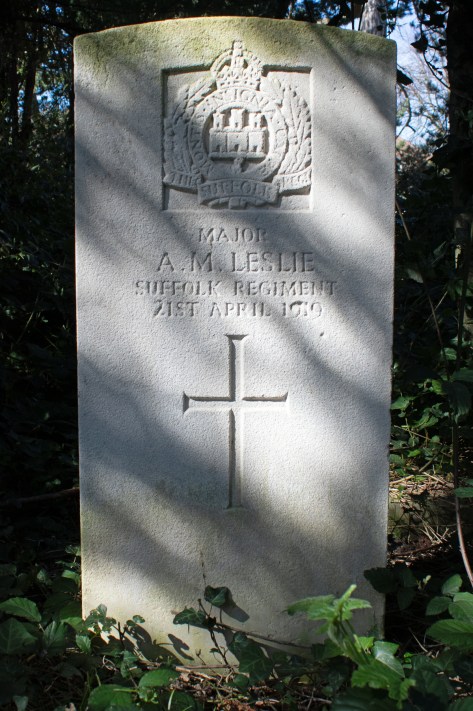
Alexander Augustus Maurice Leslie was born in France in 1852. One of five children, his parents were Government Secretary of State Francis Leslie and his French wife, Josephine.
Alexander’s mother died when he was 8 years old, by which point the family had moved back to Britain. Francis had set up home in Ealing, Middlesex, and they were living at 15 Castlebar Road, a Victorian villa.
When he completed his schooling, Alexander sought out a military life. The 1881 census recorded him as a Lieutenant in the Suffolk Regiment, living in St Helier, Jersey. He had married the year before, to Louisa Cumming, a surgeon’s daughter from Devon. They had a son, Maurice, by this point, and a daughter, Ida, was born the following year.
Lieutenant Leslie’s service records are sparse, but a later newspaper report fills in some of the gaps: “Leslie’s military experience, which extended… over a period of about 25 years, included participation in the Egyptian campaign in 1884, and service on the West Coast of Africa, in Jamaica, and in India.” [Worthing Gazette: Wednesday 30th April 1919]
During her husband’s time overseas, Louisa raised the children back home in Devon. She passed away in 1901, but which point, Alexander had retired with the rank of Captain. That year’s census found him living with Maurice and Ida at 14 Spencer Hill in Wimbledon, Surrey, a large detached villa. Maurice, now 20 years of age, was working as an accountant’s clerk, and the family had a live-in servant called Rose.
The next census record, from 1911, recorded Alexander living in rooms at 46 Leinster Gardens, Paddington. A substantial Georgian property, his landlady was Eveline Giradet, whose other residents included a barrister and a banker. Alexander’s occupation was now noted as Retired Major in the British Army.
From this point, Alexander’s trail grows cold. It is likely that he was called upon to play a part in the global conflict that broke out in 1914, though exactly when and how he did so is unclear. Records suggest he was admitted to Queen Alexandra’s Military Hospital on Millbank, Middlesex on 28th September 1916, suffering from syphilis. He only remained there for a couple of days, and his increasing age and health may have led to his retirement from duty.
For the past four years Major Alexander Maurice Leslie, who was for a period of a quarter of a century connected with the Royal Sussex Regiment, had been a resident of Worthing, and a brief intimation was given in the last issue… that he had died suddenly.
The circumstances were duly investigated by… the Deputy Coroner for West Sussex, on Wednesday afternoon, the inquiry taking place at the Central Fire Station, in High-street.
Evidence of identification was given by Colonel Francis Seymour Leslie… late of the Royal Engineers, who stated that the deceased, who was his brother, had lived at Worthing for the past four years, more or less all the time, though he had no permanent address…
Mrs Ethel William, a widow, at whose house… Major Leslie had lodged, stated that he had complained of indigestion and ate light food. On Monday evening he had his supper at half-past seven o’clock, going upstairs about half an hour later. About nine o’clock witness went to his room and found him lying in bed in great agony, and he exclaimed: “Oh, my poor heart!” Witness gave him some hot water to drink and sent for a doctor.
Dr Bernard Lees stated that he was sent for, but he found Major Leslie was dead when he got to the house. He had since made a post-mortem examination, which showed that the stomach and intestines were much distended, and there were signs of chronic gastric catarrh. The heart was fatty, but the valves were healthy. Death was due to syncope, the result of acute indigestion and the fatty condition of the heart.
A verdict of “Death from natural causes” was recorded.
[Worthing Gazette: Wednesday 30th April 1919]
[It should be noted that Alexander had been attached to the Suffolk Regiment throughout his military career. The error in the newspaper report is likely because of the Sussex town he had moved to in the mid-1910s.]
Alexander Augustus Maurice Leslie was 67 years of age when he passed away on 21st April 1919. His body was laid to rest in Broadwater Cemetery, to the north of the town he had called his home for more than four years.
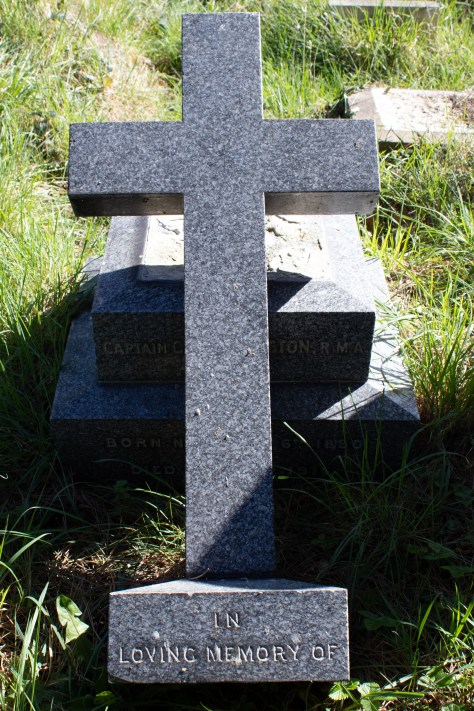
Guye Wellesley Lushington was born in India on 6th November 1880. The oldest of four children, his parents were James and Bessie Lushington. James was a worked in the Bombay Uncovenanted Civil Service and, while it’s not possible to track his location through census records, by the time of the 1891 census, Bessie had returned to Britain with the children. The document found them living at 31 Clarendon Street in Bedford, Bedfordshire.
Guye’s background stood him in good stead when it came to building a career. His chosen profession was the army and, by January 1898 he had landed a commission in the Royal Marine Artillery. Lieutenant Lushington continued to do well and, on 13th March 1908, he received a promotion to Captain.
Full details of Guye’s military service have been lost to time, but by the time war broke out, he was attached to the dreadnought battleship HMS Bellerophon. The stress of the Great War was to take its toll, however, and he was diagnosed with neurasthenia. In 1916, he was admitted to the King Edward Convalescent Home at Osborne House, on the Isle of Wight. Captain Lushington’s condition, however, was to worsen.
The Isle of Wight Coroner yesterday held an inquest respecting the death of Captain George [sic] Wellesley Lushington, 35, of the Royal Marine Artillery, sone of Mr James Law Lushington, of Briar Bank, Grove-road, Worthing [West Sussex], who was found dead… on Tuesday, having apparently thrown himself over an iron staircase fire escape into the courtyard.
Colonel Douglas Wardrop, house governor and medical superintendent, said the deceased arrived at Osborne House from Haslar on the 5th inst… He was rather depressed and worried about his loss of will power. He had been four years on the “Bellerophon” and on active service with the Grand Fleet. There was nothing in the deceased’s manner to suggest suicide. He slept on the top floor of the south wing. At two o’clock on Tuesday morning, the night nurse reported that the deceased had not slept in his room. Search was made, and the deceased was found lying in the courtyard between the kitchen and the south wing. He must have jumped from the fire escape – which was an iron staircase with platforms outside each landing – onto the flag stones below, a distance of 45 feet. His skull was smashed to pieces. There was a railing 3 feet 6 inches high round the staircase, and deceased could not have accidentally fallen over.
Two letters were found in deceased’s room, one addressed to his father and the other to his sister. His father identified the writing. The letter to the deceased’s father was as follows:
“Osborne House, Sunday.
“My dear pater, Since I broke down a month ago, I feel I shall never pick up again. I am afraid this will rather surprise you, but I cannot stand the tension any longer. I am always wondering what is going to happen to me. Give my love to Daisy. If one has to die, it is better quickly than slowly. With lots of love – GUYE”
Nursing sister Arkins, who had charge of the deceased, said he was quiet, bur showed no suicidal tendency.
Lieutenant George Stewart Manisty, of the Indian Army Reserve, attached to the 7th Bengal Lancers, said he played bridge with the deceased up till 10:30 on Monday night, and for three nights running. Deceased seemed quite friendly and in good spirits.
A verdict of “Suicide while of unsound mind” was returned.
The Coroner said that was the third suicide within a week on the Isle of Wight, either directly or indirectly due to the war.
[Sussex Daily News: Thursday 11th May 1916]
Captain Lushington’s full state of mind on the night he took his life will never be know. The family had suffered three early deaths in a matter of years: Guye’s oldest sister, Violet, had died in 1899, at the age of 18; his brother Hubert had died in 1905 at the age of 19; his mother Bessie passed away in 1911 at the age of 58. Guye had taken his life on 8th May 1916, aged 35 years old.
The body of Guy Wellesley Lushington was taken to Worthing, West Sussex, for burial. He was laid to rest in the town’s Broadwater Cemetery.
Thomas Hulkes Bingham Day was born on 2nd January 1855 in Frindsbury, Kent. The youngest of four children, his parents were Thomas and Emma Day. Thomas Sr was a banker and a justice of the peace. He died when his youngest was just a child, and Emma was left to raise the family, albeit with the help of five servants.
Thomas sought out a life in the military. After volunteering in the local militia, for a number of years, he gained a commission in the Dorsetshire Regiment. He took on the role of Lieutenant on 29th November 1876.
Over the next two decades, Thomas served around the world, spending time in Malta, Gibraltar, and the East Indies. He was also promoted through the ranks, rising to Captain in 1883 and Major in 1893.
On 25th March 1884, while serving in India, Thomas married Katharine Watts. The couple had a daughter, Winifred, who was born in July 1885, and, eventually they settled in Wiltshire as their base in Britain.
Major Bingham Day served in South Africa during the Boer War, taking part “in the operations at Parde Kraal, and in the operations at Poplar Grove… Vet River, Zand River, Johannesberg and Pretoria. He had the Queen’s and the King’s medals with five bars.” [Lincoln Leader and County Advertiser – Saturday 28 April 1917]
Thomas retired in 1903, and his trail goes cold until the time of the 1911 census. He and Katherine were on holiday when it was taken, and they were listed as boarding at the Beach Lodge on Roseville Street in St Helier, Jersey.
When war broke out, Thomas stepped up to play his part once more. He was put in charge of the 4th (Reserve) Battalion of the Devonshire Regiment, which was based at Sutton Veny in Wiltshire. It seems that he lived off site, as he and Katherine moved into a house in nearby Warminster.
A military funeral took place… on Monday, when Lieutenant-Colonel TH Bingham-Day, in command of a regiment at Sutton Veny, was laid to rest in the churchyard. The deceased officer died suddenly while at mess, as the result of a seizure.
[Devizes and Wilts Advertiser: Thursday 19th April 1917]
Lieutenant Colonel Thomas Hulkes Bingham Day was 62 years of age when he passed away on 11th April 1917. He was laid to rest in the graveyard of St Aldhelm’s Church in Bishopstrow, Wiltshire, not far from the base at which he had so dutifully served.
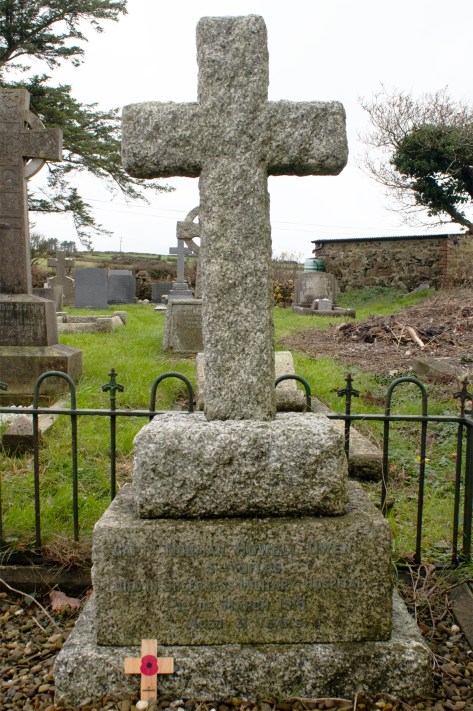
Norman Howell Owen was born in the spring of 1888, and was the third of four children – all boys – to John and Elizabeth. John was a surgeon from Pembroke Dock, Pembrokeshire, but the family were raised in Fishguard, where his practice was based.
Norman was an educated young man and, in 1906, attended the Sir Isaac Pitman & Son Phonetic Institute in Bath Somerset. He was studying shorthand, passing an examination in the subject after just three months. He passed an entrance exam for the National and Provincial Bank the following year, and, by the time of the 1911 census, he was working in the Fishguard branch and living back with his parents.
When war came to Europe, Norman was called upon to play his part. Full details of his service have been lost to time, but what remains paints an interesting picture of his time in the army. He appears to have enlisted in the King’s Liverpool Regiment as a Private, before transferring to the Labour Corps, then the Army Ordnance Corps.
By 1918 the Pembrokeshire Voters List noted Norman and two of his brothers as absentee voters – serving in the army, so not at home. Norman is recorded as being a Captain in the Army Service Corps, having received a commission on 8th February 1915. His older brother John is recorded as being a Captain in the Royal Army Medical Corps, while his younger brother, Lionel, was a Captain in the Royal Field Artillery.
The mystery of Norman continued: he survived the conflict, but by February 1919 had been admitted to the Broadway Military Hospital in Sheerness, Kent. He passed away on 1st March, the cause of his passing not readily available. Captain Owen was 31 years of age.
The body of Norman Howell Owen was taken back to Pembrokeshire for burial. He was laid to rest in Fishguard Church Cemetery.
Norman died intestate: his family went through probate, and his effects – totalling £1003 8s 10d (approximately £67,000 today) were left to his father.
Percy Townley Rawlings was born on 22nd September 1887 in Clapham, Surrey. Details of his early life are sketchy, and most of the information comes from second hand accounts. His baptism record gives his parents as Edward and Lizzie Rawlings. Edward was listed as being a gentleman, but there is no record of the family on the 1891, or 1901 census returns.
He was educated at Westminster School and Cambridge University, where he obtained honours in the Mechanical Sciences Tripos.
In 1910 he went to Woolwich Arsenal as [an] advanced workshop student, and in the following year he obtained a Commission in the Royal Engineers…
In 1912 he entered the Public Works Department of the Sudan Government, and during 1913-14 acted as engineer to the Egyptian Irrigation Service on the construction of the Blue Nile Dam.
On the outbreak of the War he was sent to France [as a Lieutenant in the Royal Engineers], in the 2nd Field Co., being transferred in the following year to the [Royal Naval Volunteer Reserve], for engineering duties with the [Royal Naval Air Service].
In 1917 he flew to Constantinople in a Handley-Page machine, and bombed the Goeben, for which he received the DSC.
[1921 Institution of Mechanical Engineers: Obituaries]
By the end of the conflict, Percy had been promoted to Captain. After the Armistice he remained involved in the Royal Air Force, and was involved in testing the rapidly changing technology of flight.
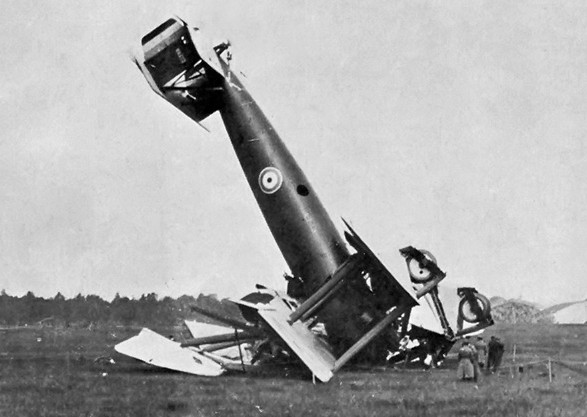
A Tarrant triplane, constructed at the Royal Aircraft Factory, Farnborough, was wrecked on a trial flight on Monday. The machine, which had six engines, each developing 500 horse power, after running along the ground toppled forward and seemed to bury itself in the earth. One of the pilots… Captain Rawlings, has died, and the other, Capt. Dunn, is in a very grave condition.
[Waterford Standard: Wednesday 28th May 1919]
Captain Percy Rawlings’ Tarrant triplane after the crash
Captain Dunn also died in the crash, which happened on 26th May 1919. Percy was 31 years of age when he died.
A close friend, Henry Edmunds, wrote to the Flight Magazine to express his sympathy at the loss:
As a boy, Rawlings was always interested in scientific matters, particularly photography and motors..
He was manly, open, and frank, fearless and honest, of an enquiring mind, and fond of experimenting. I remember his pre-heating paraffin vapour electrically, as a fuel for explosive engines…
It was at my house at Brighton that Rawlings met Mr. W. G. Tarrant, who was spending the week-end with me. Rawlings had just returned from the famous flight in the Handley Page to Constantinople, where he bombed the ‘Goeben.’ I remember his describing vividly his impressions of that memorable journey. If I recollect correctly, he motored down to Folkestone somewhat rapidly. He told me he believed the police were on the look-out for him for exceeding the speed-limit; but he went from Folkestone by air, proceeding to Naples. It was delightful to hear him recount that remarkable voyage. Their fears lest they should not be able to cross some of the high mountain ranges with the heavy load they were carrying, and where, had anything happened, they would have been out of the reach of all human aid. How he availed himself of a special camera for photographing portions of his trip, the results of which he feared it might be unwise to disclose at that time, so he brought the negatives back with him, and I believe they wore kept personally until after the War.
He and Mr. Tarrant were mutually attracted to each other, and discussed with much seriousness the construction of a new type of bombing-plane, which eventuated in the great Tarrant machine. Rawlings joined Tarrant shortly afterwards, and devoted all his energies to carrying on the work of design and construction. On several occasions he came down to see me, and related his experiences. He was full of confidence as to the future of his work; and invited me to take my first flight with him.
Townley Rawlings was a gallant gentleman. Those whom the gods love are taken early.
[Flight Magazine: 29th May 1919]
The speeding incident is an interesting anecdote, another similar incident recorded in a separate newspaper report:
Chauffeur Summoned for Fast Driving
Capt. Rawlings, who was killed in the Tarrant triplane accident, should have appeared as a witness yesterday in the Kingston court.
His chauffeur, Arthur B Cogger, of West Byfleet, summoned for exceeding the limit, was driving Captain Rawlings to Farnborough on Saturday, before the accident.
He said the captain told him he wanted to get along as quickly as possible as he was going to test an aeroplane. He had intended to come to court.
The summons was dismissed.
[Dublin Daily Express: Saturday 31st May 1919]
Percy Townley Rawlings was laid to rest in Highgate Cemetery, possibly close to where he or his family had been living.
Robert Kennedy Grogan Graves was born on 1st January 1878. An announcement in the local newspaper confirmed that “at Baronne Court, County Tipperary, the wife of Lieutenant-Colonel W. Grogan Graves, 82nd Regiment, of a son (prematurely).” Robert was the older of two children, while his parents were William Graves, a Justice of the Peace in Ireland, and his wife, Georgianna Graves.
William died in 1890, and Georgianna moved the family to London. The 1891 census found her residing at the Golden Hotel in St Martin in the Fields, while her two boys, Robert and his younger brother, Geoffrey, were boarding students at Francis Napier’s classics school on Shooter’s Hill Road in Kidbrooke, Kent.
Robert found his calling through education. He studied medicine, and by January 1896 he was a student at St George’s Hospital in Tooting, Surrey.
By 1906 Robert had set himself up in an infirmary on Southgate Street in Gloucester, Gloucestershire. That same year, he married Kathleen Schofield: the couple went on to have two children, Robert Jr in 1912, and Bernard the following year.
Graves, Robt. Kennedy Grogan, Scison Lodge, Clevedon, Somerset (Tel. 11 Y Clevedon) – MRCS, LRCP London 1904; (St Geo.); Hon, Med, Off. Clevedon Cott. Hosp.; Med. Off Mutual Insur. N.Y. & Clevedon Hydro. Estab.; late Sen. Ho. Surg. & Asst. Ho. Surg., & Surg. Gloucester Co. Infirm., & Asst. Med. Regist. & Obst. Clerk St Geo. Hosp.
[The Medical Directory, 1910]
Robert had set himself up well during his life. The 1911 census found him and Kathleen – who was better known by her middle name, Gladys – living in their 17-room house on Linden Road in Clevedon. They afforded themselves three servants, including a housemaid, a cook and a motor driver. By the outbreak of war, Robert has an entry in the town’s Kelly’s Directory, and seemed to be a focal member of the community, joining the local Grand Lodge in September 1908.
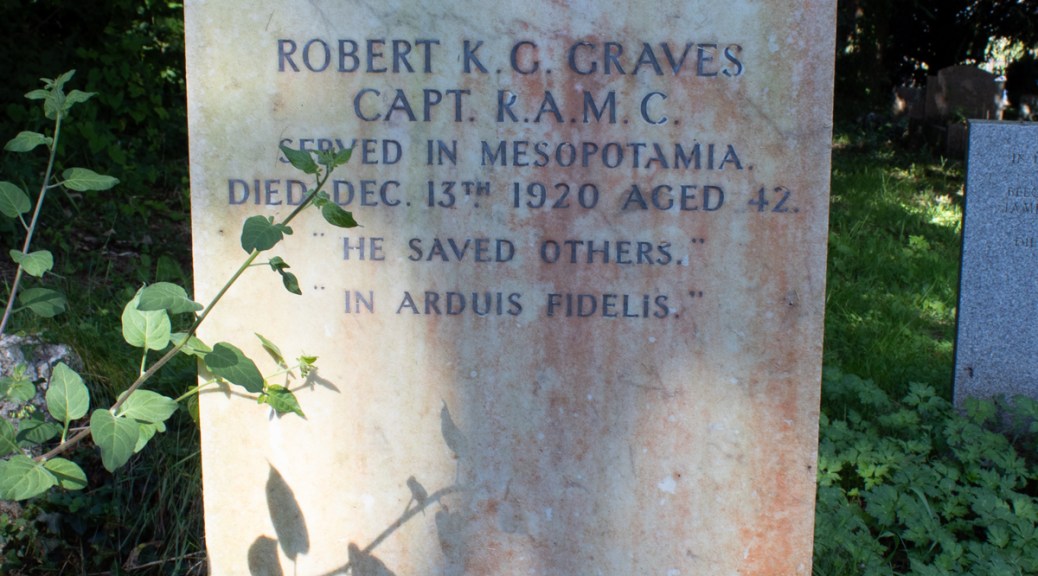
Robert’s time in the army, is hard to piece together. He joined the Royal Army Medical Corps as a Captain, and appears to have been connected to the air force. His headstone suggests that he served in Mesopotamia, but when and exactly where, however, is lost to time.
After the war, Robert returned to Britain. Leaving the Somerset coast, however, he and Kathleen appear to have set themselves up in Dorset. He died, through causes not detailed, on 12th December 1920, at 42 years of age. His entry on the probate register states:
GRAVES Robert Kennedy Grogan of 1 Charnwood Chambers Seabourne-road West Southbourne Hampshire died 12 December 1920 at The Grange Buckfastleigh Devonshire…
It is unclear whether Charnwood Chambers was his working address, with The Grange being the family’s official home, or if Buckfastleigh served as a place of convalescence.
Robert Kennedy Grogan Graves left an estate totalling £370 14s 7d (approximately £21,100 today) to Kathleen. He was buried in the graveyard of Holy Trinity church, Buckfastleigh.
William Charles Mence was born in Blackheath, Kent in the spring of 1877. He was the oldest of five children to William Cookes Mence and his wife, Susanna.
William Sr was a chemist-turned-dentist, and by the time of the 1881 census, the family had moved to prestigious lodgings on the corner of Claremont and Victoria Roads in Kingston-upon-Thames, Surrey. William had set up practice in the building, and employed two servants to assist him with the practice, and two more to help Susanna with the family.
Dentistry would keep William Sr occupied for at least the next thirty years, a move to nearby Surbiton in the late 1890s being the only change tot he business.
William Jr, meanwhile, was making his own way in the medical world. The 1901 census recorded the 24-year-old Mr Mence visiting a possible mentor, physician and surgeon Charles Gallie, in Camberwell. William was also noted as being a physician and surgeon, and this was to become the career in which he forged his way.
On 9th August 1906, William married Dorothy Mytton in the Saint Aelhaiarn’s Church in Guilsfield, Powys, Wales. Dorothy was the daughter of a retired army captain, Devereaux Mytton. She had been born in Guilsfield and, at the time of the 1901 census, was living with her family and ten servants at Garth Hall, close to the village.
The young couple’s marriage certificate also sheds some light on William’s career. It confirms that he was working as a medical practitioner, and was living in the village of Perranzabuloe in Cornwall.
William and Dorothy went on to have five children, and named them to reflect their combined family histories. Daughter Evaline Dorothy Cookes Mytton Mence was born first, in 1907, followed by sons John Herbert Myttone Cookes Mence, Devereaux Mervyn Mytton Cookes Mence and Godfrey Powis Mytton Cookes Mence. Their fifth child, daughter Myfanwy Susan Mence, was born in 1914.
When war broke out in Europe, William was drawn to play his part. While full details about his service are not available, his public standing meant that he took a commission as Captain in the Royal Army Medical Corps. His Medal Roll Index Card confirms that he was awarded the 1914-1915 star, so he joined early in the conflict. It also outlines that he served in Mesopotamia from 4th February 1916, in France in 1917 and in Salonika from 1917 to 1919.
Ill health seemed to have dogged him in later years, and by the summer of 1919, Captain Mence had returned to British shores, and to Devon, where his practice had moved to shortly before the conflict.
Dr William Charles Mence, of Axminster, who died in Axminster Cottage Hospital on Friday night, recently returned from active service… He was a medical officer under Axminster Board of Guardians…
Western Morning News: Monday 28th July 1919
William Charles Mence died on 25th July 1919 as a result of an ongoing illness: he was 42 years of age. He was laid to rest in Axminster Cemetery, not far from the family home.
Francis James Leach was born on 27th June 1878 in the Somerset village of Martock. He was the middle of four children to John and Louisa Leach. John was a solicitor who was 17 years older than Louisa, who was his second wife, and by whom he had had two children. The 1881 census found the family living in a house called The Lawn on Church Street, supported by five servants: a nurse, an under-nurse, a cook, a housemaid and a footman.
The next census return, taken in 1891, recorded the family having moved to Seaton in Devon. Louisa was living at 7 West Cliff Terrace with five of the children and a domestic servant. John, however, is not noted on the document, although Louisa is still recorded as married, which would suggest that he had not passed away.
A later newspaper report helps build a picture of Francis’ life growing up:
…Leach was educated at Allhallows School, Honiton, was a thorough sportsman in every sense of the word, a good shot, a keen rider to hounds, a polo player, and cricketer.
[Exeter and Plymouth Gazette: Friday 7th May 1915]
When he finished his schooling, Francis felt drawn to an army career, and the newspaper confirmed his progress:
He served through the Boer War with the R Battery, Royal Horse Artillery, and was present at the relief of Kimberley and at the actions at Paardeberg, Poplar Grove, Zand River, Johannesburg, Pretoria, Diamond Hill and Wittebergen, and was awarded the Queen’s medal with six clasps and the King’s Medal with two. He was given his commission in the Shropshire Light Infantry in 1901, attained the rank of Captain last August and was appointed Adjutant of his Battalion February 2nd, 1914.
[Exeter and Plymouth Gazette: Friday 7th May 1915]
The 1911 census found Francis back with his mother. She was now living in the village of Hawkchurch, near Axminster, living in a 9-roomed house called The Vineyard. Louisa also had her daughter and two servants – a cook and a housemaid – supporting her. The census return also confirmed that Louisa was a widow, John having died some rears previously. Francis’ visit may have been a fleeting one, as his fiancée, Doris Maunsell-Smyth, was also visiting in preparation for a wedding.
Francis and Doris exchanged vows on 29th July 1911, the wedding taking place in Christ Church, Paddington, Middlesex. Their marriage certificate confirmed that the groom was an army officer, while the bride’s father, George Maunsell-Smyth, was noted simply as a gentleman.
When war broke out in the summer of 1914, Captain Leach and his unit was called up to play their part. Full details of his service have been lost to time, but he was sent to the the Western Front by December that year. Over the coming months, the battalion was involved in the Battle of Eloi and the Second Battle of Ypres.
The funeral of Captain Francis Leach of the 2nd Battalion Shropshire Light Infantry, as taken place in the village churchyard amid every token of respect and sympathy. The officer died at Boulogne of wounds received in action in Flanders.
[Exeter and Plymouth Gazette: Friday 7th May 1915]
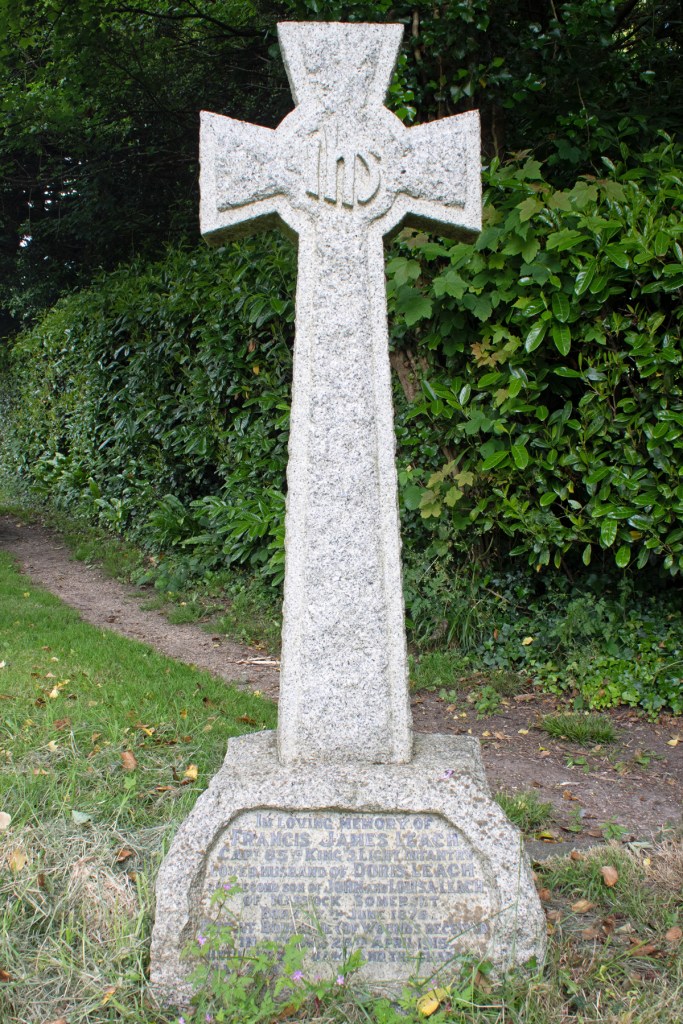
Captain Leach died of his injuries on 26th April 1915. He was 36 years of age.
Interestingly, despite a decree that the conflict’s fallen would be buried overseas if that was where they died, it seems that Captain Leach’s family were able to circumvent that ruling. Whether that was because he died in a hospital ship in Boulogne’s harbour is unclear, but had he died in the town itself, he should have been laid to rest in France.
Either way, the body of Francis James Leach was brought back to Devon for burial. He was laid to rest in the graveyard of St John the Baptist Church, Hawkchurch, not far from where his mother still lived.
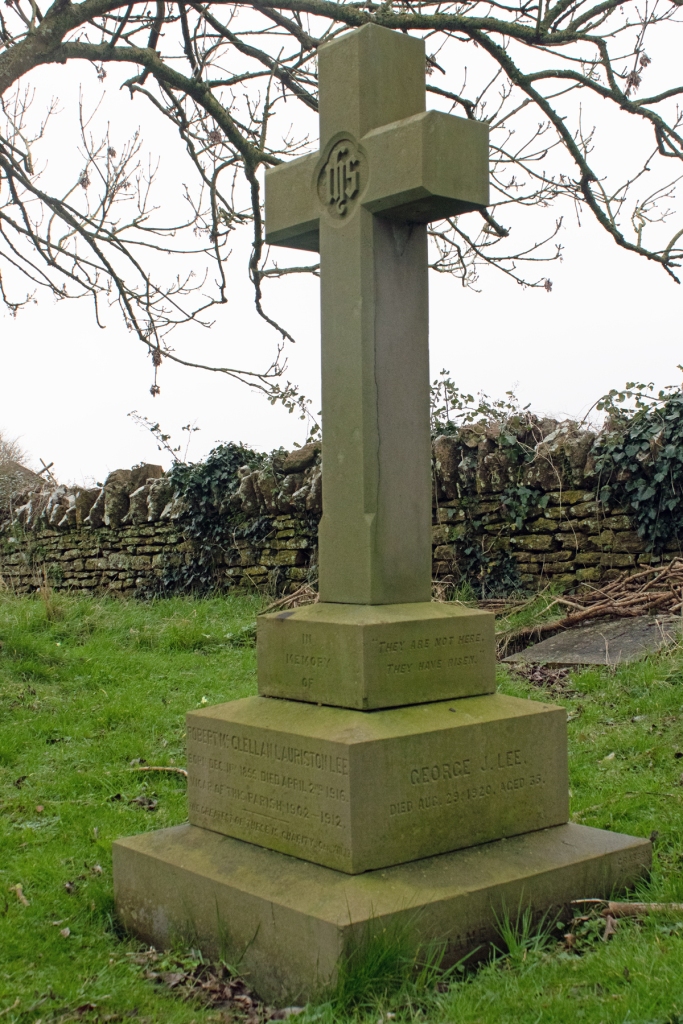
Anyone who attended the funeral of Captain George Lee, IMT (late Rifle Brigade), held in the churchyard of his old home, Yetminster, on Wednesday could not but have been impressed by the wonderful sense of peace and rest that pervaded the place. After a life of unique adventure in Africa, India, America, and Canada his worn and suffering body was laid to rest beside his beloved father. The solemn service was taken by his uncle, Red. EHH Lee (vicar of Whitchurch Canonicorum) and his cousin, Rev. E Hertslet (vicar of Ramsgate), and Rev. MJ Morgan (vicar of Yetminster), there being also present his old schoolfellow, Rev. J Lynes, and Rev. Hall, curate of Yetminster. Besides the chief mourners Captain Lee’s mother, sister and brother-in-law, there were many friends present and numerous villagers who had known him from boyhood. The coffin was attended throughout the service and for many hours before by his most faithful servant and friend, Rajab Ali Khan, who was with his master through India, Persia, Beluchistan, and Afghanistan, and came to England as his personal attendant when Captain Lee was sent home on sick leave. After the service in the churchyard Rajab, through the kindness of Mr Hall, who translated for him, was able to tell everybody what his master had been to him.
Dorset County Chronicle: Thursday 9th September 1920
George Johnston Lee was born in the summer of 1886, the second of four children to Reverend Robert Lee and his wife, Elizabeth. Robert was the vicar of St George’s Church in Fordington, Dorset, when George was born, but moved west to Toller Porcoram not long after he was born.
Tantalisingly little information about George’s early life remains. He does not appear on the 1901 or 1911 census records, and it is likely that he was already away travelling the world by this point. It seems clear that he followed a military, rather than a clerical, career and, by the end of the First World War he was serving in the Indian Army Reserve of Officers. Attached to the Rifle Brigade, George had reached the rank of Captain.
George’s father had become ill in the early 1910s, and having moved to St Andrew’s Church in Yetminster, he retired from the post in 1912. He and Elizabeth moved to Dorchester, but when he passed away in 1916, at the age of 59, his last wishes were to be buried in Yetminster, the village having held a special place in his heart.
Captain Lee survived the First World War, but, as the newspaper report suggests, he became unwell. George had contracted amoebic dysentery, and returned to England to recuperate. The condition was to prove too severe, and he passed away in London on 29th August 1920, at the age of 34 years old.
In accordance with the family’s wishes, George Johnston Lee’s body was taken back to Dorset, and he was laid to rest next to his father, in the tranquil St Andrew’s Churchyard, Yetminster.











 Death and Service