Tag Archives: family

Private Albert Townsend

Private Albert Townsend

Albert Henry Townsend was born on 7th November 1890 in Bath, Somerset. One of thirteen children, his parents were George and Annie Townsend. George was a painter by trade, but when he died in the autumn of 1895, Annie was left to take in laundry to earn money to support her and the four of her children still living at home.

By the time of the 1911 census, Albert was 21, and had found work as a baker. He was still living with his mother, two siblings and a nephew in a house in the centre of the city. All but Annie’s grandson were earning money by this point, and, with five rooms, the family were in a better position than some of their neighbours. Next door was Albert Smith, a coal carter, who had to support a family of ten people.

In the summer of 1914 war broke out, and within months, three of the Townsend brothers – Albert and his older brothers Arthur and Charles – had enlisted.

Arthur Townsend had joined the Duke of Cornwall’s Light Infantry earlier in the year, and within weeks of conflict being declared, he was on the Western Front. He was to be one of the early casualties of the conflict, and was killed in action during the Battle of the Marne on 9th September. He was just 29 years old and, while his body was never identified, he was commemorated on the La Ferte-sous-Jouarre Memorial.

Albert’s service records have been lost to time, so it is not possible to identify when he enlisted. He joined the Somerset Light Infantry, and was assigned to the 4th Battalion, who set sail for India in October 1914. Private Townsend was not to travel with them, however as he had contracted septicaemia while camped on Salisbury Plain, Wiltshire. He was transferred to the Royal United Hospital in Bath for further treatment, but his condition was to prove too severe. He passed away while still admitted on 19th October 1914. He was just 23 years of age.

Albert Henry Townsend was laid to rest in the St James’ Cemetery in his home city, Bath.


Annie Townsend had now been a widow for nearly twenty years and, within a matter of weeks, had lost two of her sons. Tragically, the war was not done with her family yet.

Charles Townsend was still serving, having enlisted in the 8th Battalion of the Somerset Light Infantry. He arrived in France in July 1915, and over the next year, wascaught up in some of the fiercest fighting of the conflict. On 1st July 1916, the Battle of the Somme began, the darkest day in history for the British Army. Twenty thousand soldiers were killed, and Private Charles Townsend was amongst the fallen. He was just 30 years of age. He was commemorated on the Theipval Memorial.

Annie had lost a third son to the conflict in a little under two years, and her pain must have been unimaginable. She lived on until 1923, when she died at home in Bath. She was laid to rest close to her husband and Albert, a family partly reunited once more.


Private Ernest Whatley

Private Ernest Whatley

Ernest James Victor Whatley was born in the spring of 1899, the youngest of three children to George and Clara Whatley. Clara passed away in 1908, and George remarried the following year, to a woman called Sarah. Ernest’s brothers were sixteen years older than him, and so by the time of the 1911 census they had moved out of their father’s home. By that point, Ernest living with his father and stepmother in their house in Bath, Somerset.

Little further information is available about Ernest. With war raging across Europe, he enlisted in the army, but this was not before September 1916, and it is likely that he came of age before joining up.

Private Whatley served in the 1st/7th (Cyclist) Battalion of the Devonshire Regiment, and was based in Suffolk. It is while he was billeted that he was admitted to a hospital in Ipswich, although the cause of his admission is unclear.

Whatever befell Private Whatley, it was to prove his undoing. He passed away in the Ipswich hospital on 9th March 1917, at the tender age of just 18 years old.

Ernest James Victor Whatley’s body was brought back to Somerset for burial. He was laid to rest in St James’ Cemetery, Bath, not far from his mother, Clara.


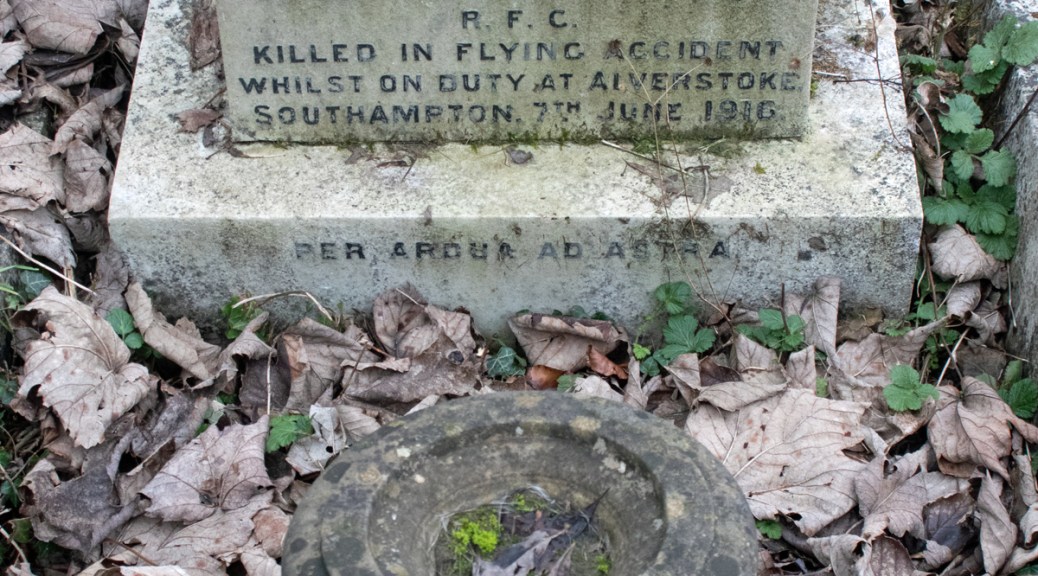
Lieutenant Gilbert Rippon

Lieutenant Gilbert Rippon

Gilbert Harold Earle Rippon was born in Paddington, London, in the spring of 1887. The third of seven children, his parents were coal merchant Frederick Rippon and his wife, Eugenie.

When Gilbert left school, he found work as a clerk for a building firm. He was an ambitious young man, however, and, after his mother died in 1903 and his father a few years later, he took on work at a rubber plantation in Jementah, Malaysia.

When war broke out, “he came home on six months’ leave in order to enlist, having an exciting voyage owing to the activities of submarines. He was refused at first owing to a slight physical defect, but after an operation learnt to fly and was given a commission in the Royal Flying Corps.” [Somerset Guardian and Radstock Observer: Friday 9th June 1916]

Second Lieutenant Rippon gained his wings at Brooklands in Surrey on 16th January 1916. By the summer he was attached to a flying school in Gosport, Hampshire, and this is where he was based by the early summer of 1916.

On 7th June, Gilbert was flying a de Havilland DH2 aircraft, when an accident occurred. According to a newspaper report: “Evidence showed that the machine, when 300 feet [91m] up, made a double turn, as though the aviator was trying to return. It then slipped and made a nose-dive to the ground, killing the pilot instantaneously. He had only been in the air three minutes. The previous evening the same monoplane had ascended 14,000 ft [4267m].” [Somerset Guardian and Radstock Observer: Friday 9th June 1916]

Second Lieutenant Rippon was 29 years of age. The same report confirmed that he was the older brother of two Bath and Somerset cricketers – twins Dudley and Sydney Rippon – and that his oldest brother, New York-based Secretary of the Board of Correction Frank Rippon, “had the unhappy experience of being in the aerodrome when the accident occurred, and saw his brother fall to the ground.”

Gilbert Harold Earle Rippon was laid to rest in the family plot St James Cemetery, Bath, Somerset. There seems to have been a family connection with the city: this is where both Frederick and Eugenie were buried, and where, after their parents’ deaths, the twins and the youngest Rippon son, Percy, were taken to live.


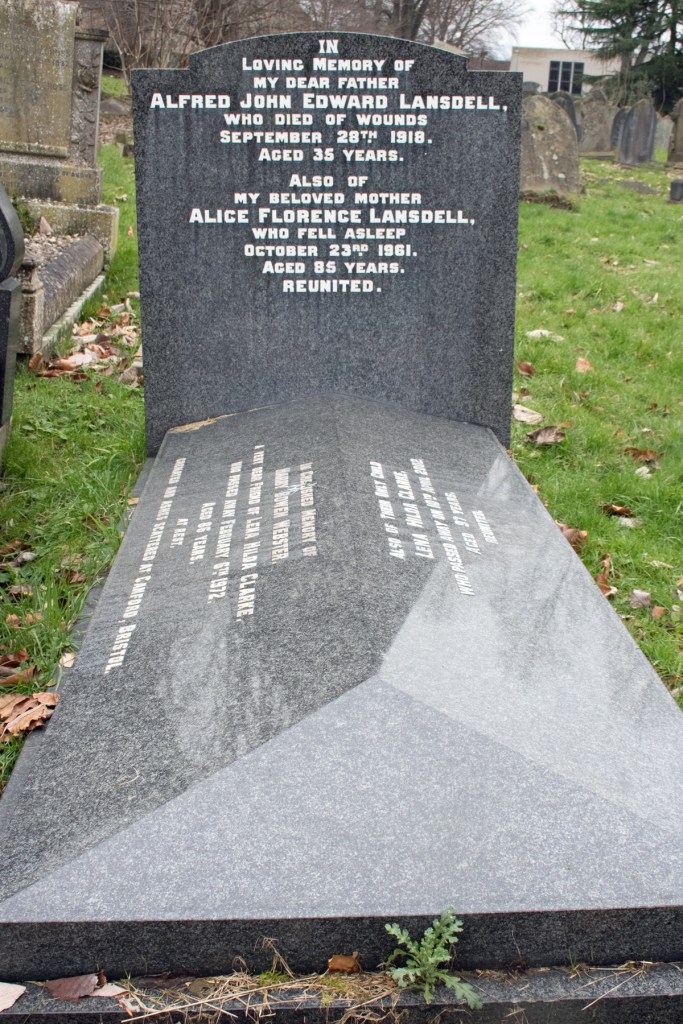
Private Alfred Lansdell

Private Alfred Lansdell

Alfred John Edward Lansdell was born on 25th October 1882 in Fulham, London. The fourth of six children, his parents were James and Matilda Lansdell.

James was a trunk maker, working in his father’s business. By the time of the 1901 census, he was recorded as living by his own means, while Alfred had taken up employment as a hotel porter in Chelsea.

By 1902, Alfred had moved to Somerset and set up home in Bath. He married local woman Alice Stevenson, and the couple went on to have a daughter, Lena, who was born in November 1904.

The 1911 census found the family living in central Bath, Alfred continuing his portering work, with one of his colleagues, lift operator Thomas Ward, boarding with them.

War came to Europe and on 9th December 1915, Alfred stepped up to play his part. He enlisted in the Worcestershire Regiment, and was formally mobilised the following June. Alfred’s service records confirm that he was, at the time of his review, he was 35 years old and 5ft 6ins (1.67m) tall.

Private Lansdell was assigned to the 1st/7th Battalion and by October 1916, he was shipped to France. He was very much on the Front Line, and was wounded on 19th August 1917, while at Ypres. His casualty record notes that “while waiting in a shell hole for a further move on he was wounded… in the back”. He has been shot, and the bullet penetrated his kidney.

Initially treated in a hospital in France, Private Lansdell was transferred to England on 25th October. He was admitted to the Norfolk War Hospital and remained there for some time.

Alfred’s injuries were too severe for him to continue in the army, and he was formally discharged on 20th March 1918. He eventually returned home to Bath, but in the end his poor health was to get the better of him. He passed away at home on 28th September 1918, at the age of 35.

Alfred John Edward Lansdell was laid to rest in St James’ Cemetery, Bath. Alice lived on until 1961, when she was buried with her late husband, a couple reunited after more than four decades.


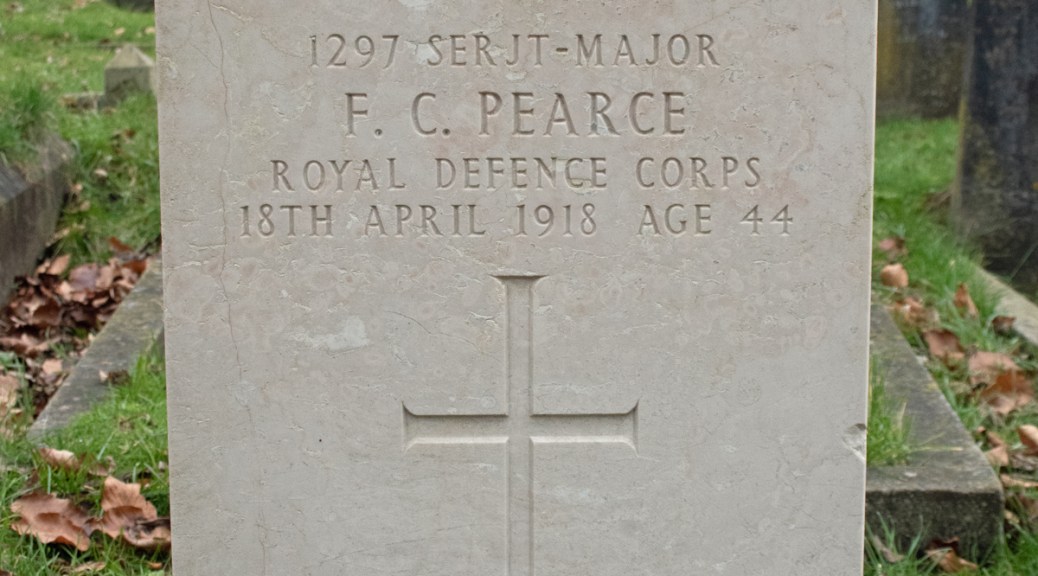
Serjeant Major Frederick Pearce

Serjeant Major Frederick Pearce

Frederick Charles Pearce was born in the spring of 1873 in the Gloucestershire town of Thornbury. The youngest of six children, his parents were Thomas and Elizabeth Pearce. Thomas was an agricultural labourer and, when he finished school, Frederick found work as a ‘rural messenger’.

This was only a step towards the career that Frederick sought, however, and on 12th July 1892, he enlisted in the Gloucestershire Regiment a a Private. His service records show that he was 5ft 5ins (1.65m) tall and weighed 128lbs (58kg). He was noted as having a fresh complexion, blue eyes and brown hair.

Private Pearce spent twelve years in the army, serving in Malta, Egypt, India and Ceylon (Sri Lanka). He had two stints in South Africa, including the 1899-1900 campaign, during which he was wounded in his chest in the battle at Farquhar’s Farm.

By the time he was discharged on 11th July 1904, he had risen through the ranks to Sergeant, his service records noting that his conduct had been “very good” (in capitals and underlined).

Thomas had died in 1896, and Frederick’s widowed brother William moved back in with his mother to help support her. Frederick also returned to Gloucestershire and, on 30th March 1905, he married Mary Rugman in the parish church in Olveston. The couple may have been childhood sweethearts, as the Pearces and Rugmans were Thornbury neighbours.

The marriage certificate noted Frederick as a groom, and it is likely that he was able to turn his hand to any role after his army career. The couple had a son Leslie, who was born in 1909, and, with the new responsibility of fatherhood, Frederick sought a more permanent career.

The 1911 census found the family living in Somerset, where Frederick was employed as a gardener at the Kingswood Reformatory School. This was a boarding school on an estate to the north of Bath, set in 57 acres of grounds, and again it seems likely that his military career stood him in good stead for such a prestigious role.

When war came to Europe, Frederick felt the pull of his military career once more. While his age did not compel it, on 20th November 1914, he re-enlisted in the Gloucester Regiment. He was enlisted with his previous rank, but within a year has been promoted to Acting Colour Sergeant.

In the spring of 1916, the Royal Defence Corps was formed, and, given his experience and age, Frederick was transferred across to the new regiment. Colour Sergeant Pearce was based in London and, over the next eighteen months served in four troops: 109, 149 and 150 Protection Companies and the 10th City of London Volunteers’ Regiment.

Frederick’s age and the demands of his role were beginning to take their toll by this point, and by the end of 1917, he had developed nephritis, or inflamed kidneys. The condition was severe enough to warrant his discharge from service, and the now Sergeant Major Pearce’s military career came to an end on 17th January 1918.

Frederick returned home to Bath, to the bosom of his family. He and Mary three children by this point, Violet and Freddie being two younger siblings to Leslie. Tragically for the Pearces, however, the family life was not to to last for long: Frederick’s condition was to get the better of him just three months later. He passed away on 18th April 1918, at the age of 44 years old.

Frederick Charles Pearce was laid to rest in St James’ Cemetery in Bath; a man of duty resting at last.


Tragedy was to strike again for poor Mary, when just six months later her youngest child, Freddie, also passed away. Details of his death are vague, but he was buried with his father, the two Fredericks reunited too soon.


Air Mechanic 3rd Class William Mells

Air Mechanic 3rd Class William Mells

William John Mells was born in Southwark, Surrey, on 13th November 1873. His parents were Thomas and Elizabeth Mells, although much of his early life is lost to time.

The 1891 census found the 19-year-old William as one of four boarders living with the Skinner family in Peckham, Surrey, where he was working as a shoe maker. By the turn of the century, however, he had changes jobs, and was employed as an advertising contractor, possibly fixing signs to walls across the country.

It was while William was working in Somerset when he met Ethel Pryor. She was the daughter of a caterer, born and bred in Somerset. On 16th August 1903, the couple married at Ethel’s parish church in Bath. They set up home in a small cottage on King Edward Road in the city, and went on to have two children, Edith, who was born in 1904, and John, who was born the following year.

Storm clouds were brewing across Europe at this point, and William was called upon to play his part in the autumn of 1918. He had previously served as part of the Army Service Corps Volunteers, and had reached the rank of Lance Corporal. When his time to actively serve King and Country came, however, he chose the fledgling Royal Air Force and, on 24th October 1918, joined them as an Air Mechanic 3rd Class.

William was sent to Blandford Forum, Dorset, for training. While here, in packed and busy billets, he contracted influenza, which developed into pneumonia. He passed away from the conditions at the camp hospital on 3rd November 1918, ten days short of his 45th birthday, eight days before the end of the conflict and after just ten days’ service.

William John Mells’ body was brought back to Somerset for burial. He was laid to rest in the city’s St James’ Cemetery, and was joined by his widow, when she passed away in 1955.


The Commonwealth War Graves Commission headstone and website gives Air Mechanic Mells’ name as John William, but all other records – including censuses, marriage document and service records – confirm his name as William John Mells.


Private Francis Millard

Private Francis Millard

The early life of Francis Albert Millard is lost to time. He was born in 1894 in Bath, Somerset. His gravestone notes that he was the adopted son of AE and H Evans, though there are no census records confirming the three as a family. His military records specifically note that he has “no relations alive only one brother who is younger than myself nor have I any guardians”.

Interestingly, when Private Millard passed, Mrs Harriet Evans, who was noted as a foster mother, applied for his personal effects. Two days later, and Albert Francis Millard, who was claiming to be Francis’ father, also put in an application.

Francis was working as a seaman when he formally enlisted. He had previously been a volunteer in the Durham Light Infantry, and was readily accepted in the regiment’s 2nd Battalion. He joined up in November 1911, his service records noting that he was 5ft 3ins (1.6m) tall, 104lbs (47.2kg) in weight, with a fresh complexion, blue eyes and light brown hair. He was also noted as having a tattoo of the figure of a woman on his right forearm and a scar on his left buttock.

Over the next couple of years Private Millard was reprimanded a couple of times for small misdemeanours – being absent from bread rations on 15th September 1912, and being absent from the company officer’s lecture on 22nd February 1913. During this time he had been promoted to Lance Corporal, but the reprimand he received demoted him to Private once more. Overall, however, his service appears to have been a positive one and, when war was declared, he soon found himself on the Western Front.

[Priavte Millard] was present at the retreat from Mons. He took part in the advance over the Marne and the Aisne, and [had] been engaged in the battles around Ypres. In the early part of August [1915] a charge was ordered, and in this he took part. The late Captain RH Legard… to whom Millard was servant, fell. Millard ran to his assistance, and was wounded in two places…

Bath Chronicle and Weekly Gazette: Saturday 21st August 1915

Francis received gun shot wounds to his thigh and across his spinal column. He was medically evacuated to Britain for urgent treatment. Admitted to the King George Hospital in South London, his admission notes make for stark reading:

Patient very collapsed. Sunken eyes, some delirium. Small circular wound on right shoulder behind level 1st Dorsal spine 2″ from middle line; wound on inner side of left thigh, with suppuration and cellulitis. Can move both arms but very poor power. Patient continued to go downhill rapidly after admission despite stimulation (brandy, [strychnine], saline).

A telegram was sent to Harriet and she took the first train to London. She arrived on the evening of Tuesday 17th August, and remained by Francis’ bedside until he passed away the following morning. He was just 21 years of age.

The shattered body of Francis Albert Millard was brought back to Somerset for burial. He was laid to rest in the city’s St James Cemetery.


Private Alfred Stoyle

Private Alfred Stoyle

Details of Alfred Lawrence Stoyle’s life a challenging to piece together. Most of the information comes from his service records, but even that is limited.

The Somerset Light Infantry records suggest that Private Alfred Stoyle was born in March 1890 in Widcombe, Bath. Physically, he was 5ft 8ins (1.73m) tall, and weighed 109lbs (49.4kg). He had blue eyes, brown hair, a tattoo of crossed flags on his right forearm and a scar above his right eye.

According to the document, Alfred’s parents were Alfred and Ellen Stoyle, and he had been working as a mason’s labourer before he enlisted on 13th February 1909. Early records for the Stoyles are hard to come by, The 1891 census found Alfred and Ellen living in Walcot, Somerset, with their eight children. They have a son, Alfred, although he is noted as being 19 at the time, which does not match the service records for the Alfred who enlisted. They have another son, Albert, who was born in 1886, and it seems that he may have used the name Alfred when enlisting (indeed, those service records note not only Alfred’s parents, but his older siblings Nellie, Ada, Henry and Alfred).

The next census, in 1901, recorded Alfred Sr as being a pauper in the Bath Union Workhouse. He was also listed there in the 1911 census, while that document recorded Ellen living in two rooms in the centre of Bath with Albert/Alfred and her youngest son, William.

Alfred Jr was recorded as being a general painter. By this time, he had enlisted in the Somerset Light Infantry, and was on reserve status, allowing his daily life to continue. He undertook annual training, and, when war broke out in August 1914, he was formally mobilised.

Private Stoyle was sent to France the following month, and ended up spending four months there. In January 1915 he returned home, and there appears to have been a medical reason for doing so. Within a matter of months, he was discharged from the army as he was no longer physically fit. The service records do not give a reason for his dismissal.

At this point, Alfred’s trail goes cold. He seems to have returned home to Somerset, and passed away on 21st August 1915. Based on his service records, he was just 25 years old, although his true age is debatable.

Alfred Lawrence Stoyle was laid to rest in St James’ Cemetery Bath.


Able Seaman William Green

Able Seaman William Green

William Charles Green was born on 27th December 1897, one of five children – and the only son – to William and Mary Green. The family’s backstory is a bit hard to decipher.

William Sr was born in the Bath Union Workhouse in 1869 and the only details of his parentage comes in his marriage certificate, which suggests that his father was also called William Green, who was deceased. The same document records the groom as being a miner, and that he and Mary were living in Widcombe, Bath.

The Greens do not appear on the 1901 census – or at least that census record for them is lost to time. The next census return, in 1911, does have the family recorded as living in three room in St George’s Place, Widcombe. This particular census was the first to put the onus on the resident to complete the form, and, in William Green Sr’s case, this has led to a handful of anomalies in the record.

William Sr notes his trade as “going out with commercial travellers and hotel work also”. He confirms that he was “Somerset-born”, but suggests that Mary was born in “South Wells” (a spelling error, which should be South Wales), even though her birth and marriage certificate confirm she came from Bath.

The Greens certainly spent some time in Wales – their eldest daughter was born in Merthyr Tydfil, while William Sr was working as a miner there. By the time of William Jr’s birth, however, the family seem to have returned to England – he is recorded as coming from Bath.

William was 13 years old at the time of the 1911 census, and still at school. When he left education, he found work at a fishmonger, but with war closing in on Europe by this point, he was keen to serve his King and Country.

On 7th May 1915, William enlisted in the Royal Navy and, as he was just under age, he was given the rank of Boy 2nd Class. His service records note that he was 5ft 1in (1.55m) tall, with brown hair, blue eyes and a fresh complexion. Intriguingly the records give the place of his birth as Aberdare, Glamorganshire, but whether it is this document or the 1911 census that is incorrect is impossible to confirm.

Boy Green was initially sent to HMS Impregnable, the training establishment based in Devonport, Devon. He spent four months there and, on the day he was promoted to Boy 1st Class, he was assigned to HMS Defiance, the navy’s Torpedo School, off the Plymouth coast. In October 1915 he was assigned to HMS Fox, and remained on board for the next three years.

Fox was a cruiser that patrolled the seas from the East Indies to Egypt and the Red Sea. While on board, William came of age, and was formally enrolled in the Royal Navy as an Ordinary Seaman. With a character that was classed very good, even if his ability was noted as satisfactory, within eighteen months he was promoted again, to Able Seaman.

In August 1918, William was assigned to HMS Mantis, a river gunboat that patrolled the Tigris around Baghdad. He remained on board until the end of the year, when he was assigned to HMS Vivid, the Royal Naval Dockyard in Plymouth.

Over the next fifteen months, Able Seaman Green’s time was split between Plymouth and HMS Columbine, the naval base at Port Edgar on the Firth of Forth. It was when he was back in Devon, early in 1920, however, that he fell ill.

Able Seaman Green had contracted influenza, which had developed into pneumonia, and it was the combination of lung conditions that was to ultimately take his life. He passed away at the naval base on 5th March 1920, at the age of just 22 years old.

William Charles Green’s body was brought back to Somerset for burial. He was laid to rest in St James Cemetery, Bath, to be reunited with his parents when William Sr died in 1938 and Mary passed away in 1959.


Sapper Albert Colston

Sapper Albert Colston

Albert Edward Colston was born in the spring of 1887 in Bath, Somerset. The oldest of seven children, his parents were Thomas and Elizabeth Colston. Thomas was a carpenter and the family were raised in Lyncombe, to the south of the city centre.

Elizabeth died in 1905, by which time Albert had left school. He worked with Thomas and, by the time of the 1911 census, the family – father and four children at home – had moved to a terraced house in the suburbs of Twerton.

During this time, Albert volunteered with the Somerset Light Infantry. When war came to Europe, however, he was enlisted into the Royal Engineers. He joined on 28th February 1916, and was assigned to the Wessex Field Company. His service record show that he was 5ft 8ins (1.73m) tall, of normal physical development and with good vision.

A few months after enlisting, Albert married Alice Selway. She was a groom’s daughter from Bath who, at the time of their marriage, was working as a housemaid in a boarding house in the centre of the city.

Sapper Colston spent the next year on home soil. In March 1917, however, he was discharged from the army as he was deemed no longer medically fit for active duty. Sadly, the records do not confirm the complaint that led to his dismissal.

It is likely that he returned home when he was discharged. He died in Bath just weeks later, on 4th April 1917. He was thirty years of age.

Albert Edward Colston was laid to rest in St James’ Cemetery in his home city, the same location as Elizabeth, mother and son reunited again.


Alice married for a second time in May 1919. He husband was William Keepen, and the couple went on to have a son, Reginald, who was born in 1920. Reginald died in 1937, while Alice lived until 1918. The couple were buried in Haycombe Cemetery on the outskirts of Bath.