Tag Archives: family

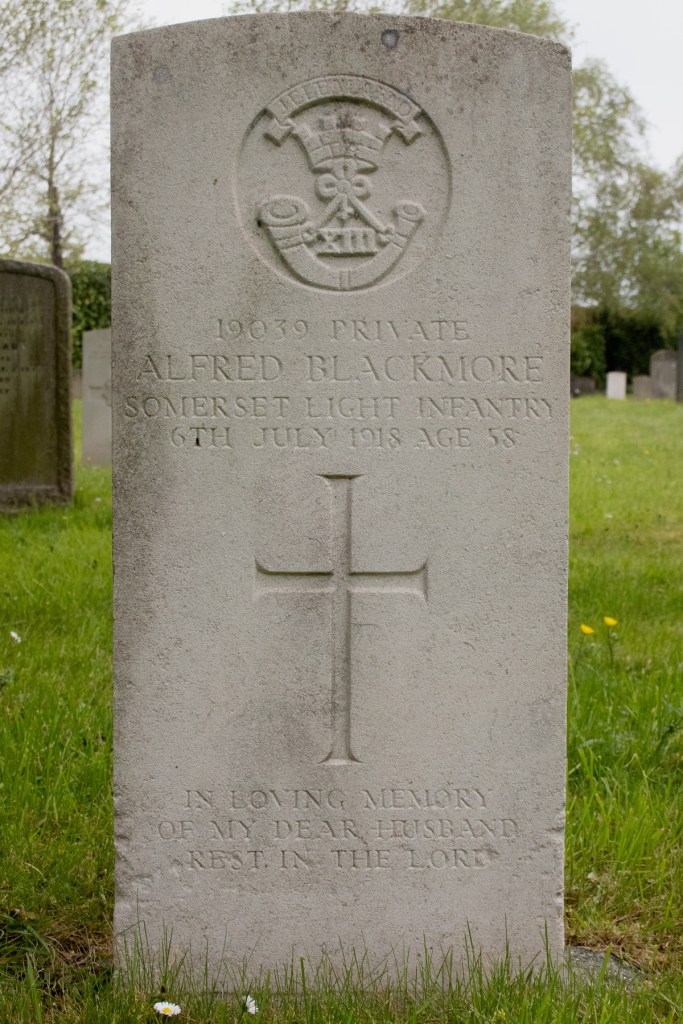
Private Alfred Blackmore

Private Alfred Blackmore

Alfred Blackmore was born on 25th October 1868 in the village of Thurlbear, near Taunton. Documentation varies and names cross over, but it appears that he was one numerous children to farm labourer William Blackmore and his wife, Mary Ann.

Details of Alfred’s early life are a bit hazy – again, in a rural location, names often cross over, so it is a challenge to totally confirm that they relate to the right person. His mother appears to have passed away by the time of the 1881 census, and Alfred was living with his father and three of his siblings and working as a farm hand.

Alfred again disappears off the radar for a while; in July 1894, he married Lucy Charlotte Yard, and the couple went on to have two daughters, Lucy and Beatrice. By 1901, the young family were living in the village of Frampton Cotterell, just to the north of Bristol, and Alfred had found employment as a marine fireman.

Ten years later, Lucy and the girls were still living in Frampton Cotterell, but Alfred was back in Taunton, lodging with a 75-year-old widow called Mary Croker and working as a labourer. This separation may have signalled the beginning of the end for the couple’s marriage.

War broke out, and it is evident that Alfred enlisted as a Private in the Somerset Light Infantry. Sadly, his service records are lost to time, but it appears that he served for at least three years.

The next time Alfred appears in documentation, it is a newspaper report on his passing, under the heading “Taunton Soldier’s Death”.

FOUND DROWNED AT BLACKBROOK

Mr F Foster Barham, coroner for West Somerset, held an inquest at the Blackbrook Inn, Ruishton, on Monday, relative to the death of Alfred Blackmore, aged 49, a private in the Labour Company at Taunton Barracks, whose body was found in the stream at Blackbrook on Saturday morning.

William Cozens, farmer… gave evidence of identification, and stated that on Friday he saw the deceased sitting by the hedge… about 400 yards from where the body was found.

William Richard Radnidge, butcher… stated that on Saturday morning he found the body in the stream dividing Ruishton from Taunton St Mary’s… His cap, belt and cape were on the bank. The deceased was lying face downward, his face and arms being in the mud below the surface.

PC Jenkins stated that at 10:45am on Saturday he received a communication from PC Wathen, in consequence of which he proceeded to Blackbrook, where he found the body lying under a hedge. He searched the body, and on it found a summons, returnable at Taunton on 29th June, for having failed to comply with a maintenance order obtained by his wife, Lucy Blackmore, on 25th September 1915, the sum of £2 13s [approx. £300 today] being due. On the back of the summons was written: “This is what my old cow has done for me.”

There was also the following letter: “When my body is found, don’t you give a farthing to my old cow. What I have got to come give to my brother, Edward Blackmore… Signed A Blackmore.” At the back of the letter was written: “Goodbye to all that I love.”

The deceased had left his lodging at nine a.m. on June 29th to attend the Taunton Police Court, but did not do so.

An officer stated that the deceased’s conduct during the three years he had been in the army had been satisfactory.

The Foreman of the jury said that according to the evidence they found that the deceased met with his death by drowning whilst temporarily insane.

Taunton Courier and Western Advertiser: Wednesday 10th July 1918

Alfred Blackmore took his own life on 6th July 1918. He was 49 years old [the war grave gives a different age].

Alfred lies at peace in St Mary’s Cemetery in Taunton, Somerset.


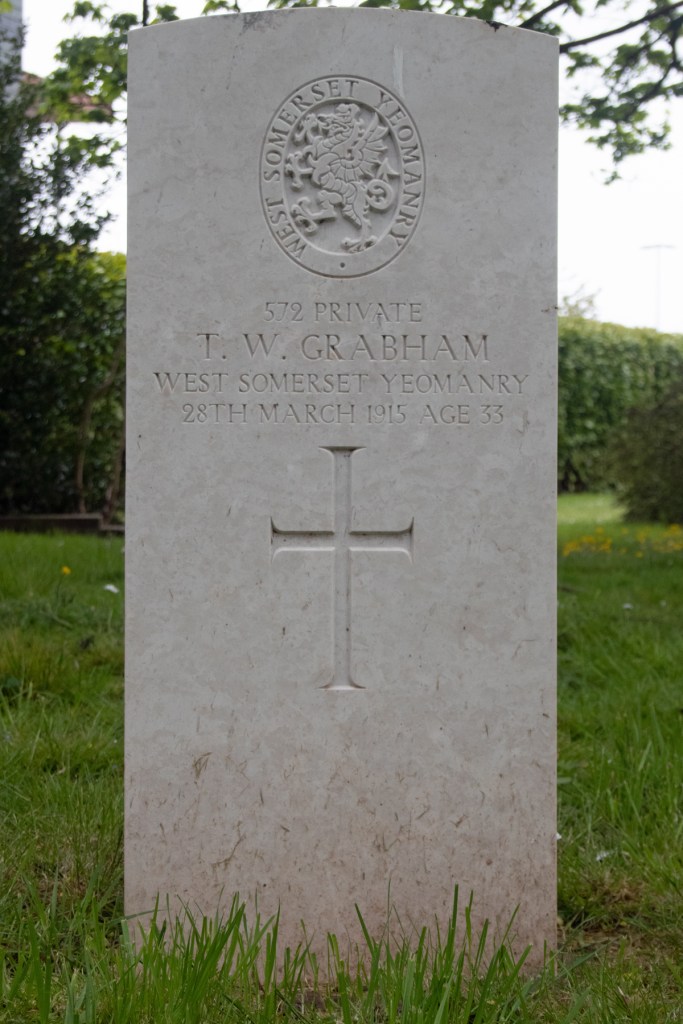
Private Thomas Grabham

Private Thomas Grabham

Thomas William Grabham was born in September 1883, one of six children to Thomas Richard Grabham and his wife Emma. Thomas Sr was a labourer and drayman for a brewery and the family lived in Taunton, Somerset.

When Thomas Jr left school, he found work as a grocer’s porter, before he too found work in a brewery, working as a maltster. He married a local woman, Maria Rowsell, and the couple went on to have a son, who they named after Thomas’ father.

Details of Thomas’ military service are sketchy; he enlisted in the West Somerset Yeomanry, but there are no details of when this was.

Sadly, Private Grabham’s period of service was short; his pension records show that he passed away from a perforated gastric ulcer on 28th March 1915. He was just 32 years old.

Thomas William Grabham lies at peace in St Mary’s Cemetery in his home town of Taunton.


Sadly, the tragedy for the young Grabham family was not to end there. Maria, Thomas’ widow, died just five months after her husband.

Young Thomas was just eight years old when his parents died; he seems to have been brought up by a Mrs Kate Barnes, possibly a maternal aunt. Here, however, the family’s trail goes cold.


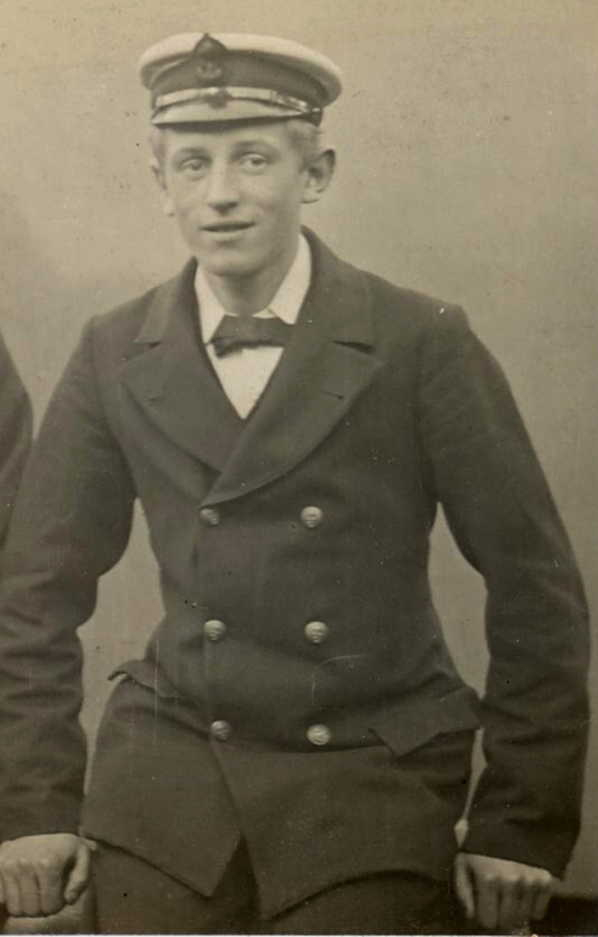
Able Seaman Gerald Brine

Able Seaman Brine

Gerald Montague Brine war born in October 1897, the youngest of seven children to John and Annie Brine. John was a potter, and, while the children were born in Dorset, the family soon moved to the Somerset village of Binegar.

Gerald’s three older brothers all went to work in a local stone quarry, as an engineer, breaker and foreman respectively. When Gerald left school, he found work with the local blacksmith as a striker. It was while employed there, in 1912, that his mother Annie passed away, aged just 50 years old.

War was on its way however, and where his brothers enlisted in the army, Gerald was bound for the sea. He enlisted in the Royal Navy on 3rd November 1915 and, as an Ordinary Seaman, was assigned to HMS Iron Duke. He was aboard the vessel when it became embroiled in the Battle of Jutland in May 1916, and was subsequently transferred to HMS Discoverer.

Promoted to Able Seaman in April 1918, the Discoverer headed back to Chatham a couple of months later. A Somerset newspaper picks up on Gerald’s sad tale from there.

When one of His Majesty’s ships was returning to port, and her crew were looking forward to “leave”, an unfortunate tragedy occurred by which Gerald Montague Brine, a young Able Seaman [and] a native of Binegar, lost his life. It appears that in the course of storing gear, a loaded revolver was removed by mistake to the armourer’s room, instead of to the officer’s cabin, and was placed on a table.

Curiosity led Peter Macfarlane, another able seaman, to handle it, and as he was bringing it to his side from an upward position, he, to use his own words, unconsciously pulled the trigger. It fired, and the bullet entered Brine’s body just under his left shoulder, fracturing his spine and producing paralysis of his lower limbs.

Wells Journal: Friday 12th July 1918

Gerald’s parents had a telegram to say that he was seriously wounded and in the Royal Naval Hospital, Chatham. They travelled at once to Chatham and found him very ill, but conscious. They remained with him until he died a week later, on 1st July 1918. He was just 20 years of age.

At the inquest, Macfarlane described Brine as his best chum, and all witnesses agreed that “the best possible relations existed between the members of the crew.” According to the doctor’s evidence at the inquest, Gerald was unable to be saved. The jury reached a verdict of Accidental Death.

Able Seaman was brought home to Binegar, and lies at rest in the graveyard of Holy Trinity Church.


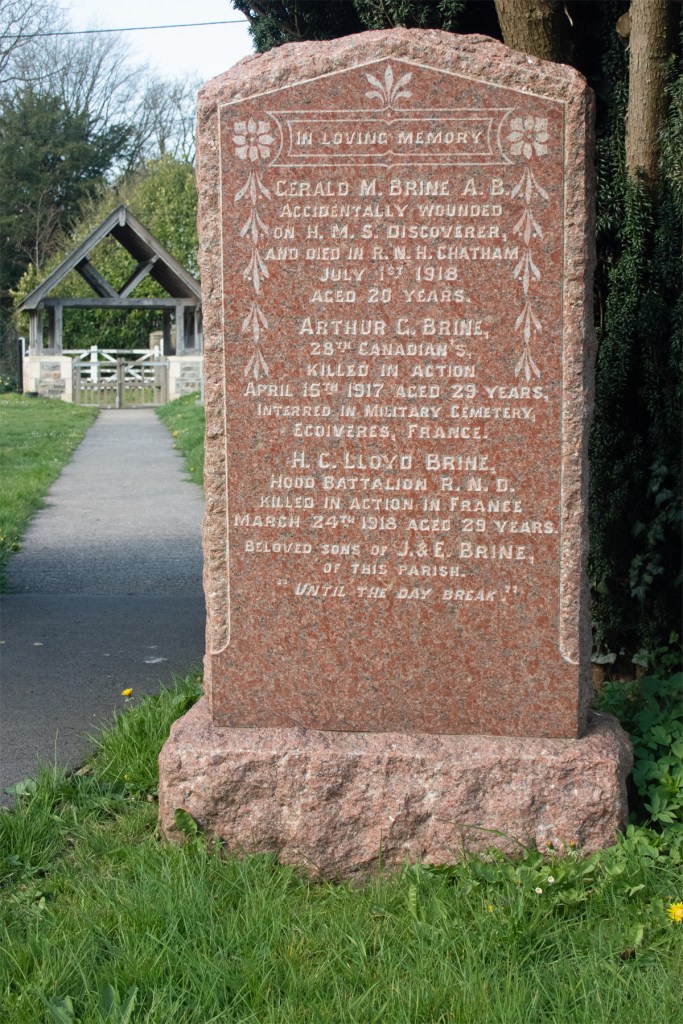
Gerald’s grave also acts as a memorial to two of his older brothers.


Arthur Brine, who had been the stone breaker in the quarry, emigrated to Canada after his mother had died, finding work there as a fireman. The Great War brought him back to European shores, however, and he enlisted in the Canadian Expeditionary Force, joining the 188th Battalion.

Private Brine arrived in England in October 1916; he transferred to the 28th Canadians, and set off for France the following January. He was caught up in the Battle of Arras and was hit and killed by a piece of shrapnel on 15th April 1917. He was just 29 years old.

Arthur Brine lies at peace in the Ecoivres Cemetery to the north west of Arras in Northern France.


Herbert Brine had been the foreman at the stone quarry He married Sarah Lucy James shortly before his mother’s death in 1912; the couple went on to have two children, Arthur and Kenneth.

Herbert was mobilised in July 1917, initially joining the 3rd Reserve Battalion. He was drafted, as an Able Seaman, to the Hood Battalion, Royal Naval Division (RND) in November 1917, before re-joining his RND Battalion at Flesquières, near Cambrai, two months later.

In early March 1918, the Germans started bombardments in preparation for a major offensive. For ten days from 12th March, the Flesquières salient was drenched with nearly a quarter of a million (mostly mustard) gas shells, There were over 2,000 resultant casualties in the RND. After this preparatory shelling, the Germans attacked in enormous numbers.

By the end of the day, the situation was precarious and the Division was forced to retreat in steps, through Bertincourt, Ytres and the Metz lines, through the old Somme battlefields.

Able Seaman Brine was first reported missing on 24th March, but was only accepted as having been killed in action on that date nine months later.  As such, Herbert is commemorated by name on the Arras Memorial; his name also resides on Gerald’s gravestone back home in Binegar.


The Great War took its toll on the Brine family. Three of the four brothers died during those tumultuous years, leaving only John’s oldest son, Wallace, to carry on the family name. John himself died in 1942, aged 84, and lies with his wife and youngest boy in the small Binegar churchyard.


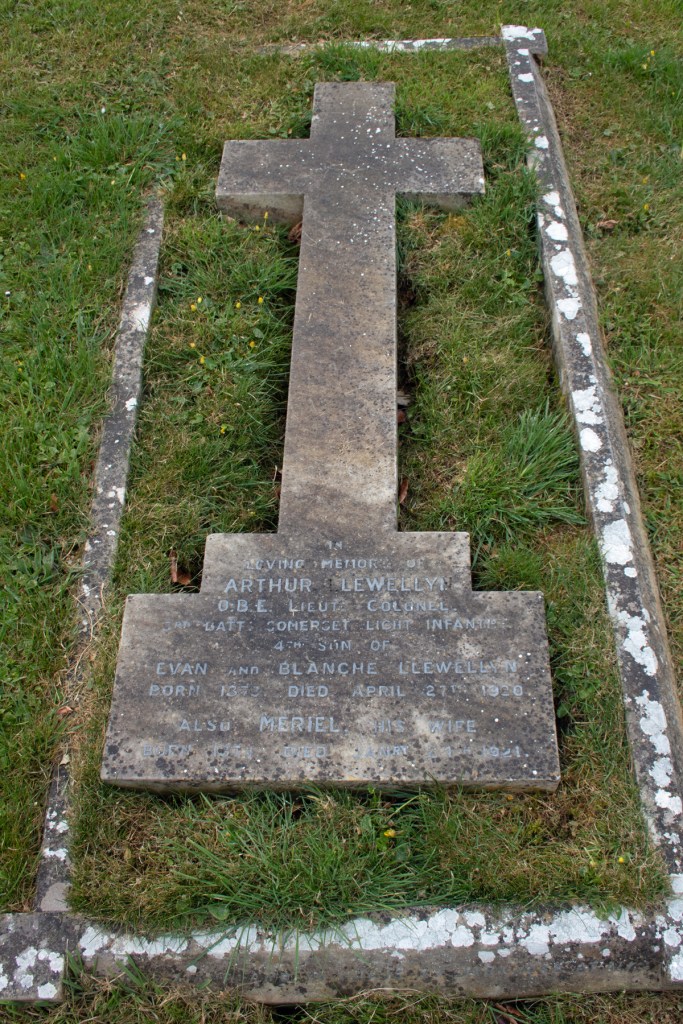
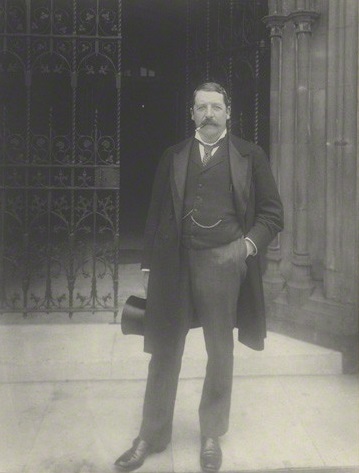
Lieutenant Colonel Arthur Llewellyn

Lieutenant Colonel Arthur Llewellyn

Arthur Llewellyn was born in the summer of 1873, one of four children to Evan and Mary Llewellyn. Originally from Wales, Evan was a Justice of the Peace in the Somerset village of Burrington, and the family lived in the comparative luxury of Langford Court, a mile or so from the village centre.

I use the term ‘comparative luxury’ with some sense of irony; according to the 1881 census, the family had a household staff of eight, including a governess, two nurses, housemaid, cook, kitchen maid, parlour maid and page.

Ambition was obviously what drove Evan; he was an army office, who served in initially in the Somerset Light Infantry. In 1885, he was elected MP for North Somerset, a position he held on and off for nearly twenty years. His military service continued, however, and he led the 2nd (Central African) Battalion, King’s African Rifles in the Boer War.

Comfort ran in the Llewellyn family; according to the 1891 census, Arthur was staying with his maternal aunt, Rose Stewart. She also lived in Somerset, and, at the time the census was drawn up, she was recorded as a widow living on her own means, with her mother, mother-in-law, two nieces and Arthur, her nephew. She was not without help, however, as the house had a retinue of eight staff to support her.

Military life was an obvious draw for Arthur. He enlisted in the Somerset Light Infantry in October 1891 and, within a year, had been promoted to Second Lieutenant.

He had met and married Meriel Byrne, in 1895. The couple’s marriage certificate confirms that he had been promoted to Captain in the militia, and his residence was Buckingham Palace Road, in south west London. They were married in Holy Trinity Church, Brompton, with Meriel’s mother and Arthur’s father acting as witnesses.

The couple went on to have five children, all girls, and they settled into a comfortable life. By 1901, Meriel had set up home in Worcestershire; Arthur does not appear on that year’s census, which suggests that he may too have been fighting in South Africa.

Arthur’s mother Mary passed away in 1906, at the tender age of 39. By 1911, he had been promoted to Lieutenant Colonel in the 3rd Somerset Light Infantry, and was head of his household in Worcestershire. The family was, by this time, complete – Arthur and Meriel and their five children also had help running their home, with two nurses, a cook, parlour maid and housemaid to support them.

Evan passed away months before war was declared, at the age of 67. Lieutenant Colonel Llewellyn felt duty bound to re-enlist, and was given command of the 3rd Reserve Battalion, Somerset Light Infantry. He subsequently served as part of the Army Service Corps in France, before transferring to the Army Labour Corps in Nottingham.

According to the Evening Mail, on 27th April 1920, he “was suddenly seized with illness in the street, and died as he was being conveyed to Nottingham Hospital. He was 46 years of age.”

Arthur was brought back to Burrington in Somerset, where he was buried alongside his parents in Holy Trinity Churchyard.


Sadly, Meriel passed away nine months after her husband; she too is buried in Holy Trinity Churchyard.

Arthur’s estate passed to his brother, Owen, and totalled £12,023 15s 11d (approximately £530,000 in today’s money).


As an aside to Arthur’s illustrious story, another of his brothers is worthy of note. Hoel Llewellyn was two years older than Arthur.

Educated for the Royal Navy, he saw active service on the East Coast of Africa, 1888-90 with despatches. He also served as Artillery Officer and commanded artillery in the Matabele War, where he was recommended for the Victoria Cross. He was promoted Captain in the British South Africa Police, and Justice of the Peace in Matabeleland in1896.

Captain Llewellyn served throughout the South African War; commanding armoured trains north of Mafeking before transferring to the South African Constabulary in 1901. Hoel was eventually created a Companion of the Distinguished Service Order for his service in South Africa.

He was wounded while serving with the Mediterranean Expeditionary Force in the Great War. Hoel was subsequently promoted to the rank of Colonel and appointed Provost-Marshal of Egypt and the British Mediterranean Expeditionary Force.

In 1908, he had been made Chief Constable of Wiltshire, a role he was to hold for 37 years. He was key to pioneering the use of police dogs, and went on to become the oldest serving person to hold the Chief Constable role in the county.


Evan Henry Llewellyn

Another aspect of the Llewellyn family is that Evan was obviously a source of political drive for the family; his great-great-grandson is David Cameron, UK Prime Minister from 2010 to 2016.


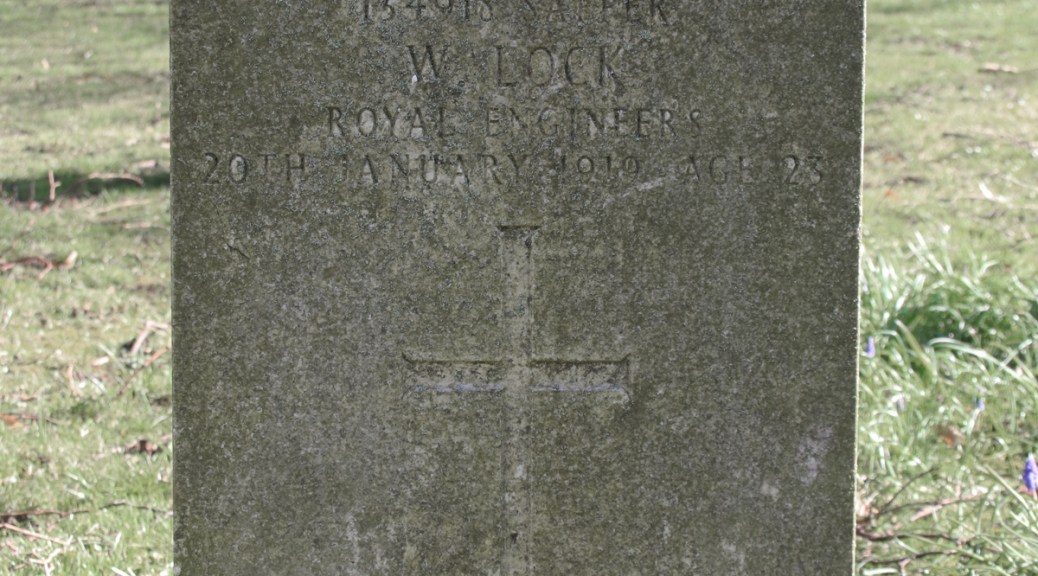
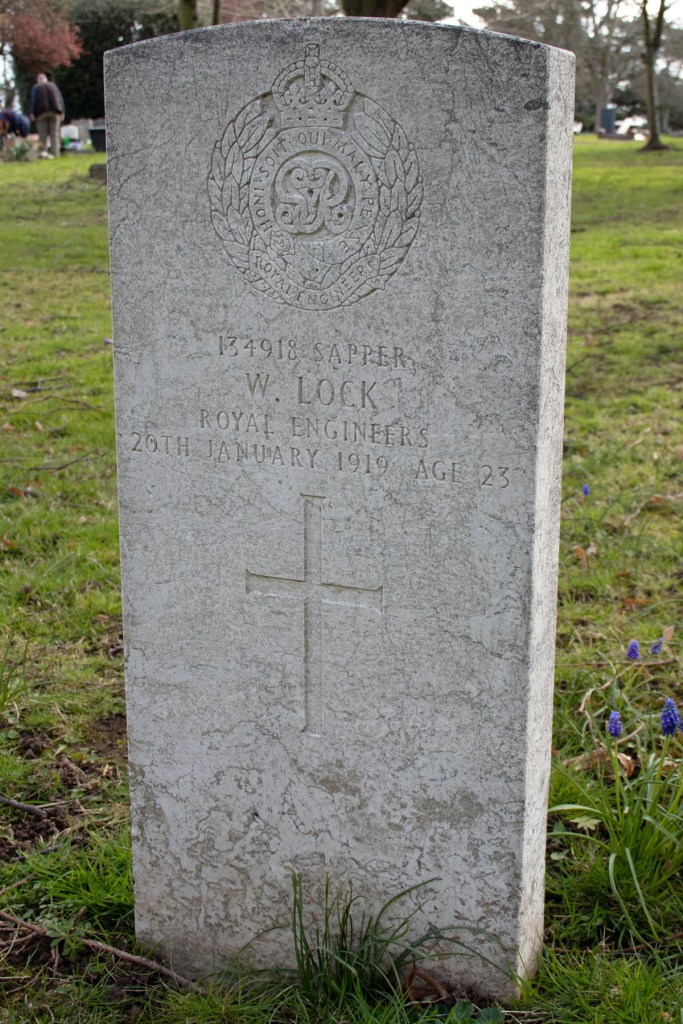
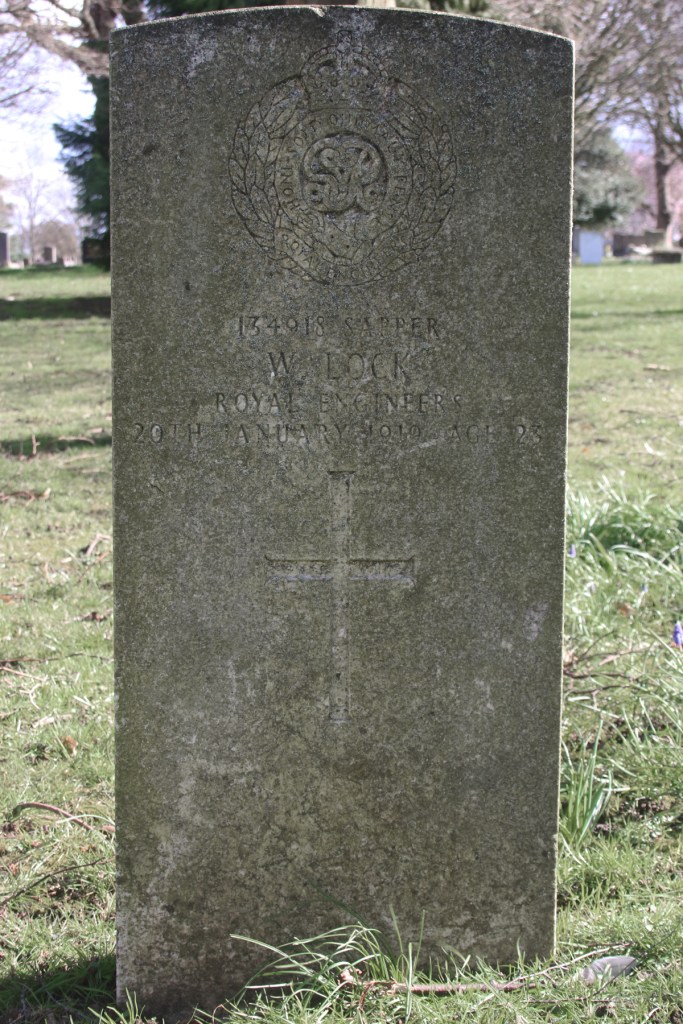
Sapper William Lock

Sapper William Lock

William Lock was born in Devon in 1896, one of three children to Tom and Mary Lock, although sadly only William survived childhood. Tom was a shipwright in on the Devon coast, but brought his young family to Kent, where he found work in the Naval Dockyard in Chatham.

When William left school, he set about finding a trade. By the time of the 1911 census, aged 15, he was listed as “learning house joinery”, presumably a trade for which his father’s work would have stood him in good stead.

War was looming, however, and William enlisted. He joined the Royal Engineers at a time where they were being inundated with volunteers. Sapper Lock was assigned to G Company, a provisional troop that formed part of the Depot Battalion.

Documentation relating to Sapper Lock’s military service are no longer available; he was awarded the Victory and British Medals, which suggests that he saw some kind of service overseas, but there is nothing on file to confirm this.

The next document relating to William is his war pension, which confirms that he died on 20th January 1919 from ulcerated endocarditis, or heart disease. He was just 23 years old.

Tom and Mary had lost the third of their three children.

William Lock was laid to rest in the Woodlands Cemetery in Gillingham, Kent.


Sapper William Lock

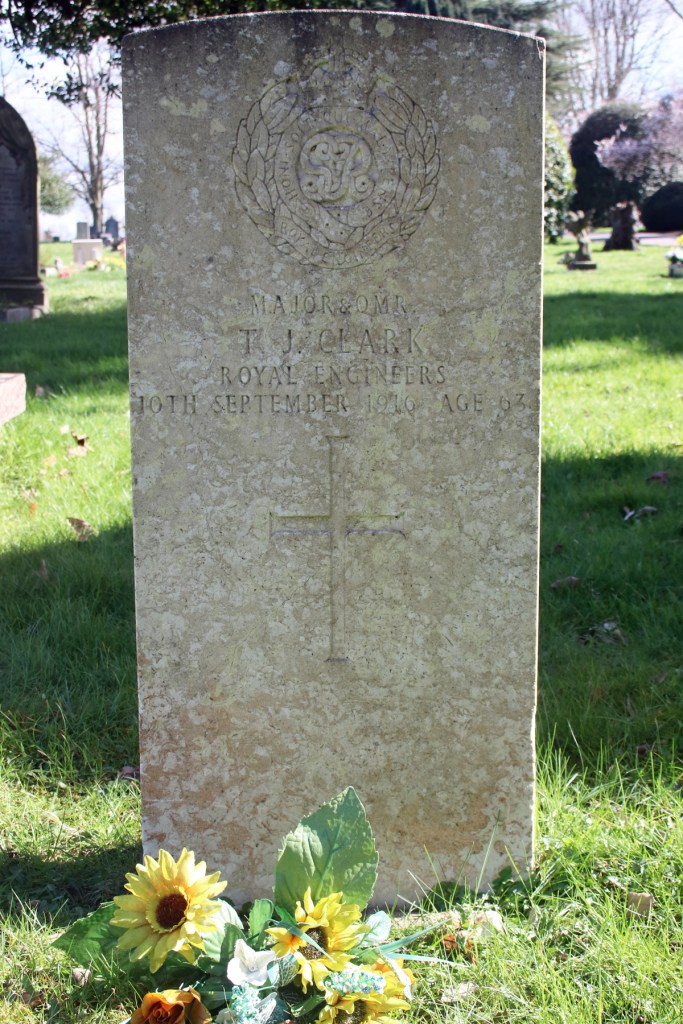
Major Thomas Clark

Major Thomas Clark

Thomas James Clark was born in Worcester at the beginning of 1853, the oldest of two children to James Clark and his wife Sarah. James was an engine smith and gas fitter, and moved the family with his work, initially to London, then on to the Kent coast.

Documentation relating to Thomas’ early life is difficult to track down; the 1871 census has him listed as a gas fitter like his father, but it is likely that he enlisted in the army fairly shortly after this date.

In 1875, he married a woman called Emily Ann. There life was to take on a grand new adventure as their first child, a boy named after his father, was born in Bombay, India, later that year.

It seems likely that it was Thomas’ military service that took the young family overseas. This was to be the case for at least a decade, as Emily gave birth to four further children in India. James, their fifth child, was born in Bombay in 1884. Their sixth, and last child, Ellen, was born in Gillingham, Kent, ten years later.

Given that the standard time for military service was twelve years, it is possible that Thomas served all of that time overseas, returning to England in around 1887.

Back home in Kent, Thomas is given the commission of Quartermaster in November 1897. By this point, he has been in the Royal Engineers for just under 21 years. He and his family are living in central Gillingham, within easy walking distance of the Royal Engineers Barracks and School of Engineering.

The 1901 census also lists Thomas as Quartermaster for the regiment, while three of his sons are by this time working in the Naval Dockyard as shipwrights and engine fitters.

Ten years later and the family are still living in the same house. By now, and aged 57, Thomas is recorded as a Retired Captain and Quartermaster for the Royal Engineers. He and Emily have been married 36 years, and their three youngest children (now aged 29, 26 and 17) are still living with them.

War was looming by now, although, age 61 when it broke out, it is unlikely that Retired Quartermaster Clark would have been involved in any front line activity. While no military records survive for Thomas, it seems possible that he may have been recalled for a training or administrative role at the barracks nearby.

Any re-commission would not have lasted for long, however, as Quartermaster Clark passed away at home on 10th September 1916. He was 63 years old.

Thomas James Clark lies at peace in the Woodlands Cemetery in Gillingham, Kent.


Thomas’ widow, Emily, passed away just two years after her husband. She was also laid to rest in the Woodlands Cemetery.

Thomas left his estate in the hands of his youngest son, James, who was still living at his parents’ home when they passed away.


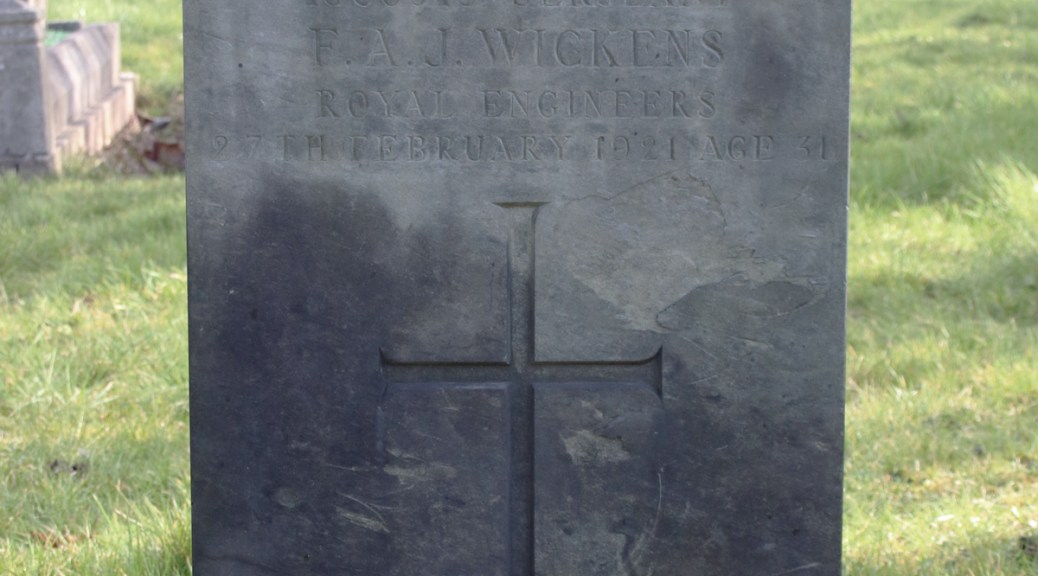
Serjeant Frederick Wickens

Serjeant Frederick Wickens

Frederick Albert John Wickens was born in Newbury, Berkshire, in the summer of 1889. The oldest of four children to Alfred and Emily Wickens, his father was a brewer’s labourer.

The military life proved more of a draw to Frederick, however. While his full records no longer exist, by the time of the 1911 census, he was recorded as being a Sapper with the 2nd Field Troop of the Royal Engineers. He was based at Potchefstroom, around 75 miles (120km) south east of Johannesburg in South Africa, and his trade was listed as a tailor.

Sadly, it is at this point that Frederick’s trail goes tepid, if not cold.

From a personal perspective, he married a woman called Rose, who was a year younger then him. Her details are scarce, and there is nothing to confirm when or where they married (other than the 1911 census, when Frederick was listed as ‘single’).

The couple must have had some connection to Gillingham, as this is where they lived; given the proximity of the Royal Engineers Barracks in neighbouring Chatham.

Sapper Wickens’ military service continued into the Great War. He was awarded the medaille militaire by Belgium, and achieved the rank of Serjeant during his career. Unfortunately, there are no details of the actions around either the award or his promotion.

Serjeant Wickens passed away on 27th February 1921; he died in Chatham, although the cause was not recorded. He was 31 years old.

Frederick Albert John Wickens lies at rest in the Woodlands Cemetery in Gillingham, Kent.


Frederick’s younger brother Thomas, also served in the Great War. He enlisted in the Princess Charlotte of Wales’s (Royal Berkshire) Regiment, and was involved in the battles on the Western Front. Sadly he was killed in the fighting on 24th May 1916, at the age of 19 years old.


Sergeant Christopher Faulkner

Sergeant Christopher Faulkner

Christopher William Thomas Faulkner was born in 1881, one of five children to William and Harriet Faulkner. There is little information about Christopher’s early life, but the 1891 census shows him living with his mother and siblings in the St George’s Barracks in St Martin in the Fields in central London. William is not listed, so it can only be assumed that he was away on duty when the census was completed.

Christopher attended the military school; his record confirms that he was born on 17th June 1881, and spent four months at the school when he was ten years old. William is listed as a Sergeant and the family were living at the St George’s Barracks, which were located in the site now occupied by the National Portrait Gallery.

The military life was indelibly in Christopher’s life by this point. Whilst the records are sparse, he had certainly enlisted by the time he was 25. On Boxing Day 1904 he married a woman called Essie Brant, the daughter of a tailor from Croydon.

On the marriage certificate, Christopher was listed as a Lance Corporal in the Royal Marine Light Infantry and was based at the barracks in Chatham, Kent.

The young couple went on to have four children together and, by 1911, Essie was living in Gillingham, not far from the naval base in Chatham. The majority of Christopher’s career was served here, although when war broke out, he also saw conflict overseas.

By 1916, he was promoted to Sergeant and was assigned to HMS Dominion, which patrolled the North Sea. Ill health must have taken hold, however, and by the end of 1917, Sergeant Faulkner was reassigned to Chatham, before being medically discharged at the beginning of the following year.

Sadly, there is no record of the cause of his release from duty, but it appears to have been something to which he would eventually succumb. The next record is of Sergeant Faulkner’s death, on 5th January 1920, at the age of 39 years old.

Christopher William Thomas Faulkner lies at rest in the Woodlands Cemetery in Gillingham, Kent.


Christopher’s grave also acts as a memorial to his son.

Leslie Albert Gerald Faulkner was born on 9th June 1910. On leaving school, he sought military service like his father, and enlisted in the Royal Navy for a period of twelve years’ service.

Unusually, details of his service appear to end after just three years, in January 1929. However, later records confirm that he continued to serve at HMS Pembroke, the on-shore vessel in Chatham, through to the Second World War, achieving the rank of Chief Petty Officer.

Chief Perry Officer Faulkner’s military records did thrown up some further information, though. Surprisingly, his death records give specific details of the cause of his passing, stating that it was a “rupture of the liver due to secondary neoplasm of the liver, due to primary seminoma of testis”. In effect, Leslie had suffered testicular cancer, which then spread to his liver.

Leslie Albert Gerald Faulkner died on 28th November 1945, at the age of just 35 years old. He was buried in the same grave as his father, in Woodlands Cemetery, Gillingham.


Chief Engine Room Artificer 2nd Class Charles Miller

Artificer Charles Miller

Charles Frederick Caleb Miller was born on 12th December 1887 in Gillingham, Kent. His parents were Charles and Harriet Miller, and he had two younger siblings, Mabel and Harriet.

Tragically, Charles Jr’s mother died when he was only three years old; his father went on to marry again – to his widow’s younger sister, Jane – and the couple had two further children – Jane and Beatrice – who were Charles Jr’s half-sisters.

Charles Sr worked as a ship’s rigger in the Military Dockyard in Chatham, and naval life obviously caught his son’s eye. In 1903, having left school, he enlisted in the Royal Navy, started as a ‘boy artificer’, working in the engine and boiler rooms of ships.

His initial service was for twelve years, and he worked on a number of vessels, as well as being assigned to HMS Pembroke, the shore base in Chatham. He worked his way through the ranks to Engine Room Artificer 2nd Class by 1915.

In June of that year, Charles married Ellen Holden. the daughter of a dairyman from Chelsea. The couple went on to have a daughter, Joan, who was born in 1918. At the time of their wedding, Charles was based on HMS Lance, and his military service was to continue.

His period of service extended until the end of the war, Charles served on a number of other vessels, including HMS Surprise, Blenheim and Prince George and rose to Chief Engine Room Artificer 2nd Class.

It was while he was assigned to HMS Ganges in January 1920 that he became unwell, however. He had contracted bronchial pneumonia, and died of a combination of that and heart failure on 9th February 1920. He was 32 years old.

Charles Frederick Caleb Miller lies at rest in Woodlands Cemetery in his home town of Gillingham, Kent.


Charles Miller (from ancestry.co.uk)

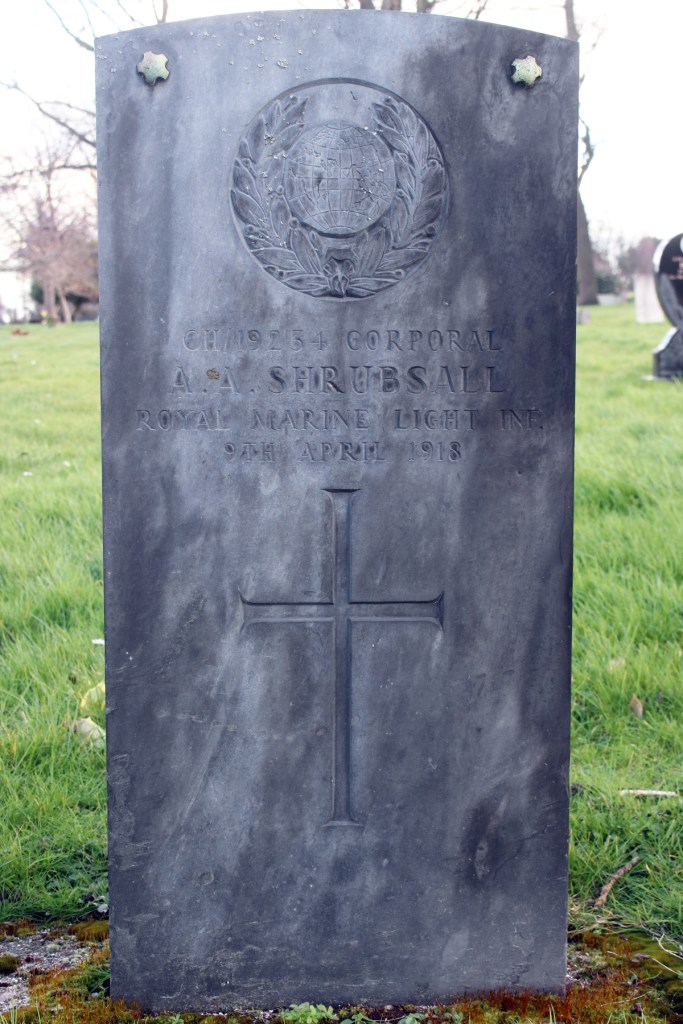
Corporal Albert Shrubsall

Corporal Albert Shrubsall

Albert Arthur Shrubsall was born in Deptford, South London, in April 1896. He was the youngest of three children – all boys – to ironmonger George Shrubsall and his wife Jessie.

While his brothers continued to live at home after they had left school and got jobs, Albert found live-in work as a pageboy, or servant, for Wilfred Lineham, who was a professor of engineering for a London college. It was while he was working here that his mother, Jessie, passed away. She died in 1913, aged just 43.

Details of Albert’s military service are a bit scant. He enlisted in the Royal Marine Light Infantry, although I have been unable to confirm when he joined up. He was assigned to the Chatham Division, and was based at the Naval Dockyard in Kent, ultimately being promoted to Corporal.

Albert married Gertrude Spoore – affectionately known a ‘Ginty’ – in Deptford in October 1917. Sadly, the marriage was to las less than six months, as, on 9th April 1918, Albert passed away, having contracted pneumonia and septicaemia. He was just 22 years old.

Albert lies at rest in the Woodlands Cemetery in his adopted home town of Gillingham in Kent.


Albert’s two brothers George and Alfred were also involved in the First World War.


George, had gone on to become a tailor’s assistant when he left school. He married Emily Hawkes in 1911, and the couple went on to have a son, also called George, the following year.

When war broke out, he enlisted in the Machine Gun Corps, and served on the Western Front. Sadly, he was caught up in the fighting, and was killed in action on 22nd August 1917. He was buried at the Tyne Cot Memorial in Flanders.


When he left school, Alfred went on to become a butcher’s assistant. War came along, and he enlisted straight away.

Enrolling in the Royal Field Artillery, Gunner Shrubsall was assigned to the 95th Brigade. Sadly, he had recorded less than six months’ service, as he passed away on 8th January 1915, aged just 21 years old. His brigade did not go to France until the following year, so, while no cause of death is recorded, it is likely that he died from a communicable disease like influenza or pneumonia.

Alfred is buried in the family grave in Deptford, South London.


Within a period of just three years, George had lost all three of his sons to the Great War. Given the previous death of his wife, you can only imagine the heartbreak he was going through.