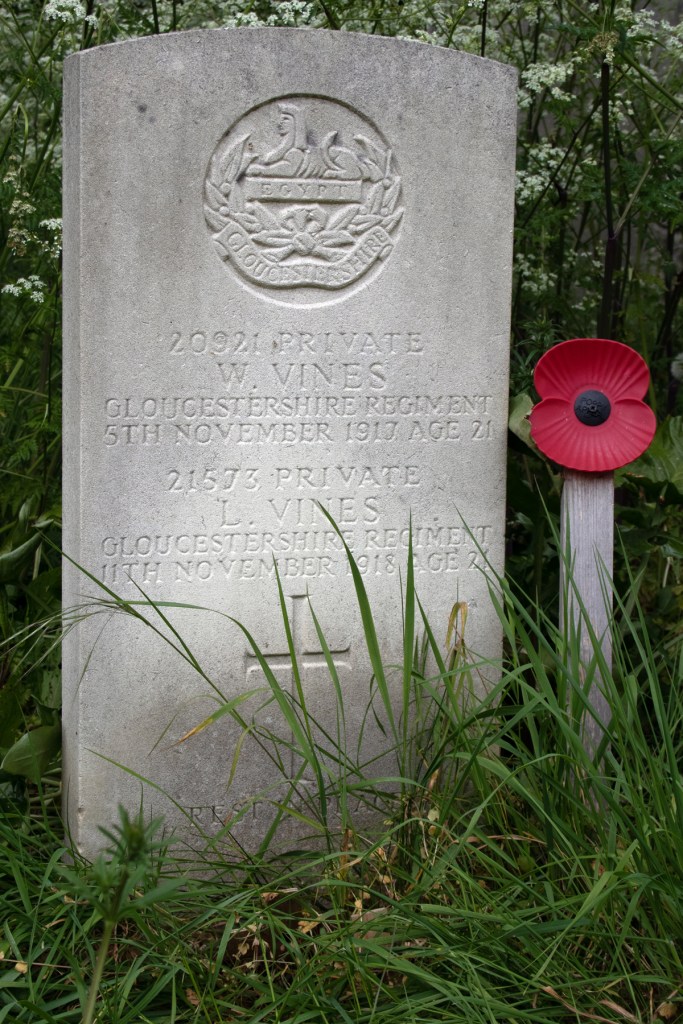
Wilfred Vines was born on 19th March 1897 and was one of seventeen children to John and Emma Vines. John was an elastic web maker or braider from Stroud, Gloucestershire, and it was in nearby Wotton-under-Edge that he and Emma raised their growing family.
Braiding and weaving ran in the family: the 1911 census recorded six of the Vines’ children who were over school age were employed in the local mill. This included Wilfred, who was working as a bobbin collector.
War came to Europe, and Wilfred was keen to play his part. He enlisted on 25th May 1915, joining the 15th Battalion of the Gloucestershire Regiment as a Private. His records show that he stood just 5ft 2ins (1.57m) tall.
Private Vines was sent for training to the camp at Chiseldon, Wiltshire. It seems that, while he was there, he was injured and, although full details are not available, his wounds were serious enough for him to be discharged from the army because of them. He was formally released on 30th May 1916, and returned home to recover and recuperate.
At this point, Wilfred’s trail goes cold. All that is recorded is that, on 5th November 1917, he passed away at home from his injuries. He was just 20 years of age.
Wilfred was laid to rest in the graveyard of St Mary the Virgin Church in his home town. He shares his grave with his younger brother, Leslie, who died the following year.
Alan Edward Lloyd was born in around 1899, the second of five children – all boys – to William and Edith Lloyd. Both of his parents were Welsh, and his older brother was born in Cardiff. Railway clerk William moved around the country with work, however, and Alan was born in Lydney, Gloucestershire, his younger brother in Paddington, London, and his two youngest siblings were born in Windsor, Berkshire.
There is little information about Alan’s early life; what is clear is that, by the autumn of 1918, he had been in the army, reaching the rank of Lieutenant. He transferred across to the newly formed Royal Air Force and, in December that year was training as a Flight Cadet at Shotwick Airfield near Chester.
On the 4th December, Alan was flying his Sopwith Camel, when he got into a flat spin; the aircraft crashed and Alan was killed. He was just 19 years old.
Alan Edward Lloyd was brought to Devon – where his family were now living – for burial. He was laid to rest in the graveyard of All Saints Church in Highweek, near Newton Abbot.
Percy Rendall Hunt was born on 25th May 1893, one of five children to Walter and Mary. Walter was a carpenter for the railway, and had been born in Newton Abbot, Devon, where he and Mary raised their young family.
When Percy left school, he found labouring work, but soon followed his father into carpentry. He met and married a woman called Ellen; the couple married, and went on to have two children. In his spare time, he volunteered for the Devonshire Royal Engineers and, when war broke out, despite now working in Chipping Sodbury, Gloucestershire, this was the regiment he joined.
Sapper Hunt enlisted on 2nd December 1914; his records show that he stood 5ft 7ins (1.70m) tall, had good vision and was of fit physical development. In March 1915, Percy was shipped off to Gibraltar, spending the next eighteen months in the territory. After a couple of months back in England, he was sent to France. He spent the next two years split between serving on home soil and with the British Expeditionary Force, before being demobbed in March 1919.
Percy returned to his old job with the railways, but, in December 1919, he found himself in court, charged with assault. Caroline Webber, an elderly married woman, was on the beach in Dawlish one afternoon, looking for shells, when a man approached her. According to a newspaper report:
“…suddenly he made a grab at me, put his hand under my clothes, and caught hold of my left knee. I screamed, and he ran away. ran after him because I was determined to see where he went. He went over to the railway wall, and disappeared under the archway of Dawlish tunnel.”
Western Times: Wednesday 24th September 1919
Mrs Webber went to the police, who returned to the police with her, then traced a trail of footprints back to the tunnel. Percy was questioned, but denied all knowledge of the incident, and of knowing Caroline. A plaster cast was taken of one of the footprints that evening, and a match alleged with his boots. Percy was committed for trial, with bail being allowed.
When the trial started in January 1920, the boots were again presented as evidence. However, on questioning, the policeman admitted than there had been a delay in getting the impression, and that “there were some other impressions in the sand at the time”.
For the defence, a number of witnesses saw Percy at work around the time of the incident, and the timings seemed to prove that he could not have had enough time to get to the beach and back to carry out the alleged assault. Based on this defence, the jury found Percy not guilty, and the case was concluded.
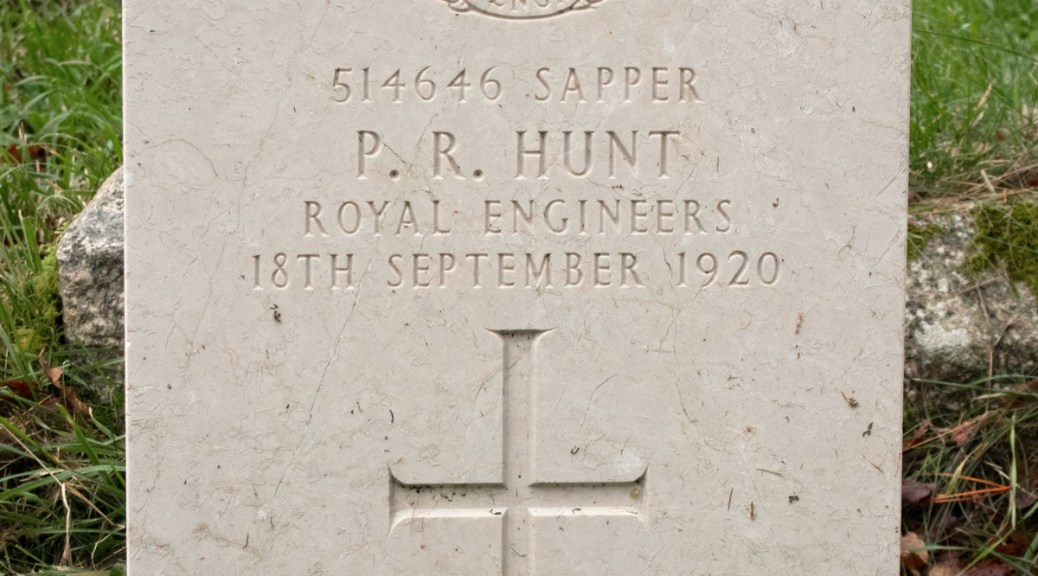
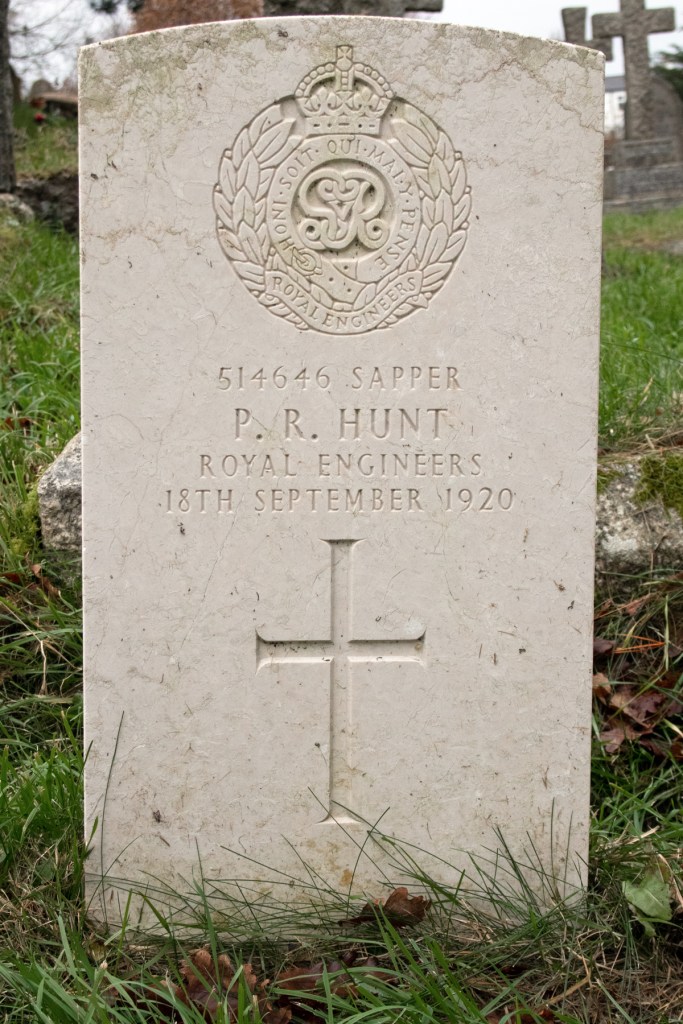
After this incident, Percy’s trail goes cold for a few months. The next record is that confirming his death, on 18th September 1920. The cause of his passing is not evident, but he was 27 years of age.
Percy Rendall Hunt was laid to rest in the graveyard of All Saints Church in Highweek, Newton Abbot, not far from his family home.
Fergusson Barclay was born in Cheltenham, Gloucestershire, towards the end of 1877 and was the oldest of six children. His father, Henry, was a retired army captain, and so it is of little surprise that Fergusson and his siblings had something of a privileged upbringing.
The 1881 census recorded Henry and his wife, Agnes, bringing up the family in Tenby, South Wales. With three children under four, the Barclays employed two live-in nursemaids to support them.
Ten years later, the family had moved to Weston-super-Mare, Somerset, living in a large house to the north of the town centre. With five children now living at home, Henry and Agnes found additional help was needed: they were now employing a governess, manservant, cook and a housemaid. The family were not alone in this support: the 1891 census shows that all of the Barclays’ neighbours had at least one domestic servant.
The new century turned, and a new census followed. Captain Barclay and his family were still living in their three-storey Victorian villa in Weston-super-Mare. By this point, however, only three of the children were still living at home. Fergusson, now 23, was working as an architect, his brother Herbert was a legal professional, and his sister, Hermione, also still lived there. The house was not empty, however, as the Barclays’ retinue of staff remained. By this point, they were employing a gardener, groom, coachman, parlour maid, cook, kitchen maid and house maid. Agnes, who was around 20 years younger than her husband, also had a live-in companion, spinster Helen Empson.
Little had changed for the family when the next census was recorded in 1911. Henry was by now 84 years old, and he and Agnes had been married 34 years. Fergusson and Herbert were still living at home, fully immersed in their jobs. Helen was still providing companionship for Agnes, and the family still employed four members of staff: butler Daniel O’Brien and his wife, Jesse, who was the cook; parlour maid Rosie Davies and house maid Edith Booden.
In March 1912, Henry passed away, and it was inevitable that things would change for the Barclay household. Fergusson had been a volunteer for the Royal Engineers since the late 1890s and had steadily worked his way up through the ranks. With the outbreak of war, he found himself called into a more formal role.
Full details of his military career are not evident, but it is clear that, by the spring of 1918, Fergusson had gained the rank of Captain. He joined the Royal Air Force and was assigned to 75th Squadron.
On the afternoon of 7th December 1918, Captain Barclay took off from Elmswell Aerodrome in Suffolk, when the engine of his Avro 504K aircraft cut out. He attempted to turn the plane to land, but it nosedived into the ground and Fergusson was seriously wounded. He was taken to hospital, and died of his injuries later that day. He was 40 years old.
Captain Fergusson Barclay’s body was taken back to Somerset – he lies at rest in the Milton Road Cemetery in Weston-super-Mare, walking distance from his family home.
Lionel James Fowler Bennett was born on 2nd September 1899, in the village of Cainscross, near Stroud in Gloucestershire. He was the only child of insurance agent Harry Bennett and his wife Louisa, who was a weaver.
By the time of the 1911 census, the young family had moved to the Somerset town of Frome. Louisa’s widowed mother had lived with the family since Lionel’s birth, and had moved to Somerset with her son-in-law. The family had also, by this time, taken in a boarder, presumably to help pay the rent.
With the move, Harry had also changed jobs, and was working as a power loom tuner, honing and fixing the weaving equipment. Lionel went into a similar role when he left school but, by now, war was imminent and, as soon as he was able to, he enlisted for King and Country.
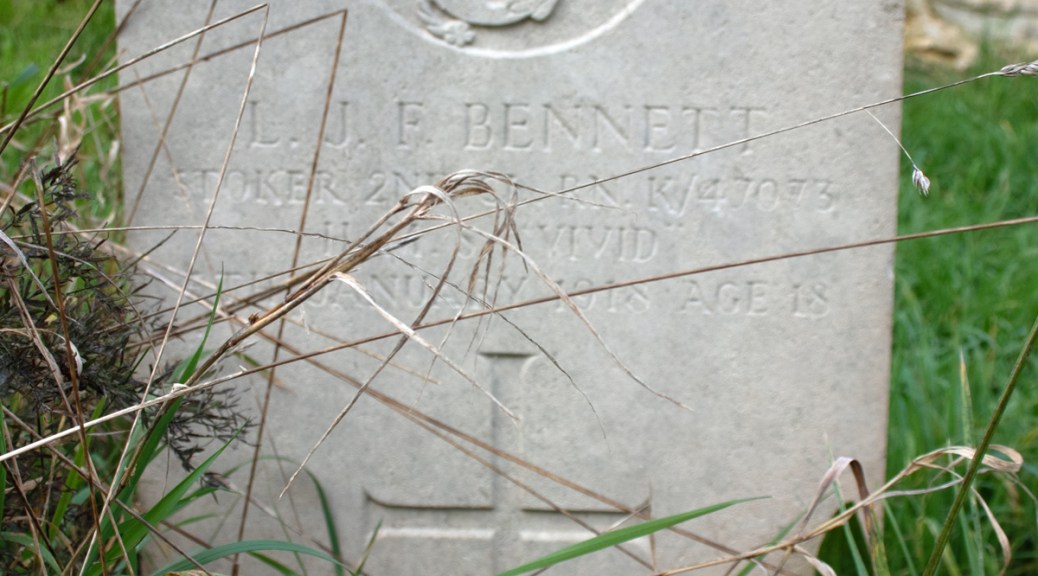
Harry joined up shortly after his eighteenth birthday, serving as a Stoker in the Royal Navy. He was sent to HMS Vivid in Devonport for training in November 1917, but, sadly, this was to be his undoing.
Barracks were notorious breeding grounds for infections and, within weeks, Stoker Bennett had been admitted to the Naval Hospital in Plymouth, suffering from pneumonia. He passed away on 5th January 1918, aged just eighteen years old and having served for just sixty days.
Brought back to his home in Frome, Lionel James Fowler Bennett was laid to rest in the Vallis Road Burial Ground (also known as the Dissenters’ Cemetery).
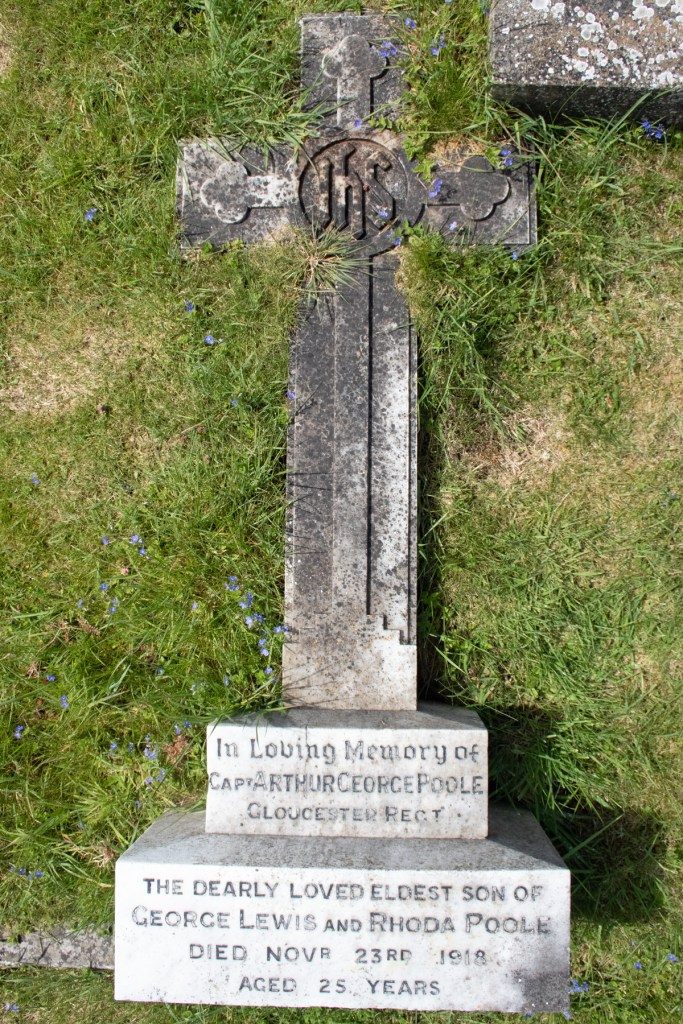
Arthur George Poole was born in Brislington, Somerset, in April 1893. His father, George, was a master builder, and with his mother, Rhoda, the family raise their five children in the Bristol suburb.
Arthur was obvious a bright lad; he attended the Bristol Grammar School, excelling at football, hockey and cricket. After finishing school, he joined a firm of Bristol solicitors and was also appointed secretary of the Bristol Law Society. He went on to continue his studies, when he was accepted to read law at Emmanuel College, Cambridge.
The war was on the horizon, however, and he was called upon to do his duty.
He joined Bristol’s Own (12th Gloucester Regiment) in 1914, and was musketry officer at Chiseldon for some months before going to France in 1915, where he was attached to the 6th Gloucester Regiment.
Within three months he had a severe attack of trench fever, and was home on sick leave for a few weeks. He was severely wounded in October 1917, and came back to England for good. Some months later he was mentioned in despatches. He spent a year in hospital, and although not discharged, was allowed to resume his law studies.
Gloucestershire Echo: Saturday 14th December 1918
While in hospital, Captain Poole contracted influenza, which then became pneumonia. Although recovering from his injuries, it was these conditions that were to get the better of him, and he passed away on 23rd November 1918, at the age of 25 years old.
Arthur George Poole was laid to rest in the pretty graveyard of St Andrew’s Church in Clevedon, Somerset, where his parents now lived.
Alfred Blackmore was born on 25th October 1868 in the village of Thurlbear, near Taunton. Documentation varies and names cross over, but it appears that he was one numerous children to farm labourer William Blackmore and his wife, Mary Ann.
Details of Alfred’s early life are a bit hazy – again, in a rural location, names often cross over, so it is a challenge to totally confirm that they relate to the right person. His mother appears to have passed away by the time of the 1881 census, and Alfred was living with his father and three of his siblings and working as a farm hand.
Alfred again disappears off the radar for a while; in July 1894, he married Lucy Charlotte Yard, and the couple went on to have two daughters, Lucy and Beatrice. By 1901, the young family were living in the village of Frampton Cotterell, just to the north of Bristol, and Alfred had found employment as a marine fireman.
Ten years later, Lucy and the girls were still living in Frampton Cotterell, but Alfred was back in Taunton, lodging with a 75-year-old widow called Mary Croker and working as a labourer. This separation may have signalled the beginning of the end for the couple’s marriage.
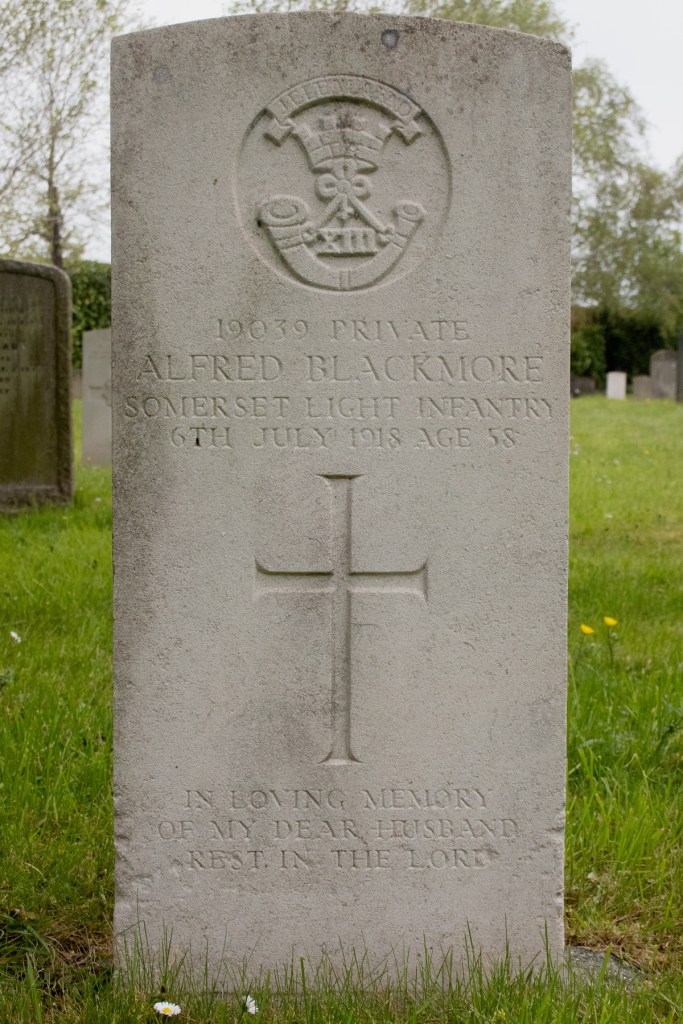
War broke out, and it is evident that Alfred enlisted as a Private in the Somerset Light Infantry. Sadly, his service records are lost to time, but it appears that he served for at least three years.
The next time Alfred appears in documentation, it is a newspaper report on his passing, under the heading “Taunton Soldier’s Death”.
FOUND DROWNED AT BLACKBROOK
Mr F Foster Barham, coroner for West Somerset, held an inquest at the Blackbrook Inn, Ruishton, on Monday, relative to the death of Alfred Blackmore, aged 49, a private in the Labour Company at Taunton Barracks, whose body was found in the stream at Blackbrook on Saturday morning.
William Cozens, farmer… gave evidence of identification, and stated that on Friday he saw the deceased sitting by the hedge… about 400 yards from where the body was found.
William Richard Radnidge, butcher… stated that on Saturday morning he found the body in the stream dividing Ruishton from Taunton St Mary’s… His cap, belt and cape were on the bank. The deceased was lying face downward, his face and arms being in the mud below the surface.
PC Jenkins stated that at 10:45am on Saturday he received a communication from PC Wathen, in consequence of which he proceeded to Blackbrook, where he found the body lying under a hedge. He searched the body, and on it found a summons, returnable at Taunton on 29th June, for having failed to comply with a maintenance order obtained by his wife, Lucy Blackmore, on 25th September 1915, the sum of £2 13s [approx. £300 today] being due. On the back of the summons was written: “This is what my old cow has done for me.”
There was also the following letter: “When my body is found, don’t you give a farthing to my old cow. What I have got to come give to my brother, Edward Blackmore… Signed A Blackmore.” At the back of the letter was written: “Goodbye to all that I love.”
The deceased had left his lodging at nine a.m. on June 29th to attend the Taunton Police Court, but did not do so.
An officer stated that the deceased’s conduct during the three years he had been in the army had been satisfactory.
The Foreman of the jury said that according to the evidence they found that the deceased met with his death by drowning whilst temporarily insane.
Taunton Courier and Western Advertiser: Wednesday 10th July 1918
Alfred Blackmore took his own life on 6th July 1918. He was 49 years old [the war grave gives a different age].
Alfred lies at peace in St Mary’s Cemetery in Taunton, Somerset.
William Gardner was born in Cirencester, Gloucestershire, in around 1877. While I have been unable to totally confirm this, his parents seem to have been William and Sarah Carpenter; William Sr was an agricultural labourer, and both he and his wife were from Cirencester.
It has been difficult to track down William’s early life, because of the potential variations of his surname and the number of William Gardner’s in the Gloucestershire area.
The first time I can definitively identify him is on the 1911 census; he was living in Cheltenham and working as gardener. While the census shows that he had been married for 16 years and had one child. However, William’s wife is not recorded on the census; instead a Lily Marie Denley is boarding with him, as is her daughter, Irina May Gardner Denley.
William’s military life also needs a little piecing together. His gravestone confirms that he was a Serjeant in the Gloucestershire Regiment, and it seems that he enlisted towards the end of the 1800s, as he is recorded as having served in South Africa.
Serjeant Gardner re-enlisted (or was called back up) when the Great War broke out; at the age of 39, he was sent to France, collecting the Victory Medal, the British Medal and the 1915 Star for his service. At some point, however, he transferred back to England, joining the 440th Agricultural Coy. Labour Corps.
While there is no evidence of why William transferred, his later records certainly seem to suggest there were some issues going on in his life. When he was demobbed in February 1919, this seems to have been for medical reasons; his pension records show that he was suffering from neurasthenia (or shell shock), and that this was directly attributable to his war service.
William’s suffering evidently continued: a further record shows that he was admitted to an asylum in March 1921 and the 1921 census corroborates this. William was noted as being one of nearly 900 patients at the Somerset and Bath Pauper Lunatic Asylum in Wells and this is where he died, just a month later. While there is no cause of death, he passed away on 14th July 1921, at the age of 45 years old.
William Gardner lies at peace in the Cemetery in Wells, Somerset.
One additional point for William’s story. Another part of his was pension records give Miss Lily Denley as his dependent, and that she was guardian of his child. No eyebrows raised now, but how must their relationship have been viewed in 1911?
What I have discovered while researching the Commonwealth War Graves, is that, despite the general themes I find, the people behind the names always have an individual story to tell. Sometimes that story raises an eyebrow, or produces a gasp.
Such was the story of Private Harry Pullen.
What raised the eyebrow? Two words, written on the Army Records of Soldiers’ Effects.
Accidentally Drowned.
Harry Pullen was born in Shirehampton, Gloucestershire in 1886. His father, Robert Edward Pullen, was a carpenter; he and his wife Hannah Presulga Cissy Pullen had three other children, Gwendoline, Herbert and John.
By the time of the 1901 census, Robert is boarding in a house in Bristol with his three sons; Hannah and Gwendoline are not listed (nor do they appear on any other census records I have been able to locate).
Harry is listed as a Telegraph Boy, as is his brother Herbert, but he seemed to have wanted to take up a trade; by 1910 he had moved up to London.
In March of that year, Harry married Harriet Critchell, a spinster fifteen years his senior. On their marriage records for Christ Church, St Pancras, Harry lists himself as a tradesman. The census a year later confirms this – head of the household, he is an Agent for the Provident Clothing Supply Company. (Founded in Bradford, West Yorkshire, Provident’s mission was to help working-class families provide for themselves through the use of vouchers. These were exchanged for goods in local shops, and paid for in affordable instalments.)
Harry enlisted at some point after 1916. His regiment, the 1st (Reserve) Garrison Battalion of the Suffolk Regiment, was not formed until March of that year, and, after starting in Buckinghamshire, it moved to Tilbury in Essex and Gravesend in Kent. The battalion was finally settled in Grain, North Kent in 1918, and it was here that he served.
Here the trail goes frustratingly cold…
Private Pullen’s enlistment and service records are not available, so research is limited to the Army Register of Soldier’s Effects and the Pension Ledgers.
All we have about his death are those two words – Accidental Drowning. There are no contemporary news reports of his passing, which you might expect given the circumstances, so the circumstances surrounding his death are elusive.
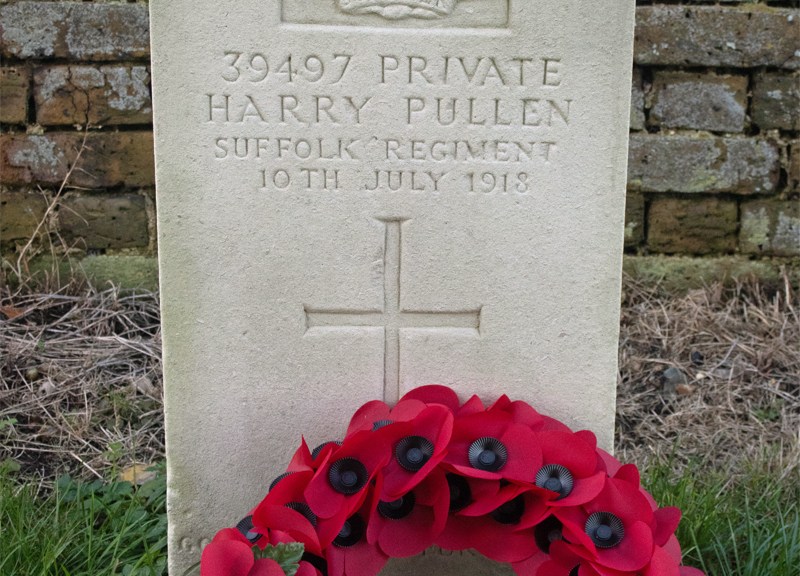
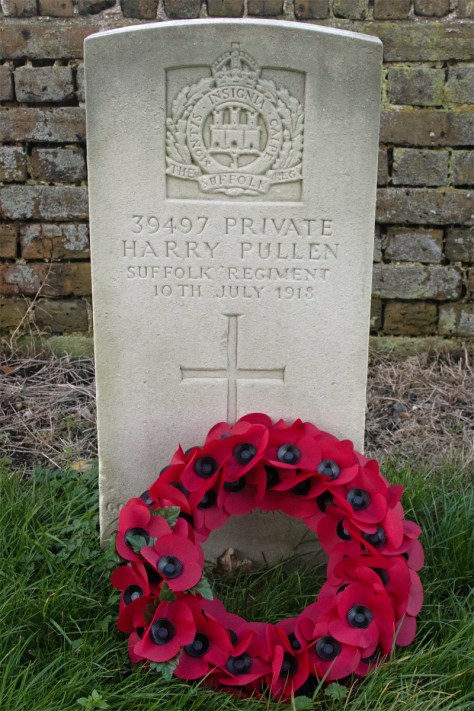
Private Pullen died on 10th July 1918. He was 31 years old.
His records confirm that Harriet was entitled to a weekly pension of 15s for the duration of the war and twelves months after.
Harry Pullen is buried in the graveyard of St James’ Church in Grain, Kent, close to where he was stationed.











 Death and Service