Tag Archives: heart

Chief Yeoman of Signals Charles Welling

Chief Yeoman of Signals Charles Welling

Charles James Welling was born on 23rd October 1860, and was the oldest of three children to Charles and Ann Welling. The Wellings were a military family, Charles Sr employed as a Serjeant Instructor of Musquetry in the Parkhurst Barracks on the Isle of Wight when his son was born.

Ann had been born in South Africa while her Irish parents were based out there. She and Charles Sr married in Farnham, Surrey, presumably where the families were based by that point.

Charles Jr’s mother died in 1863, just a month after giving birth to his youngest sibling. His father married again, to Sarah Ash, and by 1871, the Wellings were living in barracks at the School of Musketry in Hythe, Kent.

Being his father’s son, Charles Jr was set to make his own mark on the world and, on 21st January 1876, he joined the Royal Navy. Too young to formally enlist, he was given the rank of Boy 2nd Class, and sent off to HMS Impregnable, the shore base in Devonport, Devon, for his training.

Over the next eighteen months, Boy Welling learnt his trade, spending time at HMS Ganges – another shore base near Ipswich, Suffolk – and the sloop HMS Penguin. It was here that Charles came of age in 1878, and he officially joined the Royal Navy with the rank of Ordinary Seaman. His service papers show that he was just 4ft 10.5ins (1.49m) tall, with light brown hair, blue eyes and a fair complexion.

Ordinary Seaman Welling career was to take a turn in 1880, when he began training as a signaller. His initial contract with the navy was for ten years, and, by the time that came to an end in May 1889, he had served on eight ships in all, rising through the ranks from Signalman 3rd Class, to Signalman 2nd Class in August 1881 and Qualified Signalman seven years later.

When Charles’ term of service came to an end, he immediately renewed it, and with the new contract came a promotion to Leading Signalman. The next decade saw him travel the world, returning to HMS Pembroke, the Royal Naval Dockyard in Chatham, Kent, in between voyages. His commitment to the role paid off: in March 1894 he was promoted to 2nd Class Yeoman of Signals. Just eight months later he took the rank of Yeoman of Signals.

It was around this time that Charles married the love of his life, Harriet Carlaw. Born in London, the couple exchanged vows in St Pancras, Middlesex, on 13th January 1894 and had a son, also called Charles, the following year.

Charles’ naval career continued its upward trajectory, and on 1st March 1898, he was awarded the rank of Chief Yeoman of Signals. By this point HMS Pembroke had become his permanent base and, at the end of his contract in 1899, he was stood down to reserve status.

The 1901 census shows what may have been a downward step for the Wellings: it recorded the family living in rooms at 136 Bayham Street, Camden, Middlesex, where Charles was working as a messenger.

Opportunities come in the most unexpected of places, however, and the following census found them living at Pier House, Sunderland, Tyne and Wear, where Charles was employed as a lighthouse keeper.

By this point, Charles had been invalided out of the navy for medical reasons. The writing on his service papers is unclear, and his dismissal seems to have been as a result of disease of gestes, possibly the neurological disorder dystonia.

When war broke out in 1914, however, anyone with experience was called upon to play their part. Given his age at the time, it seems likely that Charles volunteered for service, reporting to HMS Pembroke on 2nd August 1914. He was given his old rank of Chief Yeoman of Signals, and remained at the naval base for the next two years.

Charles’ health was definitely suffering by this point, and he was admitted to the Royal Naval Hospital in Chatham, in September 1916. Suffering from the heart condition endocarditis, this would take his life. He passed away on 16th September, at the age of 55 years old.

With Harriet still living in Sunderland, Charles’ body was laid to rest in Woodlands Cemetery, Gillingham, Kent, not far from the base he had called home for so long.


Charles and Harriet’s son had also stepped up to play his part when war broke out. Enlisting in the Royal Engineers, Pioneer Welling soon found himself in the Middle East. While serving in Palestine, he contracted malaria, and passed away from the condition on 16th October 1918. Charles was just 23 years of age, and was laid to rest in Haifa War Cemetery.

It is tragic to note that Harriet had lost her husband and her son within two years.


Blacksmith Robert Holdsworth

Blacksmith Robert Holdsworth

Robert William Holdsworth was born on 11th February 1880 in Pilmoor, Yorkshire. The third of nine children, his parents were John and Fanny. John was a railway signalman, and, by the time of the 1891 census, the family had moved to Kirby Wiske, near Thirsk.

When he completed his schooling, Robert found work as a blacksmith. Moving away from home, by 1901, he was boarding at the Albion Foundry on New Street in Pocklington. The job, however, was a stepping stone to bigger things, and, on 28th July 1902, he enlisted in the Royal Navy.

Blacksmith’s Mate Holdsworth’s service records show that he was 5ft 6ins (1.68m) tall. He had dark brown hair, brown eyes and a dark complexion. It was also noted that he had a scar on his right elbow.

Robert was initially sent to HMS Pembroke, the Royal Naval Dockyard in Chatham, Kent, for his training. He would spend the next year at the base, and was promoted to Blacksmith proper in April 1903. Over the twelve years of his initial contract, he would serve on board seven ships, returning to Chatham in between assignments. The 1911 census recorded him as being one of 283 crew aboard HMS Patrol, a scout vessel moored in Harwich Harbour, Essex.

In the summer of 1916, Robert married Minnie Eames. Born in Kensal Rise, London, by the time of the nuptials, her family had moved to Gillingham, Kent, where her father James worked as a night watchman. Minnie was working as a shop assistant by this point, and was living with her parents and older brother at 35 Wyles Street.

Back at work, Blacksmith Holdsworth had renewed his contract. His annual reviews noted both very good conduct and superior ability, and he had added another string to his bow – the role of Diver – in the spring of 1912. In April 1913 he was assigned to HMS Astraea, on board which he would spend the next three years. The cruiser patrolled the seas off the eastern coast of Africa, bombarding Dar-es-Salaam in the autumn of 1914.

By the summer of 1916, Blacksmith Holdsworth was back at HMS Pembroke, where he would remain for the rest of the year, barring a couple of months’ on board HMS Royal Arthur. On 2nd December Robert was feeling unwell, and was moved the Hospital Ship Garth Castles. He had suffered a cardiac arrest, but his transfer would prove too late: he died that afternoon, at the age of 36.

The body of Robert William Holdsworth was laid to rest in Woodlands Cemetery, Gillingham, not far from the naval base he had called home, and within walking distance of where his widow still lived.


Blacksmith Robert Holdsworth
(from ancestry.co.uk)

The epitaph on Robert’s headstone reads: In loving memory of Robert William Holdsworth, 1st Class Petty Officer (Blacksmith & Diver). There is no evidence in his service records for the PO rank, although this may have been an informal nod to his dual roles.


Ordinary Seaman Thomas Fleet

Ordinary Seaman Thomas Fleet

Thomas Fleet was born on 3rd February 1879 in Kingswear, Devon, and was the sixth of nine children to Thomas and Emma. Thomas Sr was a fish dealer, and the family lived on Lower Street over the river in Dartmouth. Most of the family were involved in the fish industry, and by the time of the 1901 census, Thomas Jr was also working as a fisherman.

On Christmas Day 1901, Thomas Jr married Hannah Jury. She was a farm labourer’s daughter from Torquay, Devon. The couple married in Hannah’s home town, but settled back in Dartmouth. They had five children – Reginald, Elspeth, Edith, Florence and Thomas – and set up home in a five-roomed house on Victoria Road.

By the time of the 1911 census, Thomas had changed jobs, and was working as a yachtsman. The following year, Reginald died, at the age of just 9 years old. It is unclear how he died, but he passed in August 1912, and was buried on 2nd September, in St Clement’s Churchyard, Dartmouth.

When war broke out, Thomas would be called upon to serve. Unsurprisingly, given his job, he joined the Royal Navy, enlisting on 30th March 1917 as an Ordinary Seaman. His service records show that, at 5ft 2ins (1.57m) tall, he had brown hair, blue eyes and a fresh complexion.

Ordinary Seaman Fleet was sent to HMS Vivid, the Royal Naval Dockyard in Devonport, Devon, for his formal training. Tragically, however, his time in the service was to be a brief one. He contracted lobar pneumonia and was admitted to the barracks’ sick quarters. He passed away from heart failure on 13th May 1917, at the age of 38 years old.

The body of Thomas Fleet was taken back to Dartmouth for burial. He was laid to rest in the family plot in St Clement’s Churchyard, reunited with his oldest son, Reginald.


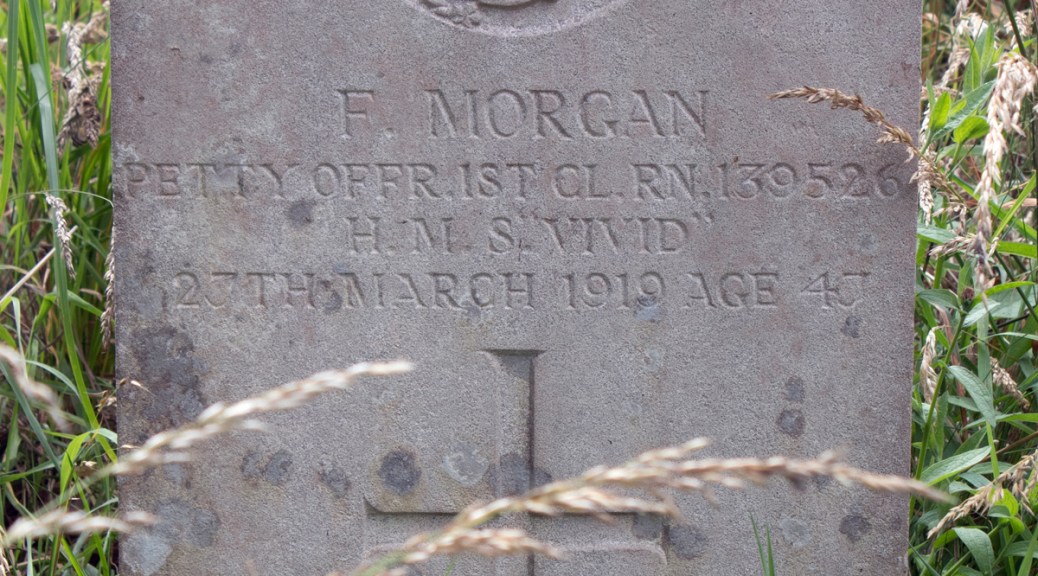
Petty Officer 1st Class Frederick Morgan

Petty Officer 1st Class Frederick Morgan

Frederick Morgan was born on 15th July 1871, the oldest of four children to Samuel and Selina. Samuel was a miner from Bristol, Gloucestershire, but it was in the Staffordshire town of Tipton that he and local girl Selina married and raised their family. The 1881 census found the Morgans living at 17 Brewery Street, to the south of the town centre.

Frederick was not destined to follow in his father’s footsteps, however, and had his sights set on a life at sea, rather than in the depths of a coal mine. On 23rd November 1896 he joined the Royal Navy, and was sent to HMS Impregnable, the training base in Devonport, Devon, for his induction.

Being too young to formally enlist, Frederick was given the rank of Boy 2nd Class. Over the next three years, he learnt the tools of his trade, and served at three further bases: HMS Lion, HMS Penelope and HMS Raleigh. During this time, he was promoted to Boy 1st Class and, on 15th July 1889, when he turned 18, he was formally inducted into the Royal Navy.

Ordinary Seaman Morgan’s service records show that he was just 5ft 2.5ins (1.59m) tall. He had light brown hair, blue eyes and a fair complexion. He also had a tattoo by this point, of a dancing sailor on the inside of his right arm.

Frederick remained at HMS Raleigh for the next couple of years, and was promoted to Able Seaman on 1st July 1891. From the autumn, however, his sea-going life really took hold. Over the next ten years, he served on five ships, and was to be based at HMS Vivid, the Royal Naval Dockyard in Devonport, in between voyages. His dedication to the service was recognised – his annual reviews regularly noted his character as very good, and he rose through the ranks to Leading Seaman in May 1898, Petty Officer 2nd Class that October, and Petty Officer 1st Class in January 1901.

Away from work, Frederick’s love life was blossoming. In the autumn of 1893 he married Zipporah Elizabeth Beatrice Griffiths. Better known as Beatrice, she was the daughter of waterman Thomas Griffiths and his wife, Zipporah. The family came from Dartmouth, and this is likely where the young couple got to know each other. They married in St Clement’s Church, Dartmouth, and went on to have two children, George and Kathleen.

On 15th July 1901, Petty Officer Morgan’s initial contract with the Royal Navy came to an end. He renewed it straight away, and would spend the next decade sailing the world. Again Frederick was based at HMS Vivid in between voyages. On 11th July 1911, after 21 years in service, he was formally stood down to reserve status, and he returned to shore.

Frederick’s trail goes cold over the next couple of years, but when war broke out, he was called into service once more. Petty Officer Morgan would serve on the depot ships HMS Leander and Cyclops, which served out of Scapa Flow. He also spent time at HMS Gunner, the naval base to the north of Edinburgh. By March 1919, with the Armistice signed, he found himself based back in Devon.

At the Royal Naval Hospital, Plymouth, on Saturday, an inquest was held relative to the death of Fredk Morgan, 47, a naval pensioner, who died suddenly in the train on Thursday last.

Wm. Griffiths, inspector, GWR, at Millbay, said that PO Morgan was removed from the 6.20 train from Saltash on Thursday, apparently in a fit. He was laid on a seat, and a doctor who was about to travel on another train pronounced life extinct.

Charles Evans Jenkins, surgeon-lieutenant at the Naval Hospital said death was due to fatty degeneration of the heart.

The Coroner, who expressed his sympathy with the widow, declared that death was due to natural causes.

[Western Times: Tuesday 1st April 1919]

Frederick Morgan died of a heart attack on 27th Match 1919. He was laid to rest in the graveyard of St Clement’s Churchyard, Dartmouth, where he and Beatrice had been married.


Private Joseph Tyler

Private Joseph Tyler

Joseph Tyler was born in the spring of 1882, and was the youngest of three children to Joseph and Sarah. Joseph Sr was a carter from Staffordshire, and the family were born and raised in Wordsley.

The 1901 census found the Tylers living in Brierley Hill, with Joseph Jr having found employment as a glass worker. His father passed away in 1907, and so he remained at home to support his now widowed mother.

By the 1911 census, Sarah and Joseph had moved to Birmingham, and were living at 32 Wiggin Street, a terraced house in the Ladywood area. Joseph listed his employment as a glassblower, while his mother gave no employment, presumably looking after the home.

When war came to Europe, Joseph stepped up to play his part. Full details of his service have been lost, but it is clear that he enlisted early on in the conflict. He joined the Hampshire Regiment, and was sent to Wiltshire for training.

Tragically, Private Tyler’s time in the army was not to be a lengthy one. Barracked near the village of Boyton, he was quickly admitted to the local military hospital. Suffering from heart failure, this would take his life: Joseph died on 13th October 1914, at the age of 32.

The body of Joseph Tyler was laid to rest in Boyton Cemetery, not far from the camp that had, so briefly, been his home.


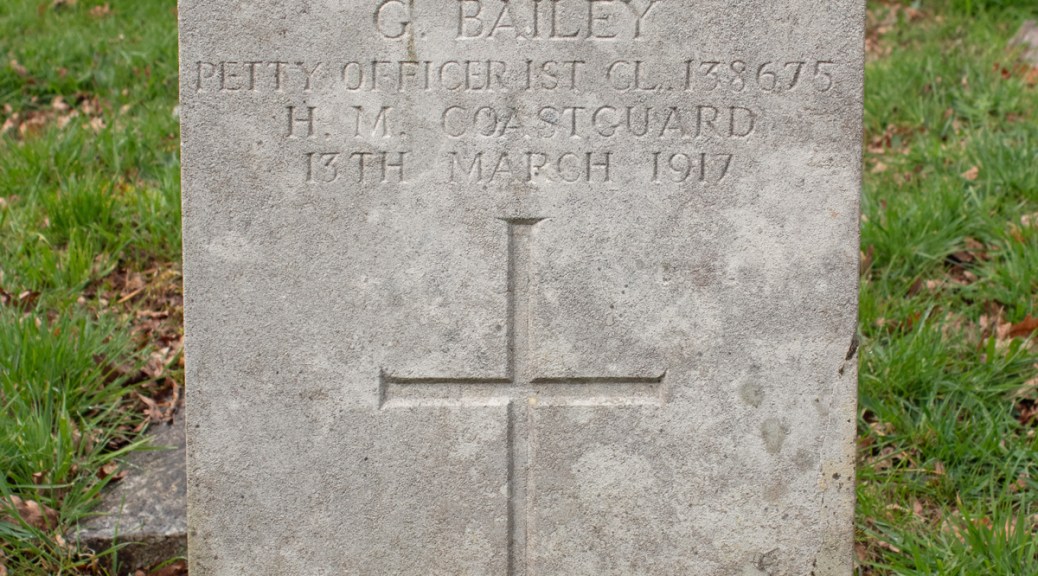
Petty Officer 1st Class George Bailey

Petty Officer 1st Class George Bailey

George Bailey was born in Bedminster, Somerset, on 20th August 1871. One of six children, his parents were George and Anna (or Hannah) Bailey. George Sr was a labourer and, when he died in 1876, Anna moved the family to Clifton, near Bristol.

The 1881 census found the family living in a small cottage at 5 Crosby Row in the then village. Hannah was listed as a late general labourer’s wife, while her three older children were all working for a dairy.

When George finished his schooling, he sought out a career. Joining the Royal Navy, this would prove a long-term role, bringing in a relatively decent wage for him and his family, but also gave him some adventure, not surprising given the number of ships he would have seen going to and fro from Bristol.

George was only 15 years old when he joined up on 25th September 1886, and so was below the age to formally enlist in the navy. Taken on with the rank of Boy 2nd Class, he was sent to HMS Impregnable, the training ship based in Devonport, Devon. Over the next three year he learnt his craft, and served on a few ships, including the battleship HMS Iron Duke.

In October 1887, George was promoted to Boy 1st Class and, on 20th August 1889, while assigned to the Iron Duke, he came of age, and was formally inducted into the Royal Navy. Ordinary Seaman Bailey’s service records show that he was 5ft 5.5ins (1.66m) tall, with auburn hair, blue eyes and a fresh complexion. He was also noted as having a spot tattooed between the finger and thumb of his left hand, a scar on his left leg and another in the centre of his back.

Over the next seven years, George served on a total of ten ships, and saw the world. In between voyages he returned to HMS Vivid, the Royal Naval Dockyard in Devonport. In 1895 he married Elizabeth Bull, from Burrington, Somerset, and the couple went on to have six children.

George’s naval career continued, and he rose through the ranks, to Able Seaman in September 1890, Leading Seaman in June 1895, and to Petty Officer 2nd Class and 1st Class the following year.

In January 1899, George’s life took a different direction. After some time training at HMS Collingwood in Hampshire, he joined the Coastguard service, and would spend the next twelve years serving on the coast of Southern Ireland. This opportunity allowed him to have his family with him, and his and Elizabeth’s four youngest children were born in County Clare and County Cork.

By 1911, the family returned to Britain, setting up home in Brixham, Devon. That year’s census found the Baileys living at 6 Coastguard Station on the waterfront. The family remained there through to October 1913, when George was transferred to the Royal Naval Reserve, having served for 26 years.

George found work as the caretaker of the Electric Theatre in Tiverton, Devon, and this is where he and Elizabeth settled down.

Petty Officer Bailey’s time out of active service was to be limited, however, as, just nine months later, war was declared. Called back into action, he was sent to Western Stack Fort in Milford Haven, Pembrokeshire.

An interesting personality has passed away in First-Class Petty Officer George Bailey, who died suddenly on Tuesday… He came home about a fortnight ago on sick leave, and seemed to be improving in health, and on Tuesday went out for a walk. After retiring to bed his death came suddenly as a result of heart failure.

[Crediton Gazette: Saturday 24th March 1917]

George Bailey died on 13th March 1917: he was 45 years of age. He was laid to rest in Tiverton Cemetery.


Petty Officer William Clark

Petty Officer William Clark

William George Clark was born on 23rd November 1884, and was the oldest child to John and Harriet. John was an agricultural labourer from Exminster, Devon, and this is where the family were born and raised.

When he completed his schooling, William found work as a gardener. However, he wanted bigger and better things for himself, and sought out a career at sea. On 12th March 1900 he enlisted in the Royal Navy: being under the formal age to enlist, he was given the rank of Boy 2nd Class.

William was sent to HMS Impregnable, the training establishment in Devonport, for his induction. Over the next two years – until he turned 18 in November 1902 – Boy Clark started to learn his trade. He was promoted to Boy 1st Class in October 1900, and spent time on the frigate HMS Agincourt and the cruiser HMS Melampus.

When William came of age, he was formally inducted into the Royal Navy as an Ordinary Seaman. His service records show that he was just under 5ft 1in (1.55m) tall, with black hair, blue eyes and a fair complexion. He was also noted as having a tattoo of an anchor in his left arm.

Over the next five years, William served on three further ships, returning to HMS Vivid – the Royal Naval Dockyard in Devonport – in between voyages. He travelled the world and, in May 1904, was promoted to the rank of Able Seaman.

Away from the navy, love blossomed. In May 1907, William married Louisa Cosway in Tiverton, Devon. She was a few months older than her husband, and the couple would go on to have one child, William, who was born the following spring.

Back at sea, and Able Seaman Clark’s career continued. In November 1911 he was promoted to Leading Seaman, reaching the rank of Petty Office in January 1917. During his eighteen year career, he would serve on a total of eleven ships, but in the closing months of the war, William’s health was beginning to suffer. On 9th May 1918, he was medically discharged from service, suffering from heart disease.

William returned home to Tiverton. His time with his family was to prove tragically brief: he passed away from mitral disease and pneumatic fever on 13th May 1918, at the age of 33 years old.

William George Clark was laid to rest in Tiverton Cemetery. His grave was just a 15min walk from where his widow and son lived on Fore Street, in the town centre.


Private Francis Holland

Private Francis Holland

Francis Arthur Holland was born in Maryborough, Victoria, Australia, the fifth of seven children to Matthew and Elizabeth. Details of his early life are lost to time, although a later document confirms his date of birth as 19th July 1887.

Matthew died in 1901, and the New South Wales Police Gazette of 16th February 1910 included a request seeking a missing person:

Francis Arthur Holland, 22 years of age, 6feet high, about 13 stone weight, dark complexion; a sleeper-getter or labourer. Inquiry at the instance of his brother, James Holland, Bradshaw’s College, 250 Flinders-street, Melbourne, Victoria.

The 2nd March edition of the same publication noted that Francis had been found.

By 1916, Francis had moved to New Zealand, and was working as a bushman at the Grosvenor Hotel, New Plymouth. It was while here that he was called upon to serve in the war, and he enlisted on 29th June 1916 in Trentham, North Island. His service records confirm his height, and give his weight as 174lbs (78.9kg). It also noted that he had brown hair, hazel eyes and a fair complexion. He had a scar across the based of his right foot, and another on the left side of his throat.

Private Holland was assigned to the New Zealand Auckland Regiment, and his unit spend the next few months training. On 22nd September 1916, Francis was promoted to the rank of Lance Corporal, but reverted to his previous rank just a matter of weeks later. On 11th October, his unit boarded a ship and set sail for Europe.

Francis arrived in Plymouth, Devon, on 29th December, and set off for France just over a month later. His unit would serve on the Western Front, and, within a matter of months, Private Holland was admitted to field ambulance hospitals twice, for an undisclosed illness in May 1917, and a sprained ankle in June.

This second injury led to a transfer to Britain, and from here on in Francis’ health become more and more impacted. Admitted to hospital in London, he developed tonsillitis and, as he was recovering from this, he was moved again, this time to the ANZAC military camp near Codford, Wiltshire.

While in the camp hospital, it was determined that Private Holland was suffering from a heart infection, endocarditis. Sadly, his health had been tested to the limits by this point, and this was the condition to which he would succumb. Francis passed away on 6th September 1917, at the age of 30 years old.

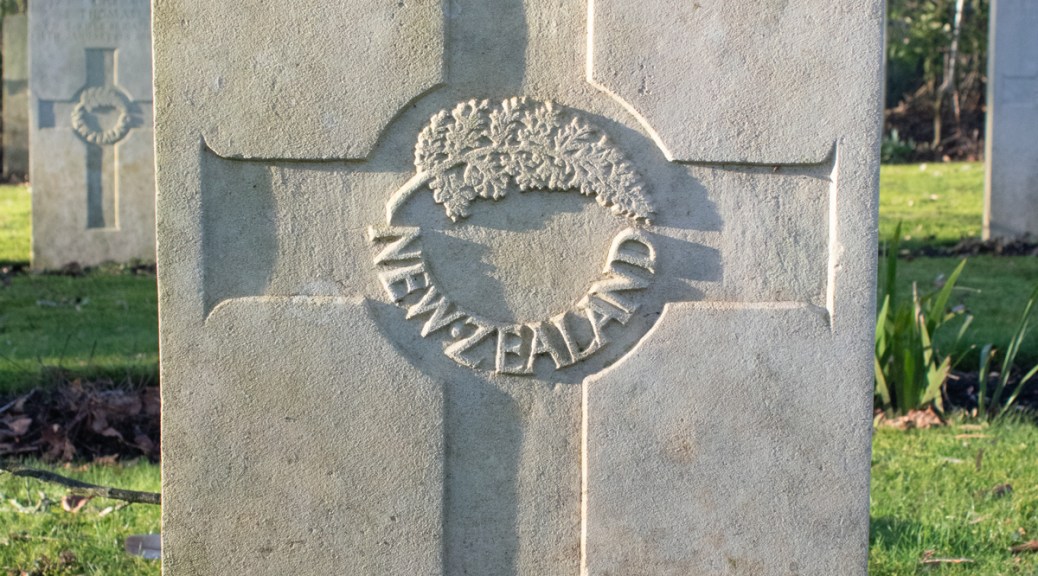
Having been born in Australia, emigrated to New Zealand and fought on the Western Front, Francis Arthur Holland was now thousands of miles from wherever he might call home. He was laid to rest in the extension to St Mary’s Churchyard in Codford, not far from the camp in which he had spent his last days.


Private Francis Holland
(from findagrave.com)

Gunner Arthur Putt

Gunner Arthur Putt

Arthur Sidney Putt was born on 22nd October 1895 in Paignton, Devon. The youngest of five children, his parents were James and Elizabeth. James died when his son was jest five years old, leaving Elizabeth to raise the family in her own. By the time of the 1901 census, they Putts were living at 22 Roundham Cottages (four doors down from the fellow future soldier Charles Baker and his family), where Elizabeth was working as a charwoman to bring in the rent money.

When he finished his schooling, Arthur found employment as a wood chipper. At 15 years of age, he and his older brother, Frederick, were both bringing a wage into the household, and were the only two of Elizabeth’s children to still be living at home.

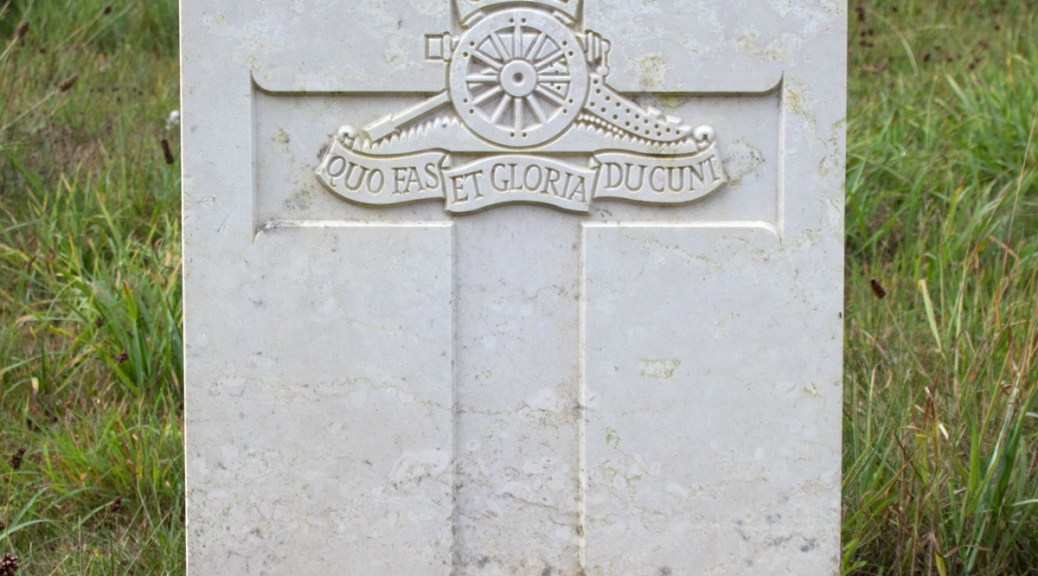
War broke out in the summer of 1914, and Arthur was one of the first to step up and play his part. He enlisted on 16th August, giving up his new job as a hairdresser, with the view of better prospects in the army. He joined the Royal Field Artillery, and was assigned to the 2nd Devon Depot Battery.

Gunner Putt’s initial medical report showed that he was 5ft 7ins (1.7m) tall, with good vision and normal physical development. He was sent for training, but a later, fuller, medical found that he was, in fact, not physically fit for army service. The report of the medical board of 27th April 1915 found that he had both rheumatism and valvular heart disease. He was dismissed from military service on 10th May 1915, after 267 days’ duty.

At this point, Arthur’s trail goes cold. It seems likely that he returned to Paignton, and to the life he had before the war, and the next record for him is that of his passing. He died on 14th May 1919, at the age of 23 years old.

Arthur Sydney Putt was buried in Paignton Cemetery, overlooking the town in which he had been born and raised.


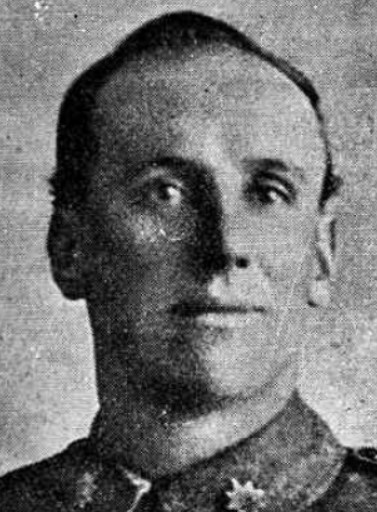
Private James Williams

Private James Williams

James Thomas Williams was born in Toodyay, Western Australia, in May 1888. The third of eight children, his parents were John and Mary Williams.

When he finished his schooling, James found work farming. Details of his early life are lost to time, but it seems likely that he had followed in his father’s footsteps.

When war engulfed the Empire, James stepped up to serve his King and enlisted in the Australian Imperial Force on 24th August 1916. His service records show that he was 5ft 6ins (1.68m) tall and that he weighed 134lbs (60.8kg). He was noted as having auburn hair, blue eyes and a fresh complexion.

Private Williams’ unit departed Australia from Freemantle on 9th November 1916. He would spend the next two months on board the Argyllshire, and eventually reached British shores on 10th January 1917. Assigned to the 16th Battalion of the Australian Infantry, his unit disembarked at Devonport, Devon, and made straight for base near Codford, Wiltshire.

The ANZAC troops had spent weeks cramped in the bowels of their ships, and space was once again at a premium in their army barracks. This congestion would prove fatal for numerous soldiers, as disease ran rife across the encampments.

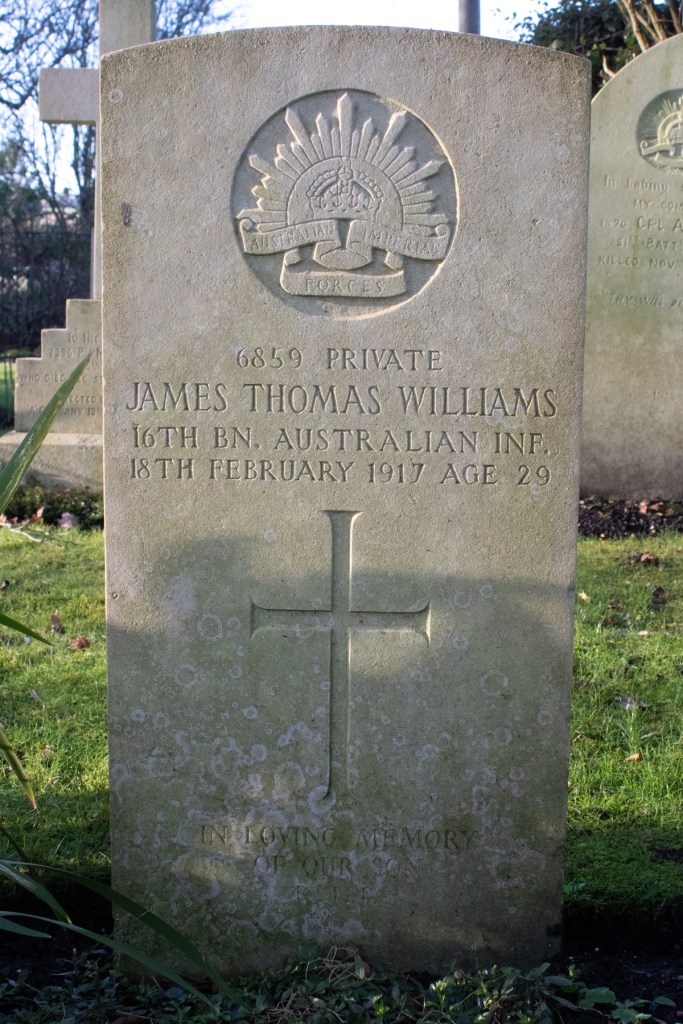
Sadly, James would not be immune to poor health. Having contracted influenza, he was initially admitted to the camp infirmary, before being moved to the military hospital in nearby Sutton Veny. The condition was to get the better of him, and Private Williams passed away from a combination of flu and heart failure on 18th February 1917. He was 29 years of age.

The body of James Thomas Williams was laid to rest in the peaceful graveyard of St Mary’s Church in Codford, surrounded by others from his regiment.


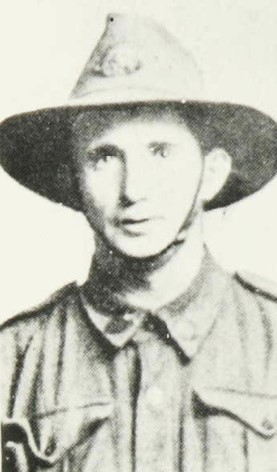
Private James Williams
(from ancestry.co.uk)