Tag Archives: history

Second Aircraftman Albert Jenner

Second Aircraftman Albert Jenner

Albert Jenner was born on 27th April 1887 in the Kent village of Hollingbourne. He was one of nine children to scaffolder and builder’s labourer Thomas Jenner and his wife, Emma.

By the time of the 1911 census, Albert was living with his parents and three of his siblings in a house on Well Street in Loose, near Maidstone. He was employed as a bricklayer’s labourer, while his brothers and father were all doing farm work.

At this point, Albert’s trail goes cold. It is clear that, when war was declared, he enlisted in the Royal Naval Air Service, although the specific dates are unknown. His younger brother Private Arthur Jenner, of the 6th Battalion of the Queen’s Own (Royal West Kent) Regiment died in northern France in July 1916, but it is unclear whether Albert had already stepped up to serve by this point.

Second Aircraftman Jenner was based at the Kingsnorth Air Base, on the Hoo Peninsula in Kent. This was a Royal Naval Air Service training station, which also experimented with air ships. There is little to document Albert’s time there, however, and, given his rank, it is likely that he was not there for very long.

The only other document directly connected to Albert confirms his passing. He died at the base on 3rd April 1917, having contracted measles, which escalated into pyaemia, or sepsis. He was a few days away from his 30th birthday.

Albert Jenner was laid to rest in the Woodlands Cemetery, in Gillingham, Kent.


Private John Merritt

Private John Merritt

John Merritt was born on 17th August 1880 in Shoreditch, London, and was the youngest of three children to James and Emily Merritt. James was a dock labourer, who passed away when his son was just four years old. Emily remarried the following year, having a child with her new husband, George Wise, in 1888.

When he completed his schooling, John found work as a stoker. However, he sought bigger and better things and, on 21st February 1898, he enlisted in the Royal Marine Light Infantry. Not yet eighteen years old, his service records show that he was 5ft 5.5ins (1.64m) tall, with grey eyes, brown hair and a fresh complexion. His service records also record a couple of tattoos: an anchor on his left forearm, and a crossed heart on his right.

Over the next two decades, Private Merritt sailed and saw the world. Primarily based out of the Royal Naval Dockyard in Chatham, Kent, he served on ten ships in all. His superiors obviously thought highly of him, as his records note his character and ability as very good throughout his service.

On 3rd July 1909, John married Harriett Wise. She was a lighterman’s daughter from East London, who was working as a cork cutter when the couple exchanged their vows. They went on to have two children: Florence, who was born in 1910, and Reginald, who came along six years later.

By the time war was declared in the summer of 1914, John seems to have been mainly shore-based, his time being split between Chatham and Portsmouth, Hampshire.

On 7th March 1917, Private Merritt was on board the gunboat HMS Spey, which was carrying out diving operations in the Thames Estuary. At 4 o’clock in the afternoon, in “bitterly cold and boisterous conditions” [Whitstable Times and Herne Bay Herald: Saturday 24th March 1917], the ship lost an anchor, and the decision was made to return to base at Sheerness, Kent. Another vessel, the HMS Belvedere, was close by and turned towards the Spey, and, despite trying to avoid a collision, the smaller ship was struck a glancing blow.

The Spey was 40 years old, and the impact sheered numerous rivets from the side. Water gushed in, and the gunboat sunk beneath the Thames within a matter of minutes. Some of the crew had managed to escape on a life raft, but it was not fitted with lights or flags. The boat drifted and was not found until five hours later, partially submerged: all on board had died.

In total, twenty of the thirty-seven crew perished on that March afternoon, including Private Merritt. He was 36 years of age.

It would seem that Harriett was unable to cover the cost of bringing her late husband’s body back to London for burial. Instead, John Merritt was laid to rest in Woodlands Cemetery in Gillingham, Kent, not far from the naval base in Chatham which he had called home for so long.


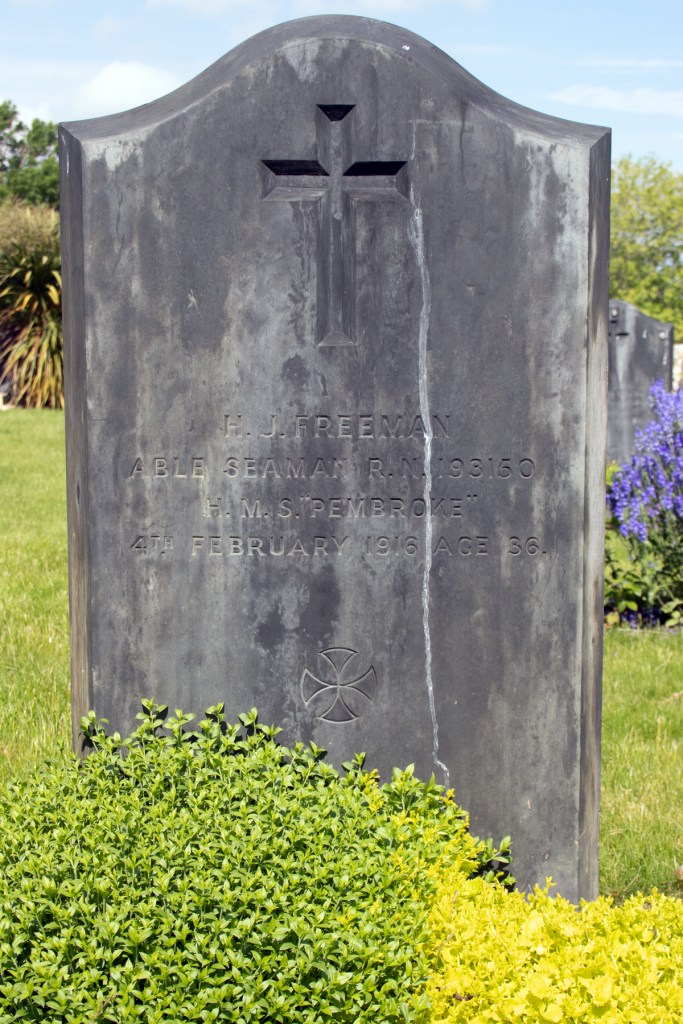
Able Seaman Horace Freeman

Able Seaman Horace Freeman

Horace James Freeman was born in Hackney, East London, on 16th September 1879. The second of five children, his parents were Archibald and Mary Freeman. According to the 1891 census, Archibald was employed as a carman, but the next document had him listed simply as a ‘traveller’.

When he completed his schooling, Horace found work as a baker’s assistant. He sought bigger and better things, however, and, on 13th February 1897, he enlisted in the Royal Navy. His service records show that he was 5ft 5.5ins (1.66m) tall, with brown hair, hazel eyes and a fresh complexion.

A few months under full age, Horace was initially given the rank of Boy 2nd Class. He was sent to the training ship HMS Northampton, and seemingly impressed his superiors, rising to Boy 1st Class within a couple of months. He moved to another training vessel, HMS Calliope, in July 1897, and was serving on board when he came of age that September.

Now formally inducted into the Royal Navy, Ordinary Seaman Freeman began what was to be an eighteen year career at sea. He would become based at HMS Pembroke, the Royal Naval Dockyard in Chatham, Kent, and went on to serve aboard nine ships during his time.

Promoted to the rank of Able Seaman in October 1899, Horace’s time in the navy was not to be without incident. He spent eight separate periods of time in the cells, 158 days in total. Full details of his misdemeanours are lost to time, but at least on at least one occasion he was placed in the brig for refusing orders.

On Christmas Day 1911, Horace married Sarah Byatt. She was a bricklayer’s daughter from Tottenham, and the couple went on to have two children: Clifford, born in 1913, and Leslie, born two years later.

While Sarah was looking after their young family, Horace spent a lot of his time at sea. As time moved on, however, he was based at HMS Pembroke for longer spells, and it was while he was in Chatham early in 1916 that fate befell him.

The body of Horace J Freeman, an able seaman of the RFR, who had been missing from his ship since February 25th, was found floating in South Lock at Chatham Dockyard on Saturday.

[South Eastern Gazette: Tuesday 11th April 1916]

Little additional information is available about Horace’s death, and it is unclear how he had fallen into the lock. He was 36 years of age.

The body of Able Seaman Horace James Freeman was laid to rest in Gillingham’s Woodlands Cemetery, not far from the naval base he had called home for so long.


Stoker James Clark

Stoker James Clark

In the regimented Woodlands Cemetery in Gillingham, Kent, stands the headstone dedicated to Stoker James Clark of the Royal Naval Reserve. The grave marker, and associated documents, confirm James’ age at the time of his passing as 48 years, but gives no details of next of kin or any relatives.

Stoker Clark’s service records are sparse, but confirm a date and place of of birth – 13th December 1867 in Glasgow, Scotland – and his parents’ names, William and Catherine. Sadly, while the document also gives the names of two of James’ siblings – Mary and William – it has not been possible to match these with any census documents from the Glasgow area.

James’ service records state that he joined the Royal Naval Reserve on 1st October 1897. He was 5ft 8.5ins (1.74m) tall, with grey eyes and a fresh complexion. He was also noted as having a number of tattoos on his right arm, including a sunrise and a heart.

Stoker Clark’s time in the Royal Naval Reserve are a bit patchy, but it seems that he was called into full duty in 1914. Over the next couple of years he served on three different ships, each time returning to HMS Pembroke, the Royal Naval Dockyard in Chatham, Kent.

While his overall service seems to have gone well, in July 1915, he deserted. Full details are not evident, but he was captured, and seems to have returned to duty by the end of the month.

The next record for Stoker Clark is that of his passing. His service records state that he “died suddenly at [Royal Naval Barracks] Chatham on 2nd May 1916 (cause of death at present unknown)”. There is no other information about his death, and, while his siblings were informed of his death, it appears they were unable – or unwilling – to bring his body back to Scotland for burial.

Instead, James Clark was laid to rest in Woodlands Cemetery, Gillingham, not far from the dockyard he had called his home.


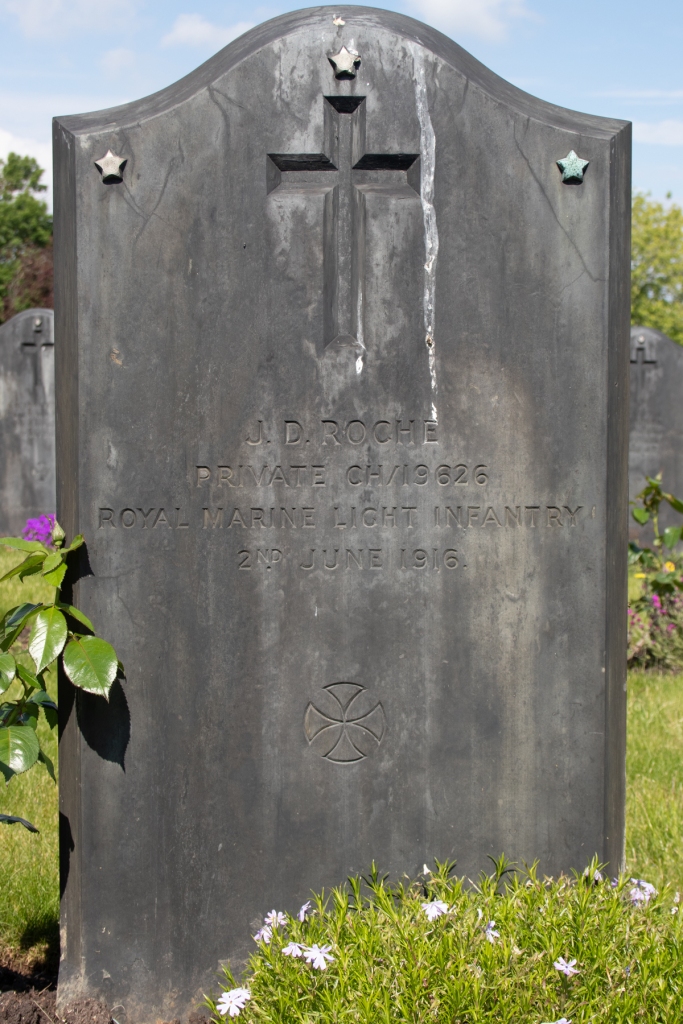
Private John Roche

Private John Roche

In the middle of the military section of the Woodlands Cemetery in Gillingham, Kent, is a headstone commemorating the life of John David Roche.

Details of John’s life are a challenge to piece together, although a later document gives his next-of-kin as Mrs E Roche of 108 Osnaburgh Street, Regent’s Park, London. There is a baptism record from 1897 for John David Roche, whose mother’s name was given as Lizzie. John’s father is listed as David, and the christening took place in Chelsea. There are no other records or census returns to give any further family background.

John’s time in military service is also hard to determine. That he joined the Royal Marine Light Infantry is clear, although when he enlisted and where he served are sadly lost to time.

Details of Private Roche’s passing are also unclear. He is noted as having died of disease, although the specific cause is not detailed. Given the location of his burial, it seems likely that he passed either at the Royal Naval Dockyard in Chatham, Kent, or at the hospital in the town connected to it.

John David Roche passed away on 2nd June 1916. If the baptism was correct, he was a day short of his 19th birthday.


Able Seaman Charles Dorman

Able Seaman Charles Dorman

Charles Columbus Dorman was born on 21st October 1892, and was the middle of three children to James and Margaret Dorman. Charles’ parents both hailed from Belfast, Country Antrim, but the 1901 census records his and his older sister’s birthplace as America. No baptism documents are available and no later information supports this, so, while his unusual middle name may suggest the place of his birth, it seems destined to remain unclear.

When he left school, Charles found work as a printer’s apprentice. He sought more, however, and was drawn to a life at sea. On 29th November 1910, he enlisted in the Royal Navy as an Ordinary Seaman. His service records confirm that he was 5ft 3.5ins (1.61m) tall, with brown hair, hazel eyes and a fresh complexion.

Charles was sent to HMS Pembroke – the Royal Naval Dockyard in Chatham, Kent – for his training. In January 1911, he was assigned to the ill-fated HMS Bulwark, before moving to the battleship HMS Implacable three months later. He would remain on board until the summer of 1914, gaining a promotion to Able Seaman during his three year stint there.

Charles was serving on Implacable when war was declared. At the beginning of September, after a week back in Chatham, was assigned to the sloop HMS Cormorant. After six months aboard, the cruiser HMS Blenheim became his home, and he spent the next month supporting troops who were being sent to Gallipoli.

By this point, Able Seaman Dorman had become unwell. He had contracted the autoimmune disease pemphigus, resulting in blistering to his skin and body. He returned to HMS Pembroke, and was stood down from the service on medical grounds 9th July 1916.

It is unclear whether or not Charles was admitted to hospital for his condition. Either way, he succumbed to the illness on 31st August 1916. He was just 23 years of age.

Charles Columbus Dorman’s family appear to have been unable to bring their boy back to Ireland for burial. Instead, he was laid to rest in Woodlands Cemetery, Gillingham, not far from the Kent naval base he had come to call home.

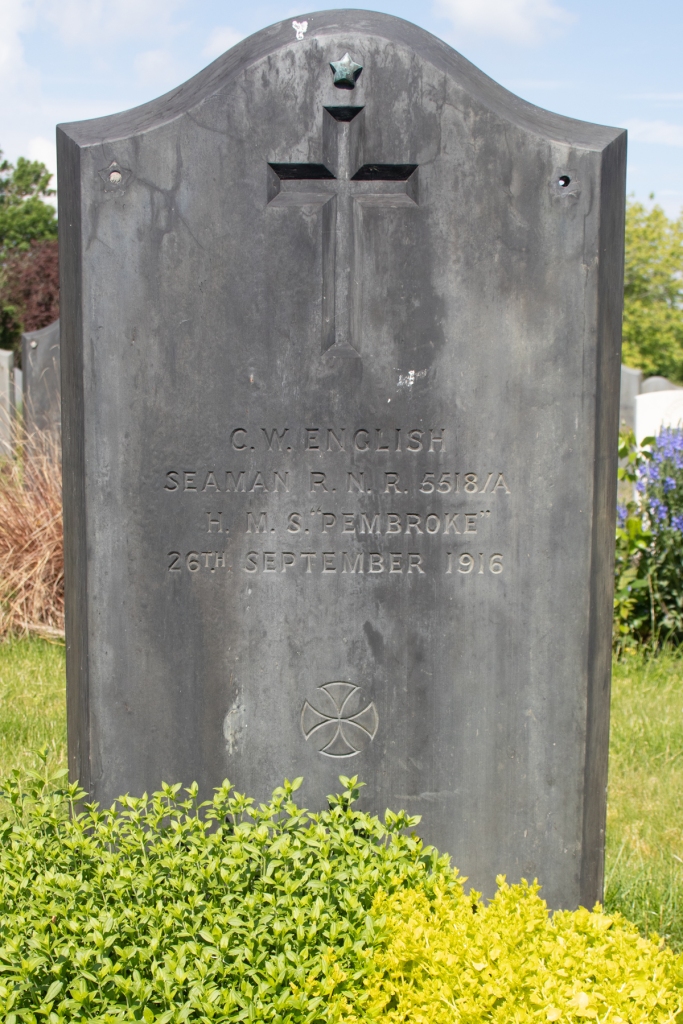
Seaman Charles English

Seaman Charles English

Charles William English was born on 30th August 1895 in the Suffolk town of Southwold. According to his later naval service records, his parents were Ellis and Sarah English, although there is little other information available to back this up.

Charles evidently had a draw to the sea and, when he enlisted in the Royal Naval Reserve on 10th January 1914, he was working as a fisherman. His service records confirm that he was 5ft 9ins (1.75m) tall, with grey eyes and a fresh complexion.

Over the next few years, Seaman English served off the east coast, and was attached to HMS Mantua, a former cruise ship taken over by the Royal Navy to patrol the North Sea. In between trips, Charles made HMS Pembroke, the Royal Naval Dockyard in Chatham, Kent, his home and it was to here that he returned in the autumn of 1916 when he fell ill.

Charles was admitted to the Royal Naval Hospital in the town, tests showing that he was suffering from lymphatic leukaemia. This was to prove fatal, and Seaman English passed away on 26th September 1916, aged just 21 years of age.

It seems likely that Charles William English’s family were unable to foot the bill for bringing their son back to Suffolk. Instead, he was laid to rest in Woodlands Cemetery, Gillingham, not far from the base he had come to call home.


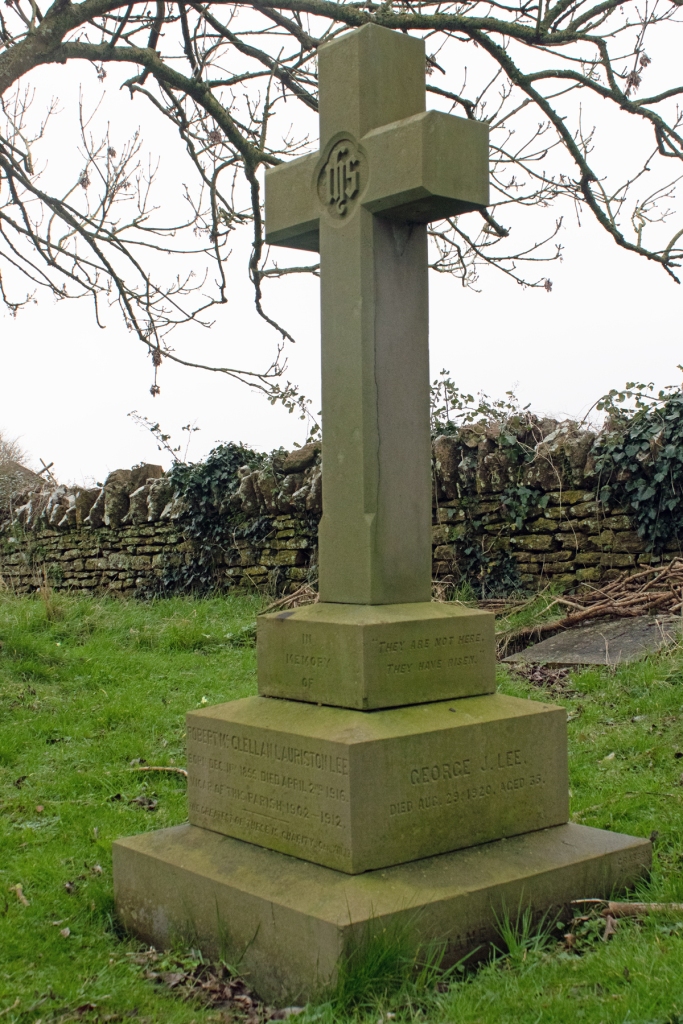
Captain George Lee

Captain George Lee

Anyone who attended the funeral of Captain George Lee, IMT (late Rifle Brigade), held in the churchyard of his old home, Yetminster, on Wednesday could not but have been impressed by the wonderful sense of peace and rest that pervaded the place. After a life of unique adventure in Africa, India, America, and Canada his worn and suffering body was laid to rest beside his beloved father. The solemn service was taken by his uncle, Red. EHH Lee (vicar of Whitchurch Canonicorum) and his cousin, Rev. E Hertslet (vicar of Ramsgate), and Rev. MJ Morgan (vicar of Yetminster), there being also present his old schoolfellow, Rev. J Lynes, and Rev. Hall, curate of Yetminster. Besides the chief mourners Captain Lee’s mother, sister and brother-in-law, there were many friends present and numerous villagers who had known him from boyhood. The coffin was attended throughout the service and for many hours before by his most faithful servant and friend, Rajab Ali Khan, who was with his master through India, Persia, Beluchistan, and Afghanistan, and came to England as his personal attendant when Captain Lee was sent home on sick leave. After the service in the churchyard Rajab, through the kindness of Mr Hall, who translated for him, was able to tell everybody what his master had been to him.

Dorset County Chronicle: Thursday 9th September 1920

George Johnston Lee was born in the summer of 1886, the second of four children to Reverend Robert Lee and his wife, Elizabeth. Robert was the vicar of St George’s Church in Fordington, Dorset, when George was born, but moved west to Toller Porcoram not long after he was born.

Tantalisingly little information about George’s early life remains. He does not appear on the 1901 or 1911 census records, and it is likely that he was already away travelling the world by this point. It seems clear that he followed a military, rather then a clerical, career and, by the end of the First World War he was serving in the Indian Army Reserve of Officers. Attached to the Rifle Brigade, George had reached the rank of Captain.

George’s father had become ill in the early 1910s, and having moved to St Andrew’s Church in Yetminster, he retired from the post in 1912. He and Elizabeth moved to Dorchester, but when he passed away in 1916, at the age of 59, his last wishes were to be buried in Yetminster, the village having held a special place in his heart.

Captain Lee survived the First World War, but, as the newspaper report suggests, he became unwell. George had contracted amoebic dysentery, and returned to England to recuperate. The condition was to prove too severe, and he passed away in London on 29th August 1920, at the age of 34 years old.

In accordance with the family’s wishes, George Johnston Lee’s body was taken back to Dorset, and he was laid to rest next to his father, in the tranquil St Andrew’s Churchyard, Yetminster.


Private James Payne

Private James Payne

The early life of James Payne is a challenge to piece together. The first document that can be properly attributed to him is his marriage certificate from 27th May 1901.

This confirms that he was 21 years old, and working as a labourer. His father’s details are noticeable by their absence. The document also gives his wife’s name, Kate Bessie Warr, and information about her father – labourer Sydney Warr. James was also working as a labour at this point, and the two of them were living in Pulham, Dorset.

By the time of the 1911 census, the newlyweds had moved to the village of Yetminster. James was working as domestic gardener, and the couple had two children – Cyril and Louis. James’ place of birth is given just as Somerset, further clouding his past.

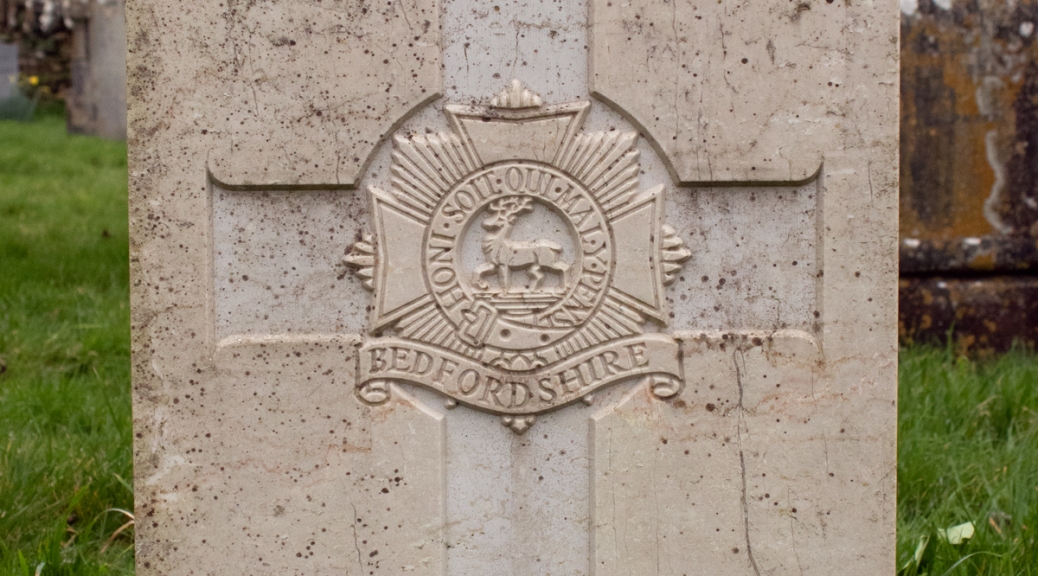
When war came to Europe, James stepped up to play his part. Full details of his time in the army are lost to time, but documents suggest that he had enlisted by October 1917 at the latest. Private Payne joined the Bedfordshire Regiment, and was attached to the 1st Battalion. His unit service on the Western Front throughout the conflict, although there is no evidence that James spent any times overseas himself.

Piecing the sparse number of documents together suggest that in March 1918, James was admitted to the 3rd Western General Hospital in Cardiff, Glamorganshire. He was suffering from nephritis and pneumonia, but it is unclear whether he was serving in Wales at the time, or was taken there for treatment. Either way, his condition was to prove too severe. Private Payne passed away on 20th March 1918: he was 38 years old.

James Payne’s body was taken back to Dorset for burial. He was laid to rest in the peaceful graveyard of St Andrew’s Church in his adopted home of Yetminster.


Company Serjeant Major Robert Pollard

Company Serjeant Major Robert Pollard

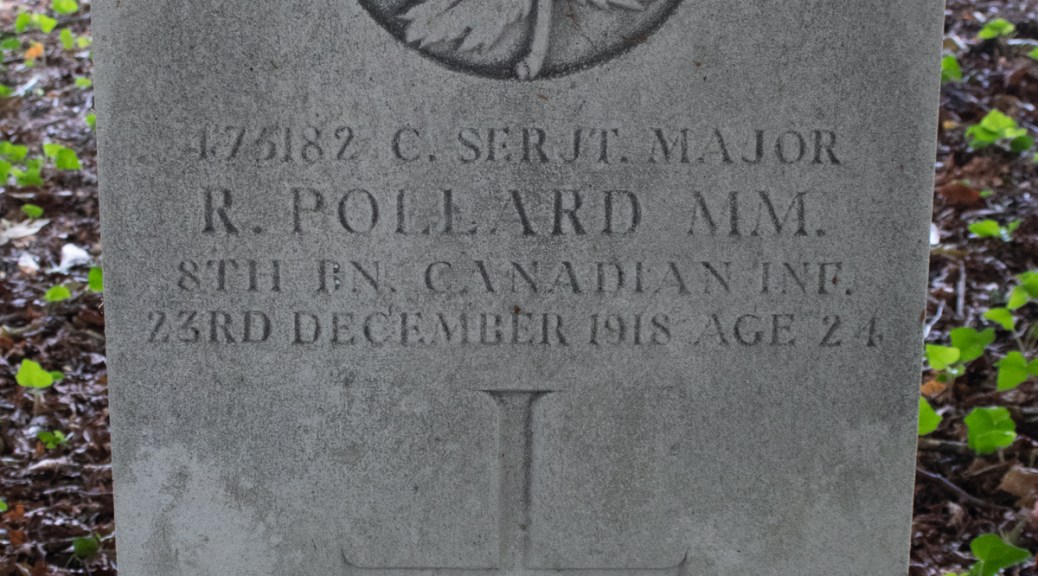
Robert Edwin Dawe Pollard was born on 8th April 1894 in Bath, Somerset. The youngest of three children, his parents were Joseph and Elizabeth Pollard. Joseph was a gardener from Banwell, but it seems that Robert had his sights on bigger and better things.

At some point Robert emigrated to Canada, and, by the time war was declared in Europe, he was working as an insurance clerk in Winnipeg. He felt a duty to serve his country, however, and on 2nd August 1915, he enlisted in the Canadian Expeditionary Force.

Private Pollard’s service records confirm he was 5ft 6ins (1.69m) tall, with dark brown hair, brown eyes and a fair complexion. He was also noted as being a Presbyterian.

Robert’s commitment to the cause is underlined by his rise through the ranks. Attached to to the 8th Battalion of the Canadian Infantry (also known as the 90th Winnipeg Rifles), he arrived in France on 27th February 1916.

The 8th Battalion was involved in some of the fiercest fighting of the war, and, on the 1st June 1916, he was wounded in his left arm. Admitted to a hospital in Camiers, he was moved to Etaples, before returning to his unit before the month was out.

For good or for bad, this was just before the Battle of the Somme and, over the next few months, Private Pollard fought bravely and hard. Moving from the Somme, his unit fought at Passchendaele and Ypres. On 1st October 1916, Robert was promoted to Corporal, and made Sergeant just three months later.

In April 1917, Robert was admitted to hospital again, this time with an infected foot. Within six weeks he was back with his unit, though, and on 7th November 1917, he was promoted to Company Serjeant Major. He was obviously good at what he did, and this was recognised. On 28th December 1917, he was mentioned in despatches, and the following June he was awarded the Meritorious Service Medal.

As the war entered its closing months, Company Serjeant Major Pollard, still led from the front. He returned to Britain at the end of November 1918, and was attached to the 18th Reserve Battalion in Seaford, Sussex ahead of being demobbed.

It was here that Robert contracted influenza. Whether at his family’s request is unclear, but he was admitted to Bath War Hospital for treatment but, after everything that he had been through, it was a combination of the flu and toxaemia, or blood poisoning, that was to prove his undoing. Company Serjeant Major Pollard died on 23rd December 1918, aged just 24 years old. His mother, Elizabeth was by his side.

Robert Edwin Dawe Pollard was laid to rest Bath’s sweeping Locksbrook Cemetery, not far from where his family lived. His headstone recognises the Military Medal he was posthumously awarded.


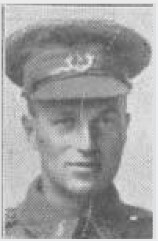
Company Serjeant Major Robert Pollard
(from findagrave.com)