Tag Archives: illness

Major Montgomerie Boyle

Major Montgomerie Boyle

Montgomerie Boyle was born on 20th March 1859 in Hendon, London. The youngest of three children, his parents were John and Jane Boyle. John was a barrister, and the family lived in some comfort – the 1861 census found them living in a house in Harrow, Middlesex, with four live-in servants and a groom.

[Montgomerie] joined the South Notts Yeomanry 22 years ago. Subsequently he obtained an appointment at Weston-super-Mare, under the Somerset Territorial Force Association, and did much useful work in co-ordinating the Army Service Corps in the county.

Taunton Courier and Western Advertiser: Wednesday 2nd April 1919

In the spring of 1891, Montgomerie married Constance Smith. She was a banker’s daughter from Nottingham, and the couple tied the knot in Basford, now a suburb of the larger city. They went on to have a daughter, Marion, who was born the following year.

By the 1901 census, the young family had moved to Timsbury, Somerset. Montgomerie was recorded as living on his own means, and the family had a retinue of servants to support them. A decade later, they had moved into the manor house in Staple Fitzpaine, Somerset. Montgomerie was now listed as a Captain in the Army Service Corps.

Storm clouds were gathering over the continent and, when war broke out, Captain Boyle was called back into active service.

…he was stationed with his Regiment on the East Coast for twelve months, and then went to France, where he remained for six months. He was re-called for service with the Mechanical Transport Section of the Army Service Corps in German East Africa, contracted malaria at the end of fifteen months and was invalided home. On his recovery he was despatched to the Egyptian front, and was with the British troops in Jerusalem. He became ill while there, and, on going down to the base at Cairo, was for a month in the Citadel Hospital, where he was treated for a malignant disease. By slow stages, first in a hospital ship, then in a Red Cross train through France, he was conveyed to [Le] Havre. Here, curiously enough, the doctor in charge of the hospital ship upon which he was placed happened to be… an old friend and medical attendant. Major Boyle landed at Southampton, and went immediately to the 3rd London General Hospital at Wandsworth [Surrey], where he was examined by an eminent specialist. His condition was serious but on Monday week last he arrived at his old home, where, despite the devoted care of his wife and daughter, he passed away quietly.

Taunton Courier and Western Advertiser: Wednesday 2nd April 1919

Major Montgomerie Boyle passed away on 27th March 1919, a week after his sixtieth birthday. He was laid to rest in the quiet graveyard of St Peter’s Church, on the outskirts of the grounds of the manor house the Boyles had made their home ten years before.

When Constance died ten years later, at the age of 70 years old, she was laid to rest in the family plot, reunited with her late husband once more.


Major Montgomerie Boyle
(from findagrave.com)
Lieutenant Vincent Mellor

Lieutenant Vincent Mellor

Vincent Charles Serocold Mellor was born in Chelsea, Middlesex, in the spring of 1897. The younger of two children, his parents were Chief Solicitor to the Treasury – and later Sir – John Paget Mellor and his Australian-born wife, Mabel. The 1901 census recorded the family living on Chelsea Embankment, with four servants: a cook, a nurse and two housemaids.

For someone with a relatively high standing in Edwardian England, there is surprisingly little documentation relating to Vincent – who was known as Vin. His name does not appear in the 1911 census, although nor does his family.

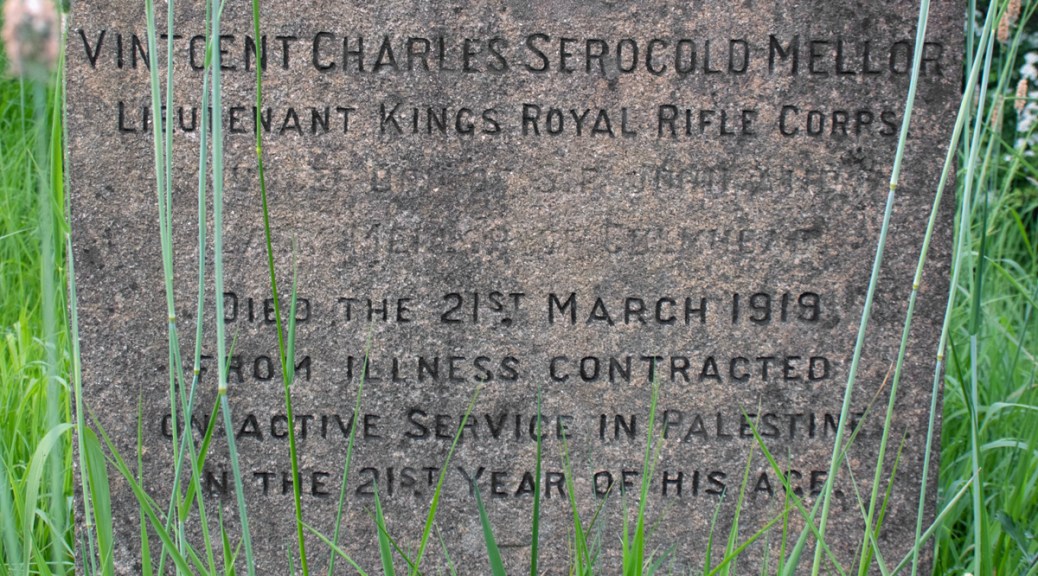
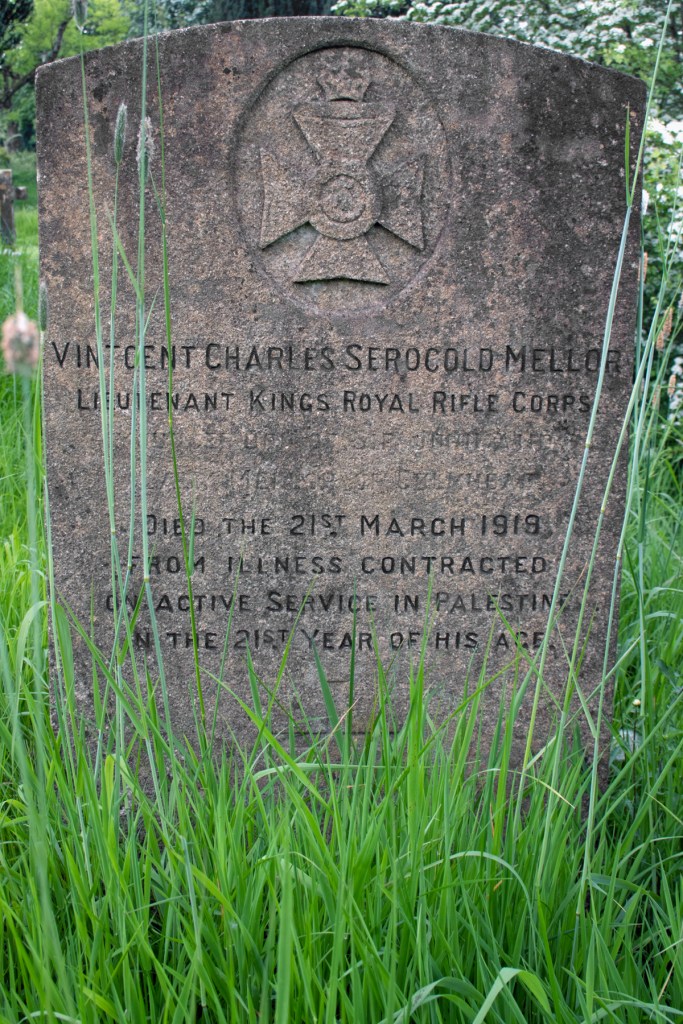
At some point, Vincent was given a commission in the King’s Royal Rifle Corps, but his service records are lost to time, which makes it impossible to find any specific information about his military career. Lieutenant Mellor’s headstone confirms that he served in Palestine, and that he fell ill while in the Middle East.

Vincent returned to Britain for treatment, and was admitted to the Red Cross Hospital for Officers in Portland Place, London. Whatever his condition, he was to succumb to it: he passed away on 21st March 1919, aged just 20 years of age.

Vincent Charles Serocold Mellor was brought back to Somerset for burial. He was laid to rest in the peaceful graveyard of St Paul’s Church in Churchstanton, close to the family’s country home, and the same church in which he had been baptised two decades before.


Lieutenant Vincent Mellor
(from findagrave.com)

Private Edward Paul

Private Edward Paul

Edward James Paul was born in Curry Mallet, Somerset, early in 1888, one of nine children to William and Eliza Paul. William was a stone mason, but Edward and his brothers went into agricultural labouring when they finished their schooling. Eliza and Edward’s sisters found employment making and finishing clothes.

Little further information about Edward’s early life is available but when war broke out, he stepped up and volunteered. Full details about his military service are no longer evident, but he enlisted early in 1915, joining the Prince of Wales’ Leinster Regiment.

Assigned to the 6th Battalion, Private Paul’s Medal Roll Card confirms that he was sent overseas on 9th July 1915, destined for the Dardanelles, and Gallipoli.

How long Private Paul served in the Balkans for is unclear, but he was back on British shores by early in 1916, and had been admitted to a hospital in Birmingham, having fallen ill. Again, details are sketchy, but he was to succumb to the condition on 15th February, at the age of 27 or 28.

Edward James Paul’s body was brought back to Somerset for burial. He was laid to rest in the quiet graveyard of St James’ Church, in his home village, Curry Mallet.


Serjeant Robert Priddle

Serjeant Robert Priddle

Zebulon Priddle was born in the autumn of 1876 in Curry Mallet, Somerset. One of ten children, who included Meliam, Cornelius, Absalom, Ebenezer, Lancelot and Jabez, his parents were Robert and Mary Priddle.

Robert was a farm labourer, and his son followed suit at first, but a career away from home beckoned and, on 16th January 1894, he enlisted in the Royal Artillery. Aged just 18 years and 2 months, Zebulon had volunteered in the Somerset Light Infantry, a militia group at that point. His service records confirm that he was 5ft 5ins (1.65m) tall and weighed 122lbs (55.3kg).

Driver Priddle was based on home soil for eighteen months before his wish for a life of adventure was realised. On 16th September 1894, his battalion set sail for India, and he was to remain there for more than six years. Zebulon returned to Britain in February 1902, where he was placed on reserve status. He completed his twelve years’ service in January 1906, and stepped down from the army.

Britain’s shores could not contain Zebulon, however, and at some point he emigrated to Canada. Little information of his life in North America is available, other than that the move seemed to have provided him with an opportunity to change his name, as in documents from this point on he is known as Robert Priddle.

The next record for Robert is that of his re-enlistment when war broke out. He was living in Winnipeg by this point, and, as he gives his mother, Mary, as his next-of-kin, it seems that he did not marry or have children.

Robert joined up again on 16th December 1914, and was attached to the 9th Battalion of the Canadian Infantry. Promoted to the rank of Sergeant, he arrived back in England in March the following year. His time there was to be brief, however, and within a matter of weeks, Robert arrived on the Western Front.

Over the next six months, Sergeant Priddle’s health suffered significantly, and he had several periods in hospital. Initially suffering from bronchitis, in July 1915 he was medically evacuated to Britain with cardiac angina. He remained in England and, when rheumatism set in in October, he was transferred to reserve status.

Sadly, this was not to be the last time Sergeant Priddle’s health suffered: he was admitted to hospital in Shorncliffe, Kent, with a ruptured aortic aneurysm. He succumbed quickly, passing away on 25th January 1916, at the age of 39 years old.

The body of Robert Priddle was brought back to Somerset for burial. He was laid to rest under his assumed name, in the peaceful graveyard of St James’ Church in his home village of Curry Mallet.


Captain John Cooper

Captain John Cooper

John Bruce Cooper was born on 21st July 1869 in Croydon, Surrey. He was the oldest of eight children, all but one boys, to John and Maria Cooper. John Sr was a boot and shoe manufacturer whose business, by the time of the 1881 census, was employing around 600 people.

By 1901, the business was doing well. The family had moved to Northamptonshire, and were living at Delapré Abbey, on the outskirts of Northampton. They were now supported by fourteen servants living on site, while grooms, coachmen and gardeners were housed on the estate.

John Sr died in August 1906, while Maria passed away less than six months later. Their children, now aged between 25 and 37, went on to live their separate lives. Five of John Jr’s brothers remained in bootmaking, in Leicestershire, Northamptonshire and Surrey, while one of them, Philip, took holy orders. John, however, sought a different route.

In April 1907, John married Violet Mary Gordon in Kensington, London. She was the daughter of a general in the Indian Army, and had been born in Simla. The couple settled in a house in Basingstoke, Hampshire, and went on to have two children: Thomas and Richard. The 1911 census records the family residing in Daneshill Cottage, with two live-in domestics. By this point John was noted as being a dealer in motor cars.

When war broke out, John felt duty bound to serve his country. Little information about his military career remains documented, but a contemporary newspaper report of his funeral provides some indication of his service.

Captain Bruce Cooper… was formerly an officer of Territorial [Royal Army Medical Corps], being transport officer of the 2nd South-Western Mounted Brigade, and was stationed at Frome [Somerset]. Obtaining a commission in the [Army Service Corps], he was promoted captain, and was so proficient and zealous that he became Officer Commanding Vehicles at Bulford Camp, where he was held in the greatest esteem.

Bath Chronicle and Weekly Gazette: Saturday 27th November 1915

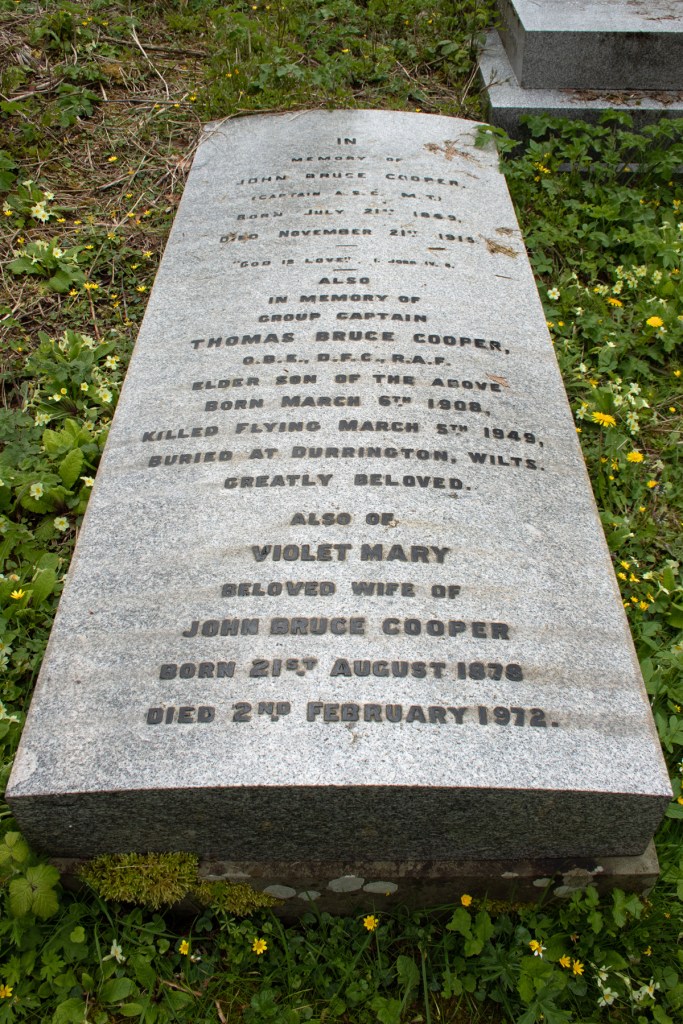
Captain Cooper fell ill in October 1915, and was suffering from phlebitis, or inflammation the veins. This was to prove fatal, and he passed away at the family home in Bath, Somerset, on 21st November 1915. He was 46 years of age.

John Bruce Cooper was laid to rest in a family plot in the cemetery of Bath Abbey. His older son, Thomas was laid to rest with him, when he passed away in 1949. Violet was reunited with her husband and son when she was buried with them in 1972.


Captain John Cooper (from ancestry.co.uk)

Private William Taylor

Private William Taylor

Much of the life of William Charles Taylor is destined to remain lost to time. His Commonwealth War Grave Commission and military records give his father as Henry Taylor, while another document suggests his mother’s initial was E, but no birth, baptism or census records match the three names given.

The document that can be directly attributed to William is his military service records. They confirm that he enlisted in Bath, Somerset, on 18th February 1916, joining the Somerset Light Infantry. The document notes that he was 21 years and 7 months old when he enlisted, and stood 5ft 7ins (1.7m) tall.

Initially assigned to the 10th Battalion of the Somerset Light Infantry, within a couple of months, Private Taylor was transferred across to the Durham Light Infantry in July 1917. He remained on home soil for the duration of his time in service, and was moved across to the Labour Corps in March 1918.

By May that year, William had become unwell. He was based in Essex at this point, and was admitted to the Warley Military Hospital in Brentwood, suffering from tuberculosis. He spent six weeks in hospital, before finally being discharged from the army as he was no fit for military service.

At this point, William’s trail goes cold once more. He seems to have returned home to Bath, finally succumbing to tuberculosis on 15th September 1918. He was just 24 years of age.

William Charles Taylor was laid to rest in Bath’s Twerton Cemetery.


Sapper James Osborne

Sapper James Osborne

James Albert Edward Osborne was born early in 1887, in Weston, on the northern outskirts of Bath, Somerset. One of eight siblings, his parents were road labourer James and launderess Emily Osborne.

When he completed his schooling, James Jr found work as an ‘under brewer’, but soon took up woodwork. By the time of the 1911 census, he was employed as a jobbing carpenter, bringing in one of four wages into the family home.

On 25th May 1915, James married Frances Kettlety. Born in Twerton, near Bath, she was the daughter of a nurseryman. At the time of the wedding, she was working as a tailor’s machinist. The couple set up home in a terraced house in Locksbrook Road, Bath, and had a daughter, Joyce, who was born in May 1916.

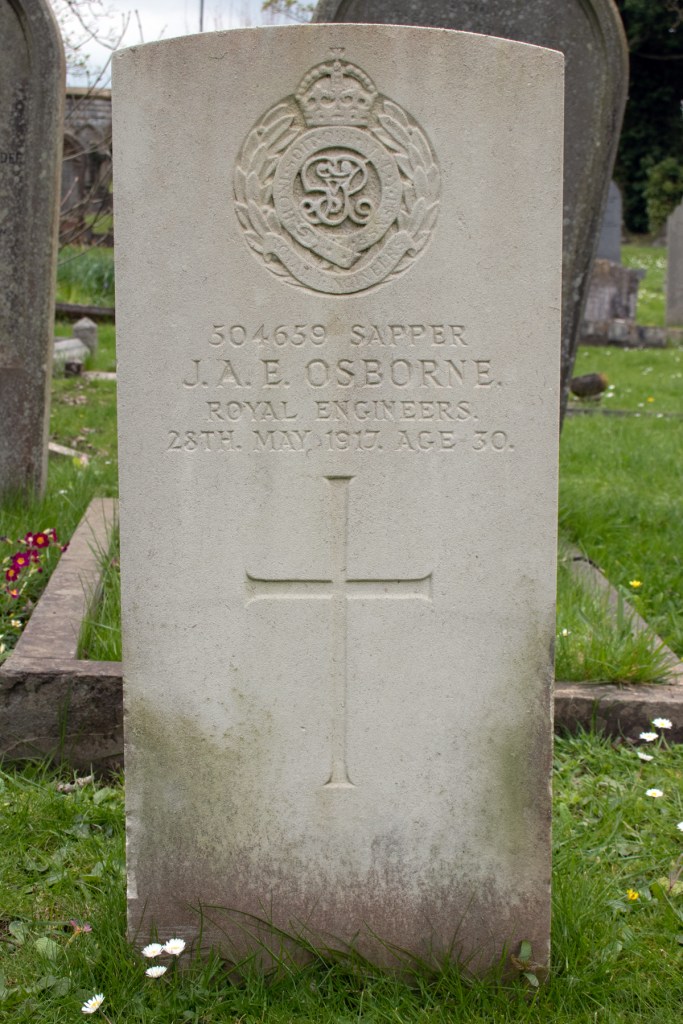
War was closing in on Europe and, in December 1915, James enlisted. His trade made him ideal to join the Royal Engineers, and he signed up as a Sapper. His service records show that he was 5ft 4.5ins (1.64m) tall, weighed 144lbs (65.3kg) and note that his lower molars were absent.

Initially placed on Reserve, Sapper Osborne was mobilised on 8th May 1916, and sent to a camp near Whitchurch, Hampshire. Over the next year he served in the area and was billeted with a Mr and Mrs Carpenter. While details of the work he did are lost to time, there is nothing in his records to suggest that he was anything other than committed to what he was doing.

In the spring of 1917, Sapper Osborne began to suffer from headaches. He visited the camp doctor a couple of times for them, but, again, there is no detail about the outcome of these appointments. By the end of May, the pains were becoming severe, and James took drastic action.

On Sunday 27th May, he spent the morning with colleagues Sapper Trott and Private Sutcliffe, both of whom said he was in good form, and was talking as normal. They saw him again the following morning, but only in passing. James’ landlord said that he had not seen him on the Monday, and so set out to look for him.

[Mr Carpenter] found Osborne in a field about two miles away from his home; he was in the middle of a big double hedge and must have crawled through. [He] thought at first he was asleep, but when he went round to the other side of the hedge he could see that Osborne’s throat had been cut, but he did not touch him; he could see that he was dead… His hands, coat and trousers were covered with blood… Near his right hand was a blood-stained razor, this throat was cut and his windpipe severed He searched the deceased and in his tunic pocket found a letter… addressed to his wife, his mother, Lance-Corpl. Macey, two other mates and Mr and Mrs Carpenter…

Andover Advertiser: 1st June 1917

The inquest into Sapper Osborne’s dead returned a verdict of suicide while temporarily insane: he was 30 years of age.

James Albert Edward Osborne was brought back to Somerset for burial. He was laid to rest in Twerton Cemetery, not far from where his widow and daughter lived.


Private Thomas Parsons

Private Thomas Parsons

Thomas Alfred Parsons was born in the summer of 1885 in Twerton, Somerset. One of six children, his parents were railway engine driver William Parsons and his wife, Mary. When Thomas finished his schooling, he found work at a labourer at a mineral water supplier, something he continued doing through to the outbreak of war.

On 27th May 1912, Thomas married Lily Howell, a labourer’s daughter, the couple tying the knot in Twerton parish church. They were living in Charlton Buildings, next to the river and now student accommodation for Bath’s universities. Lily had had a son, in November 1905: young Ronald was either Thomas’, or he was accepted as his own.

When war came to Europe, Thomas stepped up to play his part. He enlisted on 11th December 1915, although he was not formally mobilised until six months later. Private Parsons initially joined the Devonshire Regiment, but by early 1917, he became attached to the 169th Labour Corps.

Sent to France in February that year, Private Parsons only remained overseas for a matter of six months. By early September Thomas had fallen ill, contracting a combination of bronchitis and phthisis (or tuberculosis). Medically evacuated back to Britain, he was admitted to a hospital in Plymouth, Devon, but grew weaker until, on 2nd October 1917, he passed away. He was 32 years of age.

The body of Thomas Alfred Parsons was taken back to Somerset for burial. He was laid to rest in Twerton Cemetery, not far from his widow’s home.


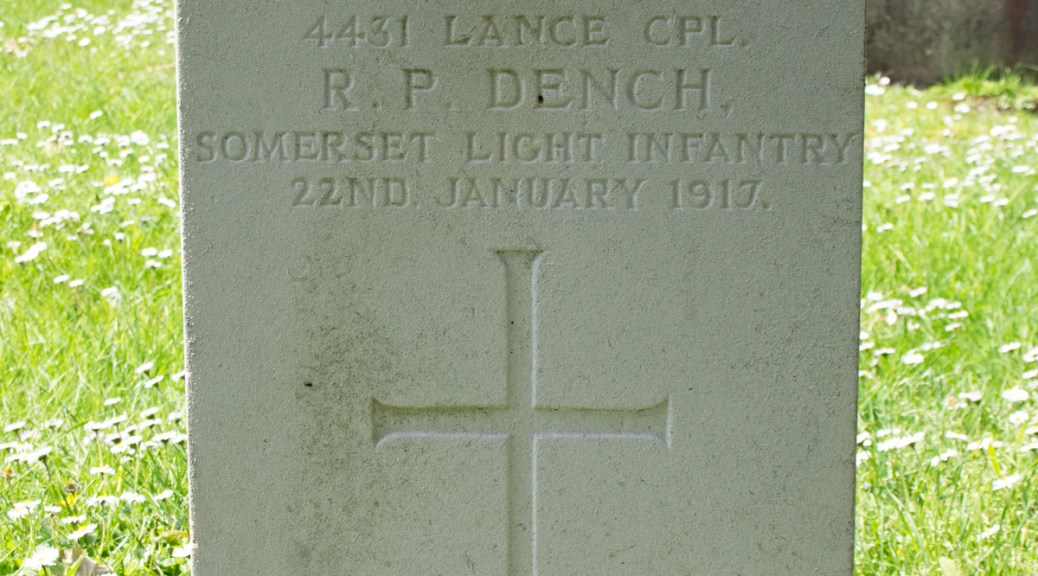
Lance Corporal Reginald Dench

Lance Corporal Reginald Dench

Reginald Percy Dench was born in the spring of 1884 in Twerton, Somerset. He was one of seven children to Henry and Jane – known as Lily – Dench. Henry was a shoe maker turned cloth dyer, but Reginald found work as a stone mason when he finished his schooling.

War came to Europe in 1914, and Reginald stepped up to play his part. His full service details are no longer available, but from what remains it is clear that he had enlisted in the Somerset Light Infantry by the summer of 1916. He was attached to the 5th Battalion, which spent of the conflict in India and Egypt, but there is nothing to confirm that Private Dench served overseas.

Reginald earned a promotion during his military career, and, by the end of 1916 was a Lance Corporal. By this point, however, he had fallen ill, contracting pleurisy. He was, by this point, back in Somerset, and it is likely that he was admitted to the Bath War Hospital. The condition was to get the better of him, and he passed away on 22nd January 1917. He was 32 years of age.

Reginald Percy Dench was laid to rest in Twerton Cemetery, a short walk from the family home in Mill Lane, and close to his two brothers, Edmund and Edward, who had died some twenty years before, while still children.


Tragedy was to strike again for the Dench family when, just six weeks after Reginald’s passing, Henry also died. He was laid in the same cemetery, not far from his sons. When Lily passed away in 1924, she was also buried in Twerton Cemetery, reunited with her family once more.


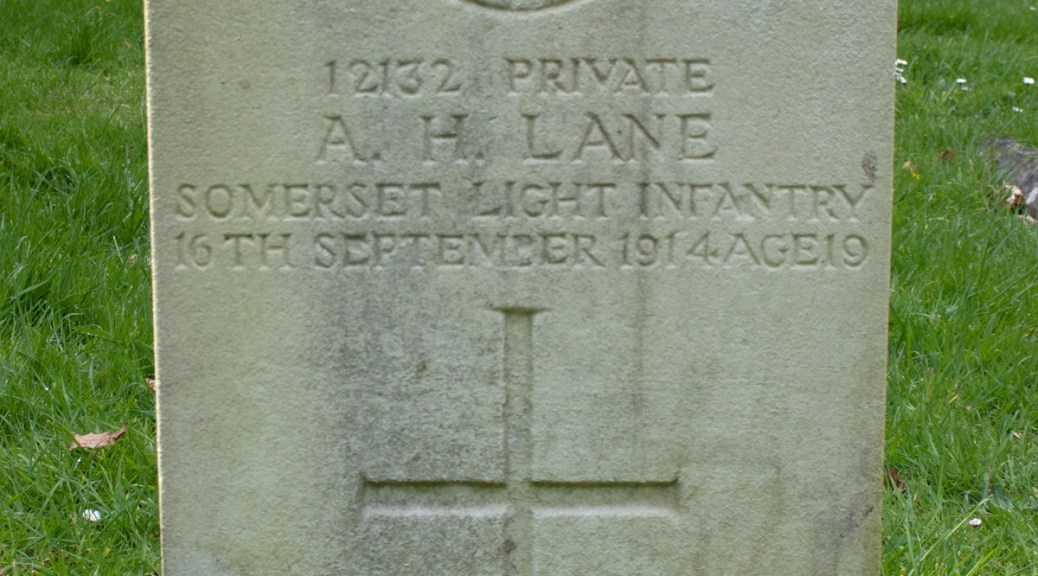
Private Arthur Lane

Private Arthur Lane

Arthur Henry Lane was born in the summer of 1895, the third of eight children to Henry and Ada Lane. The family were initially born and raised in Templecombe, Somerset, before moving to Bath in the early 1900s.

Henry was employed as an engine driver for Great Western Railways and, after initially finding work as a jobbing gardener, Arthur moved in with relatives in Highbridge in 1911. He found work as an engine cleaner for the Somerset and Dorset Joint Railway Company, and was there for nearly three years.

When war broke out, Arthur was one of the first to enlist. He joined the 3rd Battalion of the Somerset Light Infantry at the barracks in Taunton. Private Lane was then sent to Devon for further training, but he quickly fell ill.

Admitted to Devonport Hospital with appendicitis, he suffered complications following the operation, dying just five days later. He was only 19 years of age, and had been in the army for less than a month.

Arthur Henry Lane’s body was brought back to Somerset for burial. He was laid to rest in Bath’s Twerton Cemetery.