Walter Griffin was born on 15th December 1886 in Woolwich, Kent. Details of his early life are lost to time, but, by the time of the 1901 census, he was working as a cooper’s mate at a cement factory in Higham, Kent.
Walter sought bigger and better things for himself, and, on 19th June 1907, he enlisted in the Royal Navy as Cook’s Mate 2nd Class. His service records confirm that he was 5ft 4ins (1.62m) tall, with brown hair, grey eyes and a fresh complexion.
Walter was initially sent just down the coast to the Royal Naval Dockyard in Chatham, Kent, for his training. He remained there for nine months, and was promoted to Cook’s Mate 1st Class for his service.
In January 1908, he was given his first posting, on board HMS Wildfire, and, over the next nine years, he served on a further four ships, returning to Chatham in between postings. Walter was obviously dedicated to the work he was doing: in January 1910 he was promoted to Leading Cook’s Mate, and by 1917, he was promoted again, to the ran of Ship’s Cook.
This promotion coincided with a transfer to what would be his last assignment, on board HMS Racoon. This Beagle-class destroyer patrolled the waters between Scotland and Northern Ireland, and he spent the winter of 1917/18 on board.
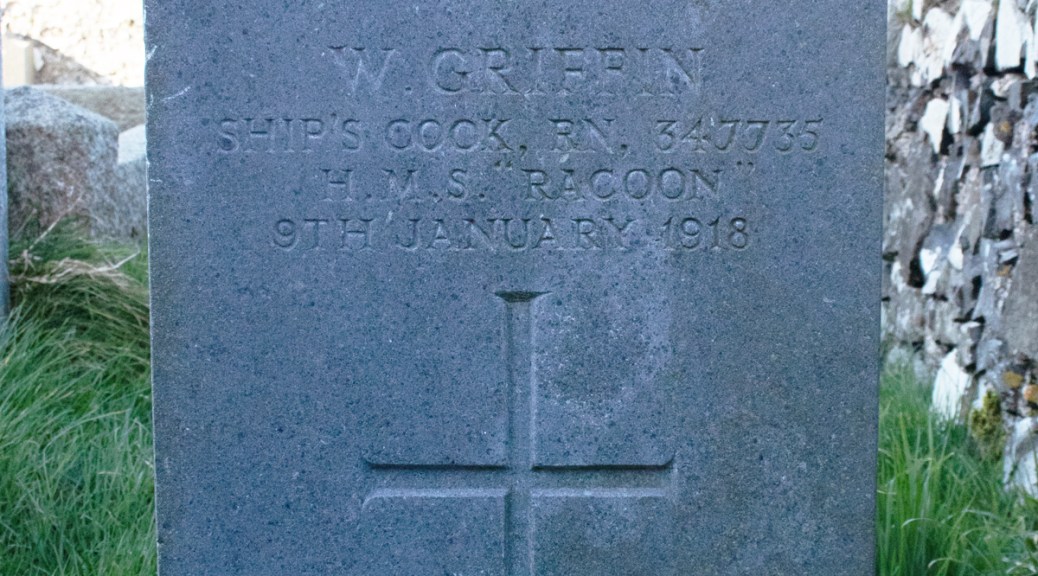
On 9th January 1918, there were storm conditions off the Irish coast: high seas and blizzard limited limited vision. At 2am, the Racoon struck rocks, and foundered: in the treacherous conditions, all hands were lost. Shio’s Cook Griffin was 31 years of age.
Walter Griffin’s body washed ashore near the village of Ballintoy, Country Antrim, the following day. He was laid to rest in the parish church, next to two other crew members, Ordinary Seaman Frank Green and Stoker 2nd Class Frederick Sarell.
Frank Ernest Green was born in Stratford, Essex on 14th November 1889. One of nine children, his parents were printer’s compositor John Green and his wife, Susan. The family were raised in Leytonstone and, by the time of the 1911 census, they were living in a house in Elsham Road.
Frank found work as a clerk for a financial company when he finished his schooling. On 31st August 1912, he married sailor’s daughter Charlotte Greenland, who was four years his senior. The couple settled in Gibbon Road, Peckham, Surrey, where Frank continued his work.
When war broke out, Frank was called upon to play his part. On 3rd January 1917, he enlisted in the Royal Navy for the duration of the war. His service records show that he was 5ft 6.5ins (1.69m) tall, with brown hair, blue eyes and a fresh complexion.
Ordinary Seaman Green was initially sent to HMS Pembroke, the Royal Naval Dockyard in Chatham, Kent, for training. He spent short periods of time on two ships before being assigned to HMS Racoon, a Beagle-class destroyer,
Initially patrolling the Mediterranean, by the time Frank joined the crew the Racoon she was part of the Second Destroyer Flotilla, based from Northern Ireland. In January 1918, she struck harsh weather:
HMS Racoon, Lieut. George LM Napier RN, in command, struck some rocks off the north coast of Ireland at about 2am on the 9th [January], and subsequently foundered with all hands.
Nine of the crew had been left behind at her last port of call, and these are the sole survivors.
Seventeen bodies have been picked up by patrol craft, and are being buried at Rath Mullan. Five more bodies have been washed ashore, and are being buried locally.
All the next of kin have been informed.
Exeter and Plymouth Gazette – Monday 14 January 1918
Ordinary Seaman Frank Ernest Green was one of those to be washed ashore. He was just 28 years of age. He was laid to rest in the peaceful and picturesque graveyard of Ballintoy Church, County Antrim, not far from where he had come to land. He was buried next to two other crew members, Ship’s Cook Walter Griffin and Stoker 2nd Class Frederick Sarell.
William Henry Whitmore was born in Stoke-on-Trent, Staffordshire, on 21st May 1875. One of nine children, his parents were William and Mary Whitmore. He was not the first of their sons to be called William – a brother born nine years previously was also called by that name, but he died when just a few months old.
William Sr was a journeyman joiner, and seems not to have played much of a part in his family’s life. The 1881 and 1891 census returns found Mary raising her children as the head of the household, and this seems to have paid a toll. By the time of the 1901 census, she was one of 150 patients at the North Staffordshire Infirmary in Stoke-on-Trent. She died in 1907, at the age of 67 years old.
William Jr, meanwhile, had been making a life for himself. On 28th August 1895, he enlisted in the Royal Marine Light Infantry, set on a career at sea. His service records confirm that he was 5ft 8ins (1.73m) tall, with brown hair, grey eyes and a fresh complexion. The document also highlights two tattoos on his left forearm, one of a crossed heart.
Private Whitmore was sent to Walmer in Kent for his initial training. He spent nine months on site, before moving to what would become his shore base, the Royal Naval Dockyard in Portsmouth. Over the twelve years of his contact, he would go on to serve on six ships, each time returning to the Hampshire port.
On 18th February 1904, William married Margaret Cook. She was the daughter of a farm labourer from Somerset, but the couple wed in the parish church of Eastry, near the Royal Marines base in Walmer.
William’s term of service came to an end in September 1907, and he was placed into the Royal Fleet Reserve. He and Margaret, together with daughter Kathleen, settled in Wellingborough, Northamptonshire. Their home was a small terraced cottage on Salisbury Road, close to the train station. William had found employment as a labourer in a blast furnace not far from home. A second child, daughter Nora, was born in 1910, and the family was complete.
Private Whitmore was called into service once more when war was declared. After initially returning to Portsmouth, he was assigned to the converted liner HMS Carmania, spending nearly two years on board. After a brief spell back on dry land, William found himself assigned to the steam ship SS Anna Sophie.
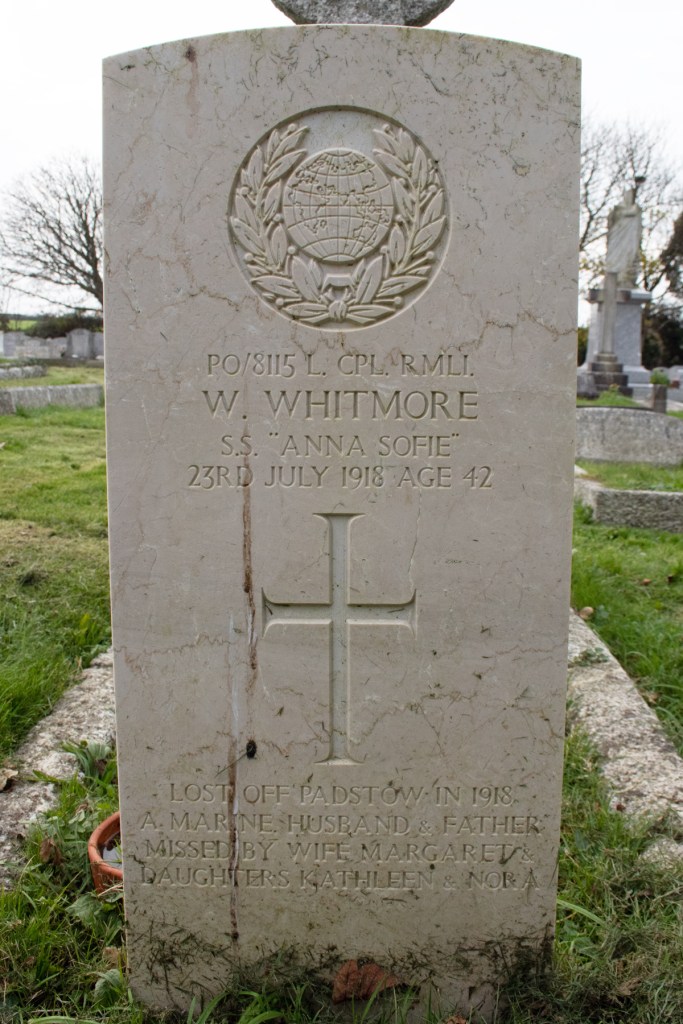
On 23rd July 1918, the ship was en route from Rouen to South Wales, when she was torpedoed the German submarine U-55 off Trevose Head, Cornwall. The Anna Sofie was sunk, and one member of the crew died. Others subsequently passed from their injuries, including the now Lance Corporal Whitmore. He was 43 years of age.
William Henry Whitmore’s body was recovered, but his family were unable to cover the cost of bringing him back to Northamptonshire for burial. Instead, he was laid to rest in Padstow Cemetery, in a shared grave with fellow crewman Gunner William Moore.
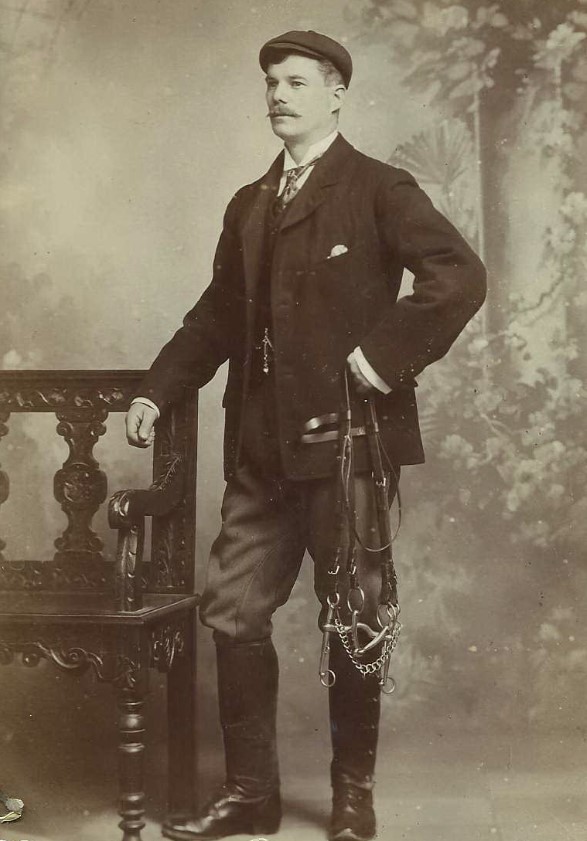
Lance Corporal William Whitmore (from ancestry.co.uk)
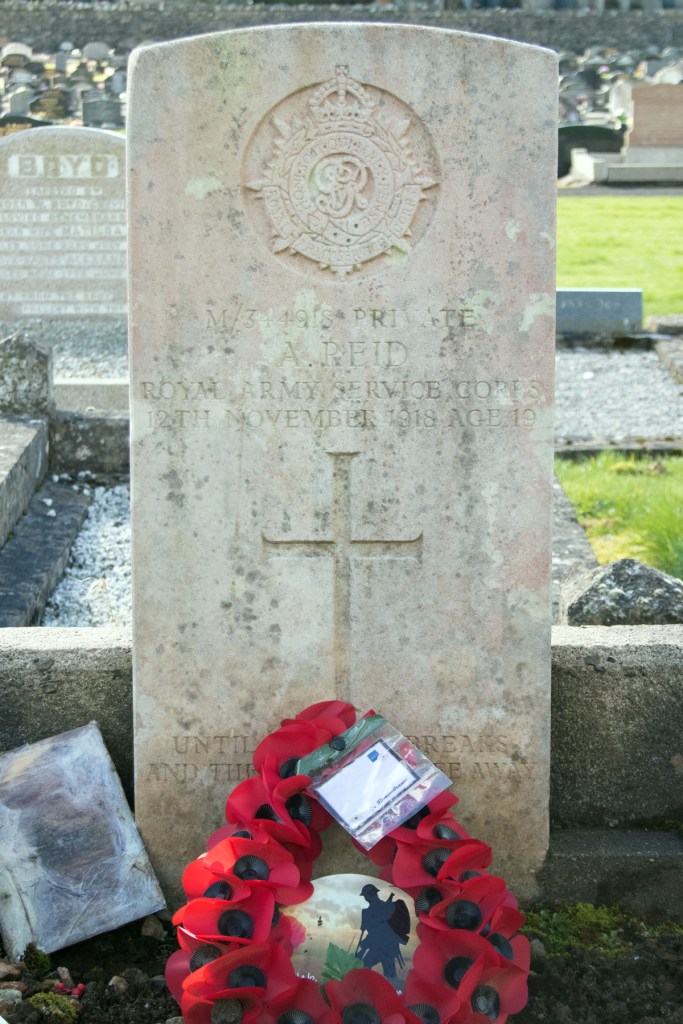
Alexander Reid was born in Ballymena, County Antrim, in the autumn of 1898. Information about his early life is a challenge to pin down, as there were a number of boys with the same name growing up in the area at the time. However, his parents were John and Margaret – or Maggie – Reid.
When Alexander finished his schooling, he found employment as a mill hand. However, when war broke out, he received the call to play his part and, on 13th October 1917, he enlisted in the Army Service Corps. His service records show that he was 5ft 7.5ins (1.71m) tall and weighed 138lbs (62.6kg). He was noted as having a tattoo of his initials on his left thumb, and that his right knee was stiff and swollen from an old injury.
Private Reid was sent to England to serve. He was attached to the Mechanical Transport Depot at Grove Park, Kent. Barracked in an old workhouse that had been taken over for army use, he remained there until the spring of 1918.
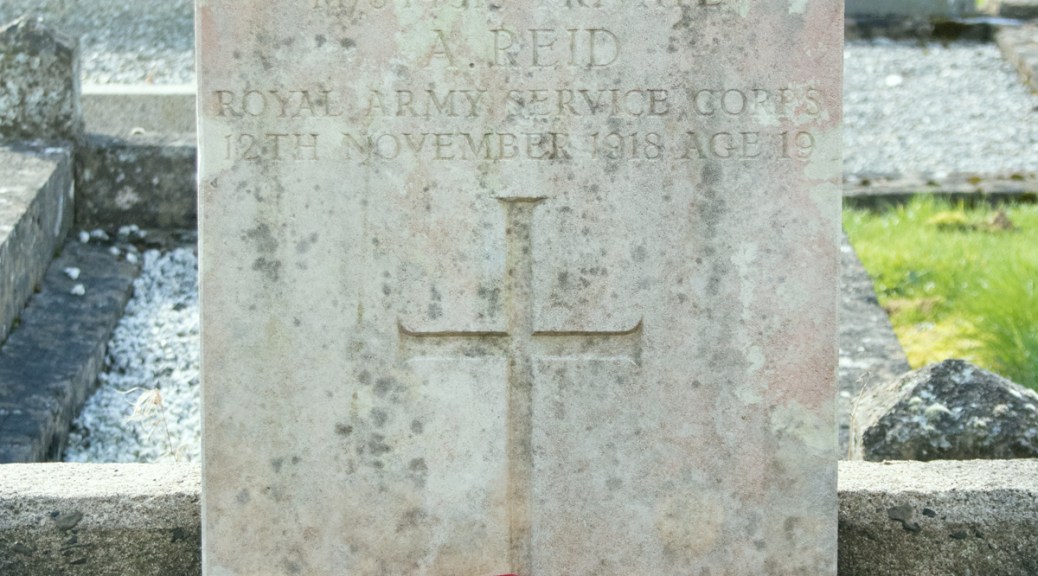
Alexander had contracted tuberculosis and was medically discharged from service because of the contagious disease. He returned home to Ballymena, but the condition worsened. He passed away at home on 12th November 1918, aged just 19 years old.
Alexander Reid was laid to rest in Ballymena New Cemetery, County Antrim, a twenty-minute walk from where his grieving family lived, in the centre of the town.
Richard Ezra Baron White was born in the autumn of 1886 in the Cornish village of St Minver. The third of four children, his parents were Joseph and Zillah White. Joseph was a ship’s carpenter by trade, and Richard served an apprenticeship as a woodworker. By the time of the 1911 census, however, the Whites were working as farmers on the outskirts of the village.
When war was declared, Richard stepped up to serve King and Empire. It is unclear when he enlisted, but he joined the Gloucestershire Regiment, and was attached to the 3rd (Reserve) Battalion. Private White was based in Kent during the conflict, his unit being attached to the Thames and Medway Garrison.
Richard survived the conflict, but the winter of 1918/19 was to prove his undoing. He contracted pneumonia, and was admitted to the military hospital in Aylesford. The condition was to get the better of him: he passed away on 20th February 1919, at the age of 33 years.
The body of Richard Ezra Baron White was taken back to Cornwall for burial. He was laid to rest in the peaceful graveyard of St Menefreda’s Church in his home village, St Minver.
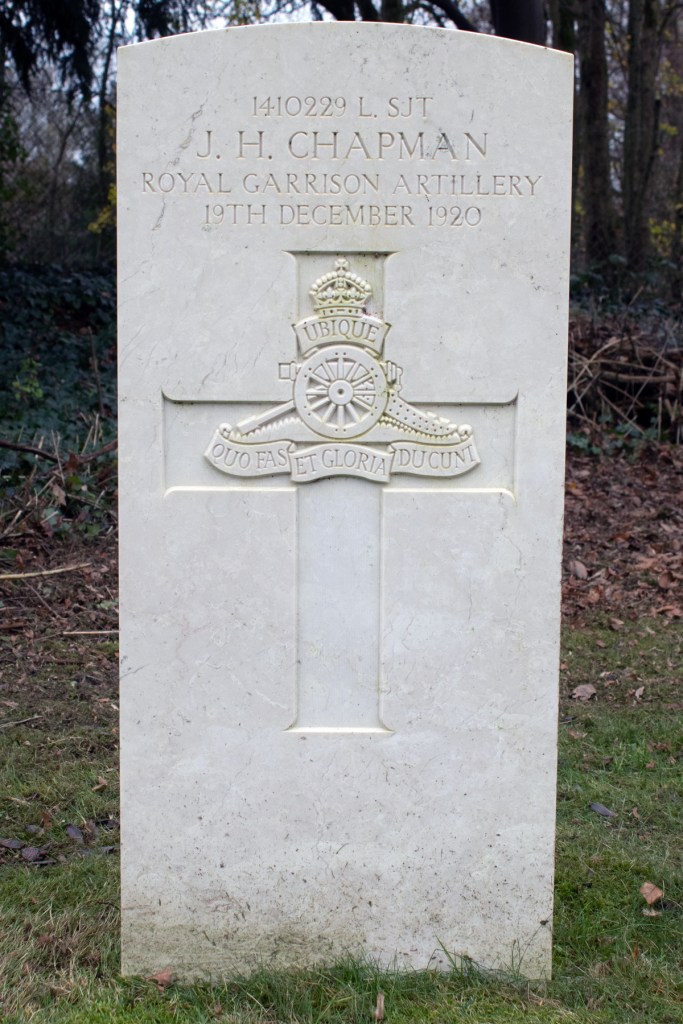
There is little concrete information available on the life of John Henry Chapman. His headstone, in Amesbury Cemetery, Wiltshire, confirms that he was a Lance Serjeant in the Royal Garrison Artillery, and that he died on 19th December 1920.
John’s pension ledger gives his widow’s name, Caroline, date of birth, 25th August 1900, and her address, High Street, New Romney, Kent. It also gives a cause of death for John, who passed away from pneumonia.
The record for Lance Serjeant Chapman’s headstone gives his next of kin as Mrs C Chapman, c/o Mrs Savage, which would suggest that that was Caroline’s maiden name. The Civil Registration Marriage Index records the union of a John H Chapman to someone with the surname of Savage in the summer of 1920: the wedding took place in Richmond, Yorkshire, although there does not appear to be any direct connection between the Lance Serjeant, Caroline and the town.
There are no further clear documents relating to John Henry Chapman. He lies at rest in the peaceful anonymity of Amesbury Cemetery.
Charles James Hibbs was born in the summer of 1895 the fifth of nine children to James and Emily Hibbs. James was a groom from Dorchester, Dorset, but the family were first raised in Bere Regis, where Charles was born, before moving to Amesbury, Wiltshire, by 1900.
When he finished his schooling Charles found work as an under boot for a local hotel. When war came, however, he stood up to play his part. Unfortunately, full details of his service are lost to time, but he had joined the Somerset Light Infantry by January 1917. Assigned to the 11th Battalion, Private Hibbs soon found himself barracked in Tankerton, Kent.
While there, Charles seemed to keep himself to himself, rarely mixing with any of his colleagues. His seniors did not appear to think a great deal of him. Towards the end of May, things had come to a head for Private Hibbs:
Charles James Hibbs… was found at a quarter past three on Wednesday afternoon lying dead by the downstairs front door of his billet at Buena Vista, Tankerton Road, with his right hand under the breech of the rifle and the muzzle pointing to his right shoulder.
Whitstable Times and Herne Bay Herald: Saturday 2nd June 1917
The subsequent inquest shone a harsh light on the Edwardian attitude towards mental health. In the week leading up to Charles’ suicide, he was pulled off patrol a couple of times for absentmindedness.
Deceased’s manner was very strange and his companions complained of him and said he was very strange the whole time…
He would lean about over the bannisters and one could not get any sense of reason out of him. He would not associate with his comrades in any way. If I [Sergeant Edward Risden] asked him whether there was anything the matter he would pull himself together and say “I’m all right, sergeant.” He would then be all right for a few minutes and then wander away from his comrades.
The Coroner – Did you think he was not quite right in his mind? – That was my opinion.
Whitstable Times and Herne Bay Herald: Saturday 9th June 1917
Private Hibbs was sent to see the Medical Officer, but was sent back to his unit and advised to stick to light duties.
One of Charles’ colleagues, Private Harold Prosser, was billeted him the night before he killed himself:
At 1:30am… [Prosser] heard deceased moving about in the next bed to him and the he got up in bed. Witness got a match and lit the gas. Deceased put on his trousers, boots, and hat and told [Prosser] to get back to bed and put the gas out. [Prosser] left the gas on and deceased sat on the bed for about half an hour smoking and kept saying “Yes, sir.” The deceased mentioned by name his father and mother and all his relations an then got up and said “Yes, this time I am going to do it.” Deceased went to the rifle rack and [Prosser’s colleague, Private Middleton] awoke then and told him to let the rifles alone or he would report him. Deceased then took his hand off the rifle rack and said “All right” and went back and sat on the bed again. He was still smoking. He had his eye fixed on the same rifle for about half an hour after that and then he undressed and went to bed.
Whitstable Times and Herne Bay Herald: Saturday 9th June 1917
Private Prosser then went to sleep in another room because, as he told the Coroner, he did not feel safe being in the same one. A report was made to Private Hibbs’ corporal the next morning and, when asked by the Coroner if he thought Hibbs “was a little off his head”, Harold replied “Yes, the previous day he sat in bed talking to himself all day. I asked him what was the matter and he said ‘I am all to pieces.'”
In summing up, the Coroner did show some sympathy towards Charles’ actions:
…while no military regulation might have been infringed he did think people should understand that it was most important to tell the doctor the symptoms of a patient. It not only applied to military patients, but to civilian patients. If the medical officer on [the morning of 30th May] had had the facts reported to him of the strange behaviour of the deceased during the night he would most probably have placed him in hospital and the man might have received such treatment there or elsewhere that would have got him back into a sane condition.
Whitstable Times and Herne Bay Herald: Saturday 9th June 1917
At the inquest, the jury recorded a verdict of suicide during temporary insanity. Private Hibbs died on 30th May 1917: he was just 21 years of age.
Charles James Hibbs’ body was taken back to Wiltshire for burial. He was laid to rest in Amesbury Cemetery, not far from where his grieving family lived.
The early life of Henry George Preece is a challenge to piece together.
The Commonwealth War Graves Commission give his father’s name as Edwin Preece, and suggest that the was the landlord of the George Hotel in Milverton.
The Army Register of Soldier’s Effects give the sole beneficiary of Henry’s estate as his sister Bessie.
The census record of 1911 appears to link the three members of the family, but give only a tenuous connection to Somerset. Edwin was a Coachman from Nunney, but the family – including Edwin’s wife Elizabeth, and two children, Henry and Bessie – were all living in Bayford, Hertfordshire, where the siblings had been born in 1900 and 1902 respectively.
It seems likely that the Preece family moved to Somerset not long after the census was taken, and this is potentially when Edwin took up his new role in Milverton.
War broke out in 1914, and Henry stepped up to play his part. He enlisted in the Devonshire Regiment, and was assigned to the 2nd Battalion. Full service details are lost to time, but Private Preece had joined up by April 1918.
Henry’s trail goes cold again at this point. He was admitted to a military hospital in Chatham, Kent, in the autumn1918, although the reason for this is unclear. He passed away there on 29th October: he was just 19 years of age.
The body of Henry George Preece was taken back to Somerset for burial. He was laid to rest in the graveyard of St Michael’s Church in Milverton.
Louis Theobald was born on 27th January 1898 in Soho, Middlesex. There is little information available about his early life, and the only document that can be directly connected to him is his military service records.
Louis enlisted in the Royal Navy on 7th September 1915. He had been working as a miner at the time, and the document gives an insight into the man he was. He stood 5ft 5ins (1.65m) tall, had brown hair, brown eyes and a fresh complexion. The service records also confirm that he had a tattoo on his right arm.
Stoker 2nd Class Theobald was sent to HMS Pembroke, the Royal Naval Dockyard in Chatham, Kent, for his training. He spent three months there, before being given his first posting, on board the minesweeper HMS Alyssum. He remained on board for three months, before transferring to the cruiser HMS Wallington in February 1916.
Louis’ health was starting to be impacted by this point: he had developed bronchitis, probably exacerbated by heat and dust of the confined engine room he worked in. By April 1916 he was transferred back to HMS Pembroke, and within two months, he was medically discharged from service.
Stoker 2nd Class Theobald had been admitted to the Royal Naval Hospital in Chatham by this point, and his health began to deteriorate. He passed away from a combination of bronchitis and empyema on 15th September 1916: he was just eighteen years of age.
Louis Theobald was laid to rest in the Roman Catholic section of the Woodlands Cemetery in Gillingham, Kent, not far from the dockyard where he had been based.
Thomas Collins was born in the Blackfriars area of Glasgow on 12th March 1877. His was a common name, and it is a challenge to find identify much about his early life. He did, however, have a brother called Andrew, and, when he finished his schooling, he found work as a carpenter and joiner.
Thomas sought new opportunities and, on 21st January 1899, he enlisted in the Royal Navy. Working as a Carpenter’s Crew, he was initially assigned to HMS Vivid, the Royal Naval Barracks in Devonport, Devon. His service records show that he was 5ft 5ins (1,65m) tall, with dark brown hair, grey eyes and a dark complexion.
Devonport was to become Thomas’ base, but, over the twelve years of his initial navy contract, he went on to serve on eight separate vessels. He records suggest that he was good at what he did, and his moved up through the ranks as a result. However, he seemed to have another side to him, which occasionally revealed itself.
Thomas was promoted to Leading Carpenter’s Crew on 19th December 1901, but what had been noted as a very good character seemed to take a downturn at this point. He was committed to cells for two weeks in January/February 1903, while serving on HMS Highflyer, with an incident leading to his demotion to Carpenter’s Crew once more. This also appears to match with a drop in his character: noted as Very Good in his reviews of 1899 to 1901, he slipped to Good in 1902 and fair in 1903 and 1904.
His imprisonment seems to have been the shake up Thomas needed. From here on in, his character was consistently recorded as Very Good and, by August 1909, he had regained the rank of Leading Carpenter’s Crew. There was, however, a serious blip in this good behaviour, noted in his service records:
This man was tried for the manslaughter of Richard Ernest Bell, blacksmith, on [illegible date], who died from injuries received in a fight with Collins on HMS Cambridge. Verdict of Jury at Assizes: “Not guilty”. Judge in summing up stated that he considered Collins was technically guilty of manslaughter.
Thomas had been on the mess deck of HMS Cambridge on 26th August 1905, when he became embroiled in a fight with Petty Officer Bell. Medical evidence showed that Bell died as a result of a blow behind his ear, the punch delivered by Leading Carpenter’s Crew Collins. While it seems likely that he unintentionally caused the Petty Officer’s death, he was cleared by the jury, and remained assigned to HMS Cambridge until November 1905.
Thomas’ initial term of service came to an end on 20th January 1911, and he had no hesitation in re-enlisting. On board HMS St George at the time, his new contract brought with it the rank of Shipwright 2nd Class. Over the next five years, he served on four more ships, and rose a rank to Shipwright 1st Class.
On 8th January 1916, Thomas married Flora Peacock. Little information is available about here, although the wedding took place in Harwich, Essex. Thomas was serving on board the cruiser HMS Conquest by this point, and was based out of the Royal Naval Dockyard in Chatham, Kent.
On Tuesday evening, March 28th, a cutter belonging to HMS Conquest, which was taking forty liberty men off to the ship, was caught in a blizzard and nothing was seen or heard of her again till the morning, when she was found cast up on shore many miles away. All hands were drowned.
The cutter was being towed out by a steam-launch. The hawser broke and the boat drifted away ad capsized.
Westerham Herald: Saturday 8th April 1916
Shipwright 1st Class Thomas Collins was one of those lost from the cutter. He had not long turned 39 years of age. He was laid to rest in the Roman Catholic section of Woodlands Cemetery, Gillingham, not far from the dockyard at which he had been based.
Thomas’ headstone incorrectly gives his surname as Collings.







 Death and Service