
Tag Archives: killed

Able Seaman Percy Nicholls

Able Seaman Percy Nicholls

Percy Walter Nicholls was born in West Ham, Essex, on 10th July 1898. One of seven children, he was the fourth son to Ernest and Selina Nicholls. Ernest was a carman for the local iron works, and the family lived close to the factory, in rooms at 28 Rocher Road.

The 1911 census recorded that the growing family had moved to 185 North Woolwich Road. Three of the family were employed by the iron works: Ernest and his oldest son Ernest Jr as carmen, while second son George was an iron worker. Percy, just twelve years of age, was still at school, and the document noted that his older brother, Charles, was unable to work as he had been epileptic since birth.

Percy chose a different route for himself when he left school, taking up work as a farm hand. He was after bigger and better things, however, and, on 17th June 1914 he joined the Royal Navy. Too young to formally enlist at that point, he was given the rank of Boy 2nd Class, and sent to HMS Ganges, the training base near Ipswich, Suffolk, for his induction.

Is appears that Percy impressed his superiors: he was promoted to Boy 1st Class in January 1915, and was given a posting on board HMS Centurion, a dreadnought battleship, on the 20th March. She would remain his home for the next two years, during which time he came of age.

Now able to formally enlist, Percy was given the rank of Ordinary Seaman, his papers showing the young man he had become. He was noted as being just under 5ft 3ins (1.59m) tall, and had dark brown hair, dark brown eyes and a fresh complexion. He was also recorded as having a scar on his right eyebrow.

Centurion patrolled the waters around Scotland, and took part in the Battle of Jutland at the end of May 1916. Percy was proving to be a steady worker and, on 22nd February 1917, he was promoted to Able Seaman. His time on board the battleship was coming to a close, however, and, on 1st September 1917, he disembarked at HMS Pembroke, the Royal Naval Dockyard in Chatham, Kent.

The base was a busy and overcrowded place at that point in the war. The sinking of the Vanguard left its replacement crew shore-bound while they awaited their next assignments, and an outbreak of meningitis meant that temporary accommodation was needed to space out the men, and, with luck, slow the spread of infection. Able Seaman Nicholls found himself billeted in the dockyard’s Drill Hall.

On the night of the 3rd September 1917, the German air force carried out a daring raid on the North Kent Coast. Dozens of bombs were dropped on Chatham, two of which landed unplanned direct hits on the Drill Hall. The glass roof shattered showering the sleeping men below with deadly shards. Able Seaman Nicholls was badly injured, and taken to the Royal Naval Hospital in the town.

Percy’s wounds would ultimately prove fatal. He died from his injuries on 8th September 1917: he was just 19 years of age.

The body of Percy Walter Nicholls was taken back to Essex for burial. He was laid to rest in the East London Cemetery, Plaistow, a couple of miles from where his family were now living, on Ellesmere Road, West Silvertown.


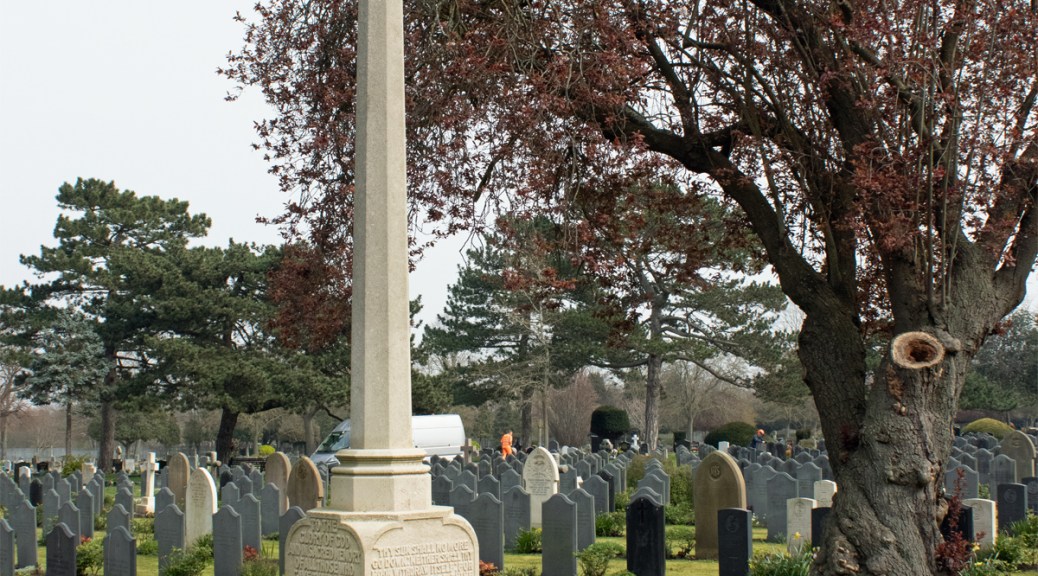
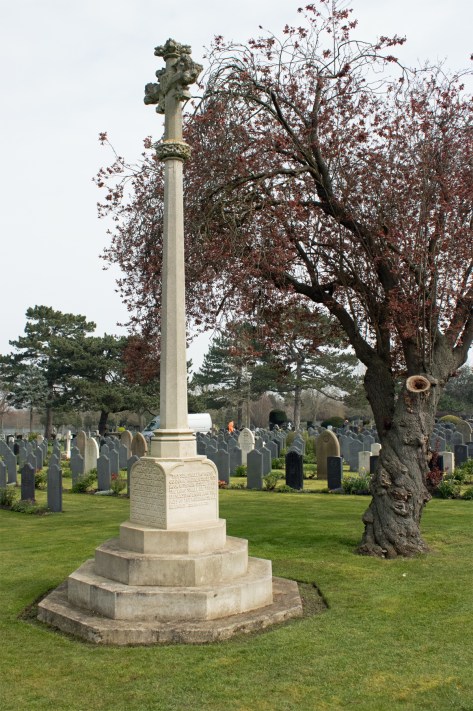
[Note: the photo above is of the memorial to the Chatham Air Raid victims, close to the mass grave for those whose bodies were not identified, in Woodlands Cemetery, Gillingham, Kent.]

Stoker 1st Class Alfred Moss

Stoker 1st Class Alfred Moss

Alfred George Moss was born in West Ham, Essex, on 14th February 1885. One of eight children, his parents were John and Sarah Moss. John was a leather worker, but Alfred initially found work as a butcher’s assistant when he completed his schooling.

Butchery wasn’t the career that Alfred sought, however, and, on 12th November 1903, he enlisted in the Royal Navy as a Stoker 2nd Class. His service papers note that he was 5ft 9ins (1.75m) tall, with brown hair, hazel eyes and a fresh complexion. He was also recorded as having a scar on both knees.

Stoker Moss was sent to HMS Acheron, a training ship based on the Thames Estuary, for his initial service. He stayed there until July 1904, when he was given his first sea-going assignment, on board the cruiser HMS Terpsichore. She would remain his home for the next eighteen months, during which he was promoted to Stoker 1st Class.

Alfred seems to have been a steady worker, his annual reviews noting a very good character. In November 1908, having come to the end of his five year contract, he was stood down to reserve status. He had served on four vessels and, when not at sea, HMS Pembroke, the Royal Naval Dockyard in Chatham, Kent, became his home from home.

Alfred is missing from the 1911 census, but turns up on 21st December 1913. On that day he married Ellen Lipscombe in All Saints’ Church, West Ham. Nellie, as she was known, was the oldest of seven children to plasterer Tomas Lipscombe. The couple set up home on Grafton Road, Plaistow, and went on to have a son, Thomas, the year after exchanging vows.

When war was declared, Alfred was called back into service. He returned to Pembroke, and spent the next year split between there and HMS Victory, the Royal Naval Dockyard in Portsmouth, Hampshire. In the summer of 1915, Stoker 1st Class Moss was assigned to the cruiser HMS Europa. For the next two years, he would be based in the Eastern Mediterranean, supporting the troops in and around the Gallipoli peninsula.

By the summer of 1917, Alfred was back at Pembroke, which, by this point in the war, was a busy and overcrowded place. The sinking of HMS Vanguard meant that her replacement crew were stuck in port waiting to be reassigned, and an outbreak of meningitis demanded more space to slow or stop its spread. Stoker 1st Class Moss found himself barracked in overflow accommodation set up in the dockyard’s Drill Hall.

On the night of the 3rd September 1917, German bombers launched an audacious raid on the North Kent Coast. Two bombs landed on the Drill Hall, shattering its glass roof, and killing dozens of sleeping servicemen beneath. Stoker 1st Class Moss was one of those who lost his life: He was 32 years of age.

The body of Alfred George Moss was taken back to Essex for burial. He was laid to rest in West Ham Cemetery, not far from where his grieving widow and young son were living.


[Note: the photo above is of the memorial to the Chatham Air Raid victims, close to the mass grave for those whose bodies were not identified, in Woodlands Cemetery, Gillingham, Kent.]


Stoker Neil Moore

Leading Stoker Neil Moore

Neil Moore was born on 17th April 1882 in Glasgow, Lanarkshire. One of twelve children, he was the second son to John and Jane Moore. John was a cabinetmaker and, according to the 1891 census, the family lived in rooms at 13 Melville Street in the city’s Govan district.

Although little is known about Neil’s early life, his enlistment in the Royal Naval Reserve on 26 July 1904 offers the first clear insight into the young man he had become. His service papers describe him as twenty-two years old, 5 ft 4 in (1.63 m) tall, with grey eyes and fair hair.

Over the next decade, Stoker Moore travelled the world, taking in Canada and South America. There were times when he was out of work – he was recorded as seeking employment over the winter of 1912 – but his work appears to have been steadfast.

Intriguingly, after a stint on the SS Sardinian, Neil left the Royal Naval Reserve on 17th November 1913. He was re-engaged on 17th December, but is then reported as having deserted just three days later. He was then recorded as being assigned to HMS Wildfire – a shore base in Northwood, Middlesex – on 3rd February 1914.

It is possible that it was around this time that Neil got married. His wife was called Elizabeth, but there is little further information about her.

When war broke out, Stoker Moore appears to have been formally mobilised once more. Over the next three years, he served on half-a-dozen vessels, before finally being attached to HMS Pembroke, the Royal Naval Dockyard in Chatham, Kent, in the spring of 1917.

Over the course of that summer, Pembroke was hit by two significant challenges. The battleship HMS Vanguard was sunk in Scapa Flow, leaving its planned replacement crew stuck in the Kent dockyard with nowhere to go. At the same time, a bout of spotted fever broke out and more space was needed to slow the transmission of the contagious disease.

Pembroke’s Drill Hall was brought into use as temporary accommodation, and this is where, in September 1917, Stoker Moore found himself billeted.

On the night of the 3rd September, the German air force carried out an audacious raid on North Kent. Four aircraft bombed Chatham, and two devices landed direct hits on the Drill Hall. The glass roof shattered, raining shards onto the sleeping men below. Stoker Moore was badly injured, and he was transported to the town’s Royal Naval Hospital for treatment. Sadly, this would prove ineffective, and Neil died from his injuries on 8th September 1917. He was 35 years of age.

The body of Neil Moore was taken back to Scotland for burial. He was laid to rest in St Kentigern’s Roman Catholic Cemetery, to the north of the city centre.


[Note: the photo above is of the memorial to the Chatham Air Raid victims, close to the mass grave for those whose bodies were not identified, in Woodlands Cemetery, Gillingham, Kent.]


Able Seaman William Magog

Able Seaman William Magog

William Dowsey Magog was born on 23rd March 1898 in Sunderland, County Durham. He was the only child to William and Mary Magog. William Sr was a railway fireman who died when Mary was three months pregnant. He would never know his son, but William was named in his father’s honour.

With a baby to raise, Mary needed support and married for a second time in 1900. Her new husband was Thomas Gardner, who was employed as a chain testing labourer. The extended family set up home on Thomas Street, initially at No. 7, then moving to No. 19 by the time of the 1911 census. By this point, William had three half-siblings, Mary Jr, Elizabeth and Robert.

William followed his stepfather into factory work, taking a job as a moulder. However, he had his sights set on bigger and better things, and on 31st August 1913, he joined the Royal Navy. Too young for formally enlist at this stage, he was given the rank of Boy 2nd Class, and sent to HMS Ganges, the training base near Ipswich, Suffolk.

Boy Magog seemed to impress his seniors, and within nine months had been promoted to Boy 1st Class. He was given his first assignment, on board the cruiser HMS Grafton, in June 1914. That summer, as war broke out, he was sent to HMS Pembroke, the Royal Naval Dockyard in Chatham, Kent.

At the end of October 1914, William was transferred to the battleship HMS Dominion, and she would remain his home for the next three years. During this time, he came of age, and formally joined the Royal Navy. His service papers show that the he stood just 5ft 1/2in (1.54m) tall, and had brown hair, brown eyes and a fresh complexion.

The now Ordinary Seaman Magog was dedicated to his role, although his annual reviews noted a very good (or average) character and a satisfactory (again average) ability. He rose through the ranks, however, becoming an Able Seaman in April 1917.

During this time, Dominion patrolled the North Sea as part of the Third Battle Squadron. She was not involved in many of the major skirmishes of the First World War, although she did take part in the protection of Scarborough during the German raids of 1914, and the Battle of Dogger Bank just a few months later.

By the summer of 1917, Able Seaman Magog had returned to Chatham to await his next assignment. The dockyard was a particularly busy and overcrowded place by this point in the conflict: the sinking of HMS Vanguard had left its replacement crew with nowhere to go, and an outbreak of meningitis had meant that additional accommodation was needed to provide space in the cramped barracks. It was because of this that William found himself billeted in temporary barracks in the dockyard’s Drill Hall.

On the night of the 3rd September 1917, the German air force carried out an audacious night raid on the north Kent coast. The Drill Hall was hit by two bombs, shattering its glass roof, and killing dozens of men who were sleeping below. Able Seaman Magog was badly wounded, and was taken to the Royal Naval Hospital in Chatham. Tragically, his injuries would prove too severe, and he passed away two days after the bombing. He was just 19 years of age.

The body of William Dowsey Magog was taken back to County Durham for burial. He was laid to rest in Sunderland’s Ryhope Road Cemetery, just a few minutes’ walk from where Mary and the family were living.


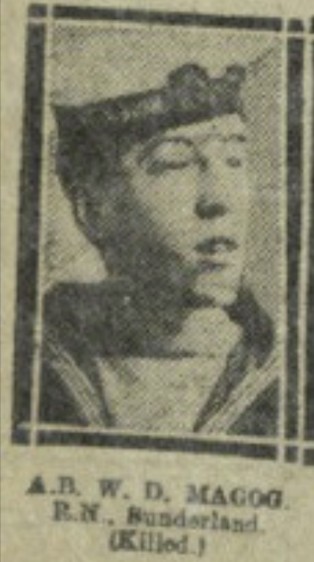
Able Seaman William Magog
(from findagrave.com)

[Note: the photo above is of the memorial to the Chatham Air Raid victims, close to the mass grave for those whose bodies were not identified, in Woodlands Cemetery, Gillingham, Kent.]


Cook’s Mate 2nd Class Stephen Hare

Cook’s Mate 2nd Class Stephen Hare

Skegness Lad Killed In Air Raid

Among the Naval ratings killed in the recent air raid by the Germans on Chatham we regret to record that a Skegness lad was among the victims. This was Percy Hare, the only son of Mr and Mrs Henry Hare, of Algitha Road. The deceased lad joined the Navy some months ago, and was stationed at Chatham undergoing training. Prior to entering the Service he assisted his father in the baking business. The family are well-known in Skegness and neighbourhood, and Mr Hare has for several years been prominently identified with the Wesleyan cause locally, while his dead son was secretary of and a teacher in the Skegness Wesleyan Sunday School, and was also qualifying as a local preacher in the circuit.

[Lincolnshire Standard and Boston Guardian: Saturday 15th September 1917]

Stephen Percy Hare was born on 31st March 1897 in Skegness, Lincolnshire. He was the only child to Henry and Annie Hare. Henry was a baker, and the family lived on the main shopping thoroughfare, leading to the seafront.

The 1901 census recorded the family residing at 29 Lumley Road, where the ground floor presumably served as the bakery, with the upstairs as their living accommodation.

The following census records take some unpicking. Annie Hare was recorded as being a boarding house keeper, and was living with Stephen at 25-27 Lumley Road. They had two residents – bakers Robert England and George Gay. Henry is absent from the record, but at No. 23 were John and Eliza Hare, aged 73 and 67 respectively and possibly Henry’s parents, were running another boarding house with their three adult daughters.

When war broke out, Stephen was just 17 years of age. He was too young to formally enlist, but he had his chance when, on 1st December 1916, he joined the Royal Navy. Send to HMS Pembroke, the Royal Naval Dockyard in Chatham, Kent, his baking background stood him in good stead, and he was given the rank of Cook’s Mate 2nd Class. His service papers show that he was just under 5ft 8ins (1.7m) tall, with fair hair, blue eyes and a fresh complexion.

Cook’s Mate Hare spent the next nine months learning his trade. By the summer of 1917, Pembroke was a busy and cramped place. The battleship HMS Vanguard had been sunk, leaving its replacement crew, waiting in Chatham, with nowhere to go. There had been an outbreak of spotted fever, and the decision was taken to turn the dockyard’s Drill Hall into temporary accommodation. Stephen was one of those to be billeted there.

On the evening of the 3rd September 1917, five German Gotha bombers undertook the first night time raid on Britain. Chatham was in their line of fire, and two bombs landed direct hits on the Drill Hall. Cook’s Mate Hare was among the dozens of sleeping men who lost their lives when the glass roof shattered and crashed down on them. He was just 20 years of age.

The body of Stephen Percy Hare was taken back to Lincolnshire for burial. He was laid to rest in the town’s St Clement’s Churchyard.


[Note: the photo above is of the memorial to the Chatham Air Raid victims, close to the mass grave for those whose bodies were not identified, in Woodlands Cemetery, Gillingham, Kent.]


Stoker Samuel Hadley

Stoker Samuel Hadley

Samuel Hadley was born in Bilston, Staffordshire, on 1st July 1892. The fifth of six children, his parents were Edward and Mary Hadley. Edward worked in the local iron works and, the family lived on Cross Street, to the south of the town centre.

Opportunities awaited elsewhere, however, and by the time of the 1911 census, the Hadley family had moved to Stockton-on-Tees, County Durham. Iron foundries were a key industry in the area, and census found four members of the household – Samuel, his two older brothers, Edward Jr and Matthew, and father Edward Sr – all employed at the Bowesfield Steel Works. The house at 28 Grove Street was crowded, with Thomas Green, another foundry worker, also boarding there.

When war broke out, all three brother enlisted. Samuel joined the Royal Naval Reserve on 15th January 1915, and was sent to HMS Pembroke, the Royal Naval Dockyard in Chatham, Kent, for his training. His papers show that he was a little under 5ft 9ins (1.75m) tall, with brown eyes and a fair complexion. He had a scar on his left leg following an operation for varicose veins.

Over the next two years, Stoke Hadley served on three vessels – the depot ships HMS Tyne, HMS Crescent and HMS Royal Arthur. All three served in Scottish waters, and Samuel spent time in the Firth of Forth and Scapa Flow. By the summer of 1917, however, he was back in Kent, billeted at HMS Pembroke while he awaited his next posting.

Chatham Dockyard was a bustling and packed place at that point in the war. The battleship HMS Vanguard had been sunk, and its replacement crew were stuck at Pembroke while the authorities organised alternative attachments. There was also an outbreak of spotted fever, and the precautions were taken to space out the crowded barracks. Stoker Hadley found himself billeted in temporary accommodation in the base’s Drill Hall.

On the 3rd September 1917, the first night air raid carried out by the German Air Force bombarded Chatham. Two bombs landed squarely on the Drill Hall, and Stoker Hadley was among the dozens of sleeping men to be killed. He was just 25 years of age.

The body of Samuel Hadley was taken back to Stockton-on-Tees for burial. He was laid to rest in the town’s Oxbridge Lane Cemetery.


Samuel’s older brother Matthew chose the army when he enlisted. A Private in the Argyll & Sutherland Highlanders, he was attached to the 11th Battalion. By the spring of 1917, he was caught up in the Arras Offensive. He was killed on the opening day of the First Battle of the Scarpe. Private was 27 years of age, and is commemorated Arras Memorial.


[Note: the photo above is of the memorial to the Chatham Air Raid victims, close to the mass grave for those whose bodies were not identified, in Woodlands Cemetery, Gillingham, Kent.]


Leading Seaman Alfred Gladwell

Leading Seaman Alfred Gladwell

Alfred Eldred Gladwell was born in Clacton-on-Sea, Essex, on 15th November 1885. The oldest of three children, his parents were Eldred and Emma. Eldred was a bricklayer, and his son followed him into that trade.

Away from labouring, Alfred also took time to join the Royal Naval Reserve. He enlisted on the 8th January 1910, his service papers showing the young man he had become. He was noted as being 5ft 11.5ins (1.82m) tall, with blue eyes and a fair complexion. He was also noted as having a scar on his left leg.

Alfred’s time at sea was focused on the Essex coast, with trips to Colchester, Brightlingsea, and across the Thames to Chatham, Kent. By the time that war was declared in 1914, he had risen to the rank of Leading Seaman and, being on reserve status, he was called into action when hostilities commenced.

Leading Seaman Gladwell was sent to HMS Pembroke – the Royal Naval Dockyard in Chatham – and this would remain his base during the conflict. In February 1915, he was assigned to the SS Palma, which served off the Spanish coast. By the summer of 1917, however, Alfred was back at Pembroke to await his next posting.

The dockyard was overly busy that summer, with a replacement crew for HMS Vanguard waiting to be reassigned following its sinking and an outbreak of meningitis to contend with. Leading Seaman Gladwell was billeted in temporary accommodation that had been set up in the dockyard’s Drill Hall.

On the night of 3rd September 1917, Chatham suddenly found itself in the firing line as a wave of German aircraft bombed the town. The Drill Hall received direct hits from two bombs, and Leading Seaman Gladwell was one of dozens of men to be killed. He was 31 years of age.

The body of Alfred Eldred Gladwell was taken back to Essex for burial. He was laid to rest in Clacton Cemetery, not far from where his family was still living.


[Note: the photo above is of the memorial to the Chatham Air Raid victims, close to the mass grave for those whose bodies were not identified, in Woodlands Cemetery, Gillingham, Kent.]


Senior Reserve Attendant George Gilbert

Senior Reserve Attendant George Gilbert

The funeral took place at All Saints’ Cemetery, Jesmond Road, Newcastle, on Saturday, of Senior Sick Berth Reserve Attendant George Gilbert, of Portland Road, Newcastle, who was killed in the air raid on the South-East Coast on Monday last. The deceased, who was 53 years of age, was, prior to the outbreak of war, employed as a machine-man at Elswick Works, and was an active member of the St John Ambulance Brigade. When hostilities began he volunteered for service as a sick berth attendant in the Naval Division.

[Newcastle Journal: Monday 10th September 1917]

George Gilbert was born in 19th March 1866 in Birmingham, Warwickshire. One of five children, he was the oldest son to George and Mary Gilbert. George Sr was an engine fitter and, according to the 1881 census, the family lived at 42 Devonshire Street, to the north west of the city centre.

The next census, taken in 1891, found a change of circumstances for George Jr. Having moved to Leicester, he had found work as a boot finisher. He had also found love, and, in 1889, had married a woman called Ellen. Little information about her early life is available, but she had been born in Northampton: given that shoe-making was a key industry in the town, it is possible that the couple had met at work, although this is purely conjecture.

George was keen to support his family as best he could, and they moved to the Benwell area of Newcastle-on-Tyne. George found factory work, and the couple set up home at 64 Tyne Street. By the time of the 1901 census, Ellen had had two children, daughters Mabel and Lilian.

George’s career continued, and, as the newspaper report suggests, he took employment as an engine-man for the Elswick Ordnance Company. A munitions manufacturer, the factory was just a few minutes’ walk from where the Gilbert family had moved to, 30 Wellfield Road, Benwell. The 1911 census confirmed a third child, daughter Beatrice, who had been born in 1902. Ellen was now working, her occupation listed as a grocery dealer in her own account.

War broke out in the summer of 1914 and, despite his age, George was quick to step up and serve his country. Joining the Royal Naval Division on 2nd August, he took the role of Senior Reserve Attendant, and was assigned to the naval hospital in Chatham, Kent. His service records note that he was 5ft 9ins (1.75m) tall, with light hair, grey eyes and a fresh complexion.

Senior Reserve Attendant Gilbert stayed at the hospital for the next three years and was barracked at HMS Pembroke – the Royal Naval Dockyard. By the summer of 1917, the base was overcrowded: the sinking of HMS Vanguard led to its replacement crew being stuck there waiting for new assignments, and an outbreak of meningitis meant additional accommodation was needed to slow the spread of infection. George found himself billeted in temporary quarters in the dockyard’s Drill Hall.

By this point in the war, the German Air Force was looking to minimise daytime casualties, and was, instead, trialling night raids; on 3rd September, Chatham found itself in their flight path. The Drill Hall received a direct hit, and Senior Reserve Attendant Gilbert was badly injured. He was taken to the hospital he had worked in, but his wounds proved too severe. He passed away the day after the attack: he was 51 years of age.

The body of George Gilbert was taken back to Newcastle for burial. He was laid to rest in the city’s All Saints’ Cemetery, not far from where his grieving family lived.


[Note: the photo above is of the memorial to the Chatham Air Raid victims, close to the mass grave for those whose bodies were not identified, in Woodlands Cemetery, Gillingham, Kent.]


Stoker 1st Class Alfred Gibbs

Stoker 1st Class Alfred Gibbs

Alfred Gibbs was born on 14th November 1893 in Tower Hamlets, Middlesex. He was one of four children to Alfred and Sarah Gibbs.

There is tantalisingly little information available about Alfred Jr’s early life. Sarah appears to have died not long after her youngest child’s birth in 1897, and the 1901 census found the family living in Tenbury Place, Limehouse. Alfred Sr was recorded as being a rope maker, and they had a boarder, Mary Cambridge, to bring in a little extra money.

Alfred Sr seems to have passed away by the end of the decade, and his son found work as a general labourer. A more reliable career was needed, however, and on 11th March 1912, Alfred Jr enlisted in the Royal Navy.

Stoker 2nd Class Gibbs was sent to HMS Pembroke, the Royal Naval Dockyard in Chatham, Kent, for his training. His papers show that he was 5ft 2.5ins (1.59m) tall, with brown hair, brown eyes and a fresh complexion.

The start of Alfred’s naval career was not an auspicious one. He enlisted for a period of five years, but just a couple of months after joining up, he ran off, and was not caught and brought to justice until the end of September.

Once back in the fold. Stoker Gibbs seemed to have settled into something of a routine. While is appears he would not be one to rise through the ranks – his annual reviews noted a good or very good character and an ability that varied between moderate and satisfactory – for the next couple of years he focused on the job.

Alfred’s first assignment was on board the gunboat HMS Speedy, and during his short time on board, he was promoted to Stoker 1st Class. In March 1913 he returned to Chatham, HMS Pembroke becoming his home in between attachments.

Over the next four years, Stoker Gibbs would serve on three further vessels, but his time in the navy would not be without incident. In December 1914, he was thrown in the brig for seven day for an unrecorded misdemeanour. He found himself back in the cells for a similar time in March 1916.

By the summer of 1917, Alfred was back at HMS Pembroke. The dockyard was a particularly busy place at that point in the war and temporary accommodation had been set up. Stoker Gobbs found himself billeted at The Drill Hall, away from the main barracks.

On the night of 3rd September 1917, Chatham suddenly found itself in the firing line, as the German Air Force launched a bombing raid. Two bombs landed squarely on the Drill Hall, and dozens of men were killed. Alfred was badly wounded, and taken to the local Naval Hospital. His injuries would prove insurmountable, however, and he died the next day. He was just 23 years old.

The body of Alfred Gibbs was taken back to Middlesex for burial. He was laid to rest in the City of London and Tower Hamlets Cemetery.


[Note: the photo above is of the memorial to the Chatham Air Raid victims, close to the mass grave for those whose bodies were not identified, in Woodlands Cemetery, Gillingham, Kent.]

Engineman John Foreman

Engineman John Foreman

John Kerr Foreman was born in Aberdeen, Scotland, on 18th December 1878. The son of Thomas and Jessie, details of his early life are sparse. The 1881 census records him living on York Street with Jessie, while the next return notes him as living just round the corner at 4 Links Street with his paternal grandfather, Jessie Kerr.

Thomas’ absence from the documents would suggest that he was away at the time the details were taken. John’s grandfather was a fish labourer, and the family lived next to the port. It is likely that Thomas was a fisherman or part of a boat crew, and a life at sea was something that his son also fell into.

John does not appear on either the 1901 or 1911 census returns. In the early 1900s he married Lily Craig, the daughter of another fish worker. They went on to have five children between 1905 and 1916 but, like her husband, there is no record of Lily or the family in the early 20th century.

When war broke out, John stepped up to play his part. Joining the Royal Naval Reserve – another hint at an undocumented life at sea – on 36th May 1916, his papers note that he was 5ft 8ins (1.73m) tall, with grey eyes and a fair complexion. He was also recorded as having a number of tattoos: a pierced heart, thistle and the word Scotland on his right arm, and an anchor and his initials on his left.

Engineman Foreman’s time in the navy was actually spent on shore. For eighteen months he was attached to HMS Gunner, the shore base at Granton Harbour, near Edinburgh. In August 1917, however, he was transferred south. He arrived at his new home, HMS Pembroke, the Royal Naval Dockyard in Chatham, Kent, on 4th August 1917.

The dockyard was a particularly busy place that summer, and temporary accommodation was set up. John found himself billeted at Chatham Drill Hall, away from the main barracks.

On the night of 3rd September 1917, Chatham suddenly found itself in the firing line, as the German Air Force launched a bombing raid. One of the bombs landed squarely on the Drill Hall, and Engineman Foreman was badly injured. He was taken the naval hospital in the town, but died from his injuries the following day. He was 38 years old.

The body of John Kerr Foreman was taken back to Scotland for burial. He was laid to rest in Aberdeen’s Trinity Cemetery, a short walk from where his family still lived.


Engineman John Foreman
(from findacrage.com)

[Note: the photo above is of the memorial to the Chatham Air Raid victims, close to the mass grave for those whose bodies were not identified, in Woodlands Cemetery, Gillingham, Kent.]