Tag Archives: Lincolnshire

Bombardier Charles Newbery

Bombardier Charles Newbery

Charles James Anderson Newbery was born in Misterton, a stone’s throw from Crewkerne, Somerset, in the spring of 1895. The oldest of eight children, his parents were Benjamin and Edith Newbery. Benjamin was a farmer, who passed away in 1908, when his son was just 13 years of age.

Charles seems not to have spent a great deal of time in the family home, however: the 1901 census found him living with his paternal grandmother, while the 1911 census, taken three years after his father’s death, recorded him as living with his paternal aunt, and working on their farm.

The farming life seemed to suit Charles: indeed he emigrated to Australia to pursue the life. When war broke out in Europe, however, he returned to England’s shores to better serve King and Country. He enlisted in the Royal Garrison Artillery on 18th October 1915, and was given the rank of Gunner.

Charles’ service records confirm that he was 5ft 5ins (1.65m) tall and weighed 140lbs (63.5kg). He was noted as having a mole on his left shoulder and an upper denture.

Private Newbery was sent to France in April 1916 and, a little over a year later, was promoted to Bombardier. He was attached to the 137th Heavy Battery and all seemed to be going reasonably well for him. He had ten days’ in England in July 1917, and a further two weeks’ in March 1918.

On 13th August 1918, possible during the Battle of Amiens, Charles was injured by a gun shot wound to his right leg. He was initially treated at the 47th General Hospital at Le Treport on the French coast, but was medically evacuated to Britain for further treatment.

Charles was moved to the 4th Northern General Hospital in Lincoln. To complicate matters, he had contracted bronchitis and, while his injury was being managed, it was a combination of the lung condition and cardiac failure to which he succumbed. Private Newbery passed away on 2nd September 1918, his mother and sisters by his side. He was just 23 years of age.

Charles James Anderson Newbery was taken back to Somerset for burial. He was laid to rest in Crewkerne’s Townsend Cemetery, not far from the family home.


Bombardier Charles Newbery
(from ancestry.co.uk)

Edith had to write to the regimental office three times to get her late son’s belongings back, and in the end it took more than six months to do so. She received the items he had on him in Lincoln in April 1919: they included and “upper row [of] teeth, cigarette case, wallet containing letters, hair brush [and] comb, disc, letter, wristlet watch, note paper and envelopes.”


Air Mechanic 1st Class Joseph Chivers

Air Mechanic 1st Class Joseph Chivers

Joseph Shore Chivers was born in the summer of 1889 in Walcot, Bath, Somerset. He was the youngest of seven children to William and Jane Chivers. William was a blacksmith and, after he and Jane died within nine months of each other in 1904/05, Joseph went to live with his brother, Edward, remaining there with his sister-in-law when his sibling also died in 1910.

Joseph had found work as a French polisher and cabinet maker by this point and this is what he was doing when he married local woman Ellen West in on 11th September 1915.

War was on the horizon by this point and Joseph was soon called on to serve his country. On 26th July 1916 he enlisted in the Royal Flying Corps, as an Air Mechanic 2nd Class. His service records give little away, but do confirm that he was 5ft 8ins (1.73m) tall.

Joseph was dedicated to his role and, on 1st January 1918, was promoted to Air Mechanic 1st Class. Three months later, when the Royal Flying Corps and Royal Naval Air Service combined to become the Royal Air Force, Joseph made the transfer across.

In August, Air Mechanic Chivers moved to RAF Bracebridge, to the south of Lincoln, where he remained until the end of the war and beyond. He was attached to 120 Squadron, which delivered mail and communications to the troops overseas. Little additional information is available about his life there, other than his admission to the 4th Northern Hospital in April 1919, through causes unknown.

Whatever the cause of his need to be admitted, he was to succumb to it. Air Mechanic Chivers passed away on 1st May 1919, at the age of 29 years old.

Joseph Shore Chivers’ body was brought back to Somerset for burial. He was laid to rest in St James’ Cemetery, in his home city of Bath.


Private Harry Etherton

Private Harry Etherton

Harry Etherton was born in Ansty, near Cuckfield, West Sussex on 3rd April 1872. The oldest of five children, his parents were Edwin and Louisa Etherton. Edwin was an agricultural labourer, and this was work in which his son followed his father.

On 29th April 1899, Harry married Annie Eliza Pennifold, a labourer’s daughter who was also from Ansty. The couple set up home in Cuckfield, and went on to have five children. Harry was, by this point, working as a road labourer for the local council, and this was a job he was to continue doing until the outbreak of the war.

Harry enlisted in 1915, joining the Royal Sussex Regiment as part of the National Reserve. As Private Etherton, he was then transferred across to the Labour Corps, and was assigned to the 409th Labour Coy. which was based at the Infantry Depot in Lincoln.

It was while Private Etherton was here, in the spring of 1918, that he contracted meningitis, and was admitted to the Northern General Hospital in the city. Sadly, he was to succumb to the disease, passing away on 30th June 1918, at the age of 46 years old.

Harry Etherton’s body was brought back to West Sussex for burial. He was laid to rest in Cuckfield Cemetery, not far from where his widow and children still lived.


Corporal Herbert Lyon

Corporal Herbert Lyon

Herbert Woodley Lyon was born in Lincoln early in 1897, one of five children to Walter and Emma Lyon. Walter was a cashier for an engineering company, and the family grew up in some comfort, employing a housekeeper, sick nurse and servant by the time of the 1911 census.

When he finished school, Herbert found work as a draper’s assistant, but with war closing in things were to change. Initially joining the Lincolnshire Regiment, by February 1918, he had transferred across to the Royal Flying Corps, moving to the Royal Air Force when it was founded that April.

Corporal Lyon was based with 112 Squadron at RAF Throwley, just to the south of Faversham, Kent. Details of his service are scarce, but it seems that he trained and qualified as a fitter, helping with the maintenance of the aircraft. His service records show that he stood 5ft (1.52m) tall.

Herbert’s time in the Royal Air Force was limited. His records show that he died of natural causes on 1st November 1918. He was just 21 years of age.

Corporal Herbert Woodley Lyon’s family had relocated to Wells in Somerset by this point. He was laid to rest in Faversham Borough Cemetery, not far from the airfield at which he had been based.


Flight Officer Walter Stevens

Flight Officer Walter Stevens

Walter James Stevens was born on 29th November 1899, the oldest of three children to James and Elizabeth. James was a labourer in the munitions factory in Faversham, Kent, and this is where Walter and his siblings were born and raised.

Initially attending the council schools, Walter won a scholarship to Wreight’s Grammar School, before gaining work as a clerk at the Shepherd Neame brewery in the town.

From the age of 11, Walter was also an active member of the local United Methodist Church. He was a keen organist, taught at the Sunday School, and played a key role in the Wesley Guild. He was also a sometime member of the St John’s Ambulance, undertaking duties at The Mount Hospital in the town.

When was broke out, Walter was keen to play his part. He enlisted in the Royal Naval Air Service, and was sent for training at their air base in Cranwell, Lincolnshire. While on a flight on 11th March 1918, Flight Officer Stevens’ aircraft crashed, and he was killed instantly. He was just 18 years of age.

Walter James Stevens’ body was brought back to Kent: he was laid to rest in the Faversham Borough Cemetery, not fat from his family home. At the funeral, Walter’s senior officers reported the promise he had shown, and that he was close to passing his probationary exams. Two weeks after his burial, a memorial service to him was given at the church to which he had dedicated so much of his young life.


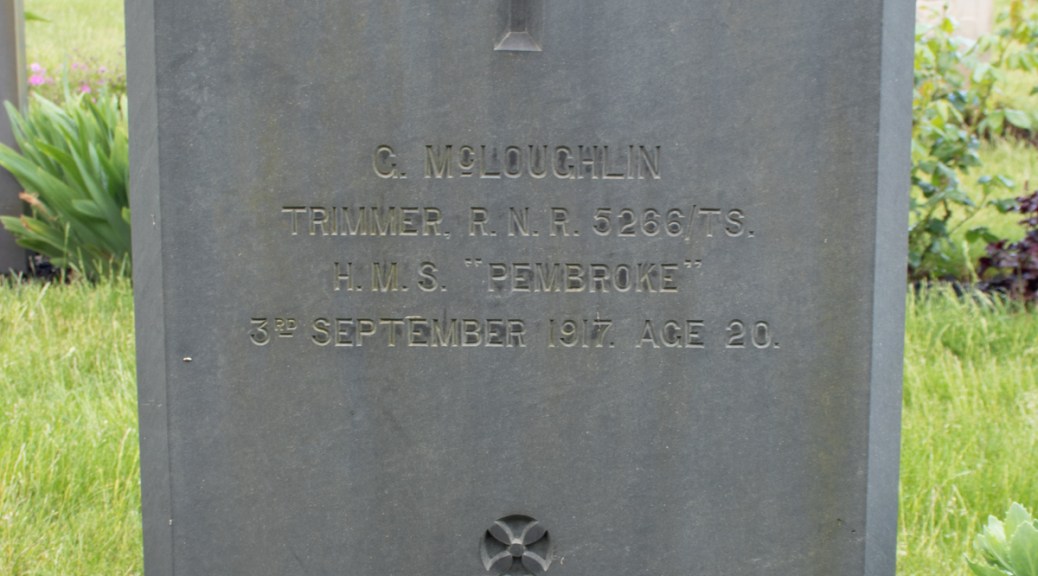
Trimmer Gilbert McLoughlin

Trimmer Gilbert McLoughlin

Gilbert McLoughlin was born in Grimsby, Lincolnshire, on 19th August 1896, one of eight children to Charles and Isabella McLoughlin. Being a fishing port, it is likely that Charles was involved in the industry, and it is no surprise that Gilbert and his siblings followed suit.

When war came to Europe, his skills at sea led to him being brought into the Royal Naval Reserve, and indeed Gilbert joined up on 20th March 1916. His service records show that he stood 5ft 2.5ins (1.59m) tall, had brown eyes and a sallow complexion, and had tattoos on his left arm.

Trimmer McLoughlin was based at HMS Pekin, a shore establishment in Grimsby, from which he would have served on ships patrolling the Lincolnshire coast. He remained posted in his home town until the end of 1916, at which point he moved down the coast to HMS Ganges, the naval base in Ipswich.

Gilbert made a further move in July 1917, when he was posted to HMS Pembroke, the Royal Naval Dockyard in Chatham, Kent. The base was particularly crowded that summer, and he was billeted in temporary accommodation set up in the barracks’ Drill Hall.

On the night of 3rd September, Chatham came under attack from a German air raid, and the Drill Hall received a direct hit. Trimmer McLoughlin was among those to be killed that night. He was just 20 years of age.

Gilbert McLoughlin was laid to rest in the Woodlands Cemetery in Gillingham, Kent, alongside the other victims of the Chatham Air Raid.


Gilbert’s older brother Joseph McLoughlin was also a victim of the First World War. As the conflict began, he continued his work as a trawlerman, although the role of his ship – the Kilmarnock – now also included elements of mine location.

On the afternoon of the 22nd September 1914, the Kilmarnock left Grimsby on a routine trip. She was around thirty miles offshore when the captain spotted floating mines ahead.

The skipper put out a buoy to mark the position, and intended returning to port to report the matter to the Admiralty authorities, but seeing some naval vessels in the distance he made towards them instead with the object of reporting.

Whilst doing so an explosion occurred amidships, and the vessel was blown into two parts, which sank immediately.

The skipper was blown to pieces on the bridge and the chief engineer badly injured.

The naval vessels, attracted by the explosion, hurried to the spot, picked up the wounded engineer, mate, and one member of the crew.

Boston Guardian: Saturday 26th September 1914

Joseph was one of the six crewmen to be killed in the incident. He was just 19 years of age.


Stoker 1st Class Michael Brown

Stoker 1st Class Michael Brown

Michael Brown was born on 25th October 1891 in Kirkdale, Lancashire, one of four children to James and Julia Brown. James was a sailor who died when Michael was just a boy. While Julia tried to make ends meet by taking in washing, it must have worried her when her son then fell into a sea-going life when he left school.

Michael enlisted in the Royal Navy on 19th February 1910, by which time he was already a seaman in the merchant fleet. His service records show that he was 5ft 4.5ins (1.64m) tall, had bark brown hair, brown eyes and a dark complexion. He also had a number of tattoos on his forearms, including a shamrock and a cross.

Recruited as a Stoker 2nd Class, Michael served on a number of vessels in the lead up to the outbreak of war, including the scout ship HMS Patrol, which served from Harwich Harbour, Essex. It was here that he gained promotion to Stoker 1st Class in February 1911.

When not at sea, Stoker Brown was based at HMS Pembroke, the Royal Naval Dockyard in Chatham, Kent. When war broke out in 1914, however, he was in the middle of a three-year stint on board HMS St George, a cruiser that went on to guard the Humber Estuary on the east coast of Yorkshire and Lincolnshire.

By the spring of 1916, he was back in Chatham and from this point on, remained firmly on dry land, with assignments in Kent and at HMS Victory, the Royal Naval Dockyard in Portsmouth, Hampshire. By the summer of 1917, though, Stoker Brown returned to HMS Pembroke once again.

The naval base was particularly busy and cramped at that point in the war, and temporary overflow accommodation was set up in the barracks’ Drill Hall. This is where Michael came to be billeted.

On the night of the 3rd September, the German Air Force conducted the first night time raid on England. Chatham came in the firing line, and the Drill Hall received a direct hit. Stoker 1st Class Brown was among those to be killed. He was just 24 years of age.

Michael Brown was laid to rest in the Woodlands Cemetery in nearby Gillingham, along with the other victims of the Chatham Air Raid.


Gunner William Withers

Gunner William Withers

William John Withers was born in the spring of 1883, in the Somerset town of Midsomer Norton. He was one of six children to William and Rose Withers. William Sr was a coal miner who went on to become a night bailiff, or caretaker, for the colliery. His son, however, sought different things, and, when he left school, he found work as a grocer’s assistant.

In the summer of 1909, William Jr married Florence Robbins, a miner’s daughter from Radstock. The couple went on to have a son, Allan, in June 1913 but tragically it appears than Florence either died in childbirth, or shortly afterwards.

In the summer of 1914, war came to Europe; by the end of the following year, William had enlisted, joining the Royal Garrison Artillery as a Gunner. His service records show that he stood 5ft 8.5ins (1.74m) tall, and weighted 147lbs (66.7kg). By this time he was working as a shop manager and, as a widower with a young son, it seems that, while he volunteered for service, he wasn’t formally mobilised for another year.

Gunner Withers was initially posted at the Citadel Fortress in Plymouth, but soon moved to Halton Park in Buckinghamshire. He spent time there training to be a Signaller, and in April 1918, he succeeded. That summer, he was posted overseas, serving as part of the 461st Siege Battery in France.

In March 1919, Signaller Withers returned to England. Details are a bit sketchy, but it seems that he was posted to Lincolnshire, and while there he fell ill. He was admitted to the Northern General Hospital in Lincoln with peritoneal adhesions; sadly these proved too much for his body to take; he passed away on 9th April 1919, at the age of 36 years old.

William John Withers’ body was brought back to Somerset for burial. He lies at rest in the graveyard of St Nicholas’ Church in Radstock.


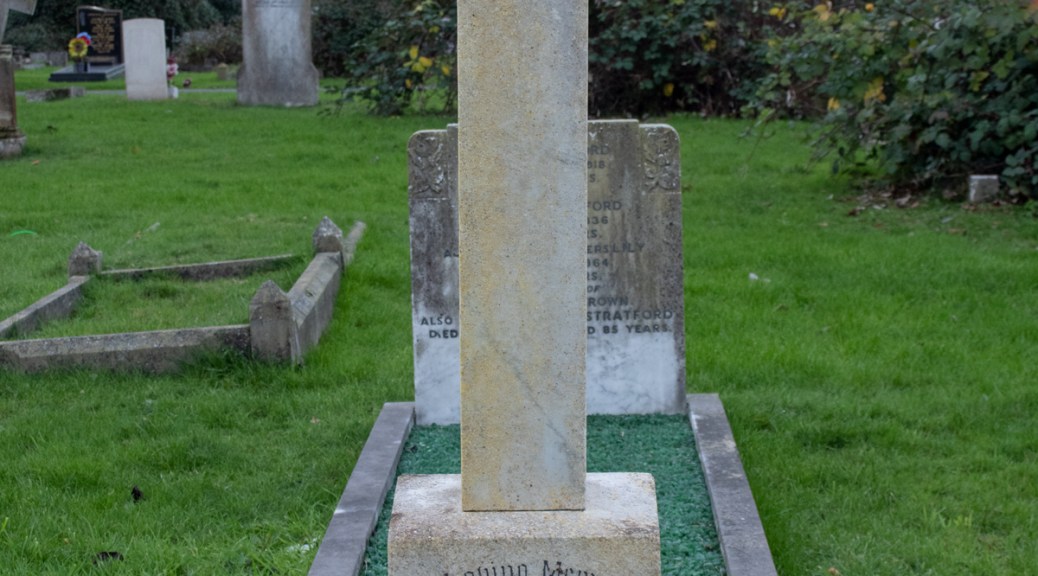
The exact spot of William’s burial is unknown. The grave in the image is of his father, who passed away in 1921. It is likely that William Sr was buried with his son.


Private Arthur Taylor

Private Arthur Taylor

Arthur Ernest Taylor was born at the end of 1892, the middle of three children to James and Sarah. James was a baker, and the family lived in Bruton, a small town in the west of Somerset.

Only one of James’ three sons followed him into the baking business; this was his youngest, Reginald. The oldest of the three brothers, Oatley, found employment in Wales as a miner. Arthur, on the other hand, stayed in Bruton, but found work as a cycle repairer when he left school.

In December 1913, Arthur married Gertrude James, the daughter of a local carpenter; the young couple went on to have a son, Gerald, the following year.

Sadly, little information about of Arthur’s military career survives. He enlisted in the Machine Gun Corps, although there is nothing to confirm exactly when he enrolled.

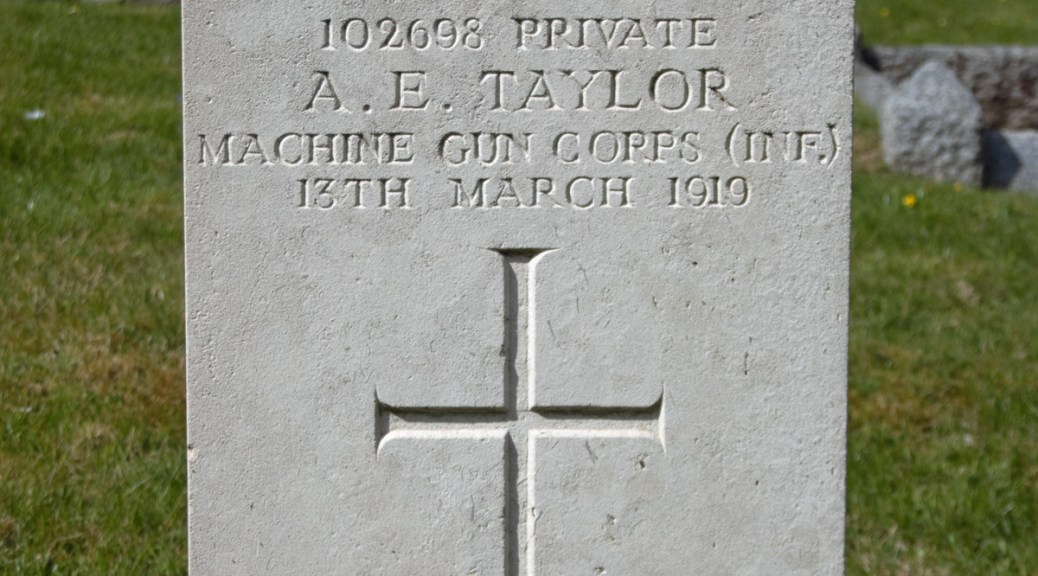
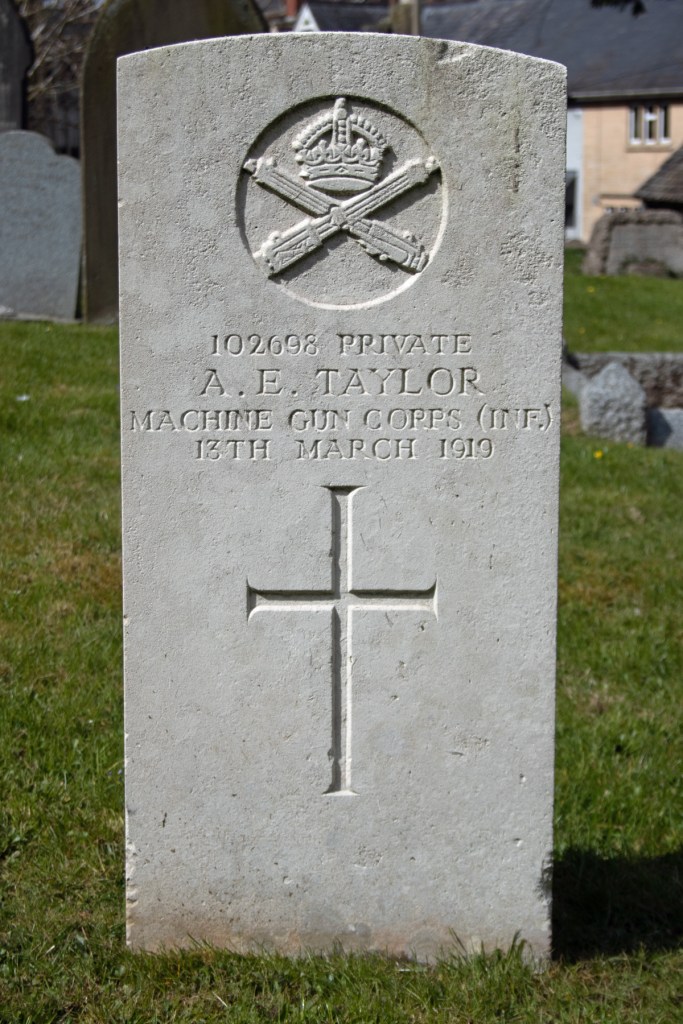
The next time Private Taylor appears in the records is a notice in the Western Gazette on 28th March 1919. The newspaper reports that he passed away in the Military Hospital in Grantham, Lincolnshire. Further documentation shows that he passed away on 13th March 1919, at the age of 27 years old. Sadly, there is no confirmation of the cause of his passing.

Arthur Ernest Taylor was brought back to Somerset, and his body lies at rest in the graveyard of St Mary’s Church in his home town of Bruton.


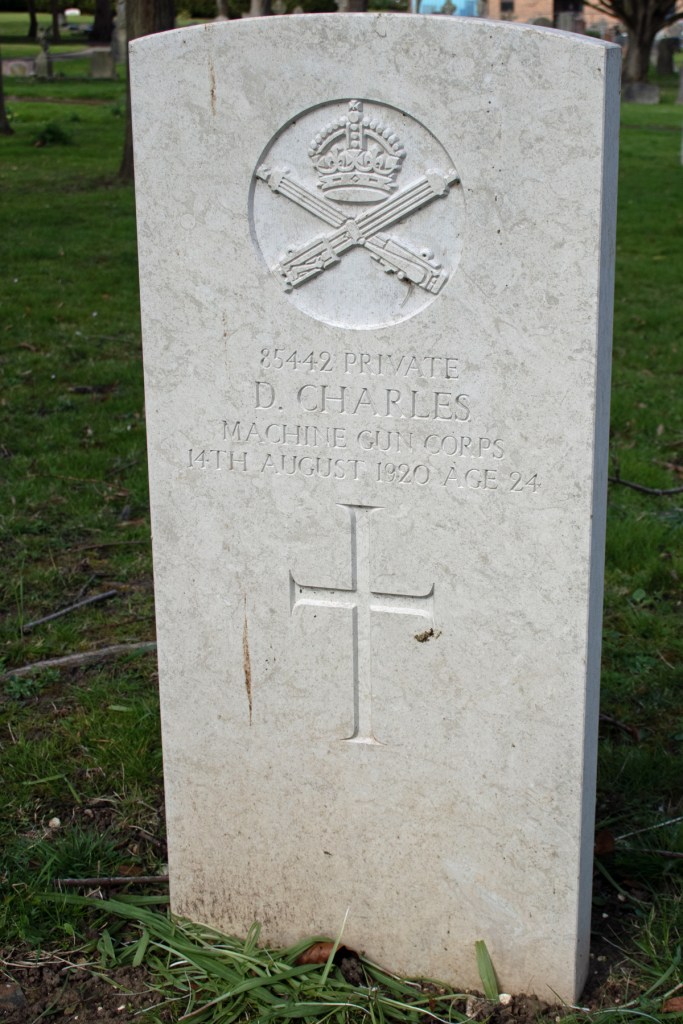
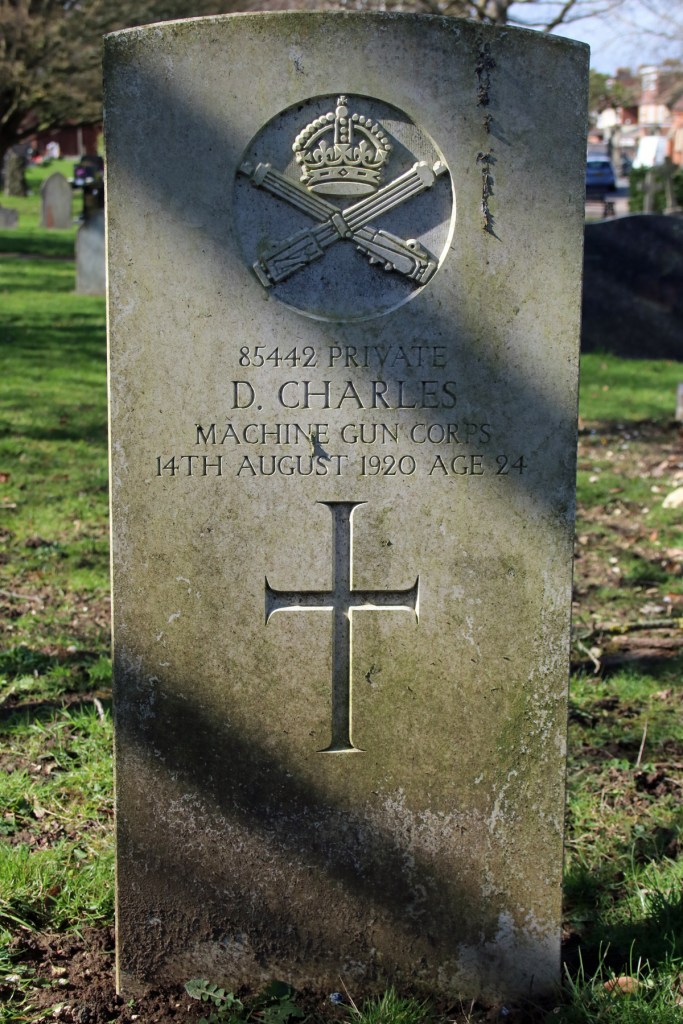
Private David Charles

Private David Charles

David Charles was born towards the end of 1893 and was one of eight children. His parents – David Sr and Elizabeth Charles – both came from Wales, and moved their young family to Kent in 1891. David Sr worked at a torpedo factory, and the move may have been determined by employment at the Naval Dockyard in Chatham, Kent.

When he left school, David Jr found work at an ironmonger’s, but storm clouds were forming over Europe, and he was soon called up on to do his duty for King and country.

David Jr enlisted in July 1915, joining the 23rd Reserve Battalion. He transferred to the Machine Gun Corps in February 1917 and was posted to the Western Front a month later.

Private Charles was wounded in action on 7th October 1917, although the injury did not prevent him from returning to duty after three weeks’ rest. He was readmitted to hospital on 23rd November, eventually being transferred home on a hospital ship before Christmas.

On 11th January 1918, Private Charles was transferred to No. 5 Battalion in Grantham, where he was promoted to Acting Lance Corporal within a couple of months. Sickness dogged him, however, and he was eventually discharged from military service for medical reasons on 7th August 1920.

By this time, David had been admitted to Fort Pitt Hospital in Chatham with endocarditis – enlarged heart – and this is where he sadly passed away from the condition just a week after being discharged from the army. He died on 14th August 1920, at the age of 27 years old.

David Charles lies at rest in the Woodlands Cemetery in Gillingham, Kant.


David seems not to have been originally commemorated by the Commonwealth War Graves Commission. I can find no record of why this might have been the case, but this was eventually rectified 10th February 2016, and his name was immediately added to the United Kingdom Book of Remembrance.

The United Kingdom Book of Remembrance commemorates United Kingdom casualties of the two World Wars who were not formerly recorded by the Commonwealth War Graves Commission. The men and women remembered on it are recent additions to the list of war dead and are presently commemorated solely by their database record and register entry.

The register is maintained at the Commonwealth War Graves Commission’s Head Office, Maidenhead, and the names remain recorded there until such time as The Commission has investigated the grave location details.

David’s grave was identified and a headstone now placed in its rightful position.


Private David Charles