Tag Archives: London

Private Alfred Lansdell

Private Alfred Lansdell

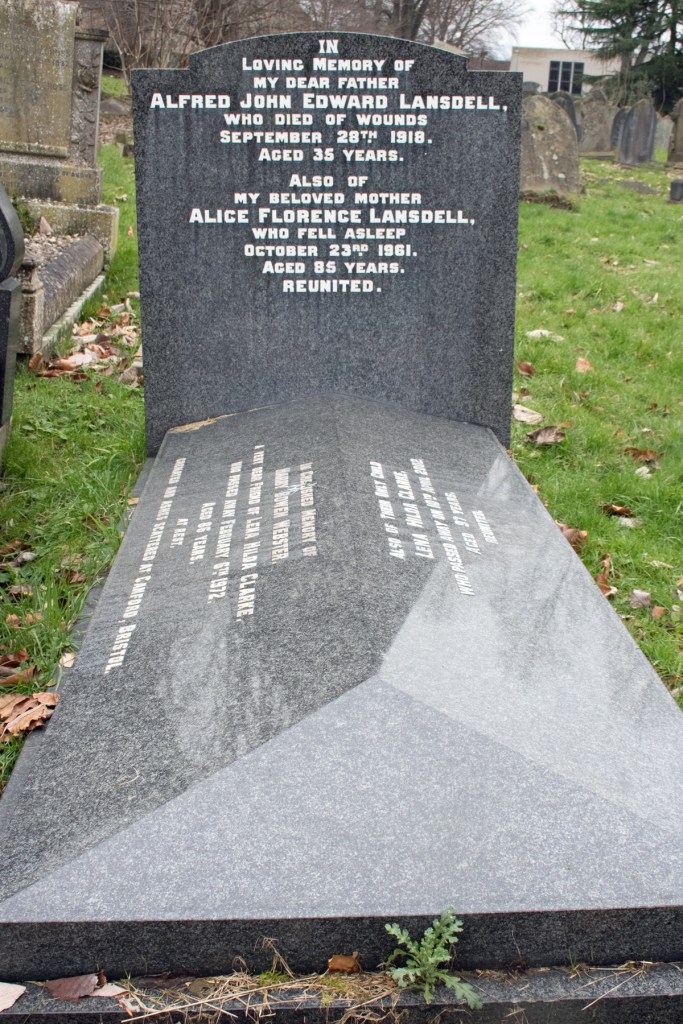
Alfred John Edward Lansdell was born on 25th October 1882 in Fulham, London. The fourth of six children, his parents were James and Matilda Lansdell.

James was a trunk maker, working in his father’s business. By the time of the 1901 census, he was recorded as living by his own means, while Alfred had taken up employment as a hotel porter in Chelsea.

By 1902, Alfred had moved to Somerset and set up home in Bath. He married local woman Alice Stevenson, and the couple went on to have a daughter, Lena, who was born in November 1904.

The 1911 census found the family living in central Bath, Alfred continuing his portering work, with one of his colleagues, lift operator Thomas Ward, boarding with them.

War came to Europe and on 9th December 1915, Alfred stepped up to play his part. He enlisted in the Worcestershire Regiment, and was formally mobilised the following June. Alfred’s service records confirm that he was, at the time of his review, he was 35 years old and 5ft 6ins (1.67m) tall.

Private Lansdell was assigned to the 1st/7th Battalion and by October 1916, he was shipped to France. He was very much on the Front Line, and was wounded on 19th August 1917, while at Ypres. His casualty record notes that “while waiting in a shell hole for a further move on he was wounded… in the back”. He has been shot, and the bullet penetrated his kidney.

Initially treated in a hospital in France, Private Lansdell was transferred to England on 25th October. He was admitted to the Norfolk War Hospital and remained there for some time.

Alfred’s injuries were too severe for him to continue in the army, and he was formally discharged on 20th March 1918. He eventually returned home to Bath, but in the end his poor health was to get the better of him. He passed away at home on 28th September 1918, at the age of 35.

Alfred John Edward Lansdell was laid to rest in St James’ Cemetery, Bath. Alice lived on until 1961, when she was buried with her late husband, a couple reunited after more than four decades.


Private William Parry

Private William Parry

In St James’ Cemetery, Bath, is a headstone dedicated to one William Parry, once a Private in Devonshire Regiment. A lot of his life is lost to time, but his death highlights the length to which soldiers returning from the Great War were often left to fend for themselves.

On 4th November 1919, Private Parry “was found in an exhausted state lying under an arch in a suburb of [Bath], and told the police he had been there for 17 days. Crawling there to rest, he found himself afterwards too weak to move owing to trench feet” [Western Gazette: Friday 14th November 1919]

On 18th November, having been admitted to the Royal United Hospital in Bath, he passed away from pneumonia. “The police are endeavouring to ascertain something as to the man’s antecedents. He stated to them that he had no home.” [Western Gazette: Friday 21st November 1919]

An inquest into William’s death was held, and a miserable tale unfolded.

Parry was described as a seaman, and his address was given as 36 Catherine Street, Exeter…

[He had] said he was born at Swansea, had served in the 2nd Devons, and was demobilised at Exeter last March. He got into the arch because his feet were aching. He had come from Bristol. He did not say where he was going.

[When he died] Parry’s belongings… included a ration book, issued to him for the address in Exeter, his insurance card, and his out-of-work book. Parry had 10s 8d [approximately £11 in today’s money] in cash on him; but 10s 6d of this sum was given him by a lady since his arrival at the hospital. Parry had received various other gifts sent him by ladies from all over the country, who had read of the account of his discover in the Press. The last out-of-work donation received by him was on June 26th, and the ration book was issued at Exeter on March 24th. The address at Catherine Street, Exeter, as which Parry had stayed was that of a Church Army Home. He had also with him a card indicating membership of the Comrades of the Great War. The entries on his insurance card showed he was last employed on September 8th.

Inspector Lovell… gave the Coroner the result of exhaustive enquiries which he had made… regarding Parry’s antecedents… By the Exeter police he was informed that Parry registered at the Labour Exchange there as a seaman on March 25th. He then produced a certificate showing him to be a member of the Mercantile Marine. He had apparently served with the 2nd Battalion of the Devon Regiment for 2½ years. On May 16th, 1919, he obtained work as a painter in Exeter. He retained this employment till June 21st. A week later he obtained similar employment with another Exeter firm at 1s 3d [approx. £1.68] an hour and his earning averaged £2 [around £87] or more a week. He lest the Church Army Home on September 12th, explaining that he was going to Barrow-in-Furness, where he expected to obtain employment with Messrs Vickers, Sons, and Maxim. While staying at the Church Army Home he appeared to have been regarded as of a morbid disposition…

Inspector Lovell added that the members of the Exeter branch of the Comrades of the Great War had assisted him… and he was able to furnish the Court with a letter from Mr FW Drew, with whom Parry had lodged at the Church Army Home. The writer said he had met Parry in the latter part of April, and their friendship lasted until ten weeks ago, when deceased left Exeter. As they were two ex-Service men they became intimate friends, but apparently before the war he belonged to London.

After enlistment he had served in France, and was taken prisoner by the Germans. He was in their hands for three months; and acted as interpreter between his captors and the other British prisoners. He could speak German and other foreign languages, and undoubtedly was a man of superior education. Apparently, so far as his relations were concerned, he was “one of England’s lonely soldiers.” He said he was badly treated by the Germans, and suffered from a bad cough, the result of a wound in the chest. He was liable to depression when out of work, and the writer well remembered how pleased he was to think that he had obtained work at Barrow-in-Furness… “I deeply regret,” concluded the writer, “that he has come to such an untimely end. He was a good fellow, and would do anyone a good turn, if possible.”

In summing up, the Coroner remarked that exhaustive enquiries had been made into the case. There was no doubt from the medical evidence that the cause of death was pneumonia. It would appear that Parry had been on the road for some time when he crawled under the arch where he was found…

Bath Chronicle and Weekly Gazette: Saturday 22nd November 1919

Private William Parry died on 18th November 1919, aged around 44 years old. The British Federation of Discharged Soldiers and Sailors and the Comrades of the Great War jointly made arrangements for, and funded, his funeral, at which he was given full military honours. He was laid to rest in St James’ Cemetery, Bath.


Funeral of William Parry
(from britishnewspaperarchive.co.uk)

Serjeant John Carthew

Serjeant John Carthew

John Wallace Carthew was born in Warminster, Wiltshire, in the spring of 1892. The second youngest of seven children – three of whom did not survive childhood – his parents were miller James Carthew and his tailoress wife, Sarah.

John was destined to make a path for himself. By the time of the 1911 census, he was boarding with the Southon family in Aldershot, and working as a chauffeur.

On 22nd March 1914, John married Caroline Hamilton, a parlour maid for Captain Charles Woodroffe and his family in Aldershot. The couple set up home in Queensgate Mews, London, and having had a daughter, Cecilia, who was born that February.

When war came to Europe, John was quick to enlist. He joined up on the 21st December 1914, and was assigned to the Mechanical Transport section of the Royal Army Service Corps. His service records note that he was 6ft 1in (1.85m) tall, with a scar on his right eyebrow.

Private Carthew rose through the ranks, becoming a Corporal in 1916, and a Serjeant in 1918. During this time he acted almost exclusively as chauffeur to General Sir William Robertson. His duties were mainly based on home soil, but he did spend a year in France, while Robertson was Chief of the General Staff there.

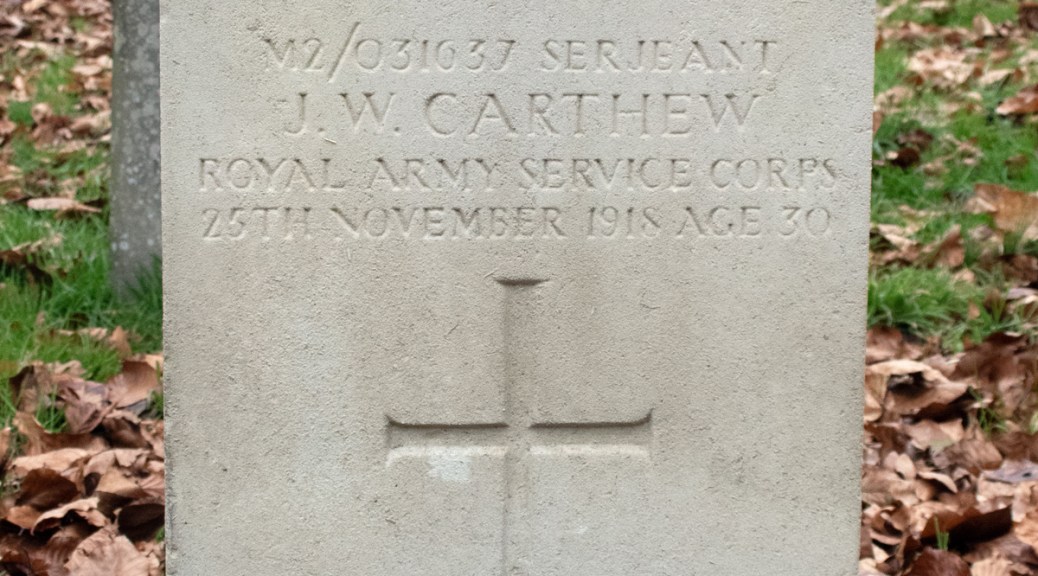
As the war came to a close, Serjeant Carthew fell ill. Based in a camp in Aldershot, he contracted influenza, and this developed into pneumonia. This was to take his life, and he passed away at the town’s Connaught Hospital on 25th November 1918. He was just 26 years of age.

Caroline was living in Bath, Somerset by this point, and this is where the body of her husband was brought for burial. John Wallace Carthew was laid to rest in St James’ Cemetery, in the family plot where his father, who had died in 1911, was also buried.


Private Harry Lawrence

Private Harry Lawrence

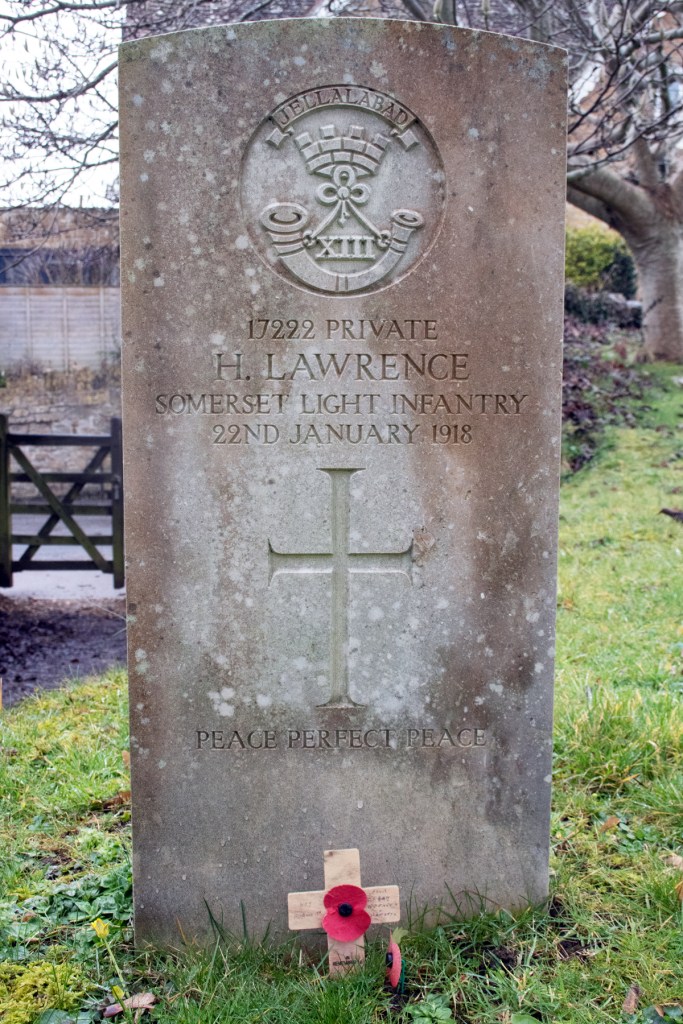
Harry Lawrence was born on 21st March 1895 in the Somerset village of Merriott, and was one of seven children to Samuel and Rose Lawrence. Samuel was a farm labourer, and, when he left school, this is work that Harry also took up.

When war was declared, Harry stepped forward to play his part. He had enlisted in the Somerset Light Infantry by the summer of 1917 and, while his full service records are no longer available, he definitely spent time on the Front Line in France.

Private Lawrence’s troop – the 6th (Service) Battalion – was involved in some of the fiercest fighting of the war, at the Somme, Arras and Ypres. At some point he was injured, and medically evacuated back to Britain for treatment.

He had been under medical treatment for some time in St George’s Hospital, London. Unfavourable symptoms, resulting from concussion of the brain, set in, which terminated fatally, and death this added one more name to the already long list of the Roll of Honour of [Merriott].

Western Chronicle: Friday 8th February 1918

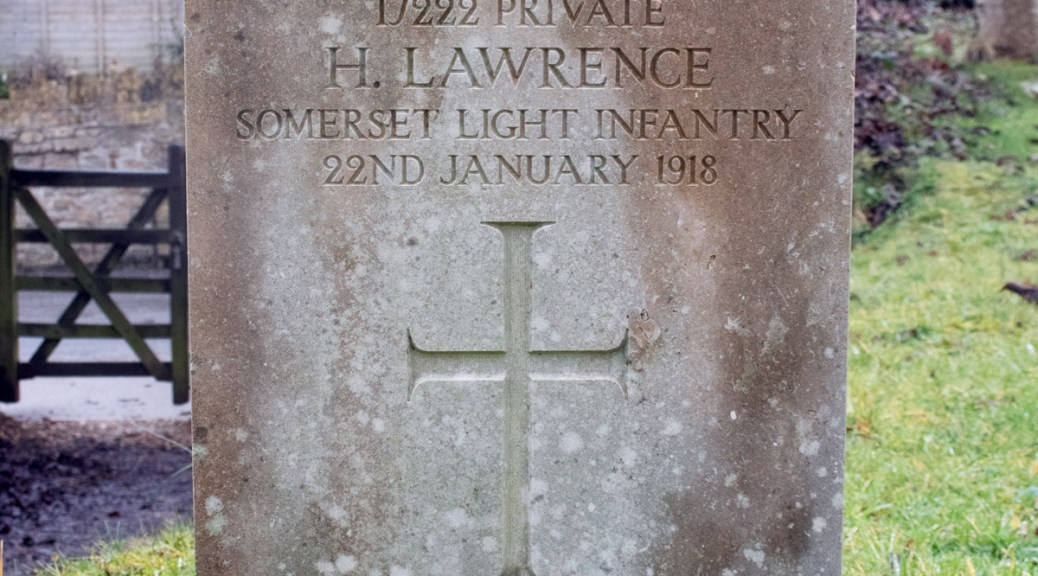
Harry Lawrence died in St George’s Hospital on 22nd January 1918. He was just 22 years of age. His body was brought back to Somerset for burial, and was laid to rest in the quiet graveyard of All Saints’ Church in his home village.


Private Arthur French

Private Arthur French

Arthur John French was born on 3rd September 1889 in the Somerset village of Merriott. He was the youngest of three children to John and Annie French. John was a miller and baker in the village, and Arthur’s older brother Edward helped his father with the business. Arthur, however, followed a different path and, with Annie passing away in 1903, he had moved to London for work.

The 1911 census recorded Arthur boarding with his maternal aunt and uncle, who were both schoolteachers. He had found employment as a clerk in the head office of the National Telephone Company and shared the large terraced house with the couple, their son Alfred and their servant, Esther.

When war was declared, Arthur was in the first wave of those enlisting. He joined the Oxford & Bucks Light Infantry and, as a Private, was assigned to the 2nd/4th Battalion. Initially sent to Northampton for training, his troop soon came south again and, by April 1915, was based just outside Chelmsford, Essex.

Tightly-packed barracks, housing men from across the country soon became hotbeds for illness and disease, and Private French was not to be immune. He contracted meningitis, and was admitted to the 3rd London General Hospital in Wandsworth for treatment. Sadly he was to succumb to the condition, and he breathed his last on 16th April 1915, at the age of just 25 years old.

Arthur John French’s body was brought back to Somerset for burial. He was laid to rest in the graveyard of All Saints’ Church in his home village, Merriott.


Sapper Henry Tabor

Sapper Henry Tabor

Henry James Tabor was born in 1877, the second of six children to James and Sarah Tabor. Wiltshire-born James was a carpenter and joiner by trade, and the family were raised in Sarah’s home town of Milborne Port, Somerset.

Henry followed in his father’s footsteps when he left school and, by the time of the 1901 census, both were carrying out their trade (along with younger brother, Sidney) from the family home in East Street.

James died in September 1915, at the age of 75, and shortly afterwards, his oldest son stepped up to play his part for King and Country. He enlisted in the spring of 1916, joining the Royal Engineers as a Sapper.

Little information about his military life remains documented, but, according to a later newspaper report, he went to France and fought at both Ypres and the Somme. It was while he was overseas that Sapper Tabor contracted bronchitis, which then developed into tuberculosis. He was medically evacuated to Britain for treatment, but passed away on 28th March 1917, having been admitted to the Military Hospital in Southwark. He was 40 years of age.

The body of Henry James Tabor was brought back to Somerset for burial. He was laid to rest in the family plot in the cemetery of his home town, Milborne Port.


The loss of her husband and oldest son in such a short space of time, may have proved too much for Sarah Tabor. She passed away just two months after Henry, and he was reunited with both parents once again.


Second Lieutenant Charles Hales

Second Lieutenant Charles Hales

Charles Edward Hoare Hales was born in Bournemouth, Dorset, in the summer of 1886. The fourth of five children, his parents were Arthur Hales – a Major General in the Royal Inniskilling Fusiliers – and his wife, Maria.

Arthur’s career stood the family in good stead: the 1891 census records the Hales living in a house in Crystal Palace Park, South London, with five servants supporting their – and their two visitors’ – every need. Arthur also believed in education for this two sons: Charles was dispatched to Hartwood House School in Hartley Wintney, Hampshire.

Arthur died in 1904 and at this point the Hales family disappears – there is no record for Maria or her five children in any of the 1911 census returns.

When war came to Europe, Charles and his older brother Arthur, stepped up to play their part. Both joined the Wiltshire Regiment, both being attached to the 1st Battalion. Sadly, neither of the brothers’ service records remain, so it is difficult to piece together their military careers.

Arthur achieved the rank of Captain, gained a Military Cross for his dedication and service. He was caught up in the Battle of Albert – one of the phases of the fighting at The Somme – in 1916. He was initially reported killed in action, then, to the elation of Maria, this was changed to missing. Tragically, he was subsequently confirmed as dead, having passed away on 6th July 1916, aged 34 years of age. He is commemorated on the Thiepval memorial in Northern France.

A further tragedy was to strike the Hales family the following year, when Charles, who had risen to the rank of Second Lieutenant, also passed away.

The internment took place in Bathwick Cemetery on Monday, of Mr Chas. Edward Hoare Hales, 2nd-Lieutenant Wiltshire Regiment, who died on Thursday, after a long illness contracted on active service. He was the last surviving son of the late Major-General A Hales, Royal Inniskilling Fusiliers, Commandant of the Straits Settlements, and of Mrs Hales… The young officer, whose body was brought from Buxton, was buried in the same grave where rest the remains of his father, who died in April 1904.

Bath Chronicle and Weekly Gazette: Saturday 1st December 1917

Details of Charles’ illness, from which he passed on 22nd November 1917, are unclear. He was 31 years old when he died. He left his estate – which amounted to £6524 18s 1d (the equivalent of £579,000 in today’s money) to his youngest sister, Sophia.


Maria Hales passed away in 1924, at the age of 74. She was buried in the family ploy, reunited with husband and younger son once more.


Second Lieutenant Charles Hales
(from findagrave.com)

Captain Arthur Hales
(from findagrave.com)

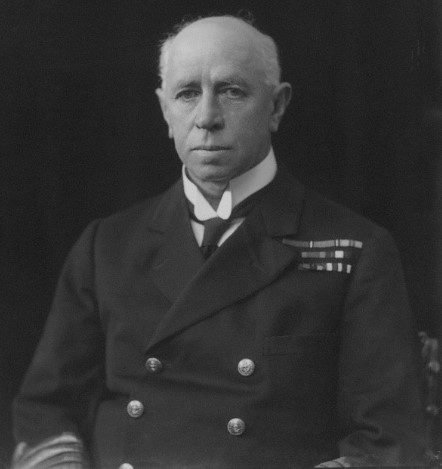
Admiral of the Fleet Sir George Callaghan

Admiral of the Fleet Sir George Callaghan

George Astley Callaghan was born in London on 21st December 1852, the third of six children to Frederic and Georgiana Callaghan. Frederic was born in Ireland and was the son of MP and landowner Daniel Callaghan. He built a career for himself as a magistrate and set up home in Bath, Somerset with Cheltenham-born Georgiana.

The family had means and the 1861 census records them living at a five-storey Georgian house in Catharine Place, Bath, with five live-in servants: a butler, cook, housemaid, nursemaid and nurse.

George enlisted in the Royal Navy in January 1866, and was assigned to the training ship HMS Britannia. From here, his career was to prove meteoric. He was promoted to the rank of Midshipman in October 1867 and by 1870 he was serving in the East Indies. On 15th April 1872 he gained the rank of Sub-Lieutenant, and was promoted to full Lieutenant exactly three years later.

In 1877, Lieutenant Callaghan received a commendation for saving the lives of sailor whose boat had capsized in the Irrawaddy River. George was assigned to HMS Excellent, a gunnery school, in 1880, and formally joined the staff there in 1882. Back on the open seas by 1885, he was promoted to Commander on 31st December 1887 and given control of the battleship HMS Bellerophon. By 1894, George had been promoted again, to the rank of Captain, and took on the additional duties of naval advisor to the War Office.

As the new century dawned, George was mentioned in dispatches for his support during the Boxer Rebellion. Further commands followed, including HMS Edgar and HMS Caesar, both in 1901. He was made Captain of Portsmouth Dockyard and then naval aide-de-camp to the King in 1904. By the following year, he was given the rank of Rear Admiral, became Second-in-Command of the Channel Fleet in 1906, Second-in-Command of the Mediterranean Fleet in 1908. In December that year he was awarded Knight Commander of the Royal Victorian Order for the aid he provided to survivors of the Messina earthquake.

In April 1910, George was knighted and promoted to Vice Admiral, and within eighteen months he was made Commander-in-Chief of the Home Fleet, gaining the rank of Admiral in November 1911.

During this time of military promotion, George had also had his own family. On 2nd February 1876, he had married Edith Grosvenor in St Andrew’s Church, Walcot, Bath. The couple went on to have four children: Dorothy, Cyril, Noël and Stella.

A naval officer’s wife was destined to be a lonely life, and the census records seem to reflect this. In 1881, Edith and Dorothy were visiting a curate and his family in Wiltshire. Ten years later, Edith and her four children were living at the family home in Bathwick, with one visitor and three servants. The 1901 census found Edith, Cyril (who was now a midshipman himself) and Noël living in Devonport with a cook and two other servants. By 1911, Edith had moved again. She was 54 by this point, and based at a house in Havant, Hampshire, with a cook and two maids. All of this time, of course, George was away at sea, performing his duties.

George, by this point, had spent years preparing for the war he knew was coming. However, in July 1914, the First Lord of the Admiralty, Winston Churchill, commanded Sir John Jellicoe to relieve George of his position as Commander-in-Chief of the Home Fleet. Whether Churchill believed that Sir Callaghan was now too old to successfully carry out the duties the advancing conflict would impose upon him is unclear. It must have disappointed the 62-year-old George, however.

His work continued, however: he was appointed First an Principal Naval Aide-de-Camp to the King in September 1914, and became Commander-in-Chief of The Nore in three months later. He was promoted again, to Admiral of the Fleet, in April 1917, but subsequently retired less than a year later.

George’s life over the next couple of years goes a little quiet. Indeed it is only in November 1920 that further information is available.

The death occurred in London yesterday afternoon of Admiral of the Fleet Sir George Callaghan KCB. He had been ill for some months, and the immediate cause of death was an affection of the heart.

The Scotsman: Wednesday 24th November 1920

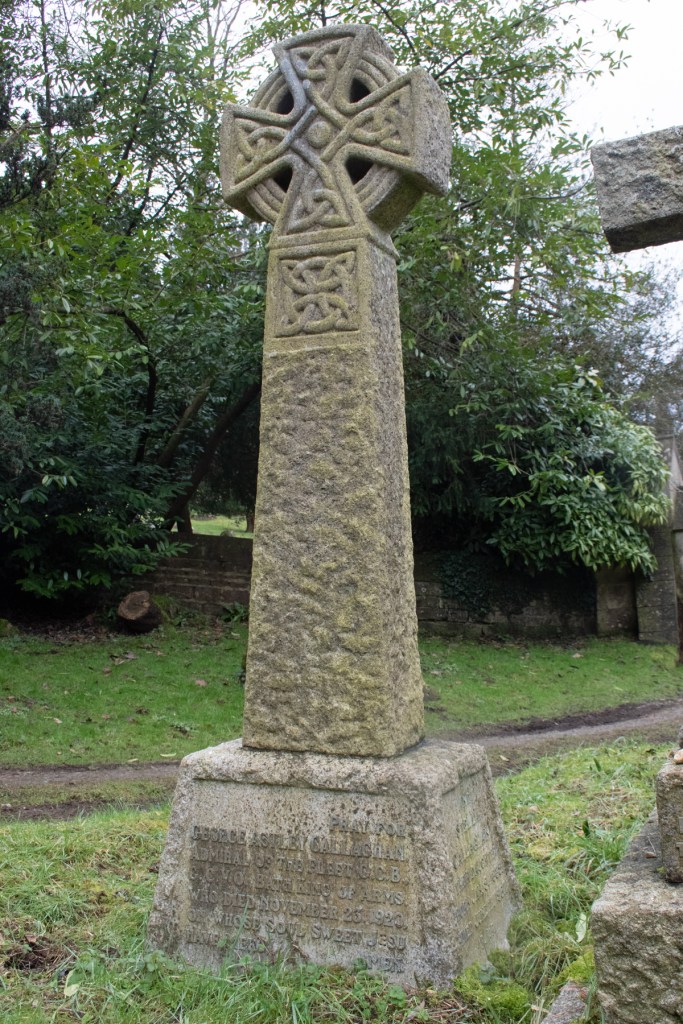
Sir George’s passing at his London home was reported in most of the press, highlighting his military achievements and decorations. His funeral was held at Westminster Abbey, and he was then laid to rest in the graveyard of St Mary’s Church in Bathwick, not far from his and Edith’s main home.


Sir George Callaghan

Major Richard Jordan

Major Richard Jordan

Richard Avary Arthur Young Jordan was born on 24th May 1866 in Cashel, Tipperary, Ireland. His father, Richard Jordan, died a week after his son’s birth, leaving his mother, Annabella, to raise him.

The 1871 census records mother and son living in Woolwich, London, with Annabella’s widowed mother, Grace. They were obviously a well-connected family, with Grace living as an annuitant, or pensioner, one son a Surgeon Major in the army and another as a Colonel in a different regiment. Annabella herself was recorded as a landowner, and the family had support with a cook and housemaid living in.

Surrounded by army servicemen as he was, it is no surprise that a military career called to Richard. He enlisted on 10th November 1886, joining the King’s Shropshire Light Infantry as a Lieutenant. Assigned to the 1st Battalion, his service records confirm that he had attended Burney’s Gosport School – a military academy – and was 5ft 7.5ins (1.71m) tall.

Richard was sent to Egypt just before Christmas that year, and over the next five years, he served both there and in Malta. On 11th May 1889 he attained the rank of Captain and, in December 1891 he was sent further afield, to Hong Kong.

After three years in the Far East, returned to Britain, and spent the majority of 1895 back on home soil. His travels were not at an end, however, and by the end of the year, Captain Jordan found himself in India. He spent three-and-a-half years in the sub continent, returning to the UK in May 1899.

At this point, details of Richard’s life get a little sketchy. He seems to have settled in Pembroke Dock, South Wales, and, on 18th April 1904, he married Ella Mary Caroline Grove. She was eight years his junior, and the daughter of a late Lieutenant in the Highland Light Infantry. The couple married at St George’s Church, Hanover Square, London.

Richard’s trail goes gold again, for a couple of years. He retired from the army on 8th August 1906, after nearly twenty years’ service. By the time of the 1911 census, he and Ella had set up home in Heywood House, on the outskirts of Tenby, Pembrokeshire, with two servants – Beatrice and Edith – as two live-in staff.

War came to Europe in the summer of 1914, and Richard seemed to keen to play his part once again. He enlisted again in August 1915, and was assigned the rank of Major in his former regiment. While it is not possible to determine Major Jordan’s complete service at this time, he definitely arrived in France the following month. If he remained in France, it is likely that he saw fighting at the Somme in 1916, Cambrai in 1917 and at Lys and on the Hindenburg Line in 1918.

Again, Major Jordan’s post-war life remains tantalisingly elusive. By the summer of 1920, he and Ella were living at Holcombe Lodge in Bathampton, on the outskirts of Bath. It was here on 14th June, that Richard passed away. He was 54 years of age.

Despite all his travelling, it seems that Ella was comfortable living in Bathampton, and this is where she laid her late husband to rest. Richard Avary Arthur Young Jordan was buried in the graveyard of St Nicholas’ Church in the village.


The widowed Ella married again, to Captain Clare Garsia, on 9th October 1921. She remained in Bathampton, and lived to the age of 77, passing away on 13th August 1951. She was laid to rest in the same plot as her late husband.

When Captain Garsia died the following year, he was also buried in St Nicholas’ Churchyard, in a neighbouring plot to his beloved Ella.


Quartermaster Serjeant Iva Brewer

Quartermaster Serjeant Ivor Brewer

Iva Victor Brewer was born on 2nd May 1886, the fourth of four children to James and Annie Brewer. James was a farm labourer from Weston-super-Mare, but the family were living in Bathampton by the time of Iva’s birth. James died in 1887, and Annie remarried three years later. Her new husband, Thomas Dolman, was the manager of the George Inn in Bathampton, and the couple went on to have four children of their own, half-siblings to Iva.

Tragedy struck again when Annie passed away in February 1897, at the age of just 37 years old. By the time of the next census in 1901, Iva was boarding with his stepfather’s parents; the following year, however, Thomas also passed away, and the children were left to build their own lives.

Iva – who was now going by his middle name, Victor – found an escape in the army and, according to the 1911 census was an Acting Bombardier in No. 69 Company of the Royal Garrison Artillery, based in Colaba, at the tip of the Mumbai peninsula.

By the time war was declared, Victor had cemented his military career. Full details of his service are no longer available, but the summer of 1916 he had left India for Aden, and was then mentioned in dispatches that October for his bravery in the field at the Somme.

In November 1917, the now Battery Quartermaster Sergeant Brewer was injured in fighting at Passchendaele, and was medically evacuated to Britain for treatment. It seems that he was treated in South Wales, and it seems a whirlwind romance set in when he was living in Pontardawe, near Swansea. On 2nd January 1918, Victor married Laura Seddon, a railway inspector’s daughter from the village of Ystalyfera, just up the valley from Victor.

The couple moved to Bathampton before Victor returned to the fighting. He was badly wounded and, having been evacuated back to Britain in May 1918, he was admitted to the Northern Central Hospital in London where his shattered leg was amputated. Sadly, bronchial pneumonia set in while he was recovering, and he passed away from the subsequent sepsis. Quartermaster Sergeant Brewer passed away on 7th May 1918, days after his 32nd birthday.

Iva Victor Brewer was brought back to Bathampton for burial. He was laid to rest in the quiet graveyard of St Nicholas’ Church in the village.


Tragedy was to strike again, sadly. After his funeral, Laura returned to Wales and found employment at a draper’s store.

…the loss of her husband played on her mind.

On Monday she set off for Bathampton, and on her way posted two letters to her late husband’s relatives.

One ran: “I cannot live without my husband. If you don’t hear from me, search Bathampton, as I shall be there somewhere.” Another letter asked her relatives to let her mother in the Swansea Valley know.

She reached Bath, and it is thought she there took a taxi to Bathampton. She then paid a visit to the cemetery, and placed her hat and handbag on her husband’s grave. At the canal-side nearby she laid her fur coat on the bank, and, it is supposed about midnight, plunged into the water

Western Gazette: Friday 9th April 1920

Laura was just 27 years old when she died: she was buried with Victor, husband and wife reunited again.