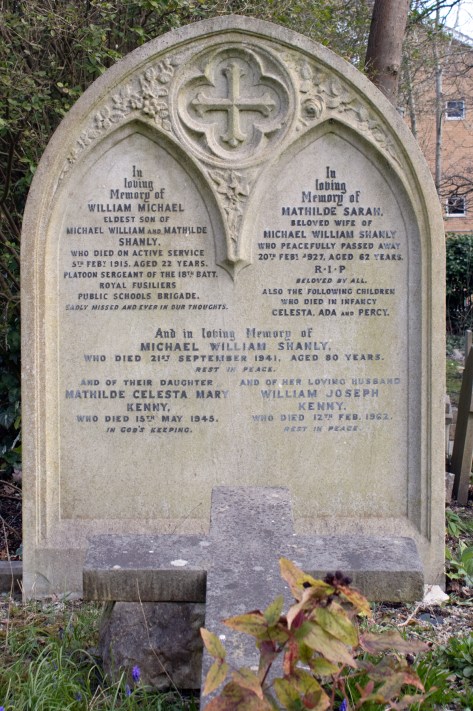
William Michael Shanly was born in Hampstead, Middlesex, in the summer of 1892. The fourth of eight children, of whom three died in infancy, he was the eldest son to Michael and Mathilde Shanly. Michael was the owner of a coffee and refreshment company.
The Shanly family lived at 78 Sumatra Road, Hampstead, but by the time he was nine years old, William had been sent to Sussex, and was boarding at the Xavarians Brothers School in Uckfield.
There is little further information available about William’s life. His epitaph on the family headstone suggests that he died on active service and was a Platoon Sergeant of the 18th Battalion of the Royal Fusiliers. His unit was also known as the 1st Public Schools, although exactly what role he held is unclear. His entry on the Commonwealth War Graves Commission Grave Index suggests that he was attached to the 15th (Reserve) Battalion, but his military records no longer exists, so it isn’t possible to confirm either way.
Serjeant Shanly died on 5th February 1915, aged 22 years of age. He had had an operation for appendicitis five days earlier, but had succumbed to peritonitis.
William Michael Shanly was laid to rest in the family plot in Highgate Cemetery, not far from where his grieving family were living.
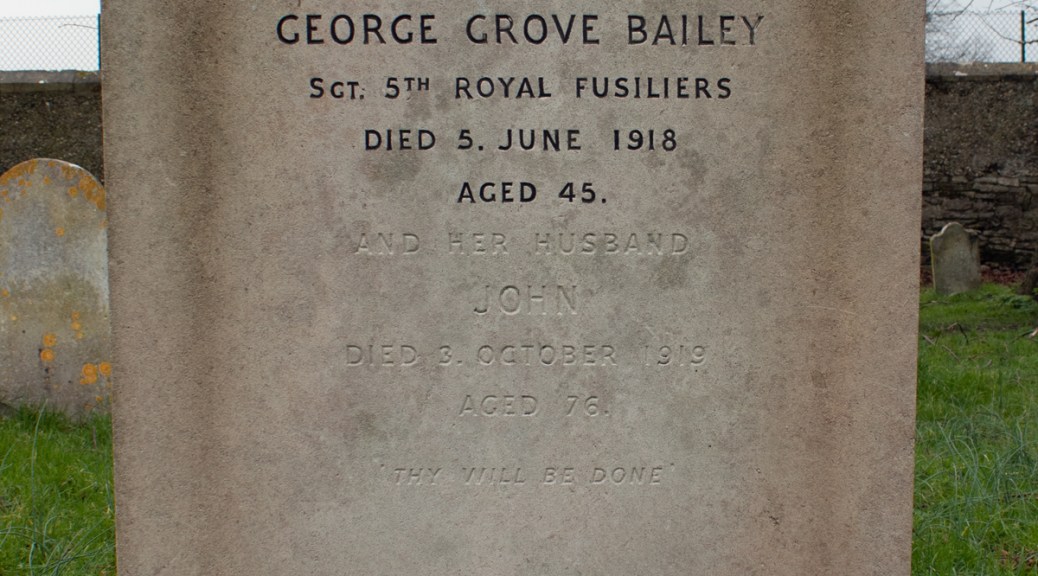
George Grove Bailey was born towards the end of 1873, in the Hampshire town of Lymington. He was the second of two children to John and Emma Bailey. John was a butler, but when Emma died when their youngest boy was just two years old, he seems to have changed career. The 1881 census found the family living at 45 High Street, Lymington, not far from the school and the Church of St Thomas the Apostle.
While he had the support of domestic servant Mary Ann, John was still young and, in 1884, he married again. His new bride was Sarah Woodman, and the couple would go on to have a daughter, Edith, two years later.
George falls off the radar at this point, and it is only from a newspaper report of his funeral in June 1918 that we are able to fill in some of the details:
The funeral took place on Monday afternoon of Sergt. George Bailey, youngest son of Mr John Bailey, of Highfield, Lymington, who passed away in the military hospital at Brighton, following a short illness. The deceased, who was 45 years of age, and was recently married, served in the South African War, and joined up at the commencement of the present war, being for some twelve months in the Fusiliers at the front. He was wounded, and since his return to this country has been acting as sergt.-instructor.
[Hampshire Advertiser: Saturday 15th June 1918]
George’s new wife was Winifred Mary Bailey, but there is little additional information about her. His regiment – the 5th Battalion of the Royal Fusiliers – was based on home soil, and would not have been the unit with which he had served on the Western Front. It’s not possible, therefore, to determine where he fought, or how he was wounded.
George Grove Bailey was buried in the family plot in the graveyard of St Thomas’ Church, Lymington, not far from where his father’s shop had been. John, who had been working as a poor rate collector, died a year after his son, and was laid to rest alongside his wife and youngest child.
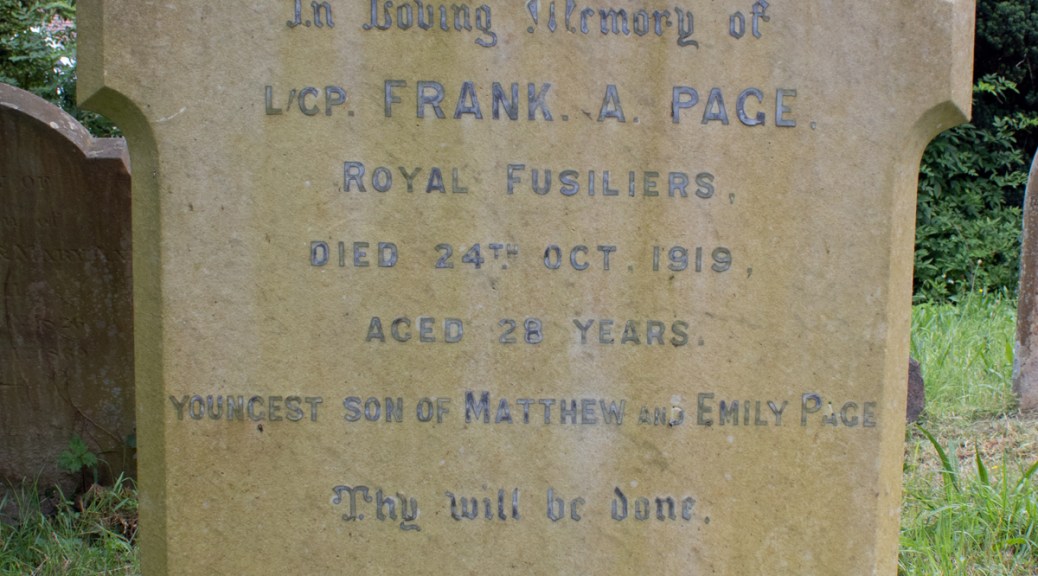
Frank Arthur Page was born early in 1891, and was one of seven children – and the youngest son – to Matthew and Emily Page. Matthew was a bricklayer’s labourer from Lancing in Sussex, while Emily had been born in Norfolk. It was in the village of Steyning, however, that the couple raised their family.
By the time of the 1901 census, Matthew had been invalided out of work. The family had moved to a small cottage in Lancing by this point, and Frank’s older brothers were working to bring in some money for the family.
The next census return, taken in 1911, found Matthew and Emily living Frank and his older brother Sydney at 2 Ivy Cottages in Lancing. Both of the Page siblings were working as market gardeners by this point, bringing in some money to help support the family.
War came to Europe in the summer of 1914, and Frank stepped up to serve his King and Country. Full details of his military service are lost in the mists of time, but it is clear that he enlisted in the Royal Fusiliers, and was attached to the 26th (Service) Battalion (Bankers).
Frank’s unit served in both France and Italy, although, without his documents, it isn’t possible to determine where, and for how long, he served. During his time in the army, however, he was promoted to the rank of Lance Corporal, underlining a level of dedication on his part.
Matthew passed away in the spring of 1917, and it appears that Frank was demobbed at some point after the Armistice. By the autumn of 1919, he was back in Sussex, living with his now widowed mother. His time in the army seems to have impacted on Frank’s health by this point, and he died ‘from disease’ on 24th October 1919. He was 28 years of age.
Frank Arthur Page was laid to rest in the graveyard of St James the Lesser Church in Lancing, not far from where his father had been buried.
Edward Charles Vale was born in the spring of 1890, one of ten children to William and Ellen. Born in Cambridgeshire, William was employed by the local railways, becoming a signalman by the time of the 1901 census. The family were raised in Great Shelford, before moving to the Ely area in the early 1900s.
By the time of the 1911 census, Edward was the oldest of three of his siblings to still be living at home. The Vales were living at 12 Granta Terrace, Stapleford, and Edward was employed as a domestic gardener.
When war broke out, Edward volunteered to serve his country. Full service details are lost to time, but he had enlisted in the Royal Fusiliers by the spring of 1915. By June of that year, Private Vale was fighting in the Balkans.
At some point during the conflict, Edward transferred to the Oxfordshire & Buckinghamshire Light Infantry. He remained in the Easter Mediterranean, but was badly wounded in the summer of 1917.
Medically evacuated to Britain, Private Vale was admitted to the Voluntary Aid Detachment hospital that had been set up at Knightshayes Court, Devon. While details are unclear, Edward’s injuries were to prove too severe. He passed away on 9th October 1917, at the age of 27 years old.
Edward Charles Vale was laid to rest in the peaceful graveyard of St Thomas’ Church in Chevithorne, not far from the hospital in which he had passed.
William Daniel Yandell was born in 1884 in Bishops Lydeard, Somerset. The second of four children, his parents were Samuel and Jane Yandell. Samuel was a farm labourer, and this is work that William and his younger brothers, wins Sam and Walter, also went into.
The 1911 census found William living with Walter, who had found employment as a labourer at Cotford Asylum, not far from the village. The brothers also had a boarder, Samuel Chaffey, a carter, who brought in some more money to the household. Samuel Sr and Jane were all that remained in the family home. Samuel Jr had married three years before, and was living in a small cottage with his wife, Rosina, and their two children. The oldest of the Yandell siblings, Alice, had been married for ten years by the time of the census, and was living with her husband and son in Minehead.
Samuel Sr died in the spring of 1914. By the summer, war had been declared, and the three Yandell brother enlisted to serve their king and heir country.
William, by this point, had found work at the Goodlands Coal Yard and volunteered for the local fire brigade. He did not enlist immediately but joined the Royal Fusiliers in the spring of 1916. Attached to the 3rd Battalion, Private Yandell found himself in France that summer.
On 1st October 1916, he was badly wounded in the right arm and shoulder, and was medically evacuated to the 2nd Western General Hospital in Manchester for treatment. This proved to be long-term support, and on 21st January 1917, he underwent an operation on the injury. Private Yandell was not to come round from the surgery: he passed away the following day at the age of 33 years of age.
William Daniel Yandell was brought back to Somerset for burial. He was laid to rest in the peaceful graveyard of St Mary’s Church in his home village of Bishops Lydeard.
The deepest sympathy is felt for [William’s] widowed mother and relatives, as the widow has another son a prisoner of war in Turkey, who was taken with General Townshend’s force at Kut, and no news has been heard since they were taken prisoner. Another son is somewhere in Salonica, from whom no news has been heard for some weeks past.
Taunton Courier and Western Advertiser: Wednesday 31st January 1917
Walter was the son being held in Turkey. He had joined the Somerset Light Infantry as a Private, and was assigned to the 1st/5th Battalion. His troop was caught up in the Siege of Kut in the spring of 1916. He died on 31st May 1916, soon after being taken prisoner, a fact his mother would not be made away of for at least nine months, based on the newspaper report. Private Walter Yandell is commemorated on the Basra Memorial in Iraq.
Sam Jr was the son who was based in Salonika. Full details of his military service are not available, but later records confirm that he survived the war. By the time of the 1939 England and Wales Register, he was living back in Bishops Lydeard with Rosina, and was working as a Mess Orderly at a military camp. Sam died in January 1951, at the age of 63.
Richard George Birch was born on 8th July 1878, in Westminster, Middlesex. One of nine children, his parents were Samuel and Alice Birch. Samuel started work as a messenger for the House of Lords, and went on to be a military cap maker by the time of his son’s baptism.
When he finished his schooling, Richard found employment as a printer and compositor. He married Evelyn Groom in 1906, and the couple went on to have three children: Harry, Doris and Richard Jr.
The 1911 census showed a change in circumstances for the family. They were living in Farnham, Surrey, and their household was made up of Richard, a pregnant Evelyn, Harry, Doris and a servant, Florence. Richard had now left the printing business, as was employed as a comedian.
When war came to Europe in August 1914, Richard stepped up to play his part. Having enlisted by the spring of 1917, he initially joined the East Surrey Regiment, although at some point he made the transfer to the Royal Fusiliers.
Little information remains available about Private Birch’s military life. Attached to the 22nd (Service) Battalion, he seems not to have served overseas. It appears that he either served in Somerset, or was sent there to recuperate following an illness or injury, as he was in Burnham-on-Sea by the autumn of 1917. He passed away in the town on 19th September, the cause of his passing not freely recorded. He was 39 years of age.
Richard George Birch’s body was not taken back to Surrey, possibly because of financial constraints. Instead laid to rest in Burnham Cemetery, Somerset.
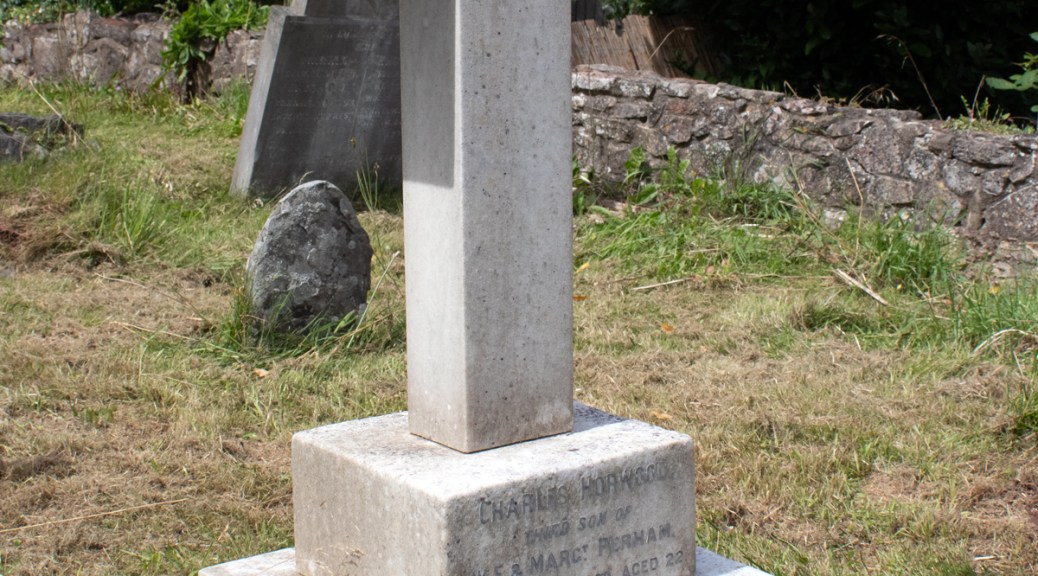
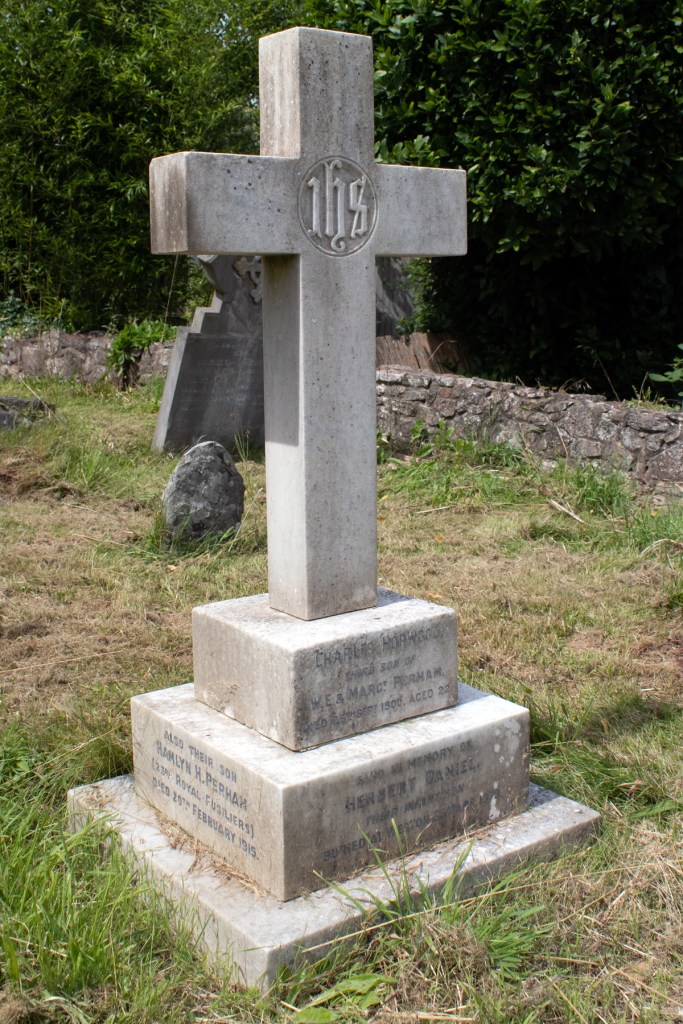
Hamlyn Horwood Perham was born in the autumn of 1872, one of seven children to William and Margaret. William was a solicitor from Wrington in the north part of Somerset, but it was in the village of Flax Bourton that the family settled.
Expectations were high for Hamlyn, who was the Perhams’ oldest son: the 1881 census found him boarding as a student in a private school in Weston-super-Mare. Ten years later, he was back home, but listed as a law student. The 1901 census recorded him as living with his family, but a practicing solicitor, presumably alongside his father (who, the document notes, was a solicitor and a Lieutenant Colonel in the Somerset Light Infantry).
Colonel WE Perham, the commanding officer of the 3rd Volunteer Battalion Somerset Light Infantry, had just been retired, after a connection with the corps dating from the year 1861, when he joined as a private. His retirement will occasion within the regiment universal regret, for he deservedly held the esteem and respect of all ranks. That Colonel Perham was well qualified to command is shown by the high state of efficiency in which he leaves the 3rd Battalion. He had taken the higher examinations, and in tactics passed with distinction. An officer who has worked through all grades from private to commander should, indeed, be a practical administrator and leader, and Colonel Perham was essentially both, and his knowledge of military matters singled him out for the important divisional and other commands. Latterly he was foremost in organising officers’ rides through the West Country – an instruction much valued at the War Office.
Somerset Standard: Friday 15th February 1907
The next census, taken in 1911, found Hamlyn still living with his parents and older sister. The family were supported by three live-in staff: a cook, a parlour maid and a housemaid. Hamlyn’s younger brother, Herbert, had also followed their father into law and, according to the same census, had set up a practice in Nailsea, where he lived with his wife of three years.
When war came to Europe, Hamlyn quickly stepped up to play his part. He enlisted in the Royal Fusiliers as a Private, and was assigned to the 23rd Service Battalion, also known as the 1st Sportsmen’s. Based at a camp in Hornchurch, Essex, Private Perham’s service was not to be a long one. He contracted meningitis, and was admitted to the South Western Hospital in Southwark. Sadly, the condition was to get the better of him: he died in hospital on 20th February 1915, at the age of 42 years old.
Hamlyn Horwood Perham’s body was brought back to Somerset for burial. He was laid to rest in the family plot in St Michael’s Church, Flax Bourton.
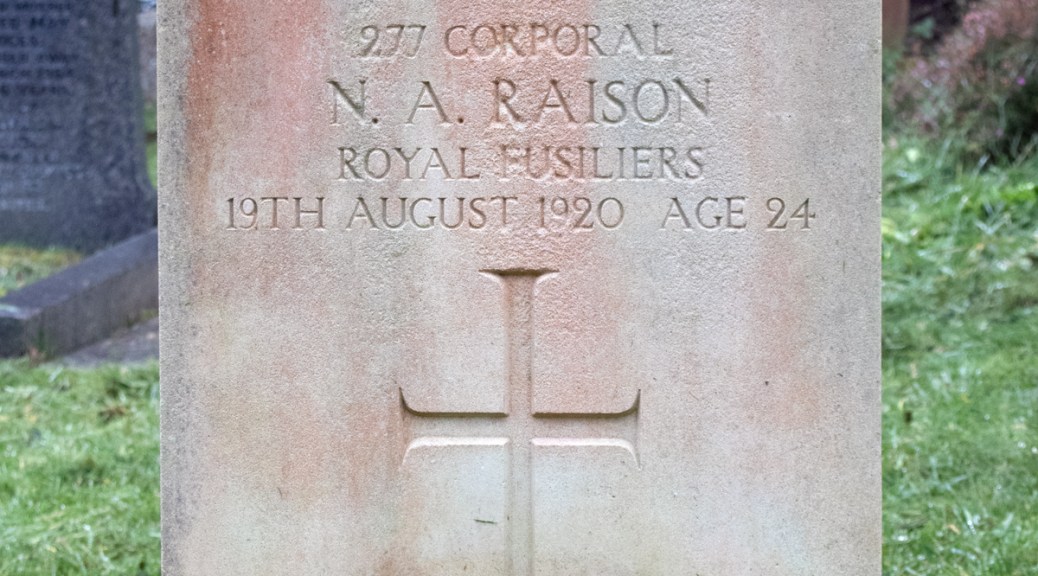
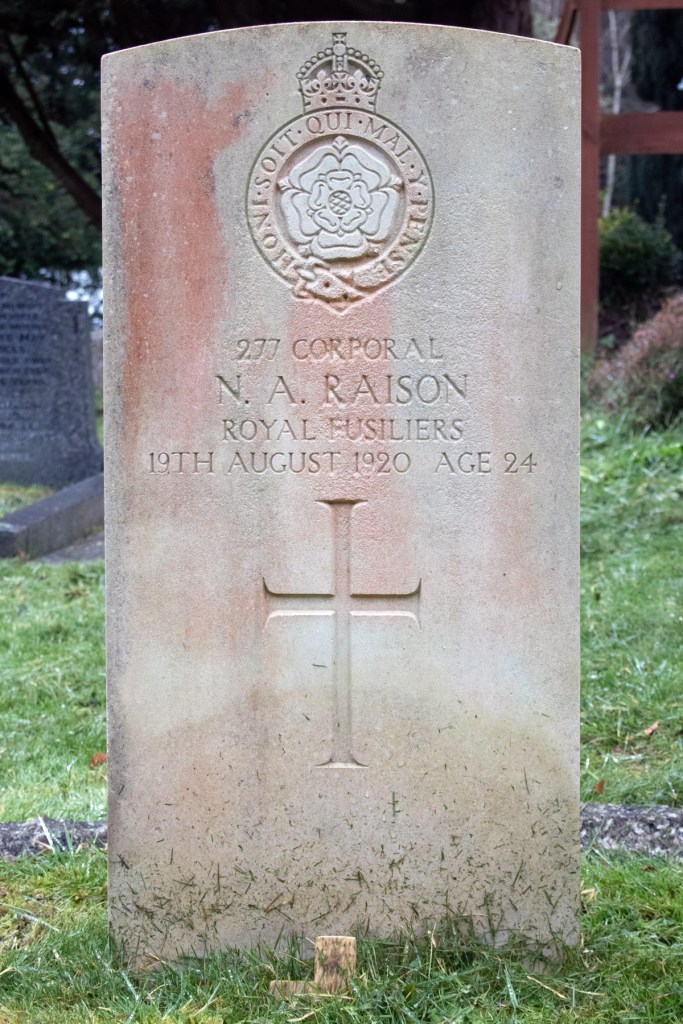
Austin Neal Raison was born in the spring of 1896 in Crewkerne, Somerset. The eighth of thirteen children, his parents were bootmaker Charles Raison and his wife, Lucy.
Austin’s siblings found a variety of trades, from dressmakers and costumiers to grocers and stationers. When Austin left school, however, he was apprenticed to a printer, a career laid our in front of him.
When war came to Europe, Austin joined the Royal Fusiliers. Full details of his military service have been lost to time, but a local newspaper, reporting on his funeral, provided a summary of his war experience:
The funeral took place at the Cemetery on August 24 of Corporal Austin Neal Raison… who died on the previous Thursday from wounds received in action. Deceased was 24 years of age and in September 1914, he volunteered for service in the Army, joining the Royal Fusiliers. He went to France in October 1915, and took part in most of the important battle from that date until he was severely wounded in the retreat from Cambrai. He returned home, and everything possible was done for him, but he never recovered health, and gradually sank, dying at his father’s house to the sorrow of all who knew him.
Western Chronicle: Friday 3rd September 1920
Corporal Austin Neal Raison died on 19th August 1920. He was laid to rest in the Townsend Cemetery, Crewkerne, within sight of the family home.
The Commonwealth War Graves Commission gives Corporal Raison’s name as Neal Austin, while all other records, including his service documents, confirm his name as Austin Neal.
Alexander Popham Spurway was born on 8th April 1891 in Newbury, Berkshire. He was the second of six children to Edward and Gertrude Spurway. Edward was a clergyman, and the family moved to Heathfield in Somerset when Alexander was a small boy. Education was key to Edward and, the 1901 census records show Alexander as being a boarder at the Portmore School in Weymouth, Dorset.
Reverend Spurway set the family up well in Heathfield: by the time of the next census in 1911, the family were living in the village rectory, with five members of staff.
Alexander, meanwhile, had taken a different route, entering the Royal Naval College at Osborne on the Isle of Wight in January 1904. He was a keen sportsman and, while there, he represented the college at both cricket and football.
In September 1908, he passed out from the college as a Midshipman, and served on HMS Canopus in the Mediterranean. His career continued, and he was made Sub-Lieutenant in December 1911, and Lieutenant two years later.
Reverend Spurway died at home in February 1914 and, by the time war broke out, Lieutenant Spurway was assigned to HMS Achilles. He remained on board the cruiser for the next two years and it was during this time that he developed diabetes: something that was to prove an ongoing issue for him.
Returning home in the autumn of 1915, the condition was to prove too much, and he passed away on 29th November 1915, at the age of 24 years old.
Alexander Popham Spurway was laid to rest in the graveyard of his late father’s church, St John the Baptist in Heathfield.
Lieutenant Spurway (from findagrave.com)
Sadly, Alexander was not the only member of the Spurway family to lose their life as a result of the war.
Richard Popham Spurway, Alexander’s older brother, was a 2nd Lieutenant in the Somerset Light Infantry, and was attached to the Hampshire Regiment, when it was moved to Gallipoli in 1915. He was killed on 13th August 1915, and is commemorated on the Helles Memorial at Canakkale, Turkey.
Alexander’s younger brother, George Vyvyan Spurway, joined the Royal Fusiliers, before transferring to the Machine Gun Corps. He had arrived in France in September 1916, and was killed while fighting on the Western Front on 28th March 1918. He was laid to rest at Arras and is commemorated on the memorial there.
Frederick Jacob Harris was born in Wadeford, near Chard in Somerset, on 28th August 1887. The fourth of eleven children, his parents were William and Grace Harris. William was an agricultural labourer and carter, but the busy lace and weaving industry in the area is what provided Frederick and his siblings with work when they finished school.
It may have been through his work in the factory that Frederick met Alice Dowell: she was the daughter of a lace hand from Chard. The couple married on 20th October 1906, and settled in a house near the centre of the town. They went on to have four children, two boys and two girls.
War was closing in on Europe by this point, although there is little specific information about Frederick’s service. He initially joined the Somerset Light Infantry, although he soon made the move to the Royal Fusiliers. He received the Victory and British Medals, as did everyone else who served in the Great War, but there is no confirmation of whether he saw action overseas or not.
However and wherever Private Harris served, he survived the conflict, and was demobbed on 25th May 1919. His discharge record suggests that, at the point of being released from duty, he had no injuries or disabilities, and nothing that could be attributed to his time in the army.
Frederick appears to have returned to Chard, and spent the next six months adjusting to civilian life. However, something changed, as, on 10th December 1919, he passed away at home. No cause of death is evident, and nothing in the contemporary local media suggests that he died of anything other than natural causes. Whatever led to his passing, he was taken early, as he was only 32 years of age.
Frederick Jacob Harris was laid to rest in Chard Cemetery.