Tag Archives: Royal Naval Reserve

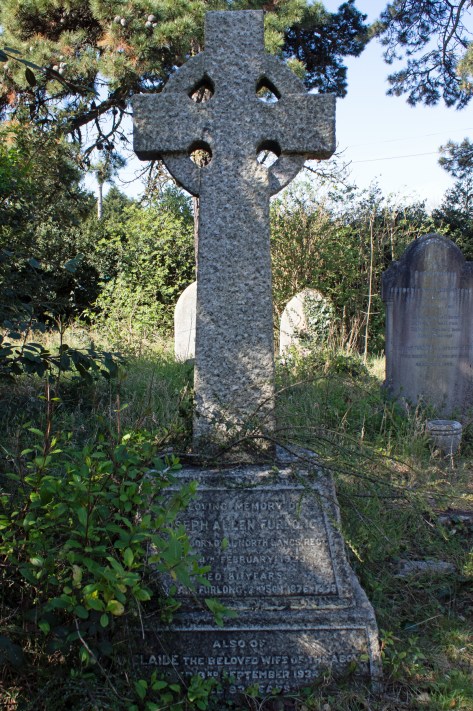
Lieutenant Allan Furlong

Lieutenant Allan Furlong

Allan Hyde Furlong was born the autumn of 1874, and was the oldest of seven children to Joseph and Adelaide Furlong. The place of his birth varies depending on which document you’re looking at, with census records suggesting he was born in Pembrokeshire, Wales, or Aldershot, Hampshire. His birth was registered in Eastry, Kent, however, so it is possible that this is where the family were based at the time.

Joseph was an officer in the North Lancashire Regiment, and his work meant the family moved time and time again. Allan’s younger siblings were born in Hampshire, Pembrokeshire and Athlone, Ireland. By the early 1880s, they had settled in Lancashire, the 1891 census recording them as living in the Fulwood Barracks in Preston.

Given his father’s military background, it is not surprising that Allan was drawn to follow suit. He took a different route, however, and enlisted in the Royal Naval Reserve. Midshipman Furlong took a commission on 27th August 1892, and would make a career out of the navy.

By the time war broke out, Allan was serving on board the SS Burma. In May 1915 he was promoted to Sub Lieutenant, and a further rise in rank – to full Lieutenant – followed in January 1918. He survived the war, and remained at sea through to the start of the new decade.

In March 1920, Lieutenant Furlong was admitted to the Royal Marine Infirmary in Deal, Kent, suffering from a combination of influenza and pneumonia. The conditions would get the better of Allan, and he passed away from them on 14th March 1920: he was 45 years of age.

Joseph and Adelaide were living in Worthing, West Sussex, by this point. Keen to bring their son home, the body of Allan Hyde Furlong was laid to rest in the town’s Broadwater Cemetery.


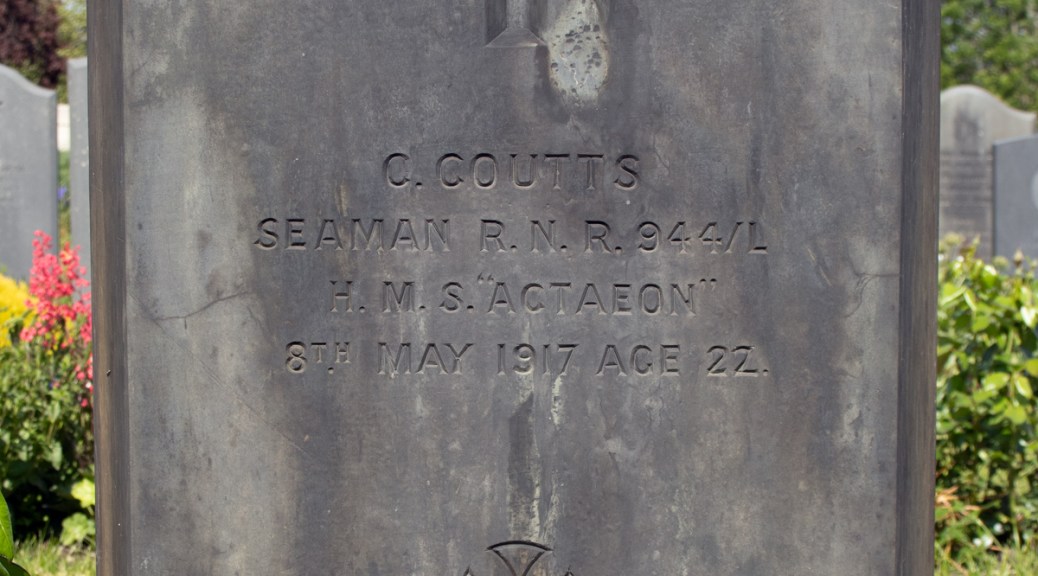
Seaman Christopher Coutts

Seaman Christopher Coutts

Christopher Coutts was born in Lerwick, Shetland, on 2nd August 1894, and was the only child to Robina Coutts. There is little information about his early life, but by the time war broke out, he was working as a shop assistant.

Given the location of his island home, it makes sense that Christopher also had a knowledge of the sea and seafaring. This was put to use during the war, and he was assigned to the Royal Naval Reserve as a Seaman. Initially based in Shetland, by the summer of 1916, he had been transferred to HMS Acteon, the torpedo school based in Sheerness, Kent.

Information has been received here that Christopher Coutts, RNR, has died in Hospital at Haslar. He had been in failing health for some time, and the end was not unexpected. Prior to the outbreak of war, deceased was employed as a shop assistant with Mr Brown, Freefield. After war broke out, he joined the RNR (Shetland Section), and after undergoing a period of training in Lerwick proceeded south to one of the naval depots, where he contracted the illness to which he has now succumbed. Deceased was a bright and promising young man, and much sympathy is extended to his sorrowing mother and other relatives.

Shetland Times: Saturday 12th May 1917

Given the location of HMS Acteon and the subsequent place of his burial, it is likely that Seaman Coutts died at the Royal Naval Hospital in Chatham, Kent, rather than Haslar Hospital, which is in Gosport, Hampshire. He died on 8th May 1917, at the age of 22 years old.

Christopher Coutts was laid to rest in the naval section of Woodlands Cemetery, Gillingham, Kent.


Seaman Christopher Coutts
(from findagrave.com)

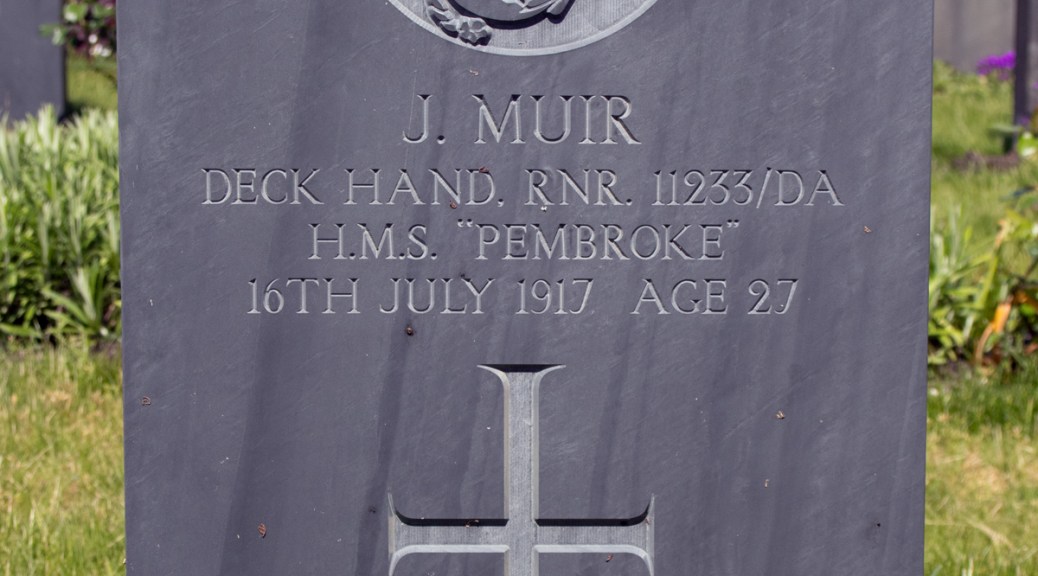
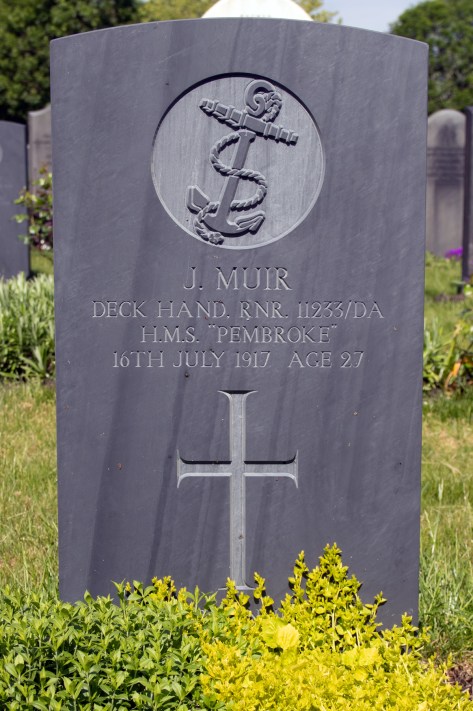
Deck Hand James Muir

Deck Hand James Muir

James Muir was born on 29th October 1889 in the hamlet of Burness on the remote Orkney island of Sanday. The youngest of three children, he was the only son to agricultural labourer Alexander Muir and his wife, Ann.

Little information remains about James’ early life. He seems to have found work at sea, as, when war broke out, he enlisted in the Royal Naval Reserve. His service records show that he was 5ft 8in (1.72m) tall, with brown eyes and a fresh complexion.

Deck Hand Muir initially served on the depot ship HMS Zaria, before bring transferred to the cruiser HMS Brilliant. By the spring of 1917, he was stationed at HMS Pembroke, the Royal Naval Dockyard in Chatham, Kent.

James was admitted to the town’s Royal Naval Hospital, suffering from fibroid phthisis, a wasting disease of the lungs. Formally discharged from the Royal Naval Reserve on medical grounds on 28th June 1917, his condition was to worsen, and he passed from the heart condition pericarditis on 16th July. He was 27 years of age.

James Muir passed away 560 miles (900km) from home: he was laid to rest in the naval section of Woodlands Cemetery, Gillingham, Kent, not far from the dockyard that had been his home.


Deck Hand James Muir
(from ancestry.co.uk)

Seaman Angus McLeod

Seaman Angus McLeod

Angus McLeod was born on 18th April 1881 in the hamlet of Deiraclete (or Diraclett) on the Isle of Harris, Scotland. Little information is available about his early life, but a later record suggests his parents were called Norman and Mary.

Given the remote location of his birth, it is unsurprising that Angus was to gain knowledge of a life a sea, whether for work, or as a mode of transport. When war broke out, his expertise was called upon, and he joined the Royal Naval Reserve as a Seaman. He enlisted on 31st October 1916, and his records show that he was 5ft 9.5ins (1.77m) tall, with grey eyes and a fresh complexion.

Over the next fifteen months, Seaman McLeod was based out of HMS Pembroke – the Royal Naval Dockyard in Chatham, Kent. His exact records are unclear, although it seems that he served mainly on merchant vessels and travelled as far as India.

By the end of 1917, Angus was becoming unwell. He was suffering from stomach cancer, and was medically discharged from naval service on 1st February 1918. He had been admitted to the Royal Naval Hospital in Chatham by this point, but his condition was to get the better of him. He passed away on 14th February, at the age of 36 years old.

More than 500 miles from his home – and his widow, Johanna – Angus McLeod was laid to rest in the naval section of Woodlands Cemetery, Gillingham, Kent.


Midshipman Randolph Lemon

Midshipman Randolph Lemon

Randolph Charles Lemon was born on 23rd September 1900. An only child, his parents were Charles and Edith. Charles was a schoolmaster from Hampton Wick, Middlesex, by he and Edith raised their son at 176 Union Road, Leytonstone, Essex.

There is little information available about Randolph’s life. When war broke out he stepped up to play his part, but the only documentation about his time at sea confirms that he served as a Midshipman in the Royal Naval Reserve. Randolph was assigned to the TSS Hurunui, owned by the New Zealand Shipping Company, in April 1916. By the spring of 1918, however, he had transferred to the destroyer HMS Exe.

That March Exe was sailing with HMS Kale south down the eastern coast of Britain, from Hull to Portsmouth. On 27th March 1918, both ships inadvertently steered six miles out of a clear channel and into a British-laid minefield. Both ships hit mines and the Kale was sunk, with the loss of 41 lives. The Exe floundered and, while the full impact is unclear, Midshipman Lemon was killed in the incident. He was just 17 years of age.

The Exe made it to the Royal Naval Dockyard in Chatham, Kent. Randolph Charles Lemon’s body was laid to rest in the naval section of Woodlands Cemetery, Gillingham, Kent.


The loss of their only child at such a young age must have been for his parents to bear. The 1921 census found Charles and Elizabeth had moved to Ilford, Essex, where Charles was now teaching.

Charles died in 1939, at the age of 65, Elizabeth passing away in February 1967, aged 90. Both were buried with their son: a family reunited after nearly five decades.


Leading Seaman William Coombes

Leading Seaman William Coombes

William Henry Marsh was born on 6th September 1879 in Whitstable, Kent. An only child, his parents were William and Maria Marsh, and, based on the census records, his early life seemed to have lacked some stability.

The 1881 census recorded William and his mother living on Beach Walk in the town. Marias was recorded as being a mariner’s wife. By 1891, William and his father was living with Maria’s sister and son. Still a mariner, with his son also working as a seaman, William Sr was listed as being a widower.

A decade on, and William Jr’s life had taken a different turn and the 1901 census listed him living on Whitstable High Street. Working as a labourer in the harbour, he is recorded as having a wife, Julia, and a two-year-old son, also William. Sadly, there is no further information about either of them.

The next document for William Jr is his First World War service papers. It shows that he enlisted on 10th March 1915, his previous time at sea making him an ideal candidate for the Royal Naval Reserve. His is noted as being 5ft 7ins (1.7m) tall, with blue eyes and a fresh complexion. He also had a tattoo of clasped hands on his right forearm. The most interesting thing about this document, however, is the fact that William had chosen to go by the surname of Coombes.

Given the rank of Leading Seaman, William would spend the next couple of years serving mainly on shore, at bases in London and Devonport. By the spring of 1918, while attached to the SS Eastville, he was admitted to the Royal Naval Dockyard in Chatham, Kent. Suffering from anaemia and malaria, the conditions would take his life. He died on 19th March 1918, at the age of 38 years old.

The body of William Henry Coombes was laid to rest in the naval section of Woodlands Cemetery, Gillingham, Kent, not far from the dockyard he would have known.


William’s will left £114 (around £8200) to his widow Julia, who was by now living in Leeds, Yorkshire. At his request, however his war pension, however, was given to his aunt, Mrs Rose Rout, of Hull, Yorkshire.


Deck Hand John McDonald

Deck Hand John McDonald

Born in Laxay (Lacasaigh) on the Isle of Lewis, Scotland, John Murdo McDonald was the son of Donald and Maggie McDonald. He can be readily identified on the 1901 census, which suggests that he was born in January of that year. The family do not appear on the 1911 census, and John’s trail quickly goes cold.

When war broke out, it would seem that John stepped up to play his part. He joined the Royal Naval Reserve – suggesting that he had some seafaring experience, but his service papers have been lost to time. There are at least four John Murdo McDonalds born around 1901, who all served in the Royal Naval Reserve. None of their service numbers match that of John’s, however.

By the summer of 1917, Deck Hand McDonald was serving on board the motor drifter Ocean’s Gift. The boat, little more than a trawler requisitioned by the Royal Navy, was used as a patrol ship around the Thames Estuary.

That July, John was admitted to the Royal Naval Hospital in Chatham, Kent. He was suffering from tuberculosis, and this would ultimately take his life. He died on 2nd July 1917, aged just 17 years old.

The Isle of Lewis was an unimaginable distance from Kent, and so the body of John Murdo McDonald was not returned to his family. Instead, he was laid to rest in the naval section of Woodlands Cemetery in Gillingham, Kent, not far from the dockyard in Chatham, that had briefly been his home.


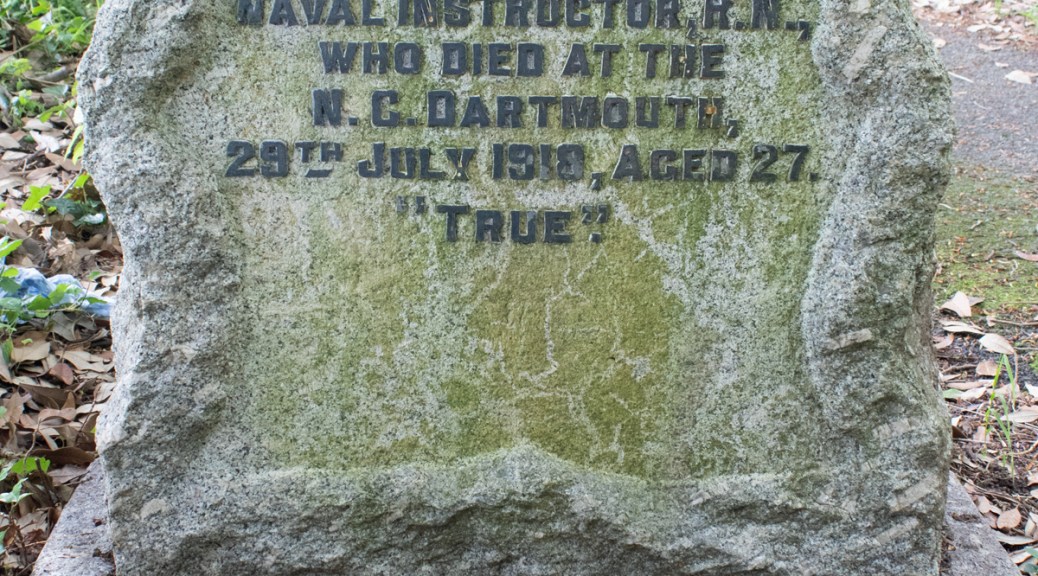
Naval Instructor George Carter

Naval Instructor George Carter

George Leslie Lewis Carter was born at the start of 1891 in New Cross, Kent. The oldest of three children, his parents were laundry managers William and Isabel Carter.

The Carters’ work seemed to take them across South London and the 1891 census found them living in Hammersmith. George’s two siblings had been born by this point, one in Gravesend, Kent, the other in Richmond, Surrey.

By 1911, William and Isabel had moved the family to Kingston-upon-Thames, Surrey. That year’s census recorded them as living at 142 London Road, which was noted as being a 12-roomed property. The couple were managing a laundry – possibly living in at the laundry itself. George was recorded as being a university student, while his younger brother Lionel was at school. The family also had a housekeeper, Frances Stoke, living with them.

When George finished his studies, he found employment as an Assistant Paymaster with the Royal Naval Reserve. On 15th February 1916, he married Ada Ritchie. She was a merchant’s daughter from Long Ditton, Surrey, and the couple exchanged vows in her local parish church.

At this point, George’s trail goes cold. He became attached to the Royal Naval College in Dartmouth, Devon – also known as HMS Pomone – and took on the role of Naval Instructor. It is unclear what type of instructing he was doing, but it seems likely to have been connected with the administration or financial part of the Royal Navy.

The funeral of Naval Instructor George Leslie Lewis Carter, Royal Naval College, Dartmouth, who died on Monday from pneumonia following an attack of influenza, took place on Wednesday morning…

The mourners were Mrs Carter (widow), Mrs Carter, Surbiton (mother), Mr Carter (brother), and Mr Jamieson Ritchie, London (brother-in-law)…

[Dartmouth & South Hams Chronicle: Friday 2nd August 1918]

Naval Instructor Carter was 27 years of age when he died on 29th July 1918. The newspaper article’s distinction between Ada and Isabel would suggest that Ada may have been living in Dartmouth at the time as well.

George Leslie Lewis Carter was laid to rest in the graveyard of St Clement’s Church in Dartmouth, Devon.


Trimmer Cook Douglas Ferguson

Trimmer Cook Douglas Ferguson

At Dartmouth on Saturday, Mr AM Dawson held an inquest on Douglass [sic] Davidson Mitchell Ferguson, cook, aged 30, of a Government trawler, whose body was recovered from the boat float the previous afternoon.

TG Elliott, of the Britannia Inn, said deceased had one drop of whiskey at his house on Thursday.

W Bursey, seaman, said he saw deceased at the King’s Arms Hotel, the same evening. He was very quiet and chatted with others.

Frank Lavers, coal lumper, said he thought he saw Ferguson at 9.50 on his way to the Embankment. Deceased asked the time and spoke quite rationally.

After evidence as to the recovery of the body, and Dr GM Soper’s evidence that the death was due to drowning, an open verdict was returned.

Lieut. PN Taylor [Royal Naval Reserve], commander of the vessel to which deceased had belonged, said Dartmouth was the most dangerous place for the embarkation at night that he had visited, owing to the restricted lighting. He thought rails should eb placed not only around the Boat Float, but along the whole of the Embankment.

Members of the jury agreed that lights in the vicinity of the Boat Float were inadequate, and the jury added a rider to their verdict urging the authorities to provide adequate lighting as advised by the Town Council, for the benefit of persons embarking in the vicinity of the Boat Float, and with a view to preventing further tragedies.

[Western Times: Tuesday 29th February 1916]

Douglas Davidson Ferguson was born in Stirling, Scotland, on 28th August 1896. One of four children, his parents were Andrew and Mary Ferguson. There is little information available about his early life, unfortunately, but it is clear that he enlisted in the Royal Naval Reserve on the 6th September 1915.

Assigned the role of Trimmer Cook, Douglas’s records show that he was 5ft 3ins (1.6m) tall, with brown eyes and a pale complexion. He was also noted as having a tattoo of a dancing girl on his left arm.

Douglas was initially assigned to the cruiser HMS Pactolus, and travelled from Scotland to Devon, where the Royal Naval Dockyard in Devonport would become his base. He remained stationed there for the next few months, working on ships’ galleys as they patrolled out the Channel coastline. It was during one of these voyages that he fell into the River Dart and drowned.

It would seem that Douglas Davidson Ferguson’s family were unable to cover the cost of taking his body back to Scotland for burial. Instead, he was laid to rest in the graveyard of Dartmouth’s St Clement’s Church.


Stoker 1st Class Joseph Hawke

Stoker 1st Class Joseph Hawke

Joseph Hawke was born in Paignton, Devon, on 8th January 1887. Details of his early life are lost to time, although the 1891 census suggests that he was one of five children to Maria Hawke, who had been widowed by that point. The family had taken rooms at 104 Pembroke Street in Devonport.

When he finished his schooling, Joseph initially found work as a packer. However, possibly driven by his proximity to the Devon dockyards, he soon stepped up to take a job in the Royal Navy. Joining the training cruiser HMS Northampton, he was given the rank of Boy 2nd Class, as he was under the age to enlist.

Over the next few years, Joseph proved his mettle. In May 1904 he was promoted to Boy 1st Class and, when he came of age on 8th January 1895, he was formally inducted into the Royal Navy, taking the rank of Ordinary Seaman. His service papers show that he was 5ft 3ins (1.6m) tall, with fair hair, hazel eyes and a fresh complexion. It was also noted that he a mole on his right shoulder and abdomen, a scar on his chin, and tattoo marks on the back of his left hand and on his right forearm.

Ordinary Seaman Hawke would serve on three ships in total. On 26th February 1906 he became a Stoker 2nd Class, a role change that might be seen as a semotion, although his records suggest he was of very good character. By November 1906 Joseph had become Stoker 1st Class, but within twelve months, he gave up his life at see, buying himself out of the Royal Navy.

This change of heart may have been driven by love as, on Christmas Day 1908, he married Ellen Saunders, in Tower Hamlets, London. Their wedding certificate gives Joseph’s father’s name as cabinet maker George Hawke, but doesn’t suggest that he is deceased.

The document also gives Joseph’s job as a stoker, later confirmation suggesting that he was employed by the electrical works in Paignton, Devon. Joseph and Ellen would go on to have five children – Marie, Joseph, Albert, Harry and Ellen – between 1909 and 1917.

When war broke out, Joseph was called upon to play his part once more and, as part of the Royal Naval Reserve, he was assigned to HMS Gibraltar in November 1914. Over the next four years, he would serve as a Stoker 1st Class on four more ships, each time returning to HMS Vivid, the Royal Naval Dockyard in Devonport, in between voyages.

By the spring of 1918, Joseph’s health was struggling. He was medically dismissed from active service on 22nd May, and returned home to Paignton. His condition was to worsen, however, and on 17th October 1918 he passed away froma combination of dysentery and influenza. He was 31 year of age.

Joseph Hawke was laid to rest in Paignton’s sweeping cemetery, not far from his family home in Laura Terrace.