Tag Archives: Royal Navy

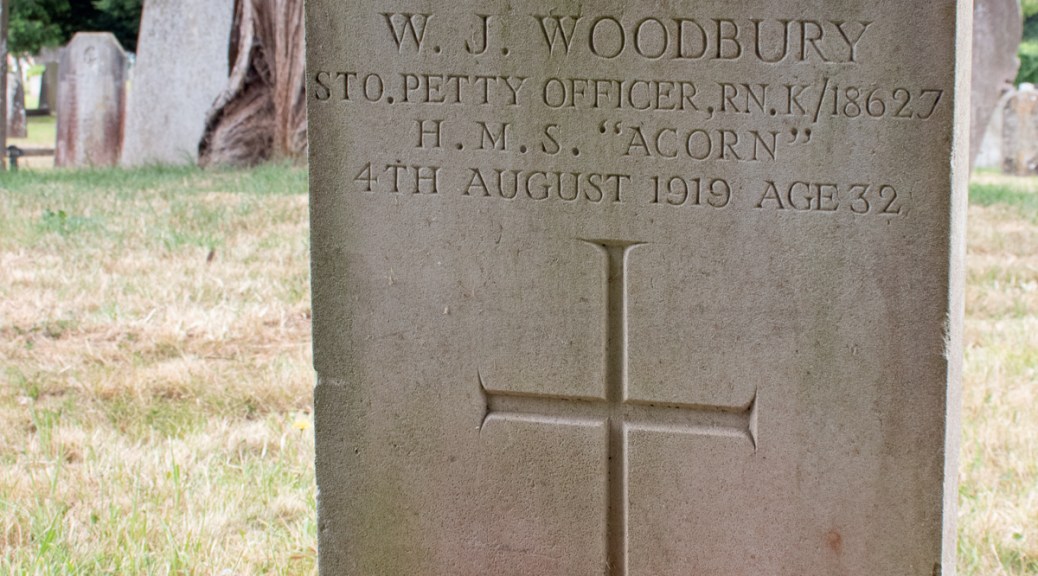
Stoker Petty Officer Wilson Woodbury

Stoker Petty Officer Wilson Woodbury

Wilson John Woodbury was born on 8th December 1888, and was the third of seven children to Daniel and Elizabeth Woodbury. Daniel was a chair maker from Wellington, Somerset, and this is where the family – including six boys and one girl – were raised.

By the time of the 1901 census, Daniel had had a change of career – he was now working as an oil presser. His and Elizabeth’s oldest three boys, Wilson included, had also found work, and were employed as wool spinners.

Elizabeth passed away in 1906, when Wilson was just seventeen years old. This may have pushed him to bigger and better things, and a career. On 13th August 1908, at the age of 19, he enlisted in the Royal Navy as a Stoker 2nd Class. His service record shows that he was 5ft 7.5ins (1.71m) tall, had light brown hair, blue eyes and a fresh complexion. It also noted that he had a tattoo of a cross on his right forearm.

Stoker Woodbury was initially trained at HMS Vivid – the naval dockyard at Devonport. On 9th February 1909, however, he was given his first posting, on board HMS Defence. He spent two years on board the armoured cruiser, and, gained a promotion to Stoker 1st Class.

During the remainder of his initial service, Wilson served on two further ships – HMS Sentinel and HMS Bellona – returning to Devonport between each posting. When he completed his five-year contract, Wilson voluntarily signed up for a further seven years with the Royal Navy.

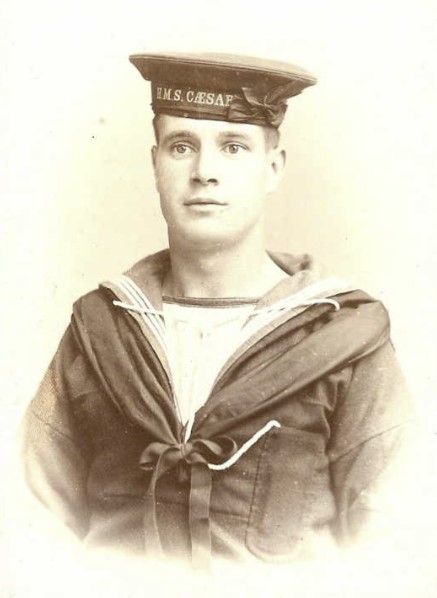
As war came to Europe, Stoker Woodbury was given a number of assignments, on the battleships HMS Caesar and Lord Nelson, the cruisers HMS Blake and Apollo, and the depot ship HMS Blenheim. Further promotions followed – Leading Stoker in 1915 and Stoker Petty Officer two years later.

Wilson’s oldest brother, James, was serving in the Labour Corps during the conflict. Based in Northern France, he was assigned to the 720th Company, although further details are unclear. He almost survived the war unscathed, but contracted an illness of some description and died on 3rd November 1918, aged 34 years old. He was laid to rest in the Terlincthun British Cemetery in Wimille, France.

Stoker Petty Officer Woodbury returned home on leave in July 1919. The plan was to meet up with his fiancée who lived in Rockwell Green, near Wellington, but he instead turned up unexpectedly at his brother Fred’s home instead. Wilson said he had returned to Somerset because his girlfriend had broken off the engagement the previous week: the couple had been due to marry when he next came home on leave.

Fred told Wilson that she was not worth it, and they had gone drinking with a friend. Fred later said that on his previous leaves his brother had taken to drinking more than was good for him, but on that evening – Saturday 2nd August 1919 – he did not get drunk.

The following Monday, Stoker Petty Office Woodbury had taken himself down to the railway at Wellington, and been hit by a train. The action was deliberate, as, about his person were three letters. The first was to Daniel.

To My Dear Father,

Sorry to cause you any inconvenience or trouble, and please don’t worry about me, as I’m not fit to worry about. I have had this in mind for about a week. I can’t sleep and can’t eat, as I am broken-hearted, but not insane. This is through love. Now I must exit myself, and I am in great pain. Written at 4:15pm Sunday afternoon…

This is all I have to say in this world. Hoping you and my dear sister will soon forget their broken-hearted

Wilson John Woodbury.

Wilson’s second letter was to his only sister, Ivy. This included details of a parcel left on board his ship, in which was the ring he had given to his fiancée, which he asked that Ivy wear as a memory of him.

Knowing the implications of what he was doing, the third letter was addressed to the jury of the inquest.

My leave expires at 1pm, and my life expires just before by my own hand. I wait to get the chance to put a stop to my life. This would not have happened to bring disgrace on my relations. I am quite sane. Written at 2pm.

On the afternoon of Monday 4th August 1919, Wilson made his way to the Woodford crossing, a short distance from Wellington Railway Station.

…he waited by the side of the line at the crossing for a train, and as the Northern express approached he laid down with his head on the metals, being practically decapitated.

Taunton Courier and Western Advertiser: Wednesday 13th August 1919

The fiancée in question did attend Wilson’s inquest, although the Coroner did not think it was necessary to call her. The newspaper report referred to her, but not by name. She will remain a mystery.

Despite the evidence of his own hand, the inquest found that Stoker Petty Officer Woodbury had committed suicide while temporarily insane. He was just 30 years of age.

Wilson John Woodbury was laid to rest in the cemetery of his home town, Wellington.


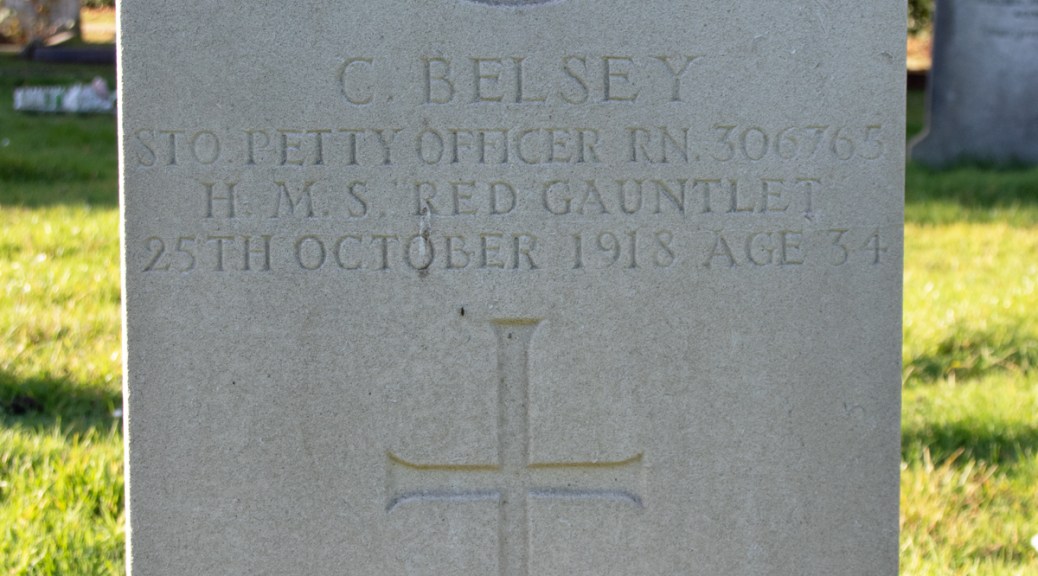
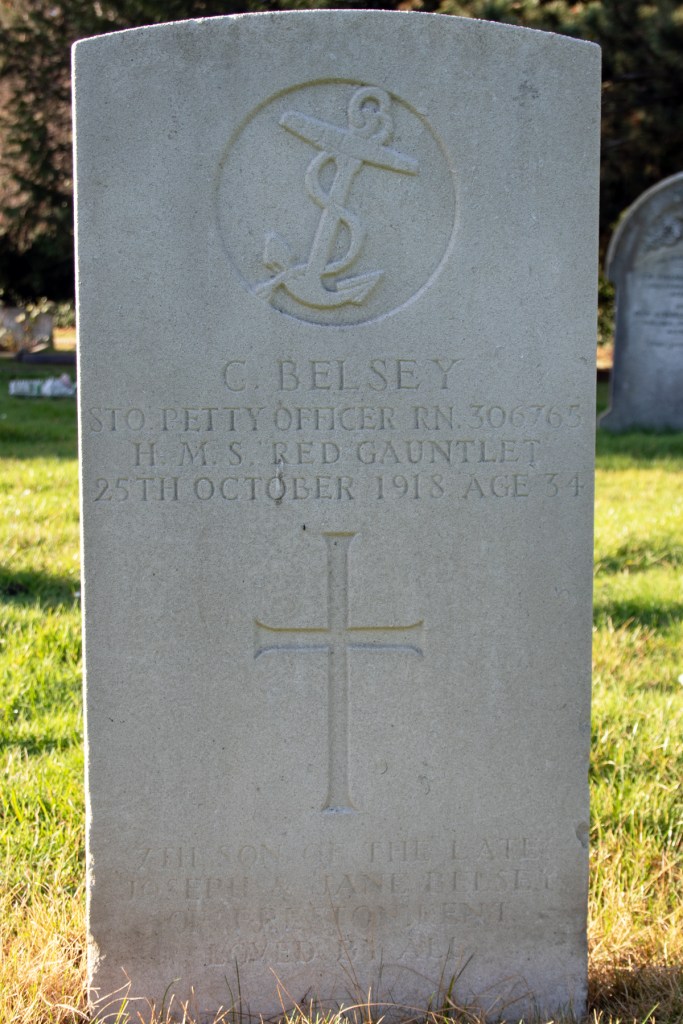
Stoker Petty Officer Christian Belsey

Stoker Petty Officer Christian Belsey

Christian Belsey was born on 12th February 1884 in the village of Preston, Kent. He was one of fourteen children to Joseph and Jane Belsey. Joseph was a farm labourer, and Christian followed suit on leaving school.

He wanted bigger and better things, however, and after his older brother Charles had sought out a life in the Royal Navy, he followed suit. Christian enlisted on 28th June 1904; his service records show that he was 6ft (1.83m) tall, had brown hair, brown eyes and a fresh complexion.

Stoker 2nd Class Belsey was based out of HMS Pembroke, the Royal aval Dockyard in Chatham, Kent, and this is where he returned to in between voyages. His first posting was on board the destroyer HMS Acheron, on board which he spent six months.

Over the twelve years of his initial service he was assigned to six different ships, rising through the ranks to Stoker 1st Class (in 1906), Leading Stoker (1911) and Stoker Petty Officer (1912).

When war broke out in August 1914, Christian was back in Chatham; he was soon assigned to HMS Laertes, a destroyer based out of Harwich, which patrolled the North Sea. She was involved in the attempt to head off the German attack on Yarmouth and Lowestoft in April 1916, during which, two of Christian’s colleagues, Stoker Ernest Clarke and Stoker Petty Officer Stephen Pritchard, were awarded the Distinguished Service Medal for their bravery under fire.

After three years on board Laertes, Christian was transferred to HMS Redgauntlet. He served on board for eighteen months until, in October 1918, he fell ill.

Admitted to a hospital in Samford, near Ipswich, Suffolk, Stoker Petty Officer Belsey was suffering from pneumonia. Sadly, the lung condition was to get the better of him, and he passed away on 25th October 1918, at the age of 34 years old,

Christian Belsey was brought back to Kent for burial. He was laid to rest in Faversham Borough Cemetery.


Stoker 1st Class John Coxhedge

Stoker 1st Class John Coxhedge

John Coxhedge was born on 28th October 1889 in Faversham, Kent. It seems that he and his siblings were brought up by an aunt and uncle, Mr and Mrs John Hodge, although why this was the case is lost to time. John attended Davington School, to the north of the town, and, for four years, was a chorister at his local church.

When a youth, [John] went to America and worked in some steel works, but after a year or so he returned home, and for a while prior to joining the Navy he was working at the Cotton Powder Works.

Faversham News: Saturday 27th April 1918

John married a woman called Louisa, and they went on to have five children. He enlisted in the Royal Navy as a Stoker 2nd Class on 21st August 1916. His service records show that he was 5ft 6ins (1.68m) tall, had fair hair, hazel eyes and a fresh complexion.

After his initial training at HMS Pembroke, the Royal Naval Dockyard in Chatham, Kent, Stoker Coxhedge was assigned to the boom defence vessel HMS Wallington. He served on board for nine months, gaining a promotion to Stoker 1st Class, before returning to HMS Pembroke.

While back in Chatham, in the summer of 1917, he would have been involved in the German Air Raid on the Dockyard. Unlike dozens of his colleagues, however, he seems to have escaped unscathed.

On 3rd October 1917, Stoker Coxhedge was given another assignment, this time at HMS Attentive, the Dover Patrol. In April 1918, the patrol was involved in some raids on Ostend and Zeebrugge. The local newspaper again picked up John’s story:

No operation in the present war, distinguished though it has been all along by the indomitable heroism of the sons of Britain, has so thrilled the Empire as that of last week – an exploit, which, as has been remarked, recalls some of the undying deeds of the days of Drake and Nelson.

Stoker Coxhedge… was one of the crew of a vessel detailed for covering duty. This vessel got on a sandbank and could not get off, and so in the brilliant light of star shells, which made the night as bright as day, it became a target for the enemy’s guns and a heavy fire was concentrated upon it. It was during this fire that Stoker Coxhedge was badly wounded. Later he, with others of the ship’s complement, was transferred to another vessel, and his death took place in hospital ashore.

Faversham News: Saturday 4th May 1918

John Coxhedge had died of his injuries on 23rd April 1918. He was 28 years of age. He was laid to rest in Faversham Borough Cemetery, not far from where his widow and family lived.


Stoker 1st Class William Banfield

Stoker 1st Class William Banfield

William Banfield was born on 7th November 1890, in Henfield, near Horsham, West Sussex. He was the second youngest of seven children to George and Ellen Benfield. George was a carpenter, and this was a trade his two sons – William and his older brother, George – were initially both to follow as well.

William had a longing for the sea, however, and, on 11th June 1909, he enlisted in the Royal Navy as a Stoker 2nd Class. His service records show that he was 5ft 7.5ins (1.71m) tall, had brown hair, blue eyes and a fair complexion.

Stoker Banfield was based out of HMS Victory, the Royal Naval Dockyard in Portsmouth, Hampshire, but, over the eventual decade of his service, he spent no more than seven months ashore. Instead, he served on a total of nine ships. This included the battleship HMS Exmouth where, during the eighteen months he spent on board, he was promoted to Stoker 1st Class, and also spent 14 days in the brig, for reasons undisclosed.

On 27th September 1915, William was assigned to HMS Princess Royal. He served aboard for nearly three and a half years, patrolling the North Sea, coming under fire during the Battle of Jutland, and providing support during the Second Battle of Heligoland Bight.

Towards the end of January, Stoker 1st Class Benfield fell ill, and was admitted to the Edinburgh City Hospital. Suffering from encephalitis, sadly the condition proved too much for his system to bear and he passed away at the hospital on 31st January 1919. He was 28 years of age.

William Banfield was brought back to Sussex for burial. He was laid to rest in the cemetery of his home town, Henfield.


William’s older brother, George, was also to fall victim to the First World War. He had enlisted in the Royal Navy three years before his younger sibling, and also served as a Stoker 2nd Class (subsequently being promoted to Stoker 1st Class in 1907).

George was also based out of HMS Victory, and, in April 1911, was stood down to the Royal Naval Reserve, having completed an initial five years’ service.

When war broke out, George was called back into service, and was assigned to HMS Good Hope, travelling from English shores to Nova Scotia, before heading to South America and into the Pacific.

Caught up in the Battle of Coronel on 1st November 1914, the Good Hope was sunk by the German cruiser SMS Scharnhost. All souls on board – all 926 of them – were lost; this included Stoker 1st Class George Banfield. He was only 27 years of age.


Ordinary Seaman William Nolan

Ordinary Seaman William Nolan

William John Nolan was born in County Kildare, Ireland, on the 8th October 1892, one of ten children to agricultural labourer Thomas Nolan and his wife, Anna.

There is little documentation connected to his early life, but when he left school, William found work as a porter, and is was this that he was doing up until war broke out in 1914.

William was conscripted on 1st March 1915, joining the Royal Navy as an Ordinary Seaman. His service records show that he stood 5ft 5.5ins (1.66m) tall, had brown hair, brown eyes and a fresh complexion. He was also noted as having tattoos on his forearms, and a scar on his right one.

Ordinary Seaman Nolan was sent to HMS Pembroke, the Naval Dockyard in Chatham, Kent, for training. Within a month, he was given his first posting, on board the armoured cruiser HMS Lancaster. He spent fifteen weeks aboard and, over the next two years, he served on four more ships, returning to his base in Chatham after each voyage.

William came back to HMS Pembroke in July 1917: the base was particularly busy and cramped that summer, so much so that additional temporary accommodation was set up in the barracks’ Drill Hall. This is where Ordinary Seaman Nolan was billeted.

On the night of the 3rd September 1917, Chatham was bombarded by a German air raid, and the Drill Hall received a direct hit. Tragically, Ordinary Seamen Nolan was amongst those killed. He was just 24 years old.

William John Nolan’s body was laid to rest in the Woodlands Cemetery in Gillingham, alongside the other victims of the Chatham Air Raid.


Stoker 1st Class Michael Brown

Stoker 1st Class Michael Brown

Michael Brown was born on 25th October 1891 in Kirkdale, Lancashire, one of four children to James and Julia Brown. James was a sailor who died when Michael was just a boy. While Julia tried to make ends meet by taking in washing, it must have worried her when her son then fell into a sea-going life when he left school.

Michael enlisted in the Royal Navy on 19th February 1910, by which time he was already a seaman in the merchant fleet. His service records show that he was 5ft 4.5ins (1.64m) tall, had bark brown hair, brown eyes and a dark complexion. He also had a number of tattoos on his forearms, including a shamrock and a cross.

Recruited as a Stoker 2nd Class, Michael served on a number of vessels in the lead up to the outbreak of war, including the scout ship HMS Patrol, which served from Harwich Harbour, Essex. It was here that he gained promotion to Stoker 1st Class in February 1911.

When not at sea, Stoker Brown was based at HMS Pembroke, the Royal Naval Dockyard in Chatham, Kent. When war broke out in 1914, however, he was in the middle of a three-year stint on board HMS St George, a cruiser that went on to guard the Humber Estuary on the east coast of Yorkshire and Lincolnshire.

By the spring of 1916, he was back in Chatham and from this point on, remained firmly on dry land, with assignments in Kent and at HMS Victory, the Royal Naval Dockyard in Portsmouth, Hampshire. By the summer of 1917, though, Stoker Brown returned to HMS Pembroke once again.

The naval base was particularly busy and cramped at that point in the war, and temporary overflow accommodation was set up in the barracks’ Drill Hall. This is where Michael came to be billeted.

On the night of the 3rd September, the German Air Force conducted the first night time raid on England. Chatham came in the firing line, and the Drill Hall received a direct hit. Stoker 1st Class Brown was among those to be killed. He was just 24 years of age.

Michael Brown was laid to rest in the Woodlands Cemetery in nearby Gillingham, along with the other victims of the Chatham Air Raid.


Stoker 1st Class Edmund Walsh

Stoker 1st Class Edmund Walsh

Edmund Walsh was born on 11th September 1884 and was one of eleven children – eleven sons – to James and Christiana Walsh. James was a builder and plasterer from Chelsea, London, while his wife was from nearby Marylebone. The family lived in Treverton Street, North Kensington: by the time of the 1911 census, James and Christina were living in two rooms with seven of their children – the oldest of whom were in their twenties.

Edmund, however, had moved on. The same census found him living in two rooms in Rackham Street, not far from his parents. He was sharing the house with his wife, Lilian Walsh, who he had married five years before, and his brother-in-law, Thomas Culverhouse. All three were bringing in some money – Edmund and his brother-in-law were working as labourers, while Lilian was employed as a shirt machinist.

War was coming to Europe and, in March 1915, Edmund was called upon to play his part. He enlisted in the Royal Navy as a Stoker 2nd Class, and was sent to HMS Pembroke, the Royal Naval Dockyard in Chatham, Kent, for training. Edmund’s service records show that he was 5ft 6ins (1.68m) tall, had auburn hair, grey eyes, a fair complexion and a scar on his left eyebrow.

Stoker Walsh’s first posting was on board the gunboat HMS Halcyon. He served there until 5th September 1915, when he was recorded as “run”. Edmund was caught (or handed himself in, it is unclear) on 13th October, and was sentenced to three months’ detention back at HMS Pembroke.

On his release in January 1916, Stoker Walsh returned to duties at the dockyard, before being given a second posting on board the cruiser HMS Bonaventure. He spent just over a year on board, gaining a promotion to Stoker 1st Class in the process. At the end of his time on board, however, Edmund was again sentenced to detention for being absent from duty. The Bonaventure had returned to HMS Pembroke by this point, and this is where he served 28 days in the cells.

Stoker 1st Class Walsh was released back to duties on 17th June 1917, and remained at HMS Pembroke. The Dockyard was a busy and cramped place that particular summer, and he was billeted to temporary accommodation set up in Chatham Drill Hall.

On the night of 3rd September, the town came under attack from a German air raid, and the Drill Hall received a direct hit. Stoker Walsh was among those to be killed that night. He was a week short of his 32nd birthday.

Edmund Walsh was laid to rest in the Woodlands Cemetery in Gillingham, Kent, alongside the other victims of the Chatham Air Raid.


Stoker 1st Class Edmund Walsh
(from ancestry.co.uk)

Stoker 1st Class Sidney Seymour

Stoker 1st Class Sidney Seymour

Sidney Seymour was born on 5th April 1895 in Islington, London, the son of Elizabeth Seymour. Sadly, as his was a common name in the area, there is little concrete information about his early life, and is it not until his military service that anything specific can be confirmed.

Sidney was working as a clockmaker when he signed up. He enlisted on 29th April 1913, joining the Royal Navy as a Stoker 2nd Class on a twelve year contract.

Sidney was initially sent to HMS Pembroke, the Royal Naval Dockyard in Chatham, Kent. He trained for nine months at the dockyard, before being given his first posting on board the battleship HMS Dominion. Stoker Seymour spent more than three years on board: during this time he was promoted to Stoker 1st Class, but also spent two weeks in the cells for an unrecorded reason.

In July 1917 Sidney returned to HMS Pembroke; that summer was a busy time for the base, and Stoker 1st Class Seymour found himself billeted in overflow accommodation set up in the barracks’ Drill Hall.

On the night of 3rd September, Chatham came under attack from a German air raid, and the Drill Hall received a direct hit. Stoker Seymour was injured, and died of his injuries in hospital the following day. He was 22 years of age.

Sidney Seymour was laid to rest in the Woodlands Cemetery in Gillingham, Kent, alongside the other victims of the Chatham Air Raid.


Able Seaman Ernest Cornock

Able Seaman Ernest Cornock

Ernest Charles Cornock was born on 16th June 1896, in the Gloucestershire town of Wotton-under-Edge. His parents were carter Charles Cornock and his wife, Millicent, both born and bred in the town, and he was one of eight children.

When he left school, Ernest found work as a rubber winder in the local mill. However, he wanted bigger and better things and so, on 8th April 1913, he enlisted in the Royal Navy. His service records show that he stood just 5ft 3ins (1.60m) tall, had brown hair grey eyes and a fresh complexion. He was also noted as having a scar on his right cheek.

As Ernest was under age when he joined up, he was initially given the rank of Boy 2nd Class. He was sent to HMS Vivid, the Naval Dockyard in Devonport and, after four months’ training, during which he was promoted to Boy 1st Class, he was given his first posting on board the battleship HMS Queen.

After five months on board, Boy Cornock was given another assignment, and was transferred to HMS Lion. While on board, a number of things happened: the First World War broke out, and the battle cruiser fought at Heligoland Bight and Dogger Bank; Ernest came of age, and was given the rank of Ordinary Seaman on his 18th birthday; with ongoing good conduct, in September 1915, he was then given a promotion to Able Seaman.

After a short spell back in Devonport, Ernest served on a further five ships, taking him through to the end of the war. By the start of 1919, however, Able Seaman Cornock’s health was beginning to suffer. Having contracted tuberculosis, he was medically discharged from service on 19th February, and was admitted to a sanatorium back in Gloucestershire. Sadly the condition was to get the better of him, and he passed away on 14th April 1919, at the age of just 22 years old.

Ernest Charles Cornock was brought back to Wotton-under-Edge for burial. He was laid to rest in the graveyard of St Mary the Virgin Church in the town, not far from his second cousin, Albert Cornock, who had been buried just the week before.


As an aside to Ernest’s tale, the newspaper that reported on his funeral also noted that his grandmother, Ruth Cornock, had not long received a message from the King, congratulating her on the fact that nine of her sons had served in the conflict


Leading Telegraphist Ernest Webber

Leading Telegraphist Ernest Webber

Ernest Webber was born on 19th April 1897 in Newton Abbot, Devon, although there is little further documented about his early life

The 1911 census records Ernest as being at the Scattered Home in Newton Abbot. This was, in fact, the Greenaway Home for Boys, part of the town’s Union Workhouse. It was run by a Mrs Louise Foote, had 22 ‘inmates’ and was located on the Highweek Road.

The following year, however, Ernest found a way to better himself, enlisting in the Royal Navy. His service records confirm that he joined up on 9th October 1912 and gave a physical description of him: he was 5ft 5ins (1.65m) tall, had fair hair, blue eyes and a fresh complexion. He was also noted as having a scar on his left index finger.

As he was below the age for full service, he was given the rank of Boy, and was sent to HMS Ganges, the naval base in Ipswich, Suffolk, and HMS Impregnable, a training ship, for his initial instruction. Some talent seems to have been unearthed as he was soon promoted to Boy Telegraphist.

In August 1913, Ernest was assigned to the battleship HMS Conqueror. He spent nearly two years on board and, during that time, came of age. Now formally inducted into the service, he was given the rank of Ordinary Telegraphist, before being promoted again – to the full role of Telegraphist – in April 1915.

Two months later Telegraphist Webber was transferred to HMS Phaeton; over the next year, he spent time on two further vessels, before being assigned to HMS Victorious in April 1916. With this assignment came a further promotion: Ernest was now a Leading Telegraphist.

In the summer of 1917, Ernest moved again, this time to HMS Vivid, the Royal Naval Dockyard in Devonport. At this point, however, he had fallen ill, and was medically discharged from duty on 5th September 1917, having contracted tuberculosis.

At this point, Ernest’s trail goes cold. He returned to Newton Abbot, but the events of the next year are lost to time. All that can be confirmed is that he passed away, presumably of his lung condition, on 11th December 1918. He was just 21 years of age.

Ernest Webber was laid to rest in the graveyard of All Saints Church in Highweek, near Newton Abbot.