Tag Archives: son

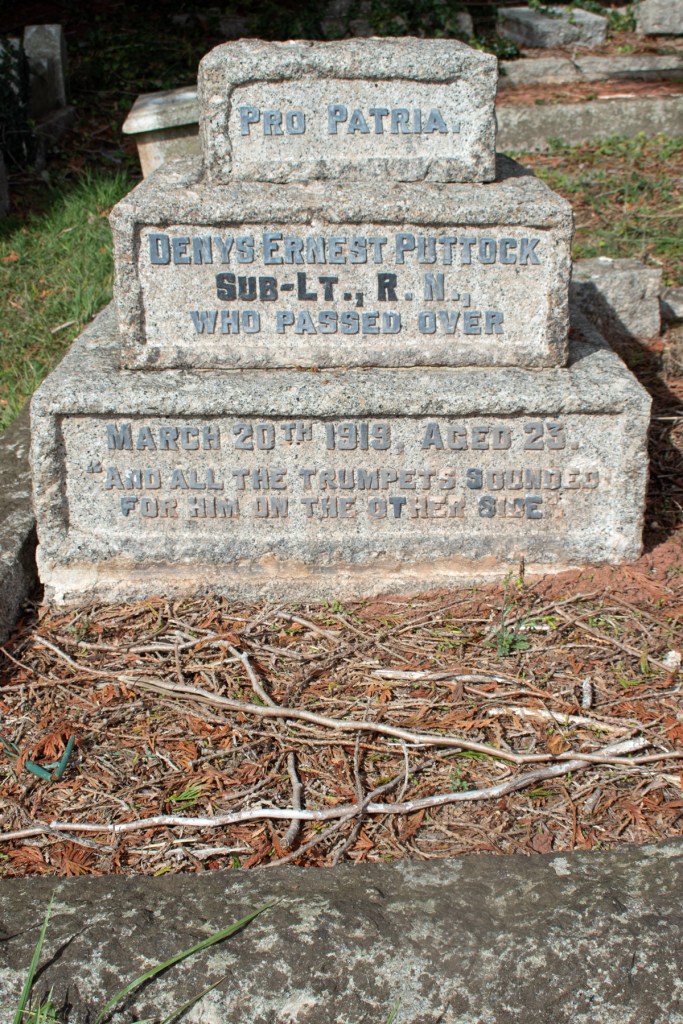
Sub-Lieutenant Denys Puttock

Sub-Lieutenant Denys Puttock

Denys Ernest Puttock was born on 14th September 1895 in the Devon village of Halwill. The middle of three children, his parents were Edward and Alice Puttock. Edward was a vicar of the village’s St Peter & St James’ Church, but died tragically early:

The Red. E Puttock, Rector of Hallwill died on Wednesday, after a brief illness… Mr Puttock had been in charge… for six and a half years. He was much beloved by those among whom he labourer and universally respected. His devotion to the due performance of all his sacred duties was unceasing and his visitations among the poor and afflicted were much appreciated by the whole parish. He was fond of all manly sports, and under his captaincy the Cricket Club at Halwill attained considerable success. Up to the day of his death he could hardly believe that he was ill, and up to the last it was hoped that his wonderful constitution might have carried him through the illness. About a fortnight since he contracted a chill. He would not be deterred from carrying out his duties, and against the advice of his friends, he persisted in taking every service at the church long after he was fit for it. On Sunday, the 24th January, although then in a high fever, he took both the morning and evening services at Halwill Church unassisted, and also the Sunday School in the afternoon. Pneumonia set in at the end of last week, and on Tuesday evening, the 2nd February, the action of the heart failed. He leaves a widow and three young children to mourn their loss.

[Exeter and Plymouth Gazette: Friday 5th February 1897]

After Edward’s death, Alice moved the children to Okehampton. The 1901 census found the family living at 4 Brondage Park, Alice by this time living off her own means. She felt that learning was important, and Denys was sent to Twyford School and St Edmund’s School in Canterbury, Kent. From here he took up a career in the Royal Navy, enlisting in September 1913.

He served in the Highflyer as a Cadet, and was Midshipman in HMS Conqueror, and later Sub-Lieutenant in the destroyers Patriot and Valorous. Long exposure to the rough weather in the North Sea during the winters of 1916 and 1917 brought on tuberculosis, which incapacitated him for further war service. He was invalided our of the Navy and spent many months in a Sanitorium.

[Exeter and Plymouth Gazette: Friday 4th April 1919]

Denys Ernest Puttock’s health was failing him, and he passed away on 20th March 1919, while still admitted. He was 23 years of age. The report of his funeral included comments from those who knew him:

His Headmaster writes: “He has not lived in vain, for he has exercised the power of unconscious influence on all those around him. He knew the secret of happiness – purity of soul and unselfishness of heart.” His Commanding Officer has written: “He was a zealous and capable young officer. Possessed of great charm of manner, he was popular with both officers and men.”

[Exeter and Plymouth Gazette: Friday 4th April 1919]

Alice, having moved to Paignton by this point, laid her son to rest in the town’s cemetery. When she passed away in 1932, she was buried alongside him.
Serjeant Fred Maynard

Serjeant Fred Maynard

Details of Fred Maynard’s early life are a challenge to piece together. His First World War service records give his age as 44 years old when he enlisted in September 1914, and confirm his place of birth as Melksham, Wiltshire.

A newspaper report of his funeral gives the name of three brothers – Charles, Frank and Arthur – while only one census return, from 1881, provides a potential match for the family. This suggests Fred’s parents were iron fitter Alfred Maynard and his wife, Deborah, and gives the family’s address as Waterworks Road in Trowbridge.

Fred joined the army in the autumn of 1888. Initially assigned to the Gloucestershire Regiment, he had transferred to the Wiltshire Regiment by the following spring. Private Maynard showed a commitment to duty: in December 1890 he was promoted to Lance Corporal, rising to Corporal in the summer of 1893.

Fred was stood down to reserve status after his seven years’ active duty, but was recalled to the army in December 1899, when war broke out in South Africa. Promoted to Serjeant, he was sent to fight in the Boer War, and was mentioned in dispatches on 2nd April 1901 for special and meritorious service in South Africa. He was stood back down to reserve status in October 1901.

On 21st November 1895, Fred had married Louisa Card. The couple set up home in Trowbridge, but soon moved to London. They went on to have six children: Ernest, Nora and Leslie, who were all born in the London; and Arthur, Martha and Stuart, who were born in Cardiff, the family having moved to Wales by 1910.

The army was not finished with Fred, however, and, within weeks of war breaking out in the summer of 1914, he was called back into service. Given the rank of Serjeant again, he was attached to the South Wales Borderers. Fred was 44 years of age by this point, his service records confirming that he stood 5ft 8ins (1.73m) tall, weighed 164lbs (74.4kg) and had brown hair and hazel eyes.

Attached to one of the regiment’s depots, it seems unlikely that Fred saw service overseas this time around. He was discharged from the army on 1st September 1916 and this seems to have been on medical grounds. Later documents suggest that Serjeant Maynard had been diagnosed with carcinoma of the pylorus, or stomach cancer.

Fred returned to Cardiff, but his time back home was to be short. He was admitted to the Lansdown Road Military Hospital, and passed away on 23rd November 1916. He was 46 years of age.

It seems that Fred’s brother’s had some sway in his funeral. Instead of being laid to rest in Cardiff, where Louisa and the children were living, he was, instead, buried in the Locksbrook Cemetery, Bath, Somerset. His sibling Charles, who was a sergeant in Bath City Police, lived in the city, as did another brother, Frank.


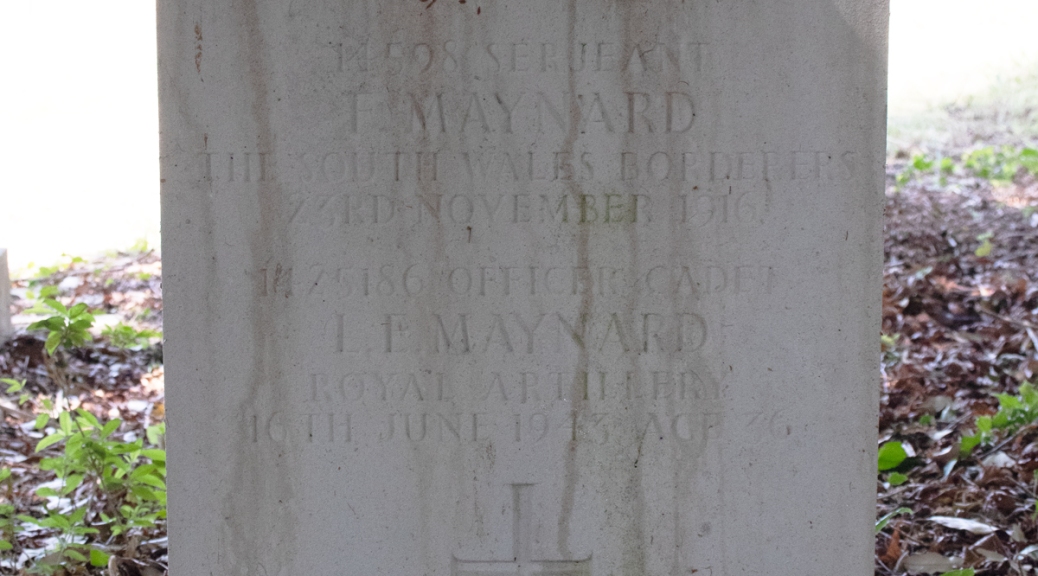
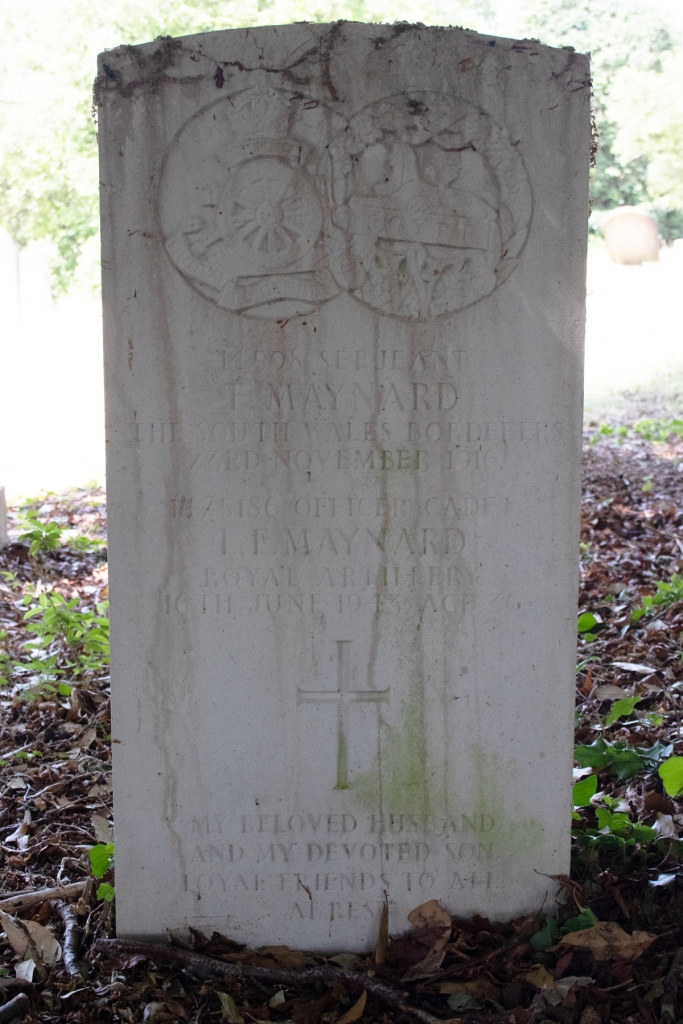
Fred’s headstone also commemorates his and Louisa’s son, Leslie. He had joined the army in the 1920s and, in the summer of 1943, was in Yorkshire, undergoing officer training.

The death of an officer cadet through the accidental discharge of a rifle whose bolt had jammed was described at an inquest…

Captain WH Price said he was in charge of an exercise on the moors which involved the used of small arms and the firing of live ammunition. A squad of cadets lay on the ground in front of a trench firing over a range. All finished firing except Cadet Frank Holroyd, who said his bolt had hammed while firing a second round. [Price] told him to release the bolt by knocking the cocking piece up and back.

This attempt failed, and he told Holroyd to get back into the trench, turn the rifle magazine upwards, place the butt on the side of the trench, and kick the bolt down with his foot. While Holroyd was doing this he noticed Maynard standing in the trench about 4ft away from Holroyd and on his right-hand side.

Captain Price said he saw the rifle was pointing down the range when Holroyd kicked the butt. The cartridge suddenly exploded and Maynard dropped into the trench, shot in the head, and was dead when they reached him.

[Bradford Observer: Saturday 19th June 1943]

Officer Cadet Leslie Maynard was 36 years of age when he was killed. His body was taken back to Somerset for burial: he was laid to rest in the same grave as Fred, father and son reunited after 27 years.


Louisa remained somewhat elusive as time wore on. Fred’s military records confirm that she had moved from Cardiff to the Isle of Wight by 1922. By the time of her son’s death, she was living in Sidcup, Kent.


Private William Biddlecombe

Private William Biddlecombe

William Charles Biddlecombe was born in the spring of 1896, and was the third of nine children to Robert and Eliza. Both of his parents came from Hampshire, but their older children – William included – were born and raised in Poole, Dorset. Robert was a police constable there, but moved to the village of Longburton, near Sherborne, in around 1910.

According to the 1911 census, William was two of the household of eight to be employed, having found work as a gardener when he finished his schooling. Storm clouds were brewing across Europe, however, and he would be called upon to play his part.

Full service details have been lost to time, but it is clear that William had joined the Dorset Yeomanry (Queen’s Own) by the summer of 1915. He was attached to the 3rd/1st Battalion. The unit was based on home soil and there is no evidence that Private Biddlecombe saw any action overseas.

At this point, William’s trail goes cold and, in fact, the next record for him is that of his passing: “The funeral took place on Wednesday amid every token of respect and esteem of Trooper W Biddlecombe, of B Squadron (3/1st Dorset QO Yeomanry, son of PC and Mrs Biddlecombe of Westhill Police-station.” [Western Gazette – Friday 18 February 1916]

William Charles Biddlecombe died on 15th February 1916: he was 20 years of age. He was laid to rest in the peaceful graveyard of St James the Great Church in Longburton, close to where his grieving family lived.


William’s was not the only passing that his grieving mother would have to attend to. On 18th December, Robert was on duty, which had taken him into Sherborne. He was suddenly taken ill, and rushed to the town’s Yeatman Hospital, but died the same day. He was laid to rest close to his son in Longburton.


William’s younger brother, Robert, also served during the First World War. As a Private, he was attached to the 8th Battalion of the Somerset Light Infantry, and spent time fighting in Northern France. He was caught up and was killed in the Second Battle of Cambrai. He died on 9th October 1918, and was laid to rest in Naves Communal Cemetery Extension.


Private William Higgins

Private William Higgins

William George Newton was born in Culmstock, Devon, early in 1889. His mother, Ada, was unmarried at the time, and there is no indication as to who his father was. The 1891 census found mother and son living with Ada’s parents, John and Hannah, in South Street, Wellington, Somerset.

In the summer of 1892, Ada married Frederick Higgins, a police constable from Baltonsborough. The couple set up home in the village of Mark, and went on to have ten children. It was at this point that William took on Frederick’s name, though whether that was because he was actually his birth father is unclear.

When he finished his schooling, William found labouring work. On 9th March 1910, he married Annie Achilles, a painter’s daughter from Glastonbury. The couple set up home in a small cottage in Bank Street, Highbridge, and went on to have three children.

The next year’s census recorded that William was employed as a stoker for Highbridge Bacon Co Ltd, a large factory to the south of the town. His and Annie’s oldest child, son William Jr, who was just two months old at this point, and William’s grandfather, the now widowed John, completed the household.

When war broke out, William stepped up to play his part. He enlisted on 28th October 1915, joining the 3rd Battalion of the Gloucestershire Regiment as a Private. His service records show that he was 26 years and 10 months old, and stood 5ft 2ins (1.57m) tall.

Private Higgins’ service documents confirm that he served for nine months before being medically discharged from the army. He had contracted haemoptysis and had an enlarged heart. His medical records confirmed that, at the time of his dismissal, he was totally incapacitated and unable to work.

William returned to Somerset, but is would seem that his health continued to dog him over the next couple of years. He passed away on 29th October 1918, at the age of 29 years of age.

William George Higgins was laid to rest in the cemetery of his adopted home town, Highbridge.


Annie was now a widow, with three young children to support. She married again in the spring of 1922, to bus conductor William Davey. Annie was to outlive not only her husband, but all three of her children.

William and Annie’s youngest, Cyril, passed away when he was just a couple of months old.

Albert, their middle son, “had been for a great while a cripple from trouble in his leg, but was able to get about on crutches.” [Central Somerset Gazette: Friday 22nd July 1932] He passed away on 16th July 1932, aged just 18 years old.

William Jr had tried out in the Royal Navy when he was sixteen years of age. Beginning with the rank of Boy 2nd Class, he was dismissed in March 1928, as he was deemed unsuitable for the rank of Boy 1st Class.

In the autumn of 1934, he married Nettie King, the daughter of a factory worker from Street, Somerset. The couple went on to have three children, although in an echo of his parents’ tragedy, their middle child, Phyllis, passed away when just eighteen months old.

When war came to Europe for a second time, William sought to serve his country for a second time. He enlisted in the Royal Air Force, and rose to the rank of Leading Aircraftman. On 18th June 1940, he was on board a Blenheim aircraft flying from the UK to Malta, when the plane came down in bad weather near Marseille. William and his two companions, Pilot Officer Johnston and Sergeant Micklethwaite were all killed.

Leading Aircraftman Higgins was laid to rest in the Mazargues War Cemetery near Marseille.


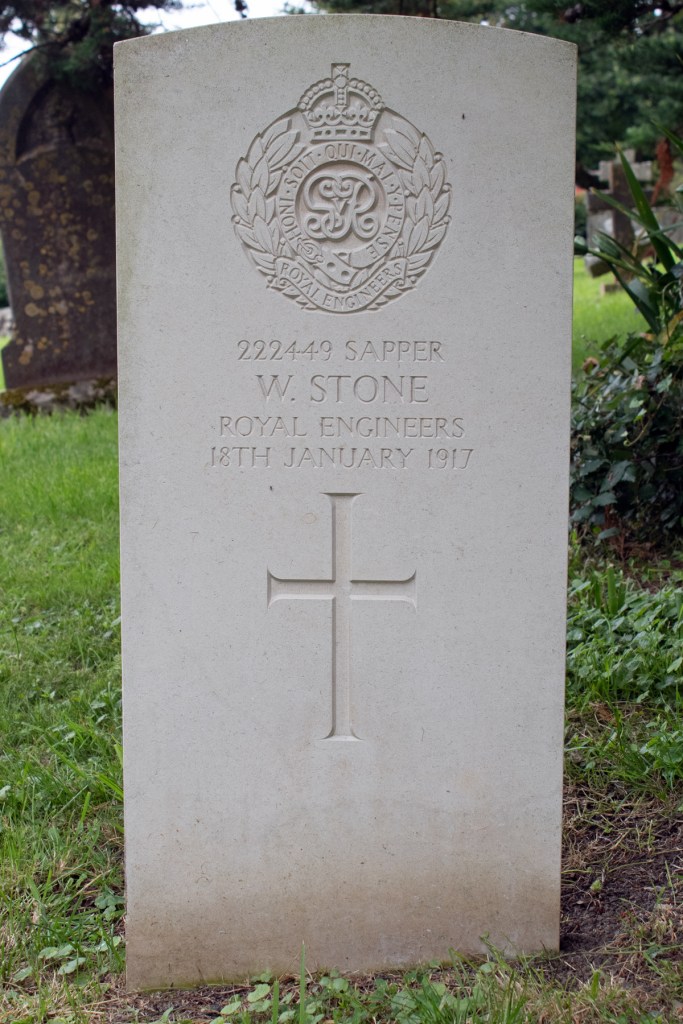
Sapper Walter Stone

Sapper Walter Stone

Walter Stone was born at the start of 1880 in Lympsham, Somerset. The middle of three children, his parents were coal merchant George Stone and his wife, Ellen.

When he finished his schooling, Walter found work as a painter and plumber. In January 1902 he married Alice Charman. Eighteen years older than Walter, she was the widow of a milkman from Bristol, and had raised her son, Edgar, since her husband had passed away a few months before. The couple settled in the village of Brent Knoll, and went on to have three children of their own: Albert, Florence and Alice.

When war came to Europe, Walter was called upon to play his part. He enlisted after June 1916, and joined the Royal Engineers as a Sapper. He was attached to the Inland Waterways and Docks division, but, as no documentation remains to confirm his service, it is not possible to confirm whether he saw any action overseas

Sapper Stone’s time in the army was not to be a long one. The next record for him is that of his admission to a military hospital in Herne Bay, Kent. He was suffering from pneumonia, and this would take his life on 18th January 1917. He was 36 years of age.

Walter Stone’s body was brought back to Somerset for burial. He was laid to rest in the tranquil graveyard of St Michael’s Church in Brent Knoll.


Further tragedy was to strike Walter’s widow, Alice. Edgar, her son from her first marriage, enlisted in the Somerset Light Infantry when war broke out. Attached to the 7th (Service) Battalion, he found himself on the Front Line by the end of July 1915.

Private Stone is reported to have been accidentally killed on 1st May 1917. No other detail is given, but he was just 24 years of age when he passed. He was buried at the Thiepval Memorial at the Somme.

Alice had lost her husband and her oldest child within a matter of months.


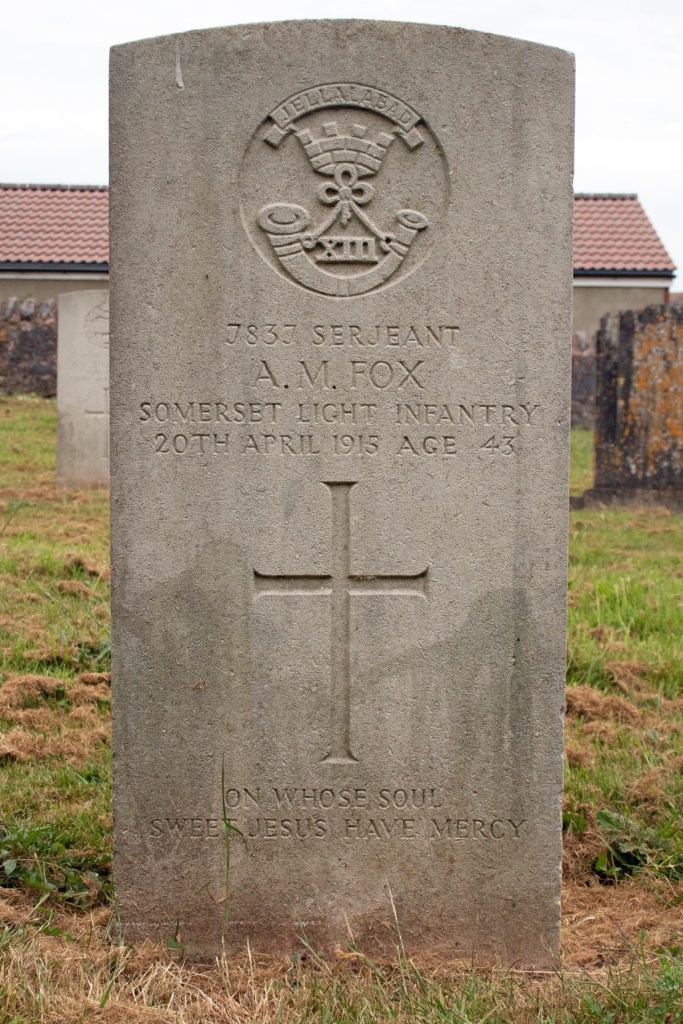
Serjeant Andrew Fox

Serjeant Andrew Fox

Andrew Michael Fox was born on 25th May 1871, the oldest of six children, to Michael and Eliza Fox. Michael was a Private in the 40th Regiment of Foot, and was based in Curragh Camp, Kildare, Ireland, when Andrew was born.

The family travelled where Michael’s work took him: Andrew’s oldest siblings were born in Uttar Pradesh, India, and the family were in England by the time of the 1881 census.

Given Michael’s military connections, it is no surprise that Andrew followed him into the army. He enlisted in August 1884, joining the South Lancashire Regiment. His service records give his age as 14 – he was, in fact, just 13 years old – and note his height as 4ft 9ins (1.44cm) and his weight as 73lbs (32.7kg). Andrew was recorded as having hazel eyes, brown hair and a fair complexion: his religion was also confirmed as Roman Catholic.

Andrew’s service records have become damaged over time, and a lot of his details are illegible. Because of his age when he enlisted, he was initially given the rank of Boy. In July 1887, he was formally mobilised, with the rank of Private. He remained on home soil for the next ten years, with the 1891 census listing him as being barracked in Fort Regent, Jersey.

It was in the Channel Islands that Andrew met Kathleen Dooling. The couple married on 7th January 1892, and went on to have ten children. Over the next couple of years, Andrew progressed through the ranks, achieving Lance Corporal in September 1892, Corporal in June 1894 and Lance Serjeant in August 1897.

In 1899, the Second Boer War led to the newly-promoted Serjeant Fox being posted overseas. He remained in South Africa for six months, while the conflict raged on. Andrew returned to Britain in April 1900, and was officially stood down from the army on 31st December that year, as he was deemed no longer fit for military service.

The 1901 census found Andrew and Kathleen still living in family barracks in Aldershot with their three eldest children, Andrew Margaret and Edith. Andrew was recorded as being an officer’s valet, likely now in a civilian role. The family remained in Aldershot until 1910, with five more of their children being born there.

Another change came at that point, however, as the following year’s census found the family living in Brighton Street, Warrington, Lancashire. Andrew was, by this point, working as a salesman for the Singer Sewing Machine Company, and the family were cramped into a four-roomed end-of-terrace house.

War came to Europe in the summer of 1914, and Andrew stepped up to play his part once more. Again, full details have been lost to time, but he took up the rank of Serjeant once more, and was attached to the Somerset Light Infantry. This necessitated another relocation for the family, and they moved to Cannington, near Taunton, Somerset.

Serjeant Fox was assigned to the 7th (Service) Battalion, but was not to remain in his role for long. He contracted phthisis, or tuberculosis, and passed away from the condition on 20th April 1915, just weeks before his regiment departed for the Western Front. He was 43 years of age.

Andrew Michael Fox was laid to rest in the peaceful Cannington Cemetery, not far from the family home.


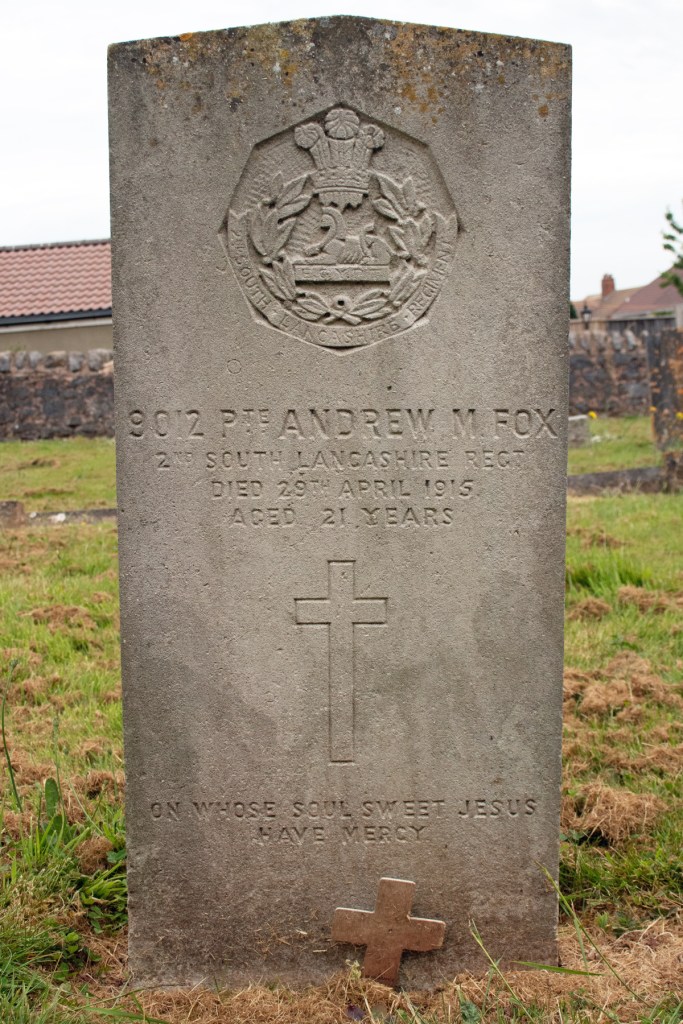
Private Andrew M Fox

In the plot next to Serjeant Andrew Fox is another, similar headstone. Not quite having the same form as the Commonwealth War Grave Commission headstone that Serjeant Fox has, this is dedicated to a Private Andrew M Fox, of the 2nd South Lancashire Regiment.

Andrew Moyse Fox was the eldest son of Andrew and Kathleen. Born on 31st March 1894 in Ireland, he wanted to follow his father and grandfather into the army.

Andrew Jr enlisted in the South Lancashire Regiment in August 1908. His service records confirmed that he was just 14 years of age, standing 5ft (1.52m) tall, and weighing 5st 2lbs (32.7kg). He was noted as having dark brown hair, hazel eyes and a fresh complexion, and that he has a scar on his right buttock.

As is the case with his father, there is limited information about Andrew Jr’s army career. He spent just under six years serving with the regiment, and was formally mobilised when he came of age in 1912. On 27th March 1914, however, Private Fox was discharged from the army on medical grounds, for reasons unclear. The next record available for him is that of his passing, just nine days after his father. He was 21 years of age.

Andrew Fox Jr was laid to rest next to his father in Cannington Cemetery. The heartbreak for Kathleen, to have lost husband and oldest boy within two weeks, must have been indescribable. While her son’s headstone is similar in design to her husband’s, he was not subsequently entitled to an official Commonwealth War Grave, as he had left the army before the outbreak of war: the Commission’s qualification dates (4th August 1914 to 31st August 1921).


Private Harold Hill

Private Harold Hill

In a quiet corner of St John’s Churchyard, Staplegrove, is a commemorative headstone to three soldiers of the Somerset Light Infantry. The bottom two, share the same surname, and are, in fact, father and son: Francis and Harold Hill.


Harold James Hill was born 23rd November 1896 in Milverton, Somerset. He was the only child to former army man turned storekeeper, Francis Hill and his wife, Florence.

When he finished his schooling, Harold found work as an office boy. By the time of the 1911 census, the family had moved six miles east of Milverton, to the village of Staplegrove. Francis was employed as a house painter, Florence had taken in work as a glove maker, and the Hills also had a boarder, Reginald Cave, who was a nursery foreman.

Storm clouds were brewing by this point and, when war broke out, Harold was keen to play his part, possibly because he wanted to emulate his father’s army life. He enlisted in the Somerset Light Infantry and was assigned to the 2nd/5th Battalion. Private Hill’s medical records show that he was 5ft 10ins (1.78m) tall, and weighed 140lbs (63.5kg). By coincidence, these are almost exactly the same measurements as those of his father, when he joined the army 28 years before.)

After three months’ training, Harold’s battalion was sent overseas, and he arrived in India on 12th December 1914. Within a matter of months, his health began to suffer and, between May 1915 and February 1916, Private Hill was admitted to hospital on six separate occasions, all but one for intestinal problems.

In the end, Harold was taken back to Britain for treatment: he arrived on home soil at the end of March 1916, and within three months had been medically discharged from the army.

At this point, Harold’s trail goes cold, although he did return to Somerset. His illness continued, however, and he passed away from his stomach condition on 23rd October 1916. He was just 19 years of age.

Harold James Hill was laid to rest in the graveyard of St John’s Church, Staplegrove. His grave is lost to time, but it can be assumed that he was buried close to his father, who had died just nine months before. Father and son are commemorated on a special memorial, close to the entrance of the church.


One can only imagine the heartache for Florence Hill, having lost her husband and her only child within a year. Details of her late husband’s life can be found here.

Few details remain of her life, although she is recorded on the 1939 England and Wales Register boarding with an Eda Cummings in Greenway Avenue, Taunton. She was noted as a widow, and employed to do household duties.


Private Francis Hill

Private Francis Hill

Francis Robert Hill was born in the spring of 1868, the middle of seven children to William and Mary Hill. William was a shoemaker from Wiveliscombe, Somerset, and this is where he and Mary raised their family.

When Francis finished his schooling, he found work as a baker. However, he wanted bigger and better things and, in June 1886, he enlisted in the 1st Battalion of the Oxfordshire Light Infantry. Private Hill would have cut a striking figure: at eighteen years old, he was 5ft 10ins (1.78m) tall and weighed 136lbs (62.6kg). He had light brown hair, grey eyes and a fair complexion.

Francis did not spend any time overseas, instead working in the regiment’s depot in Alverstoke, near Gosport, Hampshire. He spent seven years in the military, and was stood down on 16th June 1893.

By the end of 1895, Francis was back in Somerset as, on Boxing Day that year, he married Florence Ida Giles, a shoemaker’s daughter. The couple were both living in Milverton at the time, and Francis’ profession was noted as storekeeper. On 23rd November 1896, the couple had a son, Harold, and the family were living on Fore Street, the village’s main road.

The 1901 census shows another change in work for Francis, who was now noted as being a house painter. This was a career that seemed to stick with him, as he was still employed in the role by the time of the next census, in 1911. The Hills had moved to Staplegrove, on the outskirts of Taunton, by this point. Florence had taken in work as a glove maker, Harold, now 14 years old, was employed as an office boy, and the family had a boarder, Reginald Cave, who was a nursery foreman.

At this point Francis’ trail goes tantalisingly cold. When war broke out, he enlisted once more, this time joining the Somerset Light Infantry. The only other confirmed document gives a tragic hint as to his death, at the age of 48. His entry in the Pension Ledger reads simply “18.2.16: Accidentally killed by passing train while on military duty.” There are no other records to back this up, and no contemporary newspapers report on his passing.

However it happened, Francis Robert Hill’s body was brought back to Somerset for burial. He was laid to rest in the graveyard of St John’s Church, Staplegrove. His grave is lost to time, but he is commemorated on a special memorial, close to the entrance of the church.


Tragedy was to strike a second time for Francis’ widow, Florence, when, in October 1916, Harold was also to pass away. Read his story here.


Ordinary Seaman Bertie Clark

Ordinary Seaman Bertie Clark

Bertie Baden Clark was born on 5th August 1900 in the hamlet of Dunball, near Puriton in Somerset. The third of seven children, his parents were quarry and cement works labourer George Clark and his wife, Bessie.

When war came to Europe, George stepped up to play his part. Despite being 44 years old, he enlisted in the Royal Army Service Corps on 4th November 1915 and, within a year, was in France. He remained posted at the No. 4 Remount Depot until October 1918.

“On the morning of the 1st October 1918, I left the 26th Squadron 4 Base Remount Depot riding a horse and leading one to exercise about a mile & half from the Squadron while proceeding by the side of the railway line my horse was frightened by the whistle of a railway engine & ran away with me throwing me to the road and stepping on my right ankle.”

Private Clark was initially treated at the No. 2 Canadian General Hospital, but was soon invalided back to Britain and placed on furlough until being formally demobbed from the army early in 1919.

Bertie, meanwhile, could see the excitement of the war passing him by. Determine to play is part before it was too late, he gave up his job as a labourer on 13th July 1918 and enlisted in the Royal Naval Volunteer Reserve.

Given the rank of Ordinary Seaman, his service records confirm that he was 5ft 6in (1.68m) tall (1in, or 2.5cm, taller than his father), with dark brown hair, grey eyes and a fresh complexion. He was noted as having a scar on his right knee.

Bertie was sent to HMS Victory, the Royal Naval Dockyard in Portsmouth, Hampshire, for training. Tragically, this was to be his only posting. He was admitted to the dockyard hospital early in October, suffering from double pneumonia and influenza. The condition was to take his life, and he passed away on 10th October 1918, at the age of just 18 years old.

Bertie Baden Clark’s body was brought back to Somerset for burial. He was laid to rest in the quiet graveyard of St Michael’s Church in Puriton, the funeral attended by his family, including his recently returned father, George.


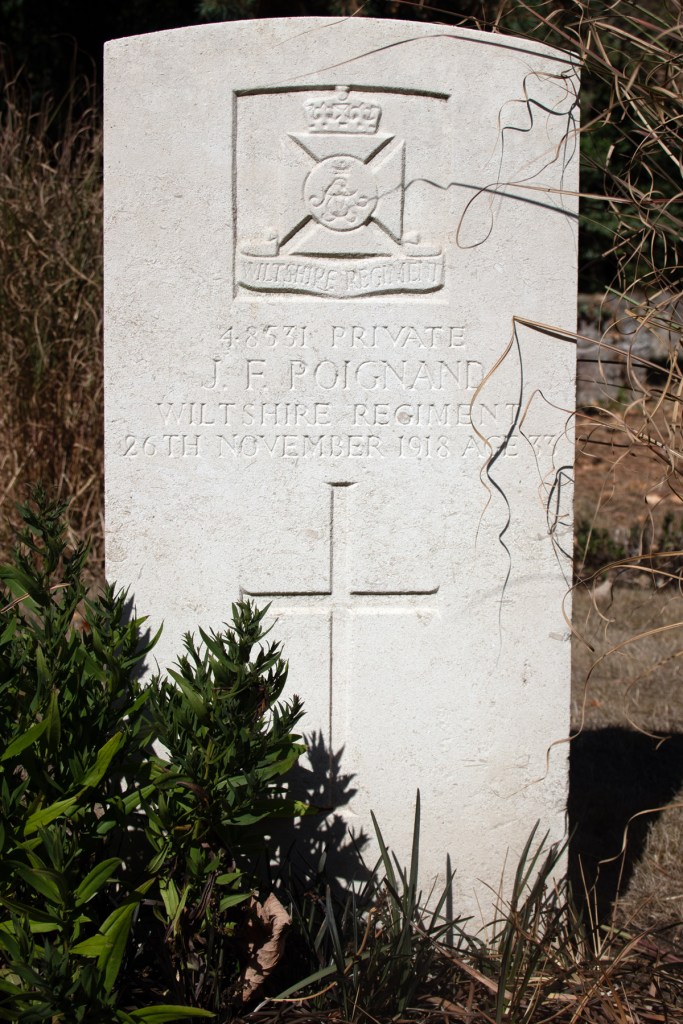
Private John Poignand

Private John Poignand

John Francis Poignand was born in St Brelade, Jersey in 1885. The oldest of four children, his parents were farmers Jean and Louisa Poignand. John followed his parents into farming and moved to nearby St Lawrence.

It was here that he met and married farmer’s daughter Lydia Helleur. The couple set up home in St Lawrence, and went on to have two children, John and Clarence.

War was closing in on Jersey’s shores and, when the call came, it seems that John was keen to play his part. Sadly, full details of his military service have been lost to time, but what remains confirms that he had enlisted in the Wiltshire Regiment by the spring of 1918.

Private Poignand was assigned to the 3rd (Reserve) Battalion, a territorial force that remained on the British mainland. He was to be based in Kent, his troop forming part of the Thames and Medway Garrison.

The only other records of John’s service are that of his passing: he had been admitted to the Preston Hall Military Hospital, suffering from a combination of influenza and pneumonia, and these are what were to take his life. Private Poignand died on 26th November 1918, at the age of 33 years old.

John Francis Poignand was laid to rest in the graveyard of St Peter and St Paul’s Church in Aylesford, not far from where he had died.


Lydia went on to marry a man called Robinson. Her trail goes cold, but her and John’s younger son, Clarence, does appear in later records.

Flight Sergeant Poignand served with the Royal Air Force in the Second World War, and was based at Seletar in Singapore. He was taken as a Prisoner of War by the Japanese on 11th March 1942, but there is no other record for him. His PoW record confirms that he was married and living in Romford, Essex, at the time of his capture.