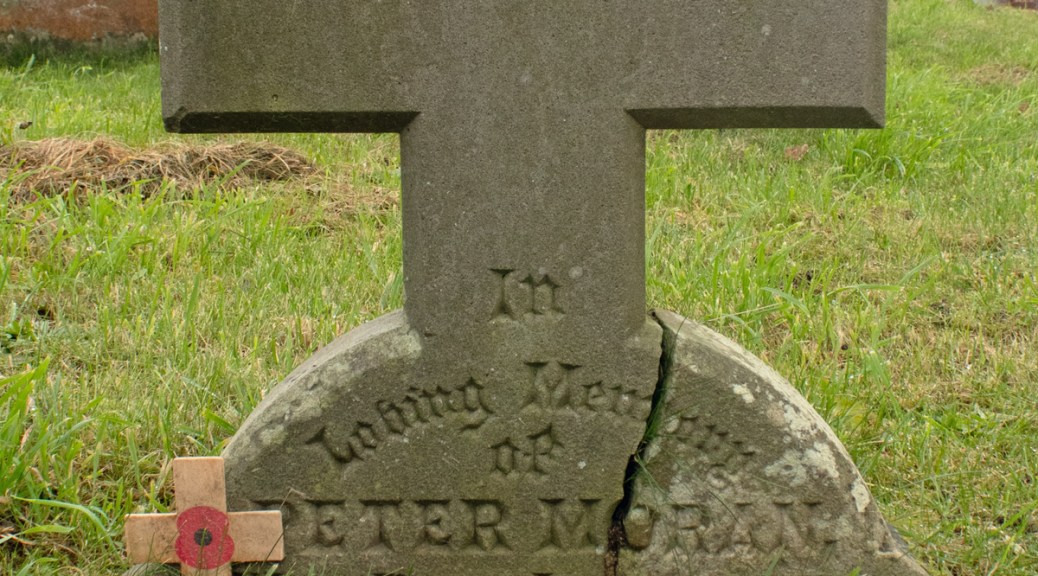
Peter Moran was born in Kilmeena, County Mayo, Ireland, on 29th January 1876. Details of his early life are hard to track down, but when he finished his schooling, he wound work as a fisherman.
By 19th August 1891, Peter sought to make a more permanent career of the sea. He signed up to the Royal Navy, and was sent to HMS Impregnable, the shore base in Devonport, Devon, for his training. Being just 15 years of age, he was too young to formally enlist, and was given the rank of Boy 2nd Class.
Over the next few years, Peter learnt the tools of his trade. On 2nd July 1892 he was promoted to Boy 1st Class, and the following February he was given his first sea-faring assignment, on board the battleship HMS Neptune. By March 1893 Boy Moran found himself serving on board HMS Daphne, a screw sloop which would become his home for the next three years.
During his time aboard Daphne, Peter came of age, and was given the rank of Ordinary Seaman. His service records show that he was 5ft 4ins (1.63m) tall, with light hair, grey-blue eyes and a fresh complexion. Within eighteen months he had proved his mettle, and was promoted to Able Seaman.
Over the next decade, Peter would serve on eight vessels. By the time the term of his contract came to an end in September 1903, he had been promoted twice – to Leading Seaman, then to Petty Officer 2nd Class.
Peter renewed his contract, but seems to have chosen a new career path. On 2nd October 1903 he moved to HM Coastguard and, as a Boatman, was assigned to Pendeen Cove, Cornwall.
Love blossomed for Peter, and he married a woman called Caroline in the next few years. There is little further information about her, but the couple would go on to have three children – Mary in 1908, Florence in 1911 and Thomas in 1913.
Boatman Moran would spend twelve years with the coastguard, moving to St Ives, Cornwall, in September 1908, and Fishguard, Pembrokeshire, in March 1914. By this point he had been promoted to Leading Boatman, and was set on a new life in Wales. Sadly, the new life was not to be: on 2nd June 1915 he passed away from pneumonia. He was 39 years of age.
The body of Peter Moran was laid to rest in Fishguard Cemetery: a life at sea, and forging homes in three countries at an end.
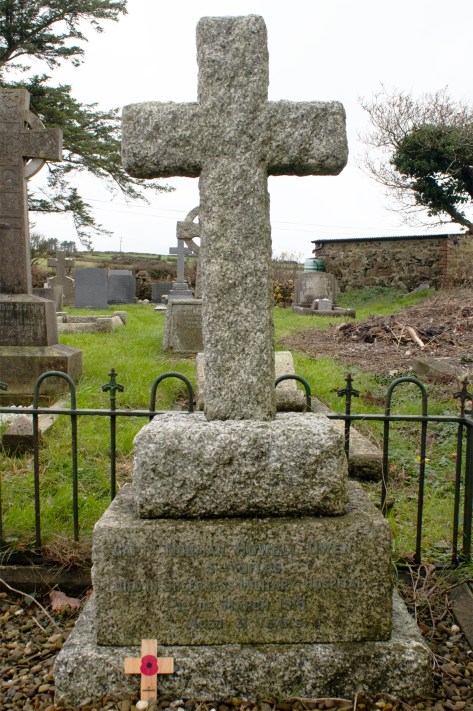
Norman Howell Owen was born in the spring of 1888, and was the third of four children – all boys – to John and Elizabeth. John was a surgeon from Pembroke Dock, Pembrokeshire, but the family were raised in Fishguard, where his practice was based.
Norman was an educated young man and, in 1906, attended the Sir Isaac Pitman & Son Phonetic Institute in Bath Somerset. He was studying shorthand, passing an examination in the subject after just three months. He passed an entrance exam for the National and Provincial Bank the following year, and, by the time of the 1911 census, he was working in the Fishguard branch and living back with his parents.
When war came to Europe, Norman was called upon to play his part. Full details of his service have been lost to time, but what remains paints an interesting picture of his time in the army. He appears to have enlisted in the King’s Liverpool Regiment as a Private, before transferring to the Labour Corps, then the Army Ordnance Corps.
By 1918 the Pembrokeshire Voters List noted Norman and two of his brothers as absentee voters – serving in the army, so not at home. Norman is recorded as being a Captain in the Army Service Corps, having received a commission on 8th February 1915. His older brother John is recorded as being a Captain in the Royal Army Medical Corps, while his younger brother, Lionel, was a Captain in the Royal Field Artillery.
The mystery of Norman continued: he survived the conflict, but by February 1919 had been admitted to the Broadway Military Hospital in Sheerness, Kent. He passed away on 1st March, the cause of his passing not readily available. Captain Owen was 31 years of age.
The body of Norman Howell Owen was taken back to Pembrokeshire for burial. He was laid to rest in Fishguard Church Cemetery.
Norman died intestate: his family went through probate, and his effects – totalling £1003 8s 10d (approximately £67,000 today) were left to his father.
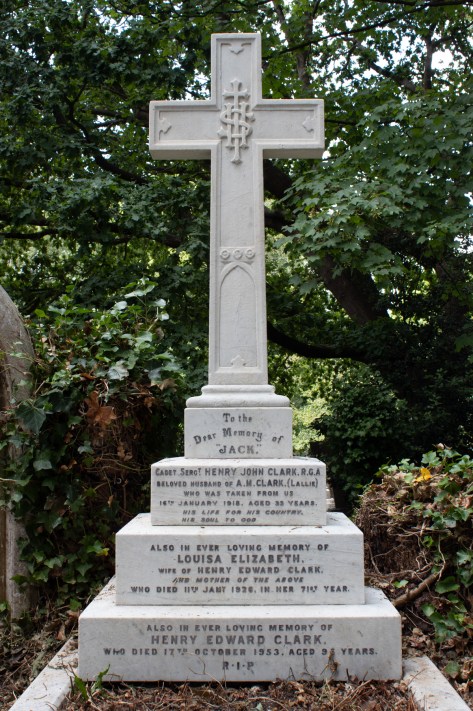
Henry John Clark was born on 17th January 1885 in Tufnell Park, Middlesex. The oldest of five children, his parents were wire worker and brass finisher Henry Clark and his wife, Louisa.
The 1891 census found the family living at 51 Cromwell Avenue, Highgate, Middlesex, and this would certainly remain Henry Sr and Louisa’s house for the next ten to fifteen years at least. Henry Jr – who was better known as Jack – is missing from the 1901 census, but by the next document, taken in 1911, he had moved back in with the family.
By this point the Clarks were living in a thirteen-room house on Shepherd’s Hill, Highgate. Henry Sr was now listed as an employer, manufacturing fenders, fire guards and metal good generally, with Jack and his brother, Cyril, also working in the business. The family were supported by two servants, with Henry Sr’s niece and another boarder living with them. Tragically, the census records that Louisa had had five children, although only Jack and Cyril were still alive.
The family business, according to De Ruvigny’s Roll of Honour, Messrs. J Clark, Ltd, of High Street, Bloomsbury, and Jack was one of the directors. The publication also notes that, in his spare time, Jack was “a prominent and active member of the Kit Marlowe Dramatic Club, and the Vaudeville Dramatic Club, and was a popular member of the Highgate Special Constabulary, which body he joined as soon as it was formed.”
On 19th June 1912,Jack married Alice King. Born in Finsbury Park, she was the daughter of a wine and spirit valuer and merchant. The couple exchanged vows at St George’s Church, Hanover Square, London, and would go on to have a child, John, in 1916.
When war broke out, Jack was called upon to play his part. He enlisted on 4th December 1916, joining the Royal Garrison Artillery as a Gunner. His service papers note that he was just over 6ft 2ins (1.89m) tall, and weighed 159lbs (72.1kg).
Gunner Clark served with the British Expeditionary Force from March 1917, returning to home soil just three months later. He had obviously impressed his superiors, as he was sent to the No. 2 RGA Officers’ Cadet School in Uckfield, Sussex, to be trained as a Sergeant.
While here, however, Jack came down with pneumonia, and was admitted to the No. 2 Eastern General Hospital in Brighton. The condition was to get the better of him, sadly, and he passed away on 16th January 1918, the day after his 33rd birthday.
Henry John “Jack” Clark was taken back to Middlesex for burial. He was laid to rest in the majestic Highgate Cemetery, a short walk from his grieving family.
Cadet Sergeant Henry Clark (from De Ruvigny’s Roll of Honour)
Percy Townley Rawlings was born on 22nd September 1887 in Clapham, Surrey. Details of his early life are sketchy, and most of the information comes from second hand accounts. His baptism record gives his parents as Edward and Lizzie Rawlings. Edward was listed as being a gentleman, but there is no record of the family on the 1891, or 1901 census returns.
He was educated at Westminster School and Cambridge University, where he obtained honours in the Mechanical Sciences Tripos.
In 1910 he went to Woolwich Arsenal as [an] advanced workshop student, and in the following year he obtained a Commission in the Royal Engineers…
In 1912 he entered the Public Works Department of the Sudan Government, and during 1913-14 acted as engineer to the Egyptian Irrigation Service on the construction of the Blue Nile Dam.
On the outbreak of the War he was sent to France [as a Lieutenant in the Royal Engineers], in the 2nd Field Co., being transferred in the following year to the [Royal Naval Volunteer Reserve], for engineering duties with the [Royal Naval Air Service].
In 1917 he flew to Constantinople in a Handley-Page machine, and bombed the Goeben, for which he received the DSC.
[1921 Institution of Mechanical Engineers: Obituaries]
By the end of the conflict, Percy had been promoted to Captain. After the Armistice he remained involved in the Royal Air Force, and was involved in testing the rapidly changing technology of flight.
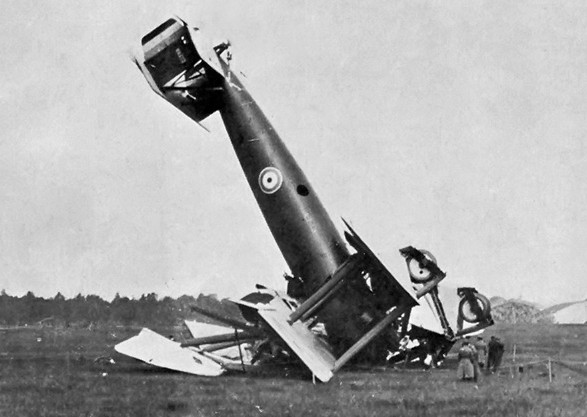
A Tarrant triplane, constructed at the Royal Aircraft Factory, Farnborough, was wrecked on a trial flight on Monday. The machine, which had six engines, each developing 500 horse power, after running along the ground toppled forward and seemed to bury itself in the earth. One of the pilots… Captain Rawlings, has died, and the other, Capt. Dunn, is in a very grave condition.
[Waterford Standard: Wednesday 28th May 1919]
Captain Percy Rawlings’ Tarrant triplane after the crash
Captain Dunn also died in the crash, which happened on 26th May 1919. Percy was 31 years of age when he died.
A close friend, Henry Edmunds, wrote to the Flight Magazine to express his sympathy at the loss:
As a boy, Rawlings was always interested in scientific matters, particularly photography and motors..
He was manly, open, and frank, fearless and honest, of an enquiring mind, and fond of experimenting. I remember his pre-heating paraffin vapour electrically, as a fuel for explosive engines…
It was at my house at Brighton that Rawlings met Mr. W. G. Tarrant, who was spending the week-end with me. Rawlings had just returned from the famous flight in the Handley Page to Constantinople, where he bombed the ‘Goeben.’ I remember his describing vividly his impressions of that memorable journey. If I recollect correctly, he motored down to Folkestone somewhat rapidly. He told me he believed the police were on the look-out for him for exceeding the speed-limit; but he went from Folkestone by air, proceeding to Naples. It was delightful to hear him recount that remarkable voyage. Their fears lest they should not be able to cross some of the high mountain ranges with the heavy load they were carrying, and where, had anything happened, they would have been out of the reach of all human aid. How he availed himself of a special camera for photographing portions of his trip, the results of which he feared it might be unwise to disclose at that time, so he brought the negatives back with him, and I believe they wore kept personally until after the War.
He and Mr. Tarrant were mutually attracted to each other, and discussed with much seriousness the construction of a new type of bombing-plane, which eventuated in the great Tarrant machine. Rawlings joined Tarrant shortly afterwards, and devoted all his energies to carrying on the work of design and construction. On several occasions he came down to see me, and related his experiences. He was full of confidence as to the future of his work; and invited me to take my first flight with him.
Townley Rawlings was a gallant gentleman. Those whom the gods love are taken early.
[Flight Magazine: 29th May 1919]
The speeding incident is an interesting anecdote, another similar incident recorded in a separate newspaper report:
Chauffeur Summoned for Fast Driving
Capt. Rawlings, who was killed in the Tarrant triplane accident, should have appeared as a witness yesterday in the Kingston court.
His chauffeur, Arthur B Cogger, of West Byfleet, summoned for exceeding the limit, was driving Captain Rawlings to Farnborough on Saturday, before the accident.
He said the captain told him he wanted to get along as quickly as possible as he was going to test an aeroplane. He had intended to come to court.
The summons was dismissed.
[Dublin Daily Express: Saturday 31st May 1919]
Percy Townley Rawlings was laid to rest in Highgate Cemetery, possibly close to where he or his family had been living.
Charles James Welling was born on 23rd October 1860, and was the oldest of three children to Charles and Ann Welling. The Wellings were a military family, Charles Sr employed as a Serjeant Instructor of Musquetry in the Parkhurst Barracks on the Isle of Wight when his son was born.
Ann had been born in South Africa while her Irish parents were based out there. She and Charles Sr married in Farnham, Surrey, presumably where the families were based by that point.
Charles Jr’s mother died in 1863, just a month after giving birth to his youngest sibling. His father married again, to Sarah Ash, and by 1871, the Wellings were living in barracks at the School of Musketry in Hythe, Kent.
Being his father’s son, Charles Jr was set to make his own mark on the world and, on 21st January 1876, he joined the Royal Navy. Too young to formally enlist, he was given the rank of Boy 2nd Class, and sent off to HMS Impregnable, the shore base in Devonport, Devon, for his training.
Over the next eighteen months, Boy Welling learnt his trade, spending time at HMS Ganges – another shore base near Ipswich, Suffolk – and the sloop HMS Penguin. It was here that Charles came of age in 1878, and he officially joined the Royal Navy with the rank of Ordinary Seaman. His service papers show that he was just 4ft 10.5ins (1.49m) tall, with light brown hair, blue eyes and a fair complexion.
Ordinary Seaman Welling career was to take a turn in 1880, when he began training as a signaller. His initial contract with the navy was for ten years, and, by the time that came to an end in May 1889, he had served on eight ships in all, rising through the ranks from Signalman 3rd Class, to Signalman 2nd Class in August 1881 and Qualified Signalman seven years later.
When Charles’ term of service came to an end, he immediately renewed it, and with the new contract came a promotion to Leading Signalman. The next decade saw him travel the world, returning to HMS Pembroke, the Royal Naval Dockyard in Chatham, Kent, in between voyages. His commitment to the role paid off: in March 1894 he was promoted to 2nd Class Yeoman of Signals. Just eight months later he took the rank of Yeoman of Signals.
It was around this time that Charles married the love of his life, Harriet Carlaw. Born in London, the couple exchanged vows in St Pancras, Middlesex, on 13th January 1894 and had a son, also called Charles, the following year.
Charles’ naval career continued its upward trajectory, and on 1st March 1898, he was awarded the rank of Chief Yeoman of Signals. By this point HMS Pembroke had become his permanent base and, at the end of his contract in 1899, he was stood down to reserve status.
The 1901 census shows what may have been a downward step for the Wellings: it recorded the family living in rooms at 136 Bayham Street, Camden, Middlesex, where Charles was working as a messenger.
Opportunities come in the most unexpected of places, however, and the following census found them living at Pier House, Sunderland, Tyne and Wear, where Charles was employed as a lighthouse keeper.
By this point, Charles had been invalided out of the navy for medical reasons. The writing on his service papers is unclear, and his dismissal seems to have been as a result of disease of gestes, possibly the neurological disorder dystonia.
When war broke out in 1914, however, anyone with experience was called upon to play their part. Given his age at the time, it seems likely that Charles volunteered for service, reporting to HMS Pembroke on 2nd August 1914. He was given his old rank of Chief Yeoman of Signals, and remained at the naval base for the next two years.
Charles’ health was definitely suffering by this point, and he was admitted to the Royal Naval Hospital in Chatham, in September 1916. Suffering from the heart condition endocarditis, this would take his life. He passed away on 16th September, at the age of 55 years old.
With Harriet still living in Sunderland, Charles’ body was laid to rest in Woodlands Cemetery, Gillingham, Kent, not far from the base he had called home for so long.
Charles and Harriet’s son had also stepped up to play his part when war broke out. Enlisting in the Royal Engineers, Pioneer Welling soon found himself in the Middle East. While serving in Palestine, he contracted malaria, and passed away from the condition on 16th October 1918. Charles was just 23 years of age, and was laid to rest in Haifa War Cemetery.
It is tragic to note that Harriet had lost her husband and her son within two years.
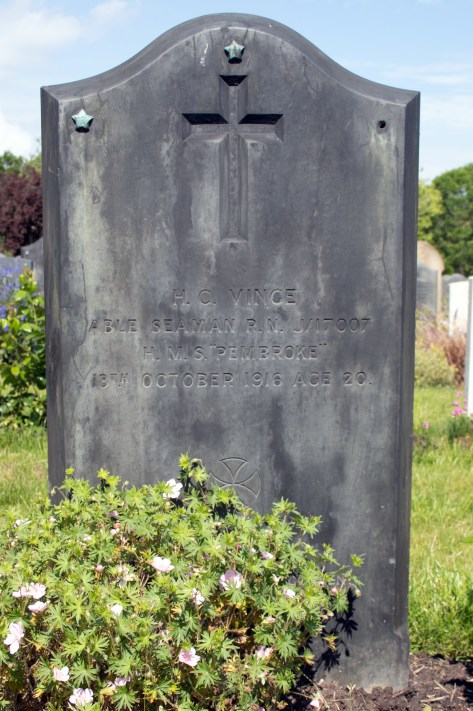
Harry Cooper Vince was born in Battersea, Surrey, on 14th January 1896. The 1901 census noted he was the son of Elizabeth Vince, a cook for barrister and solicitor Robert Purvis. The next census found Harry, Elizabeth and Elizabeth’s husband Harry, as one of four families to have taken rooms at 47 Bessborough Place, Pimlico.
Harry sought a life of adventure and, on 21st March 1912, he gave up his work as a kitchen boy to enlist in the Royal Navy as a Boy 2nd Class. He was dispatched to the training ship HMS Impregnable.
On 6th September 1912, having been promoted to Boy 1st Class, Harry was assigned to the battleship HMS Vanguard. Over the next couple of years he learnt his trade, and would come to be based out of HMS Pembroke – the Royal Naval Dockyard in Chatham, Kent – in between voyages.
Harry came of age on 14th January 1914, and was formally inducted into the Royal Navy as an Ordinary Seaman. His service records note that he was 5ft 5ins (1.65m) tall, with brown hair, blue eyes and a fresh complexion. He was also recorded as having small moles on his right buttock,
By the late spring of 1916, Harry had been assigned to the submarine depot ship HMS Bonaventure. He would remain on board for two years, during which time he was promoted to Able Seaman.
The next four months would go by in a bit of a blur for Able Seaman Vince. During this time he moved between three ships – the submarine depot ships HMS Dolphin and HMS Maidstone. The last of the three was HMS Lucia, originally the British-built steamship Spreewald, captured from the German Navy in 1914.
In September 1916, Harry was admitted to the Royal Naval Hospital in Chatham, suffering intestinal obstructions. These would prove too severe, and he succumbed to peritonitis on 13th October 1916. He was 20 years of age.
The body of Harry Cooper Vince was laid to rest in the military section of Woodlands Cemetery, Gillingham, not far from the naval base he had called home.
Interestingly, Harry’s service records not an irregularity in his name: “Registered at Somerset House in the name of Ball. Boy kept in ignorance of the fact for obvious reasons.” It would seem that Elizabeth may not have been married at the time her son was born. It also throws some potential doubt as to who his father was.
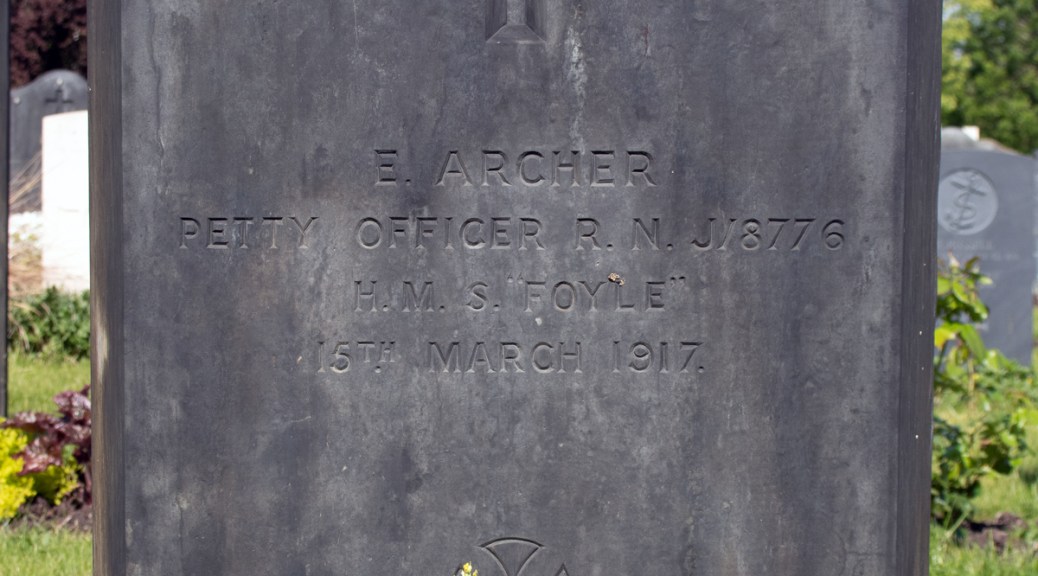
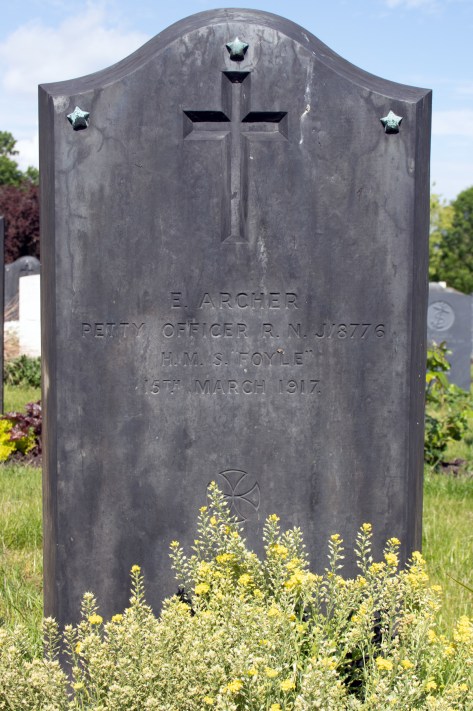
The life of Ernest Archer is challenging to piece together. His headstone, in Woodlands Cemetery, Gillingham, Kent, confirms he was a Petty Officer on HMS Foyle, which was a Royal Navy destroyer. She hit a mine in the English Channel off the Devon coast on 15th March 1917, and foundered while being towed to safety in Plymouth. A total of 28 crew members, Petty Officer Archer included, were killed.
Ernest’s service papers have been lost to time, but his Dependent’s Pension record gives his beneficiary as his aunt, Mrs H Greenhow, of 8 Kinmel Street, Liverpool. This would suggest that his parents had passed by 1917, but it’s not been possible to track her down through contemporary documents.
The same record notes that Ernest had a brother, James, and that he was an Able Seaman in the Howe Battalion of the Royal Naval Division. He was killed in action on 17th February 1917 – four weeks before his brother – and is commemorated on the Thiepval Memorial.
Further information on the lives of the siblings, however, is lost in the mists of time, Ernest Archer’s story taken to his grave with him.
William Amos Hallett was born on 2nd March 1867 in Pimlico, Middlesex. The oldest of six children, his parents were Charles and Rosa Hallett. Charles was a police inspector and, by the time of the 1871 census, the family has moved to Sheerness in Kent, where he worked.
In the summer of 1893, William married Emily Nokes. By this point he had been working for the Royal Navy for four years, initially as a Shipwright, then as a Leading Shipwright. His service records show that he was 5ft 8ins (1.73m) tall, with light brown hair, blue eyes and a fresh complexion.
Based out of HMS Pembroke, the Royal Naval Dockyard in Chatham, Kent, by June 1900 William had served on HMS Urgent, HMS Sphinx. Most of his time, however, had been spent between his Chatham base and its Sheerness counterpart, HMS Wildfire.
In November 1901 William was promoted to the rank of Carpenter. Over the next decade he served on eight vessels, and his service record for that time give an insight into his character. He was regularly commended for his hard-working and zealous nature: “[he] gets through more work in his time than any carpenter I’ve been shipmates with… He is excellent in every way.” His ability did not go unnoticed, another report noting his “special knowledge [in] geometrical drawing.”
In the summer of 1910, his superior, Captain Morgan, noted that Carpenter Hallett “worked well and zealously and has got a good deal of work done under somewhat difficult circumstances and with a small staff…” He was recommended for advancement, and it seemed that a promotion was in the offing.
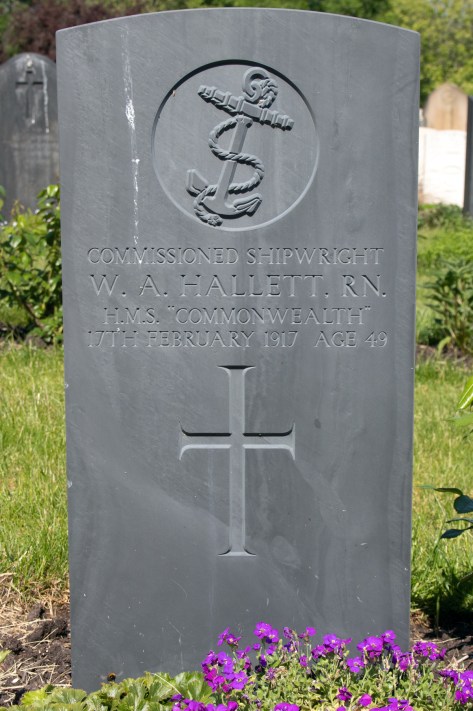
By the time war broke out, William was a Commissioned Shipwright. Details of his service are harder to trace, but by the end of 1916, he was assigned to the battleship HMS Commonwealth. The next record notes his passing:
HALLETT – On 17th February, at RN Hospital, Chatham, Chief Carpenter RN William Amos Hallett, aged 49 years, eldest son of the late Mr Charles Hallett, of Sheerness.
[Sheerness Guardian and East Kent Advertiser: Saturday 24th February 1917]
There is no further information about William Amos Hallett’s passing. He was laid to rest in the military section of Woodlands Cemetery, Gillingham, Kent, not far from HMS Pembroke, the dockyard he had for so long called home.
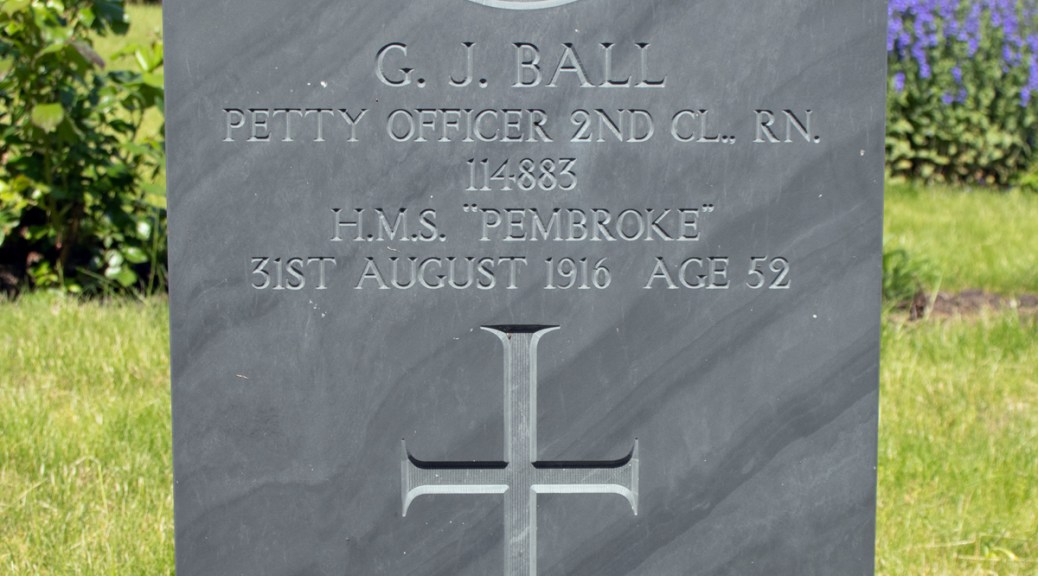
The early life of George John Ball is a challenge to piece together.
His naval records confirm that he was born in Bedminster, Somerset, on 11th October 1865. There are census records that link his name to parents coal miner Luke Ball and his wife, Ann, but these cannot be confirmed.
George’s papers show that he found work as a butcher when he finished his schooling. He was set on a life at sea, however, and, on 25th November 1880, he joined the Royal Navy. Given the rank of Boy 2nd Class, he was sent to the training base HMS Impregnable for his induction. The Devon establishment would remain his home for the next two years, and, during this time, he rose to the rank of Boy 1st Class.
On 10th October 1882, George was given his first sea-faring assignment, on board the armoured cruiser HMS Northampton. He stayed with her for the next two years, during which time he came of age. Now formally inducted to the Royal Navy, he was promoted to Ordinary Seaman. His service records from the time give an indication as to the man he had become. Short of stature, he was just 5ft 1.5ins (1.56m) tall, and had light brown hair, hazel eyes and a fresh complexion.
Ordinary Seaman Ball signed up for a ten-year contract. Over that time, he would serve on a total of eight vessels, rising to the rank of Able Seaman in January 1889. George’s slate was not completely clean, however, and his record notes three serious demeanours in that time.
In the spring of 1888 George spent 27 days in Canterbury Gaol for ‘breaking out of [the] ship’ he was then serving on, HMS Duncan. He was sent to the brig for a further fourteen days in January 1892 for an undisclosed crime.
Able Seaman Ball was also fined £3 10s (£575 in today’s money) for staying away beyond his allotted shore leave. His papers note an absence of seventeen weeks from 10th October 1893, and this time would have been added to the end of his contract.
George re-enlisted on 9th February 1894, and his service record noted that he had grown half and inch (1.3cm) since he enlisted. He had also had a number of tattoos in that time, including an anchor on his right arm and a bracelet and sailor on his left.
Over the next decade, Able Seaman Ball continued his steady progression through the ranks. He would serve on seven ships, returning to what had become his shore base – HMS Victory, the Royal Naval Dockyard in Chatham, Kent – in between assignments. In October 1897, George was promoted to Leading Seaman: by the following July he was given the rank of Petty Officer 2nd Class.
On 29th April 1904, after more than twenty years in service, George was formally stood down to reserve status. The next document for him – the 1911 census – gives an insight into his life away from the sea. By this point, George was living in a small terraced house at 234 Luton Road, Chatham, Kent.
The document confirms he had been married for fourteen years, to a woman called Sarah. The couple had a daughter – six-year-old Doris – and Sarah’s son from a previous marriage, Albert, was also living with them. George had not distanced himself too far from the sea, however. He was employed as a Ship’s Canteen Manager, a position his stepson also held.
When war came to Europe, George was called upon to play his part once more. Taking up the rank of Petty Officer 2nd Class again, he would be based at HMS Pembroke – Chatham Dockyard – and he remained in service for the next two years.
In August 1916, George was admitted to the Royal Naval Hospital in Chatham, with a combination of pychtis and a stricture. The conditions were to prove fatal: he breathed his last on 31st August 1916, at the age of 50 years old.
George John Ball was laid to rest in the military section of Woodlands Cemetery, Gillingham, Kent, not far from the dockyard that had been his home for many years.
Reginald Harold Lambert was born in the spring of 1878 in Hurstpierpoint, Sussex. One of eight children, his parents were Henry and Elizabeth Lambert. Henry was a surgeon dentist, who had five more children from first marriage, giving Reginald a total of twelve siblings.
When Reginald finished his schooling, he took up work as a dental assistant, presumably under his father’s tutelage. Away from this, he volunteered for the Royal Sussex Regiment, and the military life drew him in. On 8th July 1897, he joined the 1st Life Guards: based in London, he took on the role of Farrier, tending to the regiment’s horses and looking after their hooves in particular.
On 25th April 1909, Reginald married Lilian Burns at St George’s Church in Tufnell Park, Middlesex. There is little information about her background, but she was the daughter of a grocer and, at 38 years old, seven years her new husband’s senior.
As the point of his marriage, Reginald was listed as a Corporal, and gave his address as Knightsbridge Barracks. By the time of the 1911 census, however, he and Lilian had set up home in second floor rooms at 6 Princess Road, Camden.
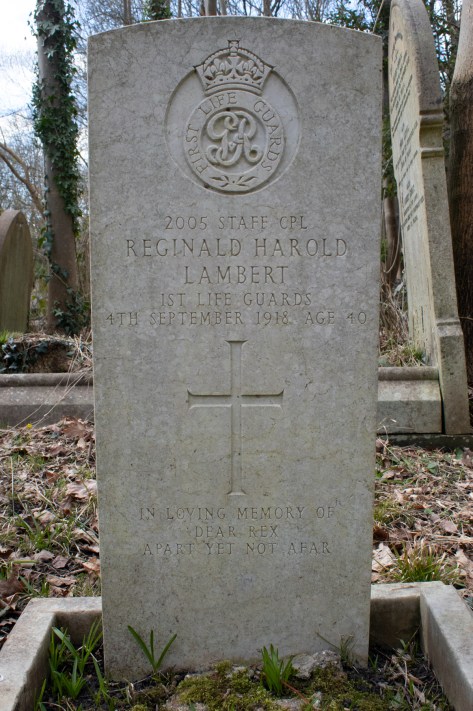
When war broke out in 1914, Corporal Lambert was called upon to play his part. His service records are long since lost, but the 1st Life Guards fought in some of the key battles of the conflict: at Ypres in both 1914 and 1915, at Loos in 1915, and at Arras in 1917. Exactly where and how Reginald served, however, is unknown, but by the end of the war he had risen to the rank of Farrier Staff Corporal.
The next record for Reginald is that of his death, which was registered in Islington, Middlesex. It seems likely that he either returned home, or was hospitalised close to home. He passed away through illness on 4th September 1918, at the age of 40 years old.
Reginald Harold Lambert was laid to rest in Highgate Cemetery, not far from where his widow still lived. His epitaph gave a nod to her pet name for him: In loving memory of dear Rex. Apart yet not afar.











 Death and Service