Walter Henry Nipper was born on 21st September 1900 in Bleadon, Somerset. The oldest of four children, his parents were Gilfred and Rose Nipper. Gilfred was an agricultural labourer turned butcher and poultry dealer, and, by the time of the 1911 census, he had set up a retail business in the middle of the village.
Walter turned to farm work when he finished his schooling, but with war raging across Europe, he seems to have been one of the young men desperate not to miss out on the action. On 16th September 1918, just five days before he turned 18, Walter enlisted in the Royal Naval Volunteer Reserve. His service records confirm that he stood just 5ft 1.5ins (1.56m) tall, had black hair, hazel eyes and a fresh complexion. The document also noted that he had a scar on the back of his right hand.
Ordinary Seaman Nipper was sent to HMS Victory VI, the shore-based training vessel in Crystal Palace, Surrey, for his induction. It is likely that, when he left Somerset for the capital, that was the last time his parents saw him. Billeted in cramp barracks, with young men from across the country, Walter fell ill: he passed away on 10th October, just 24 days after joining up. He was barely 18 years of age.
Walter Henry Nipper’s body was brought back to Somerset for burial. He was laid to rest in the tranquil graveyard of St Peter and St Paul’s Church in his home village.
Thomas Wood was born in Bristol, Gloucestershire, in the summer of 1862. The third of ten children, he was the oldest son to Thomas and Emma Wood. Thomas Sr was a cabinet maker, but his son was not to follow in his father’s footsteps, seeking a life of adventure instead.
Thomas enlisted in the army and, while documents relating to his early life are not readily available, the 1891 census recorded him as being billeted at the Cambridge Barracks in Portsmouth, Hampshire. A member of the Royal Artillery, he seems to have been enlisted for a while, as he had risen to the rank of Corporal.
In 1894, Thomas married Leah Barrett, who was born in Oxfordshire. The army life underscored where the family would settle. They had four children and, according to their ages, the Woods were in Liverpool by 1895, Gosport, Hampshire, in 1896 and Cork in Ireland by 1899. The 1901 census found the family living in Wicklow, with Thomas having now achieved the rank of Company Sergeant Major.
Ten years later, and Thomas had stepped away from the army life. Now 48 years of age, he and Leah had been married for 17 years. The couple had settled in the Worle, on the outskirts of Weston-super-Mare, Somerset, where Thomas had set himself up as a butcher, with Leah assisting him.
War came to Europe in 1914, and it seems that Thomas felt drawn to play his part once more. He joined the Royal Defence Corps as a Serjeant when it was formed in the spring of 1916, and was assigned to the regiment’s 263rd Company.
Little information is available about Serjeant Wood’s army service, but by the autumn he had been admitted to the Shell Shock Hospital (now the Maudsley Hospital) in Denmark Hill, London. His entry to the hospital, however, was actually due to kidney disease, and this was what would claim his life. Thomas died from a combination of nephritis and uraemia on 21st November 1916. He was 54 years of age.
Thomas Wood was brought back to Somerset for burial. He was laid to rest in the graveyard of St Martin’s Church in Worle.
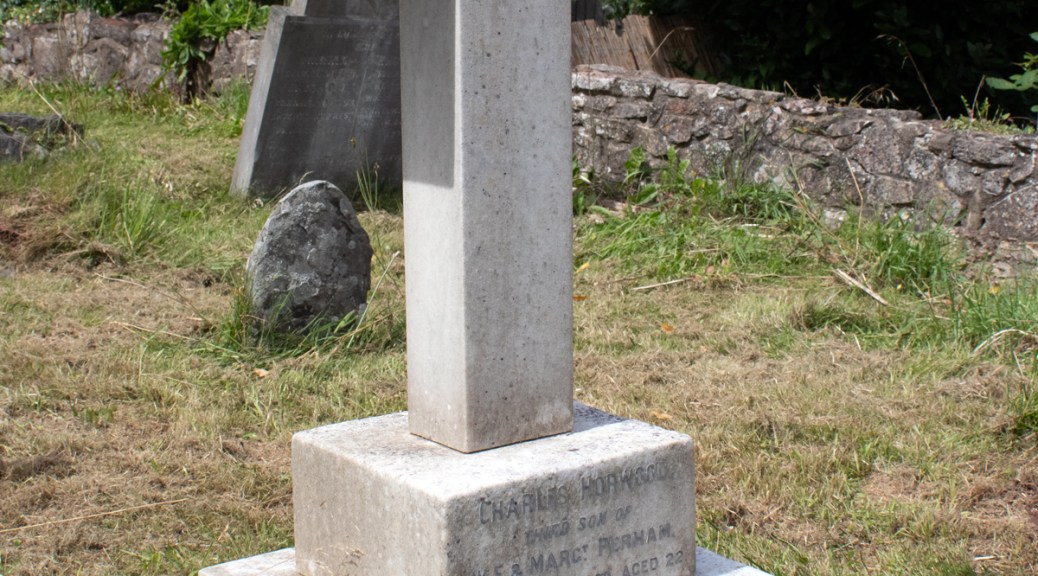
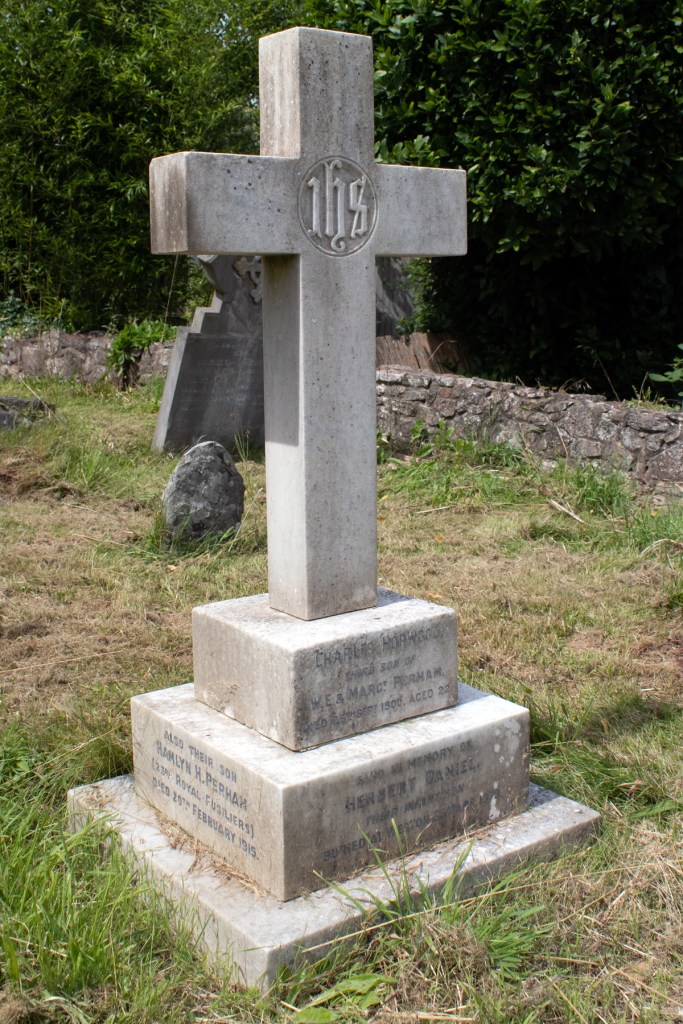
Hamlyn Horwood Perham was born in the autumn of 1872, one of seven children to William and Margaret. William was a solicitor from Wrington in the north part of Somerset, but it was in the village of Flax Bourton that the family settled.
Expectations were high for Hamlyn, who was the Perhams’ oldest son: the 1881 census found him boarding as a student in a private school in Weston-super-Mare. Ten years later, he was back home, but listed as a law student. The 1901 census recorded him as living with his family, but a practicing solicitor, presumably alongside his father (who, the document notes, was a solicitor and a Lieutenant Colonel in the Somerset Light Infantry).
Colonel WE Perham, the commanding officer of the 3rd Volunteer Battalion Somerset Light Infantry, had just been retired, after a connection with the corps dating from the year 1861, when he joined as a private. His retirement will occasion within the regiment universal regret, for he deservedly held the esteem and respect of all ranks. That Colonel Perham was well qualified to command is shown by the high state of efficiency in which he leaves the 3rd Battalion. He had taken the higher examinations, and in tactics passed with distinction. An officer who has worked through all grades from private to commander should, indeed, be a practical administrator and leader, and Colonel Perham was essentially both, and his knowledge of military matters singled him out for the important divisional and other commands. Latterly he was foremost in organising officers’ rides through the West Country – an instruction much valued at the War Office.
Somerset Standard: Friday 15th February 1907
The next census, taken in 1911, found Hamlyn still living with his parents and older sister. The family were supported by three live-in staff: a cook, a parlour maid and a housemaid. Hamlyn’s younger brother, Herbert, had also followed their father into law and, according to the same census, had set up a practice in Nailsea, where he lived with his wife of three years.
When war came to Europe, Hamlyn quickly stepped up to play his part. He enlisted in the Royal Fusiliers as a Private, and was assigned to the 23rd Service Battalion, also known as the 1st Sportsmen’s. Based at a camp in Hornchurch, Essex, Private Perham’s service was not to be a long one. He contracted meningitis, and was admitted to the South Western Hospital in Southwark. Sadly, the condition was to get the better of him: he died in hospital on 20th February 1915, at the age of 42 years old.
Hamlyn Horwood Perham’s body was brought back to Somerset for burial. He was laid to rest in the family plot in St Michael’s Church, Flax Bourton.
Much of Henry John Cordas’ early life is destined to remain a mystery. The first record for him is the 1881 census, which gives is his address as St Mary’s Orphanage in Heston, Middlesex, where he was one of 650 children.
The 1891 census recorded Henry as living in Humber Street, Grimsby, Lincolnshire, right next to the town’s docks. He is noted as being a fisherman, and is married to a woman called Mary, who was born in Deptford, Surrey.
The next available census record for Henry adds confusion to his story. The document, dating from 1911, confirms that he and Mary are now living in Hotwell Road, Bristol, Gloucestershire, again within spitting distance of the docks. Henry was employed as a marine fisherman in the merchant service. The document suggests that the couple had been married for ten years, and give Mary’s place of birth as Swansea, Glamorganshire.
While the document matches previous information for Henry, it seems unlikely that the Marys in the 1891 and 1911 censuses are one and the same. Either way, the couple were sharing their house with Mary’s niece, Ellen.
Henry seems to have joined the merchant fleet in a more official capacity in the autumn of 1900. His records show that he was 5ft 11ins (1.8m) tall, with blue eyes and a fair complexion. He served out of Bristol and, in the years leading up to the outbreak of war, he was assigned to a number of ships, travelling the Atlantic to Montreal and Jamaica, amongst other far-flung places.
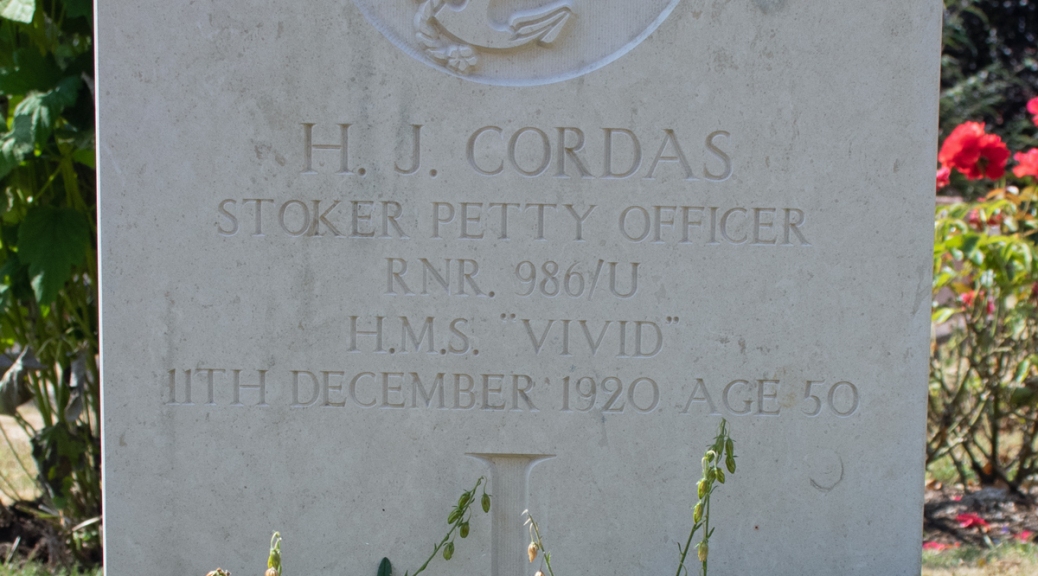
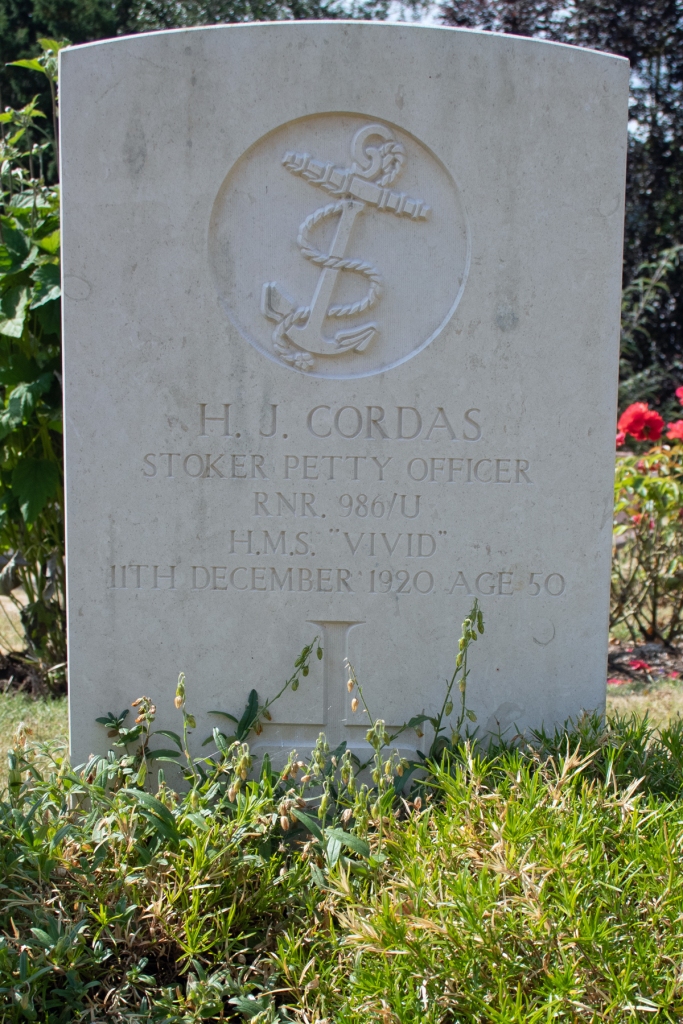
When hostilities commenced, Henry was assigned to the Royal Naval Reserve. Over the next few years, he served on a number of ships, including the armoured cruisers HMS Suffolk and HMS Doris. He worked as a Stoker, but by the end of the conflict had been promoted to Stoker Petty Officer.
In December 1918, Henry’s service came to an end. He was, by now, based at HMS Vivid, the Royal Naval Dockyard in Devonport, but his health was suffering. Medically discharged with a combination of chronic bronchitis and rheumatic pain, he seems to have returned to Bristol.
On 6th December 1920, Henry was admitted to Bath War Hospital in Somerset, as he was coughing up blood. The plan was to transfer him to Greenwich Hospital in Surrey, but he suffered an aneurysm before that move could be made. He passed away on 11th December 1920, at the age of 50 years old.
The body of Henry John Cordas did not travel far for burial. He was laid to rest in the peaceful expanse of Bath’s Locksbrook Cemetery.
Henry Wiggs was born in Camberwell, Surrey, in the autumn of 1880. One of eleven children, his parents were dock labourer Thomas Wiggs and his wife, Sarah.
When he finished his schooling, Henry also took up labouring work and, by the time of the 1911 census, was working as a partition block maker in the building trade. The census shows him a living with his brother William and his family.
On 3rd August 1913, Henry married Blanche Hill. She was eight years older than Henry, and the daughter of a Sergeant in the Royal Horse Artillery. Blanche had been widowed ten years earlier, and had four children, who Henry took on as his own.
At this point, Henry’s trail goes cold. When war broke out, he stepped up to play his part, initially joining the Worcestershire Regiment. At some point he was transferred to the Royal Berkshire Regiment, subsequently becoming attached to the Labour Corps.
Details of Private Wiggs’ military service are lost to time, and it is unclear whether he served on the Home Front or overseas. He survived the war, and was discharged from the army on 13th March 1919. He was suffering from heart disease, directly attributable to his military service.
Again, Henry falls off the radar at this point. He and Blanche made the move to Somerset, setting up home in Weston-super-Mare. His heart problem seems to have dogged him, however, and likely caused his admission to a hospital in Bath towards the end of 1920. It was in the city that he passed away, on 28th December 1920, at the age of 40 years old.
Henry Wiggs’ body was not brought back to Weston-super-Mare for burial – the cost of doing so may have been too much for the now twice-widowed Blanche to afford. Instead, he was laid to rest in the sweeping Locksbrook Cemetery in Bath.
William George MacPherson was born in the township of Greenway, Huron County, Ontario, on 24th September 1893. The eighth of nine children, his parents were farmer Edmund Macpherson and his wife, Sarah, who was better known by her middle name, Keren (short for Kerenhappuch).
Edmund was the fourth generation of the family to be born in Canada, his maternal great grandfather having emigrated from Scotland to Nova Scotia in the late 1770s. Sarah was the first generation of her family to be born in North America, her parents having moved there in the 1850s.
After he finished his schooling, William followed his father into farming. When war broke out in Europe, the Empire was called upon to serve their King. On 7th January 1916, William enlisted in the Canadian Expeditionary Force. His service records show that he was 5ft 6.5ins (1.69m) tall and weighed 150lbs (68kg). He was noted a having dark hair, brown eyes and a dark complexion.
Private MacPherson set sail from Halifax on 22nd August 1916, and arrived in Liverpool eight days later. His troop was based in Witley, Surrey, and it was here, while attached to the 125 Battalion of the Canadian Infantry, that William spent the winter.
On 23rd May 1917, Private MacPherson was transferred to the 4th Battalion, and set sail for France. He was to spend the summer at Ypres, where he encountered some of the bloodiest fighting of the conflict. William was not to be unscathed, and was wounded in his shoulder and neck on 6th November 1917.
William was initially treated at the No. 2 State Hospital at Abbeville. Dangerously ill, though, he was medically evacuated to Britain, on board the Hospital Ship Essequibo, from Le Havre to Shornescliffe. Private MacPherson was quickly moved to Somerset, and was admitted to the Bath War Hospital. Tetanus set in, and he died of his wounds on 21st December 1917. He was 24 years of age.
With his family thousands of miles away, William George MacPherson was laid to rest in the Locksbrook Cemetery in Bath, not far from the hospital in which he had breathed his last.
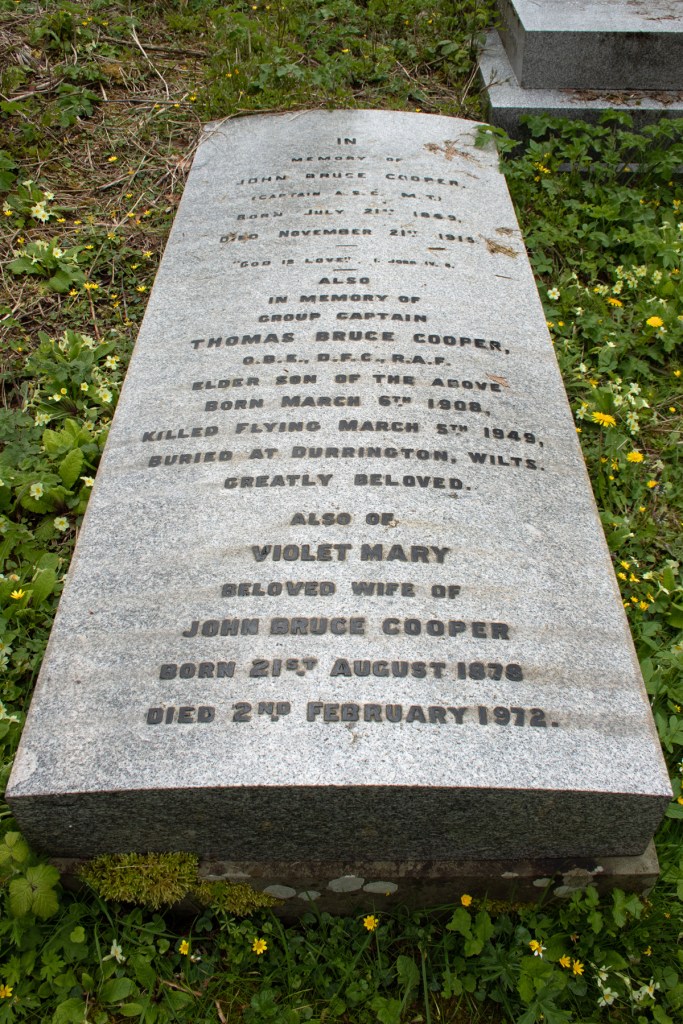
John Bruce Cooper was born on 21st July 1869 in Croydon, Surrey. He was the oldest of eight children, all but one boys, to John and Maria Cooper. John Sr was a boot and shoe manufacturer whose business, by the time of the 1881 census, was employing around 600 people.
By 1901, the business was doing well. The family had moved to Northamptonshire, and were living at Delapré Abbey, on the outskirts of Northampton. They were now supported by fourteen servants living on site, while grooms, coachmen and gardeners were housed on the estate.
John Sr died in August 1906, while Maria passed away less than six months later. Their children, now aged between 25 and 37, went on to live their separate lives. Five of John Jr’s brothers remained in bootmaking, in Leicestershire, Northamptonshire and Surrey, while one of them, Philip, took holy orders. John, however, sought a different route.
In April 1907, John married Violet Mary Gordon in Kensington, London. She was the daughter of a general in the Indian Army, and had been born in Simla. The couple settled in a house in Basingstoke, Hampshire, and went on to have two children: Thomas and Richard. The 1911 census records the family residing in Daneshill Cottage, with two live-in domestics. By this point John was noted as being a dealer in motor cars.
When war broke out, John felt duty bound to serve his country. Little information about his military career remains documented, but a contemporary newspaper report of his funeral provides some indication of his service.
Captain Bruce Cooper… was formerly an officer of Territorial [Royal Army Medical Corps], being transport officer of the 2nd South-Western Mounted Brigade, and was stationed at Frome [Somerset]. Obtaining a commission in the [Army Service Corps], he was promoted captain, and was so proficient and zealous that he became Officer Commanding Vehicles at Bulford Camp, where he was held in the greatest esteem.
Bath Chronicle and Weekly Gazette: Saturday 27th November 1915
Captain Cooper fell ill in October 1915, and was suffering from phlebitis, or inflammation the veins. This was to prove fatal, and he passed away at the family home in Bath, Somerset, on 21st November 1915. He was 46 years of age.
John Bruce Cooper was laid to rest in a family plot in the cemetery of Bath Abbey. His older son, Thomas was laid to rest with him, when he passed away in 1949. Violet was reunited with her husband and son when she was buried with them in 1972.
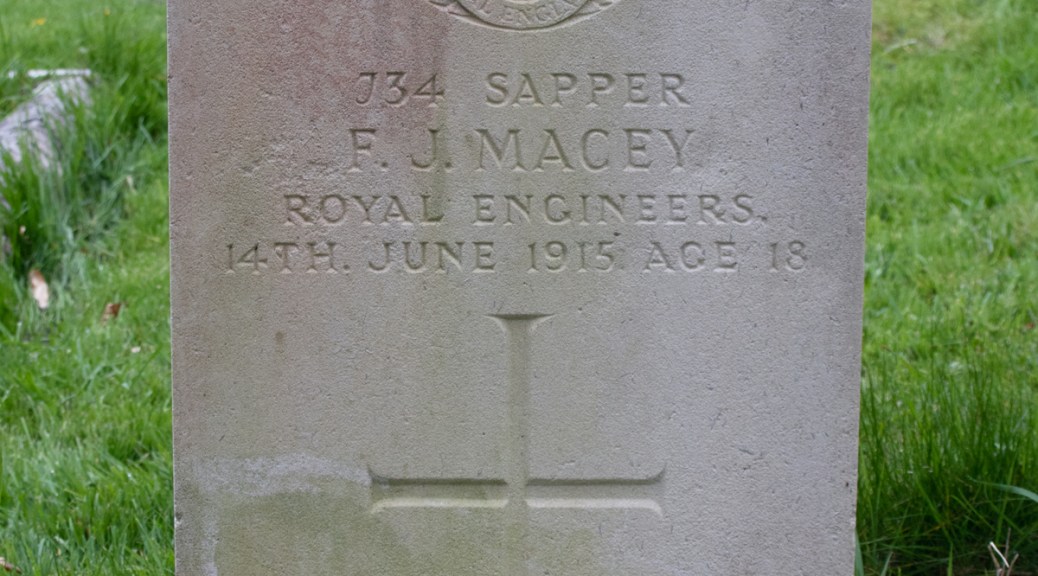
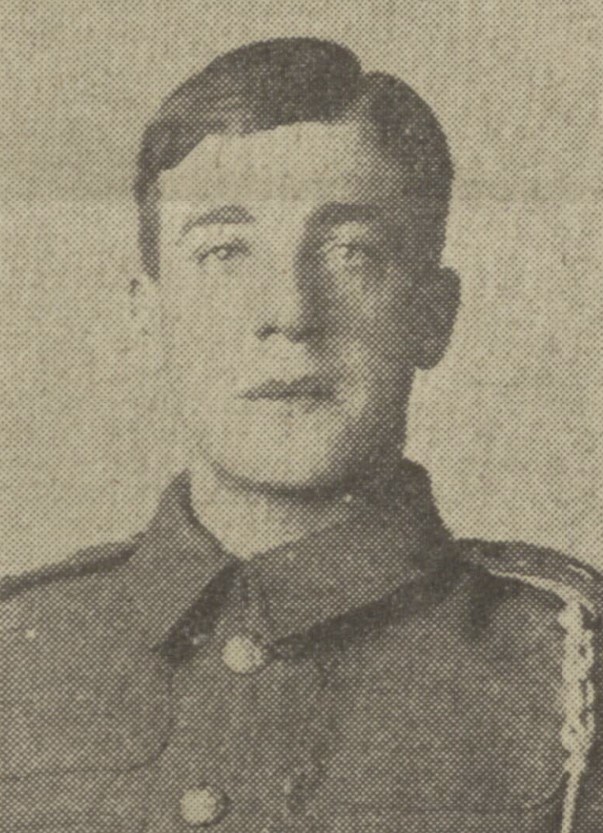
Frederick John Macey was born in the spring of 1897, the fourth of five children to James and Rose. James was a labourer from Hampshire, Rose was born in Ireland, but the children were born and raised in Monkton Combe, Somerset.
When war broke out, Fred stepped up to play his part. He enlisted in the Royal Engineers, and was assigned to the 503rd Field Company. Full details of his military service are lost to time, so it is not possible to identify whether Sapper Macey served overseas – Malta, where part of the regiment were based – or on home soil – in and around Ipswich, Suffolk.
Wherever he was based, Fred was injured, and he was sent to a military hospital in Guildford, Surrey, for treatment. Sadly, his wounds were to prove too severe, and he passed away on 14th June 1915, aged just 18 years old.
Frederick John Macey’s body was brought back to Somerset for burial. He was laid to rest in the peaceful graveyard of St Michael’s Church, in his home village of Monkton Combe.
Sapper John Macey (from britishnewpaperarchive.co.uk)
Albert Edward Taylor was born in the autumn of 1887 and was the fifth of eight children to John and Mary Taylor. John was a mason and both he and Mary came from Crewkerne, Somerset, which is where they raised their family.
Albert worked as an errand boy when he left school, but he sought a career and, enlisted in the Army Service Corps in July 1904. He lied about his age to join up, suggesting he was nearly 22, where he was actually just 17 years of age.
Driver Taylor’s service records confirm that he was 5ft 3ins (1.6m) tall and weighed 115lbs (52.2kg). He was noted as having brown hair, blue eyes and a fresh complexion. He had a mole between his shoulder and the back of his neck, and his religion was recorded as Baptist.
Albert’s contract was for two years’ service, followed by ten years in the Army Reserve. While a military career was what he sought, he seems to have had a disregard for rules, and regularly had run ins with authority, as his Regimental Defaulter Sheet testifies.
On 19th December 1904, while based in Woolwich, Surrey, he was absent without a pass from 6am until 12:15am on 30th December. He was confined to barracks for eight days.
The following year, Driver Taylor had moved to Bordon in Hampshire. On 28th November 1905, he was absent without a pass, from midnight until 8:30am on 1st December. He was again confined to barracks, this time for ten days.
A third offence came on 29th May 1906, by which time Albert had moved to Aldershot, Hampshire. He was found in neglect of duty ‘in allowing dirty pudding cloths to be deposited in the cupboards of the cookhouse’ and being ‘absent from work from 1:30pm till found in his barrack room at 9:20pm.’ For these, he was confined to barracks again, this time for eight days.
Within a matter of weeks, he was found in neglect of duty again, having broken out ‘of barracks after tattoo and remaining absent till apprehended by the Military Police at about 10:50pm’ and being ‘drunk and improperly dressed.’ This time the punishment was more severe and he was detained in prison for 96 hours.
Unsurprisingly, Albert’s military career didn’t go much further than this. When his two-year contract came to an end, he returned to Somerset and found employment as a mason.
In July 1910, Albert married Mabel Wallbridge, the daughter of a carman, also from Crewkerne. The couple set up home on the outskirts of the town, and went on to have a son, Frederick, who was born later that year.
The 1911 census found the young family living in a cottage in Lye Water, with Albert listing himself as a ‘mason (army pensioner)’. While the military reference may have been added with a sense of pride, irony or bloody mindedness, Albert was not to fully leave his army career behind. When war came to Europe in 1914, he was still within his reserve status, and was called up to play his part.
Private Taylor was to leave his family behind: son Frederick had now been joined by daughters Kathleen and Joyce, and Mabel pregnant with another daughter, Rosaline, who was born in January 1915. Albert was assigned to the 1st Battalion of the Somerset Light Infantry and, in contrast to his previous tenure on the Home Front, he soon found himself in the thick of things.
Albert’s regiment was involved in some of the fiercest opening skirmishes of the First World War, and he would have been caught up on the Battles of Le Cateau, the Marne, the Aisne and Armentières. By the spring of 1915, the battalion was entrenched at Ypres, and it was here during the Battle of St. Julien that Private Taylor was injured.
Albert has received a gun shot wound to the left side of his skull and was medically evacuated to Britain for treatment. He was admitted to the Beechfield House Hospital in Southampton, but his wounds proved too severe, and he passed away on 14th May 1915, at the age of 27 years old.
The funeral of Private Albert Edward Taylor, of the Somerset Light Infantry… who died from wounds received at the Front, took place with military honours at the Cemetery [in Crewkerne] on Tuesday afternoon, and attracted a large attendance. As a mark of respect to the memory of the deceased soldier blinds were drawn at the private and business houses en route to the Cemetery, while the flag erected outside the Victoria Hall for the children’s Empire-day celebration was lowered to half-mast.
Rev. J Street (Unitarian Minister)… spoke of the painful circumstances and the heroic conduct of the deceased, who had sacrificed his life for others. Although death was attended with pain and sorrow, yet in after years deceased’s children would look back with pride to the part their father took in the present war.
Taunton Courier and Western Advertiser: Wednesday 26th May 1915
Albert Edward Taylor was laid to rest in the cemetery of his home town, Crewkerne.
Private Albert Taylor (from findagrave.com)
Albert’s headstone gives his initials as AC Taylor. They should be AE Taylor.
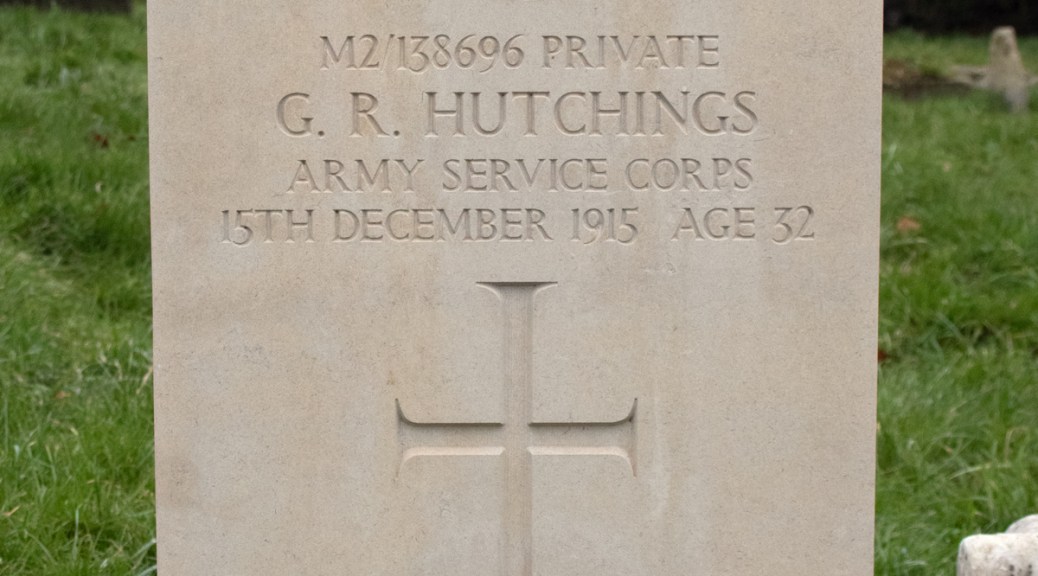
George Robert Hutchings was born towards the end of 1883 in Forest Gate, Essex. He was the oldest of four children to George and Mary Ann Hutchings. George Sr was a labourer for the railways, and this led to the family relocating to Swindon, Wiltshire, in the 1890s.
George Jr took up work with the Great Western Railway when he left school, while his father switched employment and, by the time of the 1911 census, he was working as a collector for a clothing supply company.
On 13th July 1911, George Jr married Daisy Smale in the Sanford Street Congregational Church, Swindon. Daisy was a school teacher, and was the daughter of an iron moulder. It is likely that the couple met through George’s workplace. The newlyweds had a son, Raymond, who was born in 1914 and, at some point moved to Bath in Somerset.
When war came to Europe, George stepped up to play his part. He enlisted in the Royal Army Service Corps and, unsurprisingly, given the work he was doing, was assigned to the Mechanical Transport division. Little information about his military service remains, but is it clear that he had enlisted in the second half of 1915.
The next available record for Private Hutchings is that of his passing. He had been admitted to the Royal Herbert Hospital in Woolwich, South East London, and died there on 15th December 1915. No cause for his death is evident, but he was 32 years of age.
George Robert Hutchings was brought back to Somerset for burial. He was laid to rest in Bath’s St James Cemetery.
When her husband died, Daisy was pregnant. In March 1916 she gave birth to a daughter, Winifred, who was never to know her father.
Daisy never remarried. By the time of the 1939 register, she was living in Northampton Street, Bath, sharing the house with a Mr and Mrs Spreadbury. Her employment was listed as unpaid domestic duties.
Daisy and George’s son Raymond was focused on his education. He made an eventual move to Birmingham, where, at the outbreak of war, he was working as a research chemist. He died in Bath in 1982, at the age of 68.
Winifred married grocer Kenneth Batten in Bath in 1938. The couple had three children and emigrated to Australia after the war, and settled in Coffs Harbour, New South Wales. Kenneth died in 1988, at the age of 72; Winifred died in 2003, aged 87.










 Death and Service