Joseph Arthur Barnes was born in the spring of 1887, and was the youngest of four children to George and Hannah Barnes. George was a farm labourer from Longbridge Deverill, Wiltshire, and this is where he and Hannah – or Anna – raised their family.
When he completed his schooling, Joseph found work as a horseman on the farm, alongside his older brother, George. On 30th July 1913, he married Minnie Ring, a furniture maker’s daughter from the village. The couple exchanged vows in the parish church.
War was on the horizon, and a little over a year after their marriage, Joseph stepped up to play his part. He joined the Wiltshire Regiment and was assigned to the 3rd Battalion. Private Barnes was sent to Dorset for training, but his time in the army would not be a lengthy one.
Joseph contracted pneumonia, and was admitted to hospital in Weymouth. The condition would provide to severe, however, and he passed away on 9th April 1915: he was 27 years of age.
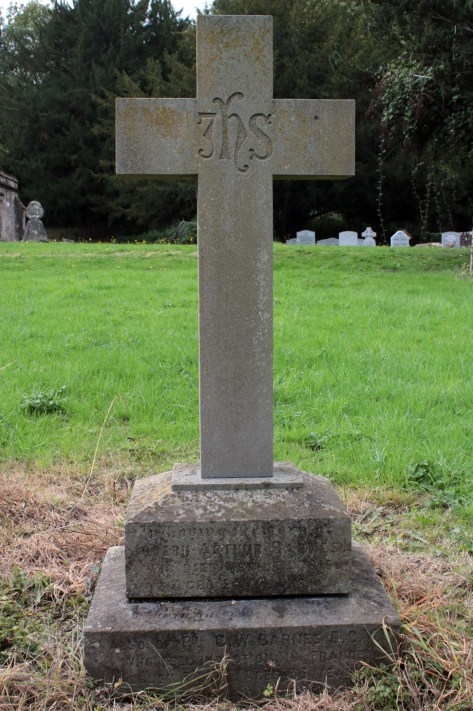
The body of Joseph Arthur Barnes was taken back to Wiltshire for burial: he was laid to rest in the tranquil surrounds of St Peter & St Paul’s Church, Longbridge Deverill.
Joseph’s brother George also served in the First World War. Assigned to the 1st Battalion of the Wiltshire Regiment, he served on the Western Front. Private Barnes was killed in action on 5th August 1917, at the age of 33. He is commemorated on the Menin Gate.
Frederick John James was born in Willesden, Middlesex, in the spring of 1890. The oldest of six children, his parents were William and Louisa James. Louisa was William’s second wife, his first, Emily, having died in 1887. Frederick had ten half-siblings from this first marriage.
William was a fishmonger: the 1891 census recorded the family at 159 York Road, Battersea, Surrey. Ten years later, they had moved over the river, and were living to 46 Artizans Dwellings, Hammersmith, Middlesex.
Frederick’s father had passed away by the time of the 1911 census. The document recorded his mother residing at 18 Western Terrace, Notting Hill, Middlesex. She lived with three of her children – Ben, Alice and Grace – and was doing char work to bring in a little money.
Frederick, however, was already carving out a career in the army for himself. The same census recorded him as one of 250 troops billeted in Fyzabad, India, where he was a Private in the 2nf Battalion of the East Yorkshire Regiment.
Private James’ military career lacks some detail, and can only be picked up around the time of his passing. By this point, he had switched regiments, and was a Corporal in the 8th (Service) Battalion of the Somerset Light Infantry. He is also noted as being married to a woman called Frances Esther New: the couple had married in 1913, although there is no other information about her.
In the summer of 1917, Corporal James’ unit was caught up in the fighting at Passchendaele. Frederick was initially reported missing, but was later declared as being killed in action on 4th October 1917. He was 27 years of age.
The body of Frederick John James was laid to rest in the Zandvoorde British Cemetery, Ypres.
Dudley Harry Weedon was born in Islington, Middlesex in the spring of 1891. The second of two children, his parents were solicitor’s clerk Thomas Weedon and his wife, Frances.
When Dudley finished his schooling, he also found work as a clerk. The 1911 census recorded the Weedon family living at a prestigious address – an eight roomed Victorian villa at 59 Canonbury Park North, Islington. Thomas was still employed as a solicitor’s clerk, Dudley as a clerk for a corn merchant, and his older brother, Horace, as a clerk for a mining company.
War came to Europe in the summer of 1914, and Dudley was keen to step up and play his part. He enlisted early on, joining the 1st/2nd County of London Yeomanry, also known as the Westminster Dragoons. The regiment spent most of the war in the Middle East, and by November 1914, Private Weedon found himself in Egypt.
Dudley would spend the next year or so overseas, and was sent to, and evacuated from, Gallipoli. In February 1916, he received a promotion – to the rank of Second Lieutenant – this increase in rank coming with a transfer to the Northumberland Fusiliers. His new unit – the 8th (Service) Battalion – had also served in the Dardanelles, but by that summer they had moved to France.
Second Lieutenant Weedon spent the next eighteen months on the Western Front, fighting at Messines and at Ypres. It was here, possibly at the Battle of Polygon Wood, that Dudley was injured. Details are unclear, but his wounds were sever enough for him to be medically evacuated to Britain for treatment.
Dudley was admitted to a hospital in Roehampton, Surrey, but his injuries were to prove too severe. He passed away on 20th November 1917, at the age of 26 years old.
Dudley Harry Weedon was laid to rest in Highgate Cemetery, not far from his grieving family’s home.
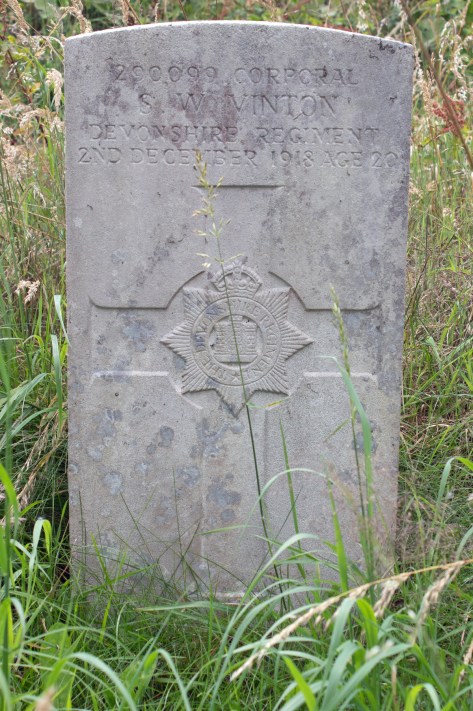
Stanley William Vinton was born on 30th April 1898 in Dartmouth, Devon. The second of eight children, his parents were William and Kate. William was an outfitter’s assistant, and by the time of the 1911 census, the family of ten were living in a four-roomed cottage on South Ford Road.
When he finished his schooling, Stanley was apprenticed to a shipwright. Away from work, he volunteered with the Dartmouth Cadet Company, and was drawn towards an army career. On 25th May 1914, he enlisted, joining the 7th (Cyclist) Battalion of the Devonshire Regiment. His service records show that he gave his age as 17 years and four months old. He was 5ft 6.5ins (1.69m) tall, and weighed 154lbs (69.9kg). Private Vinton was of good physical development and had good eyesight.
Stanley was formally mobilised on 5th August 1914. He remained on home soil for the next three years, primarily because soldiers were unable to fight on the Western Front until they turned 19 years of age. During this time, he appears to have impressed his superiors: in July 1916 he was promoted to Lance Corporal, and just four months later he rose to full Corporal.
In July 1917, Stanley’s chance to see some action arrived, when he was posted to the 2nd Battalion, and sent overseas. This move came with a caveat, however, and he reverted to the rank of Private. It was a challenging time for the regiment, and Stanley quickly found himself in the thick of it at Passchendaele.
On 30th November 1917, after four months on the Western Front, Private Vinton’s luck came to end. Caught up in the fighting, he was wounded in his left thigh by shrapnel and the fingers of his left hand by a gun shot wound. He was medically evacuated to Britain for treatment, and admitted to the Edinburgh War Hospital in Bangour.
Thankfully, the injury to Stanley’s hand was minimal, but his leg took longer to heal, and he remained in hospital for more than two months. When he was discharged, Private Vinton was transferred to the regiment’s command depot in Sutton Coldfield. In March 1918, he was promoted to Corporal, but his injured leg was still causing him discomfort. In the end, he was reassigned to a munitions works in Lowestoft, Suffolk, and this is where he would spend the remainder of the year.
Stanley’s constitution was weakened by this point, and that winter, he contracted influenza. The condition was to prove fatal, and he passed away on 2nd December 1918. He was just 20 years of age.
The body of Stanley William Vinton was taken back to Devon for burial. He was laid to rest in the graveyard of St Clement’s Church, Dartmouth, high above the town’s centre, but within walking distance of his grieving family’s home.
Melbourne Linas Mumford was born on 13th June 1898, and was one of seven children to William and Fanny. William was a Gunner in the Royal Artillery, and while Melbourne and his siblings were born in the Kent village of Cliffe, the family soon moved to rented rooms in Stafford Street, not far from his new barracks in Gillingham, Kent.
It seems that William’s term of service came to an end, and he moved the family to Devon, where he had been born. Fanny died in 1909, at the age of just 33, and he was suddenly left to raise the family alone. The1911 census found William and his three sons – including Melbourne – living in a cottage in Paignton. William was by now working as a nurseryman, while Melbourne’s older brother, also called William, was bringing in some money as a paperboy for Smith & Sons.
When war came to European shores, Melbourne stepped up to play his part. Full service details have been lost to time, but later documents confirm that he had enlisted in the Devonshire Regiment on 9th August 1915. Attached to the 9th (Service) Battalion, papers confirm that he was 5ft 3.5ins (1.61m) tall, and weighed 99lbs (44.9kg).
Private Mumford’s unit fought as Loos in 1915, and at the Somme in 1916, but it was at Ypres, on 7th October 1917, that he was badly injured. Melbourne was shot in the left thigh, which caused a compound fracture in his femur. Medically evacuated to Britain for treatment, he spent time hospitalised in Manchester.
Recuperation was ongoing, but was not to prove successful, and Private Mumford was eventually discharged from the army on 22nd January 1919.
Melbourne’s treatment would continue, however, and he had a further operation on his leg that summer. Tragically, however, his body had been weakened, and he passed away following the procedure, on 27th August 1919. He was just 21 years of age.
The body of Melbourne Linus Mumford was laid to rest in Paignton Cemetery, not far from the family home in Corsham Road.
Private Mumford’s Dependant’s Pension was assigned to Mrs Kate Mumford, who was recorded as his mother. This would suggest that William had remarried after the 1911 census, although there are no records to confirm this.
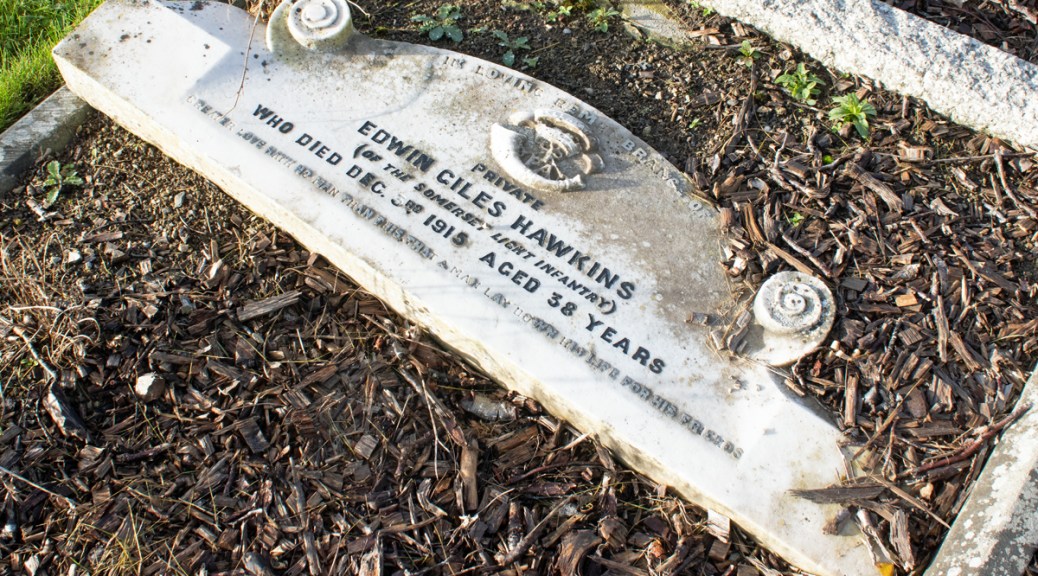
Another sudden death has occurred… when Edwin Giles Hawkins, Divisional Reserve company, 8th Divisional Train, BEF, passed away at the age of 38 years. Deceased… was called up with the National Reserves, and for some time he had been in France. On December 2nd he was granted eight days leave from the Front and arrived at home the same evening. He retired to rest at 10pm, apparently in his proper health. At 5am next morning he called his mother and complained of pains in the stomach. Hot water was applied and a doctor sent for but before the latter arrived he passed away.
Western Chronicle: Friday 10th December 1915
Edwin Giles Hawkins was bornin the autumn of 1877, the oldest of six children to Giles and Elizabeth. Giles had been born in West Coker, Somerset, and the family grew up in the Anchor Inn, Yeovil, where he was the innkeeper and glover.
By the time of the 1891 census, Giles had stepped down as landlord, and the growing family were living in a cottage next to the pub. He was working as a leather dresser and glover, working to feed his wife and five children.
Little information about Edwin’s time in the army before the First World War is available. However, his details are missing from the 1901 census, which would suggest that he was serving overseas at that point.
Edwin was called upon to due his duty once more when war was declared. Joining the Somerset Light Infantry, he was assigned to the 1st Battalion, and, by December 1914, he was in France. Private Hawkins was caught up at Ypres the following spring and returned home on leave in December 1915.
The cause of Private Hawkins’ death was recorded as being heart failure. As the newspaper report noted, he was 38 years of age.
Edwin Giles Hawkins was laid to rest in Yeovil Cemetery, a short walk from where his parents still lived.
Herbert Perry was born in Sampford Brett, Somerset, on 2nd July 1887. One of fifteen children, his parents were Henry and Mary Perry. Henry was a groom and gardener, and the family were raised in a small cottage in the centre of the village.
Herbert and his siblings attended the local Church of England school, but once he finished his education his own trail goes cold. The next records relate to his military service, although they are also a bit scarce.
What is clear is that Herbert enlisted early in the war. He joined the 1st Battalion of the Devonshire Regiment, and was in France as soon as January 1915. Private Perry found himself at Ypres, and it was here, in July, that he was badly injured.
Private Perry was medically evacuated to Britain for treatment, and he was admitted to the 5th Northern General Hospital in Leicester. Sadly, this was to be where he would breathe his last: his wounds were to prove too severe, and he succumbed to them on 1st August 1915. He had not long turned 28 years of age.
Herbert Perry’s body was taken back to Somerset for burial. He was laid to rest in the family plot in the peaceful graveyard of St George’s Church. There he was reunited with his mother, Mary, who had died three years before.
Herbert’s older brother, William, joined the Duke of Cornwall’s Light Infantry when war broke out. Assigned to the 1st Battalion, he rose to the rank of Lance Corporal. William fought at the Somme, and was killed there. He is commemorated at the Thiepval Memorial, and remembered on the family headstone in Sampford Brett.
Charles Sainsbury Bagley was born in the autumn of 1889, one of eleven children to Benjamin and Jane Bagley. The couple’s early life was an intriguing one: they had both been born in Shoreham-by-Sea, West Sussex. The 1891 census recorded the couple living on board the barque Mizpah, with their three oldest children. Benjamin was the vessel’s master and there were ten other members of crew on board.
By the time Charles was born, the family had returned to shore and settled in Minehead, Somerset. By now Benjamin was working as a hairdresser and tobacconist on Park Street near the centre of the town.
Benjamin died in 1910, but left a thriving business to support Jane. At least three of the Bagley siblings went into hairdressing, while Charles’ older brother, Joseph, set up a bakery and confectioner’s in the town with his wife. Charles is absent from the 1911 census, although later records would suggest that he had moved to Lancashire, where he was also working as a hairdresser.
On 3rd July 1915, Charles married Celia Rogers in Lancaster. War was raging across Europe at this point and, in August 1916, he enlisted in the army. His service records confirm that he was 5ft 7.5ins (1.71m) tall and weighed 128lbs (58kg). Private Bagley joined the 5th Battalion of the King’s Own (Royal Lancaster Regiment) and by the end of the year he was on the Western Front, based around the Ypres salient.
The early part of 1917 proved relatively quiet for Private Bagley’s troop. At the end of July, however, he was caught up in the battle of Pilkem Ridge, and was shot in his left leg. Initially treated on site, the wound was severe enough for him to be medically evacuated to Britain for treatment.
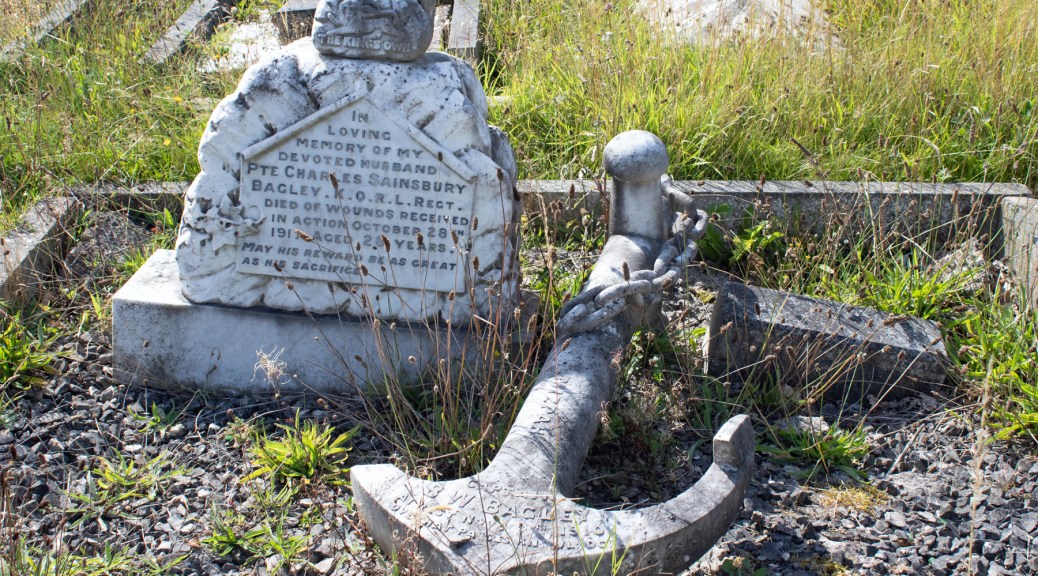
Charles was admitted to the Royal Surrey County Hospital in Guildford, but his wounds were to prove to be too severe. He passed away on 28th October 1917, at the age of 27 years old.
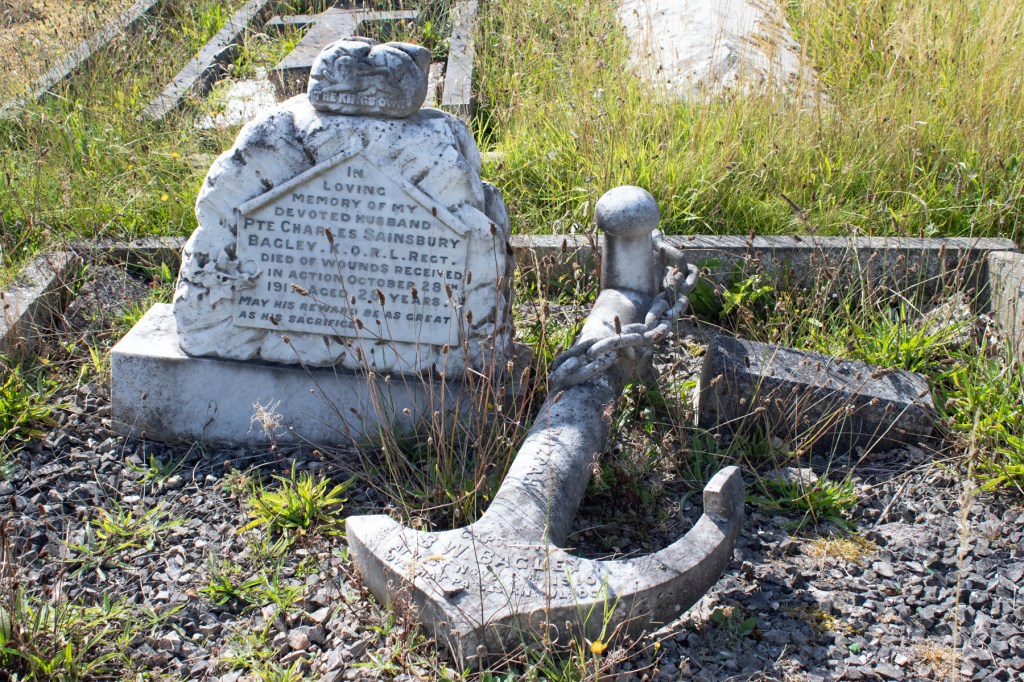
The body of Charles Sainsbury Bagley was taken back to Somerset for burial. He was laid to rest in the family plot in Minehead Cemetery, reunited with his parents, Jane having died at the beginning of 1917. The seafaring headstone paid homage to his father’s maritime service.
Albert Edward Taylor was born in the autumn of 1887 and was the fifth of eight children to John and Mary Taylor. John was a mason and both he and Mary came from Crewkerne, Somerset, which is where they raised their family.
Albert worked as an errand boy when he left school, but he sought a career and, enlisted in the Army Service Corps in July 1904. He lied about his age to join up, suggesting he was nearly 22, where he was actually just 17 years of age.
Driver Taylor’s service records confirm that he was 5ft 3ins (1.6m) tall and weighed 115lbs (52.2kg). He was noted as having brown hair, blue eyes and a fresh complexion. He had a mole between his shoulder and the back of his neck, and his religion was recorded as Baptist.
Albert’s contract was for two years’ service, followed by ten years in the Army Reserve. While a military career was what he sought, he seems to have had a disregard for rules, and regularly had run ins with authority, as his Regimental Defaulter Sheet testifies.
On 19th December 1904, while based in Woolwich, Surrey, he was absent without a pass from 6am until 12:15am on 30th December. He was confined to barracks for eight days.
The following year, Driver Taylor had moved to Bordon in Hampshire. On 28th November 1905, he was absent without a pass, from midnight until 8:30am on 1st December. He was again confined to barracks, this time for ten days.
A third offence came on 29th May 1906, by which time Albert had moved to Aldershot, Hampshire. He was found in neglect of duty ‘in allowing dirty pudding cloths to be deposited in the cupboards of the cookhouse’ and being ‘absent from work from 1:30pm till found in his barrack room at 9:20pm.’ For these, he was confined to barracks again, this time for eight days.
Within a matter of weeks, he was found in neglect of duty again, having broken out ‘of barracks after tattoo and remaining absent till apprehended by the Military Police at about 10:50pm’ and being ‘drunk and improperly dressed.’ This time the punishment was more severe and he was detained in prison for 96 hours.
Unsurprisingly, Albert’s military career didn’t go much further than this. When his two-year contract came to an end, he returned to Somerset and found employment as a mason.
In July 1910, Albert married Mabel Wallbridge, the daughter of a carman, also from Crewkerne. The couple set up home on the outskirts of the town, and went on to have a son, Frederick, who was born later that year.
The 1911 census found the young family living in a cottage in Lye Water, with Albert listing himself as a ‘mason (army pensioner)’. While the military reference may have been added with a sense of pride, irony or bloody mindedness, Albert was not to fully leave his army career behind. When war came to Europe in 1914, he was still within his reserve status, and was called up to play his part.
Private Taylor was to leave his family behind: son Frederick had now been joined by daughters Kathleen and Joyce, and Mabel pregnant with another daughter, Rosaline, who was born in January 1915. Albert was assigned to the 1st Battalion of the Somerset Light Infantry and, in contrast to his previous tenure on the Home Front, he soon found himself in the thick of things.
Albert’s regiment was involved in some of the fiercest opening skirmishes of the First World War, and he would have been caught up on the Battles of Le Cateau, the Marne, the Aisne and Armentières. By the spring of 1915, the battalion was entrenched at Ypres, and it was here during the Battle of St. Julien that Private Taylor was injured.
Albert has received a gun shot wound to the left side of his skull and was medically evacuated to Britain for treatment. He was admitted to the Beechfield House Hospital in Southampton, but his wounds proved too severe, and he passed away on 14th May 1915, at the age of 27 years old.
The funeral of Private Albert Edward Taylor, of the Somerset Light Infantry… who died from wounds received at the Front, took place with military honours at the Cemetery [in Crewkerne] on Tuesday afternoon, and attracted a large attendance. As a mark of respect to the memory of the deceased soldier blinds were drawn at the private and business houses en route to the Cemetery, while the flag erected outside the Victoria Hall for the children’s Empire-day celebration was lowered to half-mast.
Rev. J Street (Unitarian Minister)… spoke of the painful circumstances and the heroic conduct of the deceased, who had sacrificed his life for others. Although death was attended with pain and sorrow, yet in after years deceased’s children would look back with pride to the part their father took in the present war.
Taunton Courier and Western Advertiser: Wednesday 26th May 1915
Albert Edward Taylor was laid to rest in the cemetery of his home town, Crewkerne.
Private Albert Taylor (from findagrave.com)
Albert’s headstone gives his initials as AC Taylor. They should be AE Taylor.
Alfred John Edward Lansdell was born on 25th October 1882 in Fulham, London. The fourth of six children, his parents were James and Matilda Lansdell.
James was a trunk maker, working in his father’s business. By the time of the 1901 census, he was recorded as living by his own means, while Alfred had taken up employment as a hotel porter in Chelsea.
By 1902, Alfred had moved to Somerset and set up home in Bath. He married local woman Alice Stevenson, and the couple went on to have a daughter, Lena, who was born in November 1904.
The 1911 census found the family living in central Bath, Alfred continuing his portering work, with one of his colleagues, lift operator Thomas Ward, boarding with them.
War came to Europe and on 9th December 1915, Alfred stepped up to play his part. He enlisted in the Worcestershire Regiment, and was formally mobilised the following June. Alfred’s service records confirm that he was, at the time of his review, he was 35 years old and 5ft 6ins (1.67m) tall.
Private Lansdell was assigned to the 1st/7th Battalion and by October 1916, he was shipped to France. He was very much on the Front Line, and was wounded on 19th August 1917, while at Ypres. His casualty record notes that “while waiting in a shell hole for a further move on he was wounded… in the back”. He has been shot, and the bullet penetrated his kidney.
Initially treated in a hospital in France, Private Lansdell was transferred to England on 25th October. He was admitted to the Norfolk War Hospital and remained there for some time.
Alfred’s injuries were too severe for him to continue in the army, and he was formally discharged on 20th March 1918. He eventually returned home to Bath, but in the end his poor health was to get the better of him. He passed away at home on 28th September 1918, at the age of 35.
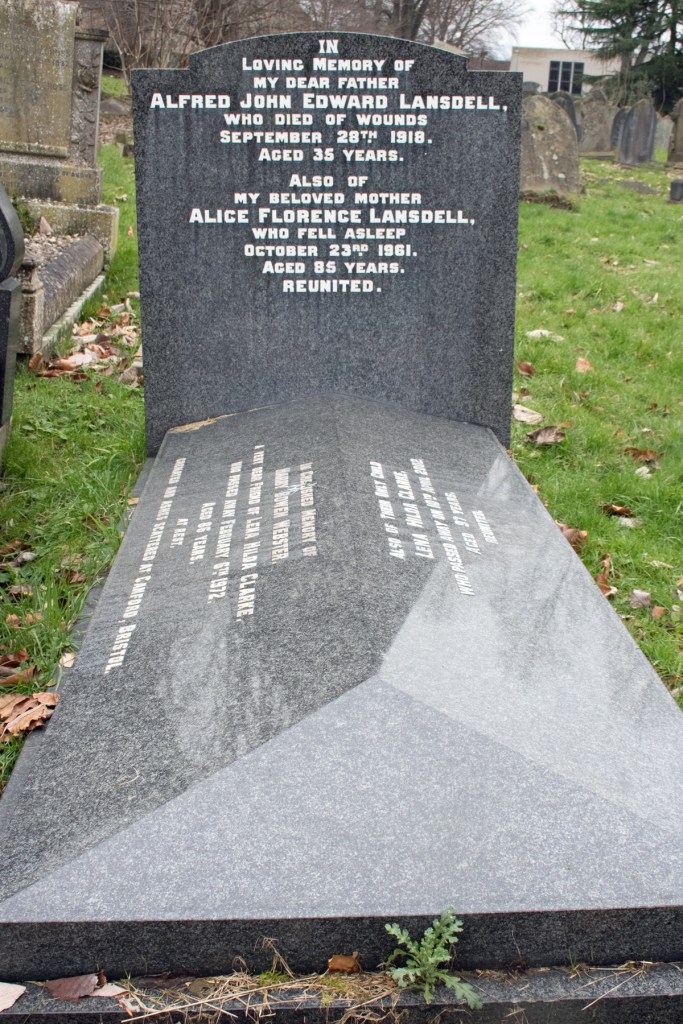
Alfred John Edward Lansdell was laid to rest in St James’ Cemetery, Bath. Alice lived on until 1961, when she was buried with her late husband, a couple reunited after more than four decades.








 Death and Service