All posts by ckponderings

Rifleman Frederick Avards

Rifleman Frederick Avards

Frederick John Avards was born in Lamberhurst, Kent, in the summer of 1891. The oldest of three children, his parents were Frederick and Lucy Avards. Frederick Sr was a licenced publican and went on to run the Beckingford Arms in Tovil, near Maidstone.

Frederick Jr helped his father with the business, but when war came to Europe, he stepped up to play his part. He enlisted on 1st January 1915, joining the 7th (Service) Battalion of the King’s Royal Rifle Corps.

Rifleman Avards was sent to France on 19th May 1915 and very quickly found himself in the thick of things. Based on the Western Front, his regiment was involved in a number of skirmishes during the Battle of the Somme.

Last week [Rifleman Avards’] parents received a telegram stating that he was lying at the Royal Victoria Hospital, Netley, dangerously wounded. They at once proceeded to Netley but only to find that he had passed away.. Meanwhile his lieutenant, knowing he had been hit and thinking he had been killed on the battlefield, had written a feeling letter to the parents, saying his gallantly he had done his duty and that he had died a true rifleman’s death in the hour of victory, and worthily upheld the name of his regiment.

Kent Messenger & Gravesend Telegraph: Saturday 9th September 1916

Rifleman John Avards had passed away from his injuries on 3rd August 1916: he was just 24 years of age. His body was brought back to Kent for burial and he was laid to rest in the graveyard of St Peter & St Paul’s Church in Aylesford, Kent, not far from the Lower Bell public house, which his parents were then running.


Rifleman Frederick Avards
(from britishnewspaperarchive.co.uk)

While buried in the churchyard, the location of Frederick’s grave is not known. Instead, he is commemorated on a joint headstone in the First World War section of the graveyard.


Private Frederick Johnson

Private Frederick Johnson

Frederick Leonard Johnson was born in the spring of 1898, in Wandsworth, South London. His parents are recorded as Frederick and Catherine Johnson, although no other information about his early life remains.

On 16th February 1918, Frederick married Winifred Peters. She was a dock labourer’s daughter from Aberavon in Glamorganshire, and the couple wed at the parish church in the town. The marriage certificate confirms that Frederick was living in Port Talbot and working as a carpenter. It also notes that his father had died by this point.

It seems likely that the young couple married because Winifred was pregnant. The couple had a son, who they called Frederick, on 1st August 1918.

Frederick had enlisted in the army by this point. While his service records no longer exist, he joined up at some point towards the end of the war – no earlier than May 1918 – and was assigned to the 3rd (Reserve) Battalion of the Gloucestershire Regiment. This was a territorial force, and Private Johnson would have been based in Kent as part of the Thames and Medway Garrison.

Little else is known about Frederick’s service. The only other thing that can be confirmed is that he was admitted to the Preston Hall Military Hospital in Aylesford, Kent, in the autumn of 1918, suffering from a combination of influenza and pneumonia. Sadly, the lung conditions were to get the better of him and he passed away on 27th November 1918, at the age of just 20 years old.

Frederick Leonard Johnson was laid to rest in the graveyard of St Peter and St Paul’s Church, Aylesford, not far from the hospital in which he had passed. It is unclear whether he ever met his son.


Lance Serjeant John Whiddett

Lance Serjeant John Whiddett

John Whiddett was born in Hammersmith, Middlesex, in 1892, and was one of thirteen children to Alfred and Mary Ann Whiddett. Alfred was a house painter while Mary Ann worked as a charwoman to bring in some additional money for the growing family.

John worked as a porter when he left school, but when war came to Europe, he stepped up to play his part. He enlisted in the Wiltshire Regiment in the summer of 1915, and was assigned to the 3rd (Reserve) Battalion.

While Private Whiddett served in France, he returned to Britain, and promoted to Corporal and then Lance Serjeant. His battalion eventually formed part of the Thames & Medway Garrison. Frederick found himself in Kent by the autumn of 1917 and served out the remainder of the war there.

At some point during the autumn of 1918, Lance Serjeant Whiddett fell ill. He was admitted to the Preston Hall Military Hospital in Aylesford, suffering from a combination of influenza and pneumonia. Sadly he was not to survive these lung conditions, and he succumbed to them on 22nd November 1918. He was just 26 years of age.

Finances may have restricted John’s family’s ability to bring his body back to Middlesex. Instead, he was laid to rest in the graveyard of St Peter and St Paul’s Church in Aylesford, Kent.


Private Frederick Neale

Private Frederick Neale

In a quiet corner of St Peter & St Paul’s Churchyard in Aylesford, Kent, is a headstone dedicated to 35013 Private F Neale of the Gloucestershire Regiment. The memorial confirms that he died on 24th November 1918, but little more information remains on his life.

The Army Record of Soldiers’ Effects confirms his first name as Frederick, but that he was not eligible for the War Gratuity payment, which suggests that he had less than six months’ service when he passed.

The document also confirms that he was assigned to the 3rd Battalion of the Gloucesters, and that he had passed away at the Preston Hall Military Hospital in Aylesford. There is no next of kin of beneficiary for his personal effects, and so the trail goes cold.

With no age or date of birth it is impossible to trace any further details for Frederick. No other military records survive, nor is there any note of his passing or funeral in contemporary newspapers. Frederick Neale’s life is destined to remain lost to time.


Private Michael Barton

Private Michael Barton

Michael Barton was born in the spring of 1863 in the Kent village of Hadlow. The youngest of three children, his parents were farm labourer William Barton and his wife Annie. Michael became a farm labourer when he left school and, when William died in 1890, he remained at home to support his mother.

Annie passed away in 1905, and this proved a turning point for Michael. By the time of the next census in 1911, he was recorded in the Tonbridge Union Workhouse, one of its 600 inmates.

Michael’s trail is harder to pick up at this point. Despite his age, it seems that he sought a way out of his situation when war broke out and had certainly enlisted in the army by the last year of the conflict. Initially joining the Royal Defence Corps, Private Barton was soon transferred to the Labour Corps, and was assigned to 572nd Agricultural Coy.

The next document relating to Michael is that of his passing. He died on 17th December 1918 at the Preston Hall Military Hospital in Aylesford, Kent, although the cause of his death is not readily available. He was 55 years of age.

Michael Barton was laid to rest in the graveyard of St Peter & St Paul’s Church in Aylesford, not far from the hospital in which he had passed.


The Army Register of Soldiers’ Effects records that Michael’s belongings passed to a Miss Kate Burley when he died. Not one of his immediate relatives, it is likely that she was a friend or other relation.


Acting Bombardier Charles Barden

Acting Bombardier Charles Barden

In the First World War section of St Peter and St Paul’s Churchyard, Aylesford, is the grave of Charles Henry Barden. Born in the summer of 1888 he was the sixth of seven children to Isaac and Harriett Barden. Isaac was a stoker at the local cement works, and this was an industry Charles’ brothers went into.

As for Charles, however, his life is more of a mystery, and it is possible to build a picture of him only from the snippets that are left behind. Even his full name is lost to time – his headstone is dedicated to CHV Barden, but what the V stands for is now unclear.

Absent from the 1911 census, what is known is that Charles’ father died in 1914 and that in August that year, Charles enlisted in the Royal Field Artillery. Driver Barden was sent to France within weeks of the declaration of war and, during the conflict he rose to the rank of Acting Bombardier.

In the spring of 1917, Charles married Angelina Pudney, who had been born in Rochford, Essex. The couple had twin daughters – Sarah and Emily – the following year, although tragically Sarah passed away before her first birthday.

It is unclear when or if Charles was demobbed when the Armistice was declared. He passed away at home on 29th March 1920, at the age of just 31 years old.

Charles Henry V Barden was laid to rest in the graveyard of St Peter and St Paul’s in his home village.


Angelina found happiness again after her husband’s death. She married again, to Alfred Hughes, in the spring of 1923.


Charles’ older brother George also fought in the First World War. He enlisted in the 1st Battalion of the Royal West Kent Regiment, and was killed in the fighting at Ypres. He was 36 years old when he died, and is commemorated on the Menin Gate.


Private Arthur May

Private Arthur May

The life of Arthur May is a difficult one to uncover. Born in Aylesford, Kent, in the summer of 1879, he was baptised on 10th August, and only his mother’s name – Eliza May – recorded.

There is a record of an Arthur May from Aylesford in the 1881 census, but that gives his mother’s name as Ann (and the father’s as labourer William May). Twenty years later, the same Arthur may is listed as boarding with his sister and brother-in-law’s family in Halling, Kent, where he was working as a labourer in the local cement works. Again, however, it is impossible to confirm that this Arthur May is the one being sought.

Further records identify Arthur’s wife as a woman called Annie, although no marriage records remain to confirm a union.

Details of Private May’s war service is pretty limited, but he seems to have enlisted in the Devonshire Regiment in February 1917. He subsequently transferred to the 167th Coy Labour Corps and was sent to France, but returned to Britain a month later, having fallen ill. His condition turned out to be tuberculosis and he was medically discharged from the army in August 1917.

Private May’s medical report adds some tantalising detail to his military service. He is recorded as being 39 years and one month old, 5ft 9ins (1.75m) tall, with a pale complexion, blue eye and light brown hair. He had a tattoo on his left forearm and was working as a labourer, while living in Ditton, near Maidstone, in Kent.

The report also suggests that Arthur had initially enlisted in the Royal Naval Volunteer Reserve in November 1915. It notes that he was frequently disabled with shortness of breath and a cough during his fourteen months with the navy.

Arthur returned home after his discharge. While his trail goes cold, it is likely that his lung condition continued to dog his civilian life. On 6th July 1919, he passed away and, although no cause is freely recorded, as there is a lack of comment in contemporary local newspapers, illness would be a possible cause. He was 40 years of age.

Arthur May was laid to rest in the graveyard of his local church, St Peter’s & St Paul’s in Aylesford, Kent.


Private John Poignand

Private John Poignand

John Francis Poignand was born in St Brelade, Jersey in 1885. The oldest of four children, his parents were farmers Jean and Louisa Poignand. John followed his parents into farming and moved to nearby St Lawrence.

It was here that he met and married farmer’s daughter Lydia Helleur. The couple set up home in St Lawrence, and went on to have two children, John and Clarence.

War was closing in on Jersey’s shores and, when the call came, it seems that John was keen to play his part. Sadly, full details of his military service have been lost to time, but what remains confirms that he had enlisted in the Wiltshire Regiment by the spring of 1918.

Private Poignand was assigned to the 3rd (Reserve) Battalion, a territorial force that remained on the British mainland. He was to be based in Kent, his troop forming part of the Thames and Medway Garrison.

The only other records of John’s service are that of his passing: he had been admitted to the Preston Hall Military Hospital, suffering from a combination of influenza and pneumonia, and these are what were to take his life. Private Poignand died on 26th November 1918, at the age of 33 years old.

John Francis Poignand was laid to rest in the graveyard of St Peter and St Paul’s Church in Aylesford, not far from where he had died.


Lydia went on to marry a man called Robinson. Her trail goes cold, but her and John’s younger son, Clarence, does appear in later records.

Flight Sergeant Poignand served with the Royal Air Force in the Second World War, and was based at Seletar in Singapore. He was taken as a Prisoner of War by the Japanese on 11th March 1942, but there is no other record for him. His PoW record confirms that he was married and living in Romford, Essex, at the time of his capture.


Private William Johnstone

Private William Johnstone

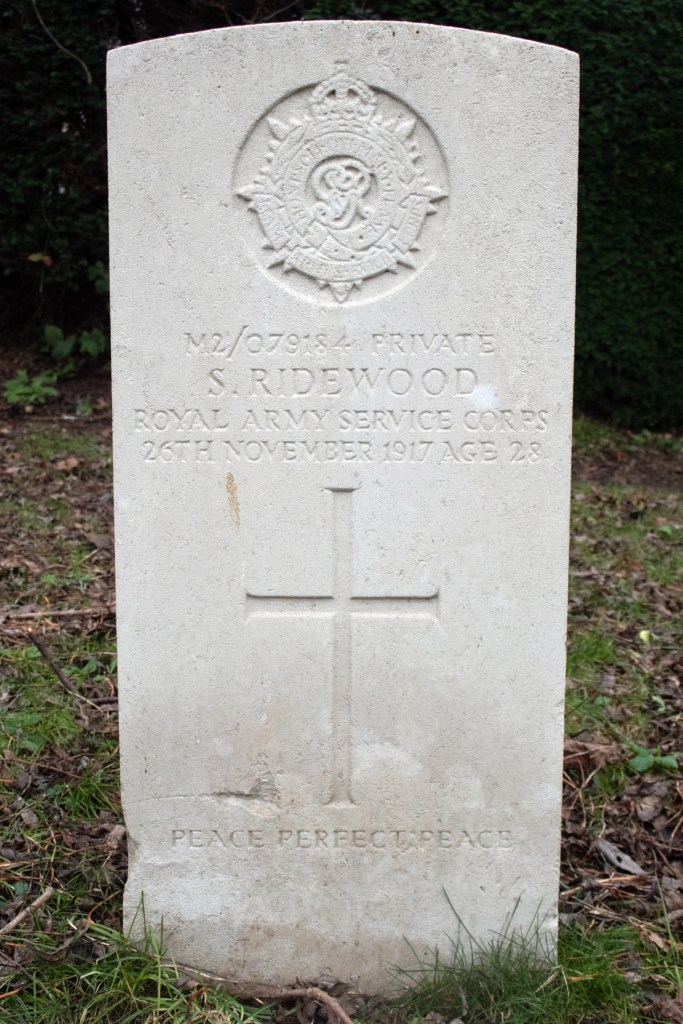
In the First World War section of St Peter and St Paul’s Churchyard in Aylesford, Kent, is a headstone dedicated to T4/174339 Private W Johnstone of the Royal Army Service Corps. Little other immediate information is apparent, and there are no military records available based on his service number.

The Commonwealth War Graves Commission website confirms that Private Johnstone transferred across to the 697th Agricultural Coy of the Labour Corps. He was given another service number – 440640 – and this allows access to a few more strands of his life.

Private Johnstone’s first name was William, and he had a dependent, Mrs CM Gunn, who lived at Moss Fall in Linwood, Paisley. The records, however, add a little more confusion to the story – Mrs Gunn is recorded as U/Wife and a guardian is also noted: Mrs Catherine McDree.

The waters are muddied further by the Army Register of Soldiers’ Effects. While this confirms that William had enlisted by the spring of 1918, it also highlights that his effects and war gratuity were not actually claimed.

With no date of birth for William, it is impossible to narrow down any further details of his early life: there are too many combinations of William and Catherine in the Paisley area to be able to identify them with any confidence.

The only thing that can be confirmed is that Private William Johnstone died from a combination of influenza and pneumonia on 5th November 1918, at the Preston Hall Military Hospital in Aylesford, Kent. He was buried in the nearby churchyard.


Staff Serjeant Henry Dyer

Staff Serjeant Henry Dyer

Henry Charles Dyer was born in January 1865 in the Devon town of Ivybridge. The oldest of five children, his parents were carpenter James and dressmaker Mary Dyer. When he left school, Henry found work as a cordwainer’s apprentice but, after James died in 1886, he sought out a career that would help support his mother.

Henry enlisted in the Army Service Corps on 10th July 1886 and, by the time of the next census was based at barracks in Woolwich, South London. His service records note that he was 5ft 4.5ins (1.64m) tall and weighed 124lbs (56.25kg). He had a dark hair, grey eyes and a dark complexion. He was also noted as having a tattoo of a cross on his left forearm.

Private Dyer served in the regiment on home soil for more than thirteen years, qualifying as a horse collar maker and saddler during this time and rising through the ranks. He was made a Driver in 1889, Corporal in 1895 and Staff Sergeant in October 1899.

Trouble was afoot on the other side of the world by this time and his promotion was linked to Henry being sent to South Africa. He was there for eighteen months, and was awarded the Queen’s South Africa Medal, as well as clasps for service at Tugela Heights, the Relief of Ladysmith, Laing’s Nek, Transvaal and Orange Free State.

Staff Sergeant Dyer went back to Britain in April 1901, where he remained for a further six years. On 4th July 1907, reached the end of his term of service and having completed 21 years with the Army Service Corps he returned to civilian life.

Henry moved back to Devon, moving back in with his mother and younger brother. Mary had remarried after James passed, but her second husband had also passed away, and so having two of her sons home would have been of comfort to her. The 1911 census records the family as living in three rooms of a house in Grenville Street, Plymouth. They shared the property with the Smith family, a husband, wife and two children. Henry was recorded as an army pensioner (saddler), while his brother Ernest was listed as being a watchmaker, while also in the army reserve.

War was on the horizon again, and, Henry was one of the first to step up when it was declared. He was 49 years old by this point, and so technically exempt from enlisting, but as an army life had served him well before, it must have seemed fit for him to serve King and Country once more.

Staff Sergeant Dyer’s new service records noted that he was formally employed as a saddler, and that he had put on 18lbs (8kg) since he initially signed up.

Henry was based firmly on home soil this time round, and while he was initially based in Aldershot, Hampshire, he seems to have been moved to barracks in Kent. He served for more than two and a half years, but his health seems to have been suffering by this point. At a medical on 24th July 1917, he was deemed to be no longer fit enough for war service and was discharged from the army.

It is likely that this discharge came while he was admitted to the Preston Hall Military Hospital in Aylesford. While Staff Sergeant Dyer’s earlier military service is fairly detailed, his later career is not. What is clear is that, four days after being discharged, he passed away. He was, by this time, 52 years of age.

A lack of funds may have prevented Mary from bringing her son home to Devon. Instead Henry Charles Dyer was laid to rest in the graveyard of St Peter and St Pauls Church in Aylesford, not far from the Kent hospital in which he passed.