Category Archives: story

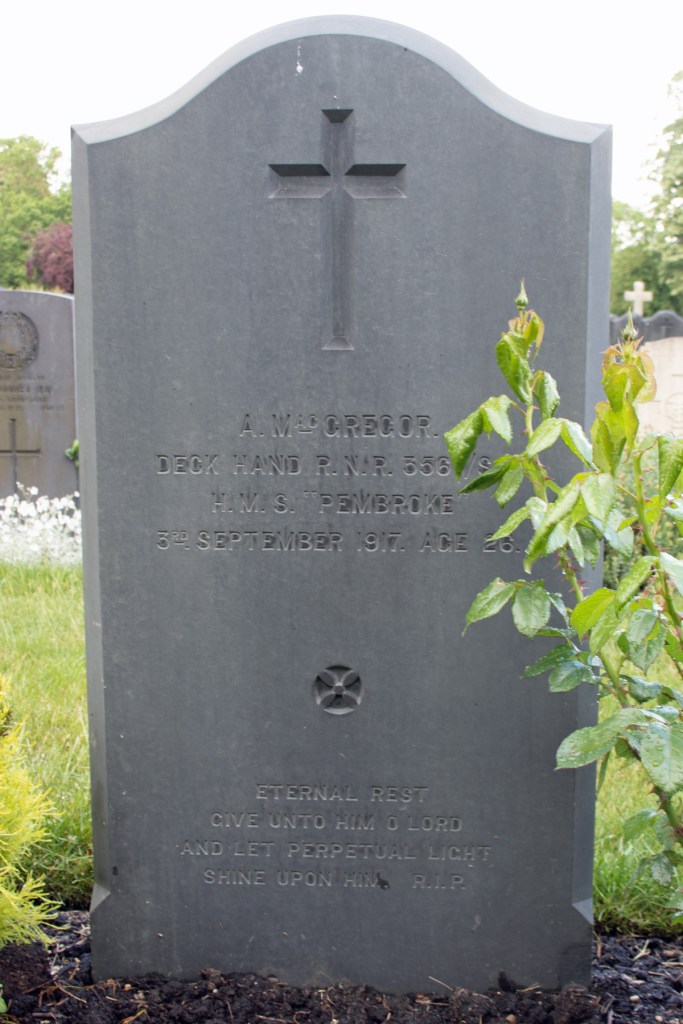
Deck Hand Alexander MacGregor

Deck Hand Alexander MacGregor

Alexander MacGregor was born on 1st January 1890 in the Scottish village of Acharacle. The oldest of eleven children, his parents were Dugald and Mary MacGregor.

There is little concrete information about Alexander’s early life, but, by the outbreak of war, he had moved to London. He married a woman called Bridget in around 1916: the couple settled in Battersea, and went on to have a son, Peter, who was born in December 1916.

Alexander had, by this point, signed up to play his part in the European conflict. He joined the Royal Naval Reserve as a Deck Hand on 1st December 1915. His service records confirm that he was 5ft 7.5ins (1.71m) tall, had grey eyes and a medium complexion. The section of the Royal Navy that he joined suggests that he had had previous sea-faring experience (given the proximity of his home village to the Argyll coast, this is not surprising).

Deck Hand MacGregor’s was assigned to HMS Pembroke, the Royal Naval Dockyard in Chatham, Kent. Details of his military service are unclear, but he spent just under two years at the dockyard. By the summer of 1917, the base was a busy and cramped place, and Alexander found himself billeted in temporary accommodation set up in the barracks’ Drill Hall.

On the night of the 3rd September, the German Air Force conducted the first night time raid on England. Chatham came in the firing line, and the Drill Hall received a direct hit. Deck Hand MacGregor was among those to be killed. He was just 27 years of age.

Alexander MacGregor was laid to rest in the Woodlands Cemetery in nearby Gillingham, along with the other victims of the Chatham Air Raid.


Stoker 1st Class Edmund Walsh

Stoker 1st Class Edmund Walsh

Edmund Walsh was born on 11th September 1884 and was one of eleven children – eleven sons – to James and Christiana Walsh. James was a builder and plasterer from Chelsea, London, while his wife was from nearby Marylebone. The family lived in Treverton Street, North Kensington: by the time of the 1911 census, James and Christina were living in two rooms with seven of their children – the oldest of whom were in their twenties.

Edmund, however, had moved on. The same census found him living in two rooms in Rackham Street, not far from his parents. He was sharing the house with his wife, Lilian Walsh, who he had married five years before, and his brother-in-law, Thomas Culverhouse. All three were bringing in some money – Edmund and his brother-in-law were working as labourers, while Lilian was employed as a shirt machinist.

War was coming to Europe and, in March 1915, Edmund was called upon to play his part. He enlisted in the Royal Navy as a Stoker 2nd Class, and was sent to HMS Pembroke, the Royal Naval Dockyard in Chatham, Kent, for training. Edmund’s service records show that he was 5ft 6ins (1.68m) tall, had auburn hair, grey eyes, a fair complexion and a scar on his left eyebrow.

Stoker Walsh’s first posting was on board the gunboat HMS Halcyon. He served there until 5th September 1915, when he was recorded as “run”. Edmund was caught (or handed himself in, it is unclear) on 13th October, and was sentenced to three months’ detention back at HMS Pembroke.

On his release in January 1916, Stoker Walsh returned to duties at the dockyard, before being given a second posting on board the cruiser HMS Bonaventure. He spent just over a year on board, gaining a promotion to Stoker 1st Class in the process. At the end of his time on board, however, Edmund was again sentenced to detention for being absent from duty. The Bonaventure had returned to HMS Pembroke by this point, and this is where he served 28 days in the cells.

Stoker 1st Class Walsh was released back to duties on 17th June 1917, and remained at HMS Pembroke. The Dockyard was a busy and cramped place that particular summer, and he was billeted to temporary accommodation set up in Chatham Drill Hall.

On the night of 3rd September, the town came under attack from a German air raid, and the Drill Hall received a direct hit. Stoker Walsh was among those to be killed that night. He was a week short of his 32nd birthday.

Edmund Walsh was laid to rest in the Woodlands Cemetery in Gillingham, Kent, alongside the other victims of the Chatham Air Raid.


Stoker 1st Class Edmund Walsh
(from ancestry.co.uk)

Stoker 1st Class Sidney Seymour

Stoker 1st Class Sidney Seymour

Sidney Seymour was born on 5th April 1895 in Islington, London, the son of Elizabeth Seymour. Sadly, as his was a common name in the area, there is little concrete information about his early life, and is it not until his military service that anything specific can be confirmed.

Sidney was working as a clockmaker when he signed up. He enlisted on 29th April 1913, joining the Royal Navy as a Stoker 2nd Class on a twelve year contract.

Sidney was initially sent to HMS Pembroke, the Royal Naval Dockyard in Chatham, Kent. He trained for nine months at the dockyard, before being given his first posting on board the battleship HMS Dominion. Stoker Seymour spent more than three years on board: during this time he was promoted to Stoker 1st Class, but also spent two weeks in the cells for an unrecorded reason.

In July 1917 Sidney returned to HMS Pembroke; that summer was a busy time for the base, and Stoker 1st Class Seymour found himself billeted in overflow accommodation set up in the barracks’ Drill Hall.

On the night of 3rd September, Chatham came under attack from a German air raid, and the Drill Hall received a direct hit. Stoker Seymour was injured, and died of his injuries in hospital the following day. He was 22 years of age.

Sidney Seymour was laid to rest in the Woodlands Cemetery in Gillingham, Kent, alongside the other victims of the Chatham Air Raid.


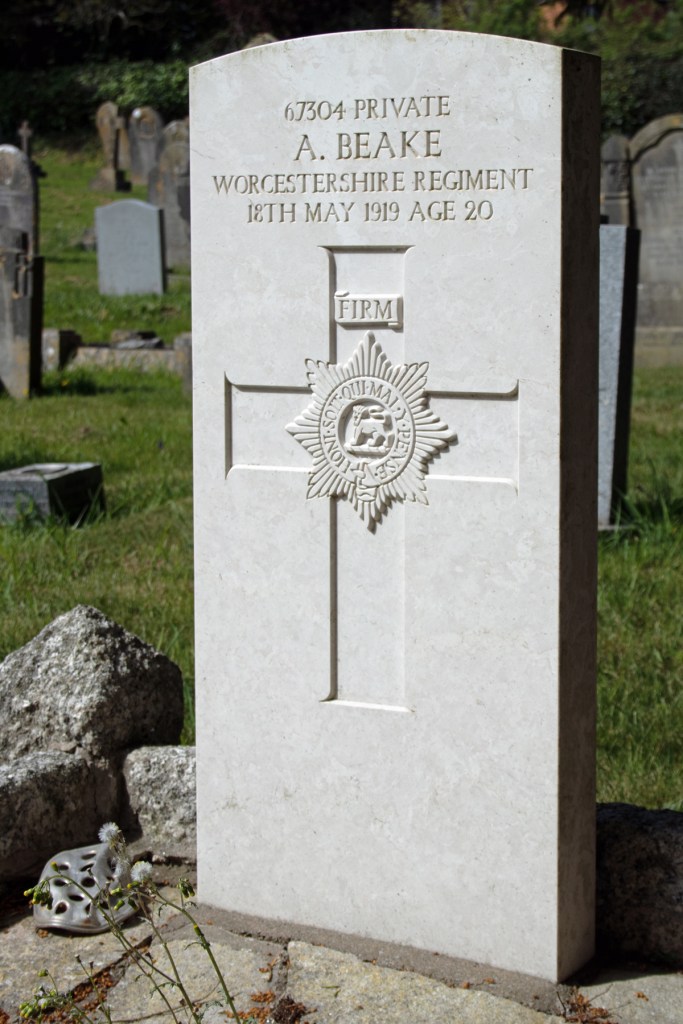
Private Alfred Beake

Private Alfred Beake

Alfred Beake was born in December 1898 and was one of nine children to Alfred and Charlotte Beake. Alfred Sr was a baker from Westonzoyland in Somerset, but it was in Chard that he and Charlotte had set up home and raised their family.

There is little documented about Alfred’s life. He played his part in the First World War, and had joined the Worcestershire Regiment by November 1918. His troop – the 5th (Reserve) Battalion – was a territorial force, and he would have split his time between Harwich, Essex, and Plymouth, Devon.

Private Beake survived the war and, by the spring of 1919 had been moved to Dublin. It was here on 18th May that he met with colleagues Private Simpson and Swindlehurst in the centre of the city. The trio caught a tram to the coastal town of Howth for a day out, where tragedy struck.

The Dublin Evening Telegraph reported on what happened next:

Private Sydney Simpson, Royal Engineers, stated… when they got to Howth, they walked along the Cliff Walk for about a mile, when they saw some seagulls down the cliff. [Beake and Swindlehurst] went out of witness’s sight for a while, when he heard a shout from Swindlehurst for help. On hurrying back, he saw Swindlehurst looking towards the sea, and he said the deceased had slipped down. The cliff was so steep that, although they tried to get down, they could not do so. Witness sent for help. None of the party had taken any drink.

Private Swindlehurst… said that he and deceased climbed down the grassy slope to get some seagulls’ eggs, but that the deceased suddenly slipped down. There was no horseplay going on at the time when the accident took place.

Captain Wynne, Royal Army Medical Corps, who made a post mortem examination, described the terrible injuries which the deceased had sustained. Death must have been instantaneous.

Dublin Evening Telegraph: Wednesday 21st May 1919

Private Beake had suffered a fractured skull from the fall. He was just 20 years of age.

Alfred Beake’s body was brought back to Somerset for burial. He was laid to rest in the family plot in Chard Cemetery.


Alfred’s oldest brother, Walter George Beake, had also served in the First World War.

Private Beake fought with the 7th Battalion of the Somerset Light Infantry, and was involved in some of the key skirmishes of the Somme. But it was at Ypres that he was buried alive during an attack, and the resulting shell shock left him totally incapacitated.

Walter was discharged from the army on medical grounds in September 1916. He returned home to try and piece his life together again. He never married, and passed away in December 1978, at the age of 87 years old.


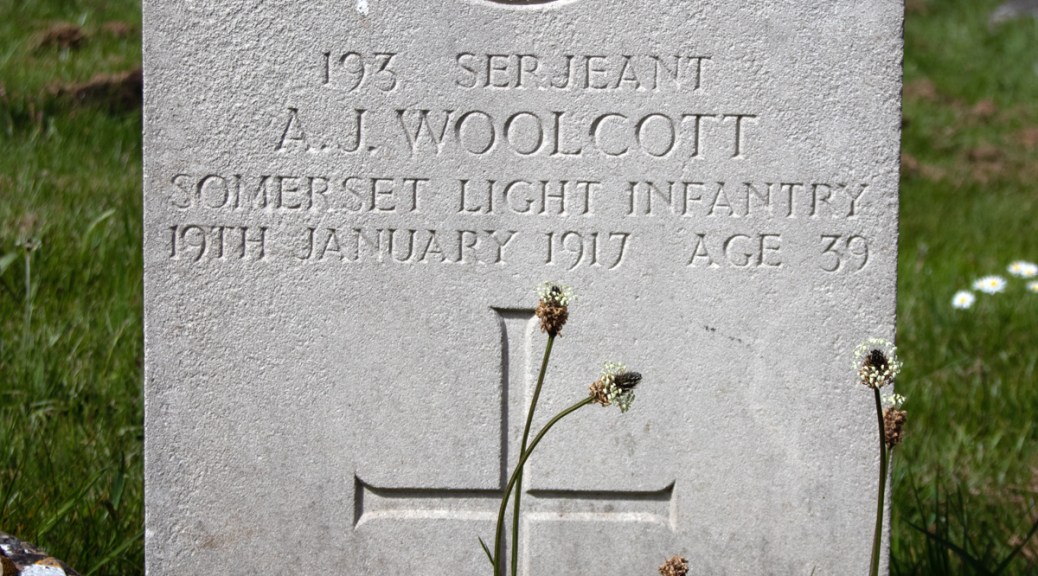
Serjeant Albert Woolcott

Serjeant Albert Woolcott

Albert John Woolcott was born in the spring of 1877 and was one of three children to Thomas and Mary. Thomas was a labourer for a spirit company, and both he and his wife came from Chard in Somerset, which is where Albert and his siblings were born.

When he finished school, Albert was apprenticed to a local iron foundry and, by the time of the 1901 census, he was recorded as being a blacksmith in his own right.

By this point, Albert had met local woman Mary Pattimore: the couple married in the local church on Boxing Day 1901, and went on to have four children, all of them boys. Albert continued with his ironwork: the 1911 census records him as being the blacksmith at Chard’s Gifford Fox & Co.’s lace factory.

Albert played a keen role in the local volunteer movement for the Somerset Light Infantry. Through the town’s Constitutional Club he took an active role in its rifle range and was known to be a particularly skilled marksman. He also played in both the Volunteer Band and Chard’s Municipal Band.

When war came to Europe in August 1914, Albert was already billeted on Salisbury Plain as part of the volunteers, and was promoted to the rank of Serjeant. He was sent to India with his troop – the 5th Battalion of the Somerset Light Infantry – and remained there until April 1916.

By this point, Serjeant Woolcott was suffering from dorsal abscesses on his hands, and was evacuated back to England for treatment. Over the next nine months he was in and out of Netley Hospital on the outskirts of Southampton, where he had a number of operations to try and fix the problem.

Sadly, his treatment proved unsuccessful: Serjeant Woolcott passed away in the hospital on 19th January 1917, at the age of 39 years old.

Albert John Woolcott’s body was taken back to Somerset for burial. He was laid to rest in his home town’s cemetery.


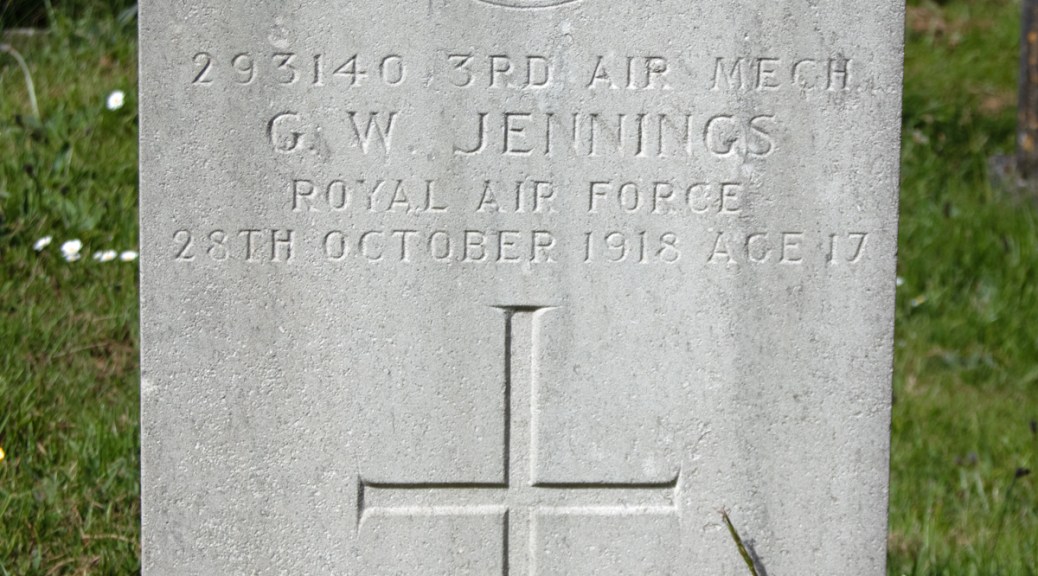
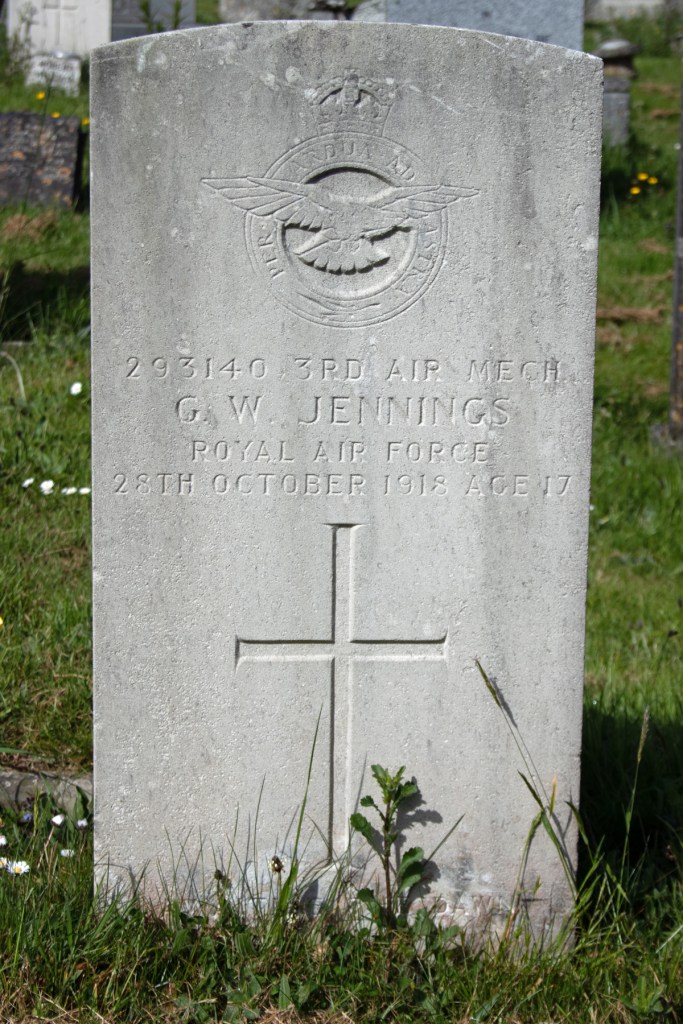
Air Mechanic 3rd Class Gilbert Jennings

Air Mechanic 3rd Class Gilbert Jennings

Gilbert William Jennings was born on 4th January 1901, and was the third of four children to William and Lily Jennings. Both were born in Chard, Somerset, and this is where they raised their young family. William was a foreman in one of the town’s lace factories and when he finished school Gilbert followed his father into the industry.

War broke out across Europe in 1914 and, while Gilbert was too young to enlist at the start of the conflict, it is evident that he wanted to play his part as soon as he was able to.

On 6th September 1918 he enlisted in the Royal Air Force: his experience with factory machinery led him to the role of Air Mechanic 3rd Class. His service records confirmed that he was 5ft 7ins (1.70m) tall, had brown hair, hazel eyes and a fresh complexion.

Air Mechanic Jennings was sent to Buckinghamshire for training, but his time there was to be tragically short. Within a matter of weeks he was admitted to the Central Military Hospital in Aylesbury with pneumonia. The condition was to prove too much for his body: he passed away on 28th October 1918. He had been in the Royal Air Force for just 52 days and was a victim of his desire to get involved in the war before it was too late to do so. He was 17 years of age.

Gilbert William Jennings’ body was brought back to Somerset for burial: he was laid to rest in the cemetery of his home town, Chard.


Private Wilfred Follett

Private Wilfred Follett

Wilfred Alson Follett was born in the spring of 1898, and was the second of eight children to Robert and Ellen (known as Nellie) Follett. Robert was a scavenger (or street cleaner) for Chard council, and it was in this Somerset town where his and Nellie’s young family were raised.

Lace making was the predominant industry in the area, and it was for local employer Boden & Co.’s Old Town Mills that Wilfred worked when he finished school. The 1911 census recorded him as being a threading boy in the factory.

War was coming to Europe, however, and Wilfred was keen to play a part. Sadly, full details of his military service are lost to time, but he had enlisted by the spring of 1917, initially joining the Somerset Light Infantry. He soon transferred across to the Welch Regiment, however, and was assigned to the 10th (Service) Battalion.

Private Follett was sent to the Western Front at the start of July 1917, and was soon caught up in the thick of the action at Ypres. He came through the Battle of Pilkem, but was injured at the fighting in Langemark. His wounds were severe enough for him to be evacuated to England for treatment, and he was admitted to a hospital in Bradford, Yorkshire.

Robert was sent for, but sadly did not arrive in time to see Wilfred before he passed away from his injuries. He died on 20th August 1917, at the tender age of just 19 years old.

Wilfred Alson Follett was brought back to his home town for burial. He was laid to rest in Chard Cemetery.


Private Frederick Harris

Private Frederick Harris

Frederick Jacob Harris was born in Wadeford, near Chard in Somerset, on 28th August 1887. The fourth of eleven children, his parents were William and Grace Harris. William was an agricultural labourer and carter, but the busy lace and weaving industry in the area is what provided Frederick and his siblings with work when they finished school.

It may have been through his work in the factory that Frederick met Alice Dowell: she was the daughter of a lace hand from Chard. The couple married on 20th October 1906, and settled in a house near the centre of the town. They went on to have four children, two boys and two girls.

War was closing in on Europe by this point, although there is little specific information about Frederick’s service. He initially joined the Somerset Light Infantry, although he soon made the move to the Royal Fusiliers. He received the Victory and British Medals, as did everyone else who served in the Great War, but there is no confirmation of whether he saw action overseas or not.

However and wherever Private Harris served, he survived the conflict, and was demobbed on 25th May 1919. His discharge record suggests that, at the point of being released from duty, he had no injuries or disabilities, and nothing that could be attributed to his time in the army.

Frederick appears to have returned to Chard, and spent the next six months adjusting to civilian life. However, something changed, as, on 10th December 1919, he passed away at home. No cause of death is evident, and nothing in the contemporary local media suggests that he died of anything other than natural causes. Whatever led to his passing, he was taken early, as he was only 32 years of age.

Frederick Jacob Harris was laid to rest in Chard Cemetery.


Private Harry Ashford

Private Harry Ashford

Harry Ashford was born in Sidford, Devon, on 2nd June 1880, the oldest of seven children to Samuel and Fanny Ashford. Samuel was a mason and Fanny worked as a lace worker managing this at the same time as raising her children. The family left Devon in the late 1880s, settling instead in Chard, Somerset.

After initially working as an errand boy, when Harry finished school he found employment as a house painter. He had met lace worker Ada Hancock by this point, and the couple married in Chard’s Methodist Church on 4th May 1901. The couple set up home in the same road as Harry’s parents, and went on to have a daughter, Nora, the following year.

By this point, storm clouds were brewing over Europe, however, and Harry felt the need to play his part. On 22nd September 1915, at the age of 35, he enlisted in the Royal Army Medical Corps. His service record shows that he stood 5ft 6ins (1.68m) tall and was of good physical development.

Private Ashford served on the Home Front, and was based at the Tweseldown Camp near Farnham, Surrey. He served there for a little over a year before he contracted nephritis – inflamed kidneys – and was admitted to hospital. Sadly, the condition proved too severe, and he died on 31st October 1916 from a cerebral haemorrhage. He was 37 years of age.

Harry Ashford’s body was brought back to Somerset for burial. He was laid to rest in the cemetery of his adopted home town, Chard.


Both of Harry’s parents passed away not long after he died – Samuel in 1919 and Fanny in 1920. Ada never remarried, and lived a reasonable life, passing away in Nottinghamshire in the autumn of 1932, at the age of 53 years old.


Private Sidney Budd

Private Sidney Budd

Sidney John Budd was born in the spring of 1888, the middle of three children to Abel and Mary Budd. Abel was a gardener from Tiverton, Devon, and this is where the family were born and raised. In the late 1890s, the family moved to West Monkton, near Taunton in Somerset.

When he finished school, Sidney found work as a house painter, and, by the time of the 1911 census, was boarding in a house near Minehead. Within a few years, he had moved again, this time to Chard, and had met Florence Moulding, the daughter of a shepherd from the town. The couple married on 1st August 1914, just days before the outbreak of war.

There is little information available relating to Sidney’s military service. He enlisted before the end of 1917, joining the 3rd (Reserve) Battalion of the Somerset Light Infantry as a Private. This was a wholly territorial troop, and Private Budd would have served in Somerset and Devon.

One of the downsides to being in close proximity to servicemen from other parts of the country in tightly-packed barracks was the ease with which disease could spread. Sadly, Private Budd was not immune from this and, in the spring of 1917, he contracted pulmonary tuberculosis. He was admitted to the Ford House Hospital in Plymouth, but his condition deteriorated and he passed away on 31st May 1917. He was just 29 years of age.

Sidney John Budd’s body was brought back to Chard for burial: he lies at rest in the town’s cemetery.


Florence went on to marry again, wedding Harry Golesworthy in the spring of 1918. Sadly, her happiness was to be short-lived: she passed away just two years later, at the age of 28 years old.


Sidney’s older brother, named Abel after his father, was an interesting character. When he left school, he found work as an apprentice to a photographer.

In July 1909, though, he was brought to court for stealing a bicycle. It seems that he had rented one from a dealer in West Monkton in order to visit friends in Cullompton, but not returned it at the end of the day, as expected.

The dealer contacted Abel’s parents, and he was found to have stayed over in Cullompton. It seems that while there, he had run low on funds, and had sold the bicycle to a dealer in the town. A week later, he returned to the Cullompton dealer, asking to buy the bike back, but hadn’t brought any money with him.

Eventually, Abel’s father went to Cullompton, bought the bicycle, then took it to the original dealer in West Monkton. By this point, however, Abel had been charged with theft, and pled guilty. His father stood witness, and, according to the Taunton Courier and Western Advertiser [Wednesday 14th July 1909], admitted that Abel “was rather weak of mind” and had not intended to steal the bicycle.

Abel was bound over for twelve months, with his father standing surety of five pounds.

The later parts of Abel’s life seem a mystery. There is a record of him travelling to Brisbane, Australia, in the spring of 1914, where he was to work as a farm labourer. He must have returned home, possibly as part of the war effort, and five years later he married Annie Talbot in Taunton, Somerset.

At this point, however, he falls off the radar, and there is no further information about him.