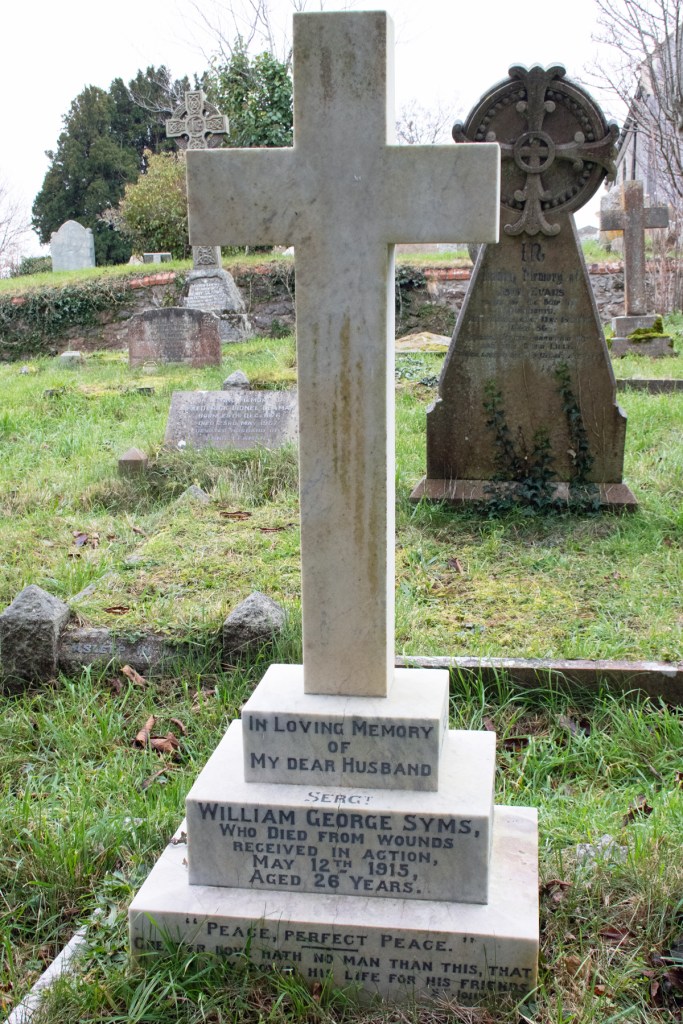
William George Syms was born in in the spring of 1889, the oldest of two children to George and Rose Symes (both spellings are recorded). George was a postman from Devon, and the family were born and raised in Highweek, Newton Abbot.
When William left school, he followed in his father’s footsteps becoming a postman in his home town. Life was not without its ups and downs, however, and the 1911 census record him as an inpatient, convalescing from an unknown illness in Exmouth.
In the summer of 1913, William married Amelia Oliver, a gardener’s daughter, who also from Highweek.
When war broke out William was eager to play his part, and enlisted in the early months of the conflict, alongside a number of his colleagues. He joined the Royal Engineers, and was assigned to the 1st (Wessex) Division Signal Company. He was sent to France on 22nd December 1914 and was involved on the Front Line from early on.
By the spring of 1915, he was fighting at Ypres, and was badly injured, fracturing both legs and suffering from the effects of being gassed. Serjeant Syms – as he was by then ranked – was medically evacuated to England for treatment. He was admitted to the Auxiliary Military Hospital in Manchester, but died of his injuries on 12th May 1915. He was just 26 years old.
William George Syms’ body was brought back to Devon for burial. He was laid to rest in the graveyard of All Saints Church in his home town of Highweek. Tragically, he was never to see his son, also called William, who had been born just two months before.
Ernest Webber was born on 19th April 1897 in Newton Abbot, Devon, although there is little further documented about his early life
The 1911 census records Ernest as being at the Scattered Home in Newton Abbot. This was, in fact, the Greenaway Home for Boys, part of the town’s Union Workhouse. It was run by a Mrs Louise Foote, had 22 ‘inmates’ and was located on the Highweek Road.
The following year, however, Ernest found a way to better himself, enlisting in the Royal Navy. His service records confirm that he joined up on 9th October 1912 and gave a physical description of him: he was 5ft 5ins (1.65m) tall, had fair hair, blue eyes and a fresh complexion. He was also noted as having a scar on his left index finger.
As he was below the age for full service, he was given the rank of Boy, and was sent to HMS Ganges, the naval base in Ipswich, Suffolk, and HMS Impregnable, a training ship, for his initial instruction. Some talent seems to have been unearthed as he was soon promoted to Boy Telegraphist.
In August 1913, Ernest was assigned to the battleship HMS Conqueror. He spent nearly two years on board and, during that time, came of age. Now formally inducted into the service, he was given the rank of Ordinary Telegraphist, before being promoted again – to the full role of Telegraphist – in April 1915.
Two months later Telegraphist Webber was transferred to HMS Phaeton; over the next year, he spent time on two further vessels, before being assigned to HMS Victorious in April 1916. With this assignment came a further promotion: Ernest was now a Leading Telegraphist.
In the summer of 1917, Ernest moved again, this time to HMS Vivid, the Royal Naval Dockyard in Devonport. At this point, however, he had fallen ill, and was medically discharged from duty on 5th September 1917, having contracted tuberculosis.
At this point, Ernest’s trail goes cold. He returned to Newton Abbot, but the events of the next year are lost to time. All that can be confirmed is that he passed away, presumably of his lung condition, on 11th December 1918. He was just 21 years of age.
Ernest Webber was laid to rest in the graveyard of All Saints Church in Highweek, near Newton Abbot.
Frederick Charles Evelyn Liardet was born in Brighton, now a suburb of Melbourne, Australia, in 1888, and the eldest son of Wilbraham and Eleanor Liardet.
There is little further information about Frederick’s early life, but, when war broke out, he wanted to play his part for King and Country, and enlisted in the Devonshire Regiment.
He had an adventurous career… Having been twice wounded while on active service in France, he was appointed an instructor in the Balloon Section of the Royal Flying Corps.
Exeter and Plymouth Gazette: Tuesday 18th December 1917
On 23rd October 1915, Frederick married Kathleen Norah Liardet in Highweek, Newton Abbot, Devon. She was the daughter of a retired Lieutenant Colonel in the Royal Marine Light Infantry, and may have been a cousin (while their surname is unusual enough for there to be a connection, I have been unable to identify a specific connection). The couple went on to have a daughter, Barbara, who was born in 1917.
In 1916, while on a night flight with the Royal Flying Corps, the now Lieutenant Liardet was involved in an accident and badly injured. He returned to England to recover, he and Kathleen living with her family. While his health initially improved, he relapsed and passed away on 13th December 1917, aged just 29 years old.
Frederick Charles Evelyn Liardet was laid to rest in the graveyard of All Saints Church in his adopted home of Highweek, Devon.
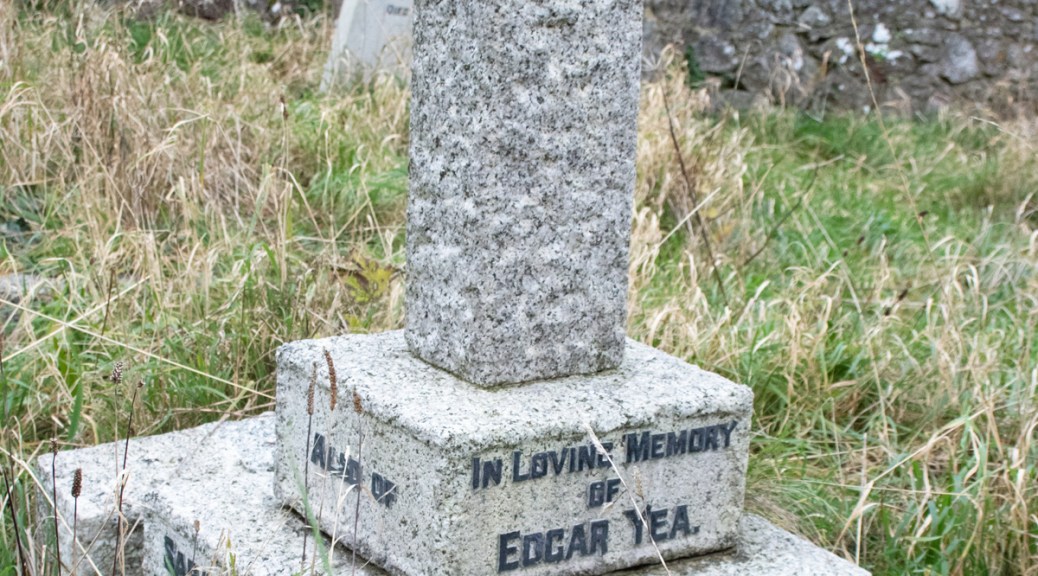
Edgar Thomas Yea was born on 23rd February 1898, the youngest of four children to Enoch and Sarah Yea. Enoch was road contractor from Devon, and it was in Highweek, near Newton Abbot, that he and Sarah raised their young family.
There is little documented on young Edgar’s life: he enlisted in the Royal 1st Devon Yeomanry not long after was war declared in August 1914. He served on home soil, and was medically discharged from service after just 241 days. There is no confirmation on the cause of his removal from the army, but Private Yea’s last day of service was 11th June 1915.
At this point, Edgar’s trail goes cold again. All that can be confirmed is that he passed away at home on 6th February 1919, just a couple of weeks shy of his 21st birthday. The cause of his passing is lost to time.
Edgar Thomas Yea was laid to rest in the graveyard of All Saints Church in his home town of Highweek, Devon.
Alan Edward Lloyd was born in around 1899, the second of five children – all boys – to William and Edith Lloyd. Both of his parents were Welsh, and his older brother was born in Cardiff. Railway clerk William moved around the country with work, however, and Alan was born in Lydney, Gloucestershire, his younger brother in Paddington, London, and his two youngest siblings were born in Windsor, Berkshire.
There is little information about Alan’s early life; what is clear is that, by the autumn of 1918, he had been in the army, reaching the rank of Lieutenant. He transferred across to the newly formed Royal Air Force and, in December that year was training as a Flight Cadet at Shotwick Airfield near Chester.
On the 4th December, Alan was flying his Sopwith Camel, when he got into a flat spin; the aircraft crashed and Alan was killed. He was just 19 years old.
Alan Edward Lloyd was brought to Devon – where his family were now living – for burial. He was laid to rest in the graveyard of All Saints Church in Highweek, near Newton Abbot.
Arthur Thomas Rendell King was born early in 1896, the oldest of six children to Thomas and Bessie King. Engine driver Thomas had been born in London, but, after marrying his wife the year before Arthur was born, he settled in Highweek near Newton Abbot, Devon.
When he left school, Arthur followed his father in working for Great Western Railways, working as a carriage cleaner at the town’s depot. War was on the horizon, however, and he enlisted in the Devonshire Regiment shortly after conflict was declared.
Private King was assigned to the 1st/5th Battalion and sailed for India in October 1914, arriving in Karachi a month later. After nearly three years, his regiment moved again, this time to Egypt, in advance of action in the Middle East.
Involved in the Battle of Nebi Samwil in November 1917, Arthur was badly wounded – and initially recorded as missing, presumed dead. However, he was found, and evacuated to England. Tragically, within hours of being admitted to a hospital on home soil on 31st January 1918, Private King died of his injuries. He had just turned 22 years of age.
Arthur Thomas Rendell King’s body was brought back to Devon for burial. He was laid to rest in the family grave in the graveyard of All Saints Church, Highweek.
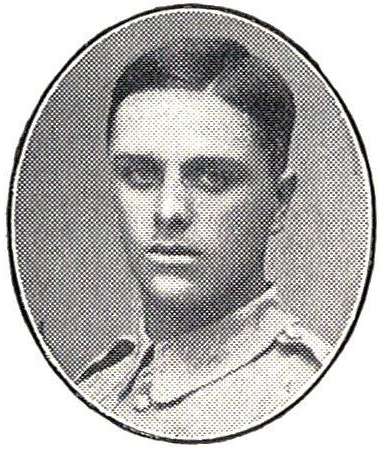
Percy Rendall Hunt was born on 25th May 1893, one of five children to Walter and Mary. Walter was a carpenter for the railway, and had been born in Newton Abbot, Devon, where he and Mary raised their young family.
When Percy left school, he found labouring work, but soon followed his father into carpentry. He met and married a woman called Ellen; the couple married, and went on to have two children. In his spare time, he volunteered for the Devonshire Royal Engineers and, when war broke out, despite now working in Chipping Sodbury, Gloucestershire, this was the regiment he joined.
Sapper Hunt enlisted on 2nd December 1914; his records show that he stood 5ft 7ins (1.70m) tall, had good vision and was of fit physical development. In March 1915, Percy was shipped off to Gibraltar, spending the next eighteen months in the territory. After a couple of months back in England, he was sent to France. He spent the next two years split between serving on home soil and with the British Expeditionary Force, before being demobbed in March 1919.
Percy returned to his old job with the railways, but, in December 1919, he found himself in court, charged with assault. Caroline Webber, an elderly married woman, was on the beach in Dawlish one afternoon, looking for shells, when a man approached her. According to a newspaper report:
“…suddenly he made a grab at me, put his hand under my clothes, and caught hold of my left knee. I screamed, and he ran away. ran after him because I was determined to see where he went. He went over to the railway wall, and disappeared under the archway of Dawlish tunnel.”
Western Times: Wednesday 24th September 1919
Mrs Webber went to the police, who returned to the police with her, then traced a trail of footprints back to the tunnel. Percy was questioned, but denied all knowledge of the incident, and of knowing Caroline. A plaster cast was taken of one of the footprints that evening, and a match alleged with his boots. Percy was committed for trial, with bail being allowed.
When the trial started in January 1920, the boots were again presented as evidence. However, on questioning, the policeman admitted than there had been a delay in getting the impression, and that “there were some other impressions in the sand at the time”.
For the defence, a number of witnesses saw Percy at work around the time of the incident, and the timings seemed to prove that he could not have had enough time to get to the beach and back to carry out the alleged assault. Based on this defence, the jury found Percy not guilty, and the case was concluded.
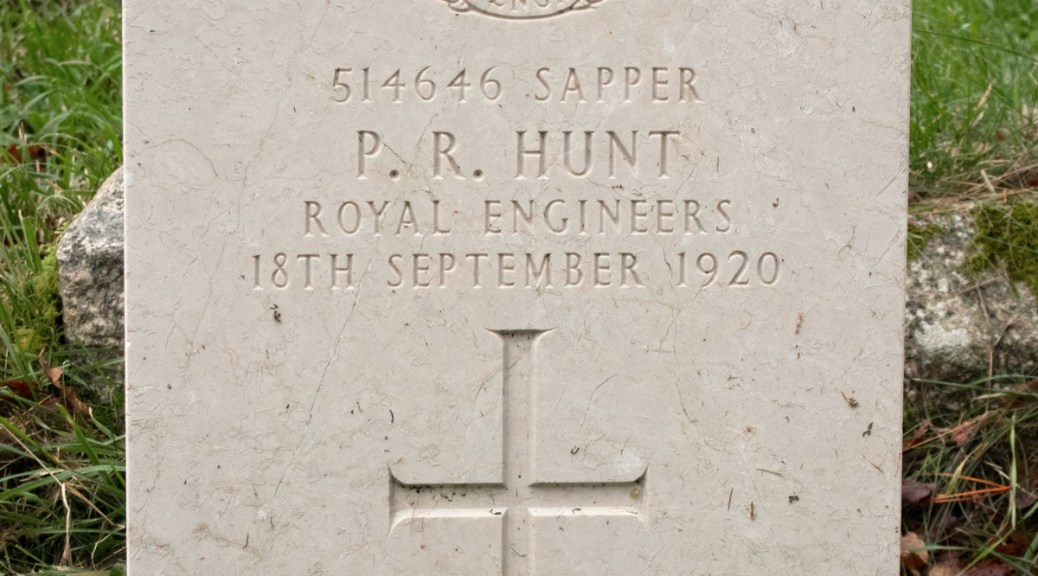
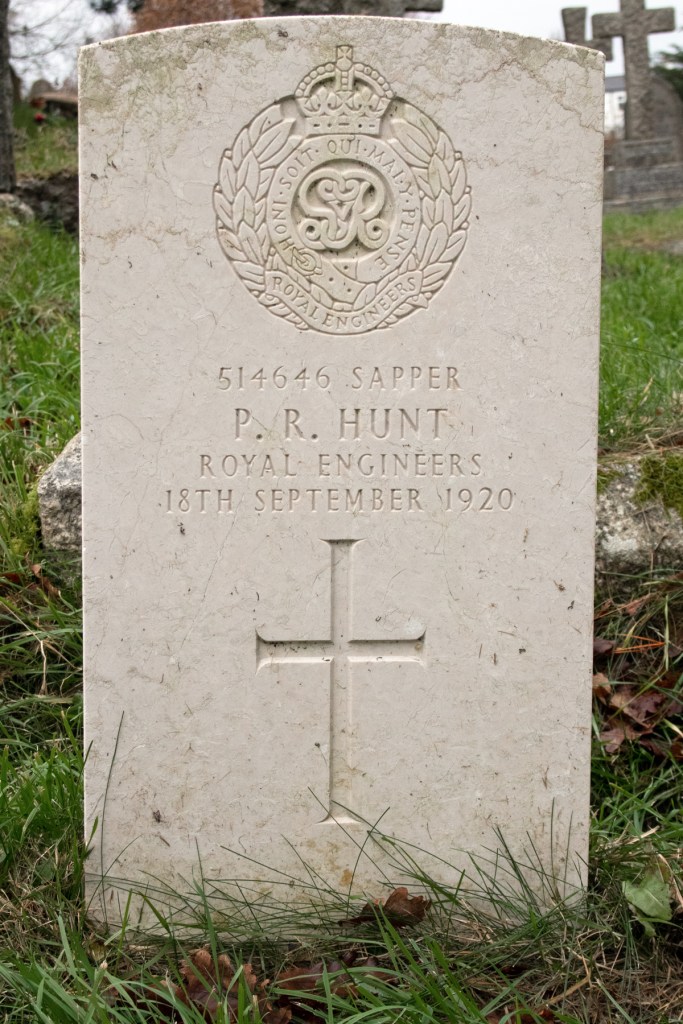
After this incident, Percy’s trail goes cold for a few months. The next record is that confirming his death, on 18th September 1920. The cause of his passing is not evident, but he was 27 years of age.
Percy Rendall Hunt was laid to rest in the graveyard of All Saints Church in Highweek, Newton Abbot, not far from his family home.
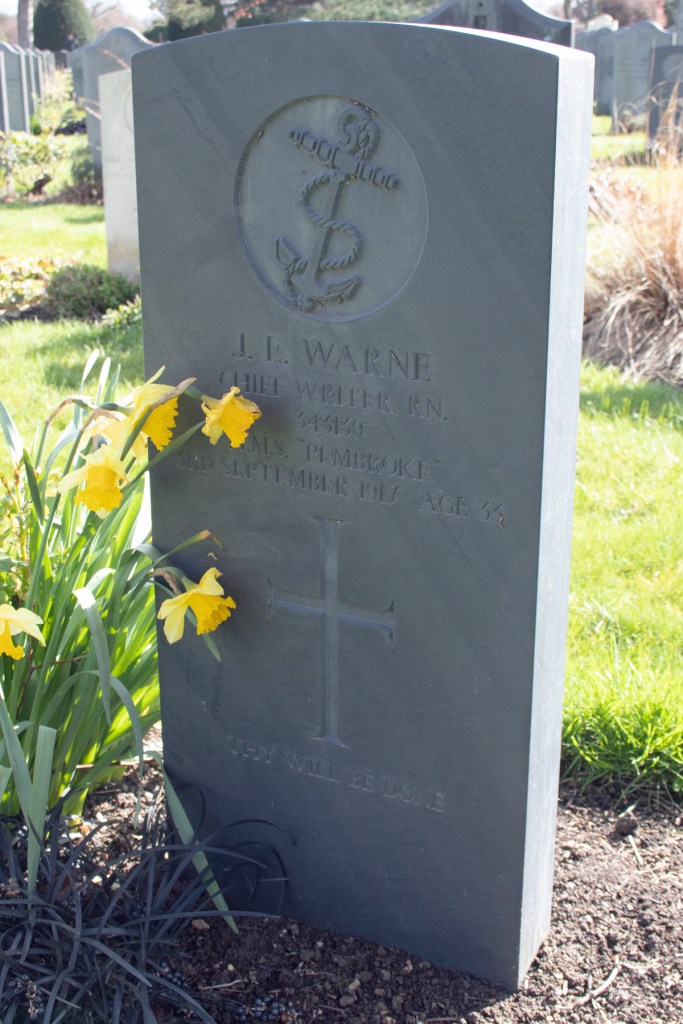
James Edwin Warne was born on 4th August 1884, in Portsmouth, Hampshire. He was one of four children to shipwright Edwin Warne and his wife Elizabeth.
The naval life was all around him and, straight out of school, James sought out a career in the service and, on 28th December 1899, aged just 15 years old, he enlisted. His service records show that he was just 5ft 2.5ins (1.59m) tall, had dark brown hair, brown eyes and a dark complexion. Initially taken on in the role of Boy Writer, he was sent to HMS Pembroke, the Royal Naval Dockyard in Chatham, Kent, for training.
Over the next couple of years he learned his trade, serving on a couple of ships, but also at HMS Pembroke and the nearby base in Sheerness, HMS Wildfire. When he came of age in 1902, he was formally inducted into the Royal Navy. His records show that his time in the navy were standing him in good stead – he had grown 5ins (13cm) in the previous couple of years.
James was afforded the rank of 3rd Class Writer. This was a mainly clerical role, James would have been involved in the day-to-day welfare concerns for the crew. Over the next twelve years, he honed his trade, serving on a handful of vessels, but being mainly based in Chatham and Sheerness.
By the time James’ initial period of service came to an end in August 1914, he had risen through the ranks to 2nd Class Writer (in 1906) and 1st Class Writer (four years later).
It was while James was based in Sheerness that he met Emily Jane Hayes. She was the daughter of a naval boilermaker; the couple married in 1906, and went on to have four children: Leonard, Jenny, Edwin and Phyllis.
When war broke out, James’ contract with the Royal Navy was renewed, and he was promoted to Chief Writer. He became permanently based at HMS Pembroke, and the family set up home in Nelson Road, Gillingham, not far from the Dockyard.
In the summer of 1917, HMS Pembroke was an overcrowded place. This was compounded by two events: men who had been earmarked to join the HMS Vanguard had been forced to remain at the barracks after the ship had been sunk at Scapa Flow, while an outbreak of ‘spotted fever’ in the barracks meant that the sleeping accommodation had to be increased in an effort to avoid further infection.
This would have increased Chief Writer Warne’s workload and hours, and he slept on site, in temporary accommodation set up in the barracks’ Drill Hall.
On the night of the 3rd September, the German Air Force conducted the first night time raid on England. Chatham came in the firing line, and the Drill Hall received a direct hit.
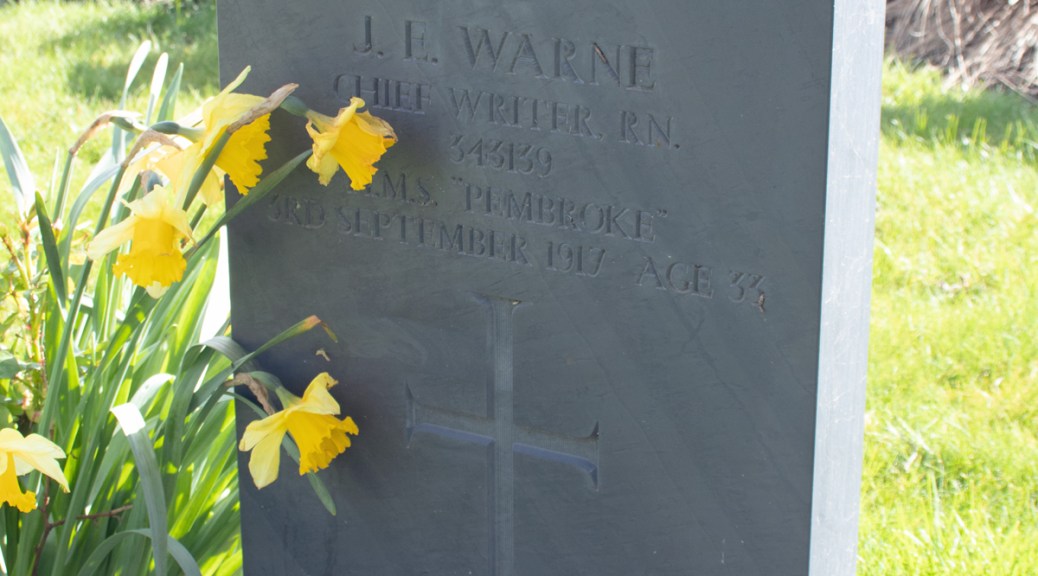
Given the proximity of the dockyard to the family home, Emily must have known something was wrong, and could only have hoped that her husband was not involved. Sadly, Chief Writer Warne was among those to be killed. He was 33 years of age.
James Edwin Warne was laid to rest in Gillingham’s Woodlands Cemetery – again, walking distance from the family home – along with the other victims of the Chatham Air Raid.
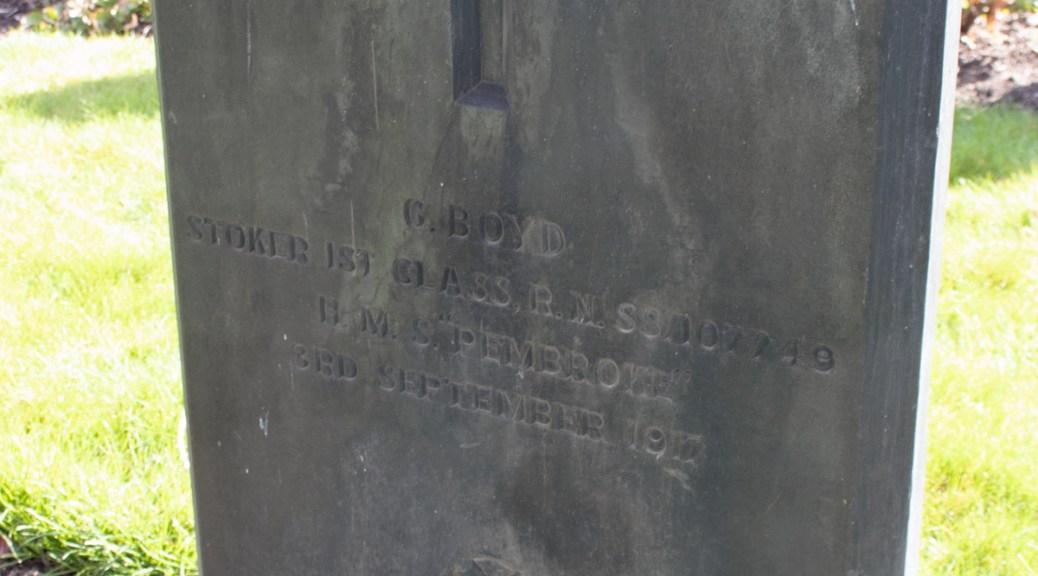
George Boyd was born in Belfast, Northern Ireland on 1st May 1890, although further information about his early life is not available.
What can be confirmed is that George enlisted in the Royal Navy on 8th September 1908 as a Stoker 2nd Class. He had been working as a labourer for shipbuilder Workman Clark, when the opportunity to better himself was presented. His service records show that he was 5ft 3ins (1.60m) tall, had light brown hair, grey eyes and a fresh complexion. He was also noted as having a tattoo of a compass and square on the back of his left hand.
Over the five years of his service, Stoker Boyd served on five different ships, returning each time to what would become his base, HMS Pembroke, also known as the Royal Naval Dockyard in Chatham, Kent. During his time, he was also promoted to Stoker 1st Class.
When his five years’ service was up, George was transferred to the reserve ranks, only to be called up again less than a year later, when war broke out. Stoker Boyd’s enthusiasm for the job may have been waning by this point: his previous Very Good character was noted only as Fair when he was re-engaged, and, in July 1915, while based in Chatham, he went absent without leave, a crime than resulted in six weeks’ detention.
Stoker 1st Class Boyd served on a number of ships during his renewed period of service, although he returned to HMS Pembroke between voyages. He returned there for good on 7th August 1917.
That summer was a particularly busy time for the Royal Naval Dockyard: temporary overflow accommodation was put in place at the barracks’ Drill Hall, and this is where George found himself billeted.
On the night of 3rd September, Chatham came under attack from a German air raid, and the Drill Hall received a direct hit. Stoker 1st Class Boyd was among those to be killed that night. He was 27 years of age.
George Boyd was laid to rest in the Woodlands Cemetery in Gillingham, Kent, alongside the other victims of the Chatham Air Raid. His pension was transferred to his widow, Adelaide Boyd (née Kerr).
Adelaide Kerr was an interesting character in her own right. Born in Belfast on 9th June 1893, she was one of three children to labourer Joseph Kerr and his wife Elizabeth (or Lizzie).
Adelaide married James Stephenson when she was just 17 years old, and five months before the birth of their first child, James Jr. The couple went on to have a second child, Joseph, although he tragically passed away when just a year old.
James also passed away, 27th February 1916, aged just 23 years old. Intriguingly, his place of death is Crumlin Road Gaol in Belfast, but there is no record of why he was imprisoned, nor the cause of his death.
It seems that Adelaide needed support and, within a few months of James’ death, she had married George. After he too died during the air raid, she went on to marry a third time, to Samuel Buller. The couple tied the knot in March 1918, and went on to have a son, William, that September. Tragedy was to strike again, however, when he passed away in December 1923, having just turned five.
There is no further information about Samuel, and time passed for Adelaide as well. She outlived her remaining son, James, who died in Belfast in 1979. At some point Adelaide emigrated – records do not confirm when, nor whether Samuel left Northern Ireland as well – and she passed away, at the age of 90, in the Australian hamlet of Paschendale, some 219 miles (352km) from Melbourne.
Alexander Kennedy was born in Cromore on the Isle of Lewis on 15th June 1895. He was one of five children – four of them boys – to John and Isabella Kennedy.
Living in the remote coastal township, he would have grown up knowing the sea and, when the opportunity arose, he volunteered for the Royal Naval Reserve. His service records show that he enlisted on 12th December 1913; they also note that he was 5ft 6.5ins (1.69m) tall, had blue eyes, a fresh complexion and a scar under his chin.
Seaman Kennedy was kept on a retainer until war broke out the following summer, at which point he was sent to the other end of the country – HMS Pembroke, the Royal Naval Dockyard in Chatham, Kent – for formal training. His time in the navy was then split between the dockyard and the battleship HMS Implacable.
Over the next couple of years, Seaman Kennedy toured the Mediterranean, berthing in Egypt, Malta and Gibraltar between stops back in the ports on the English coasts. By the summer of 1917, he had returned to HMS Pembroke for good.
At that point in the war, Chatham Dockyard was a particularly busy place, and Alexander was billeted in overflow accommodation set up in the naval barracks’ Drill Hall.
On the night of the 3rd September, the German Air Force conducted the first night time raid on England. Chatham came in the firing line, and the Drill Hall received a direct hit. Seaman Kennedy was among those killed. He was just 21 years of age.
Alexander Kennedy was laid to rest in the Woodlands Cemetery in nearby Gillingham, along with the other victims of the Chatham Air Raid.








 Death and Service