Category Archives: accident

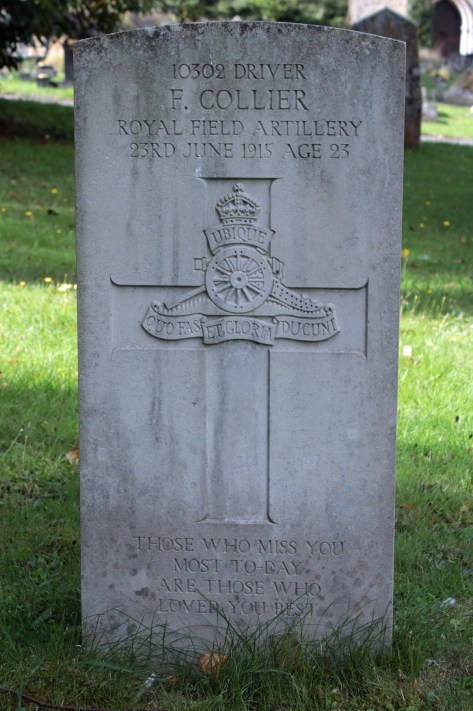
Driver Frederick Collier

Driver Frederick Collier

Frederick William Collier was born in the autumn of 1891. The oldest of four children, his parents were weavers Frederick and Annie Collier. Annie died in 1899, and her widow re-married. The 1911 census found the extended family – Frederick Sr, new wife Rose, Frederick Jr, two of his siblings and his three half-siblings – living at 30 New Prospect Buildings, Westbury, Wiltshire, their home town.

When Frederick Jr completed his schooling, he found work as a grocer’s labourer. War broke out in 1914, however, and he felt drawn to play his part. Full details of his military service have been lost to time, but it is clear that he had enlisted early in the conflict, and certainly by the start of 1915.

Driver Collier was assigned to the Royal Field Artillery, and was attached to the 59th Brigade Ammunition Column. He was sent to Surrey for training, unbeknownst to his unit, in preparation for the Gallipoli campaign. Frederick, however, was not to get his chance to be involved.

Frederick William Collier… died on Wednesday last week from injuries received while attempting to stop horses which were stampeding in his camp, the Ammunition Column, 59th Brigade, at Milford (Surrey)… Collier… was well known in Westbury, and was popular amongst his comrades, and the greatest sympathy is extended to his parents in their bereavement. The young fellow died the same day the accident happened in the hospital at Aldershot.

[Wiltshire News: Friday 2nd July 1915]

Driver Frederick William Collier succumbed to his injuries on 23rd June 1915. He was 23 years of age. His body was taken back to Wiltshire for burial, and he was laid to rest in Westbury Cemetery, not far from where his grieving parents still lived.


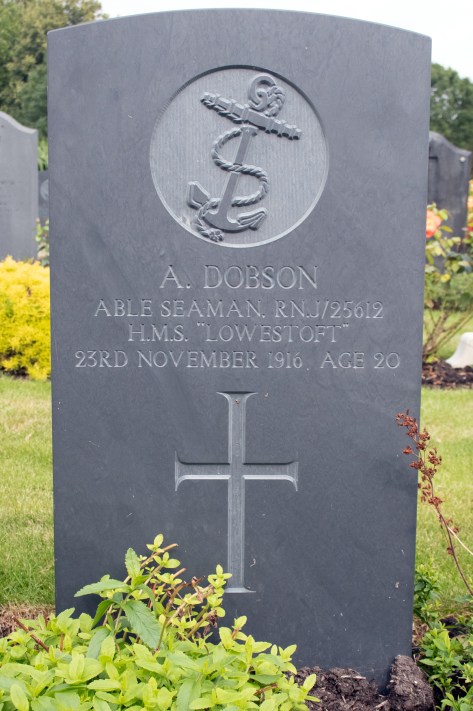
Able Seaman Albert Dobson

Able Seaman Albert Dobson

Albert Dobson was born in Bridlington, Yorkshire, on 7th April 1896. One of seven children, his parents were John and Annie Dobson. John was a bricklayer, and, when he completed his schooling, Albert was apprenticed to him. The 1911 census found the family living in a small terraced house at 55 St John’s Walk, on the outskirts of the town.

Bricklaying was not what Albert wanted from a career and, on 19th July 1913, he enlisted in the Royal Navy. Below the age to formally enlist, he was taken on with the rank of Boy 2nd Class, and sent to HMS Vivid – the Royal Naval Dockyard in Devonport, Devon, for his training.

Over the next nine months, Albert learnt the tools of his trade. Promoted to Boy 1st Class in October 1913, he spent time on board the battleship HMS Irresistible, before moving to HMS Pembroke, Chatham Dockyard in Kent. While he was there, he came of age, and was fully inducted into the Royal Navy as an Ordinary Seaman. Albert’s service papers show the man he had become: he was 5ft 7ins (1.7m) tall, with brown hair, blue eyes and a fresh complexion.

In April 1914, Ordinary Seaman Dobson was assigned to the new cruiser HMS Lowestoft. She would become his home for the next two years, and, while his annual reviews were average (character varying from good to very good and ability from moderate to satisfactory), he did gain a promotion to Able Seaman on 26th April 1915.

A singular fatality to a naval seaman names Albert Dobson, age 30 [sic], a native of Bridlington, was investigated at the Royal Naval Hospital, Chatham, on Monday. On October 20th, Dobson was one of a working party engaged on a battleship in the Dockyard, when, owing to the breaking of a plank, he and three men fell a distance of about eight feet. The knee of one of the men caught him in the stomach, with the result that he sustained a rupture of the spleen. In hospital he developed pneumonia, and died. A verdict of “Accidental Death” was returned.

[Kent Messenger & Gravesend Telegraph: Saturday 2nd December 1916]

Able Seaman Dobson’s service papers confirm that the incident occurred as the men were transferring a torpedo from HMS Illustrious. He was just 20 years of age when he died on 23rd November 1916.

The body of Albert Dobson was taken to Woodlands Cemetery in Gillingham, Kent, close to the dockyard he had come to know as home. He was laid to rest in the graveyard’s naval section.


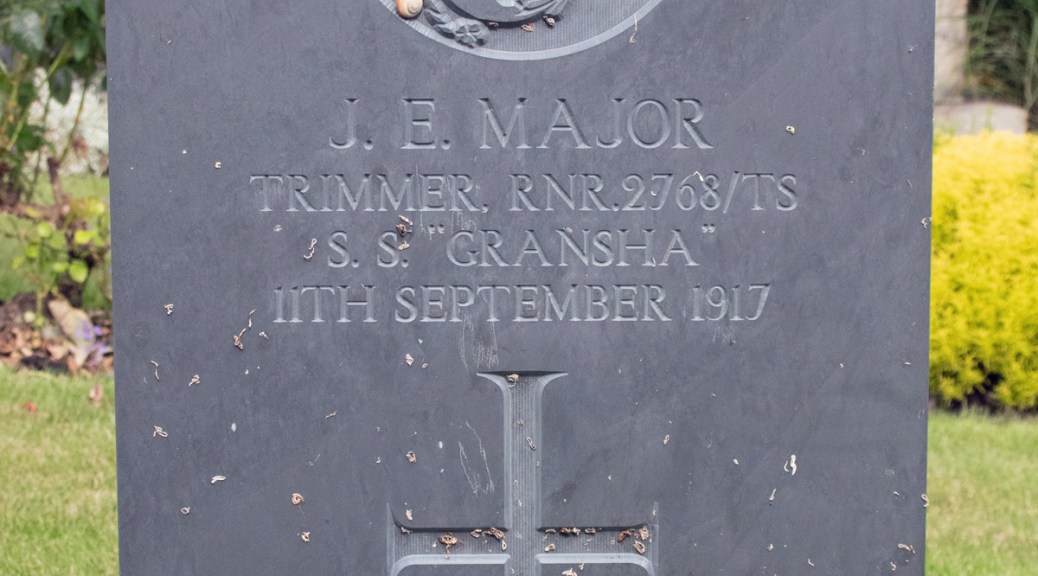
Trimmer John Major

Trimmer John Major

John Edward Major was born on 1st April 1881 in Gorleston, Suffolk. One of seven children, his parents were William and Elizabeth Major. William was a fisherman and the family lived on the town’s High Street.

Things changed for the Major family, however, and the 1891 census found them living in Barking, Essex. William was now employed as a general labourer, and the family had set up home at 16 Rosa Terrace.

John was drawn to his coastal past and, according to the next census, he was a ship’s mate on the fishing boat Cygnet. Based out of London, the return was taken in Lowestoft, so it is safe to assume that she plied the Essex and Suffolk coasts.

Love was blossoming for John at this point and, on 9th September 1906, he married Ann Davy. She was a coal porter’s daughter from Barking, and the couple married in the town’s St Margaret’s Church. They would go on to set up home in Cleethorpes, Lincolnshire, and have five children: Blanche, Amelia, Annie, Elizabeth and John Jr.

Over the next few years John’s trail goes cold. When war broke out, he was called upon to play his part, and joined the Royal Naval Reserve as a Trimmer. By the summer of 1917 he was attached to the SS Gransha, based out of the Royal Naval Dockyard in Chatham, Kent.

The next record for Trimmer Major relates to his passing. His pension ledger notes that, on 11th September 1917, he fell overboard from Gransha and was drowned. Sadly, there is no other information available about the incident, but John was 37 years of age.

The body of John Edward Major was laid to rest in the naval section of Woodlands Cemetery, Gillingham, Kent, not far form the naval base that he had come to call home.


Tragically, John’s entry on the Pension Ledger confirms that his and Ann’s youngest child – John Jr – died on Christmas Eve 1917, three months after his father.


Second Lieutenant Jocelyn Cowell

Second Lieutenant Jocelyn Cowell

Jocelyn Gore Cowell was born on 18th March 1899 in Exmouth, Devon. The older of two children, he was the only son to Edward and Eliza Cowell. Edward was a Captain in the Royal Fusiliers, and had served in India, where Eliza – who went by her middle name, Nita – had been born.

By the time of the 1911 census, Edward and Nita had moved to Milton on Stour, Dorset, where they were living in a ten-roomed house with a butler, a housemaid and a cook. Jocelyn, meanwhile, was one of fifty students boarding at a private school in Westgate-on-Sea, Kent.

When war broke out, Jocelyn was still a student. However, on 12th September 1917, he took a commission in his father’s former regiment. While he was studying, a new technology had caught his eye, and learnt to fly, gaining his wings on 18th October 1916. When he enlisted, he immediately followed his heart, and transferred to the Royal Flying Corps.

Attached to No. 3 Training Depot Station, Second Lieutenant Cowell was based at Lopcombe Corner Airfield, to the west of Salisbury, Wiltshire. On 28th January 1918, he was flying a de Havilland DH5 biplane form the airfield, when it crashed. The cause of the accident was unknown, an inquest unable to draw any specific opinions from the wreckage or crash site. Jocelyn was killed instantly: he was just eighteen years of age.

The body of Jocelyn Gore Cowell was taken back to Dorset for burial. He was laid to rest in what would become the family plot in the peaceful graveyard of Ss. Simon and Jude Church in Milton on Stour.


Second Lieutenant Jocelyn Cowell

Second Lieutenant Jocelyn Cowell
(from findagrave.com)

Second Lieutenant John Thomas

Second Lieutenant John Thomas

John Dobson Thomas was born in Leechburg, Pennsylvania, on 26th August 1889. He was the youngest of nine children to John and Isabella Thomas. John Sr was a steel inspector from Glamorganshire, while Isabella had been born in Newcastle-upon-Tyne: they emigrated to the United States in 1881, and John Jr was the second of their children to be born there.

When John Jr left school, he found work as a clerk, eventually getting into bonds and stocks. His father died in 1910, by which time the family had moved to Chicago, Illinois.

When war broke out, John stepped up to play his part. He enlisted on 6th January 1917, his service records showing that he was of medium height and build, with brown hair and brown eyes.

The American Army may not have met John’s needs as, just six months later, he enlisted again, this time joining the Canadian Expeditionary Force in Toronto. Along with his banking role, he was recorded as being an aviator cadet, his papers shoring that, at 23 years and 10 months old, he was 5ft 6ins (1.77m) tall.

Air Mechanic 3rd Class Thomas was shipped to Britain, and stationed near East Boldre, Hampshire. In October 1917, he took a commission in the Royal Flying Corps, with the rank of Second Lieutenant.

On 20th March 1918, John was flying his Sopwith Dolphin biplane, when he hit trouble. Practicing a dive, he appeared to have been unable to pull the aircraft up again and crashed into the ground. He was killed instantly.

The RAF Casualty Card cited a potential error of judgement on the part of Second Lieutenant Thomas: “[he] had proved himself a skilful pilot and well capable of handling his machine. He had previously practised many dives, but had, in his stunting, reduced his margin of safety to a minimum.”

John Dobson Thomas was 28 years of age when he died. Being thousands of miles from his family, he was laid to rest in the quiet setting of St Mary’s Churchyard, East Boldre, not far from the airfield at which he had been based.


Major John Kinnear

Major John Kinnear

John Lawson Kinnear was born on 9th February 1890 in the Yorkshire village of Copgrove. The youngest of six children, his parents were Henry and Frances Kinnear. Henry was the vicar of St Bartholomew’s Church, and, at the time of the 1891 census, the family lived in the rectory with four servants: a governess, a cook, a housemaid and a nurse.

When he completed his schooling, John was drawn to a career in the military. His full service papers have been lost, but it is clear that he joined the King’s (Liverpool Regiment) with a commission. He held the rank of Second Lieutenant when he joined the battalion in October 1910, rose to Lieutenant in March 1913, and transferred to the Royal Flying Corps not long after the First World War broke out. By June 1915, he had been made a Captain.

By the time of the Royal Air Force’s foundation in April 1918, John had risen to the rank of Major. He had also been awarded both the Military Cross and the Distinguished Service Order. Attached to the 1st Training Squadron, he was based at East Boldre, Hampshire.

On 28th April 1918, Major Kinnear was piloting his Sopwith Camel, when it stalled at a height of 200ft and fell to the ground. John was killed instantly. The RAF Casualty Card noted: “The court having carefully considered the evidence, viewed the scene of the accident and examined the wreckage are of the opinion that the smash was caused by an error of judgement on the part of the pilot.”

John Lawson Kinnear was 28 years of age when he died. His body was laid to rest in the graveyard of St Paul’s Church, East Boldre, not far from the airfield which he had called home.


Major John Kinnear
(from findagrave.com)

Second Lieutenant Walter Pawson

Second Lieutenant Walter Pawson

Walter William Stead Pawson was born in South Shields, County Durham, on 7th October 1895. The second of six children, his parents were Albert and Louise Pawson. Albert was a joiner by trade, and his work took the family north for a while. The 1901 census found them living in Glasgow, but by the time Walter’s youngest sibling was born in 1905, they were back in County Durham once more.

Little further information is available about Walter’s early life, but in around 1912, he sought a new life for himself, and emigrated to California. When war broke out, however, he felt the need to serve his home country and enlisted on 5th June 1917. His US draft card show that he was working as a clerk at the Hotel de Luxe in Long Beach, California. He was noted as being tall and slender with blue eyes and light brown hair. The document also confirms two years’ voluntary service in the militia while in Scotland, during which time he reached the rank of Lance Corporal.

The next record for Walter is a second enlistment document, this time on 6th September 1917. Signing up in Toronto, Canada, he was now joining the country’s Royal Flying Corps. Whether he had been turned down for US service, of whether he felt joining the Canadian Expeditionary Force offered him better options is unclear.

Returning to Britain, he took a commission in the Royal Flying Corps, and was attached to the 70th Training Squadron based in Hampshire. His service papers do not give much detail of the man he had become, but do note his height as 6ft (1.83m)

Second Lieutenant Pawson spent the next few months training. On the 6th Mary 1918, he was piloting an Avro 504J biplane, when things went wrong. He was looping the aircraft, when it fell into a spin and he was unable to recover it. The aeroplane crashed to the ground and Walter was killed.

The RAF Casualty Card noted that: “The court having carefully considered the evidence and having viewed the wreckage are of the opinion that the accident… resulting the fatal injuries to the pilot… was due to an error of judgement on the part of the pilot who was under instruction at the time.”

Walter was 22 years of age when he died. An obituary stated that he was a “bright promising youth, and a splendid type of British manhood he us but one of the many precious lives lost through this terrible war.” [Jarrow Express: Friday 24th May 1918]

Walter William Stead Pawson was laid to rest in the graveyard of St Mary’s Church, East Boldre, Hampshire, not far from the airfield he had so recently called home.


Lieutenant Alexander Talbot

Lieutenant Alexander Talbot

Thomas Alexander Talbot was born in Wellington, Ontario, Canada, on 16th February 1896. The youngest of seven children, he was one of two sons to Thomas and Jean Talbot. To avoid any confusion with his father, he was known by his middle name.

Before Joining the forces of the empire, Alex. Talbot was a student for three years at the University of Alberta. At the time of enlistment he was a student at law with A. G. MacKay, KC. He was well known in Edmonton and always took an active part in all sports connected with the university.

[Edmonton Journal: June 1918]

When war broke out, Alexander was keen to play his part. He enlisted in the Royal Flying Corps in 1917, although as his service records no longer exist, the above newspaper expands on his military career: “He trained at Camp Mohawk, ON., and after receiving his commission was instructor at Camp Borden, later going in the same capacity to Fort Worth, Texas. In February last he went overseas where he was a most efficient and painstaking officer and gained promotion rapidly.”

By the spring of 1918, he had gained a commission in the Royal Flying Corps and was based in East Boldre, Hampshire.

On 3rd June, Lieutenant Talbot was piloting a Sopwith Camel, when the engine stalled. The RAF Casualty Card noted: “The cause of the accident was in our opinion due to the choking of engine after being opened out following an overshooting in landing and stalling in turn and spinning to earth owing to an error of judgement on the part of the pilot.”

Lieutenant Alexander Talbot was killed in the aircraft crash. He was 22 years of age. His body was laid to rest in the graveyard of St Mary’s Church in East Boldre, not far from the airfield which he called home.


Lieutenant Alexander Talbot

Second Lieutenant Ronald Brown

Second Lieutenant Ronald Brown

In the churchyard of St Mary’s, East Boldre, Hampshire, is a headstone dedicated to Second Lieutenant RR Brown of the Royal Air Force, who died on the 18th June 1918, at the age of 24.

The Commonwealth War Graves Commission confirms his father as William Brown of Lynnville, Ontario Canada. The 1901 census return confirms his forenames as Robert Ray and his mother as Annie Brown. William was a general labourer, but there is little further information about his son’s early life.

What can be confirmed is that, by the summer of 1918, Robert had stepped up to serve the Empire. He had gained a commission in the Royal Air Force, but it is unclear which part of the Canadian Expeditionary Force he had served with previously. Second Lieutenant Brown was, however, based at the 73rd Training Squadron in Hampshire.

On 18th June 1918, Robert was piloting a Sopwith Camel across the New Forest and out towards the Isle of Wight. His aircraft stalled, and fell into the Solent, and he was killed instantly. The RAF report card on the incident stated that: “The cause of the accident was, in our opinion, 1) The machine getting over the vertical in a dive. 2) Stalling on completion of a half-roll and nose diving into the Solent.”

The body of Robert Ray Brown was brought back to shore. He was laid to rest in the graveyard of St Mary’s Church, East Boldre, not far from the airfield he had called home.


Second Lieutenant John Morrison

Second Lieutenant John Morrison

John Lindsay Morrison was born in Elma, Ontario, Canada, on 1st February 1894. One of eight children, his parents were farmers William and Elizabeth Morrison.

When John completed his schooling, he found employment as a bank clerk. He gave this up, however, when war broke out, enlisting in the Canadian Expeditionary Force on 24th August 1915. His service papers show that he was 5ft 7ins (1.7m) tall, with black hair, grey eyes and a dark complexion. No distinguishing marks were noted, but his religion was given as Presbyterian.

Private Morrison arrived in Britain on 11th April 1916. Assigned to the 32nd Battalion of the Canadian Infantry, he was billeted in Shorncliffe, Kent. His services records note that he arrived in France in June, and was promoted to Lance Corporal in February 1917. By May he was back in Britain, at Hursley Park, undertaking an aeronautics course with the Royal Flying Corps.

This seems to have been the route John wanted to take, and on 18th February 1918, he took a commission as a Second Lieutenant. He was based at the 29th Training Depot Station in East Boldre, Hampshire.

The role of a pilot was fraught with risk and, on 1st May 1918 – a month after the formation of the Royal Air Force – John was injured. His aircraft, an Avro 504, sideslipped while taking off from East Boldre airfield.

The court having viewed the wreckage at the scene of the accident, and having examined the wreckage area are of the opinion that 2nd/Lt. Morrison stalled Avro on a left hand turn and had not sufficient height to extricate the machine from the resulting spin.

Second Lieutenant Morrison would recover from his injuries, but more was to follow. Just three months later, on 31st July 1918, he had taken a Sopwith Camel up, and the aircraft crashed:

The cause of the accident was due to an error of judgement of pilot, in that he probably switched off at top of turn and had not time to get his nose down. Engine cut out at top of turn, causing machine to stall and then spin.

John was not to be so fortunate this time around. He was killed when the aircraft his the ground. He was 24 years of age.

Thousands of miles from home, the body of John Lindsay Morrison was laid to rest alongside colleagues from the squadron in St Paul’s Churchyard, East Boldre.