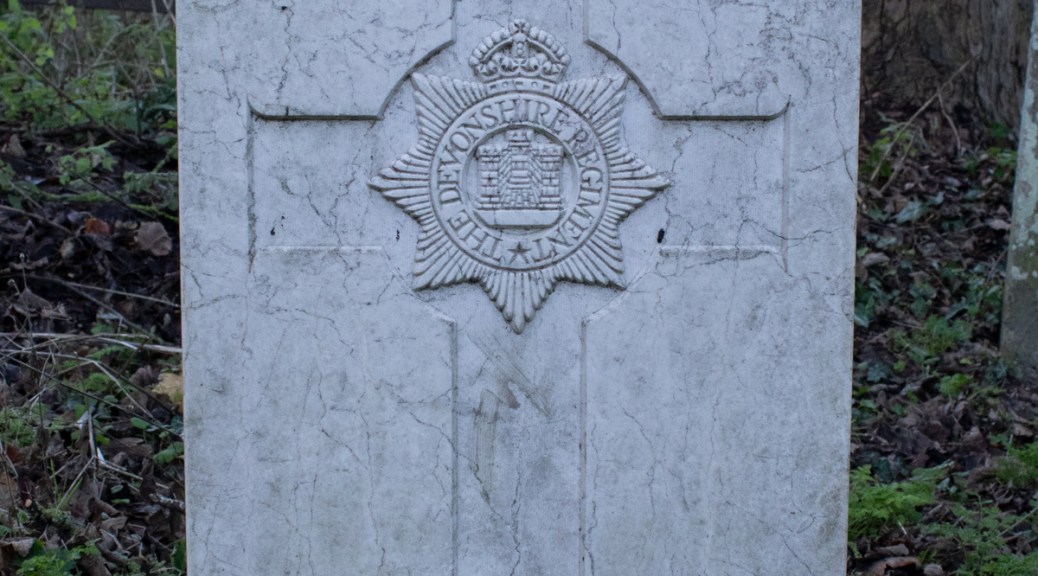
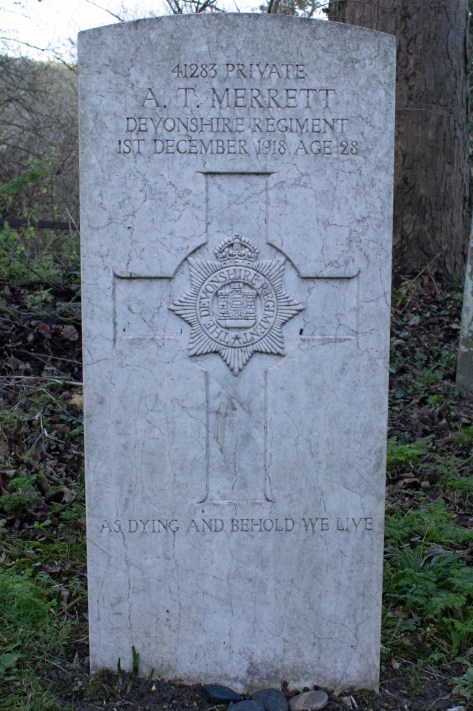
Albert Tom Merritt was born in the spring of 1890, the youngest of six children to John and Mary. John was a bricklayer from the village of Bratton in Wiltshire, and this is where the family were born and raised.
When he completed his schooling, Albert took up employment as a carpenter. His mother passed away in 1905, and on 15th September 1915, he married Elsie House. A labourer’s daughter from Aller Hilton, Dorset, the couple exchanged vows in her parish church, and went on to have three children: Frederick and Edward.
Albert was called up in October 1916, and was assigned to the 13th Battalion of the Devonshire Regiment. His service papers show that he was 5ft 6ins (1.67m) tall and weighed 119lbs (54kg). He was noted as having poor hearing, but declared fit for service in the regiment’s Labour Corps.
Assigned to the 447th Agricultural Company, Private Merritt remained on home soil during the conflict. He survived the war, but contracted influenza in the autumn of 1918. Sent home to recuperate, he passed away on 1st December, at the age of 28 years old.
The body of Albert Tom Merritt was laid to rest in the graveyard of St James’ Church, in his home village of Bratton.
Tragically, Elsie was pregnant when her husband died. She gave birth to a third son, Leonard, in May 1919.
The Commonwealth War Graves Commission’s records give Albert’s surname as Merrett. However, all other documents confirm the spelling as Merritt.
Geoffrey Hugh Willoughby St Quintin was born in Cromarty, Ross-shire, on 17th November 1899. The second of two children (although his older sister Doris had died two years before he was born), his parents were Geoffrey and Muriel St Quintin.
Geoffrey Sr was an estate manager and the 1901 census showed the family having eight live-in servants. Geoffrey Jr was then sent off to a private prep school in Wokingham, Berkshire.
The next census return, taken in 1911, found Geoffrey Sr was visiting his brother at Scampston Hall in North Yorkshire. Muriel, meanwhile, was staying with her cousin Eliza Willoughby, the wife of Baron Middleton. Between the two residences, there was a retinue of some 23 servants.
Geoffrey Sr died in 1913, and his son went on to attend Eton College. When war broke out he stepped up to serve his country, joining the Royal Fusiliers.
Ross-shire friends, especially in the Cromarty and Fortrose districts, will regret the death from heart failure, following pneumonia and influenza, of Geoffrey Hugh Willoughby St Quintin, son of the late Mr Geoffrey St Quintin, and of Mrs Geoffrey St Quintin, Flowerburn, Fortrose. He died in London just prior to an intended visit to Scampston, Yorks., to the home of his uncle, Mr WH St Quintin. Born at Cromarty House nineteen years ago, growing up into a young manhood of great strength and stature, he was well known and very popular in Ross-shire, where he passed the greater part of his young life. On leaving Eton College he was appointed to a cadetship in the Household Brigade, Officers’ Cadet Battalion, with the intention of joining the Guards, and was qualifying for his commission at Bushey, Herts., where he contracted his illness. He was a right gallant young gentleman, and everywhere a favourite…
A sad circumstance was the death on the day of the funeral of his devoted old nurse, Miss Johan Fraser, who was with him during his illness and contracted the influenza which carried her away.
[North Star and Farmer’s Chronicle: Saturday 21st December 1918]
Geoffrey Hugh Willoughby St Quintin was just 19 years of age when he passed away. His body was taken to Eton for burial, and he was laid to rest in the village’s St John’s Churchyard.
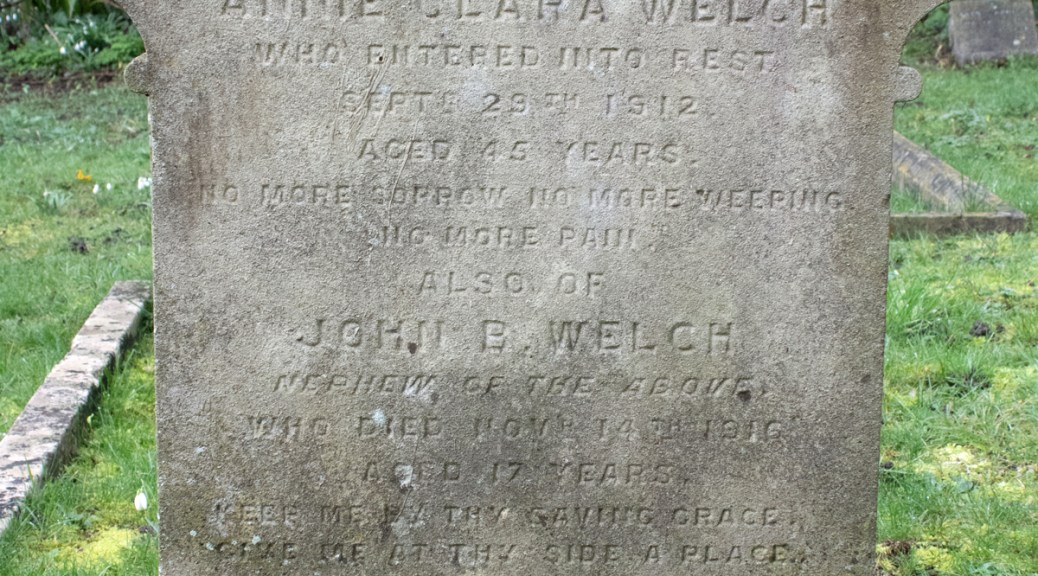
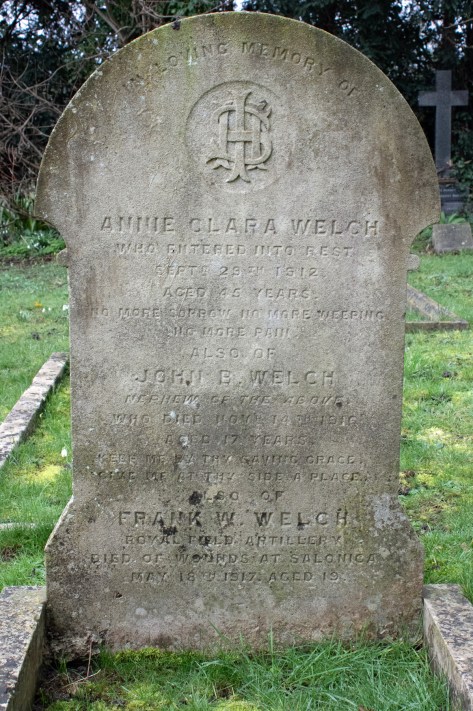
John Benjamin Welch was born in Eton, Berkshire, on 16th October 1899. The second of five children, his parents were Frank and Annie Welch. Frank was a house porter at Eton College, and the family lived at 4 Willow Place in the village, before moving to 8 Eton Square by the time of the 1911 census.
When he completed his schooling, John (who was known as Jack) found work in a local foundry. He sought a life of adventure, however, and, on 25th July 1916, he joined the Royal Navy. His service records show that he was just 5ft 3.5ins (1.6m) tall, with brown hair , blue eyes and a fresh complexion.
Being below the age to formally enlist, John was given the rank of Boy 2nd Class, and sent to the cruiser HMS Powerful to be trained on the job. Tragically for John, however, he contracted pneumonia, and the condition would take his life. He passed away on 14th November 1916: he was just 17 years of age.
The body of John Benjamin Welch was taken back to Berkshire for burial. He was laid to rest in the peaceful graveyard of St John’s Church, Eton.
John’s older brother, Frank, had also spent time serving his country. Enlisting in the Royal Field Artillery, and was attached to the 145th Brigade.
Gunner Welch served at Ypres and at Loos, and, by the spring of 1917, his unit was fighting in Salonika. He was wounded, and died of his injuries on 8th May that year: he was eighteen years of age.
By this point, through war and illness, Annie had lost a daughter, and three of her sons. The impact must have been unbearable: she died in the autumn of 1919, aged 43 years old.
Alfred Story was born in the summer of 1876 in Poplar, Middlesex. The youngest of three children, his parents were Benjamin and Margaret. Benjamin was an engine fitter from North Shields, Tyne and Wear, but he and Margaret had moved to London by the time their eldest was born in 1863.
Margaret died in the 1880s, and, when Alfred left school, he found work as a draper’s assistant. He did not carry out this trade for long, however, and took up a career in the Royal Army Medical Corps. His First World War service papers suggest that he remained in the army for twelve years, gaining the Kedive’s Star for service in the Sudan in 1898, and the Queen’s Medal with five clasps and the King’s Medal with two clasps for his time in South Africa.
By the time of the 1911 census Alfred was living at 1 Belle Vue, Eton, Berkshire, and that he was a house porter at Eton College. He was recorded as having married Alice in 1905 (although a later document suggests they did not exchange vows until 26th October 1916), and the couple were living there with their daughter, May, who was three years old. While no formal marriage certificate is available, it would seem that Alice was a widow when they got together: also living at 1 Belle Vue were her children, William Mallaband (who was 15) and Violet Mallaband (13).
The next record for Alfred is his service papers for the First World War. He enlisted on 26th February 1917, and was assigned back to his former regiment as a Private. His medical confirms that he was 5ft 8ins (1.72m), and that he weighed 160lbs (72.6kg). He was recorded as having brown hair, blue eyes and a fresh complexion.
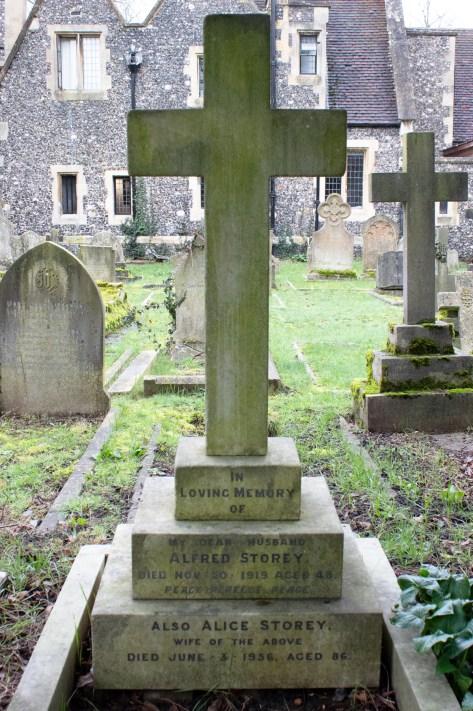
Private Storey carried out his duties on home soil, and was attached to 18th Company. He survived the conflict, and rose to the rank of Corporal, then Acting Sergeant. When he was stood down on 16th February 1919, we readily volunteered to extend his service for a further twelve months. On 20th November that year, he collapsed and died from a cerebral haemorrhage. He was 39 years of age.
The body of Alfred Storey was taken back to Berkshire for burial. He was laid to rest in the peaceful graveyard of St John’s Church, Eton. He was reunited with Alice when she died in 1956: husband and wife buried together after 37 years.
William James Maslin was born in the autumn of 1898, and was the second of four children to Mark and Emma. Mark was a hay cutter from Liddington, Wiltshire, but the family were born and raised in Edington, near Westbury.
There is little specific information about William’s life, but it is clear that when war broke out, he was keen to play his part. He enlisted in the Training Reserve Battalion, and was assigned to the 25th Battalion. Sent to Wool, near Bovington, Dorset, it wasn’t long before Private Maslin fell ill. He passed away from bronchial pneumonia on 4th April 1917: he was just 18 years of age,
The body of William James Maslin was taken back to Wiltshire for burial. He was laid to rest in the graveyard of Ss. Mary and Katherine and All Saints’ Church in his home village, Edington.
William’s older brother, Walter Frank Maslin, also served in the First World War. Born in 1891, he followed in his father’s footsteps, working as a farm labourer.
On 24th September 1911, Walter married Rose Long. The couple set up home just along the road from Mark and Emma, and wend on to have three children: Florence, Herbert and Dorothy.
Walter enlisted in the Worcestershire Regiment, and was attached to the 2nd/8th Battalion. His unit fought at Fromelles, the Ancre and Langemarck, although, as his service papers no longer exist, it isn’t clear where or how Private Maslin served.
What is clear, however, is that he was captured, and taken as a prisoner of war. Imprisoned at Hamelin Camp, not far from the German town of the same name, he was certainly there by the spring of 1918. Conditions would have been harsh, and Private Maslin succumbed to pneumonia on 6th May 1918: he was 26 years of age. His widow and family would not find out about his passing for some weeks, and a death notice was only reported in the Devizes and Wiltshire Advertiser on the 18th July.
The body of Walter Frank Maslin was laid to rest in Friedhof Ohlsdorf, Hamburg, Germany.
Leonard Stephen Lovelock was born early in 1887 in the Wiltshire village of Edington. The son of Ellen Lovelock, there is no confirmation of who his father was. Ellen married Stephen Drewett in 1889, and from this point on Leonard took that surname. Stephen was a sawyer, and he and Ellen set up home in Kington Langley, near Chippenham.
Leonard, however, was destined for a different upbringing. The 1891 census return found him living with Jesse and Ann Coldrake, who were recorded as his grandparents: also in the household were Betsy Drewett (Jesse’s mother-in-law) and Emily Drewett (his daughter-in-law). The relationships are a little confusing, but Leonard remained with Jesse and Ann for the1901 and 1911 census records.
When he completed his schooling, Leonard followed Jesse into farm labouring. The later census return recorded the family living in a three-roomed cottage on Tinhead, the road leading north from Edington village centre.
Farm work was only the first step for Leonard and, by the time war broke out, he was employed as an attendant at the Wiltshire County Asylum in Devizes. He enlisted on 12th January 1916, his medical records showing that he was a little under 5ft 6ins (1.67m) tall, and weighed 170lbs (77.1kg).
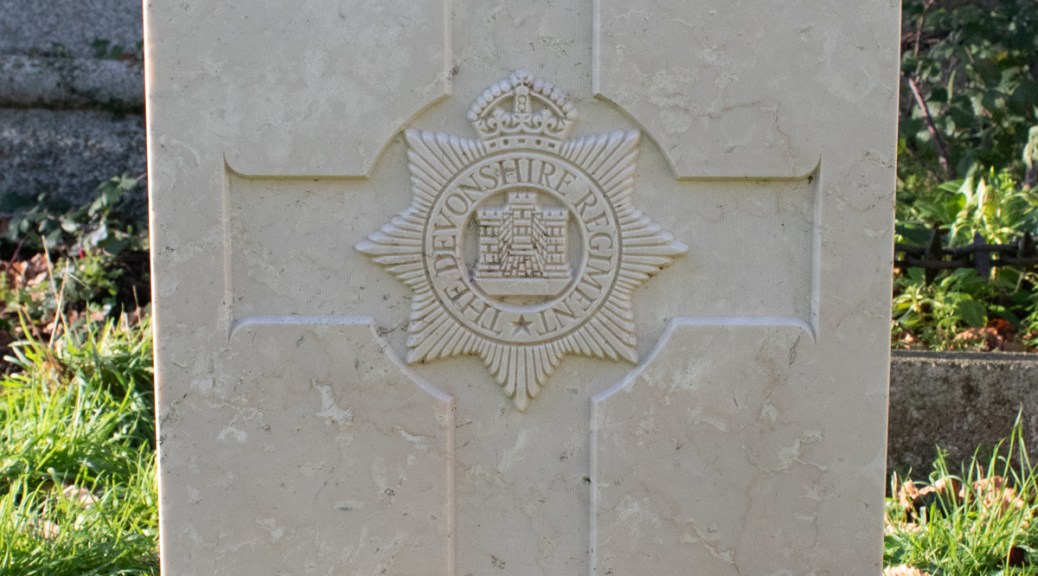
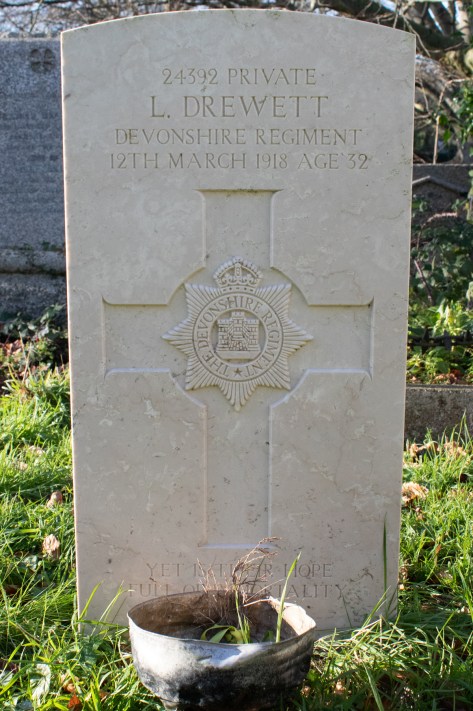
Private Drewett was initially assigned to the 12th Battalion of the Devonshire Regiment and, on 14th June 1916, his unit crossed the channel for France. While there, he was transferred to the Labour Corps, and was attached to the 152nd Labour Company. In the summer of 1917, Leonard joined the 5th Army School of Cookery, but after just six weeks he was admitted to a camp hospital suffering from epileptic seizures.
Moved from the camp hospital to the 2nd Australian General Hospital in Wimereux, by the end of the year, Private Drewett had been medically evacuated to Britain for treatment. He was sent to the General Military Hospital in Colchester, Essex, but his condition would ultimately prove fatal. Leonard died on 12th March 1918: he was 32 years of age.
The body of Leonard Stephen Lovelock Drewett was taken back to Wiltshire for burial. He was laid to rest in the graveyard of Ss Mary and Katherine and All Saints in his home village of Edington.
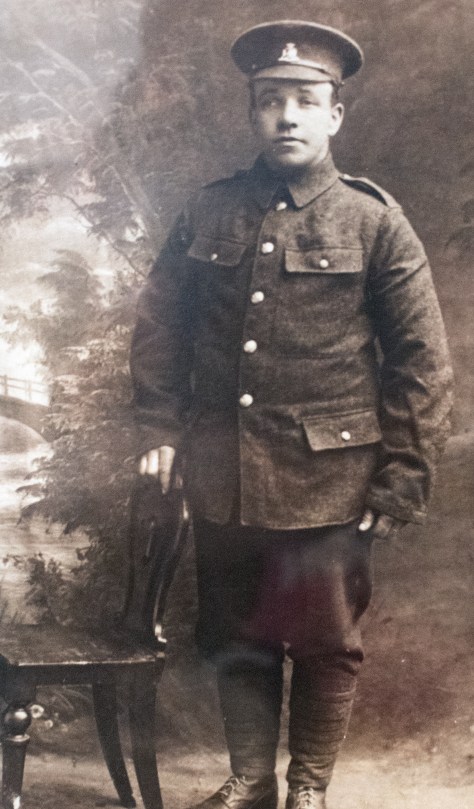
Private Leonard Drewett (from Edington Church memorial)
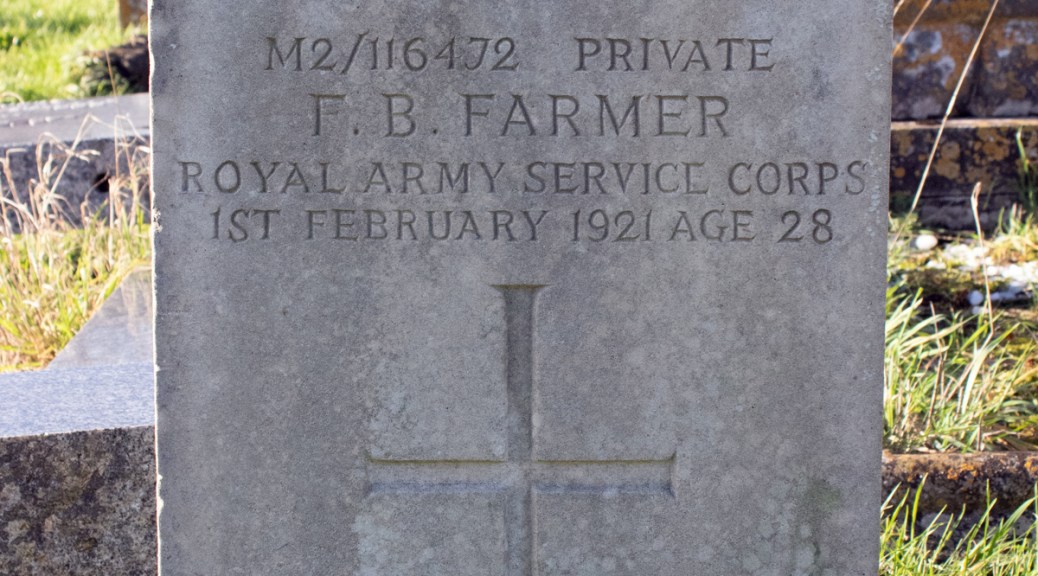
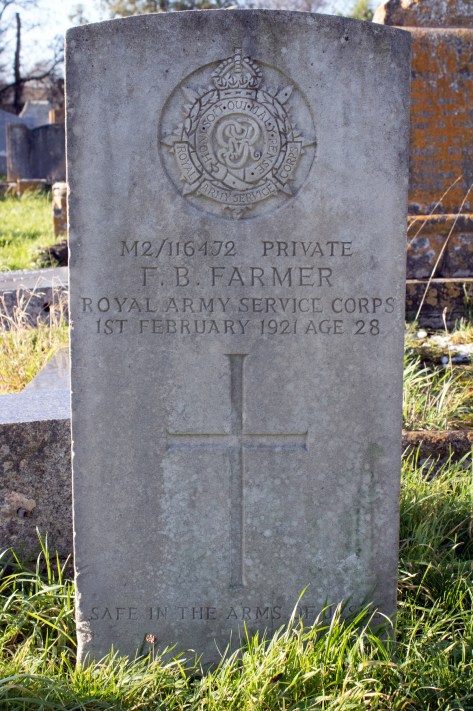
Frank Baden Farmer was born in the summer of 1892 in the Wiltshire village of Semington. The twelfth of thirteen children, his parents were groom and gardener John Farmer and his wife, Jane.
When he completed his schooling, Frank – who was known as Toby to his family and friends – found work as a labourer in a local iron foundry. War broke out in the summer of 1914, and he gave up his job to enlist. He joined the Army Service Corps as a Private and, by early August 1915, he was in France.
Details of Private Farmer’s life in the army have been lost to time, but he certainly survived the war, and returned home to Wiltshire. At this point, Frank’s trail goes cold. The next documents for him relate to his passing – from disease, on 1st February 1921. He was 27 years of age.
The body of Frank Baden Farmer was laid to rest in the graveyard of St George’s Church in his home village of Semington.
Interestingly, The Wiltshire News of the 18th February (thirteen days after Frank’s funeral) included a photograph of the newly installed war memorial tablet in St George’s. Unveiled the week before, it is likely that Private Farmer’s passing came to late for his name to be included on it.
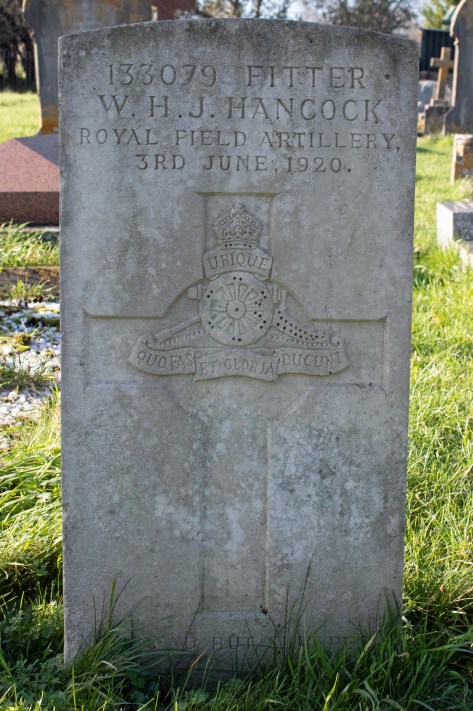
William Henry John Hancock was born in the autumn of 1896 in the Wiltshire village of Semington. One of three children – although one of his siblings had died before he was born – his parents were Henry and Alice Hancock. Henry’s line of work seemed to change over time: William’s baptism record notes he was a baker; the 1901 census suggests he was a poulterer and fishmonger; by 1911 he is recorded as being a market gardener.
William was recorded in census records as John, although his family and friends called him Jack. The 1911 document confirms that, at 14 years of age, he had completed his schooling and was employed as a rubber worker at the local India Rubber factory. His older brother, Richard, was also working, though as a wood trellis maker in a local saw mill. The Hancock family had also taken in two lodgers: William Haines was also a rubber worker, while Herbert Reynolds was employed at the saw mill as well.
When conflict broke out in Europe, William – Jack – was called upon to play his part. Full details of his service have been lost to time, but it is clear that he enlisted in the Royal Field Artillery as a Fitter, and was assigned to B Battery of the 2nd Reserve Brigade. A territorial unit, it seems likely that he was assigned to them while recovering from an illness contracted overseas. By 21st December 1918, Fitter Hancock had been discharged from service, as he was physically unfit to continue.
Jack returned home to Wiltshire, and is likely to have tried to pick up on his previous life. His health had been impacted, however, and he passed away after “a short illness” [Wiltshire Times and Trowbridge Advertiser: Saturday 12th June 1920] on 3rd June 1920: he was 23 years of age.
The body of William Henry John Hancock – Jack to his friends – was laid to rest in the graveyard of St George’s Church in his home village.
As an interesting aside, a newspaper reported on a luck escape that Henry had had back in 1911:
Last week Mr Hancock, of Semington, on going to the fowl cote found a snake quite a yard and a half long, and as thick as one’s arm. It had a toad in is mouth, and was seen to make a hasty meal of this. Mr Hancock killed the unwelcome visitor with a hay-fork
[Devizes and Wilts Advertiser: Thursday 13th July 1911]
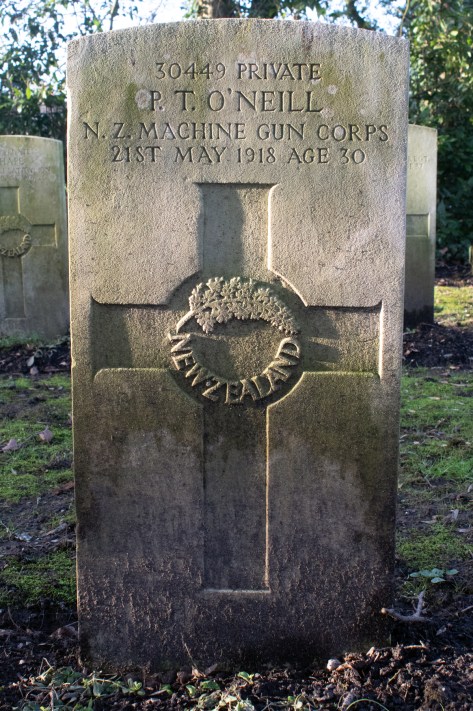
Patrick Thomas O’Neill was born in Wellington, New Zealand, on 2nd March 1888. Little information is available about his early life, but the Commonwealth War Graves Commission confirms he was the son of Jane O’Neill, and the family lived at 151 Taranaki Street.
When he completed his schooling, Patrick found work as a driver for Munt, Cotterell & Co. A large transport and cartage company, when the First World War broke out, they became involved in transporting supplies to the military camp at Trentham. Because of this connection, many of the company’s workers – Patrick included – enlisted.
Patrick’s service papers show that he joined up 22nd August 1916. His medical confirms that he was 5ft 4.5ins (1.64m) tall and had fair hair, blue eyes and a fair complexion.
After his training at Trentham, Private O’Neill’s unit – the New Zealand Machine Gun Corps – left Wellington for Europe. After a week’s break in Simon’s Town, South Africa, their ship – the Walmer Castle – arrived in Devonport, Devon, on 27th March 1917. During the second part of the voyage, Patrick was admitted to the ship’s hospital, for an infestation of pubic lice.
The voyage from New Zealand to Britain had taken nearly three months, so when the regiment finally arrived at their camp in Sling, Wiltshire, it must have been something of a relief. For Private O’Neill, however, it marked the beginning of a regular pattern of misdemeanours.
In April 1917, Patrick moved to a base in Tidworth. A matter of weeks later, he went AWOL, and forfeited three days’ pay as a result. Private O’Neill was then sent to Grantham, Lincolnshire, where the ANZAC united had their machine gun training base. Over the next two months, he went AWOL on four separate occasions, resulting in him losing a total of 10 days’ pay and, for the final absence, 96 hours’ detention.
Private O’Neill disappearances seem to have been those of a lad about town: a couple of days after his final return, he was admitted to the venereal section of the camp hospital in Grantham. His condition – and probably his behaviour – was such that he was transferred back to Wiltshire, and admitted to the No. 3 New Zealand General Hospital near Codford.
Private O’Neill was not done, however. On 6th December 1917, and having been discharged back to his unit just a day before, he went AWOL again, this time in spectacular fashion. He was arrested by military police in Edinburgh on 14th January 1918. Taken in handcuffs back to Codford, he forfeited 71 days’ pay – plus a 2s fine for his arrest – and punished with 90 days in the cells.
Patrick’s imprisonment began on the 1st March 1918, but it was a sentence he would not complete. On 16th May, he was taken from his cell and admitted to the camp hospital, once again to the venereal section. Less than a week later, he was dead, having suffered an embolism. Private O’Neill was 30 years of age when he passed, on 21st May 1918.
The body of Patrick Thomas O’Neill was laid to rest in the extension to St Mary’s Church, Codford, not far from the base in which he had been incarcerated and hospitalised.
Charles John Harvey was born in Nelson, New Zealand, on 30th May 1892. Little information is available about his early life, but documents give his parents as George and Eleanora Harvey.
Charles was working as a general labourer when war broke out, and was called upon to play his part on 19th October 1916. Attached to his country’s Canterbury Regiment, his medical report showed that he was 5ft 6ins (1.68m) tall, and weighed 11st 2lbs (70.8kg). An Anglican, he was recorded as having dark brown hair, blue eyes and a dark complexion. He was noted as having no vaccination marks.
This fact that Private Harvey hadn’t been vaccinated would come back to haunt him. Sent to an army camp in Trentham, near Wellington, within a matter of weeks he was hospitalised with measles. He remained admitted until 13th December 1916, when he was discharged back to his unit.
It was not until 2nd April 1917, that Private Harvey would set sail for Britain. The journey from Wellington to Devonport would take ten weeks, and Charles was marched in to camp at Sling, Wiltshire, on 10th June that year.
Assigned to the 2nd Company of the 2nd Battalion, Private Harvey finally arrived in France on 27th August 1917. He served on the Western Front for a couple of months, before falling ill again. This time it was influenza that had incapacitated him, and he was admitted to a hospital in Le Tréport for a month while he received treatment.
Charles’ recovery was to be a slow one and, in the end, he was medically evacuated to Britain for ongoing medical support. By February 1918, he had spent time in four different hospitals and, intriguingly, had forfeited three days’ pay for going AWOL while a patient in a medical facility in Hornchurch, Essex. By the start of April 1918, Private Harvey was discharged to the ANZAC camp in Codford, Wiltshire.
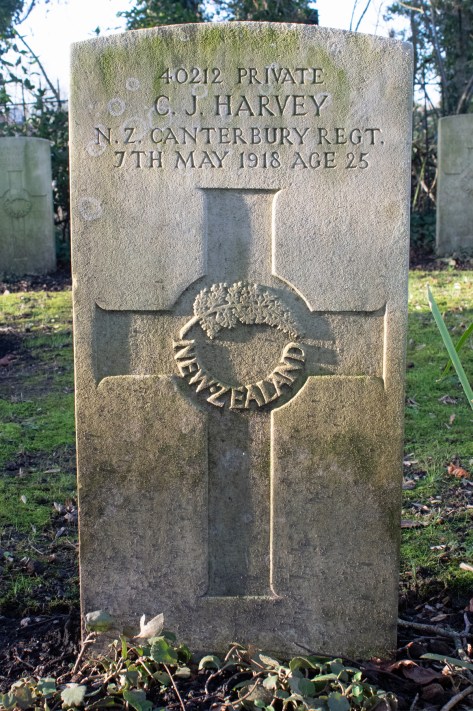
His health issues were not over, however, and, on 21st April, Charles was taken in to the No. 3 New Zealand General Hospital in near the Codford camp. He was suffering from acute nephritis, and this would ultimately prove fatal. Private Harvey died on 7th May 1918: he was 25 years of age.
The body of Charles John Harvey was laid to rest in the graveyard extension of St Mary’s Church, Codford.