Category Archives: illness

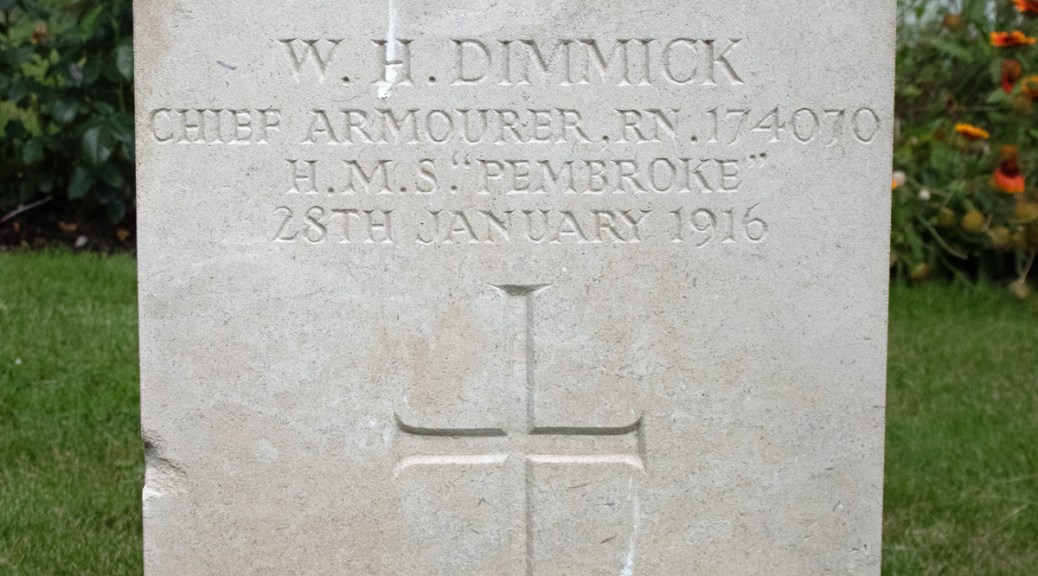
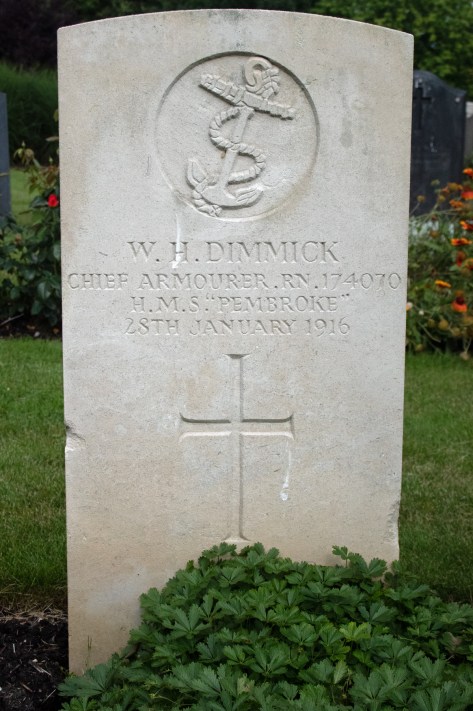
Chief Armourer William Dimmick

Chief Armourer William Dimmick

William Henry Dimmick was born in Titchfield, Hampshire, on 10th November 1871. The oldest of four children, his parents were John and Harriett Dimmick. John was a butcher, but when he completed his schooling, he became chose a different path.

The 1891 census recorded William as lodging with the Merritt family in Clanfield, to the north of Waterlooville, Hampshire. He was employed as a blacksmith, but either this was a means to an end, or he had itchy feet.

On 30th June 1893, William enlisted in the Royal Navy. Part of the Armourer’s Crew, his service records show that he was 5ft 7ins (1.7m) tall, with light hair, blue eyes and a fresh complexion. He was sent to HMS Excellent, the shore base on Whale Island in the Solent, and she would become the home to which he would return over the next few years.

Armourer’s Crew Dimmick’s contract was for twelve years and, during that time, he would serve on five separate ships. A lot of his time, however, was spent ashore, and his service papers note spells at both HMS Wildfire and HMS Pembroke, both on the North Kent Coast.

William’s time was not mis-spent, however, and he started to rise through the ranks. On 20th April 1897 he was promoted to Armourer’s Mate; in November 1898 he was made an Armourer. On 1st November 1902 he rose to Acting Chief Armourer, a role that was made permanent twelve months later.

Away from work, William found love. He married Florence Dunford in around 1902, and the couple would go on to have three children – William Jr, John and Florence Jr – between 1902 and 1911.

When William’s contract came to an end, he immediately re-enlisted. Over the next few years, he was given five more postings, before being assigned to HMS Natal in September 1912. An armoured cruiser, she was attached to the Grand Fleet during the First World War, but did not take part in any battles.

On 30th December 1915, Natal was moored in the Cromarty Firth, when an internal explosion from faulty cordite ripped her apart. She sank, and at least 390 crew and civilians were killed.

The next record for William is that of his passing – from pneumonia, at home, on 28th January 1916. He was 45 years of age. It is unclear whether he had been on board Natal a month before, and whether there was any connection between his illness and the explosion.

The family were living in Sheerness, Kent, at the time of William’s death, His body, however, was laid to rest in the naval section of Woodlands Cemetery, Gillingham, not far from HMS Pembroke, the dockyard in Chatham, Kent, which he had called home for some time.


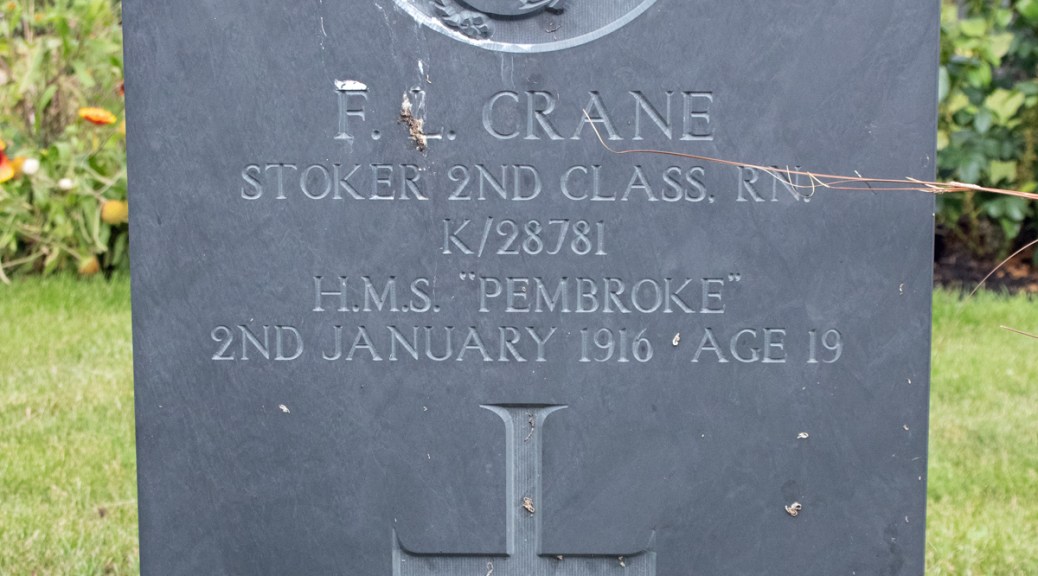
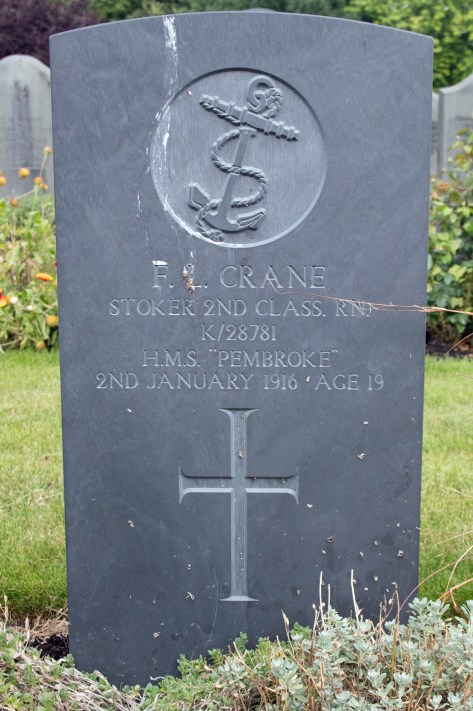
Stoker 2nd Class Frederick Crane

Stoker 2nd Class Frederick Crane

Frederick Leonard Crane was born in Sittingbourne, Kent, on 27th September 1896. The youngest of eleven children, his parents were brickfield labourer George Crane and his wife, Frances.

Frances died in the spring of 1900, and when Frederick left school, he initially found employment as a horse driver on a farm. By the time war broke out, however, he had changed careers, and was working as a blacksmith.

Frederick enlisted on 8th November 1915, joining the Royal Navy as a Stoker 2nd Class. His service papers note that he was 5ft 7.5ins (1.71m) tall, and had fair hair, blue eyes and a fair complexion. Stoker Crane was sent to HMS Pembroke, the Royal Naval Dockyard in Chatham, Kent, for his training.

Tragically, Frederick’s time in the forces was to be a tragically brief one. At the end of December, he was admitted to the naval hospital in the town, as he was suffering from cerebro-spinal meningitis. The condition was get the better of him, and he passed away on 2nd January 1916. He was just 19 years of age.

The body of Frederick Leonard Crane was laid to rest in Woodlands Cemetery, Gillingham, not far from the Kent port that he had started to call home.


Lieutenant Commander Thomas Wilson

Lieutenant Commander Thomas Wilson

Thomas Roland Wilson was born on 2nd December 1871 in Hythe, Kent. His parents were Thomas and Sarah, but there is little information available about his early life.

The 1881 census recorded Thomas as living with his uncle and aunt in Deptford, Kent. Ten years later, he was living with his parents in Finchley, Middlesex. Thomas Sr was living on his own means, while his son, now 20 years of age, was a mercantile mariner.

On 18th November 1895, Thomas Jr was awarded a certificate of competency as being able to be a master of his own vessel. Five years later, he married Charlotte Chichester. She was the daughter of a master mariner, and the couple appeared to settle in her home town of Braunton, Devon.

When war broke out, Thomas was assigned to the Royal Naval Reserve. Details of his time during the conflict are hazy, but, by 1917, he was in charge of HMS Yacht Vagrant. Built in Jarrow, she had been hired by the Admiralty at the start of the war to act as an anti-submarine vessel, with Captain Wilson leading the crew.

Little further information is available about Thomas’ life, and while the Commonwealth War Graves Commission and his headstone give his rank as Lieutenant Commander, other documents note he was a Captain.

The next available record for him relates to his passing:

The regretted death has occurred of Capt. Wilson, in his 47th year, at Fern Lea, Braunton, the residence of his mother-in-law, Mrs Chichester.

[North Devon Journal: Thursday 18th October 1917]

No cause of death is evident, but Thomas Roland Wilson passed away on 17th October 1917. He was laid to rest in the graveyard of St Brannock’s Church in Braunton, Devon.


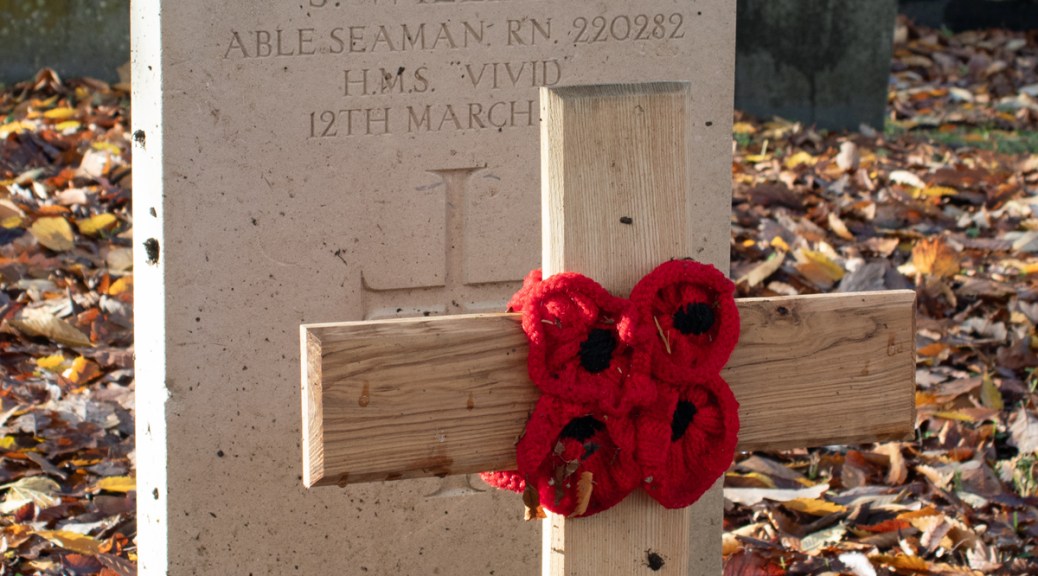
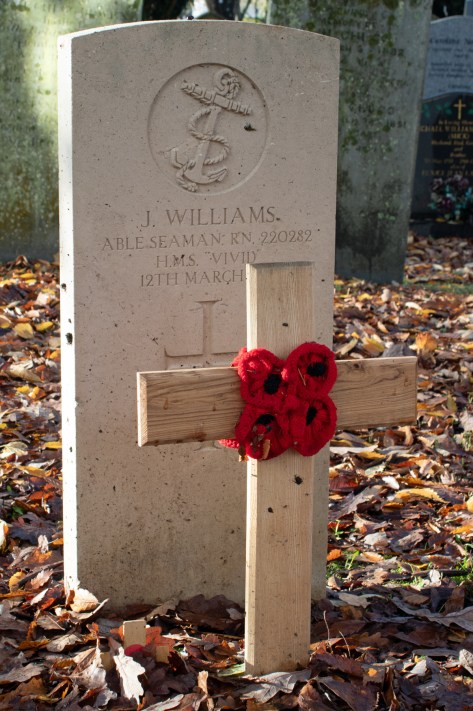
Able Seaman John Williams

Able Seaman John Williams

The funeral of Mr Williams… of South-street, took place on Saturday, the interment being made by the Vicar of Braunton (Rev. JH Prince) in the St Brannock’s Churchyard. There were many manifestations of sympathy, and blinds were drawn all along the route to the Churchyard. The Vicar, in the course of a sympathetic and short address to the bereaved relatives, related a touching incident at an interview he had had with the deceased a few days before his death. The Vicar asked him if he would not rather die peacefully at home than out with his comrades, who were keeping the silent vigil on the seas and in conflict with the enemy. The dying sailor replied in the negative, and said he would sooner be with his comrades, fighting for his King and Country. This, said the Vicar, struck the key-note of Mr Williams’ unselfish life, and by his death they had lost an upright and steady inhabitant.

[North Devon Journal: Thursday 22nd March 1917/

John Williams was born on 4th May 1886 in St Agnes, Cornwall. Details of his early life are a challenge to confirm, but the newspaper report goes on to name two of his brothers as Alfred and Cecil, and one of his sisters as Olive. Piecing this information together with census documents, it seems likely that his parents were William and Elizabeth (his pension record gives Mrs B Williams, which may be Bessie).

The 1891 census records the family as living in St Agnes. William is missing, although it is possible that he was away at sea when the return was taken. John does not appear on the 1901 census, but his trail can be picked up again a year later, when he enlisted in the Royal Navy.

John was working as a butcher when he chose a seafaring career path, and he was sent to HMS Impregnable, the training ship moored at Devonport, Devon, for his induction. He was below the age to formally join up, and so was given the rank of Boy 2nd Class.

Over the next two years, John learnt the tools of his trade. He was trained at three Devon bases – Impregnable, HMS Lion and HMS Vivid – and was promoted to Boy 1st Class in February 1903. On 4th May 1904 he came of age, and officially enlisted in the Royal Navy, given the rank of Ordinary Seaman. His service records note that he was just 5ft 1in (1.55m) tall, and had dark brown hair, grey eyes and a fresh complexion.

Ordinary Seaman Williams was on his first formal posting by this point, and was serving on board the gunboat HMS Harrier. By November 1904, however, he was transferred, and became part of the crew of the armoured cruiser, HMS Suffolk. She remained his home for the next eighteen months, during which he was promoted again, to Able Seaman.

Over the next decade, John would serve on a further six ships, returning to HMS Vivid in between assignments. The work, particularly after the outbreak of war, was taking a strain on his health, however, and, on 3rd May 1916, he was medically discharged from duty, suffering from tuberculosis.

By this point, John’s mother had moved to Devon and was living in the village of Braunton. Following his discharge, he returned to live with Elizabeth – Bessie – and remained there until his death some nine months later. John died on 12 March 1917, aged 29.

The body of John Williams was laid to rest in St Brannock’s Churchyard, Braunton.


Private Thomas Bidder

Private Thomas Bidder

Thomas Bidder was born on 10th April 1893 on Lower Winsham Farm, Braunton, Devon. One of twelve children, his parents were farmers John and Eliza Bidder.

Thomas sought a life away from the farm and he enlisted in the army, joining the prestigious Coldstream Guards. The 1911 census recorded Private Bidder as being in barracks in a camp in Chertsey, Surrey.

When war broke out, Thomas was mobilised, and soon found himself on the Western Front. It is unclear exactly when or how he served, but a later report suggests that he was wounded in February 1915, and medically evacuated to Britain for treatment.

After being treated in different hospitals, he was sent home to convalesce, but here (no doubt as the indirect result of the wounds) tuberculosis developed, and death was due to this cause.

[Western Times: Thursday 19th August 1915]

Thomas Bidder died on 16th August 1915, at the age of 23 years old. The newspaper report noted that he “was a man who was greatly admired for his soldierly and other qualities, and at Braunton he will long be held in the fondest remembrance.” [Western Times: Thursday 19th August 1915]

Thomas was laid to rest in St Brannock’s Church in his home town of Braunton.


Thomas was not the first of the Bidder siblings to die during the war. His younger brother, Walter, served in the 2nd Battalion of the Devonshire Regiment. Private Bidder was killed on 18th December 1914, aged just 19 years old. He is commemorated on the Le Touquet Memorial in France, and on the family headstone in Braunton.


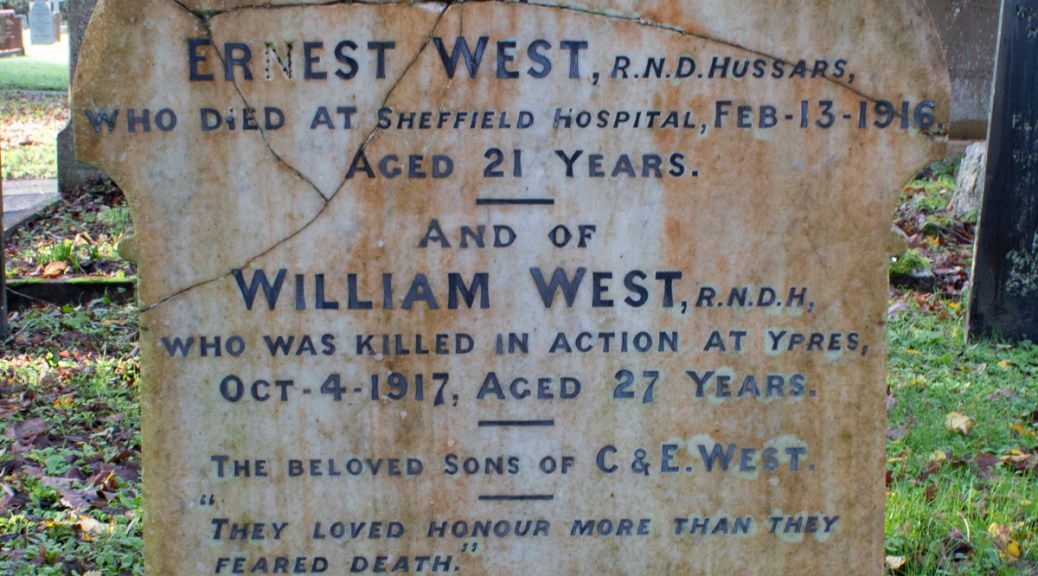
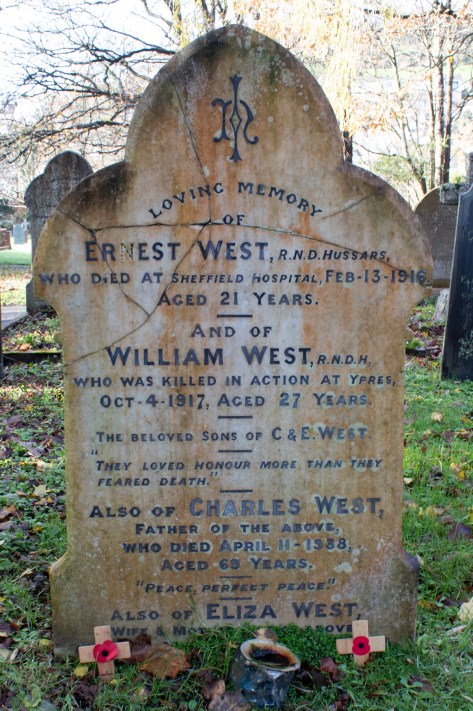
Private Ernest West

Private Ernest West

Ernest West was born in the autumn of 1894 in Barnstaple, Devon. The middle of seven children, his parents were Charles and Eliza. The 1901 censes recorded Charles as being the innkeepers of a pub on North Street in Braunton, but ten years later he had changed career, and was a corn and manure merchant. The family had moved to Scur Farm to the north of the town centre.

War broke out in the summer of 1914, and Ernest stepped up to play his part. He enlisted in the Royal North Devon Yeomanry, and was attached to the 1st Battalion. Full service details have been lost to time, but by the autumn of 1915, Private West was in the Balkans, and was among those to land at Sulva Bay on the Gallipoli peninsula.

Ernest survived the fighting, but contracted dysentery. He was medically evacuated back to Britain, and admitted to the 3rd North General Hospital in Sheffield, Yorkshire. Sadly, the condition was to get the better of him, and he passed away on the 13th February 1916, at the age of just 21 years old.

The body of Ernest West was taken back to Devon for burial, and he was laid to rest in the graveyard of St Brannock’s Church, Braunton.


Ernest was not the only West sibling to die during the First World War. His older brother William enlisted in the 1st Battalion of the Devonshire Regiment and, in the autumn of 1917, found himself in the fighting at Passchendaele. He was killed in action on 4th October, at the age of 27. He is commemorated on the Tyne Cot Memorial.


Private Ernest Shambrook

Private Ernest Shambrook

Ernest Shambrook was born in the parish of Heanton Punchardon, Devon, in the autumn of 1889. The youngest of six children, he was one of four sons to Robert and Fanny Shambrook. Robert was a miller’s waggoner, and the family lived at Heddon Mill in nearby Georgeham.

When Ernest completed his schooling, he took up work as a tailor, something his older brother, James, had previously gone into. The 1911 census found that Ernest had left home and was boarding with the Heath family in Ottery St Mary, where he was employed in tailoring.

When war broke out, Ernest stepped up to play his part. His service papers have been lost to time, but it is clear that he enlisted in the Devonshire Regiment at some point after September 1914. Private Shambrook was assigned to the 2nd/5th Battalion, and sent to Newton Abbot for training.

His time in the army, however, was to be a brief one. Ernest contracted pneumonia, and had to be admitted to the VAD Red Cross Hospital in the town. His condition, however, was to prove fatal, and Private Shambrook passed away on 4th March 1915: he was 25 years of age.

The body of Ernest Shambrook was taken back to the family church, St Brannock’s in Braunton for burial. The Exeter and Plymouth Gazette, reporting on his funeral, notes one of the mourners as “Miss Wotton (deceased’s fiancée)” [Thursday 11th March 1915]. There is no further information on Ernest’s intended.


Corporal Harry Fletcher

Corporal Harry Fletcher

Harry Luke Fletcher was born in the spring of 1889 in the Dorset town of Gillingham. The youngest of eight children, his parents were James and Mary Fletcher. James was an agricultural labourer-turned-gardener, but when his youngest left school, he took a different path.

The 1911 census found the family living in a four-roomed cottage on Wyke Road, Gillingham. James was retired by this point, and he and Mary shared their home with their daughter Bessie, who was employed as a glover. Harry completed the household, and he was working as a printer in the local iron works.

When war broke out, Harry was called upon to play his part. His service records have been lost to time, sadly, but, it is clear that he enlisted in the Dorsetshire Regiment, and was assigned to the 1st/4th Battalion. They served in South Asia, and it is likely that Harry – who rose to the rank of Corporal – spent the war in India and Mesopotamia.

Harry survived the conflict, and returned to Britain after the Armistice, waiting to be demobbed. During this time he fell ill, and passed away on 5th April 1919. He was 29 years of age.

The body of Harry Luke Fletcher was laid to rest in Gillingham Cemetery, not far from where his family were still living.


Private Arthur Coward

Private Arthur Coward

William Arthur Coward was born in the autumn of 1878 in Gillingham, Dorset. The youngest of three children, his parents were Arthur and Sarah Coward. Arthur died around the time his son was born, and, while he was baptised William, he was known by Arthur from there on in.

Sarah was left to being up her children alone and, by the time of the 1891 census, she had taken work as a laundry woman. The family were living on Gas House Lane, and Arthur’s older brother Hubert, or Bertie, had finished school and was working as an errand boy.

When he had completed his education, Arthur took a job as an ostler for a local inn, but wanted a reliable career and, on 30th October 1897, he enlisted in the army. Joining the Dorsetshire Regiment as a Private, his service papers show the young man he was becoming. His medical record notes that, at 19 years of age, he was a little under 5ft 7ins (1.7m) tall, and weighed 127lbs (57.6kg). He had dark brown hair, brown eyes and a sallow complexion. He was also found to have a scar on the left side of his neck, and slight varicose veins.

Assigned to the 2nd Battalion, Arthur spent the first few months training on home soil. In February 1898, however, his unit was sent to the Mediterranean and, that December, he transferred to the 3rd Battalion of the Lancashire Fusiliers. Over the next three years, Private Coward was based in Malta and Crete, but things were to go awry.

Bertie had passed away in the spring of 1899 and, on 25th February 1901, Arthur was imprisoned for an unrecorded felony. Tried ten days later, he was convicted of the offence, and imprisoned for three months. On his release, on 12th June, he was formally discharged from the army, and sent back to Britain.

By the time of the 1911 census, Arthur was back home. Taking up his former job as a ostler, he is recorded as living in a four-roomed house on Cemetery Road, Gillingham, with his mother. His older sister, Emily, was also living at home, the census noting that she had been an imbecile since birth.

When war broke out in the summer of 1914, Arthur would be called upon to play his part as part of Kitchener’s Army. He joined the Army Ordnance Corps on 14th April 1916, his papers suggesting little change in stature or looks, bit noted that he now suffered from eczema.

Private Coward survived the war, but in the winter of 1918, he fell ill with influenza, and this became bronchial pneumonia. His illness led to a medical discharge from the army on 15th March 1919.

At this point, Arthur’s trail goes cold. He returned home, but his health appears to have hampered him. He passed away on 24th October 1919 in Shaftesbury, Dorset. He was 41 years of age.

The body of William Arthur Coward was laid to rest in Gillingham Cemetery, just a short walk from where his mother and sister were living.


Sarah had now lost her husband and two sons and, in her early 70s, she was looking after her disabled daughter. The 1921 census found them still living on Cemetery Road, where Sarah was undertaking home duties, Emily being unable to work. She outlived her youngest child by a decade, her daughter dying just five months later, in May 1930.


Private Harry Mildenhall

Private Harry Mildenhall

Harry Mildenhall was born in the autumn of 1873 in Eton, Buckinghamshire. The third of six children, his parents were Henry and Harriet Mildenhall. Henry was a groom, and the family lived on first on Mill Lane, before moving to Alma Road in nearby Boveney, by the time of the 1891 census.

The next census return, taken in the spring of 1901, recorded Harry as having left home. Initially apprenticed to house painter Glen Rowland, the document found him as boarding with his employer at 1 Thames View, Clewer, on the outskirts of Windsor, Berkshire.

It was not long before Harry would set out on his own. On 14th April 1906, he was living on Speedwell Street, Oxford. It was on that day that he married Annie Berridge in the parish church. Seven years her new husband’s junior, Annie was a labourer’s daughter, with a history of her own:

Annie Berridge (19), domestic servant, Peterborough, was charged with obtaining 4s. by false pretences from Martha Withers on Feb. 4th. The evidence showed that Berridge had been residing with Mrs Knighton of Wellington-street, who was known to Mrs Withers. On Monday week she visited the latter’s house at Oundle-road and stated that Mrs Knighton wanted to borrow 6s. In consequence Mrs Withers gave her 4s., but afterwards discovered that Mrs Knighton had never sent for the money. Accused pleaded guilty, electing to be dealt with summarily. The Bench gave defendant a chance to retrieve her character by dealing with her ad a first offender and binding her over to come up for judgment when called upon.

[Peterborough Standard: Saturday 16th February 1901]

But Annie was not done with the law just yet:

Annie Berridge (19), single soman, of no fixed abode, was charged with stealing from 11, City-road, a pair of shoes, value 4s. 6d., the property of Elizabeth Ryall, on the 24th. She was further charged with stealing from 7, Perseverance Cottages, Star-lane, money to the amount of 1s., the property of Ethel Norman, on the 18th. In the first care Elizabeth Ryall stated that accused asked for lodgings. She stayed one day and went out the following morning. As accused did not return witness looked round and missed a pair of shoes (produced), an old pair being left in their place. Detective-Sergeant Smith stated that he saw accused in Broadway on the 25th wearing the shoes missed by the previous witness. Accused, who cried bitterly, elected to be dealt with summarily, and pleaded guilty. The Chief Constable stated that a fortnight ago the accused was before the Bench and was then bound over to be of good behaviour. The Bench retired, and on their return into Court the Chairman stated that it appeared leniency was no good. That had been tried a fortnight previously, and a sentence of two months’ imprisonment would now be passed. The second charge was not proceeded with.

[Peterborough Standard: Saturday 2nd March 1901]

The 1902 census, taken just a month later, recorded Annie’s fate: she was imprisoned in Northampton Prison. Meeting Harry may have been what helped Annie back on the rails. After their wedding the couple took rooms at 6 Mill Street, Kidlington, Oxfordshire, and went on to have three children: Edward, Albert and Annie.

War came to Europe in the summer of 1915, and, despite his age, Harry would step up to play his part. He enlisted in the Army Service Corps on 16th September 1915, his papers confirming that he was of Church of England by faith, and was 5ft 5.5ins (1.66m) tall.

Private Mildenhall was sent to France within a fortnight of enlisting, although his exact role is unclear. He certainly remained overseas until April 1917, when he returned home for three months. He returned to the fray in July 1917, transferring to the Labour Corps.

Harry next returned to Britain in May 1918. By this point, however, he had fallen ill, and was admitted to Station Road Hospital in Gillingham, Dorset, suffering from bronchitis. Any treatment proved to be too little, too late: Private Mildenhall died from heart failure at 8:15pm on 16th May 1918, at the age of 44 years old.

The body of Harry Mildenhall was laid to rest in Gillingham Cemetery, not far from the hospital where he had breathed his last.


Of Annie there is no further record. The 1921 census records the three children boarding with separate families: Edward and Albert were living with the Bowd family at 35 Gracious Street, Whittlesey, Cambridgeshire. Annie, meanwhile, was living with Joseph and Harriett Wing, just around the corner from her brothers at 5 Whitmore Street. The census records note that the children’s father was dead, but their mother alive.