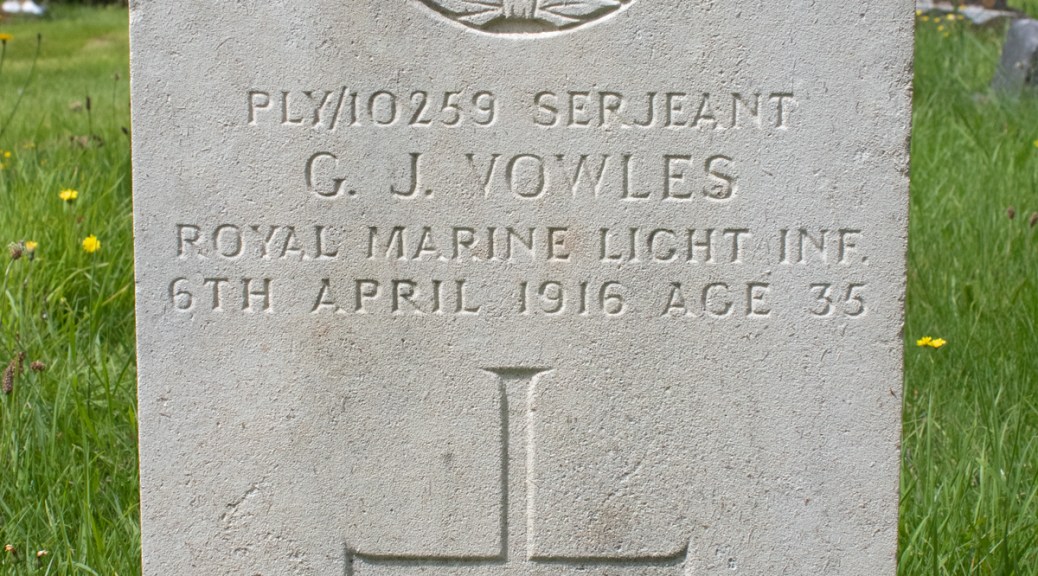
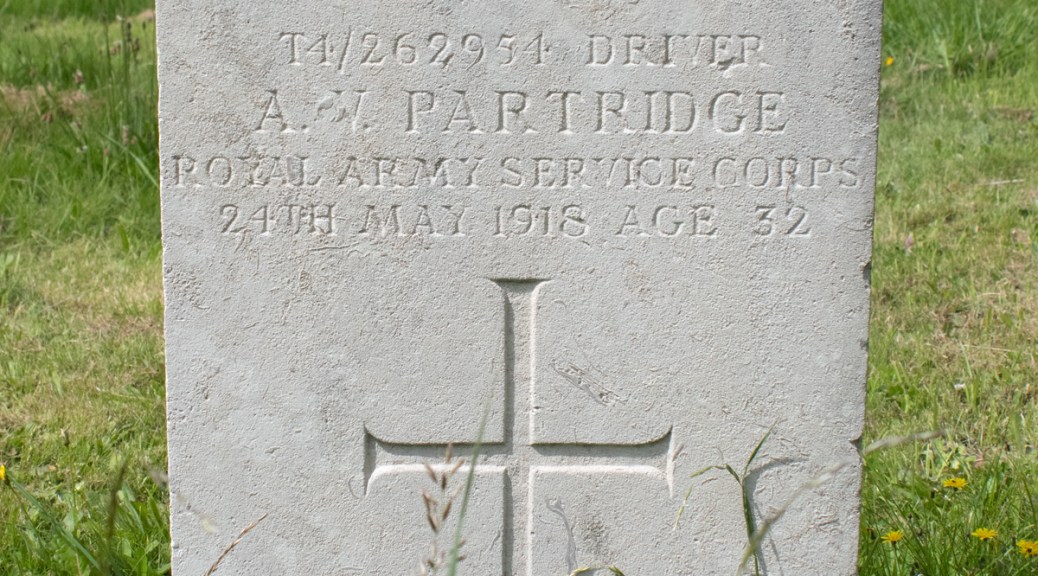
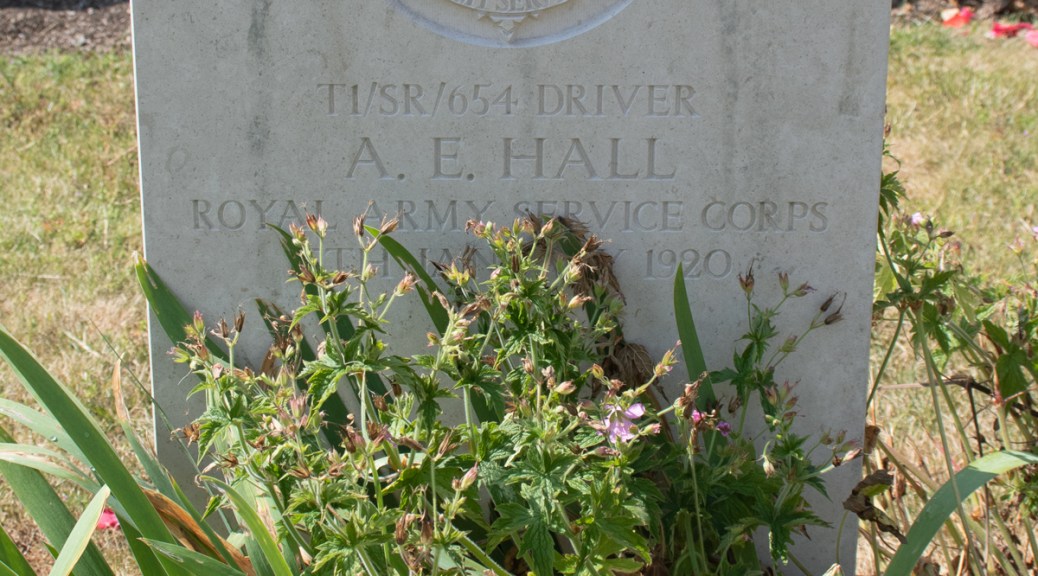
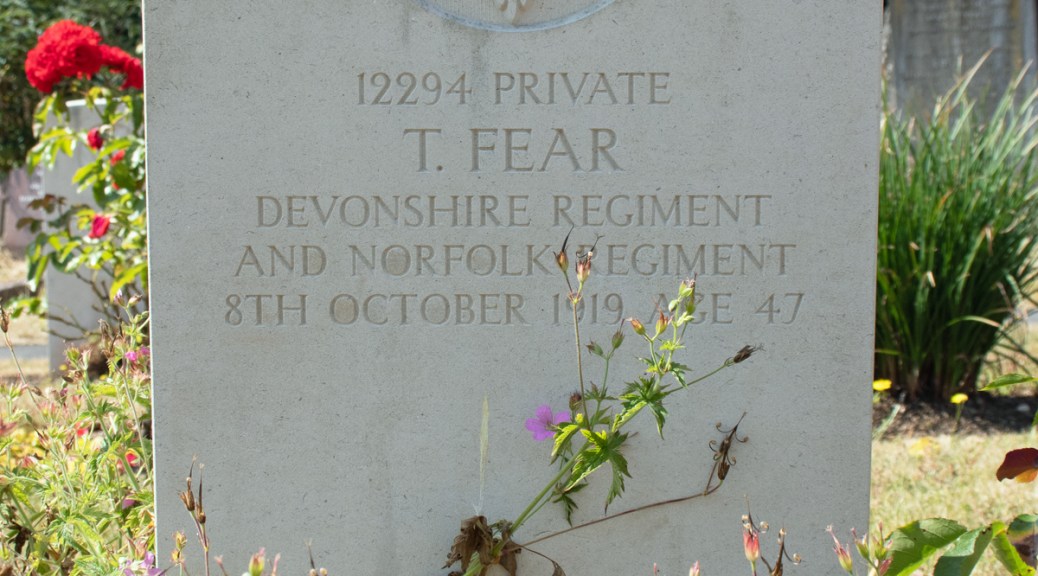
George Joseph Vowles was born in Winsley, Wiltshire, on 18th September 1881. The older of two children, his parents were Joseph and Sophia Vowles. Joseph was an agricultural labourer from Bedminster, who was 46 when his son was born, and twenty years older than his wife. By the time George’s sister was born, in 1890, the family had moved west, and had settled in Wraxall, near Nailsea in Somerset.
George found work as a gardener when he finished his schooling, but he had his sights set on bigger and better things. Sophia had died in 1894 and on 21st March 1900, he enlisted in the Royal Marine Light Infantry. His service records show that he was 5ft 6ins (1.68m) tall, with light brown hair, brown eyes and a fresh complexion. He was also noted as having a scar on the back of his neck.
For the next ten years, George seemed to flourish, serving on a number of ships, including HMS Niobe and HMS Andromeda. In between voyages, he was based at the RMLI depot in Plymouth. During this time he was promoted twice, to the rank of Corporal in September 1902 and Serjeant five years later.
Serjeant Vowles’ contract of service ended in 1911, but with his father now also having passed, he was re-engaged. He continued to make great strides, and, as war broke out, served on HMS Medea and HMS Theseus.
George’s service was cut short in the spring of 1916. Based back at the Plymouth Depot at the time, he fell ill with pulmonary tuberculosis. Sadly, the condition was to get the better of him, and he passed away on 6th April 1916, at the age of 35 years old.
George Joseph Vowles’ body was brought back to Somerset for burial. He was laid to rest in the graveyard of All Saints’ Church in Wraxall, alongside his parents, and not far from where his now-married sister, Dorothy now lived.
Albert Victor Partridge was born in the spring of 1885, in the north Somerset village of Abbots Leigh. The younger of two children, his parents were agricultural labourer James and his laundress wife, Elizabeth.
By the time of the 1891 census, the family were living at Upper Farm, but Elizabeth died at some point afterwards and James moved the family to Wraxall, near Nailsea. He was working as a carter on a farm, while Albert was employed as a domestic gardener.
Ten years later, and James had also passed away. Albert was now head of the household, and was working as a carter as his father had. Emily was sharing the home, and was employed, in the terminology of the day, as her brother’s housekeeper.
When war broke out, Albert was called upon to play his part. Details of his service are scant, but he joined up as a Driver in the Royal Army Service Corps and was attached to one of the Horsed Transport units. It is unclear whether he served on the home front or overseas, but what records remain suggested that he had enlisted by November 1917.
Driver Partridge was admitted to a hospital in London in May 1918. The only suggestion as to why comes through his Pension Ledger Card, which simply says ‘disease’. The condition was severe enough for him to pass away: Albert died on 24th May 1918, at the age of 32 years old.
Albert Victor Partridge was brought back to Somerset for burial. He was laid to rest in the peaceful grounds of All Saints’ Church in Wraxall.
Emily’s whereabouts become a little vague following her brother’s death. An entry in the 1921 census suggests she may have taken employment at the Royal School for the Blind in Bristol, and she was still recorded there at the time of the 1939 England and Wales Register. Further records suggest that she passed away in Weston-super-Mare in 1945: she would have been 65 years of age.
Albert Edwin Pearce was born on 12th November 1883 in Bristol. Gloucestershire. One of nine children, his parents were William and Mary Pearce. William was a farmer and grazier and, when he finished his schooling, Albert followed him into farm work.
In 1908, when Albert was 25, his older sister Olive was widowed: the following year, their mother, Mary, also passed away. Olive’s late husband had been a farmer in Tickenham, near Clevedon, and so Albert and his older brother Walter moved in with Olive and her four children to help run the farm.
When war came to Europe, Albert stepped up to play his part. Full service details are not available, he served with the Labour Corps. Attached to the 446th Agricultural Company, towards the end of the conflict, he seems to have been serving in the West Midlands.
By the autumn of 1918, Private Pearce was admitted to the Military Hospital on Dudley Road in Birmingham. Details of his condition are not available, but they were to take his life. He passed away on 19th November 1918: he had celebrated his 35th birthday just a week before.
Albert Edwin Pearce’s body was brought back to Somerset for burial. He was laid to rest in the quiet graveyard of St Peter & St Paul’s Church in Weston-in-Gordano. He was buried in the family plot, reunited with his mother: his father, William, would be interred there just five months later, when he died in April 1919.
Reginald Cuthbert Langford was born in Frome, Somerset, in the spring of 1899, the youngest of thirteen children to Albert and Charlotte Langford. Albert was a chalk seller turned jobbing gardener, who, by the time of the 1911 census, had moved the family to Bath.
Reginald appears to have helped his father with his work when he finished his schooling, but, during the First World War, he enlisted in the Royal Engineers as a Driver. His service records no longer remain, but a later newspaper report shed some light onto his time in the army: “[He] enlisted when he was just over 16, and went to the Wessex Engineers to Salonica. He returned to England and then went to France with the Glamorgan Engineers.” [Bath Chronicle and Weekly Gazette: Saturday 16th October 1920]
All did not fare well for Driver Langford: he contracted malaria and dysentery, and a combination of the conditions led to his ultimate discharge from the army. He left the Royal Engineers on 24th June 1919, and returned home to Somerset.
When he had recovered his health, Reginald took up employment as a gardener once more. On September 1920, he was in the employ of a Mr J Milburn, in Bath, when he felt a nail drive through his boot, scratching his foot. The following Tuesday, he visited his doctor – a Mr John Jarvis – complaining that his malaria had returned. According to a later inquest:
[He] did not make any mention of a wound in the foot. On Thursday, at about 10 o’clock, [Jarvis] was asked to go and see Langford, who was in bed. He was covered with a cold sweat, he could speak only with difficulty, and complained that he could not swallow anything, especially the medicine… His limbs were rigid, but he had not all the symptoms of tetanus. [Jarvis] decided to send Langford to the hospital at once, suspecting that he was suffering from tetanus. He did not know till later that there was an injury to [Reginald’s] foot.
Bath Chronicle and Weekly Gazette: Saturday 16th October 1920
Reginald’s landlady, Amelia Baily, also gave evidence at the inquest:
Langford had lodged with her for about nine months. His inly complaint was of his head when he had malaria… He came home saying his foot was sore and that he had thought it was gathering. He had hot water to soak it, and he did the same the next night, an afterwards sad it was alright… he went to work, but returned at dinner time again complaining of his head and perspiring terribly. He was ill and witness looked after him during the night. He complained of pains in the stomach and aid they were going up to the throat. Next morning [Amelia] sent for the doctor.
Questioned as to the injury to Langford’s foot, [she] said he told her he had a nail enter the toe while he was in the army, and that it was festering again. He wad worn the army boots up to just before he became ill, when he bought new ones.
Bath Chronicle and Weekly Gazette: Saturday 16th October 1920
Admitted to the Pensions Hospital, Bath, Reginald was to be there only one day. He passed away on 8th October 1920, aged just 21 years old. Medical evidence at the inquest diagnosed tetanus as the cause of his death, but Reginald’s older brother, George, contested this.
George’s challenge was that, having some medical background, he felt that his brother’s death was caused not by tetanus, but by malaria. He was a sufferer himself, and he knew the symptoms. He had examined Reginald’s body, and could not see how the small scratch on his foot could have induced tetanus to the extent of causing his brother’s passing.
The Coroner at the inquest, a Mr F Shum, declined George’s assertion, on the basis that separate medics had determined tetanus as the cause:
“It may not have been from the foot, but the evidence is clear. Dr Jarvis said he formed the opinion before any suggestion was made to him, that the man was suffering from tetanus. He saw the symptoms, and the man was brought here [to the Pensioner’s Hospital]. Two doctors saw him here and came to the same conclusion, and a medical specialist confirmed the diagnosis. Therefore, it is quite clear to me, and my verdict will be that he died from tetanus. It is a very unfortunate thing, and I am sorry for you.
Bath Chronicle and Weekly Gazette: Saturday 16th October 1920
George’s challenge was as much about the financial aspect as it was his late brother’s wellbeing. Had Reginald’s death been the result of malaria, it could have been attributable to his military service, and therefore any funeral costs – or at least a proportion of them – would have been paid for by the army. As the inquest had identified tetanus as the cause of his passing, however, the family would have to pay for the burial themselves.
Following the inquest, Reginald’s funeral was held: he was laid to rest in the sweeping Locksbrook Cemetery, Bath, not far from where his bereaved family still lived.
There are two other intriguing aspects of Reginald’s case.
The first is that of his being awarded a war grave. Amongst other criteria, which can be seen here, the Commonwealth War Graves Commission (CWGC) are responsible for the commemoration of personal who died after they were discharged from a Commonwealth military force, if their death was caused by their wartime service.
Based on the inquest, Reginald’s passing was clearly not – the tetanus having come on after his medical discharge for malaria and dysentery. Technically, therefore, his should not be designated a war grave.
The second confusing thing is that of the date on Reginald’s headstone. The CWGC headstone gives the date of his death as 13th October 1920, as do his grave registration documents. While newspaper reports are not always a reliable source of information, the first media report of the inquest came on Tuesday 12th October.
The Bath Chronicle and Weekly Gazette article confirms that Dr Jarvis’ visit to Reginald was on Thursday 7th October. He was admitted to hospital straight away, “where he died the following day” [Bath Chronicle and Weekly Gazette: Saturday 16th October 1920]. This would suggest that Reginald died on Friday 8th October.
While the newspapers do not confirm the date of the inquest, it is likely to have been held soon after Reginald’s passing. The date provided by the CWGC, therefore, looks to be either that of the conclusion of the inquest, or of Reginald’s burial.
The life of Albert Edward Hall is a challenging one to unpick. His headstone, in Bath’s Locksbrook Cemetery, confirms that he was a Driver in the Royal Army Service Corps, and passed away on 15th January 1920.
Driver Hall’s service records confirm that he enlisted in Gloucester on 21th September 1914, at which point he was 45 years of age. He was born in Bristol, stood 5ft 6.5ins (1.69m) tall and weighed 172lbs (78kg). He had blue eyes and brown hair. The only next of kin that Albert recorded were two brothers, Arthur and Alfred, although their addresses were not known.
Driver Hall was sent to France within a couple of weeks of enlisting. He became attached to the 23rd Field Ambulance Unit, and, barring leave, remained on the Western Front for the next four-and-half years. His service appears to have been impeccable, although in August 1918, he docked a week’s pay when he returned back to the unit a day late following a period of leave.
In June 1919, having been back on home soil for a month, Albert was discharged from the army. This seems to have been partially on medical grounds, as his records suggest he was suffering from heart disease.
At this point, Albert’s trail goes cold. He may well have returned to Bristol, but by the start of 1920 it is likely that his health was failing. He was admitted to the Pensioner’s Hospital in Bath, Somerset, and it was here that he breathed his last. He was 50 years of age.
Albert Edward Hall was laid to rest in the sweeping visa on the city’s Locksbrook Cemetery.
Thomas Fear was born in around 1872 in East Pennard, Somerset. The youngest of six children, his parents were Thomas and Harriet Fear. Thomas Sr was a general labourer, who had moved his family to Bath, where work was more plentiful, by the time of the 1881 census.
When Thomas Jr finished his schooling, he sought bigger and better things. He enlisted in the Devonshire Regiment, and while his service records no longer exist, other documents confirm that he fought in the Second Boer War in South Africa at the turn of the century.
On 5th August 1893, Thomas had married Bath-born Sarah Hughes, who was the daughter of a printer’s machinist. The couple went on to have three children: Albert, Nora and Rose. By the time of the 1911 census, the family were living in a four-roomed apartment near the centre of Bath. Thomas was employed as a stoker for a gas company, Albert was working as a tailor’s errand boy, and Nora had found employment at a lace factory.
When war broke out, Thomas felt the calling to serve his country once more. He enlisted on 1st September 1914, just weeks after conflict had broken out, joining the Somerset Light Infantry. His service records confirm that he was 5ft 5ins (1,65m) tall and weighed 136lbs (61.7kg). He was noted as having brown hair, blue eyes and a fair complexion.
Private Fear was transferred to his old regiment – the Devonshire – at the end of September, remaining on home soil until September 1915. At this point, his troop was sent to France, but he was not to remain on the Western Front for long. In November, his troop was sent to the Eastern Mediterranean, and for the next year, Thomas was based in Salonika.
While in Greece, Thomas contracted malaria, and this was to continue to affect his health in the months and years to come. By Christmas 1916, he had been sent back to Britain, and the following September, he was medically discharged from the army as he was no longer physically fit to continue.
At this point, Thomas’ trail goes cold. At the end of December 1917, “after much suffering patiently borne” [Bath Chronicle and Weekly Gazette: Saturday 5th January 1918], Sarah passed away, aged just 44 years of age. All of the children were of age by this point, and it can only be assumed that Rose, at least, was still residing in the family home.
The funeral took place at Locksbrook on Monday of the late Private Fear, whose death occurred at the [Bath] War Hospital. Private Fear, whose age was 45 [sic], was an old soldier, and had seen service in the South African and the late European Wars. In the latter he served with the 2nd/4th Battalion of the Norfolk Regiment, from which he was discharged in May, 1916. As an army pensioner, he was sent to the War Hospital by the Ministry of Pensions, but, unfortunately, his case proved fatal.
Bath Chronicle and Weekly Gazette: Saturday 18th October 1919
Thomas was actually 47 at the time of his passing, and it seems likely that he died of the condition that had resulted in his medical discharge from the army, malaria.
Thomas Fear was laid to rest in the military section of Locksbrook Cemetery, Bath, not far from where Sarah had also been buried.
John Edmonds was born on 12th November 1871 in Bath, Somerset. The oldest of five children, his parents were market gardener Albert Edmonds and his wife, Ellen.
When he finished his schooling, John found work as a miner. He sought a more adventurous career, however, and, on 8th November 1894 he enlisted in the army. Assigned to the Royal Artillery, Gunner Edmonds’ service records noted that he was 5ft 8ins (1.73m) tall and weighed 149lbs (67.6kg). He had brown hair, grey eyes and a sallow complexion, with a couple of marks above and below his left eye.
Gunner Edmonds was assigned to the 4th Mountain Battery and spent most of the next year training on home soil. On 17th September 1895, however, he was transferred to the 5th Mountain Battery, and shipped off to India, where he was to spend the next nearly nineteen years. During his time on the Asian sub continent, John was awarded the India Medal, with clasps for the Punjab Frontier and Tirah (both 1897-98). He was also awarded the Delhi Durbar Medal in 1911.
When war came to Europe in August 1914, John was recalled to British shores. He was not to remain on home soil for long, however as, on 9th December he was sent to France as part of the Royal Garrison Artillery. He spent just over a year on the Western Front before his troop was dispatched to Salonika, Greece, in December 1915.
Gunner Edmonds was to remain in the Eastern Mediterranean for a little over three years. During this time he had a short period in hospital, having contracted malaria, but saw the war out in Greece, returning home in March 1919. John was formally stood down from military service on 25th April 1919, having completed 24 years 169 days in the army.
Returning to Bath, John’s health had started to suffer. He had developed cancer, and passed away from the condition on 4th October 1919. He was 47 years of age.
John Edmonds’ body was laid to rest in the military section of Bath’s Locksbrook Cemetery.
Albert Edward Farvis Packer was born in Bristol, Gloucestershire, in 1890. The middle of three children, his parents were Francis and Eliza. Francis was a grocer, and when Albert finished his schooling, he worked as his father’s assistant.
Albert went on to work as a butcher’s manager for Messers. John Lewis and Sons in Midsomer Norton. By the time of the 1911 census, he was living in Batheaston with his parents and younger sister, Elsie. When war broke out, Albert stepped up to play his part, following in his older brother’s footsteps. He enlisted in Taunton on 9th December 1915: his service records showed that he was 5ft 10.5ins (1.79m) tall.
Gunner Packer was assigned to the Royal Garrison Artillery. Initially posted to a depot in Cornwall, he was soon assigned to the 173rd Siege Battery, and found himself in France by the beginning of October 1916. Albert remained overseas for the next fourteen months and, in March 1917, was appointed Acting Bombardier.
On 12th December 1917, Albert returned home on leave and, five days later, he married his sweetheart, stationery shop assistant Dorothy Flower, in St Paul’s Church, Bath. The couple made their way to Bristol, to stay with Dorothy’s parents, but Albert fell ill. He was admitted to the 2nd Southern General Hospital in Bristol, suffering from pleurisy and double pneumonia. The condition was to prove too much for his body, and he passed away, while still admitted, on 27th December 1917. He was just 27 years of age.
Albert Edward Farvis Packer was taken back to Bath for burial. He was laid to rest in the sweeping vista of the city’s Locksbrook Cemetery.
In less than a fortnight, Dorothy had become the blushing bride and a widow. She was to go on and find happiness, however. On 20th February 1920, she married Sapper Sidney Bethell, of the Royal Engineers. Their wedding was in Jamaica, where he was based, and the couple went on to have a daughter, Phyllis, the following year.
Sidney and Dorothy eventually settled in Hertfordshire. He died in 1953, at the age of 59: Dorothy passed the next 38 years as a widow again, passing away on 26th December 1991 – almost exactly 74 year after Albert – at the age of 93.
Albert’s older brother, Francis Packer, also fought and died in the First World War. His story can be found here.
Much of Henry John Cordas’ early life is destined to remain a mystery. The first record for him is the 1881 census, which gives is his address as St Mary’s Orphanage in Heston, Middlesex, where he was one of 650 children.
The 1891 census recorded Henry as living in Humber Street, Grimsby, Lincolnshire, right next to the town’s docks. He is noted as being a fisherman, and is married to a woman called Mary, who was born in Deptford, Surrey.
The next available census record for Henry adds confusion to his story. The document, dating from 1911, confirms that he and Mary are now living in Hotwell Road, Bristol, Gloucestershire, again within spitting distance of the docks. Henry was employed as a marine fisherman in the merchant service. The document suggests that the couple had been married for ten years, and give Mary’s place of birth as Swansea, Glamorganshire.
While the document matches previous information for Henry, it seems unlikely that the Marys in the 1891 and 1911 censuses are one and the same. Either way, the couple were sharing their house with Mary’s niece, Ellen.
Henry seems to have joined the merchant fleet in a more official capacity in the autumn of 1900. His records show that he was 5ft 11ins (1.8m) tall, with blue eyes and a fair complexion. He served out of Bristol and, in the years leading up to the outbreak of war, he was assigned to a number of ships, travelling the Atlantic to Montreal and Jamaica, amongst other far-flung places.
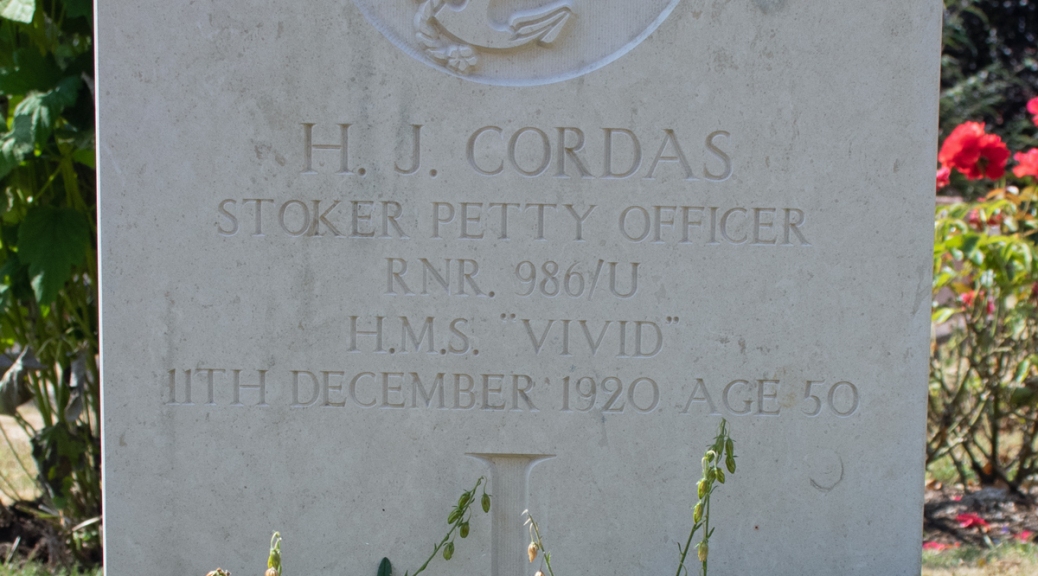
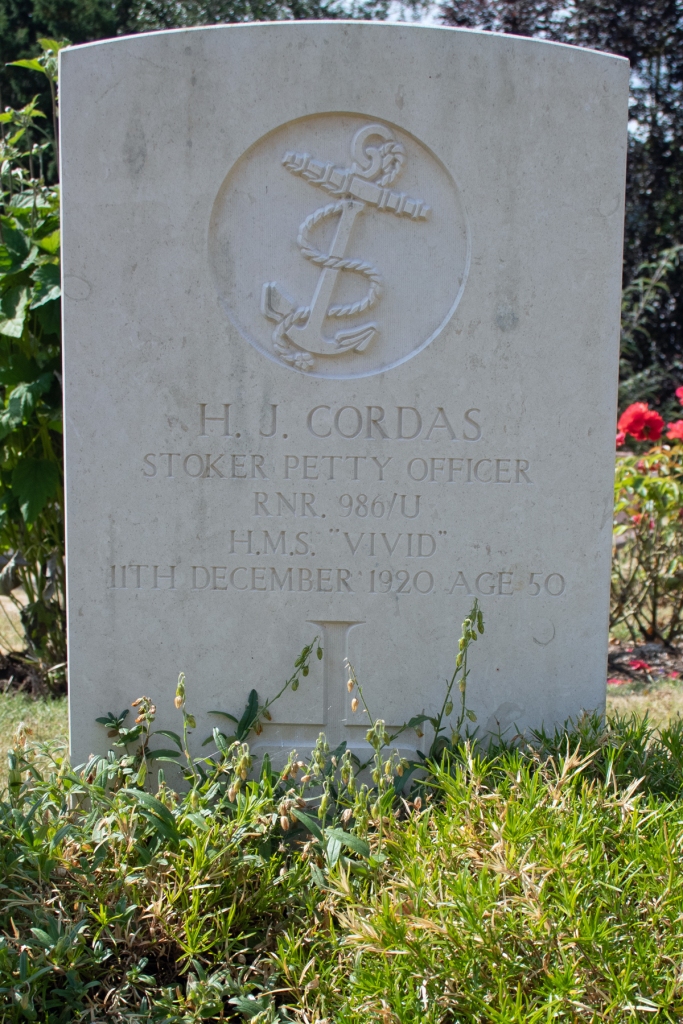
When hostilities commenced, Henry was assigned to the Royal Naval Reserve. Over the next few years, he served on a number of ships, including the armoured cruisers HMS Suffolk and HMS Doris. He worked as a Stoker, but by the end of the conflict had been promoted to Stoker Petty Officer.
In December 1918, Henry’s service came to an end. He was, by now, based at HMS Vivid, the Royal Naval Dockyard in Devonport, but his health was suffering. Medically discharged with a combination of chronic bronchitis and rheumatic pain, he seems to have returned to Bristol.
On 6th December 1920, Henry was admitted to Bath War Hospital in Somerset, as he was coughing up blood. The plan was to transfer him to Greenwich Hospital in Surrey, but he suffered an aneurysm before that move could be made. He passed away on 11th December 1920, at the age of 50 years old.
The body of Henry John Cordas did not travel far for burial. He was laid to rest in the peaceful expanse of Bath’s Locksbrook Cemetery.
Stanley William Parry was born in the spring of 1890 in St George’s on the outskirts of Bristol, Gloucestershire. One of four children to Herbert and Susannah Parry, Stanley was a twin to brother Roland. Herbert was a commercial clerk for a chemical manufacturer, and this afforded the Parry boys a level of education, with both Roland and Stanley attended the Colston Endowed School in Bristol.
Tragically, Susannah had died when Stanley and Roland were just 3 years old: their younger brother, Wilfred, had died the year before, when just a babe-in-arms. By the time of the 1911 census, Herbert had moved the family to Portishead. He was still working as a clerk, while both of the twins were employed as insurance clerks. Their older brother, Edwin, was also a clerk, in the docks at Bristol, and Herbert had employed a live-in housekeeper, Mary Govier, to look after him and his sons.
When war came to Europe, both Stanley and Roland enlisted. The two of them joined the Royal Field Artillery as Gunners. While full service records are not available, Stanley was assigned to the 40th Trench Mortar Battery, while Roland became attached to A Battery of the 240th Brigade.
Stanley was serving in France in the summer of 1916, when he became ill.
The funeral took place on Saturday afternoon, at Portishead Cemetery, of Gunner Stanley Wm Parry, who… died at Mile End Hospital, London, on September 19th. The deceased, who was 27 years of age, was always somewhat delicate in health, but was anxious to serve his King and country, and joined the [Royal Field Artillery]. He was brought to London from France on the previous Saturday suffering from enteritis, and although he lived until his father reached him, he died shortly after. He was the third son of Mr HC Parry… whose two other sons are also serving, one in France and the other in Egypt.
Bristol Times and Mirror: Monday 25th September 1916
Gunner Stanley William Parry was laid to rest in Portishead Cemetery, just a short distance from the family home.
Gunner Stanley Parry (from findagrave.com)
Roland continued to serve his country in France, but tragedy was to strike the family once more.
Mr HC Parry… has received the sad intelligence that his son, Rowland G Parry [sic], of the [Royal Field Artillery], was killed in action on the 17th September. A letter from deceased’s officer stated that Gunner Parry was returning to the battery when a shell burst on the track, killing deceased instantaneously, death being absolutely painless. The letter further states that Gunner Parry had been a very valuable member of the battery, and will be missed by them all. Gunner Parry was the second of Mr Parry’s three sons to lay down his life in the great fight, a twin brother having died in a military hospital in London last year. The other son, the eldest, is serving in Palestine.
Bristol Times and Mirror: Saturday 29th September 1917
Roland George Parry was 28 years of age when he died. He was laid to rest in the Vlamertinghe New Military Cemetery, in Ypres.
Gunner Roland Parry (from findgrave.com)
Herbert Parry passed away in the summer of 1920, at the age of 62. He had outlived three of his sons, as well as being a widower for 27 years. He was laid to rest in Portishead Cemetery with his son Stanley.
Edwin Parry, Stanley and Roland’s older brother, had returned from the First World War by the summer of 1919. He resumed his work as a clerk at the docks in Bristol, and married schoolteacher Annie Homewood in August 1919. They went on to have three children, Barbara, Gwladys and Roland. Edwin died in September 1959, at the age of 71 years old.