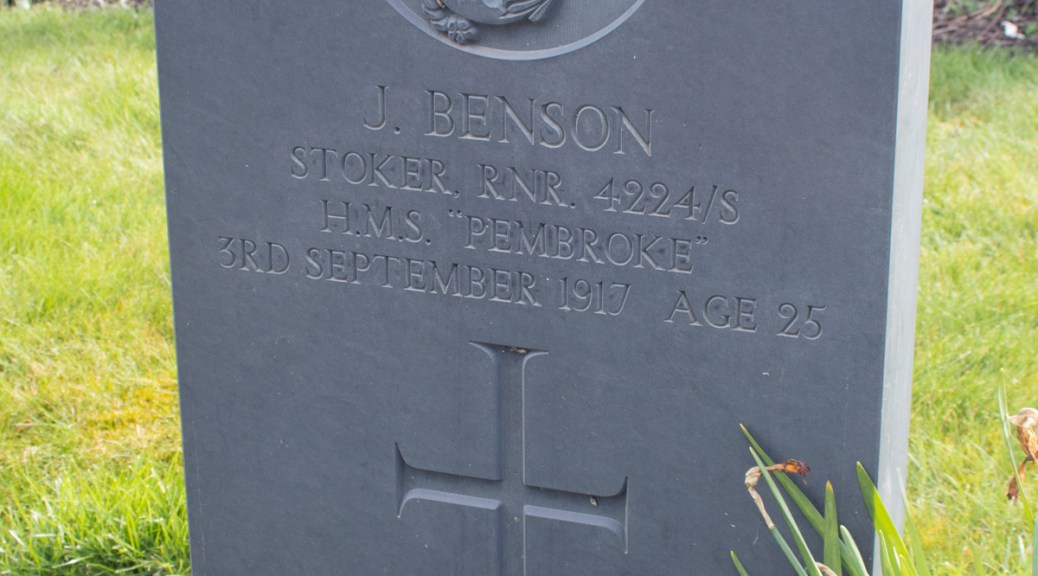
John Benson was born on 29th April 1892, the second of eleven children to Thomas and Annie Benson. Thomas was from Grays, Essex, and this is where the barge captain raised his growing family. While it is likely that John would have also experienced life on the water, by the time of the 1911 census, he was recorded as being a labourer at the town’s brewery.
When war broke out, it’s evident that John wanted to play his part. On 18th November 1914 he enlisted as a Stoker in the Royal Naval Reserve, and was based at HMS Pembroke, the Royal Naval Dockyard in Chatham, Kent.
Stoker Benson’s service records show that he was 5ft 3.5ins (1.61m) tall, had blue eyes and a fair complexion. He was also noted as having a number of tattoos on his forearms, including clasped hands, a bird and a lady’s head.
While John was primarily based at HMS Pembroke, he also served at sea; this included two years on board the cruiser HMS Grafton. In July 1917, however, he returned to Chatham again.
The Royal Naval Dockyard was a busy base that summer, so much so that temporary accommodation was set up in the barracks’ Drill Hall: this is where Stoker Benson found himself billeted.
On the night of the 3rd September, the German Air Force conducted the first night time raid on England. Chatham came in the firing line, and the Drill Hall received a direct hit. Stoker Benson was among those to be killed. He was just 25 years of age.
John Benson was laid to rest in the Woodlands Cemetery in nearby Gillingham, along with the other victims of the Chatham Air Raid.
Roderick Morgan Smith was born on 14th April 1896 in Upton Park, Essex. One of twin sons to Francis and Frances Smith, he had three siblings altogether. Francis is absent from the two census returns on which Roderick features, but the documents confirm that Frances – who was a certified teacher – was married, so he may have been elsewhere at the time.
By the time of the 1901 census, the family had moved from East London to Monmouthshire, where Roderick’s mother was teaching at the school in the village of Wonastow. Ten years later, they had moved across the River Severn to Withycombe in Somerset, not far from where Frances had been born. Other records show that they subsequently moved to Bath, then to Weston-super-Mare.
When war broke out, Roderick was keen to join up. He enlisted as a Private in the Durham Light Infantry, and was assigned to the 7th Battalion. He was sent to France in the spring of 1915, and would have been involved with his regiment at Ypres and the Somme.
It was at the Somme that Private Smith was gassed and wounded. Full details are not recorded, but they were enough for him to be medically evacuated to England. He was admitted to the military hospital in Taunton, but passed away on 7th May 1916. He was just 20 years of age.
Roderick Morgan Smith was brought to Weston-super-Mare and laid to rest in the town’s Milton Road Cemetery.
Roderick’s twin, Frank Morgan Smith, also played his part in the First World War. He enlisted in the Bedfordshire Regiment as a Private, and was assigned to the 7th Battalion. He also found himself embroiled at the Somme, and he too was wounded.
Sadly, Frank’s wounds were too severe for him to be repatriated to England; he died in a French hospital on 3rd December 1916, also aged 20 years old. He was laid to rest at the Wimeraux Cemetery.
Frederick Walter Reyner was born in Braintree, Essex, on 18th May 1884. The youngest of five children, his parents were Stephen and Martha Reyner. Stephen was a carpenter, who raised his family alone, when Martha passed away in 1889.
When Frederick left school, he found work as an iron worker. When Stephen also died in 1902, Frederick moved in with his older brother, Henry.
His father’s death seemed to have been the spur he needed to move on to bigger and better things: on 21st April 1904, Frederick enlisted in the Royal Navy as a Stoker 2nd Class for an initial period of five years. His service records show that he stood 5ft 4ins (1.63m) tall, had brown hair, brown eyes and a fresh complexion, with a small scar on his left thumb as an identifying mark.
Over the course of his term of service, Stoker Reyner served on three ships – HMS Acheron, Berwick and Irresistible – and was promoted to Stoker 1st Class. After each voyage, he returned to HMS Pembroke, the Royal Naval Dockyard in Chatham, Kent.
When his initial term ended in 1909, Frederick was placed on reserve, and moved back in with Henry and his family. He worked to pay his way, finding employment as a postman around Brixton, where his brother lived. He met local woman Charlotte Rebecca Scott, and the couple married in St Andrew’s Church, Peckham, on 31st May 1914.
War, by this time, was imminent, and Frederick soon found himself called back in to action. After spending a year on shore, at HMS Pembroke and HMS Victory – the Naval Dockyard in Portsmouth – Stoker Reyner was assigned to HMS Europa, a cruiser that patrolled the Eastern Mediterranean. He spent two years on board, before returning to HMS Pembroke in July 1917.
The base was particularly busy that summer, and the large number of extra servicemen meant that Frederick was billeted in temporary accommodation in Chatham Drill Hall.
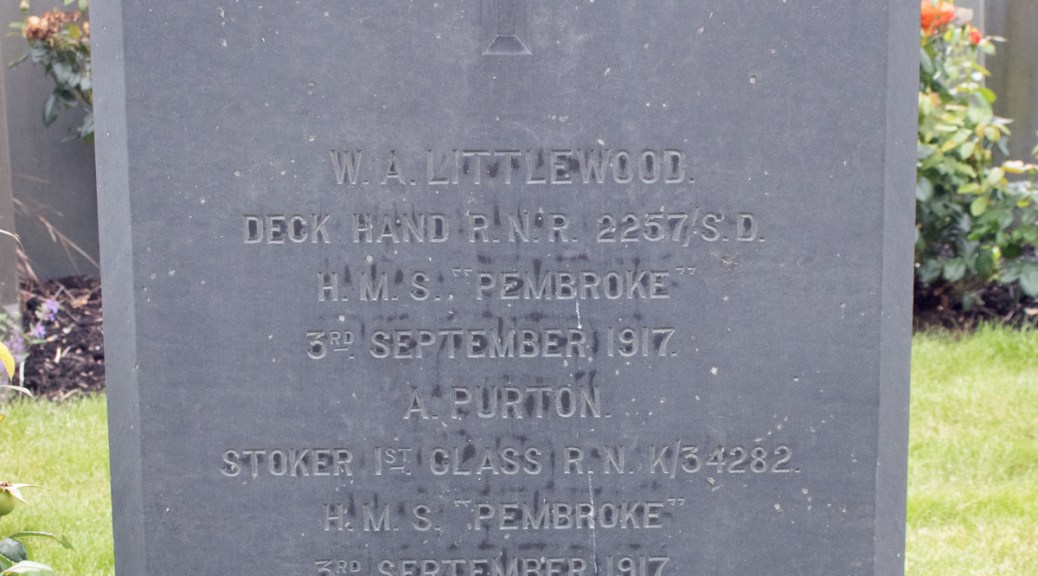
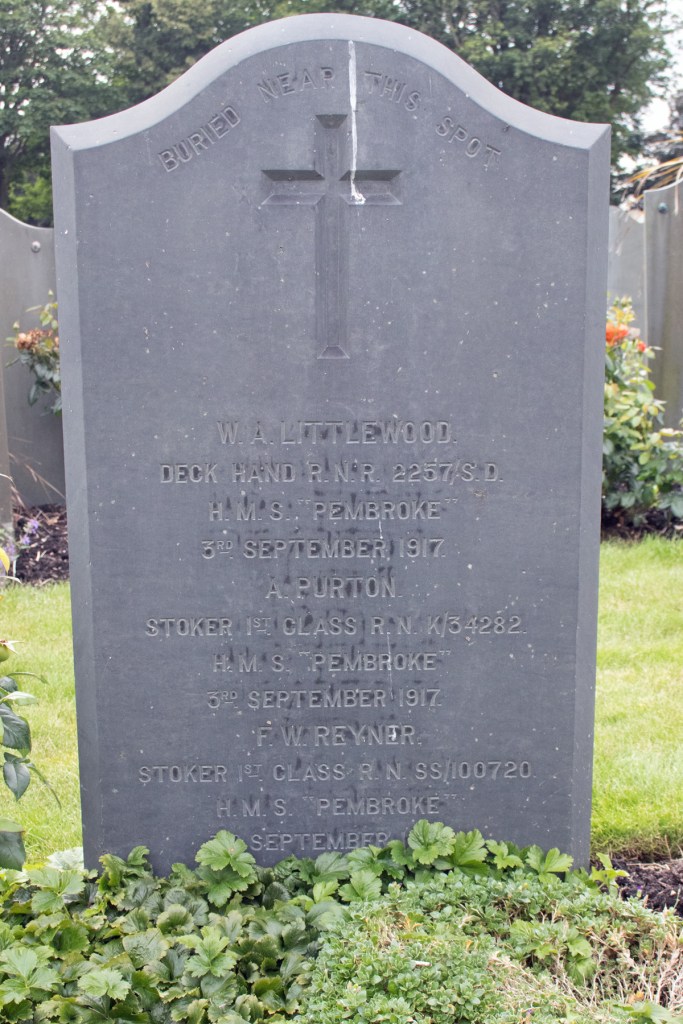
On the 3rd September 1917, the first night air raid carried out by the German Air Force bombarded the town, and scored a direct hit on the Drill Hall; Stoker 1st Class Reyner was among those killed instantly. He was 33 years old.
Frederick Walter Reyner was laid to rest, along with the other victims of the Chatham Air Raid, in the Woodlands Cemetery, Gillingham. Tragically, the Navy Death Records state that he was Buried as unidentified in one of the following graves: 516, 522, 642, 735, 935, 937 or 948.
To add to the sadness of Frederick’s story, Charlotte was pregnant when he died. She gave birth on 31st May 1918, to a son who she named in memory of her late husband.
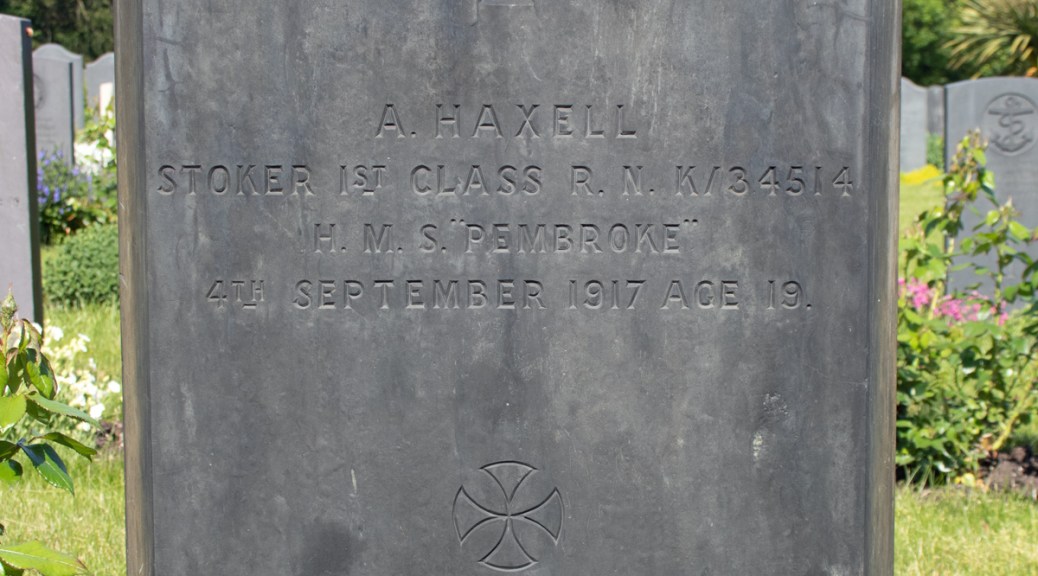
Arthur Frederick Haxell was born on 17th June 1897 and was the third of six children to Frederick and Ellen. Arthur’s father was a labourer from Tilbury in Essex, who raised his family in nearby Romford, where Arthur himself was born.
By the time Arthur was six, the family had moved to Kent; the 1911 census found them living in the then village of Welling. When he left school, he found work at a local mill. War was on the horizon, however, and things were about to change.
Arthur was called up on 22nd June 1916, joining the Royal Navy as a Stoker 2nd Class. His service records show that he was 5ft 4ins (1.62m) tall, had fair hair, blue eyes and a fresh complexion. He was sent to HMS Pembroke – the shore establishment at the Naval Dockyard in Chatham, Kent – and spent three months there being trained.
Stoker Haxell’s first sea commission was on board HMS Dartmouth, a cruiser that served in the Eastern Mediterranean which was involved in the Battle of Otranto Straits in the spring of 1917. He spent nine months on board, and received a promotion to Stoker 1st Class during this time.
By the start of July, however, Arthur was back in Chatham. HMS Pembroke was a busy place that summer, a sunken battleship and an outbreak of fever meaning that its barracks had reached capacity. Rather than being in the normal barracks, Arthur found himself billeted at the nearby Chatham Drill Hall instead.
By this point in the conflict, the German Air Force was doing all it could to minimise the losses it was suffering during its daylight raids. Instead, it trialled night flights and, on 3rd September 1917, Chatham was bombed. The Drill Hall Stoker Haxell was sleeping in received a direct hit; he died from his injuries the following day. He was just 20 years old.
Arthur Frederick Haxell was laid to rest in the Woodlands Cemetery in nearby Gillingham, alongside the other 97 victims of the Chatham Air Raid.
Edmund Thomas Bevan was born in Weston-super-Mare, Somerset, in November 1867, the son of blacksmith George Bevan and his wife, Mary Ann.
Unfortunately, little documentation remains on Edmund’s early life; after his baptism record, the next evidence for him comes in the form of his military service record, twenty years later.
Looking for a life of adventure, Edmund gave up his labouring job and joined the Somerset Light Infantry. His enlistment papers confirm the date – 12th May 1887 – and showed that he stood at 5ft 4ins (1.62m) tall and weighed in at 120lbs (54.4kg). The papers also note that he had dark brown hair, hazel eyes and a fresh complexion. He also had a scar above his right eye.
Private Bevan joined up for twelve years’ service. He spent his first four years at bases in Essex and Hampshire, before being sent to Gibraltar in November 1891. He returned home after two years, and spent his remaining time in the army in his home county, Somerset. Noted that he had shown a very good character, he was discharged to the reserve brigade on 11th May 1899 in Taunton.
Sadly – tantalisingly – Edmund’s trail goes cold again at this point. When hostilities were declared in August 1914, it seems likely that he was brought out of reserve, but given his age at this point – he was 46 – he was assigned to the territorial force. As a Private in the 125th Coy of the Royal Defence Corps, he would have had civil protection in the London area, although again, specific details are not known.
The next confirmation of Private Bevan’s life is his gravestone. This confirms that he passed away 19th July 1917, at the age of 49. While no cause of death is evident, his pension record sheds a little more light onto his life in the early years of the twentieth century.
Edmund had married a woman called Martha, and the couple had gone on to have a child. Martha passed away in September 1913 and, according to the pension record, Edmund passed guardianship on to his brother Henry.
Edmund Thomas Bevan was laid to rest in the Milton Road Cemetery in his home town of Weston-super-Mare.
George Fawcett was born on 3rd February 1873, one of ten children to John and Maria (or Mary). John was a stonemason who raised his family in Essex, and it was in Stratford that George and most of his siblings were born.
When George left school, he was drawn to a life of adventure. He joined the Royal Navy on 5th May 1888, and was first assigned the role of Boy, as he was under age. He was formally enlisted on 3rd February 1891 – his 18th birthday. He had, by this point, been serving on HMS Hotspur for nine months, and was given the rank of Ordinary Seaman. His hard work must have held him in good stead, because he was promoted to Able Seamen just two months later.
Over the course of his initial twelve years’ service, Able Seaman Fawcett served on eight different ships, and continued to rise through the ranks. He mad made Leading Seaman by 1894 and Petty Officer 2nd Class five years later. By the time his first term of service had ended, he had been promoted again, this time to Petty Officer 1st Class.
George voluntarily renewed his service in 1903, and over the next few years, he served on a number of other vessels. His shore base was always HMS Pembroke, though, and his time at sea was interspersed with periods at the Naval Dockyard in Chatham.
Petty Officer Fawcett had been in the Royal Navy for 23 years by the time war was declared. He was still at sea in August 1914, but was transferred to a permanent shore role at the beginning of the following year. He spent three years fulfilling his duties at HMS Pembroke, but fell ill in the spring of 1918.
He was admitted to the Naval Hospital in Chatham with liver disease, and this was a condition he was not to recover from. Petty Officer Fawcett passed away on 12th April 1918, at the age of 45.
George Fawcett’s body was laid to rest in the Woodlands Cemetery, Gillingham, not far from the naval base at which he was based.
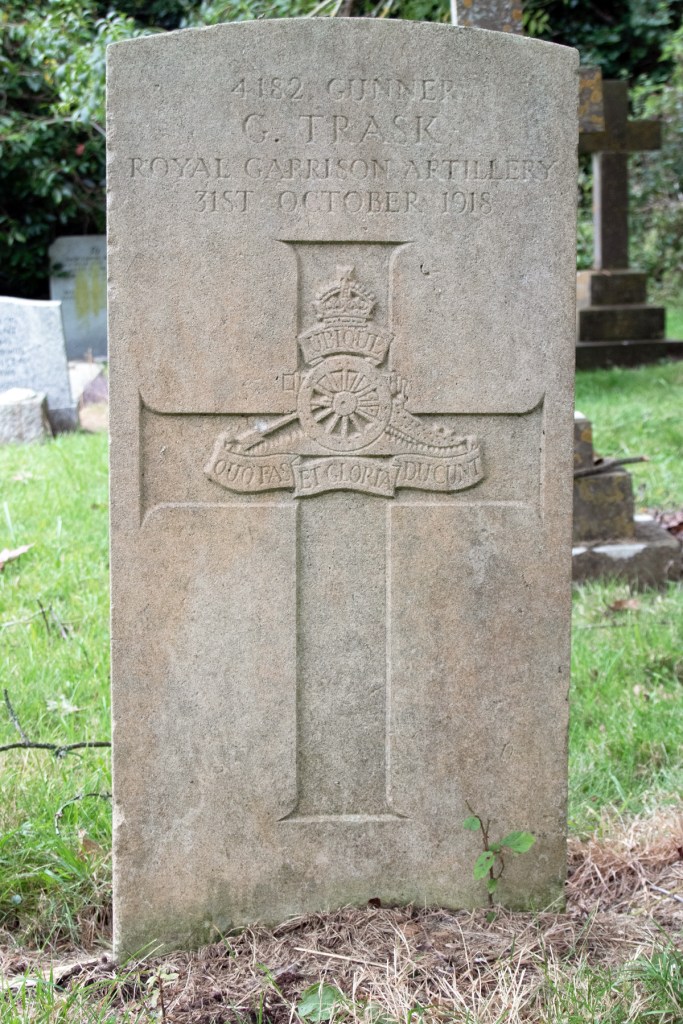
George Trask was born on 22nd December 1875 and was the oldest of nine children. His parents were Absolam and Sarah Jane Trask, although it seems that the couple did not actually marry until after their first three children had been born. Absolam was an agricultural labourer and the family lived in his and Sarah’s home village of East Coker, near Yeovil in Somerset.
George was destined for a life of adventure; in May 1894, aged just 18, he enlisted in the army, joining the Royal Artillery as a Gunner. His medical examination sheds some light on his physique. He stood 5ft 7ins (1.70m) tall and weighed in at 144lbs (65.3kg). He had a fair complexion, hazel eyes and light brown hair.
Oddly, in the section on distinguishing marks – recorded to help identification should the soldier be killed – the medic only highlighted a ‘small mole midway between pubes and umbilicus’: it seems unlikely that this was the only distinguishing mark that could have been highlighted.
Gunner Trask’s initial service was spent in England. He served four-and-a-half years on the home front, before being shipped to Malta. After six months on the island, he was moved to Crete for a few months, before returning to Malta in September 1899.
George completed his initial term of seven years’ service, and elected to remain to complete a full twelve years of enlistment. As part of this, he was transferred to the Caribbean, spending two years stationed in Bermuda, before moving on to St Lucia for a further two years. By December 1905, Gunner Trask was back home in England, and it was on home soil that he remained.
Back in Somerset, George extended his term of service for another four years. Settled in his home village, he married Elizabeth Garrett on 27th December 1908; the couple would go on to have three children: Ethel (born in 1910), Lilian (1911) and George Jr (1916).
Gunner Trask’s military service continued apace. Reassigned to the Royal Garrison Artillery, he was posted in Portsmouth up until the outbreak of the war. He was awarded a third Good Conduct Medal in addition to the ones he had received in 1900 and 1904.
At this point, details of George’s military service become a little hazy. He achieved 21 years’ military service on 29th May 1915 and was awarded a further Good Conduct Medal. At this point, with the war raging, his period of duty was extended again, until the end of the conflict.
At some point during this time, he was assigned to the Royal Artillery’s School of Experimental Gunnery in Shoeburyness Essex. Sadly, there is nothing to confirm his exact role there, although, given that he was in his 40s by this point, it is likely that he acted as more of a mentor.
And it is here that the story comes to an end. Gunner Trask is noted as passing away in the Military Hospital in Shoeburyness on 31st October 1918, though there is nothing to confirm the cause of his death. He was 43 years of age.
George Trask’s body was brought back to Somerset for burial. Having travelled the world with the army, he was laid to rest in the graveyard of St Mary’s Church in his home village of East Chinnock.
George’s son George was to follow his father into military service.
Working as a press operator for a plastics company, he married Gwendoline Harper in Southend, Essex in April 1940. There is no record of whether he had enlisted at this point, but is seems likely that he had.
When the Second World War broke out, he joined the 4th Battalion of the Suffolk Regiment. After initially helping in the defence of England following the British Army’s evacuation from Dunkirk, late in 1941, he was sent first to Egypt, then to Singapore to help strengthen the garrison there.
Early the following year, the 4th and 5th Battalions fought in the defence of Singapore, before the island surrendered to the Japanese Army. At this point, Lance Corporal Trask found himself a prisoner of war.
The prisoners were put to work building the Burma railway, and suffered great hardship at the hands of their captors. Many succumbed to illness, and George was amongst them, dying from beriberi on 18th December 1943. He was just 27 years old.
George Reginald Trask was laid to rest in the Chungkai Cemetery in Thailand, 100km west of Bangkok.
William Ernest Eglon (also known as Ernest William Eglon) was born in the Somerset village of Stoke-under-Ham (or Stoke-sub-Hamdon), in the spring of 1898. One of five children, his parents were stonemason Arthur Eglon and his glovemaker wife Sarah Elizabeth Eglon (who was better known as Bessie).
Unfortunately, little information on William’s early life remains documented. When war broke out, he was working at the Co-operative Bakery in the village. He was keen to do his bit, however, and enlisted in the Royal Army Service Corps as a Private not long after his eighteenth birthday.
Private Eglon was sent to serve in Essex, working as a baker in the Supply Section there. Within a couple of weeks of arriving, however, he was admitted to the Field Hospital in Chelmsford. He was suffering from an ear infection, and this turned out to be significant enough for him to be transferred to the Horton County of London War Hospital in Epsom.
William developed an abscess in the temporo sphenoidal region of his skull (in front of his right ear), which was operated on on the 27th May 1917. By this time meningitis had set in and, despite a second operation just over a week later, the conditions took hold.
Private Eglon passed away at 9:55am on 11th June 1917. He was just 19 years of age.
William Ernest Eglon’s body was brought back to Stoke-under-Ham for burial. He lies at rest in the family plot in the graveyard of St Mary’s Church in the village.
Frederick John Shiplee was born on 15th November 1895 in the Essex town of Harwich. The oldest of eight children, his parents were Frederick and Matilda. Frederick Sr worked as a carter for the local railway, while his son found employment as a butcher’s errand boy when he left school.
In November 1913, having just turned 18, Frederick Jr enlisted in the Royal Navy as an Officer’s Steward, and spent three years training and serving on board HMS Ganges, the shore establishment at Shotley, near Ipswich.
From Suffolk, Frederick moved to Kent, and was based at the HMS Pembroke in Chatham. From here, he was involved in trips on HMS Spey, an old river gunboat that had been converted for use as a diving tender. It was during one of these trips that tragedy struck.
STORY OF A COLLISION IN THE THAMES
Mr CB Sewell resumed the inquest at Chatham, on Monday, on the 13 naval men who lost their lives after a collision between the London County Council steam hopper Belvedere and an old naval vessel in the Thames on March 7th [1917]…
The collision occurred shortly before four o’clock in the afternoon, the weather being bitterly cold and boisterous, and the sea extremely rough. The men, who had taken to a raft, were drifting about till 9pm before the raft was driven ashore. On the raft, when discovered, were a pile of dead men, who had been rendered unconscious by the cold and subsequently drowned through the raft being partly submerged. Lieutenant Humphreys, Royal Naval Reserve, and the other officers were all drowned. In all, 30 of the 37 members of the ship’s company lost their lived, and several bodies have not been recovered. Thirteen of the ship’s crew managed to get ashore at Sheerness in the cutter and three reached the shore at the Isle of Grain in the gig, while one was saved by the hopper.
Arthur George Chick, able seaman, said he was at the wheel of the naval vessel, which was steaming up river at six knots an hour to secure shelter from the weather. Lieutenant Humphreys and a warrant officer were on the bridge, and there were two look-out men. All were now missing. He saw the hopper coming down the river when she was two miles away. When the vessels were nearing each other, the hopper suddenly altered her course to starboard. The witness then altered his course to port by his officer’s orders, but the hopper crashed into his ship, stroking it a glancing blow in line with the forepart of the bridge on the starboard side. The ship sank in three minutes.
Alfred Rawlings, leading signalman, stated that the hopper changed her course when almost abreast of the naval vessel. The hopper’s alteration of course was, he considered, the cause of the collision.
Henry Davies, second officer, and Joseph Beard Hasdell, master of the hopper, gave evidence that they considered the collision was caused through the naval vessel’s error of judgment in starboarding, instead of going to port. The hopper, they stated, ported its helm in accordance with the ‘rule of the road’.
South Eastern Gazette: Tuesday 27th March 1917
While not mentioned in the newspaper report for security reasons, the ‘old naval vessel’ was, in fact HMS Spey. Annoyingly, I can trace no further report of the inquest, other than the conclusion that the deaths were due to drowning following a collision at sea.
Officer’s Steward Shiplee was one of the twenty men who died that day. He was just 21 years of age.
Frederick John Shiplee’s body was laid to rest in the Woodlands Cemetery in Gillingham, not far from the Naval Dockyard in Chatham, where he had been based.
William Thomas Cole was born in the spring of 1897, the youngest of three children to John and Caroline Cole. John was a bank cashier from Gillingham in Dorset, while Caroline was born in Battersea, London. By the time of William’s birth, however, the young family had settled in the Dorset town of Blandford.
John was a man with ambitions for himself and his family. The 1911 census records him and Caroline living in Axbridge in Somerset, where he was now a bank manager. William, meanwhile, was a student in Wareham, Dorset, and was lodging at a boarding house in the town.
There is little documented about William’s military service. His gravestone confirms that he had originally enlisted in the Dorsetshire Regiment, but had subsequently joined the Royal Air Force, when it was formed in April 1918. By the time of his death, he had reached the rank of Lieutenant, so it would seem that his John’s ambitious nature had rubbed off on his only son.
William’s death was reported in a number of contemporary newspapers:
Lieutenant WT Cole and First Air Mechanic H Keates were killed while flying in South Essex last night. They were both in the same machine, which nose-dived and crashed into the ground. Cole’s home is at Shaftesbury, Dorset, and Keates’ at West Wood Grove, Leek, Staffordshire.
Dundee Evening Telegraph: Thursday 24th October 1918
Lieutenant Cole was flying in Hornchurch, Essex, and was in an Avro 504K bi-plane. He was just 21 years old when he died on 23rd October 1918. There is little further information about the accident, but highlighting the real danger in aviation at the time, this was one of eight fatal plane crashes across the UK that day alone.
The body of William Thomas Cole was brought back to Shaftesbury, where his parents were by then living. He was laid to rest in the Holy Trinity Churchyard in the town.







 Death and Service