Category Archives: Hampshire

Stoker 1st Class Michael Brown

Stoker 1st Class Michael Brown

Michael Brown was born on 25th October 1891 in Kirkdale, Lancashire, one of four children to James and Julia Brown. James was a sailor who died when Michael was just a boy. While Julia tried to make ends meet by taking in washing, it must have worried her when her son then fell into a sea-going life when he left school.

Michael enlisted in the Royal Navy on 19th February 1910, by which time he was already a seaman in the merchant fleet. His service records show that he was 5ft 4.5ins (1.64m) tall, had bark brown hair, brown eyes and a dark complexion. He also had a number of tattoos on his forearms, including a shamrock and a cross.

Recruited as a Stoker 2nd Class, Michael served on a number of vessels in the lead up to the outbreak of war, including the scout ship HMS Patrol, which served from Harwich Harbour, Essex. It was here that he gained promotion to Stoker 1st Class in February 1911.

When not at sea, Stoker Brown was based at HMS Pembroke, the Royal Naval Dockyard in Chatham, Kent. When war broke out in 1914, however, he was in the middle of a three-year stint on board HMS St George, a cruiser that went on to guard the Humber Estuary on the east coast of Yorkshire and Lincolnshire.

By the spring of 1916, he was back in Chatham and from this point on, remained firmly on dry land, with assignments in Kent and at HMS Victory, the Royal Naval Dockyard in Portsmouth, Hampshire. By the summer of 1917, though, Stoker Brown returned to HMS Pembroke once again.

The naval base was particularly busy and cramped at that point in the war, and temporary overflow accommodation was set up in the barracks’ Drill Hall. This is where Michael came to be billeted.

On the night of the 3rd September, the German Air Force conducted the first night time raid on England. Chatham came in the firing line, and the Drill Hall received a direct hit. Stoker 1st Class Brown was among those to be killed. He was just 24 years of age.

Michael Brown was laid to rest in the Woodlands Cemetery in nearby Gillingham, along with the other victims of the Chatham Air Raid.


Serjeant Albert Woolcott

Serjeant Albert Woolcott

Albert John Woolcott was born in the spring of 1877 and was one of three children to Thomas and Mary. Thomas was a labourer for a spirit company, and both he and his wife came from Chard in Somerset, which is where Albert and his siblings were born.

When he finished school, Albert was apprenticed to a local iron foundry and, by the time of the 1901 census, he was recorded as being a blacksmith in his own right.

By this point, Albert had met local woman Mary Pattimore: the couple married in the local church on Boxing Day 1901, and went on to have four children, all of them boys. Albert continued with his ironwork: the 1911 census records him as being the blacksmith at Chard’s Gifford Fox & Co.’s lace factory.

Albert played a keen role in the local volunteer movement for the Somerset Light Infantry. Through the town’s Constitutional Club he took an active role in its rifle range and was known to be a particularly skilled marksman. He also played in both the Volunteer Band and Chard’s Municipal Band.

When war came to Europe in August 1914, Albert was already billeted on Salisbury Plain as part of the volunteers, and was promoted to the rank of Serjeant. He was sent to India with his troop – the 5th Battalion of the Somerset Light Infantry – and remained there until April 1916.

By this point, Serjeant Woolcott was suffering from dorsal abscesses on his hands, and was evacuated back to England for treatment. Over the next nine months he was in and out of Netley Hospital on the outskirts of Southampton, where he had a number of operations to try and fix the problem.

Sadly, his treatment proved unsuccessful: Serjeant Woolcott passed away in the hospital on 19th January 1917, at the age of 39 years old.

Albert John Woolcott’s body was taken back to Somerset for burial. He was laid to rest in his home town’s cemetery.


Private Sam Mattocks

Private Sam Mattocks

Samuel Mattocks was born in Combe St Nicholas, Somerset, in 1885, one of six children to farm labourer George Mattocks and his wife, Anna. Sam sought a trade when he left school and soon found work as a butcher.

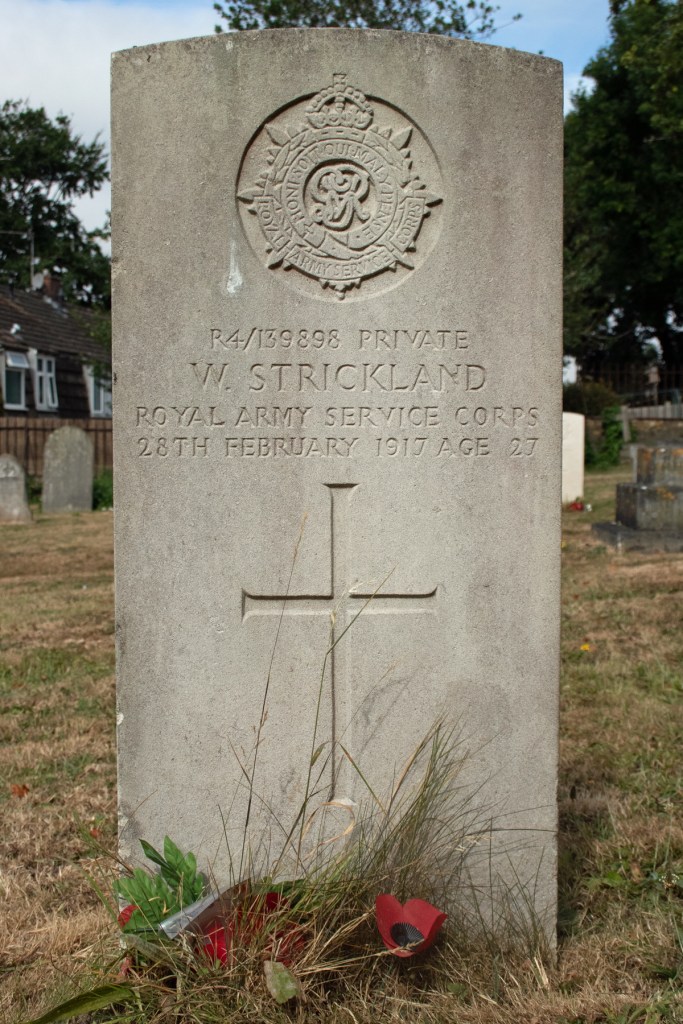
Documentation relating to Sam’s life is pretty scarce. When war broke out, he stepped forward to play his part, enlisting in the Army Service Corps (presumably because of his profession) by the start of 1916.

Private Mattocks was sent to Hampshire to work at one of the supply depots there. Sadly, this appears not to have been for long as, on 1st April 1916, he passed away at his base in Aldershot. No specific cause of death is evident – his records just note that he died ‘of disease’. He was 31 years old.

The body of Samuel Mattocks was brought back to Somerset for burial. He was laid to rest in the family plot in the graveyard of St Nicholas’ Church in his home village.


Private William Hicks

Private William Hicks

William John Hicks was born in the village of Northlew, Devon, in the spring of 1886 and one of seven children to John and Sophia Hicks. Both of his parents were born in the village, and that was where John found employment as a farm labourer.

By the time of the 1901 census the family had moved to the southern side of Dartmoor, and were living in Wolborough, near Newton Abbot. William had left school, and was also employed, working as a grocer’s porter in the town.

In December 1908, William married Maud Alice Wotton, and the couple set up home near the town’s station. They went on to have a son, also called William, who was born the following year. By this point, William had found more secure employment, and was working as a wagoner for a flour mill.

War was approaching Europe, and when the time came, William joined up to play his part. He enlisted in the Army Veterinary Corps, and there is no doubt that his pre-war employment stood him in good stead for the role. There is little information about Private Hicks’ military service, but it is clear that he had joined up by March 1916, and, for some part at least, was based in Hampshire.

Sadly, the other other available information relating to Private Hicks is that confirming his passing. He died, of causes unknown, on 19th September 1916, in Aldershot, where he was billeted. He was 30 years old.

William John Hicks’ body was brought back to Devon for burial. He was laid to rest in the graveyard of St Mary’s Church in Woborough.


Serjeant John Ive

Serjeant John Ive

John Tucker Ive was born on 30th January 1882, one of eleven children to George and Emily Ive. George was a stone dresser from Harefield, Middlesex, and this is where the family were born and raised.

John was evidently after a life of adventure and, on leaving school, he enlisted in the Duke of Cornwall’s Light Infantry. There is little documented about his military career, but he was based in Devonport and spent a couple of years in South Africa during the Second Boer War.

When he returned to England, John met Amy Ethel Staunton, from Stonehouse in Devon. The couple married in 1905 and went on to have a son, also called John, the following year.

When his military service came to an end, John found work as a butler, and he and Amy were employed by the same household. John Jr, meanwhile, was brought up by his maternal grandmother in Plymouth.

Global conflict was on the horizon, by now, and John soon felt the need to play his part once again. He rejoined the 2nd Battalion of the Duke of Cornwall’s Light Infantry, and was given the rank of Serjeant. He was shipped to France in August 1914, where his battalion fought at Ypres and at Mons, and he was injured during both battles.

By the time the conflict ended, Serjeant Ive had transferred to the regiment’s Labour Corps; at the start of 1919, he was preparing to be discharged from the army, but contracted pneumonia. Admitted to the Alexandra Hospital in Cosham, Hampshire, the lung condition sadly got the better of him: he passed away on 24th February 1919, at the age of 37 years old.

John Tucker Ive was brought back to Devon for burial; he was laid to rest in the graveyard of St Mary’s Church in Wolborough, Newton Abbot.


Two of John’s brothers also died in the conflict.

Private George Robert Ive served with the 2nd Battalion of the Royal Fusiliers. He died at Gallipoli on 28th June 1915, at the age of 34 years old.

Gunner Edward Ive served with the Royal Garrison Artillery. He died in the Persian Gulf on 1st May 1916, aged just 30 years old.


Chief Writer James Warne

Chief Writer James Warne

James Edwin Warne was born on 4th August 1884, in Portsmouth, Hampshire. He was one of four children to shipwright Edwin Warne and his wife Elizabeth.

The naval life was all around him and, straight out of school, James sought out a career in the service and, on 28th December 1899, aged just 15 years old, he enlisted. His service records show that he was just 5ft 2.5ins (1.59m) tall, had dark brown hair, brown eyes and a dark complexion. Initially taken on in the role of Boy Writer, he was sent to HMS Pembroke, the Royal Naval Dockyard in Chatham, Kent, for training.

Over the next couple of years he learned his trade, serving on a couple of ships, but also at HMS Pembroke and the nearby base in Sheerness, HMS Wildfire. When he came of age in 1902, he was formally inducted into the Royal Navy. His records show that his time in the navy were standing him in good stead – he had grown 5ins (13cm) in the previous couple of years.

James was afforded the rank of 3rd Class Writer. This was a mainly clerical role, James would have been involved in the day-to-day welfare concerns for the crew. Over the next twelve years, he honed his trade, serving on a handful of vessels, but being mainly based in Chatham and Sheerness.

By the time James’ initial period of service came to an end in August 1914, he had risen through the ranks to 2nd Class Writer (in 1906) and 1st Class Writer (four years later).

It was while James was based in Sheerness that he met Emily Jane Hayes. She was the daughter of a naval boilermaker; the couple married in 1906, and went on to have four children: Leonard, Jenny, Edwin and Phyllis.

When war broke out, James’ contract with the Royal Navy was renewed, and he was promoted to Chief Writer. He became permanently based at HMS Pembroke, and the family set up home in Nelson Road, Gillingham, not far from the Dockyard.

In the summer of 1917, HMS Pembroke was an overcrowded place. This was compounded by two events: men who had been earmarked to join the HMS Vanguard had been forced to remain at the barracks after the ship had been sunk at Scapa Flow, while an outbreak of ‘spotted fever’ in the barracks meant that the sleeping accommodation had to be increased in an effort to avoid further infection.

This would have increased Chief Writer Warne’s workload and hours, and he slept on site, in temporary accommodation set up in the barracks’ Drill Hall.

On the night of the 3rd September, the German Air Force conducted the first night time raid on England. Chatham came in the firing line, and the Drill Hall received a direct hit.

Given the proximity of the dockyard to the family home, Emily must have known something was wrong, and could only have hoped that her husband was not involved. Sadly, Chief Writer Warne was among those to be killed. He was 33 years of age.

James Edwin Warne was laid to rest in Gillingham’s Woodlands Cemetery – again, walking distance from the family home – along with the other victims of the Chatham Air Raid.


Driver Lionel Shearn

Driver Lionel Shearn

Lionel Shearn was born in April 1895, one of twelve children to, and the youngest son of, Joseph and Emily Shearn. There were two main industries in Paulton, Somerset, where the Shearn family lived, and, over time, Joseph was employed in both. He began in the boot-making industry – this was his trade when Lionel was born – but, by the time of the 1911 census, he had found work as a coal miner. Lionel, who was sixteen by the time of that document, was also working at the colliery as a carter.

War came to Europe in the summer of 1914, and Lionel was one of the first in the town to enlist. Little documentation remains about his military service, but he joined the Royal Field Artillery as a Driver and, by October was in Portsmouth, Hampshire.

Sadly, this is all the service information that’s available, as Driver Shearn passed away in the General Hospital in Southsea, Hampshire on 27th October 1914. His death certificate, which was submitted by his brother, Gilbert, gives a cause of death as otitis media (an infection of the middle ear) and meningitis. He was just 19 years of age.

Lionel Shearn was brought back to Somerset for burial. He was laid to rest in the picturesque Paulton Cemetery.


Driver Lionel Shearn
(from ancestry.co.uk)

Serjeant Frederick Flint

Serjeant Frederick Flint

Frederick Charles Flint was born in the summer of 1872 in Bath, Somerset. He was the oldest of seven children to tailor Frederick Flint and his wife, Mary Ann.

Tailoring, however, was not a career that Frederick Jr wanted to follow and, in November 1890, he enlisted in the 7th Battalion of the Somerset Light Infantry. Over his twelve years’ service, he was posted to India and South Africa, gaining clasps for the Punjab Frontier 1897-1898, Relief of Ladysmith, Tugela Heights, Orange Free State, Cape Colony, Transvaal, South Africa 1901 and 1902 and the King’s South Africa Medal.

He returned to England in 1902, when he found employment as a postman back in Bath. He met Florence Novena Fishlock and the couple married at St Michael’s Church in Bath on 5th February 1905, before moving to nearby Radstock.

Frederick remained with the Post Office until the outbreak of war, when he again enlisted for duty, re-joining the Somerset Light Infantry. While he did not serve overseas, Serjeant Flint took on a training and mentoring role on Salisbury Plain. Suffering from tuberculosis, he was formally discharged from the army on medical ground in August 1915, and returned home.

The next few years proved challenging for Frederick, as his illness left him incapacitated. He was nursed through by Florence, but eventually his body could take no more. He succumbed to the condition on 28th March 1918, at the age of 45 years old.

Frederick Charles Flint was laid to rest in the graveyard of St Nicholas’ Church in Radstock. Florence passed away ten years after her husband; she was laid to rest in the same plot in the summer of 1928.


Serjeant Frederick Flint (from findagrave.com)

Guardsman Arthur Baguley

Guardsman Arthur Baguley

Arthur George Baguley was born in the autumn of 1897 in Warwick, and was one of six children to George and Rosa Baguley. George was a journeyman butcher who had moved his family to Frome, Somerset, by the time Arthur was three years old. George died in 1908, leaving Rosa to raise the younger members of her family alone.

Little information about Arthur’s life remains, and the only other documents that can be directly connected to him relate to his passing towards the end of the war. These confirm that he enlisted as a Guardsman in the Coldstream Guards at some point after April 1918.

Based in barracks in Hampshire, Guardsman Baguley was admitted to the Connaught Hospital in Aldershot, suffering from infective endocarditis, a bacterial infection of the heart. Sadly, he succumbed to the illness, passing away on 13th September 1918, aged just 20 years old.

Arthur George Baguley’s body was brought back to Somerset for burial. He was laid to rest in the graveyard of St John the Baptist Church, Midsomer Norton, where his mother was living by that point.


Guardsman Arthur Baguley
(from ancestry.co.uk)

Lance Corporal Thomas Taylor

Lance Corporal Thomas Taylor

Thomas George Taylor was born in the summer of 1886, and was the youngest of five children to George and Sarah Taylor. George was a gamekeeper in Clutton, Somerset, and he and Sarah raised their family in Rudges Cottage opposite the village church.

Thomas’ older brother John found a variety of jobs, from boot finisher to coal miner, but Thomas followed in his father’s footsteps, and, by the 1911 census, was recorded as a butcher’s apprentice.

Storm clouds were brewing across Europe by this point and, when war broke out, Thomas was one of the first to enlist. Sadly, there is little information on his military service, but it is clear that he joined the 7th Battalion of the Somerset Light Infantry and was quickly promoted from Private to Lance Corporal.

The only other documentary evidence for Thomas is his entry in the Army Register of Personal Effects. This confirms that he was admitted to the Isolation Hospital in Aldershot, suffering from meningitis. Lance Corporal Taylor passed away from the condition on 16th April 1915, aged just 29 years old.

Brought back to Somerset for burial, Thomas George Taylor was laid to rest in the graveyard of St Augustine’s Church, across the road from his family home in Clutton.