Category Archives: Hampshire

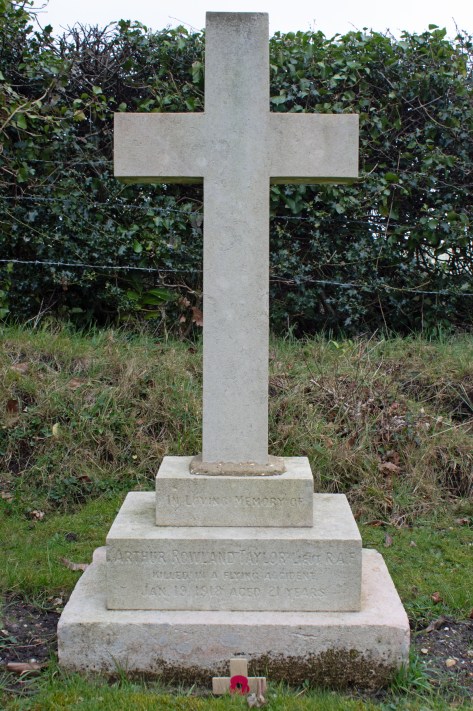
Second Lieutenant Malcolm Vande Water

Second Lieutenant Malcolm Vande Water

Malcolm Gifford Boggs was born on 14th August 1894 in Brooklyn, New York. The second of four children, his parents were Seth and Anna Boggs. Seth died in 1905, and Anna married again, to widower lawyer Charles Vande Water: her children took his name.

The next record for Malcolm is that of his Royal Flying Corps service records. Interestingly, they note that he enlisted on 10th September 1917, and did so in Toronto, Canada. While the United States had entered the First World War by this point, it may have been easier for him to join via a colonial route.

Malcolm’s papers show that he was 5ft 11ins (1.81cm) tall, and was a student aviator at the time he joined up. He was recorded as being an Air Mechanic 3rd Class, but that came to an end when, on 2nd February 1918, he was accepted for a commission.

Second Lieutenant Vande Water was attached to the 29th Training Depot Station in Hampshire. There is little information about his time there, but a later American newspaper provided details of what happened to him:

Intelligence reaching relatives of Lieutenant Malcolm G Vande Water, of the Royal flying corps, a former Passaic newspaper man, is that he was killed in a fall while testing a new airplane at the British airdrome in Beaulieu, France. Wande Water was the first member of the Pica club to pay the supreme sacrifice. He was on leave in England, after six months’ active service at the front, having operated a machine across the English channel to France on the day before his fatal fall. His machine gun shot off a propellor blade while he was flying 100 feet in the air and the airplane dove to the earth.

[The Morning Call: 17th December 1918]

The accuracy of the information included in the article is variable to say the least. Malcolm may have enlisted in the Royal Flying Corps, but, by the time of the accident on 26th October 1918, that had become the Royal Air Force. The Beaulieu aerodrome mentioned was in Hampshire, not France. The RAF’s records for the incident do confirm, however, that the propellor of his Sopwith Camel was indeed shot through, causing the aircraft to fall to the ground.

Second Lieutenant Vande Water was taken to the Forest Park New Zealand General Hospital in Brockenhurst, Hampshire, for treatment, but his injuries would prove too severe. He died later that day, at the age of 24 years old.

The body of Malcolm Gifford Vande Water was laid to rest in the graveyard of St Paul’s Church in East Boldre, Hampshire, not far from the base he had called home.


The life of a WW1 pilot was notoriously dangerous. On the same day of Malcolm’s death, and at the same airfield, Flight Cadet Douglas Baker was also killed, in a separate incident.


Second Lieutenant Edward Topley

Second Lieutenant Edward Topley

Edward Percival Augustus Topley was born on 6th November 1899 in Woolwich, Kent. He was the third of seven children to Percival and Sarah Topley. Percival was a grocer, and the 1901 census found the family living at 64 Eglinton Road, Plumstead.

Details about Edward’s early life are sketchy. There is a record of him learning to fly at the Cambridge School of Flying, and gaining his wings on 4th November 1917. “…he went through a course at the Royal Naval College, Greenwich. From there he was sent to Beaulieu Aerodrome, Hants…” [Kentish Independent: Friday 15th November 1918]

Edward rose to the rank of Second Lieutenant when the Royal Flying Corps and Royal Naval Air Service merged to become the Royal Air Force on 1st April 1918. Attached to the 29th Depot Training Station, he seems to have built up a fair amount of flying experience.

On 30th October 1918, Second Lieutenant Topley was flying his Sopwith Camel, when the engine stalled, and the aircraft crashed to the ground. Edward was killed instantly. He was a week shy of his nineteenth birthday.

The body of Edward Percival Augustus Topley – “a very promising young officer, and loved by all who knew him” [Kentish Independent: Friday 15th November 1918] – was taken to St Paul’s Church, East Boldre, not far from the base he had begun to call home, and laid to rest.


Second Lieutenant Edward Topley
(from britishnewspaperarchive.co.uk)

Second Lieutenant Wesley Archibald

Second Lieutenant Wesley Archibald

Wesley Alexander Archibald was born in Flatlands, New Brunswick, Canada, on 19th October 1894. The oldest of ten children, his parents were Scottish-born couple James and Jane Archibald. It is unclear what employment James was in, but when he completed his schooling, Wesley found work as a telegraph operator.

When not working, Wesley was an active member of the Irish Fusiliers of Canada, and, by the time was broke out, he had been with the 11th Regiment for a year.

Wesley enlisted in the Canadian Expeditionary Force on 29th November 1915. His service records show that he was 5ft 6.5ins (1.69m) tall, with black hair, brown eyes and a fresh complexion. He was also noted as having a large scar on the outer side of his right thigh.

Private Archibald’s initial training was completed on home soil. His unit – the 121st Battalion – left Halifax on 14th August 1916, and arrived in Liverpool, Lancashire, ten days later. His dedication to the role was clear: his unit moved to Bramshott, Surrey, and he had been promoted to Corporal by the time he arrived there, and Sergeant just two months later.

In January 1917, Wesley was assigned to the 7th Battalion of the Canadian Expeditionary Force and sent to the Front Line. Over the next few months, his unit saw some fierce fighting at Arras, Vimy and Hill 70. On 9th July Sergeant Archibald was awarded the Military Medal for his actions.

By the end of 1917, Wesley was seeking more adventure, and, on 10th December, he transferred to the Royal Flying Corps. Attached to the 29th Training Depot Station, he was based near Beaulieu in Hampshire when the Royal Air Force was created. Over the next year he learnt his new trade and, on 7th November 1918, he was appointed Second Lieutenant.

The following day, Wesley was preparing for a flight in his Sopwith Dolphin. The aircraft took off, but the engine stalled, and the plane crashed. Second Lieutenant Archibald was killed instantly. He was 24 years of age.

The body of William Alexander Archibald was laid to rest in the graveyard of St Paul’s Church in East Boldre, not far for the airfield he had called home.


Stoker 1st Class Henry Tregillis

Stoker 1st Class Henry Tregillis

Henry Johnson Tregillis was born on Christmas Day 1890 and was one of six children to Edward and Emma. Edward was a journeyman baker from Westminster, Middlesex, but the family were raised in Woolwich, Kent.

When Henry finished his schooling, he found work as a general labourer, but as he got older, he sought a more reliable trade. On 15th September 1909 he enlisted in the Royal Navy as a Stoker 2nd Class. His service papers show that he was 5ft 9ins (1.65m) tall, with light brown hair, blue eyes and a fresh complexion. He was also noted as having a number of tattoos: a soldier and rifle on his left forearm, a girl on his left upper arm, Buffalo Bill on his right upper arm, the words In loving memory of my dear father and his mother’s name, Emma, on his right forearm.

Stoker Tregillis was sent to HMS Pembroke, the Royal Naval Dockyard in Chatham, Kent, for his induction. In March 1910 he was assigned to the battleship HMS Lord Nelson. He would spend the next five years attached to Lord Nelson and, while he was promoted to Stoker 1st Class, his time on board was not without incident. He spent two separate periods in the cells – totally 21 days – for unrecorded demeanours.

Henry left HMS Lord Nelson in July 1915, and over the next couple of years he served on two more ships, before becoming shore based – first at HMS Victory, the Royal Naval Dockyard in Portsmouth, Hampshire, then back at HMS Pembroke again. His annual review were mediocre, ranging from fair to very good, and he spend three more periods of time in the brig: 7 days in October 1915, 28 days in April/May 1916 and 14 days in June 1916.

By the start of 1918, Stoker 1st Class Tregillis had been at Chatham Dockyard for six months. That winter he came down with pleurisy, and was admitted to the town’s Royal Naval Hospital. The condition would prove fatal, and he breathed his last on 29th January 1918: he was 27 years of age.

The body of Henry Johnson Tregillis was laid to rest in the naval section of Woodlands Cemetery, Gillingham, walking distance from the dockyard that had become home.


Reverend Joseph Dathan

Reverend Joseph Dathan

Much regret has been felt… at the death of Rev. JD Dathan MA, chaplain to the Royal Marines, at the age of 50 years. His death was due to pneumonia, caused by catching a chill while doing temporary duty… at the [Royal Naval Hospital, Chatham, Kent]. The eldest son of Captain JC Dathan RN, the deceased gentleman was educated at Christ’s Hospital and Cambridge, where he obtained the degree of MA. He entered the Royal Navy as a chaplain in 1896, and served on the China Station during the Boxer riots. For five years he was chaplain of Bermuda Dockyard and Hospital. He also served commissions in HMS Monmouth, Goliath and Russell. He was posted to the Royal Marine Barracks in July 1914, but on the outbreak of war he was appointed to HMS Formidable, and was transferred from the ship a week before she was lost. He was subsequently sent tot he Dardanelles for service in the Implacable at the first landing in April 1915. Later he joined the Italian Fleet, and was subsequently recalled to the Royal Marine Barracks. Three of the deceased officer’s brothers – Paymr.-in-Chief Ellis Dathan, Com. Hartley Dathan, and Eng.-Com. William Dathan – are serving in the Royal Navy.

[Naval & Military Record and Royal Dockyards Gazette: Wednesday 16th January 1918]

Joseph Duncan Dathan was born in 1866 in Halifax, Nova Scotia. The second of seven children, his parents were Joseph and Emma Dathan.

By the time of the 1891 census, the Dathan family had moved back to Britain. Joseph Sr and Emma were living in Portsea, Hampshire, while the younger Joseph was studying at Christ’s Hospital. The next return, taken in 1901, found him having taken up a role as curate at St John’s Church in Ipswich, Suffolk. He was, by this point, living on Foxhall Road on the western edge of the town.

On 25th February 1904, Joseph married Alicia Cane. The daughter of a vicar, she lived in Ipswich, and the couple married in the local parish church. By this point, Joseph was based in Portsmouth, Hampshire, and this is where the young couple set up home. Alicia gave birth to their first child, John, that November. The couple’s second son, Joseph, was born in 1906 and their third, daughter Alicia, was born in Bermuda while the family were stationed out there with Reverend Dathan’s work.

Joseph’s connection to the navy continued much as the newspaper reported. He died from pneumonia on 7th January 1918: he was 51 years of age.

Reverend Joseph Duncan Dathan was laid to rest in the naval section of Woodlands Cemetery in Gillingham, Kent, a place he would have known well, given its proximity to the Royal Naval Dockyard in Chatham, Kent, where he had been based.


Able Seaman Frederick Couling

Able Seaman Frederick Couling

Frederick Henry Couling was born in Lambeth, Surrey, on 15th October 1878. The oldest of five children, his parents were Frederick and Martha Couling. Frederick was a harness maker, and when he died in 1889, Martha was left to raise the family on her own. The 1891 census found she was living with her parents and Frederick’s sister Louisa, while he had moved in with his maternal aunt, Esther and her husband, fishmonger Frederick Dorey.

With his father dead and his schooling completed, Frederick was keen to find a better life for himself and, on 11th January 1894, he joined the Royal Navy. Just fifteen years of age at this point, he was given the rank of Boy 2nd Class, and sent to HMS Impregnable, the teaching ship in Devonport, Devon, for his training. By the end of the year he had been promoted to Boy 1st Class, and in the summer of 1895 he transferred to HMS Pembroke, the Royal Naval Dockyard in Chatham, Kent.

In September 1895, Frederick was assigned to the screw sloop ship HMS Icarus. She would remain his home for the next two years, and during this time he came of age, and was formally inducted into the Royal Navy. His service records from the time confirm that he was 5ft 6ins (1.67m) tall, had dark brown hair, brown eyes and a fresh complexion.

Ordinary Seaman Couling’s naval career didn’t get off to the best of starts. On 5th November – just three weeks after formally enlisting, he broke the terms of his leave and was sent to the brig for 42 days. He seems to have learnt his lesson from this point on, however, and the rest of his service was blemish-free.

Over the next eight years, Frederick would serve on eight ships, returning to HMS Pembroke in between assignments. In November 1899 he was promoted to Able Seaman, the rank he would hold for the rest of his naval career.

On 11th August 1905, Frederick was stood down to reserve status and returned to shore. The 1911 census found him living in rooms at 27 Fortescue Road, Colliers Wood, Surrey. Employed as a window cleaner, the document suggests he is married by this point. A later record gives his wife as Edith Annie Reeve, the daughter of a labourer from Kent.

When war broke out, Frederick was called upon to serve his country once more. Taking the rank of Able Seaman once more, he returned to HMS Pembroke. Over the next couple of years he remained on shore and, from the summer of 1915, was attached to HMS Vernon, a base in Portsmouth, Hampshire,

While there, Frederick became unwell. He returned to Chatham, and was admitted to the Royal Naval Hospital in the town. He was suffering from chronic mastoid disease – an inner ear infection – and this would ultimately take his life. He passed away on 4th July 1917, at the age of 38 years old.

The body of Frederick Henry Couling was laid to rest in Woodlands Cemetery, Gillingham, Kent, not far from the base he had called home for so long.


Leading Seaman Henry Hudson

Leading Seaman Henry Hudson

Henry John Gerrard Hudson was born in Whitechapel, Middlesex, on 11th November 1873. The fourth of seven children – and one of five boys – his parents were John and Emma Hudson. John was a paper stainer, and the family were raised in rooms at 62 Fern Street, Tower Hamlets.

Money was seemingly tight, and Henry sought an escape. On 5th January 1889 he enlisted in the Royal Navy, and was sent to the Devon school ship, HMS Impregnable, for his training. As he was below the age to full enrol, he was given the rank of Boy 2nd Class.

Over the next couple of years, Henry learnt the tools of his trade. He spent a year training at HMS Ganges, the shore establishment near Ipswich, Suffolk, and rose to the rank of Boy 1st Class. On 20th November 1890, he was given his first sea-faring assignment, aboard HMS Ruby, and she would remain his home for the next eighteen months.

During his time with Ruby, Henry came of age. His service records show that he was 5ft 5ins (1.65m) tall with light brown hair, brown eyes and a fair complexion. He was also noted as having a number of abscess scars under his left arm.

The now Ordinary Seaman Hudson definitely showed signs of promise as, after just three months, he was promoted to Able Seaman, a rank he would hold for the next five years. During that time, he served on four further ships, including the torpedo boat depot ship HMS Vulcan.

On 1st June 1897, Henry was promoted to Leading Seaman, although he reverted to his previous role just nine months later, at his own request. In October 1898 he transferred to HMS Caesar and, presumably with further support, he was promoted to Leading Seaman again in August 1899.

By May 1902, Henry’s initial term of service came to an end, and he was stood down to reserve status.

In January 1907 Henry married Alice Martin. She was a carpenter’s daughter, and the couple were living on Grosvenor Terrace in Newington, Middlesex, when the exchanged vows. They would go on to have three children.

The 1911 census found the Hudsons living in Weymouth, Dorset. Henry, by this point, was working as a motor boat driver, and the family had a small cottage on South View Road, not far from the town centre. The document shows how they had travelled to where Henry’s work took them: their first child, Nancy, had been born in Walworth, Surrey, in 1908, while her sister, Gladys, was born in nearby Camberwell the following year.

The next couple of years provided a big upheaval for the Hudsons and, by the spring of 1914 the family had moved to Rugby, Warwickshire. There seems to be no family connection to the area on either Henry or Alice’s side. It can only be assumed, therefore, that an opportunity of work arose.

In June 1914, Alice gave birth to the couple’s third son, John. Just two months later, war was declared, and Henry was called back into service. Taking up his previous role, Leading Seaman was to spend the next few years on land. Initially sent to HMS Victory, the Royal Naval Dockyard in Portsmouth, Hampshire. From there he moved to a base in Gorleston, Norfolk, and would remain there until the autumn of 1916.

Leading Seaman Hudson spent six month at HMS President in London, before moving to the Royal Naval Dockyard in Chatham, Kent, also known as HMS Pembroke. By this point – the spring of 1917 – his health was suffering and, that May, he was admitted to the town’s Royal Naval Hospital, suffering from tuberculosis.

The condition was to prove too severe for Henry: he passed away from a combination of the lung condition and a gastric ulcer on 20th May 1917. Henry was 43 years of age.

Alice was still living in Warwickshire at this point. Her husband, Henry John Gerrard Hudson, was therefore laid to rest in the naval section of Woodlands Cemetery, Gillingham, Kent.


Able Seaman John Butler

Able Seaman John Butler

John Stuart Butler was born on 8th May 1896 in Warminster, Wiltshire. The middle of three children, he was one of three boys to John and Harriet Butler. John Sr was a coachman, and the family lived at 3 St John’s Terrace on the eastern side of the town.

When John Jr – who was known as Jack to avoid any confusion with his father – finished his schooling, he found work as an office boy. He sought a life of adventure, however, and looked to the Royal Navy.

Jack enlisted on 3rd June 1912 and, being underage, he was given the rank of Boy 2nd Class. Initially sent to HMS Impregnable, the training base in Devonport, Devon, within three months he had been promoted to Boy 1st Class.

Over the next year-and-a-half, Jack served on three separate ships. After leaving Impregnable, he was assigned to armoured cruiser HMS Royal Arthur. From there he moved to the battlecruiser HMS New Zealand and the battleship HMS Dreadnought. In between assignments Boy Butler’s returned to what became his shore base, HMS Victory, the Royal Naval Dockyard in Portsmouth, Hampshire.

While assigned to Dreadnought, Jack came of age. He was formally enlisted in the Royal Navy, his service papers confirming that he was 5ft 6.5ins (1.69m) tall, with brown hair, grey-blue eyes and a fresh complexion. He was also noted as having a scar on his right side.

In May 1915, Jack was promoted again, this time to Able Seaman. His annual reviews noted his character was very good, but that his ability was satisfactory. He would remain on HMS Dreadnought for nearly three years, before being reassigned to HMS Mohawk, a destroyer that was attached to the Dover Patrol, protecting the English Channel against German incursions, in July 1916.

On the night of the 26th October 1916 a number of enemy torpedo boats carried out a raid into the Channel. When one of the German vessels sank HMS Flirt, Mohawk was one of six ships sent to retaliate. As she left Dover harbour, she was hit by a barrage of shells. Her steering jammed, but she remained floating. The German torpedo boats escaped, but four of the Mohawk’s crew – including Able Seaman Butler – were killed. He was just 20 years of age.

The body of John Stuart “Jack” Butler was taken back to Wiltshire for burial. He was laid to rest in the graveyard of St John’s Church, on the same road as where his grieving parents were still living.


Captain Percy Rawlings

Captain Percy Rawlings

Percy Townley Rawlings was born on 22nd September 1887 in Clapham, Surrey. Details of his early life are sketchy, and most of the information comes from second hand accounts. His baptism record gives his parents as Edward and Lizzie Rawlings. Edward was listed as being a gentleman, but there is no record of the family on the 1891, or 1901 census returns.

He was educated at Westminster School and Cambridge University, where he obtained honours in the Mechanical Sciences Tripos.

In 1910 he went to Woolwich Arsenal as [an] advanced workshop student, and in the following year he obtained a Commission in the Royal Engineers…

In 1912 he entered the Public Works Department of the Sudan Government, and during 1913-14 acted as engineer to the Egyptian Irrigation Service on the construction of the Blue Nile Dam.

On the outbreak of the War he was sent to France [as a Lieutenant in the Royal Engineers], in the 2nd Field Co., being transferred in the following year to the [Royal Naval Volunteer Reserve], for engineering duties with the [Royal Naval Air Service].

In 1917 he flew to Constantinople in a Handley-Page machine, and bombed the Goeben, for which he received the DSC.

[1921 Institution of Mechanical Engineers: Obituaries]

By the end of the conflict, Percy had been promoted to Captain. After the Armistice he remained involved in the Royal Air Force, and was involved in testing the rapidly changing technology of flight.

A Tarrant triplane, constructed at the Royal Aircraft Factory, Farnborough, was wrecked on a trial flight on Monday. The machine, which had six engines, each developing 500 horse power, after running along the ground toppled forward and seemed to bury itself in the earth. One of the pilots… Captain Rawlings, has died, and the other, Capt. Dunn, is in a very grave condition.

[Waterford Standard: Wednesday 28th May 1919]

Captain Percy Rawlings’ Tarrant triplane after the crash

Captain Dunn also died in the crash, which happened on 26th May 1919. Percy was 31 years of age when he died.

A close friend, Henry Edmunds, wrote to the Flight Magazine to express his sympathy at the loss:

As a boy, Rawlings was always interested in scientific matters, particularly photography and motors..

He was manly, open, and frank, fearless and honest, of an enquiring mind, and fond of experimenting. I remember his pre-heating paraffin vapour electrically, as a fuel for explosive engines…

It was at my house at Brighton that Rawlings met Mr. W. G. Tarrant, who was spending the week-end with me. Rawlings had just returned from the famous flight in the Handley Page to Constantinople, where he bombed the ‘Goeben.’ I remember his describing vividly his impressions of that memorable journey. If I recollect correctly, he motored down to Folkestone somewhat rapidly. He told me he believed the police were on the look-out for him for exceeding the speed-limit; but he went from Folkestone by air, proceeding to Naples. It was delightful to hear him recount that remarkable voyage. Their fears lest they should not be able to cross some of the high mountain ranges with the heavy load they were carrying, and where, had anything happened, they would have been out of the reach of all human aid. How he availed himself of a special camera for photographing portions of his trip, the results of which he feared it might be unwise to disclose at that time, so he brought the negatives back with him, and I believe they wore kept personally until after the War.

He and Mr. Tarrant were mutually attracted to each other, and discussed with much seriousness the construction of a new type of bombing-plane, which eventuated in the great Tarrant machine. Rawlings joined Tarrant shortly afterwards, and devoted all his energies to carrying on the work of design and construction. On several occasions he came down to see me, and related his experiences. He was full of confidence as to the future of his work; and invited me to take my first flight with him.

Townley Rawlings was a gallant gentleman. Those whom the gods love are taken early.

[Flight Magazine: 29th May 1919]

The speeding incident is an interesting anecdote, another similar incident recorded in a separate newspaper report:

Chauffeur Summoned for Fast Driving

Capt. Rawlings, who was killed in the Tarrant triplane accident, should have appeared as a witness yesterday in the Kingston court.

His chauffeur, Arthur B Cogger, of West Byfleet, summoned for exceeding the limit, was driving Captain Rawlings to Farnborough on Saturday, before the accident.

He said the captain told him he wanted to get along as quickly as possible as he was going to test an aeroplane. He had intended to come to court.

The summons was dismissed.

[Dublin Daily Express: Saturday 31st May 1919]

Percy Townley Rawlings was laid to rest in Highgate Cemetery, possibly close to where he or his family had been living.


Chief Yeoman of Signals Charles Welling

Chief Yeoman of Signals Charles Welling

Charles James Welling was born on 23rd October 1860, and was the oldest of three children to Charles and Ann Welling. The Wellings were a military family, Charles Sr employed as a Serjeant Instructor of Musquetry in the Parkhurst Barracks on the Isle of Wight when his son was born.

Ann had been born in South Africa while her Irish parents were based out there. She and Charles Sr married in Farnham, Surrey, presumably where the families were based by that point.

Charles Jr’s mother died in 1863, just a month after giving birth to his youngest sibling. His father married again, to Sarah Ash, and by 1871, the Wellings were living in barracks at the School of Musketry in Hythe, Kent.

Being his father’s son, Charles Jr was set to make his own mark on the world and, on 21st January 1876, he joined the Royal Navy. Too young to formally enlist, he was given the rank of Boy 2nd Class, and sent off to HMS Impregnable, the shore base in Devonport, Devon, for his training.

Over the next eighteen months, Boy Welling learnt his trade, spending time at HMS Ganges – another shore base near Ipswich, Suffolk – and the sloop HMS Penguin. It was here that Charles came of age in 1878, and he officially joined the Royal Navy with the rank of Ordinary Seaman. His service papers show that he was just 4ft 10.5ins (1.49m) tall, with light brown hair, blue eyes and a fair complexion.

Ordinary Seaman Welling career was to take a turn in 1880, when he began training as a signaller. His initial contract with the navy was for ten years, and, by the time that came to an end in May 1889, he had served on eight ships in all, rising through the ranks from Signalman 3rd Class, to Signalman 2nd Class in August 1881 and Qualified Signalman seven years later.

When Charles’ term of service came to an end, he immediately renewed it, and with the new contract came a promotion to Leading Signalman. The next decade saw him travel the world, returning to HMS Pembroke, the Royal Naval Dockyard in Chatham, Kent, in between voyages. His commitment to the role paid off: in March 1894 he was promoted to 2nd Class Yeoman of Signals. Just eight months later he took the rank of Yeoman of Signals.

It was around this time that Charles married the love of his life, Harriet Carlaw. Born in London, the couple exchanged vows in St Pancras, Middlesex, on 13th January 1894 and had a son, also called Charles, the following year.

Charles’ naval career continued its upward trajectory, and on 1st March 1898, he was awarded the rank of Chief Yeoman of Signals. By this point HMS Pembroke had become his permanent base and, at the end of his contract in 1899, he was stood down to reserve status.

The 1901 census shows what may have been a downward step for the Wellings: it recorded the family living in rooms at 136 Bayham Street, Camden, Middlesex, where Charles was working as a messenger.

Opportunities come in the most unexpected of places, however, and the following census found them living at Pier House, Sunderland, Tyne and Wear, where Charles was employed as a lighthouse keeper.

By this point, Charles had been invalided out of the navy for medical reasons. The writing on his service papers is unclear, and his dismissal seems to have been as a result of disease of gestes, possibly the neurological disorder dystonia.

When war broke out in 1914, however, anyone with experience was called upon to play their part. Given his age at the time, it seems likely that Charles volunteered for service, reporting to HMS Pembroke on 2nd August 1914. He was given his old rank of Chief Yeoman of Signals, and remained at the naval base for the next two years.

Charles’ health was definitely suffering by this point, and he was admitted to the Royal Naval Hospital in Chatham, in September 1916. Suffering from the heart condition endocarditis, this would take his life. He passed away on 16th September, at the age of 55 years old.

With Harriet still living in Sunderland, Charles’ body was laid to rest in Woodlands Cemetery, Gillingham, Kent, not far from the base he had called home for so long.


Charles and Harriet’s son had also stepped up to play his part when war broke out. Enlisting in the Royal Engineers, Pioneer Welling soon found himself in the Middle East. While serving in Palestine, he contracted malaria, and passed away from the condition on 16th October 1918. Charles was just 23 years of age, and was laid to rest in Haifa War Cemetery.

It is tragic to note that Harriet had lost her husband and her son within two years.