Category Archives: Ireland

Stoker 1st Class James Kilmartin

Stoker 1st Class James Kilmartin

James Kilmartin was born on 24th June 1894, one of four children to James and Mary Kilmartin. James Sr was a farmer from Tobercurry in County Sligo, and this is where he raised his family.

When he left school, James Jr helped his father out on the farm, but by the time he was 22, war was raging in Europe and he received his call-up papers. He joined the Royal Navy as a Stoker 2nd Class on 11th April 1916 and was sent to England for training.

After initially being based at HMS Pembroke – the shore-based establishment at the Naval Dockyard in Chatham – Stoker Kilmartin was assigned to HMS Greenwich. He served on board for nine months, during which time he was promoted to Stoker 1st Class.

James’ next assignment was on board HMS Bacchante, where he spent two years, through the Armistice and beyond. Returning back to HMS Pembroke in February 1919, he fell ill, contracting bronchial pneumonia. Admitted to hospital, the condition sadly got the better of him, and he died on 24th February 1919, aged just 24 years of age.

James Kilmartin was laid to rest in the Woodlands Cemetery, Gillingham, a short walk from the dockyard at which he had been based.


Tragically, less than two weeks after James died, his brother Michael, also passed away, at home in Tobercurry. While I have been unable to locate any specific documentation around military service, it seems likely that he too would have been in some way involved in the conflict.


Stoker 2nd Class William Bonham

Stoker 2nd Class William Bonham

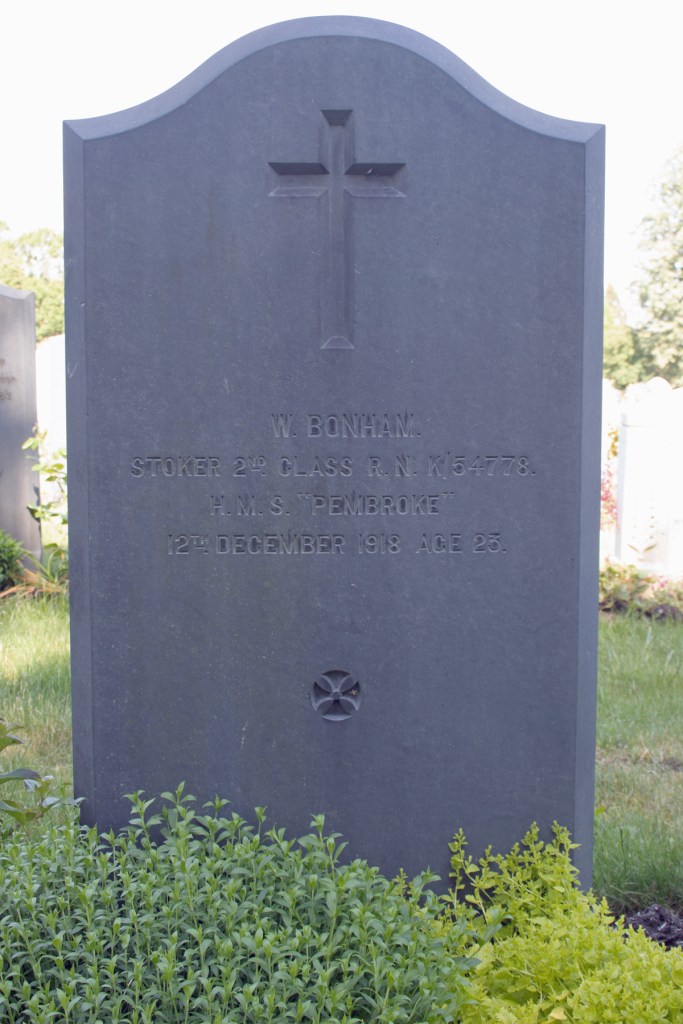
William Bonham was born in Abbeyleix, Queen’s County (now County Laois) on 6th September 1895. One of ten children, his parents were labourer John Bonham and his wife Mary.

Little information about William’s early life is available; when he left school, he found work as a railway porter, but when he was 23, with war having be raging across Europe, he received his enlistment papers.

William joined the Royal Navy on 13th October 1918, and set sail for England. Assigned the role of a Stoker, he was sent to HMS Pembroke – the shore-based establishment at the Naval Dockyard in Chatham, Kent – for training. Less than eight weeks later, however, he was dead.

Stoker Bonham had contracted pneumonia that winter, and died at his home in Chatham on 12th December 1918. He was just 23 years old.

William was laid to rest in the Woodlands Cemetery in nearby Gillingham.


Bombardier Daniel Mcauley

Bombardier Daniel McAuley

Daniel Mcauley was born in Belfast in around 1883, one of six children to John and Margaret Mcauley. John was a farmer, and when Daniel – who was named after his uncle – left school, he found labouring work to help the family bring in an income.

In January 1909, Daniel married Annie Fittis, the daughter of a linen tenter (stretching cloth on a loom while it was drying and maintaining the machines). The couple had had a son, John, eighteen months before, and would have another child, Sarah, later that year.

The 1911 census for Northern Ireland found the young family living with Annie’s mother and two sisters in Dayton Street, near the middle of Belfast. Annie and her sisters were working as flax spinners, while Daniel was a labourer. Tellingly, the document lists inhabitants’ religion – Daniel is the sole Roman Catholic amongst a family of Presbyterians.

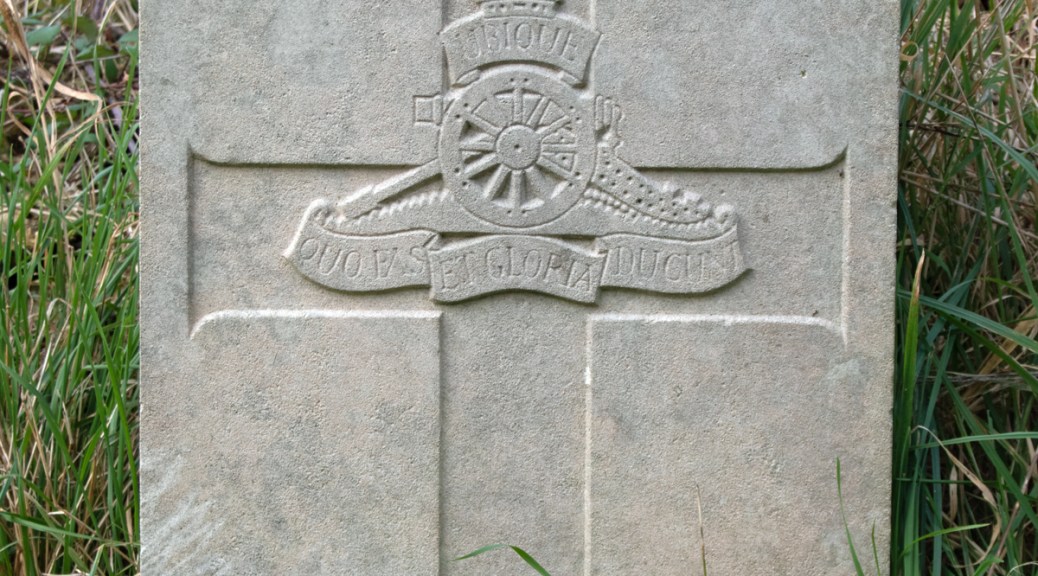
War was coming to Europe, and Daniel was called on to do his bit. Sadly, full details of his military service are not available, but what is clear is that he enlisted as a Bombardier in the Royal Field Artillery towards the end of 1914. He was shipped to England, and barracked in Somerset, near Frome.

Sadly, the next evidence of Daniel’s life comes in a wealth of newspaper articles that report on the accident that led to his death.

One soldier was killed and another seriously injured as the result of a horse attached to a Royal Field Artillery wagon bolting at Frome Saturday morning. The wagon was on its way to the stables when the horse got out of control and ran along Christ Church Street West.

One man, who was riding in the wagon, in jumping clear was seriously cut about the head and body, and was taken to the hospital. The other, Bombardier Daniel MacAulay, belonging to Glasgow [sic], remained in the wagon trying to pull up the horses, but the vehicle swerved across the road and he was thrown out, his head coming into contact with a street lamp.

He was taken to the hospital on the police ambulance, but died before admission. He was a married man, about 34 years of age, and was to have gone on leave Saturday in order to visit his sick child. In the morning he received a letter from his wife saying that the child had been seriously ill and had gone blind.

Mr Douglas Mackay, deputy coroner, held an inquest at Frome on Tuesday on the body of the deceased. The verdict was “Accidental death.”

Shepton Mallet Journal: Friday 19th March 1915

Other newspapers reported similarly, a couple stating that Daniel was father to three children. There is no evidence that this was the case and, given that all of the reports state that he came from Scotland, when he was Irish, it is likely that this too was an error. Each newspaper give variations of the spelling of his surname too, evidence that spelling was often at the mercy of the person documenting it, even in the media.

Daniel was buried in Somerset and Annie travelled to England to attend the funeral. Again, newspaper reports suggest that Daniel’s brothers also attended, although he had only one male sibling.

Bombardier Daniel Mcauley died on 13th March 1915, aged around 33 years old. He was laid to rest in the Vallis Road Burial Ground in Frome, also known as the Dissenters’ Cemetery (for those who did not follow the English Protestant faiths.


McAuley (McCauley), Daniel, Bombardier, Royal Field Artillery, 7 Wall Street Belfast, Died, March 1915

Private Donald Mees

Private Donald Mees

Donald Mather Mees was born on 14th July 1900, the only child of Arthur and Mary from Mells, Somerset. Arthur was a grocer and wine merchant, who, by the time of the 1911 census, had set the family up in Warminster.

Given his young age, there is little documented about Donald’s early life; most of the information available comes from the newspaper reports of his passing:

The military funeral which passed through Frome on Wednesday afternoon was a very sad one. It was that of Private Donald Mather Mees, only son of Mr AH Mees, grocer… formerly of Mells…

The deceased was a somewhat delicate lad, and had only joined up a few weeks – less, we believe, that a month – when he was taken ill and succumbed to pneumonia at King George V Hospital at Dublin on 15th inst.

His parents had been notified of his illness and were preparing to visit him when their journey was interrupted by the news of his death.

Somerset Standard: Friday 23rd August 1918

Private Donald Mather Mees, of the Wiltshire Regiment, had died on 15th August 1918, at the age of 18. He was laid to rest in the graveyard of St Andrew’s Church in the village of his birth, Mells.


Private Henry Teahen

Private Henry Teahen

Henry Teahen (or Teahan) was born in around 1898 in Castlegregory, County Kerry, Ireland. One of twelve children – eight of whom survived infancy – his parents were John and Catherine Teahan.

John was a wayman (or road surveyor), who was born in Kerry. Catherine was born in Wandsworth and it was in London that the couple met and married. By the time Henry was born, the family had moved back to Ireland, although Catherine had made the journey back to England in the early 1900s, after John passed away.

The 1911 census found the family living in Forest Gate in the east of the capital; Henry’s oldest brother, Joseph, was head of the household and, at 24, was working as a police constable. Schoolboy Henry was there, as was his mother, two more of his brothers, one of his sisters and his niece and nephew.

War was imminent, though, and, within a week of hostilities breaking out, Henry – who had been working as a waiter – enlisted in the Royal Marine Light Infantry. Private Teahen’s service records show that he was 5ft 8ins (1.72m) tall, had a fair complexion, grey eyes and brown hair. They also give his date of birth as 22nd June 1896, although he may have adapted this, as he would have been underage at the point he joined up.

Over the next few years, he served on a number of ships, switching between the Plymouth and Chatham divisions of the regiment. Full details of his duties are not immediately apparent, although is seems that he was injured while on board HMS Valiant in February 1916 – six months before her involvement in the Battle of Jutland – receiving a contusion to his right knee.

By the closing months of the war, Private Teahen had transferred back to the Naval Dockyard in Chatham, Kent. It was while here, early in 1919, that he fell ill. Details of his condition are lost to time, but it is known that he succumbed to them, passing away on 1st March 1919; he was 21 years old when he died.

Henry Teahen was laid to rest in the Woodlands Cemetery in Gillingham, within walking distance of the dockyard at which he was based.


Henry’s older brother James, also fought in the First World War. Full details are not clear, but documents show that he enlisted in the 6th City of London Regiment (also known as the City of London Rifles).

James’ regiment fought in many of the fiercest battles on the Western Front, including Loos, Vimy, High Wood and Messines, but it was at Ypres in the late summer of 1917, that he was injured. He died of his wounds on 30th September, aged just 23 years old.

Private James Teahan was laid to rest at the Mendinghem Military Cemetery in Poperinghe, Belgium.


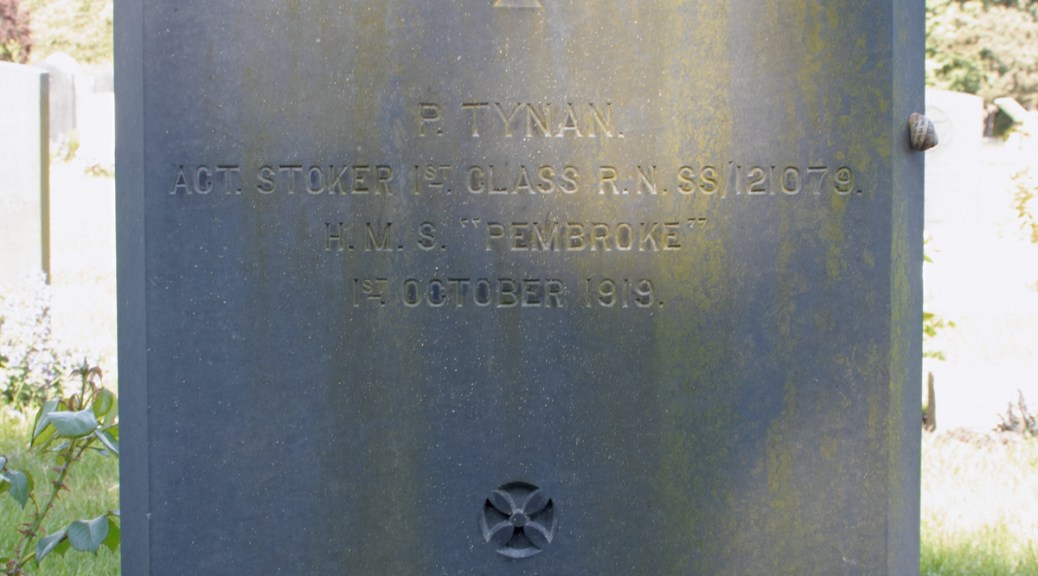
Stoker 1st Class Patrick Tynan

Stoker 1st Class Patrick Tynan

Patrick Tynan was born in Roscrea, Southern Ireland, on 9th June 1893. He was the eldest of four children to John and Anne Tynan, but sadly, there is no further information available for his early years.

Patrick’s story really picks up on 14th December 1915, when he joined the Royal Engineers as a Private. His service record states that he was living in Bangor, Gwynedd, and that he was a stall keeper at a fairground – a subsequent document noted his trade as a showman. He was noted to be 5ft 8ins (1.72m) tall, weighed 151lbs (68.5kg), and had numerous scars on his back.

Private Tynan did not stay in the UK for long. Assigned the new role of Driver, he was attached to the GHQ Signal Company and sailed from Devonport on 30th June 1916, bound for Mesopotamia. Arriving in Margil – the port connected to Basra – he was based here for more than a year, before moving north to Baghdad.

By this time, Patrick had risen to the rank of Lance Corporal, and was obviously a trustworthy member of the company. Towards the end of 1917, he had again been promoted, this time to Corporal.

During his time in modern day Iraq, Patrick was admitted to hospital a handful of times; there is little information on the conditions he suffered, but none appear to have been life threatening, as they were only for short periods. It’s also interesting to find that his service records confirm a month’s leave in May 1918, spent in India.

When the war came to a close, Corporal Tynan was still in the Middle East. Ready to be demobbed, his company moved to India and boarded the SS Chupra in Calcutta on 26th February 1919, bound for home.

Back in the UK, however, Patrick was not ready to give up the formal military life. Having returned to Gillingham in Kent, where the Royal Engineers were based, he initially found work as a tram conductor, but soon signed up for a five year term with the Royal Navy as a stoker.

He was based on HMS Pembroke II, the shore-based establishment at Chatham Dockyard, but sadly, his time in the navy was to be a short one. Admitted to the Royal Naval Hospital in the town with pneumonia, he passed away form the condition on 1st October 1919. He was just 26 years old.

Patrick Tynan was laid to rest in the Woodlands Cemetery in Gillingham. He had a short but full life, something his modest gravestone doesn’t begin to hint at.


Officer’s Steward Gerald Connolly

Officer’s Steward Gerald Connolly

Gerald Sidney Connolly was born in the spring of 1899, one of eleven children to Thomas and Mary Connolly. Thomas was a retired soldier who had been born in Malta, while Mary had come from Portsmouth. The couple had lived in India for a while, but, by the time Gerald was born, had settled in Kildare, Ireland.

Retirement from the armed forces left Thomas needing to financially support his family, and so they made the move to London in 1910. According to the following year’s census, the family had settled in Manor Park, to the east of the city, where Thomas was working as a storekeeper for a local hostelry.

Military service was obviously in young Gerald’s blood and, in April 1916, he gave up work as an errand boy for a life in the Royal Navy. Initially taken on as a servant boy at HMS Pembroke and HMS President – the shore-based establishments in Chatham, Kent – he subsequently served on HMS Shannon, a cruiser that patrolled the North Sea for German warships.

It was while he was aboard the Shannon that Gerald came of age, and was given the rank of Officer’s Steward (3rd Class). During the next few years, he served short periods on five further vessels, before returning to HMS Pembroke in December 1918.

Officer’s Steward Connolly was still serving in Chatham two months later, and he kept himself active. It was while he was making use of the barracks’ swimming baths that an accident befell him. His service record confirmed that he was found drowned in the baths on 26th February 1919 and a subsequent inquest identified that no foul play was to blame. Gerald had ‘accidentally drowned whilst bathing’. He was just 19 years of age.

Gerald Sidney Connolly’s body was laid to rest in the Woodlands Cemetery in Gillingham, Kent, not far from the Naval Dockyard where he was based.


Able Seaman Michael Goulding

Able Seaman Michael Goulding

Michael Joseph O’Neill Goulding was born on 5th May 1884, the oldest of six children to Michael and Ellen Goulding (née O’Neill). Michael Sr worked for the inland revenue and his job took him around most parts of the British Isles.

Michael Jr had been born in Limerick – both of his parents came from Ireland – but his subsequent three siblings (Patrick, Margaret and William) had all been born in Scotland. His second youngest sibling, Lily, was born in County Durham, the youngest back in Scotland, while, by the time of the 1901 census, the whole family were living in Forest Gate, East London.

The census also shows that Michael Jr, having left school, was working at Customs House (presumably where his father was employed), as a boy copyist on tea accounts. The inland revenue at that time was a career for life; by the next census in 1911, the family had moved to Hertford, where Michael Sr was a customs and excise supervisor, and Michael Jr was an assistant clerk at the same place of employment.

War was on its way, but Michael seems not to have enlisted immediately. While specific dates for his joining up are not available, it appears that he was still working for the Inland Revenue when he got married in Shoreditch, in April 1917. His wife was called Bridget Mary Gough (known as Bryde), and she had also been born in Ireland. The couple went on to have a daughter, Ellen (or Eileen), the following year.

By this time, Michael had definitely enlisted. He joined the Royal Naval Volunteer Reserve, and was based at HMS Pembroke, the shore-based establishment in Chatham, Kent. This was the location for the Navy’s main accounting base, so it is likely that he was employed for financial, rather than his military, skills.

Able Seaman Goulding served through to the end of the war and beyond, and it was while he was based in Kent that he became unwell. Admitted to the Royal Naval Hospital in Chatham, he succumbed to a combination of bronchitis and pneumonia on 22nd February 1919. He was 34 years of age.

Michael Joseph O’Neill Goulding was laid to rest in the Woodlands Cemetery in nearby Gillingham. His family were still in Hertford, while his widow and daughter moved back to Ireland.


Michael Joseph O’Neill Goulding
(courtesy of ancestry.co.uk)

Able Seaman George Davies

Able Seaman George Davies

George Herbert Davies was born in Rosses Point, County Sligo, Ireland on 28th September 1872. One of eight children, his parents were naval man Robert Davies and his wife Catharine.

George was obviously drawn to the sea, and enlisted in the Royal Navy in February 1888. Too young to be an active member of the crew, he was initially given the rank of Boy, before rising to Ordinary Seaman when he came of age in September 1890.

Over the duration of his initial twelve years’ service, George was assigned to a total of eight ships, with time between each spent at the shore-based establishment HMS Pembroke in Chatham, Kent. He rose to the rank of Able Seaman and, in February 1903, volunteered to continue his time in the Royal Navy.

At the start of 1914, having served for a further ten years, Able Seaman Davies was stood down to the Royal Fleet Reserve. He did not remain on reserve status for long, however, as, in August 1914, he was called again into active service as war was declared.

While primarily based on HMS Pembroke this time, George did service two tours on sea-going vessels: he spent two years on board HMS President from October 1914, and then six months on the General Greenford. By January 1917, however, he was back at HMS Pembroke.

Within a couple of months, Able Seaman Davies had been admitted to the Royal Naval Hospital in Chatham, suffering from pancreatitis. Sadly, this haemorrhaged, and he passed away on 27th March 1917; he was 44 years old.

George Herbert Davies was laid to rest in the Woodlands Cemetery in Gillingham; walking distance from the Naval Dockyard that had been his base for so long.


Private Bertie Bridger

Private Bertie Bridger

Bertie Charles Bridger was born in the summer of 1876, one of nine children to William and Anne. William was a carman for the railway, and the family lived close to the central station in Worthing.

When Bertie left school, he followed in his father’s trade and, by the time of the 1901 census, was working as a groom and carman alongside his father and older brother, Arthur.

Bertie came to the notice of the local court when, in February 1900 he was called up to the Petty Sessions. He was fined for ‘cruelly ill-treating a horse by working it into an unfit state’ [Sussex Agricultural Express: Friday 9th February 1900], and ordered to pay a total of 18 shillings.

In the spring of 1904, Bertie married Ethel Gray, a carpenter’s daughter from Essex, who had found employment as a parlour maid for a Worthing solicitor. The couple would go on to have two children, Bertie Jr, who as born in 1905, and Leonard, born seven years later.

By the time of the 1911 census, the young Bridger family were living near the main railway station in a two-up, two-down property, where Bertie Sr was still plying his trade as a carman at the station.

War was coming, however, and in the summer of 1915, Bertie enlisted in the Royal Defence Corps. He was assigned as a Private to the 452nd Protection Company and, while his exact duties remain unclear, it is likely that he would have been involved with horses at some level, given his experience.

Private Bridger’s service appears to have mainly been spent on home soil, although, towards the end of the conflict he was sent to Ireland. It was while he was there, that he came down with influenza, which then turned into pneumonia. He was admitted to the Military Hospital in Curragh, but he died of the conditions on 14th November 1918, three days after the Armistice was signed. He was 42 years old.

The body of Bertie Charles Bridger was brought back to Sussex, and he was laid to rest in the Broadwater Cemetery to the north of Worthing. The local newspaper commented that:

Previous to his enlistment the deceased soldier was an outside porter at the Railway Station for nearly thirty years, and the sympathy of a wide circle of friends will be extended to his widow and two children.

Worthing Gazette: Wednesday 27th November 1918

Private Bertie Bridger (from Ancestry.com)