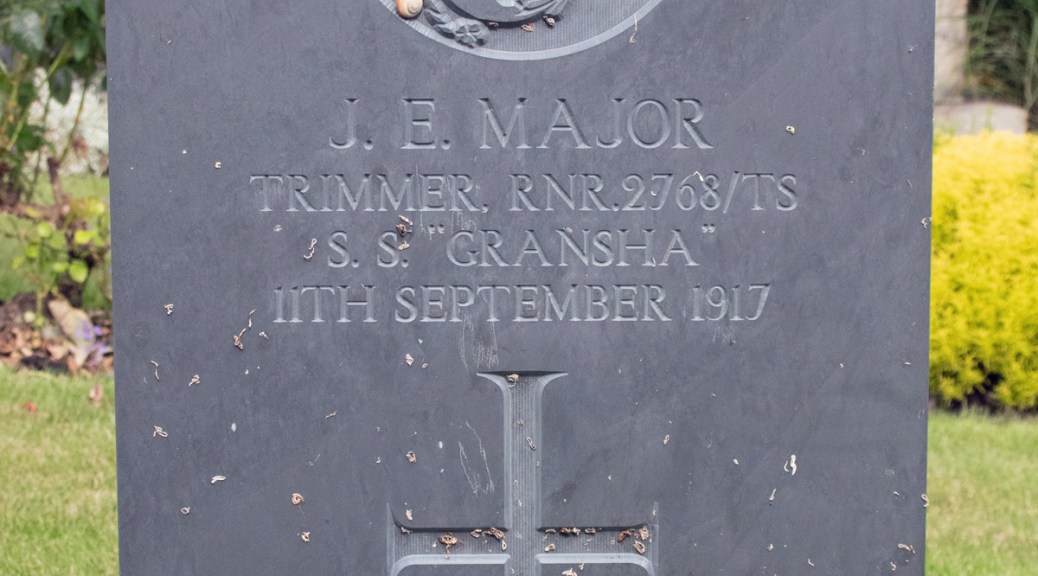
John Edward Major was born on 1st April 1881 in Gorleston, Suffolk. One of seven children, his parents were William and Elizabeth Major. William was a fisherman and the family lived on the town’s High Street.
Things changed for the Major family, however, and the 1891 census found them living in Barking, Essex. William was now employed as a general labourer, and the family had set up home at 16 Rosa Terrace.
John was drawn to his coastal past and, according to the next census, he was a ship’s mate on the fishing boat Cygnet. Based out of London, the return was taken in Lowestoft, so it is safe to assume that she plied the Essex and Suffolk coasts.
Love was blossoming for John at this point and, on 9th September 1906, he married Ann Davy. She was a coal porter’s daughter from Barking, and the couple married in the town’s St Margaret’s Church. They would go on to set up home in Cleethorpes, Lincolnshire, and have five children: Blanche, Amelia, Annie, Elizabeth and John Jr.
Over the next few years John’s trail goes cold. When war broke out, he was called upon to play his part, and joined the Royal Naval Reserve as a Trimmer. By the summer of 1917 he was attached to the SS Gransha, based out of the Royal Naval Dockyard in Chatham, Kent.
The next record for Trimmer Major relates to his passing. His pension ledger notes that, on 11th September 1917, he fell overboard from Gransha and was drowned. Sadly, there is no other information available about the incident, but John was 37 years of age.
The body of John Edward Major was laid to rest in the naval section of Woodlands Cemetery, Gillingham, Kent, not far form the naval base that he had come to call home.
Tragically, John’s entry on the Pension Ledger confirms that his and Ann’s youngest child – John Jr – died on Christmas Eve 1917, three months after his father.
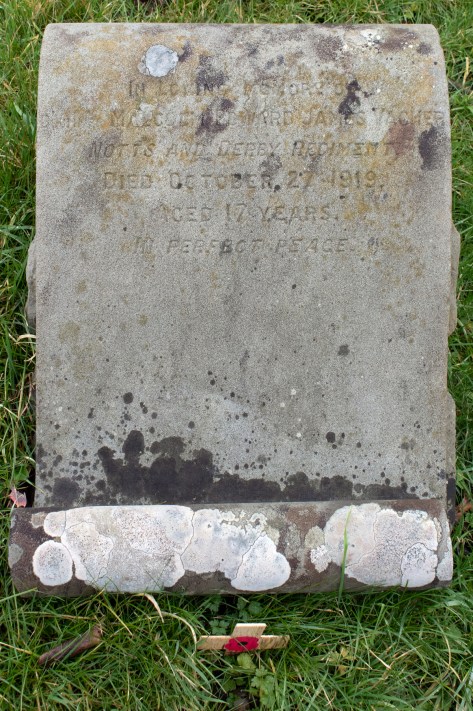
Born at the start of 1902, Malcolm Edward James Vacher was the younger of two children to James and Alice Vacher. James was a domestic coachman and both he and Alice were born in Milton Abbas, Dorset. By the time Malcolm was born, the family had relocated to the village of Mortimer, Berkshire.
Alice died when her youngest was just five, and James moved the family to the village of Kelstern in Lincolnshire, possibly for work. Sadly, James passed away in 1916, leaving Malcolm and his older sister, Gladys, as orphans.
By this point war was raging across Europe, and it seems that Malcolm looked to the army as a new family. He enlisted in the Sherwood Foresters (Notts and Derby Regiment), although his service papers have been lost to time.
It is unclear how or where Drummer Vacher served. He survived the war, however, and by the autumn of 1919, found himself on furlough in Wiltshire. His death certificate records that died on 26th October, from a combination of appendicitis and heart failure. Just 17 years of age, his sister was by his side when he passed.
Malcolm Edward James Vacher was laid to rest in St John’s Churchyard, Warminster. The Grave Registration Form notes that the headstone was paid for by his uncle.
By this point, Gladys had lost her parents and her brother. Twenty-one years of age when her sibling died, she nonetheless found the resilience to carry on.
The 1921 census recorded Gladys living at 1 Corporation Street, Kidderminster. Boarding with Jane Smith, she was working as garage assistant for the motorcycle department of the Castle Motor Co Ltd on Vicar Street.
In the spring of 1925, Gladys married radio engineer and dealer George Whitford. By the time of the 1939 Register, the couple were living at 81 New Road, Kidderminster. Gladys was helping her husband with the business, and was recorded as being a radio dealer and travel agent.
Gladys Whitford, née Vacher, passed away in the spring of 1960. An obituary outlined the life she had forged for herself after losing her brother:
Mrs Gladys Mary Whitford, who has died at her home in New Road, Kidderminster, aged 63, had conducted one of the oldest travel agencies in the Midlands for 30 years. The firm, founded by her husband’s grandfather in 1856, arranged emigration for many families seeking a new life in the Commonwealth.
Mrs Whitford joined the Women’s Legion in 1916 and was one of the first motor-cycle despatch riders attached to the Royal Army Service Corps. She was a member of the Kidderminster Chamber of Commerce and of the committee of the Kidderminster Retail Traders’ Association. She is survived by her husband, Mr George Whitford, a radio and television dealer.
[Birmingham Daily Post – Tuesday 12 January 1960]
My thanks go to Peter Calver and the members of the Lost Cousins website for their help in filling in details of Gladys’ life after the loss of her family.
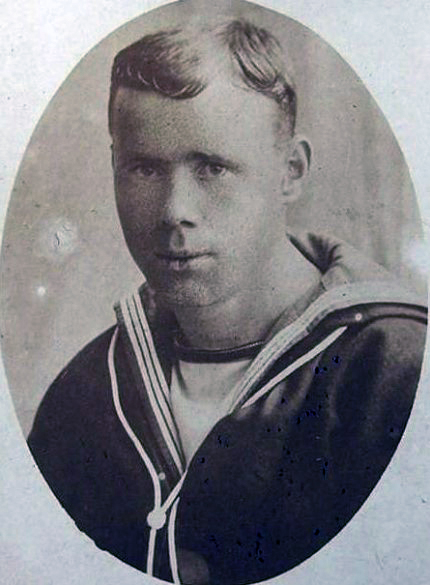
Arthur Edward Crisp was born in 16th March 1899 in the Norfolk village of South Creake. The youngest of six children, his parents were blacksmith Henry Crisp and his wife, Sarah.
When war broke out across Europe, young Arthur had already had some experience of seamanship, and was keen to play his part. He joined the Royal Navy on 7th April 1915 and, given his age, he was assigned the rank of Boy 2nd Class. Initially sent to HMS Powerful, he was trained there for three months, rising to the rank of Boy 1st Class.
On 26th July 1915, Arthur was assigned to the battlecruiser HMS New Zealand, and would remain on board for the next two years. During this time, he came of age, and was formally inducted into the Royal Navy as an Ordinary Seaman. His service records show that he was 5ft 5ins (1.65m) tall, with brown hair, grey eyes and a fresh complexion.
His stint on New Zealand also exposed him to naval warfare, as she was heavily involved in the Battle of Jutland in May 1916. Ordinary Seaman Crisp came through, however, and remained part of the battlecruiser’s crew for a further year.
After a short time on shore, where he was based at HMS Victory, the Royal Naval Dockyard in Portsmouth, Hampshire, Arthur’s next posting was on board HMS Wallington. A former trawler, she had been converted to a boom defence vessel, she protected the dockyard in Grimsby. In November 1917, while based in the Lincolnshire town, Arthur was promoted again, rising to Able Seaman.
The following March, Arthur moved again, and was assigned to HMS Attentive, the shore base for the Dover Patrol. He would not remain there for long, however, and was admitted to the Royal Naval Hospital in Chatham, Kent. He passed away on 17th March 1918, from an intriguing combination of gunshot wounds to his chest and pneumonia. He had turned 19 years old the day before.
The body of Arthur Edward Crisp was taken to nearby Gillingham for burial. He was laid to rest in the military section of the town’s Woodlands Cemetery.
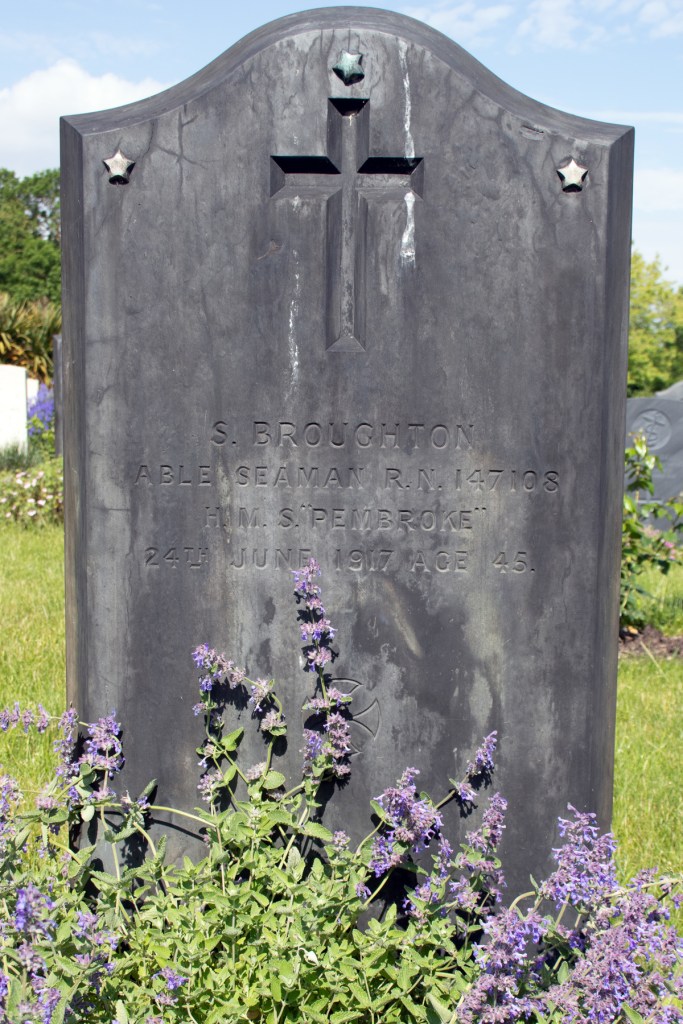
Sydney Broughton was born on 21st November 1872 in the Lincolnshire village of East Halton. The sixth of nine children – of whom eight were boys – his parents were William and Emma Broughton.
William was a boot an shoe dealer, and his older sons were destined to follow him into the business. Sydney, however, sought bigger and better things and, on 13th November 1888, he joined the Royal Navy. Being only 15 years of age, he wasn’t able to full enlist, and was taken on as a Boy 2nd Class.
Sydney was sent to Devonport, Devon, for his training. Assigned to the training vessel HMS Impregnable, she would become his home for just over two years. On 12th March 1890 he was promoted to Boy 1st Class and on his eighteenth birthday, he was formally enlisted in the Royal Navy.
Ordinary Seaman Broughton’s service records show that he was 5ft 4ins (1.63m) tall, with dark brown hair, light grey eyes and a fair complexion. He was also noted as having a slight scar under his right eye. Now of age, Sydney was moved to barracks at HMS Vivid, onshore at the heart of Devonport itself.
On 28th January 1891, Ordinary Seaman Broughton was given his first posting, on board the cruiser HMS Tauranga. He would remain there for only six months, however, as the ship was in the process of being transferred to the Australian Navy. His new assignment would be the survey sloop HMS Penguin, and she would be his home for the next two years.
Shortly before leaving Penguin, Sydney was promoted to the rank of Able Seaman. He spent the next nine months split between HMS Victory, the Royal Naval Dockyard in Portsmouth, and HMS Excellent, a base that was also connected to the dockyard.
On 26th January 1894 Able Seaman Broughton was posted to the cruiser HMS Galatea. He remained there for the rest of the year, including fourteen days spent in cells for an unknown offence that April. He then moved to the battleship HMS Edinburgh, with whose crew he would spend the next two years.
In September 1896, Sydney transferred to what would become his home base, HMS Pembroke, also known as the Royal Naval Dockyard in Chatham, Kent. Over the remaining six years of his twelve year contract, he would keep returning there, also spending time in the dockyard’s training base, HMS Wildfire.
On 10th February 1901, Able Seaman Broughton was imprisoned for 42 days for misappropriating mess funds, while based in the Dockyard. Surprisingly, the misdemeanour seems not too have impacted his career too adversely, however, and when his contract came up for renewal the following year, he voluntarily remained with the navy.
Sydney was on board the cruiser HMS Amphritite when his new term of service began. In March 1902 he was promoted to Leading Seaman and, over the next five years, he would go on to serve on a further five ships. In October 1907 he was reduced in rank to Able Seaman once more, although his service records don’t confirm whether this was through his own choice or not.
Over the next six years, Sydney would serve on three further ships. When was formally stood down to reserve status on 19th January 1913, his home was HMS Actaeon, the navy’s torpedo school in Chatham: he had been assigned there for nearly three years, and in the Royal Navy as a whole for more than 24 years.
When war broke out in the summer of 1914, Able Seaman Broughton was called back into action. He remained on solid ground, however, and split the next three years between HMS Pembroke and HMS Wildfire, places he knew well. Sydney’s health may have been a factor in his lack of seaworthiness: in the spring of 1917 he was admitted to the Royal Naval Hospital in Chatham, suffering from mouth cancer. The condition was to prove fatal: he passed away on 24th June 1917, at the age of 44 years old.
Sydney Broughton’s body was laid to rest in the naval section of Woodlands Cemetery in Gillingham, Kent, not far from his beloved dockyard.
Sydney’s next-of-kin was noted as being his wife, Edith Mary Broughton. There is no record of their marriage, but her details on his records correspond to an entry on the 1921 census.
The document recorded Edith living in Sittingbourne, Kent. 45 years and seven months old, she was sharing her home with her widowed mother, Harriett Pearce, and her two-year-old granddaughter, Edith May.
Further digging suggests that Edith had been a widow when she and Sydney exchanged vows: the 1911 census found her married to Herbert Busbridge, the couple having a daughter, Edith Nellie, who had been born in 1896.
Widowed twice, Edith Mary carried on as best she could: she passed away in the spring of 1963, at the age of 87.
Charles Pratt was born in the West Sussex village of Findon in the autumn of 1899. The oldest of five children – all boys – his parents were farm labourer Charles and his wife, Emily.
Charles Jr was still a schoolboy at the time of the 1911 census. The family were living in the five-roomed cottage called Sheepcombe by now: farm labourer Charles Sr, Emily, Charles Jr, his three younger siblings (youngest boy Albert being born in 1915), and Emily’s brother, farm horseman Daniel Hollingdale.
When war was declared, the oldest Pratt boy was still just fourteen years of age, and too young to enlist. As the fighting raged across the continent, it seems likely that he was disappointed to miss out on the adventure. Full details of his army service have been lost to time but records suggest that he joined up no later than April 1918.
Private Pratt was attached to the 9th (Service) Battalion of the East Surrey Regiment. He was certainly sent to France, and may have been caught up in the Battles of the Somme in 1918. He fought at Cambrai, and this is where he would be injured. Charles’ wounds were bad enough for him to be medically evacuated to Britain, and he was admitted to the 4th Northern General Hospital in Lincoln, Lincolnshire, for treatment.
Sadly, the soldier would succumb to his injuries. He passed away on 27th October 1918, at the age of just 19 years old.
Charles Pratt was taken back to Sussex for burial. He was laid to rest in the graveyard of St John the Baptist Church in Findon, walking distance from his family home.
Charles’ was a family plot: he would be reunited with his parents when the passed away: Charles Sr in 1953 and Emily in 1958.
Victor George Evans was born in the autumn of 1882, one of eleven children to George and Charlotte Evans. George was a woodsman from Aldworth in Berkshire, and it was here that he and Charlotte raised their growing family.
There is little concrete information about Victor’s early life. While his family were living on Bethesda Street in Basildon, Berkshire, at the time of the 1901 census, Victor is noticeable by his absence.
On 29th January 1910, Victor married Edith Rains in Kensington, Middlesex. She appears to have been a dressmaker’s apprentice, and had been born in Moulton, Lincolnshire. The next year’s census recorded Victor employed as a butler for the Clutton family. His boss, Ralph Clutton, was a lawyer, and the family resided at 5 Vicarage Gate, not far from Kensington Palace. This time, however, it is Edith who is missing from the census record and, given that she had given birth to their one and only child, Phyllis, the year before, it is likely that she was recuperating elsewhere, possibly with the support of her family.
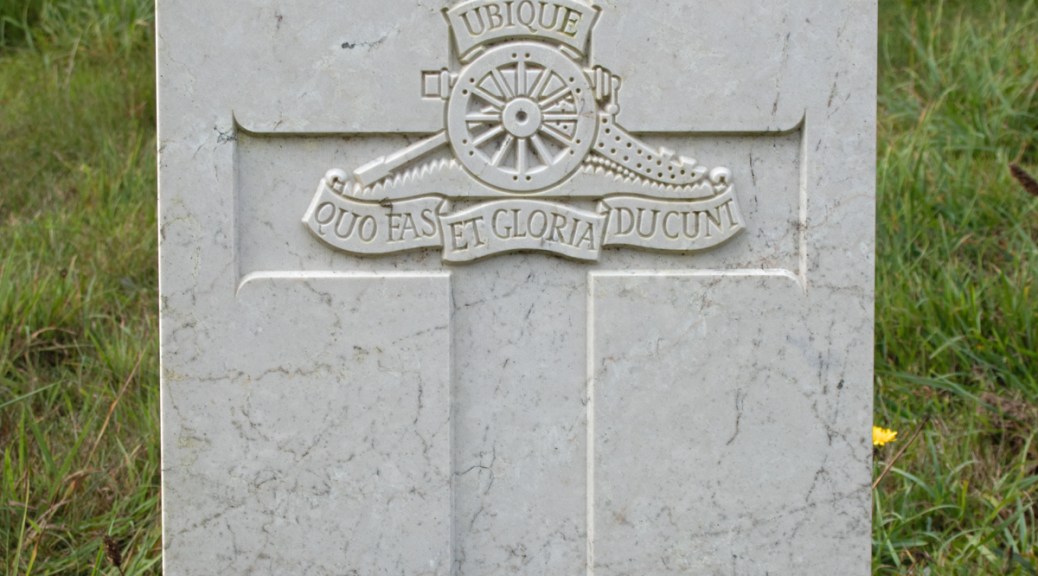
When war broke out, Victor was called upon to serve his country. On 22nd December 1916, he enlisted, joining the Royal Garrison Artillery as a Gunner. His service records show that 34 years of age and stood 5ft 7.5ins (1.71m) tall.
Victor was recorded as being a messenger, and he and Edith were living with his older sister, Rachel, at 17 Adeney Road in Hammersmith, Middlesex. The document suggests, however, that Phyllis was in the care of Edith’s parents in Lincolnshire, possible to enable both her and Victor to work.
Gunner Evans was assigned to the 270th Siege Battery, and he was soon sent to France. While based near Rouen in April 1918, he was badly injured through a number of shrapnel wounds, and medically evacuated to Britain for treatment. Admitted to a hospital in Paignton, Devon, there was little that could be done, other than being made comfortable. Victor succumbed to his wounds on 28th April 1918: he was 35 years of age.
It is likely that Edith would not have been able to afford for her husband to be brought back to Middlesex for burial. Instead, Victor George Evans was laid to rest in the ground of Paignton Cemetery.
Arthur Edward Naile was born in the summer of 1888, the youngest of ten children to James and Mary Naile. Both of his parents were born in Bath, Somerset, and this is where they raised their growing family.
The Nailes lived in the Camden area of the city, consecutive census returns showing different addresses, as the children grew and then left home. In 1891, they lived at 11 Malvern Buildings, a small terraced house on a steep hill. Ten years later, they had moved to 3 George’s Road, to another terraced cottage close to their old home. By 1911, only Arthur was still living at home, which was now the four-roomed terrace at 51 Brooklyn Road, in the more built up Larkhall area no the northern outskirts of the city.
During all of this time, James had worked as a printer’s compositor. By 1911 he was 64 years of age, and was employed by a newspaper in the area. Arthur, meanwhile, was working as a grocer’s assistant.
On 9th August 1914, he married soldier’s daughter Bessie Brine. She was working as a dressmaker, and lodging with Charles and Eleanor Richman, in a small cottage in Dover Place. Their marriage certificate shows that Arthur was living three doors down, so it is likely she caught his eye not long after he moved in. They went on to have a son, Leslie, in November 1916.
War was raging across Europe by this point, and Arthur had stepped up to serve his country. He joined the Royal Engineers as a Sapper, but there is little concrete information about his time in the army. He was awarded the Silver War Badge, which was given to men medically discharged from military service during the conflict, which would suggest that he was badly wounded at some point. He died in a hospital in Hastings, East Sussex, an annexe of which was dedicated to personnel who had been blinded during the war.
Sapper Arthur Edward Naile passed away from a combination of influenza and diabetes on 31st October 1918: he was 30 years of age. His body was taken back to Somerset for burial, and he lies at rest in a peaceful corner of Bath’s sweeping Locksbrook Cemetery.
After Arthur’s death, Bessie was left to bring up their young son. In the autumn of 1923, she married again, to John Forman, and not long afterwards the three of them emigrated to Australia, in search of a better life. They settled in Bunbury, Western Australia, and went on to have two children, Ron and Nan.
When war broke out again, Leslie was old enough to step up, and joined the Royal Australian Air Force. By 1943, he found himself as a Flight Sergeant in Waltham, Lincolnshire. He had joined 100 Squadron of Bomber Command and, on the night of 25th June 1943, was piloting a Lancaster over the Netherlands. His plane was hit and destroyed, killing all those on board. Father and son both lost to war, Flight Sergeant Naile was just 26 years of age when he passed. He was buried in Westbeemster, and commemorated on memorials in Runnymede, Surrey, and Canberra, Australia.
Bessie lived on until her early 70s. She died on 8th December 1960, and is buried in the family plot in Bunbury Cemetery.
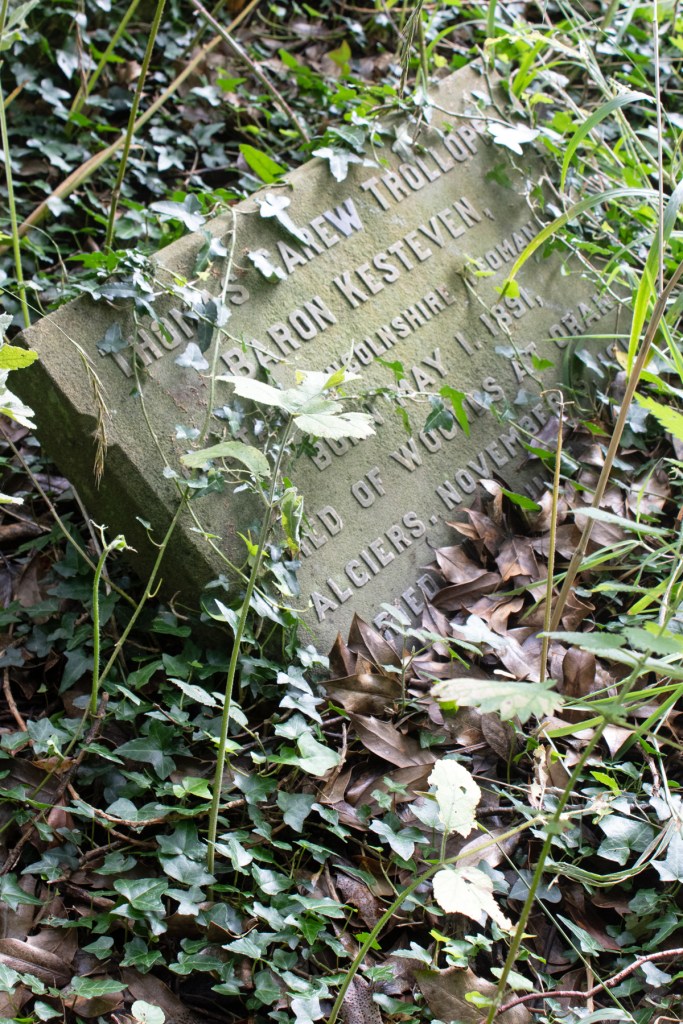
Official intimation has been received of the death of Capt. Lord Kesteven, of the Lincolnshire Yeomanry, who sailed for the Balkans last week. Sir Thomas Carew Trollope… third Baron Kesteven, who was born in May 1891, was the only son of the late Hon. Robert Cranmer Trollope and the Hon. Mrs Trollope, of Crowcombe Court, Taunton, and was educated at Eton. He succeeded to the barony on the death of his uncle, the second Baron, in July last. He joined the Lincolnshire Yeomanry about six years ago, when his uncle was Colonel of the regiment, and was gazetted Captain in October 1914. He had seen service in France during the present war, being attached to Jacob’s Horse, Indian Cavalry, until he succeeded to the title. Lord Kesteven was unmarried, and the title becomes extinct, but the baronetcy goes to Mr William Henry Trollope.
Bath Chronicle and Weekly Gazette: Saturday 13th November 1915
Thomas Carew Trollope was born in Middlesex, London on 1st May 1891. He was the younger of two children to Robert and Ethel Trollope, whose main residence was Crowcombe Court in Somerset.
Thomas was destined for great things. The 1901 census recorded him as being a boarder at Naish House Preparatory School in Wraxall, Somerset, while his older sister, Dorothy, remained at home with their parents and ten live-in servants.
Ten years later, and on his way to being prepared for the barony, Thomas was living with his uncle, John Trollope, the Baron Kesteven, at his estate, Casewick, in Uffington, Lincolnshire.
On the 5th November 1915, on Thomas’ journey to the Balkans, the ship he was on, the SS Mercian, was shelled by U-Boat SM U-38. After more than an hour being bombarded, the Mercian escaped. By that time, however, 78 men were wounded, 23 were killed, and 22 troops and eight crew members were missing. The Mercian managed to dock at Oran, Algeria, and those killed were either buried at sea or in the city’s cemetery.
Captain Sir Thomas Carew Trollope was also killed: he was just 24 years of age. It is unclear whether Thomas’ body was brought back to Britain or was buried in Oran, but the family plot includes a memorial to him.
A memorial service was held in the Church of the Holy Ghost, Crowcombe, on Monday 15th November 1915, the villagers commemorating the untimely passing of their favourite “Mr Tom Trollope”.
Captain Sir Thomas Trollope, Baron Kesteven (from findagrave.com)
Herbert Perry was born in Sampford Brett, Somerset, on 2nd July 1887. One of fifteen children, his parents were Henry and Mary Perry. Henry was a groom and gardener, and the family were raised in a small cottage in the centre of the village.
Herbert and his siblings attended the local Church of England school, but once he finished his education his own trail goes cold. The next records relate to his military service, although they are also a bit scarce.
What is clear is that Herbert enlisted early in the war. He joined the 1st Battalion of the Devonshire Regiment, and was in France as soon as January 1915. Private Perry found himself at Ypres, and it was here, in July, that he was badly injured.
Private Perry was medically evacuated to Britain for treatment, and he was admitted to the 5th Northern General Hospital in Leicester. Sadly, this was to be where he would breathe his last: his wounds were to prove too severe, and he succumbed to them on 1st August 1915. He had not long turned 28 years of age.
Herbert Perry’s body was taken back to Somerset for burial. He was laid to rest in the family plot in the peaceful graveyard of St George’s Church. There he was reunited with his mother, Mary, who had died three years before.
Herbert’s older brother, William, joined the Duke of Cornwall’s Light Infantry when war broke out. Assigned to the 1st Battalion, he rose to the rank of Lance Corporal. William fought at the Somme, and was killed there. He is commemorated at the Thiepval Memorial, and remembered on the family headstone in Sampford Brett.
William Eric Tyler was born in the spring of 1888 in Carhampton, Somerset, the older of two children to farmers William and Nina Tyler. The details of William Jr’s early life are a bit sketchy: he was sent to a private school in Minehead, where he boarded for a while.
William Sr died in 1908, and Nina re-married, to farmer George Risden a couple of years later. Of William Jr there is no trace in the 1911 census, and the next record for him relates to his military service. He enlisted in the Somerset Light Infantry when war broke out, but transferred to the Machine Gun Corps in May 1918, receiving a commission to Second Lieutenant when he did so.
Again, details of Second Lieutenant Tyler’s time in the army are scarce. The only other document relating to him is that of his passing. He died, on 28th October 1918 at Belton Park Military Hospital near Grantham, Lincolnshire. He was 30 years of age.
Belton Park was primarily a facility to treat wounded soldiers returning from the Front Line, but it was also treated Machine Gun Corps personnel connected to the neighbouring camp. It is not possible, therefore, to identify the cause of his death.
William Eric Tyler’s body was taken back to Somerset for burial. He was laid to rest in the family plot in the graveyard of St John the Baptist Church in his home village, Carhampton. Buried alongside his father, he was reunited with his mother, when Nina died in 1946.












 Death and Service