Category Archives: London

Stoker 1st Class Henry Wate

Stoker Henry Wate

Henry Wate was born on 15th June 1897, the youngest of seven children (four of whom survived) to Henry and Norah Wate. Henry Sr was from the East End of London. He raised his family in a three-room tenement in White Horse Alley, just off Cowcross Street, next to the busy Farringdon Station.

By the time of the 1911 census, Henry Sr and Norah had been married for thirty years. The head of the household, Henry was working as a rad dealer, while Norah was a housewife. Of their children, William (the eldest) worked as a labourer for a bike dealer, Annie was a packer in a chocolate factory, Nellie was a waitress and Henry Jr was still at school, though only just. Henry’s niece Julia was also staying with them, and was employed as a fancy leather worker.

When war broke out, Henry Jr was working as a carman, carting goods to and from the nearby railway. When the call came, however, he joined up, enlisting in the Royal Navy as a Stoker 2nd Class. After a couple of months training at HMS Pembroke – the shore establishment at the Naval Dockyard in Chatham – he was assigned to HMS Wallington. This was a trawler, requisitioned by the Royal Navy to act as a boom/balloon vessel, presumably to tether barrage balloons.

In January 1917, Henry received a promotion to Stoker 1st Class. He returned to Chatham six months later. That summer, HMS Pembroke was becoming crowded and he was billeted at the Chatham Drill Hall.

On 3rd September 1917, the building took a direct hit from a German bomber. Stoker Wate, along with 97 others, was killed instantly. He was just 20 years old.

Henry Wate was laid to rest – along with the others who perished that night – in a mass funeral on 6th September 1917 at the nearby Woodlands Cemetery in Gillingham.


Full details of the night raid on Chatham Drill Hall can be found here.


Henry’s older brother William also served in the Great War. Twelve years older than his brother, William joined the Royal West Surrey Regiment in January 1915 as a Private. He was posted to France in July, and ended up serving on the Front Line for nearly four months.

In September 1915, Private Wate fell ill with heart palpitations. Shipped back to England for treatment, he was admitted to the Brook War Hospital in Greenwich, South London. The medical report confirmed that William had had rheumatic fever as a child, and had had an attack of ‘sycope’ (low blood pressure and a loss of consciousness) in 1911. The report concluded that he had heart disease and he was discharged from military service in 1916, as a result of this.

Little is known about Williams post-army life. All that can be confirmed is that he passed away from his heart condition on 23rd November 1918 aged 33. He was buried in St Mary’s Roman Catholic Cemetery in Kensal Green, North London.


Petty Officer William Coughlan

Petty Officer William Coughlan

William Henry Coughlan was born on 16th November 1891, one of thirteen children to William and Catherine Coughlan. William Sr was a labourer, born and bred in the East End of London, who raised his family in Hackney.

William Jr seemed keen for a way to improve himself and in May 1909, enlisted in the Royal Navy. Initially given the rank of Boy, this was due to his age; on his eighteenth birthday a few months later, he was formally enrolled in the navy as an Ordinary Seaman.

To begin with, he was billeted at HMS Ganges II, the shore-based training ship in Harwich, Suffolk, but within a matter of weeks he was on board a sea-going destroyer, HMS Antrim.

Ordinary Seaman Coughlan was obviously a keen young man; by the time the Great War broke out, he had served on four further ships, as well as another shore base, HMS Pembroke I. He rose through the ranks to Able Seaman and, by 1915, had reached the role of Leading Seaman.

Most of his service was spent upon HMS Agamemnon, initially in the Channel, but was then moved to the Mediterranean. On the night of the 5th May 1916, the ship was moored in the harbour at Thessaloniki (Salonika). A Zeppelin, the LZ55, made a bombing raid, but when the searchlights caught it, the Agamemnon fired on it and hit the aircraft, breaking it in two. It crashed in the swamps around the Vardar river and its crew were captured.

Leading Seaman Coughlan remained on the Agamemnon, before returning to England in November 1917, where he received further training at the Naval Dockyard in Chatham. He was promoted to Petty Officer a couple of months later, and began three years of shore- and ship-based service.

In the summer of 1921, while again based in Chatham, he contracted pneumonia, succumbing to the lung condition in a matter of weeks. Petty Officer Coughlan died on 26th July 1921, aged just 29 years old.

William Henry Coughlan was laid to rest in the Woodlands Cemetery in Gillingham; within walking distance of the naval base that had become his home.


Private Frederick Finch

Private Frederick Finch

Frederick Henry Harvey Finch was born in 1876 in the Sussex village of Ripe. He was one of eleven children, born to James and Eliza Finch. James was an agricultural labourer, a trade into which most of his children, Frederick included, followed.

In the spring of 1900, Frederick married Ellen Maloney. She had been born in Fareham, Hampshire, and, by the time of the 1891 census, ages just nine years old, was recorded in the Union Workhouse in Portsea. The couple wed in Hailsham, and went on to have three children, Frederick Jr, Hilda and Herbert.

By now, Frederick had moved on from farm labouring, and was working as a groom and a gardener. Within ten years, however, he had moved the family to the coast and the village of Angmering; he had found new employment, working as a carter for a coal merchant.

Frederick continued in this line of work as war broke out, but was one of the first to join the village’s contingent of the Voluntary Training Corps. He seemed to be content with this and at the start of 1917, he enlisted in the armed forces, joining the Army Veterinary Corps.

Private Finch was sent to Woolwich for training, but within a matter of weeks fell ill. Admitted to the Royal Herbert Hospital, he passed away on 24th January 1917, at the age of 40. No specific cause of death is recorded, but a local newspaper report of his funeral suggests, rather disingenuously, that “his health, which was never very robust, proved unequal to the strain of Army life”. [Worthing Gazette: Wednesday 7th February 1917]

Frederick Henry Harvey Finch was brought back to Angmering for burial He lies at rest in the graveyard of St Margaret’s Church in the village.


Gunner Percy Gast

Rustington

Percy Cyril Edward Gast was born in the West Sussex village of Nutbourne in 1889. His parents were William and Eliza Gast and he was one of sixteen children, seven of whom survived.

William was an agricultural labourer, and farming was the line of work the whole family went into; by the time of the 1911 census, they had moved to Rustington, near Worthing, where Percy was working as a cowman.

When war broke out, Percy enlisted, joining the Royal Garrison Artillery. His skillset soon identified, he was transferred over to the 696th Agricultural Company of the Labour Corps.

While full details of his time in the army are not readily available, Private Gast served his time on home soil. Towards the end of the war he contracted influenza and pneumonia and was admitted to the Mile End Military Hospital in Newham, East London.

Sadly, the lung conditions were to prove his undoing; Private Gast passed away on 20th November 1918, at the age of just 29 years old.

Percy Cyril Edward Gast’s body was brought back to Rustington for burial. He lies at rest in the graveyard of St Peter and St Paul’s Church in the Sussex village.


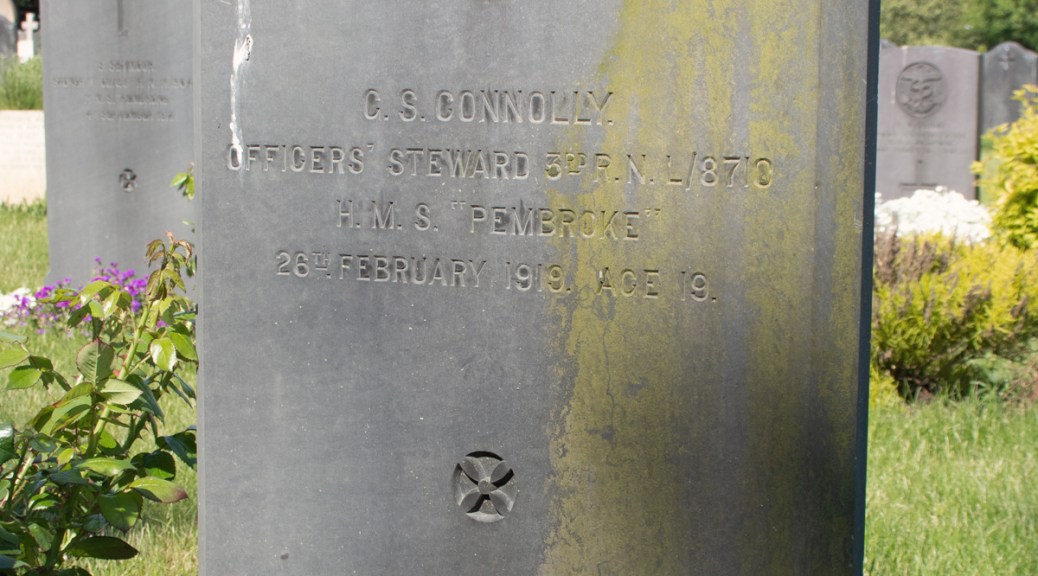
Officer’s Steward Gerald Connolly

Officer’s Steward Gerald Connolly

Gerald Sidney Connolly was born in the spring of 1899, one of eleven children to Thomas and Mary Connolly. Thomas was a retired soldier who had been born in Malta, while Mary had come from Portsmouth. The couple had lived in India for a while, but, by the time Gerald was born, had settled in Kildare, Ireland.

Retirement from the armed forces left Thomas needing to financially support his family, and so they made the move to London in 1910. According to the following year’s census, the family had settled in Manor Park, to the east of the city, where Thomas was working as a storekeeper for a local hostelry.

Military service was obviously in young Gerald’s blood and, in April 1916, he gave up work as an errand boy for a life in the Royal Navy. Initially taken on as a servant boy at HMS Pembroke and HMS President – the shore-based establishments in Chatham, Kent – he subsequently served on HMS Shannon, a cruiser that patrolled the North Sea for German warships.

It was while he was aboard the Shannon that Gerald came of age, and was given the rank of Officer’s Steward (3rd Class). During the next few years, he served short periods on five further vessels, before returning to HMS Pembroke in December 1918.

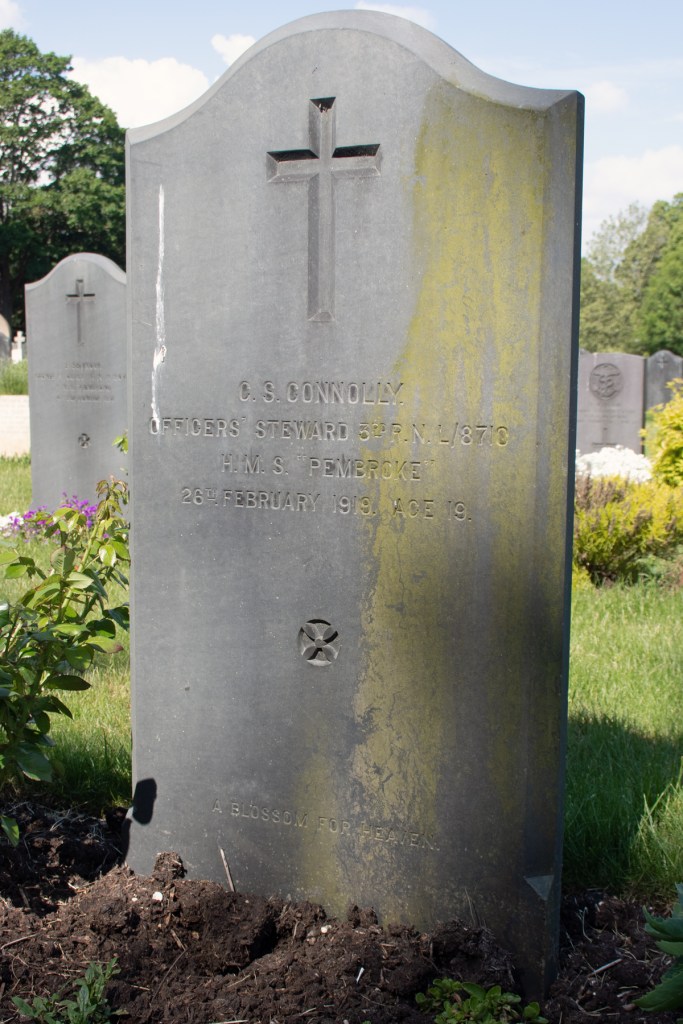
Officer’s Steward Connolly was still serving in Chatham two months later, and he kept himself active. It was while he was making use of the barracks’ swimming baths that an accident befell him. His service record confirmed that he was found drowned in the baths on 26th February 1919 and a subsequent inquest identified that no foul play was to blame. Gerald had ‘accidentally drowned whilst bathing’. He was just 19 years of age.

Gerald Sidney Connolly’s body was laid to rest in the Woodlands Cemetery in Gillingham, Kent, not far from the Naval Dockyard where he was based.


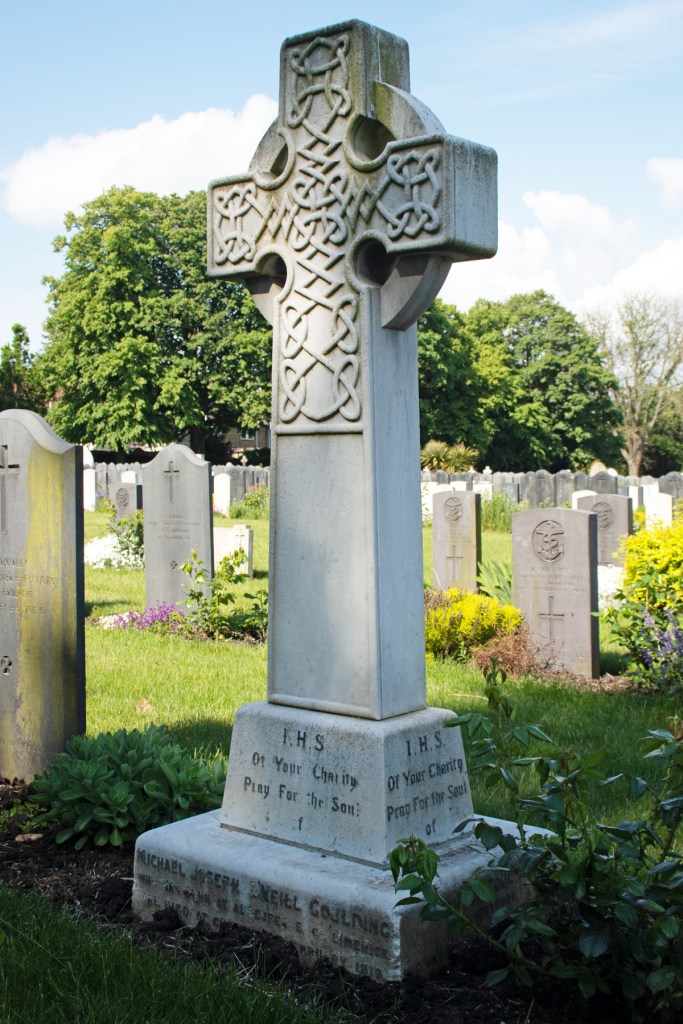
Able Seaman Michael Goulding

Able Seaman Michael Goulding

Michael Joseph O’Neill Goulding was born on 5th May 1884, the oldest of six children to Michael and Ellen Goulding (née O’Neill). Michael Sr worked for the inland revenue and his job took him around most parts of the British Isles.

Michael Jr had been born in Limerick – both of his parents came from Ireland – but his subsequent three siblings (Patrick, Margaret and William) had all been born in Scotland. His second youngest sibling, Lily, was born in County Durham, the youngest back in Scotland, while, by the time of the 1901 census, the whole family were living in Forest Gate, East London.

The census also shows that Michael Jr, having left school, was working at Customs House (presumably where his father was employed), as a boy copyist on tea accounts. The inland revenue at that time was a career for life; by the next census in 1911, the family had moved to Hertford, where Michael Sr was a customs and excise supervisor, and Michael Jr was an assistant clerk at the same place of employment.

War was on its way, but Michael seems not to have enlisted immediately. While specific dates for his joining up are not available, it appears that he was still working for the Inland Revenue when he got married in Shoreditch, in April 1917. His wife was called Bridget Mary Gough (known as Bryde), and she had also been born in Ireland. The couple went on to have a daughter, Ellen (or Eileen), the following year.

By this time, Michael had definitely enlisted. He joined the Royal Naval Volunteer Reserve, and was based at HMS Pembroke, the shore-based establishment in Chatham, Kent. This was the location for the Navy’s main accounting base, so it is likely that he was employed for financial, rather than his military, skills.

Able Seaman Goulding served through to the end of the war and beyond, and it was while he was based in Kent that he became unwell. Admitted to the Royal Naval Hospital in Chatham, he succumbed to a combination of bronchitis and pneumonia on 22nd February 1919. He was 34 years of age.

Michael Joseph O’Neill Goulding was laid to rest in the Woodlands Cemetery in nearby Gillingham. His family were still in Hertford, while his widow and daughter moved back to Ireland.


Michael Joseph O’Neill Goulding
(courtesy of ancestry.co.uk)

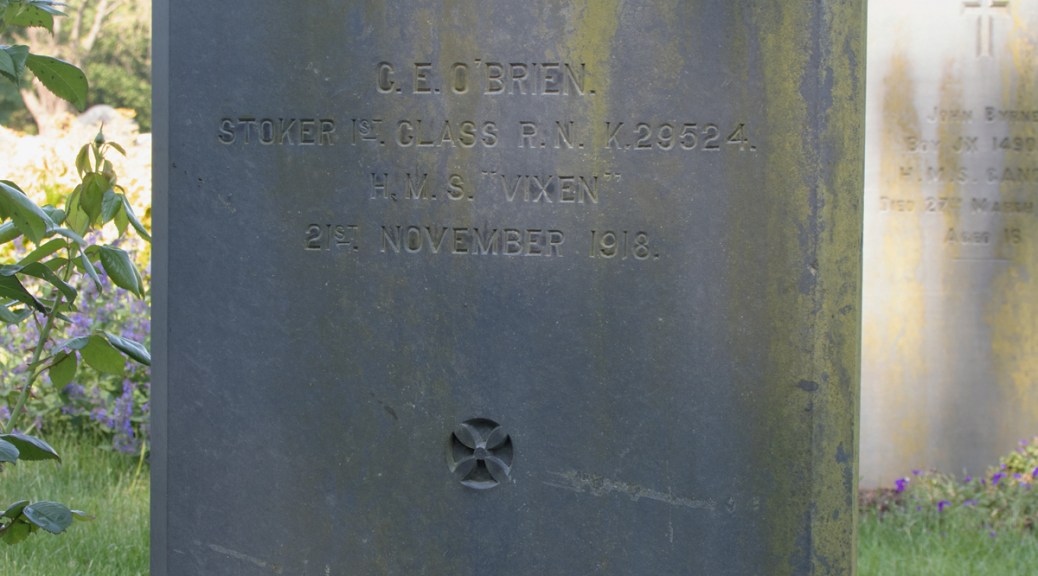
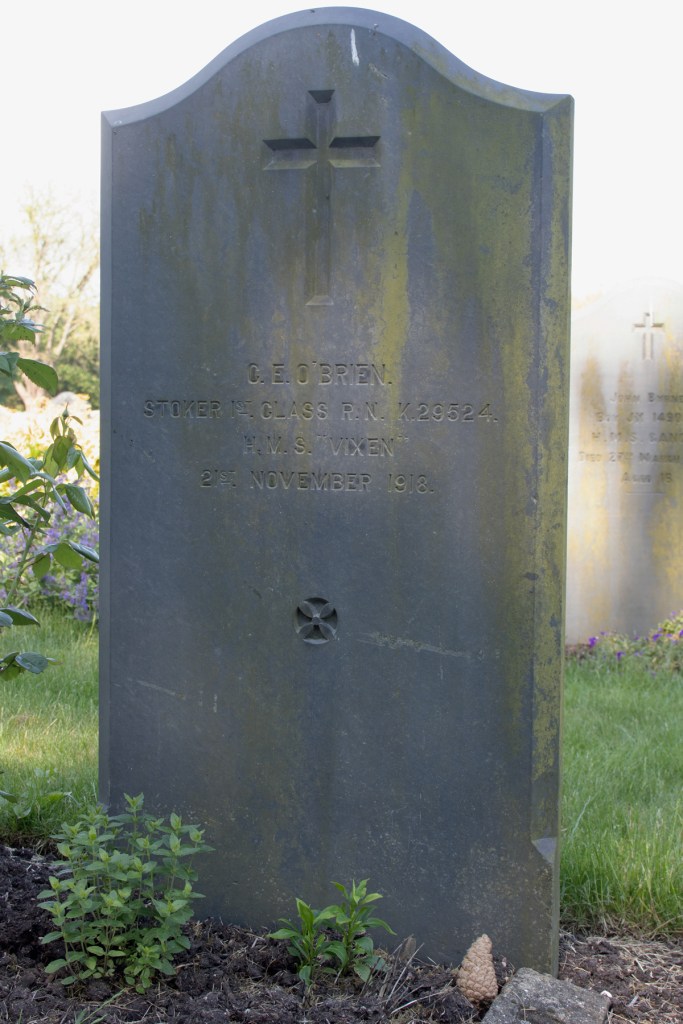
Stoker 1st Class Cornelius O’Brien

Stoker Cornelius O’Brien

Documentation on the early life of Cornelius Edward O’Brien is pretty scarce, so it is impossible to build a picture of him before the First World War. He was born in the late 1890s in Whitechapel, East London and was working as a carman when he received his enlistment papers.

Cornelius joined the Royal Navy as a stoker on 27th November 1915 and was sent to HMS Vivid II, the shore-based establishment in Devonport that served as the Stokers and Engine Room Artificers School. He trained there for a couple of months before being assigned to HMS Drake, where he spent most of 1916.

Returning to Devonport, Stoker O’Brien spent a further year on board HMS Vivid II, gaining the rank of Stoker 1st Class. By the end of 1917, however, he was back at sea, having been sent to HMS Vixen, a naval destroyer that served in the Thames Estuary, performing anti-submarine patrols and counter mining operations there.

In mid-November 1918, with the war officially over, Cornelius was admitted to the Royal Naval Hospital in Chatham, suffering from influenza, pneumonia and pleurisy. Sadly these were to prove too much of a challenge for him and he passed away on 21st November 1918.

Cornelius Edward O’Brien was laid to rest in the Woodlands Cemetery in Gillingham, not far from the Naval Dockyard in Chatham.


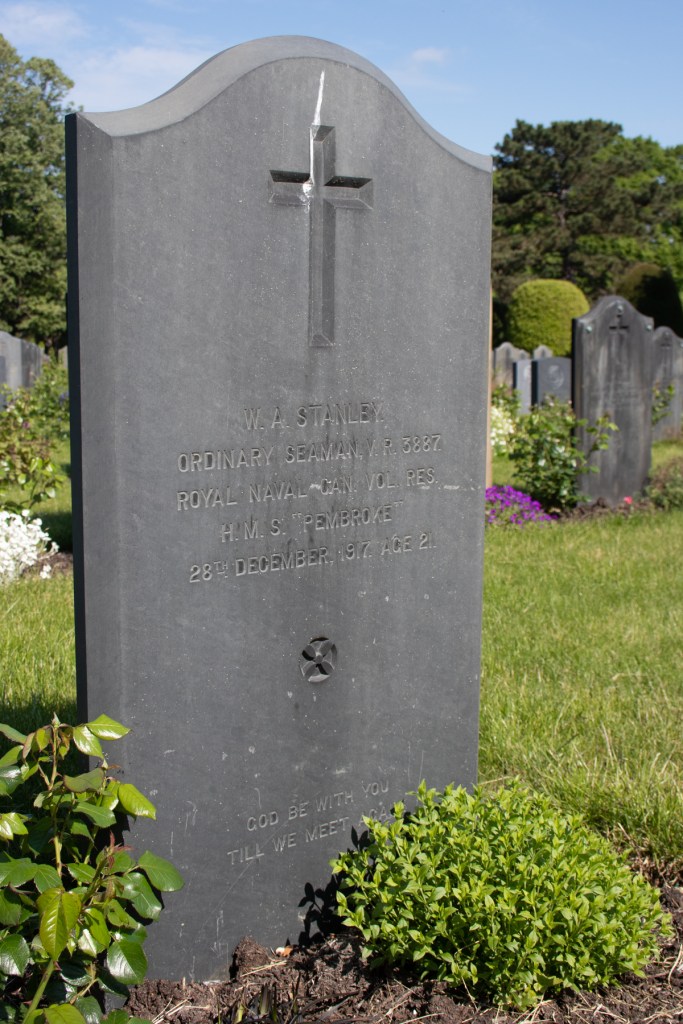
Ordinary Seaman William Stanley

Ordinary Seaman William Stanley

William Alfred Stanley is one of those names that seems destined to be lost to the annuls of time. Little documentation exists for his early life, but what there is gives some hints at a determined young man.

William was born in London to an Annie Stanley, who lived in the Kentish Town area of the city. At some point, he emigrated to Canada as, according to his wartime enlistment papers, he joined up in Ontario.

William enlisted in the Canadian Expeditionary Force on 5th November 1915, and was initially assigned to the 44th Battalion of the Canadian Infantry. His troop embarked for England in July 1916, and, on his arrival he was transferred to the 98th Battalion.

It was at this point that things too an unusual turn. With a few months, Private Stanley was again transferred, this time to the 19th Battalion, and then again to the 4th Reserve Battalion from where he was discharged from the Canadian Infantry in February 1917 for being underage.

At this point, William seems to have been undeterred.

The next record for him – in fact the memorial to him – is his headstone. This confirms that he had enlisted in the Royal Naval Canadian Voluntary Reserve as an Ordinary Seaman. He was based at HMS Pembroke, the shore establishment at Chatham Dockyard, but there is no other information for him.

Ordinary Seaman Stanley died on 28th December 1917, at the age of 21. (His previous military discharge might suggest that he was, in fact, younger than this, but that is conjecture on my part.) There is no record of a cause of death and nothing in contemporary newspapers to suggest anything out of the ordinary.

William Alfred Stanley was laid to rest in the Woodlands Cemetery in Gillingham, Kent, not far from the Naval Dockyard where he had been based.


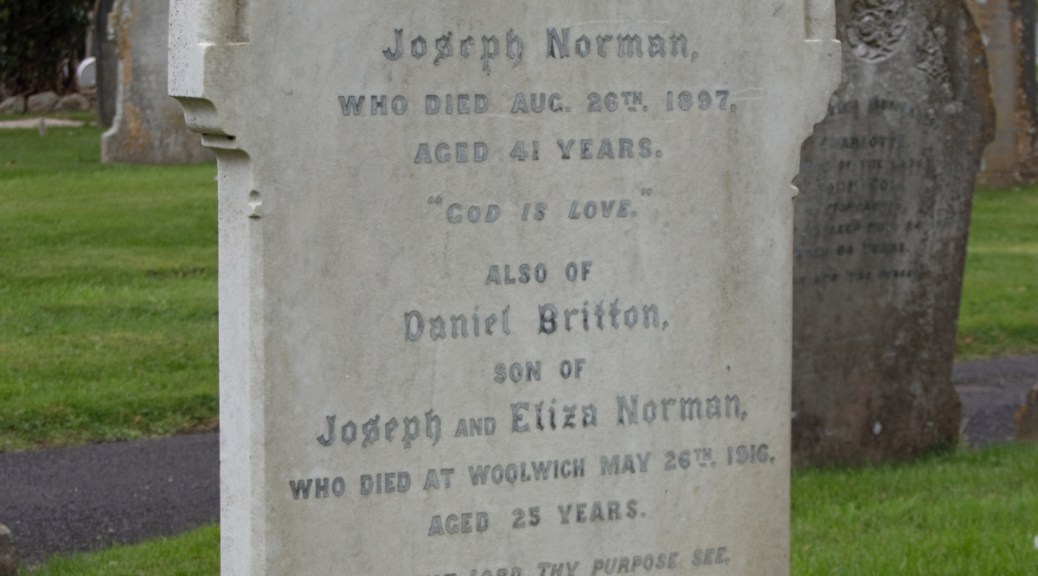
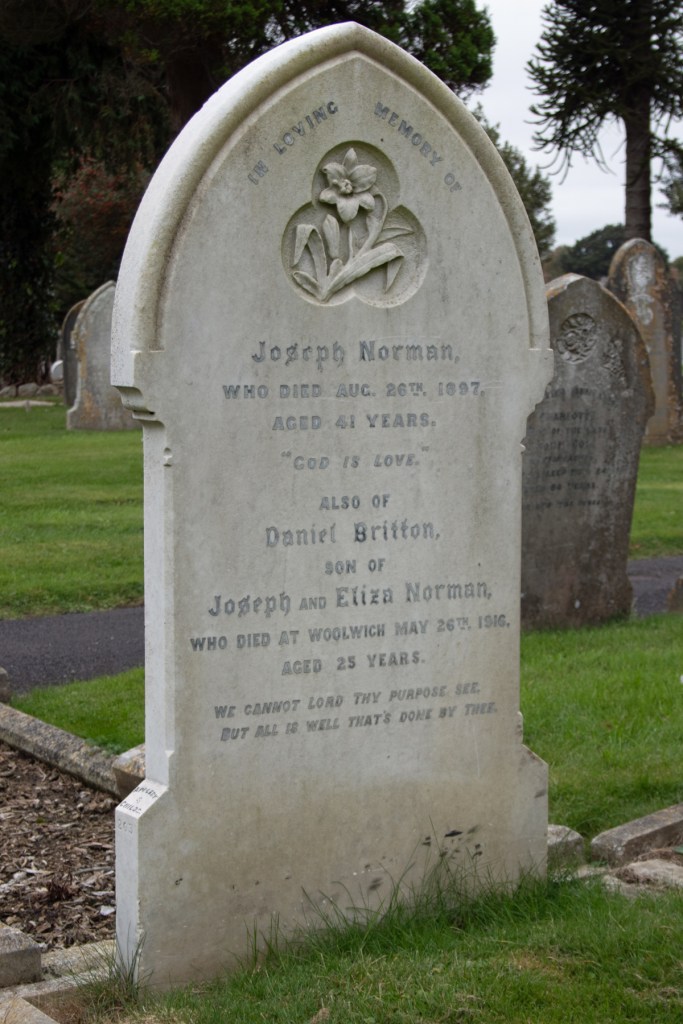
Private Daniel Norman

Private Daniel Norman

Daniel Britton Norman was born in Yeovil, Somerset, in early 1891, the youngest of four children. Joseph and Eliza Norman, Daniel’s parents, ran the Blue Ball Inn in the town centre, something Eliza took over when her husband died.

There is little information on Joseph’s passing, but a report in the local newspaper may allude to what led to his death:

On Friday [16th January 1891], Mr J Norman, of the Blue Ball Inn, was riding in a waggon through the Borough when he was jerked off onto the road. One of the wheels passed over his right leg, breaking a vein.

Western Chronicle: Friday 23rd January 1891

By the time of the 1911 census, Eliza too had given up the reins of the Blue Ball Inn. At the age of 59, she was living with her two sons in a house on the outskirts of the town; Daniel was listed as a motor mechanic, while his older brother Rowland was a cabinet maker.

War broke out and Daniel enlisted in April 1916. He joined the Royal Army Service Corps and was assigned to the Motor Transport Division. Based in London, Private Norman had received three weeks’ training, when he was taken ill.

Admitted to the Royal Herbert Hospital in Woolwich with cerebro-spinal meningitis, Private Norman quickly went downhill. He died in the hospital on 26th May 1916, aged just 26 years old.

Brought back to Yeovil, Daniel Britton Norman was buried in Yeovil Cemetery, alongside his father.


Private James Plympton

Private James Plympton

James Plympton was born in the spring of 1875, one of four children to Richard and Mary Plympton from Yeovil, Somerset. They raised the family in a cottage to the south of the town centre, where Richard was a labourer and Mary a glover. When they left school, James and his two brothers followed in their father’s footsteps, finding labouring work in the local area.

In the summer of 1899, when James was 24, he married Elizabeth Maria Holt, an agricultural labourer’s daughter from the village of Misterton, near Crewkerne. The couple would go on to have six children, but, according to the 1901 census, they had set up home near the centre of Yeovil, with their first born, Dorothy, and James’ recently widowed mother.

Mary, at 69, was no longer working, and so Elizabeth found employment as a cloth ripper – presumably for the local glove industry – earning a little extra money to support James’ labouring work. This was a job that he continued to do: the 1911 census found James and Elizabeth living in a five-roomed cottage in Yeovil; Mary had by this time passed away, as had young Dorothy, but the couple were surrounded by their other five children, Elizabeth looking after them and James working as a jobbing mason.

By now war was imminent, and James enlisted to play his part. While full details of his service are no longer available, it is evident that he had joined up by the summer of 1915. He was a Private in the Somerset Light Infantry and was assigned to the 7th (Service) Battalion. He was shipped to France on 24th July 1915, and, for his service, was awarded the 1915 Star and the British and Victory Medals.

Private Plympton returned from France at the start of 1916; he was suffering from nephritis – inflamed kidneys – and was admitted to St Bartholomew’s Hospital in London. Sadly, it seems that his treatment came too late; he passed away on 31st January 1916, at the age of 41.

James’ body was brought back to his home town; he was laid to rest in Yeovil Cemetery.


A local newspaper, the Western Chronicle, reported on James’ funeral; interestingly it gave his rank as Sergeant, although none of the official military documentation corroborates this.