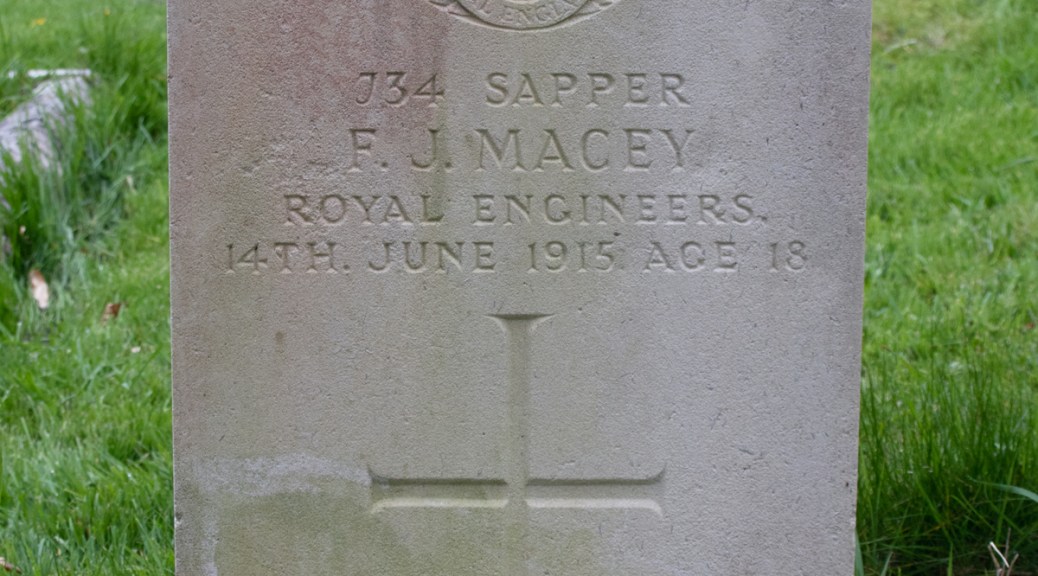
Frederick John Macey was born in the spring of 1897, the fourth of five children to James and Rose. James was a labourer from Hampshire, Rose was born in Ireland, but the children were born and raised in Monkton Combe, Somerset.
When war broke out, Fred stepped up to play his part. He enlisted in the Royal Engineers, and was assigned to the 503rd Field Company. Full details of his military service are lost to time, so it is not possible to identify whether Sapper Macey served overseas – Malta, where part of the regiment were based – or on home soil – in and around Ipswich, Suffolk.
Wherever he was based, Fred was injured, and he was sent to a military hospital in Guildford, Surrey, for treatment. Sadly, his wounds were to prove too severe, and he passed away on 14th June 1915, aged just 18 years old.
Frederick John Macey’s body was brought back to Somerset for burial. He was laid to rest in the peaceful graveyard of St Michael’s Church, in his home village of Monkton Combe.
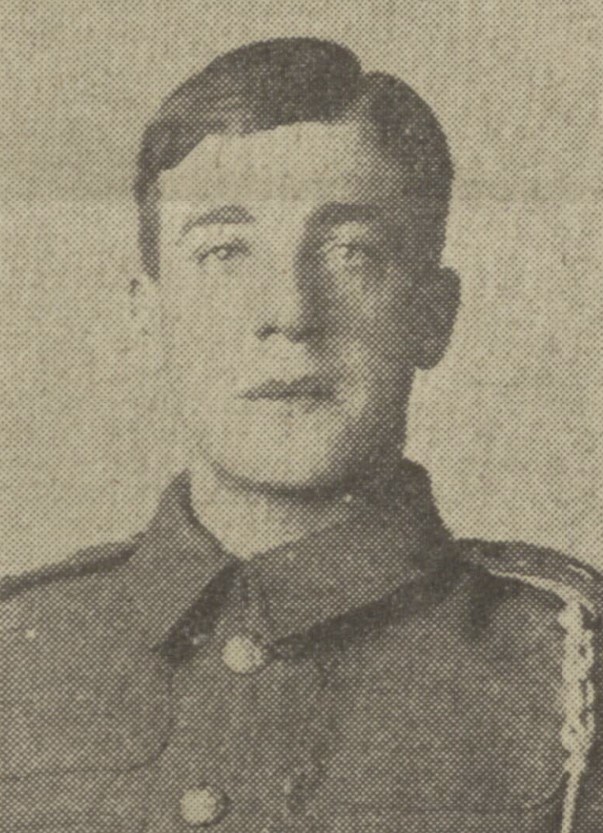
Sapper John Macey (from britishnewpaperarchive.co.uk)
Albert Edward Ferris was born in the spring of 1884, one of six children to Charles and Juliana. Charles was quarryman turned farm labourer from Gloucestershire, but it was in the village of Claverton, near Bath, that the family were born and raised.
When he finished his schooling, Albert found work as a baker, but soon sought out a career in the military. On 2nd January 1903 he enlisted in the Royal Marine Light Infantry as a Private. His services records show that he was 5ft 6ins (1.68m) tall, with brown hair, blue eyes and a fair complexion.
Based out of Plymouth, over the next nine years Private Ferris served on four different ships and was recognised as having a very good character and an ability to match.
In 1910, Albert married Eliza Jane Warren, a mason’s daughter from Monkton Combe. The 1911 census found Albert on board the armoured cruiser HMS Cumberland, while Eliza was living with her parents. Military life was taking a toll on married life and, on 6th December 1911 bought an end to his naval career and was ‘discharged by purchase’.
Returning to Somerset, Albert found employment as a motor-man with Bath Electric Tramways. He and Eliza settled into married life, but war was on the horizon and things were to change.
At the outbreak of war, [Albert] promptly responded to his country’s call, and enlisted in the [Somerset Light Infantry], as a Private. When his battalion was sent to France, he distinguished himself in a short time by his excellent work as a sniper, speedily earning his first stripes as a consequence. With his battalion he participated in the heavy fighting around the Ypres district, over an extended period, without sustaining any serious injury. Later his battalion was moved further down the line to take part in the “Great Push,” where, for meritorious conduct, he was… promoted to Sergeant in the field…
Bath Chronicle and Weekly Gazette: Saturday 7th October 1916
Sergeant Ferris’ luck was not to last, however, and things took a turn in September 1916.
In the… fighting around Delville Wood… Sergt, Ferris was severely wounded in the right thigh by a machine-gun bullet. One of his officers gave him the best first-aid treatment possible under the circumstances, and later he crawled nearly three miles in an endeavour to reach the nearest field dressing station. Through loss of blood, shock, and general exhaustion he was on the point of collapse when picked up by a field ambulance, after which he was transferred to the base and later to Tooting Military Hospital, where, despite skilled treatment and the greatest care, septic poisoning intervened and he passed away…
Bath Chronicle and Weekly Gazette: Saturday 7th October 1916
Sergeant Ferris died while admitted in the Surrey hospital on 4th October 1916. He was just 32 years of age.
The body of Albert Edward Ferris was brought back to Somerset for burial. He was laid to rest in the peaceful graveyard of St Michael’s Church, Monkton Combe.
Albert Edward Taylor was born in the autumn of 1887 and was the fifth of eight children to John and Mary Taylor. John was a mason and both he and Mary came from Crewkerne, Somerset, which is where they raised their family.
Albert worked as an errand boy when he left school, but he sought a career and, enlisted in the Army Service Corps in July 1904. He lied about his age to join up, suggesting he was nearly 22, where he was actually just 17 years of age.
Driver Taylor’s service records confirm that he was 5ft 3ins (1.6m) tall and weighed 115lbs (52.2kg). He was noted as having brown hair, blue eyes and a fresh complexion. He had a mole between his shoulder and the back of his neck, and his religion was recorded as Baptist.
Albert’s contract was for two years’ service, followed by ten years in the Army Reserve. While a military career was what he sought, he seems to have had a disregard for rules, and regularly had run ins with authority, as his Regimental Defaulter Sheet testifies.
On 19th December 1904, while based in Woolwich, Surrey, he was absent without a pass from 6am until 12:15am on 30th December. He was confined to barracks for eight days.
The following year, Driver Taylor had moved to Bordon in Hampshire. On 28th November 1905, he was absent without a pass, from midnight until 8:30am on 1st December. He was again confined to barracks, this time for ten days.
A third offence came on 29th May 1906, by which time Albert had moved to Aldershot, Hampshire. He was found in neglect of duty ‘in allowing dirty pudding cloths to be deposited in the cupboards of the cookhouse’ and being ‘absent from work from 1:30pm till found in his barrack room at 9:20pm.’ For these, he was confined to barracks again, this time for eight days.
Within a matter of weeks, he was found in neglect of duty again, having broken out ‘of barracks after tattoo and remaining absent till apprehended by the Military Police at about 10:50pm’ and being ‘drunk and improperly dressed.’ This time the punishment was more severe and he was detained in prison for 96 hours.
Unsurprisingly, Albert’s military career didn’t go much further than this. When his two-year contract came to an end, he returned to Somerset and found employment as a mason.
In July 1910, Albert married Mabel Wallbridge, the daughter of a carman, also from Crewkerne. The couple set up home on the outskirts of the town, and went on to have a son, Frederick, who was born later that year.
The 1911 census found the young family living in a cottage in Lye Water, with Albert listing himself as a ‘mason (army pensioner)’. While the military reference may have been added with a sense of pride, irony or bloody mindedness, Albert was not to fully leave his army career behind. When war came to Europe in 1914, he was still within his reserve status, and was called up to play his part.
Private Taylor was to leave his family behind: son Frederick had now been joined by daughters Kathleen and Joyce, and Mabel pregnant with another daughter, Rosaline, who was born in January 1915. Albert was assigned to the 1st Battalion of the Somerset Light Infantry and, in contrast to his previous tenure on the Home Front, he soon found himself in the thick of things.
Albert’s regiment was involved in some of the fiercest opening skirmishes of the First World War, and he would have been caught up on the Battles of Le Cateau, the Marne, the Aisne and Armentières. By the spring of 1915, the battalion was entrenched at Ypres, and it was here during the Battle of St. Julien that Private Taylor was injured.
Albert has received a gun shot wound to the left side of his skull and was medically evacuated to Britain for treatment. He was admitted to the Beechfield House Hospital in Southampton, but his wounds proved too severe, and he passed away on 14th May 1915, at the age of 27 years old.
The funeral of Private Albert Edward Taylor, of the Somerset Light Infantry… who died from wounds received at the Front, took place with military honours at the Cemetery [in Crewkerne] on Tuesday afternoon, and attracted a large attendance. As a mark of respect to the memory of the deceased soldier blinds were drawn at the private and business houses en route to the Cemetery, while the flag erected outside the Victoria Hall for the children’s Empire-day celebration was lowered to half-mast.
Rev. J Street (Unitarian Minister)… spoke of the painful circumstances and the heroic conduct of the deceased, who had sacrificed his life for others. Although death was attended with pain and sorrow, yet in after years deceased’s children would look back with pride to the part their father took in the present war.
Taunton Courier and Western Advertiser: Wednesday 26th May 1915
Albert Edward Taylor was laid to rest in the cemetery of his home town, Crewkerne.
Private Albert Taylor (from findagrave.com)
Albert’s headstone gives his initials as AC Taylor. They should be AE Taylor.
George Robert Hutchings was born towards the end of 1883 in Forest Gate, Essex. He was the oldest of four children to George and Mary Ann Hutchings. George Sr was a labourer for the railways, and this led to the family relocating to Swindon, Wiltshire, in the 1890s.
George Jr took up work with the Great Western Railway when he left school, while his father switched employment and, by the time of the 1911 census, he was working as a collector for a clothing supply company.
On 13th July 1911, George Jr married Daisy Smale in the Sanford Street Congregational Church, Swindon. Daisy was a school teacher, and was the daughter of an iron moulder. It is likely that the couple met through George’s workplace. The newlyweds had a son, Raymond, who was born in 1914 and, at some point moved to Bath in Somerset.
When war came to Europe, George stepped up to play his part. He enlisted in the Royal Army Service Corps and, unsurprisingly, given the work he was doing, was assigned to the Mechanical Transport division. Little information about his military service remains, but is it clear that he had enlisted in the second half of 1915.
The next available record for Private Hutchings is that of his passing. He had been admitted to the Royal Herbert Hospital in Woolwich, South East London, and died there on 15th December 1915. No cause for his death is evident, but he was 32 years of age.
George Robert Hutchings was brought back to Somerset for burial. He was laid to rest in Bath’s St James Cemetery.
When her husband died, Daisy was pregnant. In March 1916 she gave birth to a daughter, Winifred, who was never to know her father.
Daisy never remarried. By the time of the 1939 register, she was living in Northampton Street, Bath, sharing the house with a Mr and Mrs Spreadbury. Her employment was listed as unpaid domestic duties.
Daisy and George’s son Raymond was focused on his education. He made an eventual move to Birmingham, where, at the outbreak of war, he was working as a research chemist. He died in Bath in 1982, at the age of 68.
Winifred married grocer Kenneth Batten in Bath in 1938. The couple had three children and emigrated to Australia after the war, and settled in Coffs Harbour, New South Wales. Kenneth died in 1988, at the age of 72; Winifred died in 2003, aged 87.
Gilbert Harold Earle Rippon was born in Paddington, London, in the spring of 1887. The third of seven children, his parents were coal merchant Frederick Rippon and his wife, Eugenie.
When Gilbert left school, he found work as a clerk for a building firm. He was an ambitious young man, however, and, after his mother died in 1903 and his father a few years later, he took on work at a rubber plantation in Jementah, Malaysia.
When war broke out, “he came home on six months’ leave in order to enlist, having an exciting voyage owing to the activities of submarines. He was refused at first owing to a slight physical defect, but after an operation learnt to fly and was given a commission in the Royal Flying Corps.” [Somerset Guardian and Radstock Observer: Friday 9th June 1916]
Second Lieutenant Rippon gained his wings at Brooklands in Surrey on 16th January 1916. By the summer he was attached to a flying school in Gosport, Hampshire, and this is where he was based by the early summer of 1916.
On 7th June, Gilbert was flying a de Havilland DH2 aircraft, when an accident occurred. According to a newspaper report: “Evidence showed that the machine, when 300 feet [91m] up, made a double turn, as though the aviator was trying to return. It then slipped and made a nose-dive to the ground, killing the pilot instantaneously. He had only been in the air three minutes. The previous evening the same monoplane had ascended 14,000 ft [4267m].” [Somerset Guardian and Radstock Observer: Friday 9th June 1916]
Second Lieutenant Rippon was 29 years of age. The same report confirmed that he was the older brother of two Bath and Somerset cricketers – twins Dudley and Sydney Rippon – and that his oldest brother, New York-based Secretary of the Board of Correction Frank Rippon, “had the unhappy experience of being in the aerodrome when the accident occurred, and saw his brother fall to the ground.”
Gilbert Harold Earle Rippon was laid to rest in the family plot St James Cemetery, Bath, Somerset. There seems to have been a family connection with the city: this is where both Frederick and Eugenie were buried, and where, after their parents’ deaths, the twins and the youngest Rippon son, Percy, were taken to live.
William John Mells was born in Southwark, Surrey, on 13th November 1873. His parents were Thomas and Elizabeth Mells, although much of his early life is lost to time.
The 1891 census found the 19-year-old William as one of four boarders living with the Skinner family in Peckham, Surrey, where he was working as a shoe maker. By the turn of the century, however, he had changes jobs, and was employed as an advertising contractor, possibly fixing signs to walls across the country.
It was while William was working in Somerset when he met Ethel Pryor. She was the daughter of a caterer, born and bred in Somerset. On 16th August 1903, the couple married at Ethel’s parish church in Bath. They set up home in a small cottage on King Edward Road in the city, and went on to have two children, Edith, who was born in 1904, and John, who was born the following year.
Storm clouds were brewing across Europe at this point, and William was called upon to play his part in the autumn of 1918. He had previously served as part of the Army Service Corps Volunteers, and had reached the rank of Lance Corporal. When his time to actively serve King and Country came, however, he chose the fledgling Royal Air Force and, on 24th October 1918, joined them as an Air Mechanic 3rd Class.
William was sent to Blandford Forum, Dorset, for training. While here, in packed and busy billets, he contracted influenza, which developed into pneumonia. He passed away from the conditions at the camp hospital on 3rd November 1918, ten days short of his 45th birthday, eight days before the end of the conflict and after just ten days’ service.
William John Mells’ body was brought back to Somerset for burial. He was laid to rest in the city’s St James’ Cemetery, and was joined by his widow, when she passed away in 1955.
The Commonwealth War Graves Commission headstone and website gives Air Mechanic Mells’ name as John William, but all other records – including censuses, marriage document and service records – confirm his name as William John Mells.
John Wallace Carthew was born in Warminster, Wiltshire, in the spring of 1892. The second youngest of seven children – three of whom did not survive childhood – his parents were miller James Carthew and his tailoress wife, Sarah.
John was destined to make a path for himself. By the time of the 1911 census, he was boarding with the Southon family in Aldershot, and working as a chauffeur.
On 22nd March 1914, John married Caroline Hamilton, a parlour maid for Captain Charles Woodroffe and his family in Aldershot. The couple set up home in Queensgate Mews, London, and having had a daughter, Cecilia, who was born that February.
When war came to Europe, John was quick to enlist. He joined up on the 21st December 1914, and was assigned to the Mechanical Transport section of the Royal Army Service Corps. His service records note that he was 6ft 1in (1.85m) tall, with a scar on his right eyebrow.
Private Carthew rose through the ranks, becoming a Corporal in 1916, and a Serjeant in 1918. During this time he acted almost exclusively as chauffeur to General Sir William Robertson. His duties were mainly based on home soil, but he did spend a year in France, while Robertson was Chief of the General Staff there.
As the war came to a close, Serjeant Carthew fell ill. Based in a camp in Aldershot, he contracted influenza, and this developed into pneumonia. This was to take his life, and he passed away at the town’s Connaught Hospital on 25th November 1918. He was just 26 years of age.
Caroline was living in Bath, Somerset by this point, and this is where the body of her husband was brought for burial. John Wallace Carthew was laid to rest in St James’ Cemetery, in the family plot where his father, who had died in 1911, was also buried.
Arthur John French was born on 3rd September 1889 in the Somerset village of Merriott. He was the youngest of three children to John and Annie French. John was a miller and baker in the village, and Arthur’s older brother Edward helped his father with the business. Arthur, however, followed a different path and, with Annie passing away in 1903, he had moved to London for work.
The 1911 census recorded Arthur boarding with his maternal aunt and uncle, who were both schoolteachers. He had found employment as a clerk in the head office of the National Telephone Company and shared the large terraced house with the couple, their son Alfred and their servant, Esther.
When war was declared, Arthur was in the first wave of those enlisting. He joined the Oxford & Bucks Light Infantry and, as a Private, was assigned to the 2nd/4th Battalion. Initially sent to Northampton for training, his troop soon came south again and, by April 1915, was based just outside Chelmsford, Essex.
Tightly-packed barracks, housing men from across the country soon became hotbeds for illness and disease, and Private French was not to be immune. He contracted meningitis, and was admitted to the 3rd London General Hospital in Wandsworth for treatment. Sadly he was to succumb to the condition, and he breathed his last on 16th April 1915, at the age of just 25 years old.
Arthur John French’s body was brought back to Somerset for burial. He was laid to rest in the graveyard of All Saints’ Church in his home village, Merriott.
Henry James Tabor was born in 1877, the second of six children to James and Sarah Tabor. Wiltshire-born James was a carpenter and joiner by trade, and the family were raised in Sarah’s home town of Milborne Port, Somerset.
Henry followed in his father’s footsteps when he left school and, by the time of the 1901 census, both were carrying out their trade (along with younger brother, Sidney) from the family home in East Street.
James died in September 1915, at the age of 75, and shortly afterwards, his oldest son stepped up to play his part for King and Country. He enlisted in the spring of 1916, joining the Royal Engineers as a Sapper.
Little information about his military life remains documented, but, according to a later newspaper report, he went to France and fought at both Ypres and the Somme. It was while he was overseas that Sapper Tabor contracted bronchitis, which then developed into tuberculosis. He was medically evacuated to Britain for treatment, but passed away on 28th March 1917, having been admitted to the Military Hospital in Southwark. He was 40 years of age.
The body of Henry James Tabor was brought back to Somerset for burial. He was laid to rest in the family plot in the cemetery of his home town, Milborne Port.
The loss of her husband and oldest son in such a short space of time, may have proved too much for Sarah Tabor. She passed away just two months after Henry, and he was reunited with both parents once again.
William Stringer was born in Warlingham, Surrey, on 4th December 1885, and was one of nine children to Stephen and Jane Stringer. Stephen was a carter, but is seems that William wanted an escape.
On 18th April 1901, he enlisted in the Royal Navy and, because of his age, he was granted the rank of Boy 2nd Class. He was initially sent to HMS Impregnable, the school ship, and remained there for just over a year, during which his hard work paid off and he was promoted to Boy 1st Class.
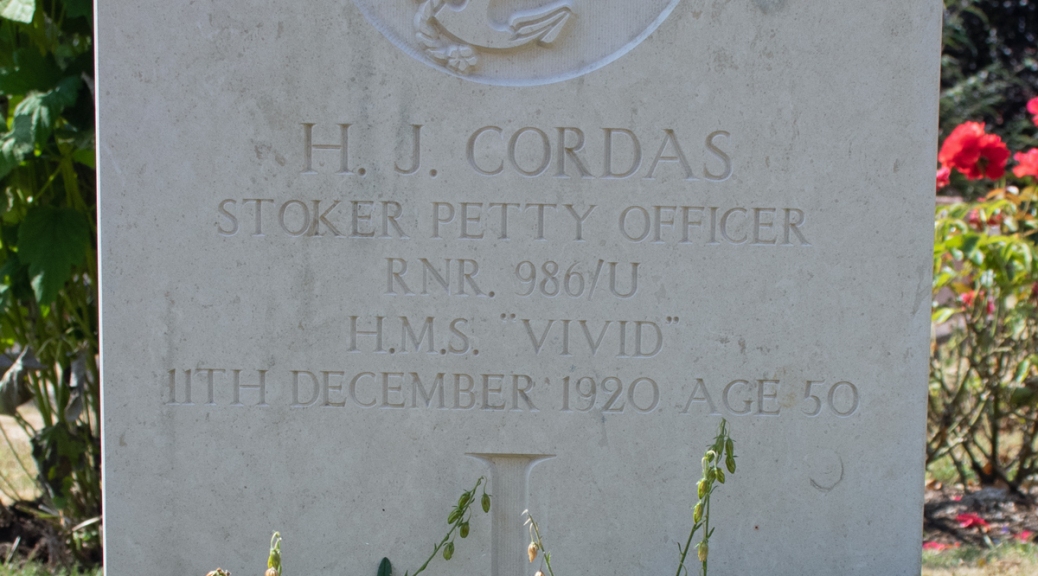
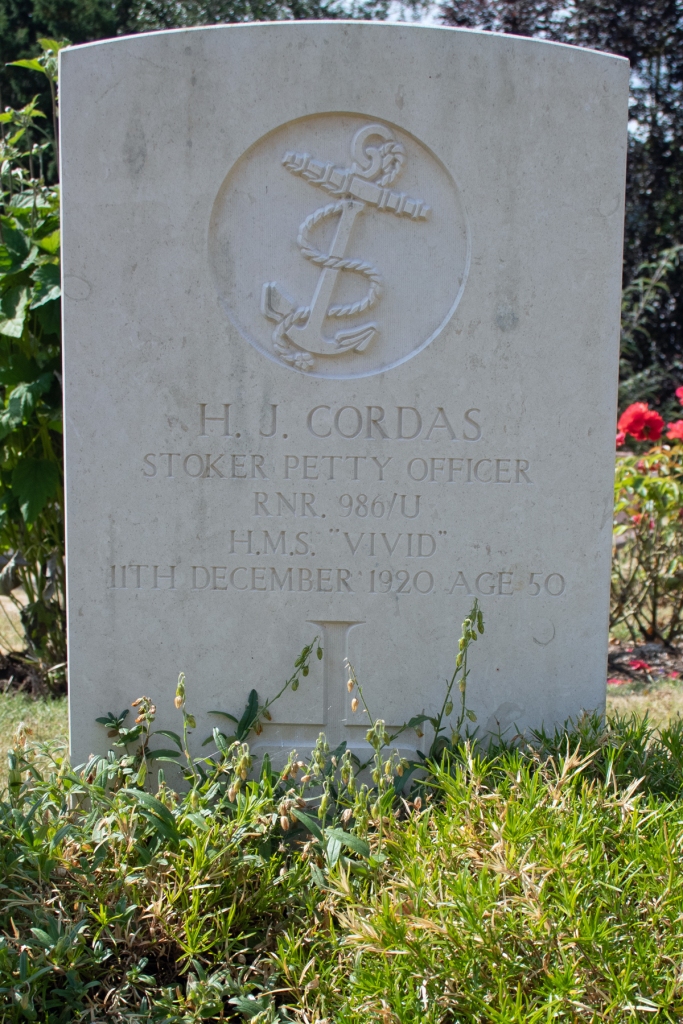
His basic training complete, and after a short stint at HMS Vivid, the Royal Naval Dockyard at Devonport, he was assigned to HMS Collingwood. Over the next couple of years, William served on a couple more vessels and, in 1903, when he came of age, he was formally inducted into the navy, and given the rank of Ordinary Seaman.
William’s service records show that he was 5ft 4ins (1.63m) tall, had auburn hair, brown eyes and a fresh complexion. For distinguishing marks, he was noted as having two dots on his left forearm and scars on his legs.
Now that he was tied to a twelve year contract, Ordinary Seaman Stringer’s seems to have viewed his life in a different light. His ‘very good’ conduct quickly changed to ‘fair’ and, at the end of 1904, he spent two separate stints in the cells, presumably because of his attitude or behaviour.
This shock to the system seems to have been what William needed, however, as in 1905, he took to the new role, and his ratings improved once more. Over the next couple of years, he served on HMS Montagu and HMS Diamond, returning to Devonport in between voyages. In January 1907 he was promoted again, this time to Able Seaman, but, as with the previous promotion, things began to go downhill again.
In March, he spent two weeks in Diamond’s brig, a punishment that was repeated in September. The following month Able Seaman Stringer’s service records not his character as ‘indifferent’ and, the following month he was discharged from the Royal Navy, having refused to work for 42 days.
It was while he was serving on board HMS Diamond that William met Lena Cropp, who was presumably working in one of the ports on the South Coast. She was the daughter of labourer Jesse Cropp and his wife, Philadelphia. When Jesse died in 1897, Philadelphia married bricklayer James Smith, who had boarded with the family for a number of years.
William and Lena had a son, Joseph, on Christmas Day 1907. Now removed from the Navy, William moved his young family back to Surrey, where he found work as a cowman, and Lena took in laundry to bring in an extra income. The couple went on to marry in 1911, and went on to have two further children – Elsie, who was born in 1912, but who died when just a toddler; and Gladys, who was born in the summer of 1918.
When war closed in on Europe, something of a sense of duty must have pulled on William. He enlisted in the summer of 1915, joining the East Surrey Regiment. He seems to have quickly transferred across to the Labour Corps, and arrived in France on 15th July.
It is unclear for how long Private Stringer served in France, but at some point he returned to Britain. In October 1918, he was admitted to the War Hospital in Bath, suffering from stomach problems. His health was to prove his undoing, and he passed away from a biliary calculi peritonitis on 8th October 1918, at the age of 34 years of age.
Finances may have been tight for Lena, as William was buried in the city where he died, rather than being brought back to Surrey, where she was living. Because of this, it is unlikely that he ever met his daughter, who had been born just two months before.
William Stringer was laid to rest in the Roman Catholic Cemetery in Bath.
William’s Pension Ledger notes Lena as his widow, but only mentions one child – Joseph – as a dependent. The document also records him as an illegitimate stepchild, as he had been born a couple of years before the couple married.
The record notes that it, while Joseph’s legitimacy meant he was not eligible for a share of his William’s pension, it had been decided that the basic rate should be provided while he remained in Lena’s care.