Joseph Shore Chivers was born in the summer of 1889 in Walcot, Bath, Somerset. He was the youngest of seven children to William and Jane Chivers. William was a blacksmith and, after he and Jane died within nine months of each other in 1904/05, Joseph went to live with his brother, Edward, remaining there with his sister-in-law when his sibling also died in 1910.
Joseph had found work as a French polisher and cabinet maker by this point and this is what he was doing when he married local woman Ellen West in on 11th September 1915.
War was on the horizon by this point and Joseph was soon called on to serve his country. On 26th July 1916 he enlisted in the Royal Flying Corps, as an Air Mechanic 2nd Class. His service records give little away, but do confirm that he was 5ft 8ins (1.73m) tall.
Joseph was dedicated to his role and, on 1st January 1918, was promoted to Air Mechanic 1st Class. Three months later, when the Royal Flying Corps and Royal Naval Air Service combined to become the Royal Air Force, Joseph made the transfer across.
In August, Air Mechanic Chivers moved to RAF Bracebridge, to the south of Lincoln, where he remained until the end of the war and beyond. He was attached to 120 Squadron, which delivered mail and communications to the troops overseas. Little additional information is available about his life there, other than his admission to the 4th Northern Hospital in April 1919, through causes unknown.
Whatever the cause of his need to be admitted, he was to succumb to it. Air Mechanic Chivers passed away on 1st May 1919, at the age of 29 years old.
Joseph Shore Chivers’ body was brought back to Somerset for burial. He was laid to rest in St James’ Cemetery, in his home city of Bath.
William John Mells was born in Southwark, Surrey, on 13th November 1873. His parents were Thomas and Elizabeth Mells, although much of his early life is lost to time.
The 1891 census found the 19-year-old William as one of four boarders living with the Skinner family in Peckham, Surrey, where he was working as a shoe maker. By the turn of the century, however, he had changes jobs, and was employed as an advertising contractor, possibly fixing signs to walls across the country.
It was while William was working in Somerset when he met Ethel Pryor. She was the daughter of a caterer, born and bred in Somerset. On 16th August 1903, the couple married at Ethel’s parish church in Bath. They set up home in a small cottage on King Edward Road in the city, and went on to have two children, Edith, who was born in 1904, and John, who was born the following year.
Storm clouds were brewing across Europe at this point, and William was called upon to play his part in the autumn of 1918. He had previously served as part of the Army Service Corps Volunteers, and had reached the rank of Lance Corporal. When his time to actively serve King and Country came, however, he chose the fledgling Royal Air Force and, on 24th October 1918, joined them as an Air Mechanic 3rd Class.
William was sent to Blandford Forum, Dorset, for training. While here, in packed and busy billets, he contracted influenza, which developed into pneumonia. He passed away from the conditions at the camp hospital on 3rd November 1918, ten days short of his 45th birthday, eight days before the end of the conflict and after just ten days’ service.
William John Mells’ body was brought back to Somerset for burial. He was laid to rest in the city’s St James’ Cemetery, and was joined by his widow, when she passed away in 1955.
The Commonwealth War Graves Commission headstone and website gives Air Mechanic Mells’ name as John William, but all other records – including censuses, marriage document and service records – confirm his name as William John Mells.
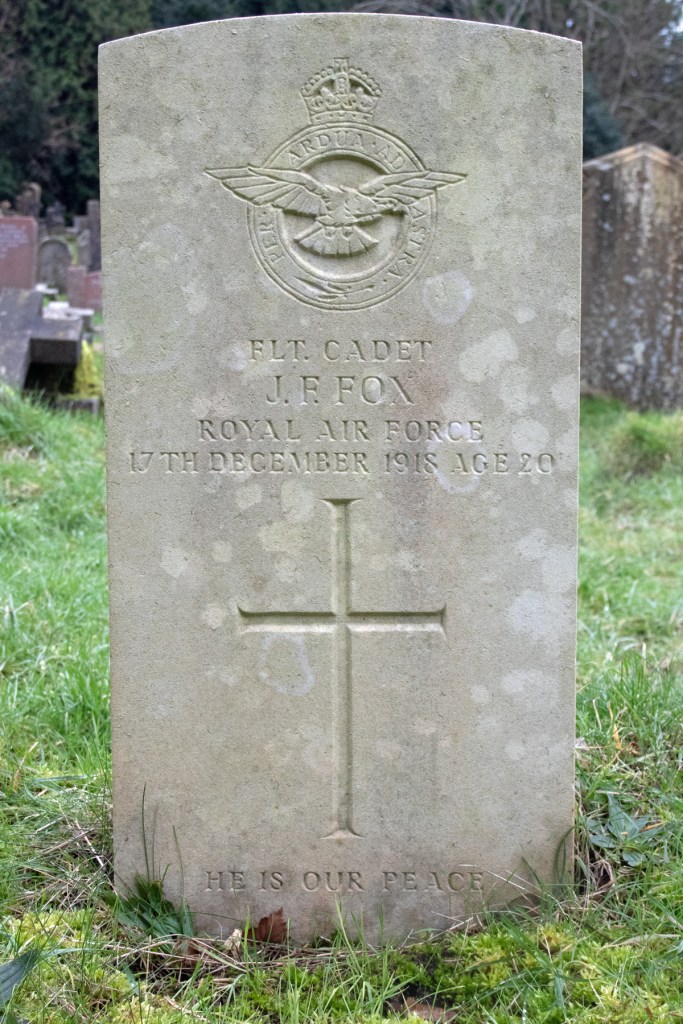
John Francis Fox was born early in 1898 in the village of Alkerton, Oxfordshire. One of eight children, he was the only son to miller-turned-butcher George Fox, and his wife, Ann. The family remained in Oxfordshire until at least the outbreak of war, when George and Ann appeared to have moved to Somerset.
When John left school, he took up an apprenticeship at Stothert & Pitt’s engineering works in Bath and in May 1918, with the First World War entering its last few bloody months, he was finally old enough to enlist. He joined the Royal Air Force as a Flight Cadet and was based at the 13th Training Depot Station near Market Drayton, Shropshire.
On 21st December 1918, Flight Cadet Fox was undertaking his first solo flight, on board an Avro 504K. His aircraft collided with another, which was piloted by a Captain Edgar Beamer. Both were killed in the accident: John was just 20 years of age.
An inquest into the crash, which also involved a third man, Captain Harrison, who was a passenger in Beamer’s plane, returned verdicts of accidental death.
John Francis Fox’s body was brought back to Somerset for burial. He was laid to rest in the graveyard of St Mary the Virgin’s Church, Bath.
Cyril Talbot Burney Croft was born on 28th January 1891 in Streetsville, Ontario, Canada. He was the only child of Dorset clergyman Otho Croft and his Canadian-born wife, Lucy.
Otho brought his young family back to England when Cyril was a boy. The 1901 census found him and Lucy living in South Cadbury, Somerset, where he had taken the role of the local rector. Their young son, meanwhile, was boarding at a school in St Leonard’s in East Sussex.
Education was key to Cyril’s development. He was sent to King’s College in Taunton and St Boniface College in Warminster, and enlisted in the Officer’s Training Corps for three years.
During this time, he and Lucy had travelled back to Canada, and there was an obvious draw for the young man as, in 1913, he made a move to Quebec, becoming the Assistant to the Commissioner of Harbour Works in the city.
When war broke out, Cyril was quick to step up and play his part. Joining the Canadian Expeditionary Force on 23rd September 1914, his service records show that he was 6ft 1in (1.85m) tall, with black hair, grey eyes and a dark complexion.
Cyril was initially assigned to the 12th Battalion of the Canadian Infantry, where he held the rank of Lance Corporal. On arriving in England, however, he took his leave of the Canadian force, and accepted a role in the King’s Royal Rifles. Within a few months, he transferred again, gaining the rank of Second Lieutenant in the 8th (Service) Battalion of the Somerset Light Infantry.
Details of Cyril’s actual service are vague, however, as his British Army service records are no longer available. It appears that he did not serve any time overseas, as his battalion was raised in Taunton, Somerset, and did not move to France until the end of 1915.
Second Lieutenant Croft had made a further transfer by this point, joining the Royal Flying Corps in the summer. He gained his wings on 27th October 1915 at a Military School in Birmingham.
On 8th December 1915, he was a passenger in an aircraft being piloted by a Lieutenant McDonald at Castle Bromwich.
The weather was “bumpy” but not bad… They went towards Birmingham, and then made a turn to the left. [McDonald] noticed that the engine was missing fire when he was at a height of 1,500ft [460m], and decided to land. He turned off the petrol, but did not switch off the electric ignition. He made a right-hand turn, so as to reduce the height, the machine then being at a normal angle, when, owing to the wind, the aeroplane banked. To put the machine back again he put the control lever over to the left, but finding that the machine did not answer to the control, he put on the right rudder, and Lieutenant C Black, of the Royal Flying Corps, who had instructions to watch the aeroplane, stated that shortly after eleven o’clock in the morning it ascended to a height of 1,500ft. Shortly afterwards he saw the machine coming down: it made a short spiral, then a complete circle, and while turning to make another at a height of 500ft [150m], fell straight to the ground, nose downwards. The aeroplane was in proper working order, and the witness was of the opinion that the accident was due to wind disturbances.
De Ruvigny’s Roll of Honour
Croft and McDonald were both killed. Cyril was just 24 years of age. His Colonel wrote to Otho and Lucy, noting that Cyril “did so well that it makes one feel the loss all the more of such a promising young officer. He is, indeed, a great loss to our country, especially in these times.” Cyril’s Major noted “he had a most charming, lovable character, and was thoroughly popular with all his brother officers. He was exceedingly keen at his work, and in him the service has lost a most promising and capable officer.”
Cyril Talbot Burney Croft was brought back to Somerset for burial. He was laid to rest in the graveyard of his father’s church: St Thomas a Becket’s in South Cadbury.
Second Lieutenant Cyril Croft (from ancestry.co.uk)
Francis John Henry Willis – who was known as Frank – was born in the summer of 1893 in Totnes, Devon. The youngest of three children, his parents were William Willis – a solicitor’s clerk turned accountant – and Susannah, who was the headmistress of a boarding school.
Education played a strong role in Frank’s upbringing, and, by the time of the 1911 census, he was recorded as being an student of architecture and surveying. (Interestingly, in the same census his older brother, William, was noted as having an infirmity, that of his being “delicate from birth.”)
When he completed his studies, Frank found employment in Newton Abbot, where he worked as an architect for Rowell, Son and Locke. War was coming to Europe, however, and in November 1915, he enlisted in the Royal Engineers.
Frank rose through the ranks, and was given a commission in the Royal Air Force when it was formed in April 1918. Based on Salisbury Plain, the now Second Lieutenant Willis became known as an expert shot, making numerous flights without incident.
On the 20th September 1918, however, that was to change. Taking off on a routine flight, the Avro 504K that he was flying stalled and spun into ground, catching fire. Second Lieutenant Willis was killed instantly. He was just 25 years of age.
Brought back to Devon for burial, Frank John Henry Willis was laid to rest in the cemetery of his home town, Totnes.
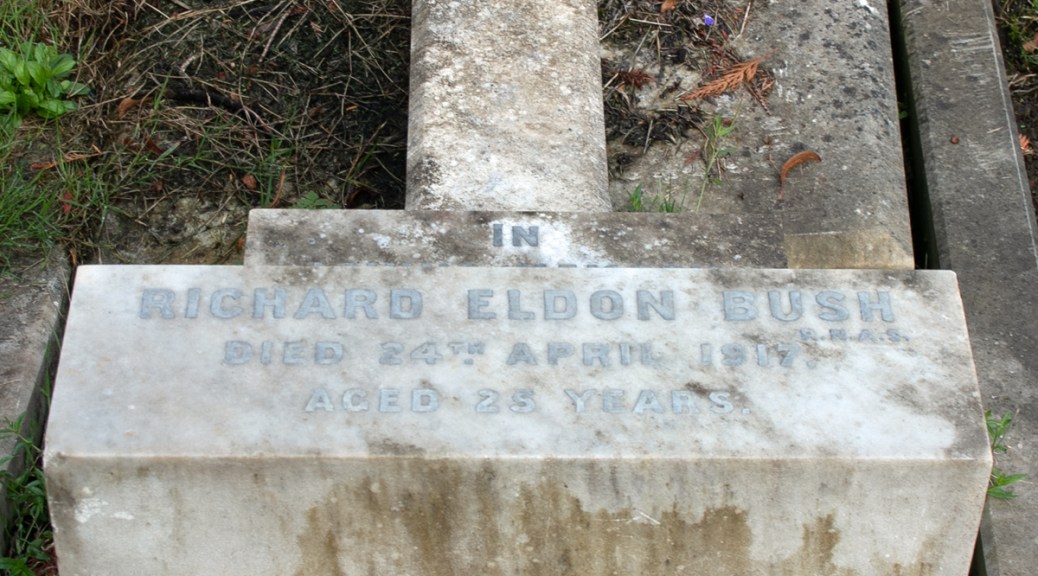
Richard Eldon Bush was born on 16th June 1891 in Keynsham, Somerset. The second of four children (all of whom were boys), his parents were Philip and Maria Bush. Philip was a solicitor, and with that status came opportunity for his children.
The 1911 census recorded the Bush family living in Keynsham with two servants – cook Clara Jones and parlour maid Laura Day. The two older boys – Richard and his older brother, Whittington, were both listed as Cambridge undergraduates, while his two young brothers were boarding at a private school in Repton, Yorkshire.
Richard had aspirations for a good life. In March 1914, he set sail for a life in Canada, looking to take up architecture in the colony. His time overseas wasn’t to be long, though, and, when war broke out in Europe, he returned home.
Full details of Richard’s military service are not available, but he joined the Royal Naval Air Service and, on 20th August 1915, he gained his wings. Richard rose to the rank of Flight Lieutenant, but tragedy was ahead.
On 24th April 1917, he was piloting a scout seaplane around the harbour in Fishguard, Pembrokeshire.
[He] failed to clear some overhead wires, and the seaplane swerved against the cliff with considerable violence, smashing the machine, which the petrol set alight, and crashed to the earth. When liberated from the blazing machine Lieutenant Bush rolled and extinguished his burning clothes.
Somerset Guardian and Radstock Observer: Friday 27th April 1917
Sadly, Flight Lieutenant Bush’s injuries proved too severe. He passed away a couple of days later, on 24th April 1917, at the age of 25 years old.
Brought back to Somerset for burial, Richard Eldon Bush was laid to rest in the cemetery of his home town, Keynsham.
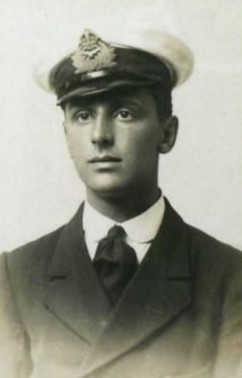
Flight Lieutenant Richard Bush (from astreetnearyou.org)
The same newspaper report noted that Richard’s brother Graham was an officer in the Royal Flying Corps. He had also been badly injured in a flying accident, but was, according to the report, “flying again now.“
Harold Stanley Weston’s early life is destined to remain a mystery. He was born, according to his Royal Air Force service records, in Southgate, Middlesex in 1887 and, before war broke our, was working as a waiter before enlisting.
On 3rd August 1915, he married a woman called Gertrude in Hastings, Eat Sussex, and it appears that this is where the couple set up home. Harold has initially enlisted in the army, but transferred across to the Royal Flying Corps on 28th October 1915. Air Mechanic 2nd Class Weston’s service records show that he stood just 5ft 2.5ins (1.59m) tall.
Over the next three years, Harold rose through the ranks to Air Mechanic 1st Class, and served in France for nine months during 1916. He then returned to England, and was based at an airfield near Detling, Kent. When the Royal Flying Corps and the Royal Naval Air Service merged in April 1918, he transferred across to the newly-formed Royal Air Force, and was attached to 27 Squadron.
In November that year, Harold was admitted to the Military Hospital in Maidstone, also in Kent, having contracted influenza and pneumonia. Sadly, the lung conditions were to get the better of him, and he passed away on 1st November 1918, at the age of just 31 years old.
Air Mechanic 1st Class Harold Stanley Weston’s body was laid to rest in the quiet graveyard of St Martin’s Church in Detling, not far from the base at which he served. Gertrude posted her thanks to “all [their] friends for their kindness and sympathy shown to her in her sad bereavement, more especially Captain Saunders, RAF, Major Chapman, KCC [Kent County Council?], Sergeant Fowle, KCC, and Sergeant Weller, RAMC [Royal Army Medical Corps]” [Maidstone Telegraph: Saturday 9th November 1918]
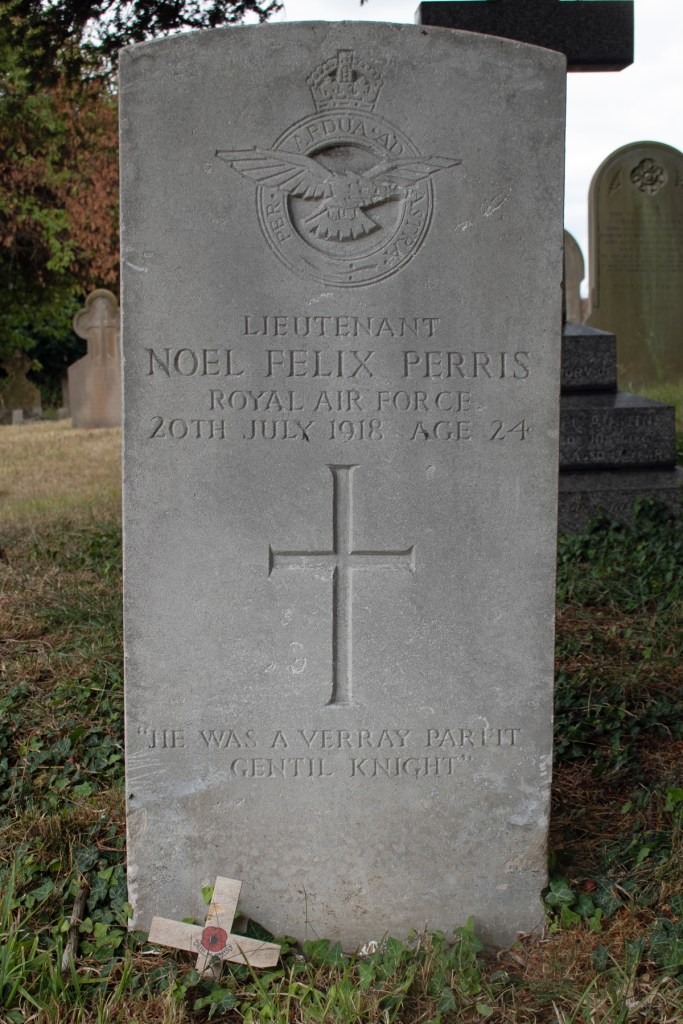
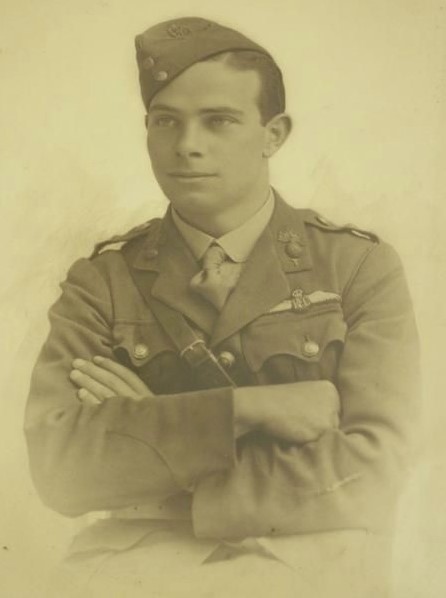
Noel Felix Perris was born early in 1894 in Chiswick, London and was the oldest of three children to George and Mary Perris. George was from Liverpool, and he and Yorkshire-born Mary made the move to south in the late 1880s.
Noel went on to study science at school, but when war broke out, he clearly felt a duty to play his part. George used his writing skills to become a war correspondent with the French army, while his son joined the 2nd London Regiment.
Quickly promoted to the rank of Lieutenant, Noel served in France and Egypt. In 1916, he was badly injured at Hébuterne, to the south of Arras, and returned to England to recuperate. When he had recovered, he transferred to the Royal Flying Corps, subsequently gaining his wings in the newly-formed Royal Air Force.
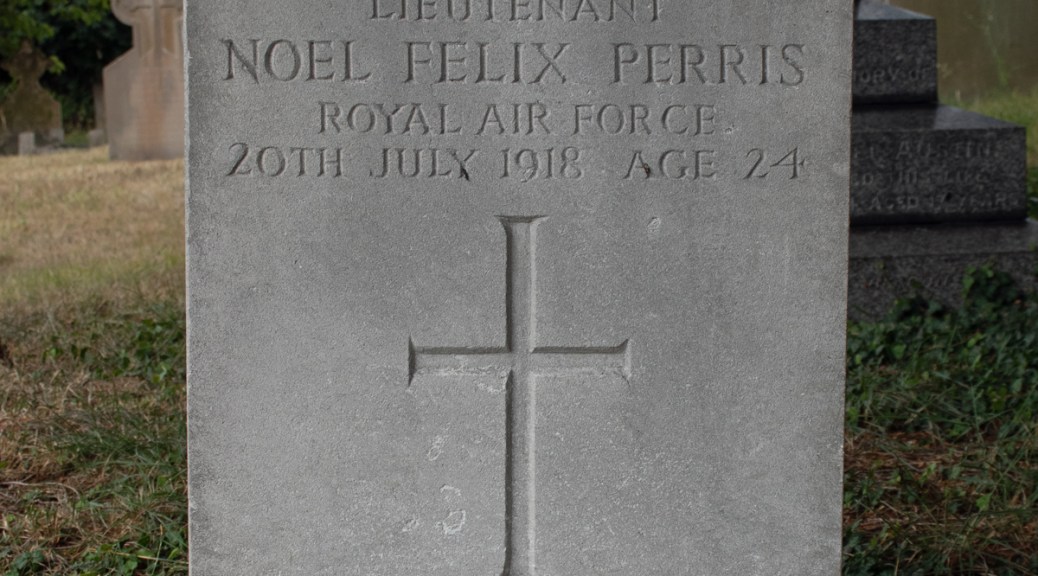
Lieutenant Perris was based in Kent as part of 143 Squadron. On the morning of 20th July 1918, he took off from Detling Airfield as part of a normal patrol flight. His aircraft – a single-seater RAF SE5a – collided with another plane, piloted by Lieutenant Thomas Wright, and both crashed to the ground in flames. Both piloted were killed on impact.
An inquest found that the cause of the pilots demise was accidental death. Lieutenant Perris was just 24 years old.
Thomas Wright’s body was taken home to Fleetwood, Lancashire, for burial. Noel Felix Perris was laid to rest in the quiet graveyard of St Martin’s Church in Detling, not far from the base.
Lieutenant Noel Perris (from findagrave.com)
The epitaph on Noel’s headstone comes from Geoffrey Chaucer’s The Knight’s Tale.
He was a verray parfit gentil knight
A modern day translation might be “He was a true, perfect knight of noble character.”
Albert Franklin Young was born on 15th August 1899 in Marylebone, London. He was the older of two children – and the only son – to Kathleen (Kate) Young, and her photographer husband, Albert Antonio Young.
Albert Sr seemed to have made a successful of his photography business: Albert Jr attended St Hugh’s School in Chislehurst, Kent, before moving on to Margate College, also in Kent, and Watford Grammar School.
From leaving school, Albert Jr joined the Royal Flying Corps as a wireless operator on 28th September 1915. He was just sixteen years old, but within eight months he was serving with the British Expeditionary Force in France. He was involved in operations at the Somme and continued his flight training.
In November 1915, Albert was promoted to Air Mechanic 1st Class, and remained on the Western Front. On 28th March 1918, a German air raid hit No. 2 Air Depot, where Albert was working: he was badly wounded, and brought back to England for medical treatment.
Admitted to London Hospital in Chelsea, Air Mechanic Young was operated on a number of times, but was to finally succumb to his wounds on 9th June 1918. He was just 18 years of age.
As highlighted in de Ruvigny’s Roll of Honour, one colleague noted “I can assure you he was very greatly esteemed for his fine qualities by all with whom he came into contact, and the news of his death was received by all of us with most profound sorrow. He was a splendid boy.” Another said that the “great courage and coolness he always displayed at most critical moments were on many occasions an incentive to me. He was truly a gallant lad.”
Brought to West Sussex, where his parents were now living, Albert Franklin Young was laid to rest in Cuckfield Cemetery: “The scene… was very solemn and pathetic, yes beautiful and effective, and as all moved forward to the grave, and viewed the fair expanse of the Sussex Weald, the sweet melody of the Choir [was] ringing in our ears.” [Mid Sussex Tomes: Tuesday 18th June 1918]
Francis Reginald Steele Wakeford was born in the summer of 1893 in Penarth, Glamorgan. The middle of five children, his parents were Herbert – who was a master printer – and Mary Wakeford. When he left school, Francis became a stockbroking clerk, but when war broke out, he was quick to ensure he played his part.
Initially enlisting in the Royal Engineers, he was attached to the Glamorgan Yeomanry. By the time he was sent to France, however, he had been assigned to the Lancashire Fusiliers.
After eighteen months of fighting, in the spring of 1918, Second Lieutenant Wakeford transferred to the Royal Air Force and gained his wings. “During six months’ flying he had many encounters with enemy airmen, many of whom he brought down, and was also in several bombing raids over Germany.” [Western Mail: Monday 30th December 1918]
When the Armistice was declared, Francis returned to Wales. He has been suffering from an ongoing illness, and this was to be to what he was to succumb. Second Lieutenant Wakeford passed away in Cardiff on Christmas Day, 25th December 1918. He was just 25 years of age.
Francis Reginald Steele Wakeford was laid to rest in the graveyard of St Augustine’s Church in his home town of Penarth.
Second Lieutenant Wakeford (from findagrave.com)
Francis’ grave also commemorates the passing of his only brother, Charles Herbert Stanley Wakeford.
Four years Francis’ senior, Charles had enlisted in the 24th (Pembroke and Glamorgan Yeomanry) Battalion of the Welch Regiment. As the war moved through its final year, Lieutenant Wakeford found himself caught up in the fierce fighting of the Second Battles of the Somme.
Charles was killed on 7th September 1918, aged 28 years old. He was laid to rest in Tincourt British Cemetery, in Picardie, France. He is also commemorated on the family grave in St Augustine’s Church, Penarth.