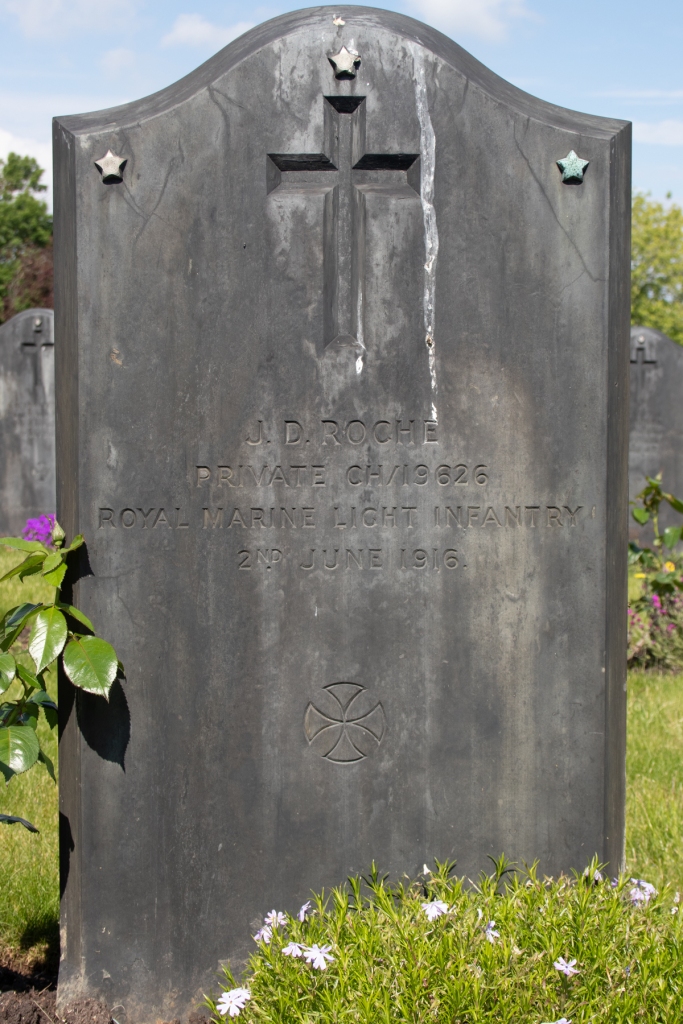
In the middle of the military section of the Woodlands Cemetery in Gillingham, Kent, is a headstone commemorating the life of John David Roche.
Details of John’s life are a challenge to piece together, although a later document gives his next-of-kin as Mrs E Roche of 108 Osnaburgh Street, Regent’s Park, London. There is a baptism record from 1897 for John David Roche, whose mother’s name was given as Lizzie. John’s father is listed as David, and the christening took place in Chelsea. There are no other records or census returns to give any further family background.
John’s time in military service is also hard to determine. That he joined the Royal Marine Light Infantry is clear, although when he enlisted and where he served are sadly lost to time.
Details of Private Roche’s passing are also unclear. He is noted as having died of disease, although the specific cause is not detailed. Given the location of his burial, it seems likely that he passed either at the Royal Naval Dockyard in Chatham, Kent, or at the hospital in the town connected to it.
John David Roche passed away on 2nd June 1916. If the baptism was correct, he was a day short of his 19th birthday.
On Saturday last an inquest was held at the Seaman’s Institute on the body of Gunner Wm. Moore, RNTS.
Mrs Brennan, sister of the deceased, stated that he was 43 years of age, and lived when off duty with her at Somerville, Seacombe, Cheshire. He joined the Royal Marine Light Infantry over 20 years ago.
Mr R Sussex Langford, Lloyd’s agent, stated that he saw deceased on landing. He help to get him into a cart, but found he was too ill to travel that way, so he had him put on an ambulance and taken to the Royal National Mission for Deep Sea Fishermen, and immediately sent for the doctor. Deceased was semi-conscious and very sick. He was a gunner from a torpedoed ship. Deceased died on Thursday [25th July 1918] at 6 o’clock.
Dr Sargent stated that he was called on the 23rd to see deceased, and found him semi-conscious, complaining of great pain in the abdomen and vomiting. He lay in that condition until the 25th, when death took place. The cause of death was acute traumatic peritonitis, the result of injuries received by the explosion of an enemy torpedo.
[Newquay Express and Cornwall County Chronicle – Friday 02 August 1918]
Other than the details outlined in the newspaper report, little concrete information is available about the life of William Moore. The name does crop up in the 1891 census in Seacombe, Cheshire, and, if this relates to Gunner Moore, then he was one of five children to widowed lithographer Margaret Moore. Beyond that one census, however, it is not possible to find any more specific details.
William was on board the steam ship SS Anna Sophie in the summer of 1918, which was sailing from Rouen to South Wales, On 23rd July, she was torpedoed by the German submarine U-55 off Trevose Head, Cornwall. The Anna Sofie was sunk, Gunner Moore was one of those who subsequently passed from their injuries.
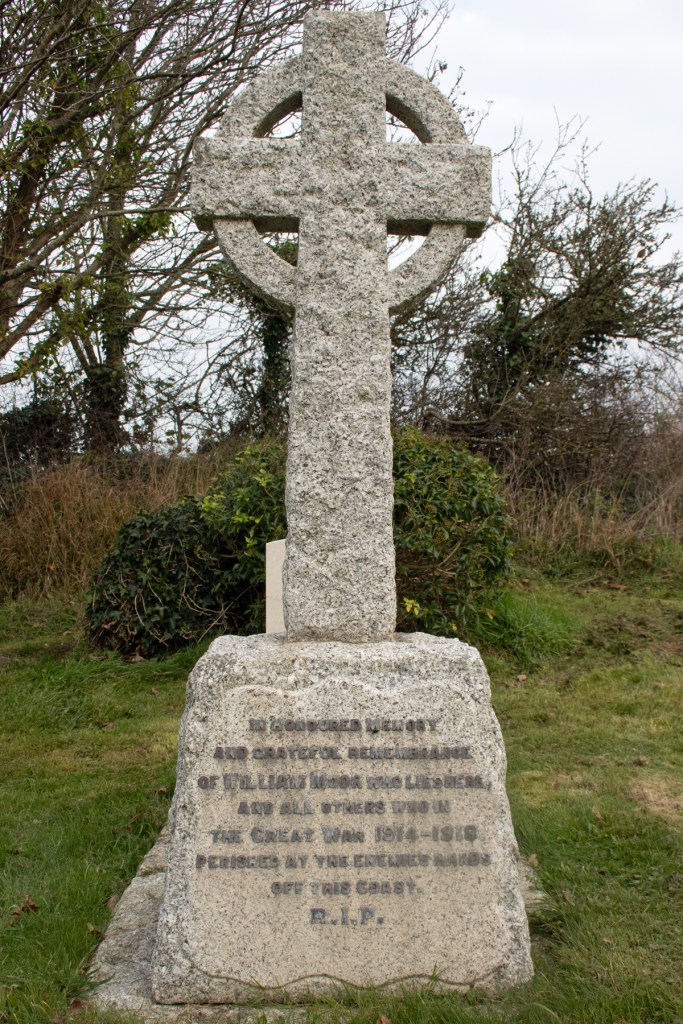
William Moore’s sister may not have been able to pay for her brother to be brought back to Cheshire for burial. Instead, he was laid to rest in Padstow Cemetery, and shares his resting place with another member of the crew, Lance Corporal William Whitmore.
William’s headstone reads: “In honoured memory and grateful remembrance of William Moor [sic] who lies here, and all others who in the Great War 1914-1918, perished at the enemies hands off this coast. RIP.”
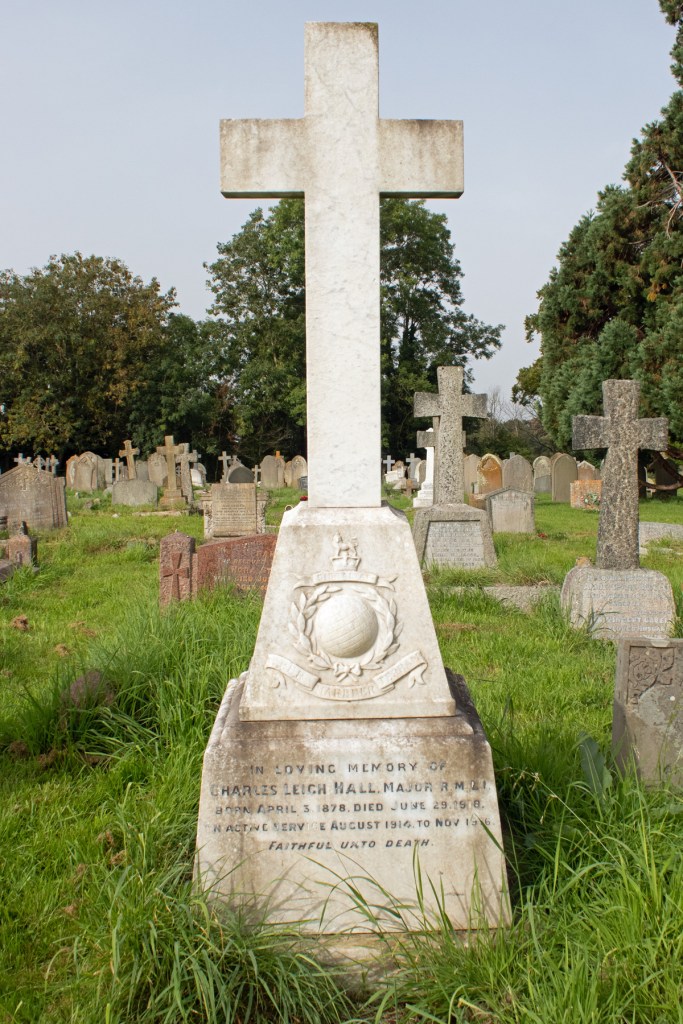
Charles Leigh Hall and his twin Maud, were born on 3rd April 1878 in Clifton, Gloucestershire. Two of eight children, their parents were Pedro and Anne Hall. Pedro, whose full name was Pedro Henrique Sinclair Hall, was better known as Henry, and was a mathematics tutor and Assistant Master at Clifton College, and it goes without saying that the Hall children had a educated upbringing.
Charles was always to be destined for great things. By the time of the 1901 census, when he was 22 years of age, he was a Lieutenant in the Royal Marines Light Infantry. Based on the cruiser HMS Amphion, he travelled the Pacific and, on the night the return was taken, was moored in Vancouver, Canada.
On 15th June 1910, Charles married Sophia Elinor Veale. Born in Caledon, South Africa, the couple wed in the village of Littleham, Devon. They set up home in Gosport, Hampshire – presumably as the now Captain Hall’s work was based from the docks there – and went on to have two children, Anthony and Nicholas.
By September 1915, Charles had been promoted again, this time to the rank of Major. His wartime service included a lot of work in Africa, including in Cameroon in 1914 – for which he was mentioned in Dispatches – German East Africa (Burundi, Rwanda and Tanzania today) in 1915 and Saadani (Tanzania) in 1916.
In October 1916, he was invalided out of the Royal Marine Light Infantry for reasons that are unclear, and returned to Britain from Simonstown, South Africa. While Charles seems not to have gone to sea any more, his experience was still respected, and, on 15th January 1917, he was promoted to Brigade Major.
The family settled back down in Portsmouth, Hampshire, and remained there for the next eighteen months. By the summer of 1918, Charles was in Bristol – either based at the docks there, or hospitalised in the city – and passed away on 29th July 1918. He was 40 years of age.
Sophia and her boys were still in Portsmouth, but Charles Leigh Hall was laid to rest in the graveyard of St George’s Church in Easton-in-Gordano, Somerset. The headstone incorrectly gives the month of death as June. Charles’ will divided his estate – £4467 (£318,000 in today’s money) – between his brother, Arthur, and Charles Garnett, a barrister, possibly as a trust for his sons.
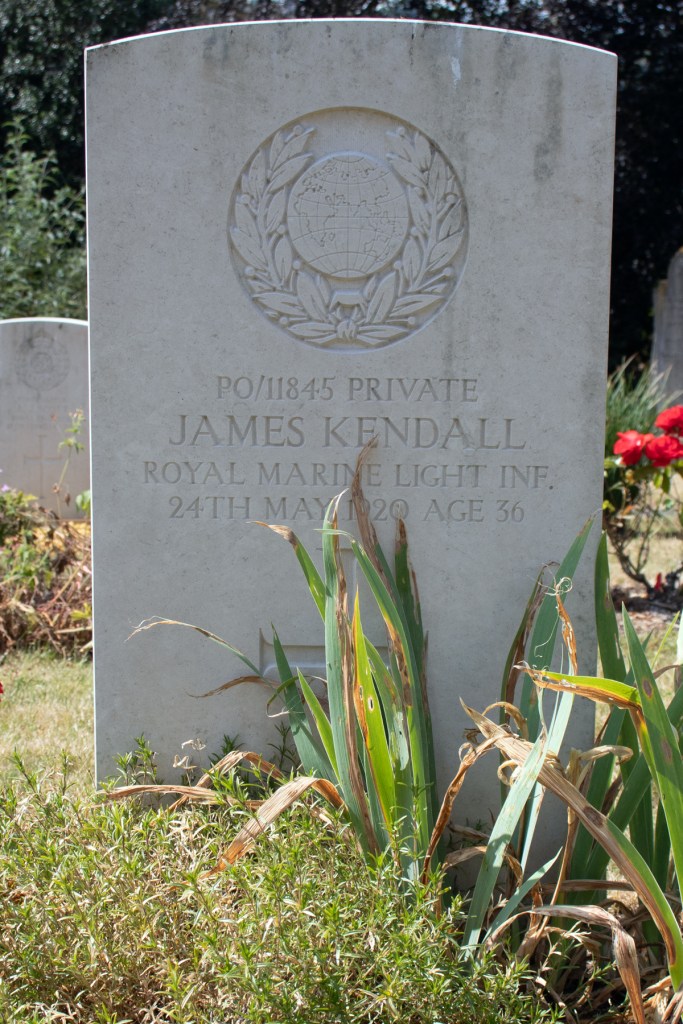
Much of the early life of James Kendall is destined to remain shrouded in the mists of time. Born on 10th June 1883 in Stalbridge, Dorset, his parents are recorded as James Kendall and Anna Louisa Yeatman.
The 1901 census recorded James as being the head of a household, despite being only 17 years old. He was working as an agricultural labourer, and was living with his maternal grandmother, Mary Ann Yeatman, and her daughter, Louisa (the census recorded her as James’ aunt, although she shared a name with his mother).
James sought a proper career, however, and, on 19th July 1901, he enlisted in the Royal Marine Light Infantry. His service records show that he was 5ft 6.5ins (1.69m) tall, with brown eyes, light brown hair and a fresh complexion.
Private Kendall was sent to Deal in Kent for his training: he remained here for nine months, before being transferred to Portsmouth, Hampshire. Over the next twelve years, he served on ten ships – including the HMS Duke of Wellington, HMS Egmont and HMS Renown – returning to the HMS Victory, the Royal Naval Dockyard in Portsmouth, in between each assignment.
James was billeted at HMS Victory when war was declared. During the conflict he remained based in Portsmouth, while being assigned to HMS Cornwall and HMS Birmingham for spells. It seems likely that his shore service helped support new recruits: Private Kendall’s experience would have been invaluable.
In 1915, James married a woman called Edith: there are no other details for her, other than that she his named as his next of kin on his service records.
When the armistice was declared, Private Kendall was serving on HMS President III, a shore base split between Bristol, Windsor and London. He returned to Portsmouth in the summer of 1919 and was formally stood down the following January, having been invalided out of the Royal Marines. He had served for more than eighteen years, and consistently received notices of high levels of character and ability.
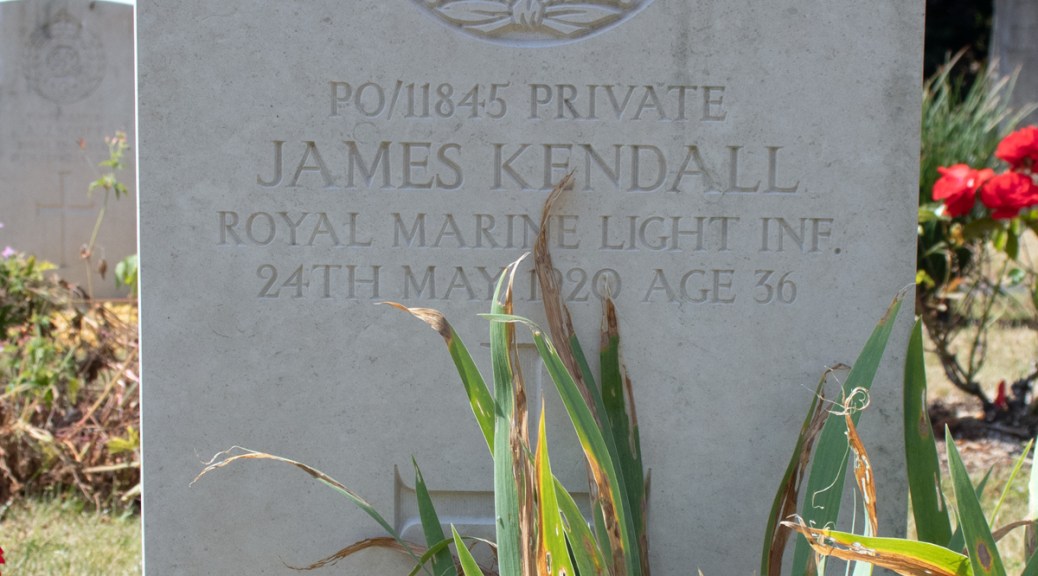
James’ dismissal from service was as a result of an unrecorded illness, likely to be one of the lung conditions prevalent at the time. The next record for him is that of his passing, on 24th May 1920, at Bath War Hospital, Somerset. He was 36 years of age.
James Kendall was laid to rest in the city’s Locksbrook Cemetery. He was interred in the military section on the graveyard, often reserved for those servicemen whose families were unable to afford to bring their loved ones home.
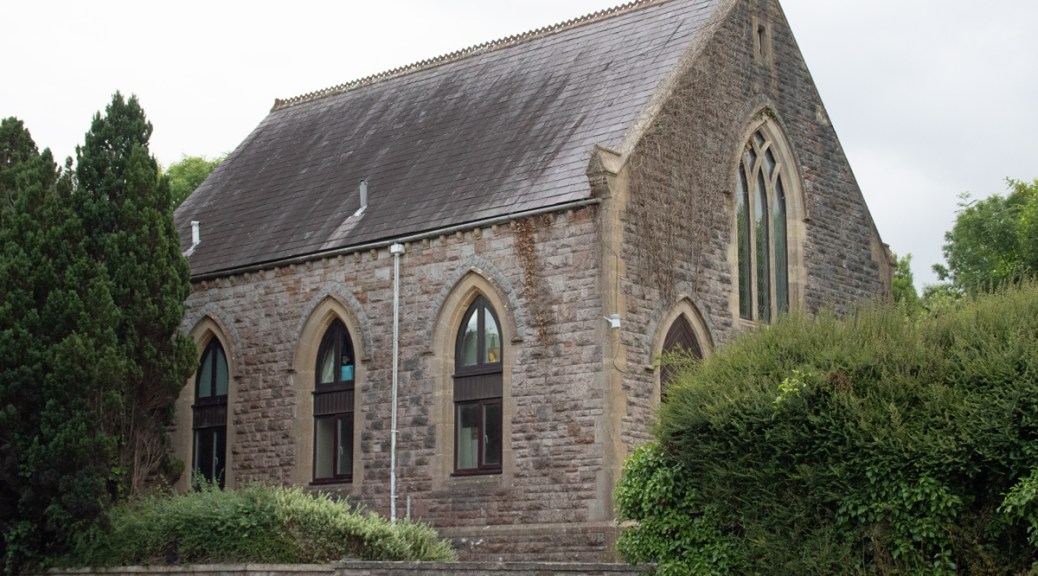
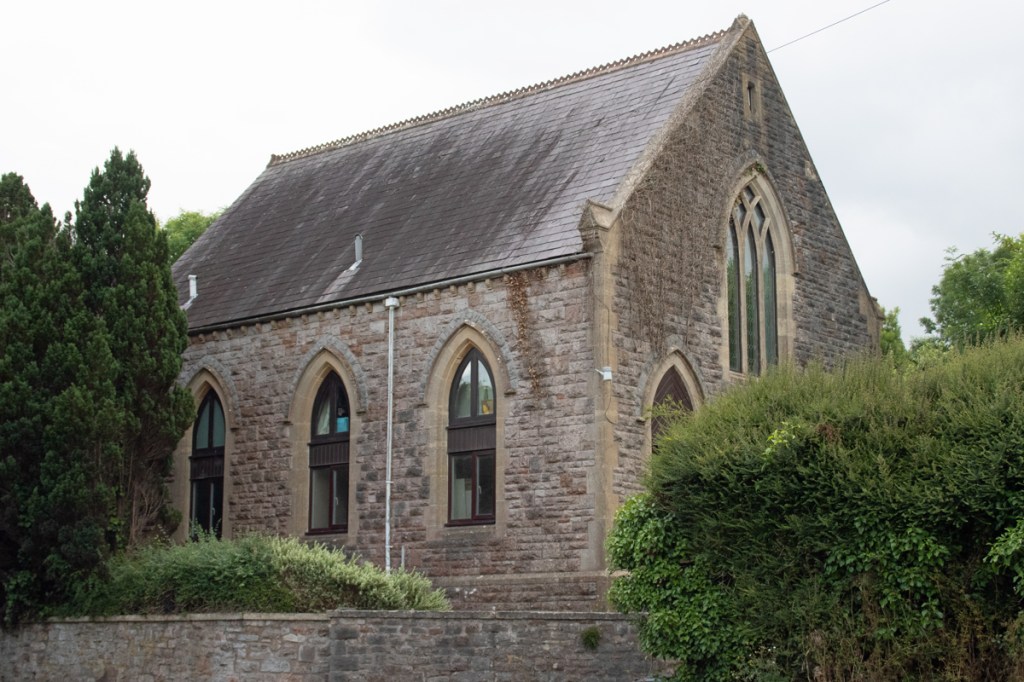
On the main road between Glastonbury and Wells, on the outskirts of the village of Coxley is the old Wesleyan Methodist Chapel. Now converted to a house, its back garden contains the remains of Private WR Parsons, who died in January 1919.
William Reginald Parsons was born on 22nd February 1895 in the hamlet of Chilton Burtle, near Bridgwater. The second of eight children, his parents were Wallace and Harriet Parsons. By the time of the 1901 census, the family had moved to Wells, where William was employed as a platelayer by Great Western Railways.
When he left school, William found employment as a paper maker, and was employed by the St Cuthbert’s Paper Mill to the west of the city. He wanted bigger and better things, however, and, on 11th April 1912, he enlisted in the Royal Marine Light Infantry.
Private Parsons’ service records show that he was 5ft 6.5ins (1.68m) tall, with brown hair, hazel eyes and a fresh complexion. It was also noted that he had a small scar on the right side of his back. Initially sent to the regiment’s depot in Deal, Kent, this is where he was tested for his swimming ability: he passed on 24th June 1912.
William remained in Deal until the end of the year. After seven months in Portsmouth, Hampshire, he embarked on a number of postings that lasted for the next six years. Initially assigned to the battleship HMS Bulwark, Private Parsons’ main posting was on board another battleship, HMS Zealandia.
Primarily based guarding the North Sea Coast, Zealandia also served in the Mediterranean, sailing as far as the Dardanelles towards the end of 1915. In all, Private Parsons spent more than three years on board the battleship.
William’s next posting was on board the cruiser HMS Royalist, on which he served until the end of the First World War. While he was on board, it appears that he became unwell, and he was admitted to the Royal Naval Hospital in Granton, near Edinburgh. Details of his condition are not readily available, but they were serious enough for him to succumb to them: he passed away on 30th January 1919, at the age of just 23 years old.
The body of William Reginald Parsons was brought back to Somerset for burial. He was laid to rest in the quiet churchyard of the Wesleyan Methodist Chapel in Coxley.
(c) Sharky Ward 2025
As the chapel is now a family home, its garden is not readily accessible. The photo of Private Parsons’ grave was taken by Commonwealth War Graves Commission volunteer Sharky Ward, to whom I am indebted for its use.
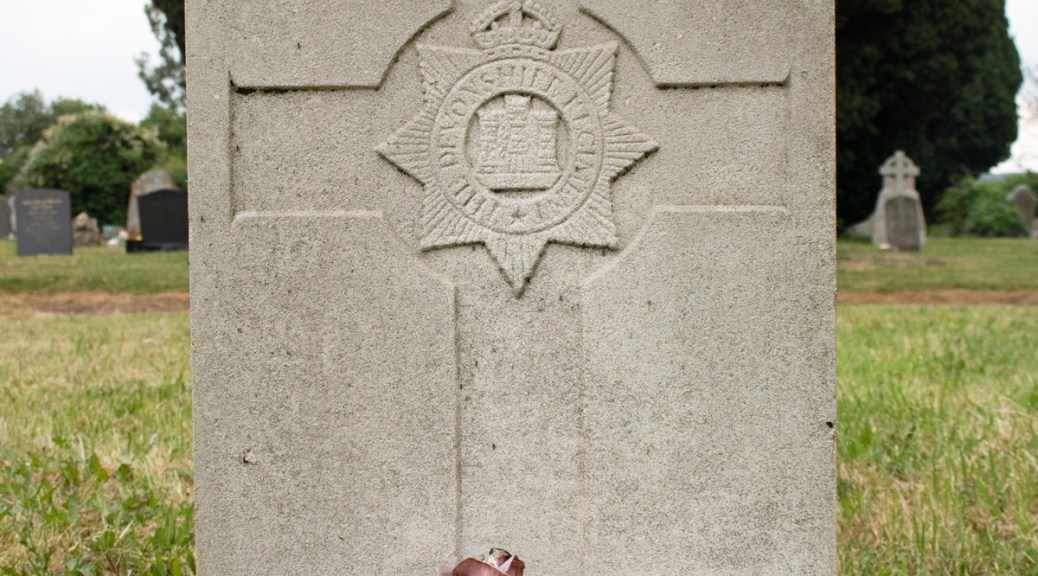
In a quiet spot in North Petherton Cemetery, Somerset, is a headstone dedicated to Private J Mahaffey of the Devonshire Regiment. He died on 5th February 1916, but there is little further information available for him.
Private Mahaffey’s service number leads you to one military record, his army pension ledger card. This confirms a little more information: his first name was John, he had two children noted (underage, and therefore eligible for part of his pension) – Elsie and Thomas – and a guardian is also given – Mrs Elizabeth Broom, who lived in Kentisbeare, Devon. The pension card also confirms the cause of John’s death: heart failure due to disease contracted on active service.
An unusual surname made searching contemporary newspapers easier, and a mystery was unveiled:
Private John Mahaffey, a native of Devonport.. was found dead in the Great Western Railway train at Durston on Saturday.
Deceased, who was in the Devon Regiment (86th Battalion Provisional Territorial Force), was 49 years of age, and had served twelve years in the Army. At the outbreak of war he re-enlisted, and latterly had been quartered at Blythe. It appears that he had been on a visit to his children at Devonport, and was upon his return journey when his death occurred. At Taunton he conversed with the guard of the train by while he travelled, and was then apparently in good health.
PS Hill, North Petherton, state that on Saturday, he… saw the body of the deceased… He examined the body, and found a bruise above the left eye and a scar on the nose. He found upon him his regimental pass and the return railway ticket. There was also money in his pockets.
George William Grinnett, a guard on the GWR, said… he was approached by deceased, who asked as to the train service to Newcastle. Witness understood that he had travelled from Exeter… He advised him to… change at Bristol. He then appeared to be all right, and in good health. On arrival at Durston [George] walked the train, and when passing the compartment that deceased entered at Taunton he noticed a man on the floor in the corridor. He went inside and found that the man was dead. He then communicated with three soldiers, who said they had not travelled with deceased. They had merely opened the door, and, seeing a man there, had walked away without telling anybody.
Dr William C Ghent… said her was called to see deceased. He was quite unable to form an opinion as to the cause of death. There was a good deal of blood on the face, and a slight wound on the nose. From a post-mortem examination he found that one of the valves of the heart was incompetent, and in his opinion death was due to heart failure. The blood on the nose might have been caused by a fall. There was no serious injury from the blow which would cause death.
Taunton Courier and Western Advertiser: Wednesday 9th February 1916
John’s previous twelve years in the army may relate to a Royal Marine Light Infantry service document for a John Mahaffoy. Born on 24th May 1864 in Newcastle-upon-Tyne, he enlisted in Bristol as a Private on 24th April 1888. Primarily based out of Plymouth, he served until the summer of 1900, and was assigned to the Royal Fleet Reserve for a further seven years.
Further complexity is added to John’s story, with a marriage record for 6th April 1896. This confirms his wife’s name as Elizabeth Brown, the couple marrying in Devon. The 1901 census confirms two older children for the couple, Kathleen (mentioned in the newspaper report, who was born in 1897) and Margaret, who came along two years later.
The next census, however, shows a divided family. John was recorded as being one of 1200 patients in the Devon County Lunatic Asylum in Exminster. Elizabeth was living in Portsmouth, with their son, Thomas. She also had a boarder, Bertram Bound, an Able Seaman in the Merchant Navy. Kathleen was a patient in the Sanatorium for Devon and Cornwall Consumptive Patients in South Brent, Devon. Elsie, meanwhile, was recorded as living in Kentisbeare with her grandparents, Edmund and Elizabeth Broom.
This would suggest that John’s wife Elizabeth had died by the time of his death, and that guardianship of his children passed to his mother-in-law when he too passed away.
The last sad element of this tale is that John Mahaffey was not to be reunited with his children. There may have been a financial element, with the Brooms possibly unable to cover the cost of bringing him down to Devon. John was laid to rest in North Petherton Cemetery, a few miles from Durston Station, where his body had been discovered.
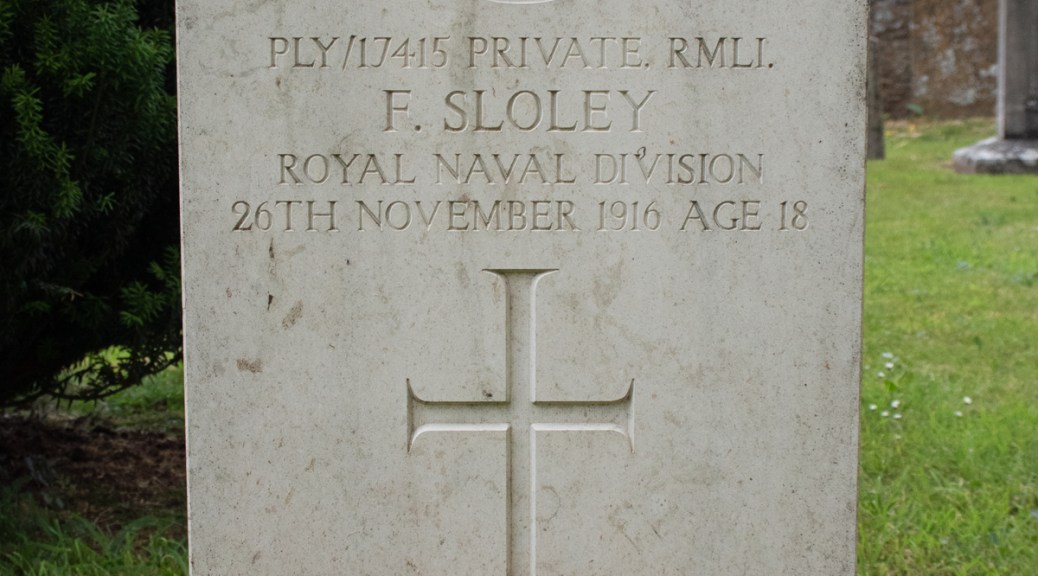
Frederick Sloley was born on 7th April 1897 in Kingston St Mary, Somerset, and was the fourth of nine children to Walter and Mary Jane Sloley. The family were farm workers and were living with Walter’s parents – also agricultural labourers – in the 1901 census.
After he finished his schooling, Frederick found began working with the horses on the farm. When war broke out, however, he saw an opportunity to serve his King and Empire, and enlisted in the Royal Marine Light Infantry. He joined up on 5th October 1914, and his service records show that he was 5ft 4ins (1.63m) tall, with black hair, grey eyes and a fresh complexion.
Private Sloley was initially sent to the Reserve Depot in Deal, Kent, for training, before moving to the Plymouth Division in Devon in March 1915. He records do not make it clear where he served specifically, but by 1916 he has fought in the Dardanelles and Mesopotamia.
It was while he was in the Eastern Mediterranean that Frederick was injured. Wounded in the spine by enemy gunfire, he was medically evacuated to Britain for treatment. Admitted to King George’s Hospital in London, surgery proved too late. Private Sloley passed away on 26th November 1916, at the age of just 19 years old. His mother, Mary, had managed to see him before he died.
The body of Frederick Sloley was brought back to Somerset for burial. He was laid to rest in the peaceful graveyard of St Mary’s Church in his home village of Kingston.
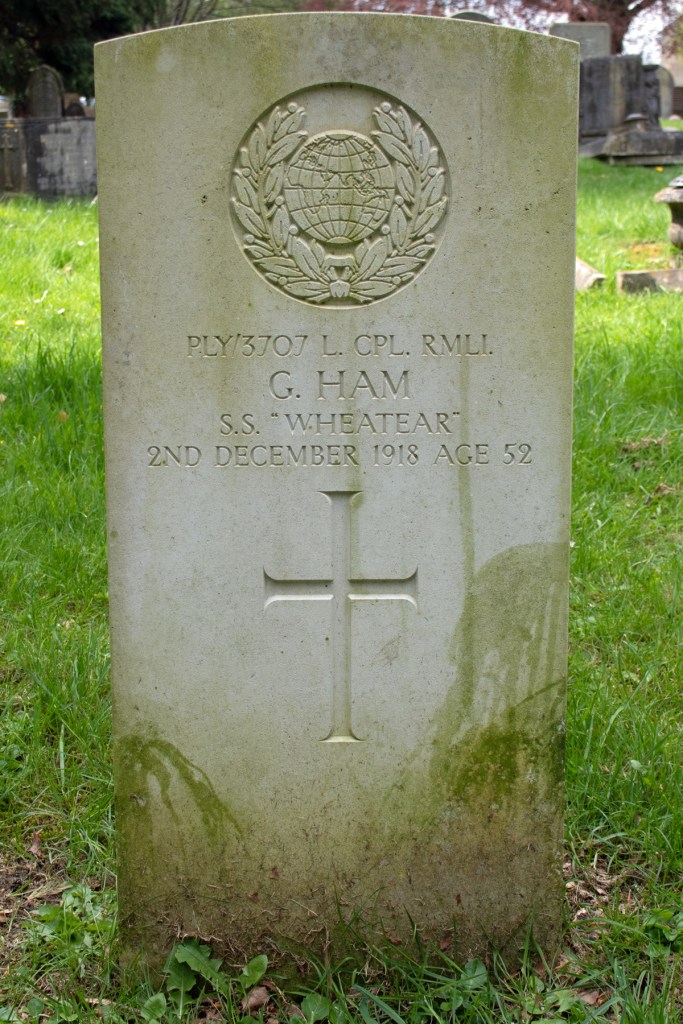
George Ham was born on 19th December 1867 in Twerton, Somerset. His parents were George and Emily Ham, and he was the oldest of their nine children. George Sr was a mason, and initially his first born followed suit, but he was pulled towards something bigger and better and, on 19th January 1886, he enlisted in the Royal Marine Light Infantry.
George’s service records note that he was 5ft 6ins (1.68m) tall, with brown hair, grey eyes and a fresh complexion. He was initially sent to the barracks at Walmer in Kent, and it was from here that Private Ham began a 21 year career in the Royal Marines. Over that time, he served on seven separate ships, and, between voyages, he was based in barracks in Plymouth, Devon. Both his character and ability were consistently noted as being very good.
Private Ham’s career took him around the world and, in 1887, he found himself on the gunboat HMS Banterer, on which he served for three years. His tour of duty included a period of time in Galway, Ireland, and it was here that he met Mary Ann Goode. On 5th July 1889, the couple married in city’s St Nicholas’ Church. The church’s records suggest that the couple went on to have four children – Frederick George; Emily, who died just after her first birthday; Albert; and Katherine.
George’s records from this point become a little disjointed. In October 1890, he returned to his Plymouth base, and the following year’s census recorded him as living in the East Stonehouse Barracks, although his marital status was noted as single.
The next census, in 1901, presents a different picture. George and Mary were, by this time, living in family barracks in East Stonehouse, with two children, (Frederick) George and Albert. Katherine, the couple’s youngest child, was born the following year.
In January 1907, after more than two decades’ service, George was stood down from active service in the Royal Marines. He was placed on reserve status, and took up work as a mason once more. At this point, however, the family seemed to have hit more troubled times, underlined by four separate 1911 census documents.
George, who was 44 by this point, was recorded as being an inmate in the Bath Union Workhouse and Infirmary in Lyncombe, Somerset. Mary and Katherine, meanwhile, were in two rooms in a house in Stonehouse, Devon. Frederick, who was now better known as George, had followed his father into military service, and was a Private in the Royal Marine Light Infantry, serving on HMS Colossus. Albert, who was 13 years old, was one of 946 students boarding at the Royal Hospital School for Sons of Seamen in Greenwich, London.
George spent nine years in the reserves, and, in 1914, was called up again for war service, this time as a Lance Corporal. According to a contemporary newspaper:
[He was] engaged on naval patrol work against submarines off the Canadian coast and elsewhere, and was in charge of a gun on an armed merchant ship. Once the boat he was on was torpedoed, and on another occasion he had a long running fight with a submarine in the Irish Channel. The ship, however, reached Portrush (Ireland), and the inhabitants gave Lance-Corporal Ham a testimonial, and he was also rewarded in other ways, the Cardiff owners of the vessel recognising his skill and gallantry.
Bath Chronicle and Weekly Gazette: Saturday 7th December 1918
Tragedy was to strike in the end, however, and George was to meet a sad end to a distinguished career.
While at Cork [George] fell, either from a boat or the dock, and sustained an injury to the side of his head. It did not appear very serious, and it is understood that he made a trip to Cardiff and back to Londonderry, [where] he became so seriously ill as to necessitate his going to a military hospital in Londonderry. Hemorrhage [sic] of the brain set in, and he died on Monday [2nd December 1918] before his brother, Mr Albert Ham, who had been telegraphed for, could reach him.
Bath Chronicle and Weekly Gazette: Saturday 7th December 1918
Lance Corporal George Ham was days short of his 51st birthday when he died. His body was brought back to Somerset for burial, and he was laid to rest in Twerton Cemetery. The newspaper report give no indication as to whether Mary or their children were in attendance and, in fact, does not mention his wife and family at all.
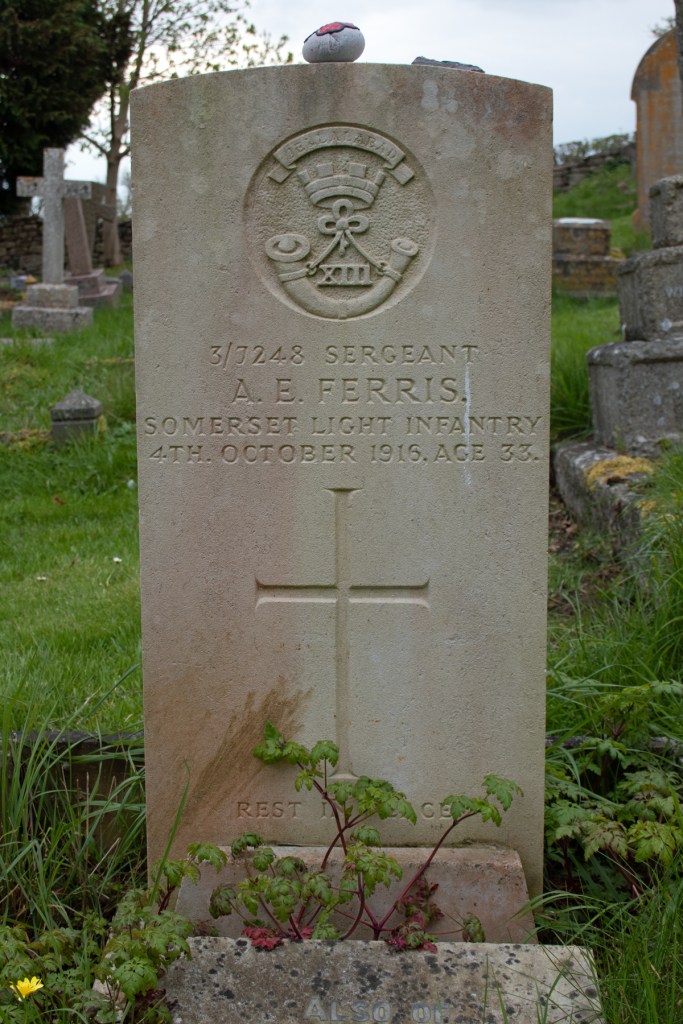
Albert Edward Ferris was born in the spring of 1884, one of six children to Charles and Juliana. Charles was quarryman turned farm labourer from Gloucestershire, but it was in the village of Claverton, near Bath, that the family were born and raised.
When he finished his schooling, Albert found work as a baker, but soon sought out a career in the military. On 2nd January 1903 he enlisted in the Royal Marine Light Infantry as a Private. His services records show that he was 5ft 6ins (1.68m) tall, with brown hair, blue eyes and a fair complexion.
Based out of Plymouth, over the next nine years Private Ferris served on four different ships and was recognised as having a very good character and an ability to match.
In 1910, Albert married Eliza Jane Warren, a mason’s daughter from Monkton Combe. The 1911 census found Albert on board the armoured cruiser HMS Cumberland, while Eliza was living with her parents. Military life was taking a toll on married life and, on 6th December 1911 bought an end to his naval career and was ‘discharged by purchase’.
Returning to Somerset, Albert found employment as a motor-man with Bath Electric Tramways. He and Eliza settled into married life, but war was on the horizon and things were to change.
At the outbreak of war, [Albert] promptly responded to his country’s call, and enlisted in the [Somerset Light Infantry], as a Private. When his battalion was sent to France, he distinguished himself in a short time by his excellent work as a sniper, speedily earning his first stripes as a consequence. With his battalion he participated in the heavy fighting around the Ypres district, over an extended period, without sustaining any serious injury. Later his battalion was moved further down the line to take part in the “Great Push,” where, for meritorious conduct, he was… promoted to Sergeant in the field…
Bath Chronicle and Weekly Gazette: Saturday 7th October 1916
Sergeant Ferris’ luck was not to last, however, and things took a turn in September 1916.
In the… fighting around Delville Wood… Sergt, Ferris was severely wounded in the right thigh by a machine-gun bullet. One of his officers gave him the best first-aid treatment possible under the circumstances, and later he crawled nearly three miles in an endeavour to reach the nearest field dressing station. Through loss of blood, shock, and general exhaustion he was on the point of collapse when picked up by a field ambulance, after which he was transferred to the base and later to Tooting Military Hospital, where, despite skilled treatment and the greatest care, septic poisoning intervened and he passed away…
Bath Chronicle and Weekly Gazette: Saturday 7th October 1916
Sergeant Ferris died while admitted in the Surrey hospital on 4th October 1916. He was just 32 years of age.
The body of Albert Edward Ferris was brought back to Somerset for burial. He was laid to rest in the peaceful graveyard of St Michael’s Church, Monkton Combe.
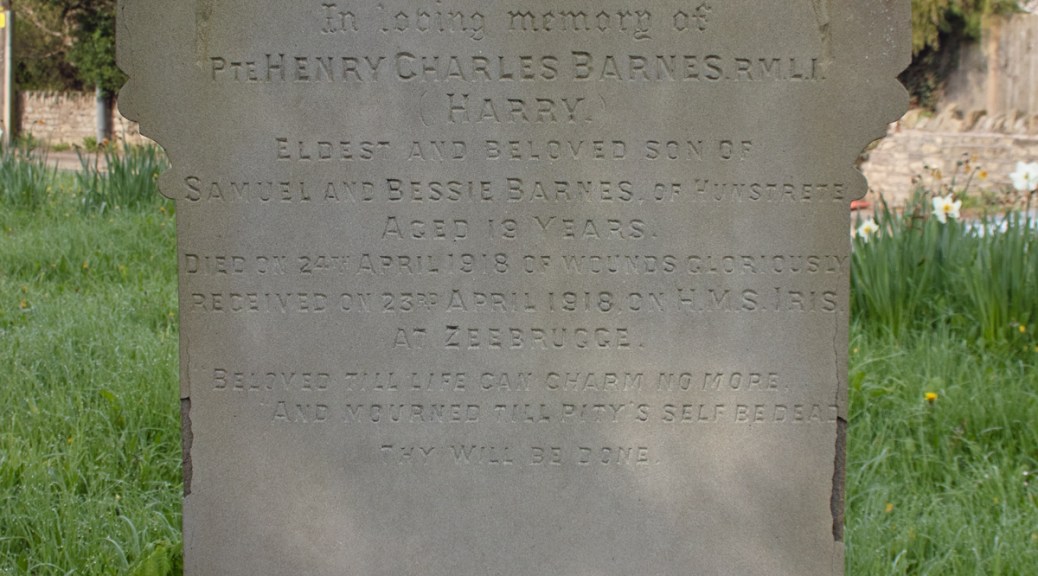
Hunstrete, Pensford was plunged into sorrow, not unmixed with pride, when is became known that one of its lads Pte. HC Barnes, RMLI… had played a hero’s part in the now famous Zebrugge raid, where he was severely wounded in the head and shoulder, from which wounds he subsequently succumbed in Chatham Naval Hospital. Before joining up at the age of 17 years and two months he was employed to look after the famous poultry of Mr HLF Popham, of Hunstrete House, taking all the honours at the Crystal Palace during one show. He was first sent to Salonika but was invalided home with malaria and was on board the Iris during the raid. The deceased lad, who was 19, was brought home and his body laid to rest at St Peter’s, Marksbury.
Somerset Guardian and Radstock Observer: Friday 10th May 1918
Henry Charles Barnes was born on 5th December 1898 in the Somerset village of Hunstrete. Also known as Harry, he was the oldest of six children to coal hewer Samuel Barnes and his wife Elizabeth, who was better known as Bessie.
After his recovery from malaria, Private Barnes was assigned to HMS Iris, a Mersey ferry requisitioned by the Royal Navy for support in the planned raid on Zeebrugge.
On 23 April 1918, Iris was towed across the English Channel to Zeebrugge by HMS Vindictive; she was carrying a couple of platoons of the 4th Battalion of the Royal Marines as a raiding party. When the Vindictive neared Zeebrugge she cast the ferry aside. Iris tried to pull up to the breakwater under heavy fire in order to off-load the raiding parties which were on board. She sustained heavy fire and a shell burst through the deck into an area where the marines were preparing to land. Forty-nine men were killed, while others, including Harry, were badly injured.
Medically evacuated to Britain, Private Barnes was admitted to the Royal Naval Hospital in Chatham, Kent, but his injuries were too severe, and he died on the day after the raid.
Henry Charles Barnes was laid to rest in the graveyard of St Peter’s church in Marksbury, the parish church for the family’s home in neighbouring Hunstrete.











 Death and Service