David William Slocombe was born on 9th November 1893, the oldest of seven children to William and Kate. William was a tin worker from Huntspill, Somerset, and it was in nearby Highbridge that the family were born and raised.
David appears to have been a bright lad, receiving a sponsorship from the King James Foundation to attend Dr Morgan’s School in Bridgwater. He spent six years there, from September 1906 to July 1912, and went on to become a customs and excise clerk when he left.
When war arrived in Europe, David was called upon to play his part. He initially enlisted on 1st December 1915, but was placed on reserve for nearly a year. His service records show that he was 22 years of age and 5ft 8.5ins (1.74m) tall. When he was finally mobilised, he was given a commission in the Royal Flying Corps.
At this point, David’s trail goes cold. Later documents confirm that he transferred across to the Royal Air Force when it was founded in April 1918, and that he rose to the rank of Lieutenant. He served in France and Italy and, by the end of the war, was attached to the 44th Training Depot Station in Oxfordshire.
By the autumn of 1918, Lieutenant Slocombe had come down with pneumonia. He was admitted to the 3rd Southern General Hospital in Bicester, and this is where he was to breathe his last. David died on 24th October 1918, aged just 24 years old.
David William Slocombe was brought back to Somerset for burial. He was laid to rest in Highbridge Cemetery.
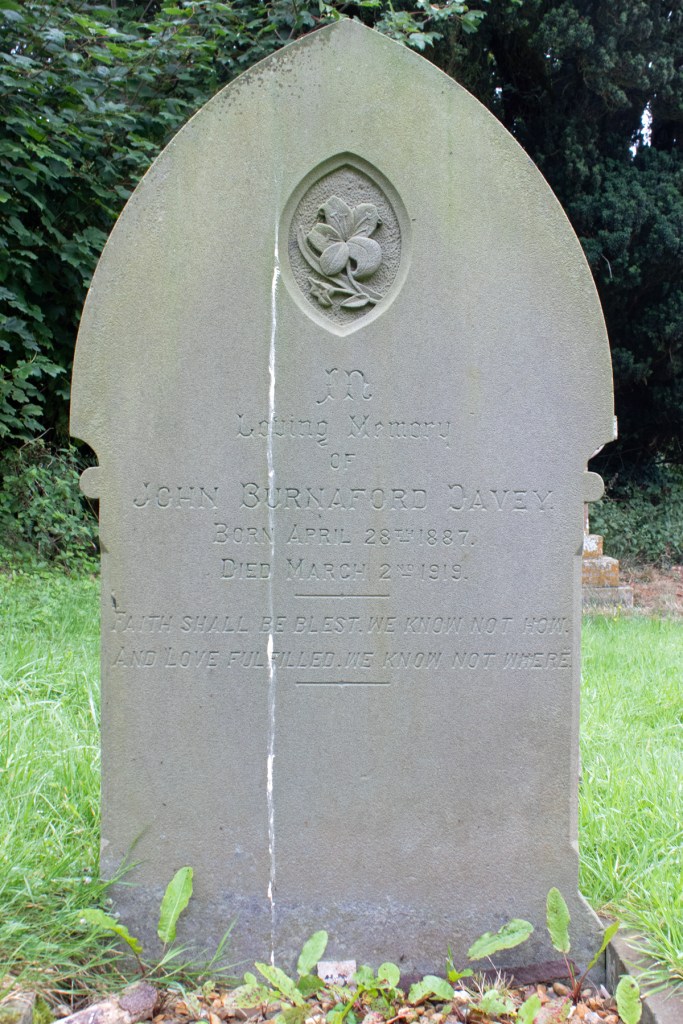
John Burnaford Davey was born on 28th April 1887 in Cannington, Somerset. The youngest of nine children, his parents were farmers Thomas and Emma Davey. Emma died in 1899, and the next census, two years later, found John and two of his siblings living with their father at Beere Manor Farm on the outskirts of the village.
John’s trail goes cold at this point, and it seems that he may have emigrated to South Africa. When war broke out, he enlisted in the Natal Light Horse, and was awarded the 1915 Star in Pretoria for his involvement in fighting in Africa. Private Davey’s troop later moved to England, and it was here that he transferred to the Royal Field Artillery.
The move, in September 1915, included a promotion to Second Lieutenant. Within a couple of years his dedication meant that he advanced to the rank of Lieutenant. By this point, John was based in London, and it was here, on 16th July 1917, that he married Katherine Trayler, a tanner’s daughter from Bridgwater, who had gone on to become a teacher of gymnastics. The couple went on to have a daughter, Jean, who was born in November 1918.
Illness caught up with John and, with the Armistice signed, he was invalided out of service on 8th February 1919. The family were now living in Bridgwater, and this is where John returned. His time back with family was to be tragically short, however, as he passed away just weeks after leaving the army, on 2nd March 1919. He was 31 years of age.
John Burnaford Davey was laid to rest in the peaceful graveyard of St Mary’s Church in Holford, Somerset.
Arthur Edward Devas was born in Devizes, Wiltshire, on 29th July 1877. One of ten children, his parents were Reverend Arthur Devas and Louisa. Arthur Sr was chaplain at the County House of Correction, the prison a short walk away from the family home, over the Kennet and Avon Canal. The 1881 census showed the Devas’ were living to the south of the town centre, and were supported by three servants.
Arthur standing as a vicar’s son earned him an education. He was sent to the prestigious Haileybury College in Hertfordshire. When his father died in 1901, he felt a pull to see more of the world, and joined the army. Enlisting in the Essex Regiment in September 1902, he was taken on as a Second Lieutenant.
Promoted to the rank of full Lieutenant in January 1906, the next census, in 1911, recorded Arthur at the Warley Barracks in Billericay. When war broke out in August 1914, he was based in Mauritius: he remained there for the next five months, before his battalion – the 1st – were brought back to England.
Setting up camp in Banbury, Oxfordshire, the aim was to train the battalion in readiness for an assault in Gallipoli. For Lieutenant Devas, however, this was not to be. He had fallen ill on the journey back to Blighty and, having contracted typhoid, he was admitted to the 3rd Southern General Hospital in Oxford. He died at the hospital on 15th February 1915, at the age of 37 years old.
Louisa and some of her children had moved to Minehead, Somerset, after her husband’s death, and this is where Arthur Edward Devas’ body was brought for burial. He was laid to rest in the extensive Minehead Cemetery, to be reunited with his mother when she passed away some eighteen years later.
The death of Capt. James Wilson Pettinger has taken place in a military hospital at Aldershot. Captain Pettinger came to Kingsbridge [Devon] in 1903, entering into partnership with Dr D de Courcy Harston… He made a wide circle of friends, and was appreciated for his professional skill. Previously to coming to Kingsbridge, he was house surgeon at St George’s Hospital, London. In July 1915, Dr Pettinger volunteered for service in the Royal Army Medical Corps, being appointed Lieutenant to the Plymouth Military Hospital. He quickly gained promotion to captain, and was appointed to a hospital ship, and served in the Mediterranean for several months. He contracted blood poisoning in the arm, and was sent to Netley Hospital [Hampshire]. On recovery he was placed in charge of an infections hospital for several months at Salisbury. He was later ordered to France, and being taken ill was transferred to an Aldershot hospital, where he died from pneumonia. He leaves a widow and one son. Dr Pettinger was 43 years of age.
Western Times: Tuesday 16th October 1917
James Wilson Pettinger was born in the spring of 1874 in Moss Side, Lancashire. The youngest of four children, his parents were doctor and surgeon George Pettinger and his wife, Sarah.
James may have been a sickly child: the 1901 census recorded him as being a patient in community hospital in North Meols, near Southport, Lancashire. The oldest of only three patients, the facility was overseen by caretaker John Carr and his matron wife, Susan.
Having gone on to study at Cambridge University, James was carving a career for himself. By the time of the next census he was living in Shaftesbury, Dorset, he was recorded as being a medical practitioner, living on his own in a house near the centre of town.
As the Western Times was to report, James moved to Devon in 1903. On 8th January, he married Clara Risdon, a nursing sister seven years his sister. She came from the Somerset village of Old Cleeve, and the couple married in her local parish church. The couple set up home in Ewart House in Kingsbridge, and went on to have a son, Geoffrey, who was born that November.
James’ career continues to flourish. The 1910 medical directory noted that he was the Honourable Medical Officer for Kingsbridge & District Cottage Hospital, and noted that he had previously worked as an Honourable Physician, Honourable Surgeon, Ophthalmologist, Aural, Obstetric and Dental Assistant and Assistant Surgical Registrar at St George’s Hospital in London.
Little information relating to James’ time in the armed forces is available, and so it falls to his obituary in the Western Times to fill in the gaps. It would seem that Clara and Geoffrey moved to Minehead, Somerset, while James was serving overseas. The town was not far from where she had been born, and family connections may have helped with her husband’s absence.
When James Wilson Pettinger died, on 6th October 1917, his body was brought to Minehead for burial. He was laid to rest in the town’s sweeping cemetery, and was joined there by Clara when she passed away in 1945: a husband and wife reunited.
News has been received at Bathpool, Taunton, that Lieutenant HB Redler, MC (RAF), was killed while flying at Turnberry, near Ayr. Lieutenant Redler, who was 21 years of age, was the eldest son of Mr and Mrs DB Redler, of Moorreesbury [sic], South Africa, and formerly of Bathpool, Taunton, and he sailed from South Africa with a schoolfellow at the end of 1915, at the age of 18, in order to join the Royal Flying Corps. On arrival in England they found no vacancies, and entered the Artists’ Rifles OTC, from which they joined the RFC. After obtaining his commission, Lieut. Redler spent a few months in France last year, and was then sent to Ayr as a fighting instructor. In March of this year he was sent to France for a six weeks’ course, during which he won the Military Cross, and it is believed that his record will show a total of nearly twenty enemy machines brought down.
Taunton Courier and Western Advertiser: Wednesday 3rd July 1918
Harold Bolton Redler was born in Worcester, Worcestershire, on 27th January 1897. The oldest of five children, his parents were Daniel and Annie. Daniel was a flour miller from Devon, and the family had moved to Worcester the year before Harold was born.
In 1903, the Redlers emigrated to South Africa. Initially settling in King William’s Town (now Qonce), they moved to Moorreesburg after the birth of Harold’s youngest sibling, Norman, in 1906.
Harold was educated at the Bishops Diocesan College in Rondebosch, Cape Town, and it was from here that he and his friend decided to step up and serve their King and Empire. Sadly, his service records have been consigned to history, and only the newspaper report remains to piece together his time in service.
Lieutenant Redler’s awarding of the Military Cross, however, is documented:
For conspicuous gallantry and devotion to duty. He encountered four enemy two-seater machines and attacking the lowest drove it to the ground with its engine damaged. Later he attacked one of five enemy two-seater machines and drove it down out of control. He has destroyed in all three enemy machines and driven three others down out of control. He continually attacked enemy troops and transport from a low altitude during operations and showed splendid qualities of courage and determination throughout.
London Gazette: 22nd June 1918
On the morning of 21st June 1918, Lieutenant Redler was flying a de Havilland DH9 aircraft, accompanied by Captain Ian Henderson. The plane was fitted with a Lewis gun, which the pair were testing. At 10am, the aircraft crashed, and both were killed. No immediate cause was identified, and their RAF cards record an open verdict. Harold was just 21 years of age.
With his parents and siblings in South Africa, Harold Bolton Redler’s body was taken to Somerset for burial. He was laid to rest with his paternal grandparents in the peaceful St Augustine’s Churchyard in West Monkton.
Vincent Charles Serocold Mellor was born in Chelsea, Middlesex, in the spring of 1897. The younger of two children, his parents were Chief Solicitor to the Treasury – and later Sir – John Paget Mellor and his Australian-born wife, Mabel. The 1901 census recorded the family living on Chelsea Embankment, with four servants: a cook, a nurse and two housemaids.
For someone with a relatively high standing in Edwardian England, there is surprisingly little documentation relating to Vincent – who was known as Vin. His name does not appear in the 1911 census, although nor does his family.
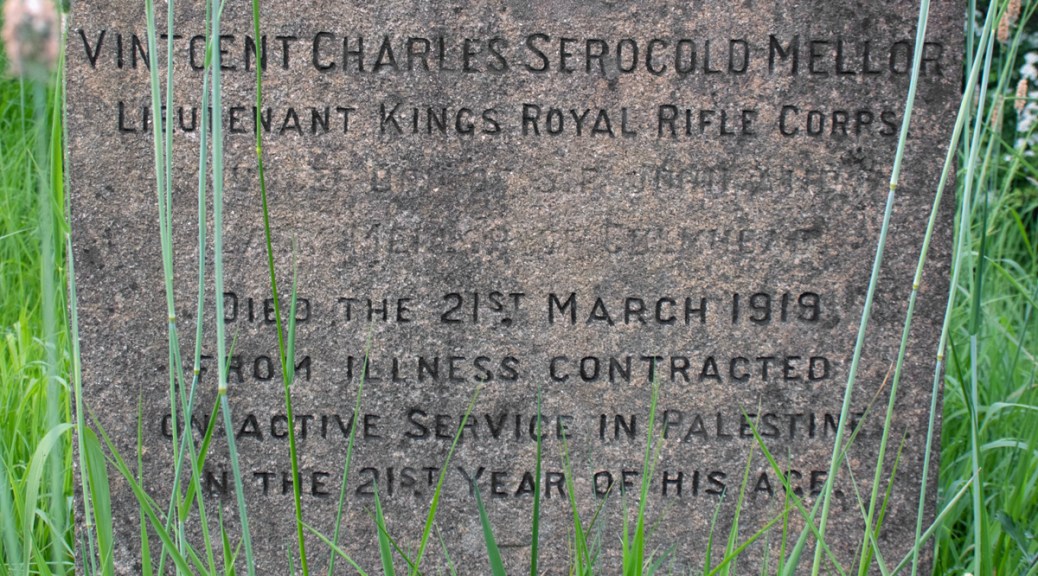
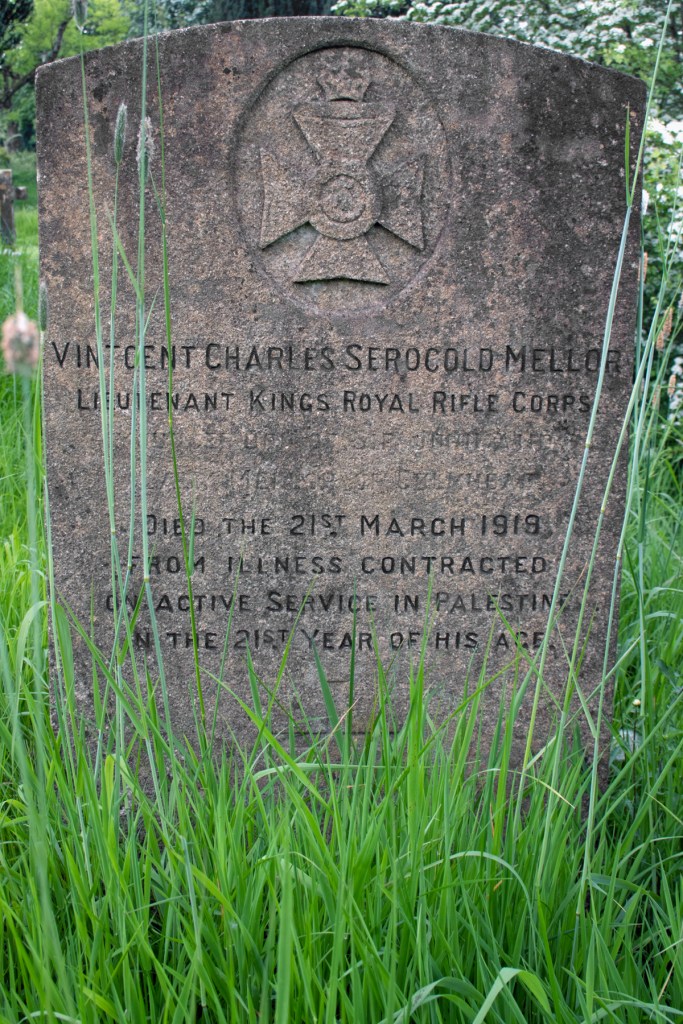
At some point, Vincent was given a commission in the King’s Royal Rifle Corps, but his service records are lost to time, which makes it impossible to find any specific information about his military career. Lieutenant Mellor’s headstone confirms that he served in Palestine, and that he fell ill while in the Middle East.
Vincent returned to Britain for treatment, and was admitted to the Red Cross Hospital for Officers in Portland Place, London. Whatever his condition, he was to succumb to it: he passed away on 21st March 1919, aged just 20 years of age.
Vincent Charles Serocold Mellor was brought back to Somerset for burial. He was laid to rest in the peaceful graveyard of St Paul’s Church in Churchstanton, close to the family’s country home, and the same church in which he had been baptised two decades before.
Frederick Murray Walker was born on 29th July 1862 in the village of Terregles, Kircudbrightshire, Scotland. The fifth of eleven children, his parents were Colonel Sir George Gustavus Walker, Member of Parliament for Dumfries & Galloway, and his wife, Anne. Sir George owned the Crawfordton Estate, and this is where Frederick was raised, with a retinue of fourteen staff to help the family.
Following his father’s military career, Frederick felt a draw to serve. On 15th July 1875, he entered the Royal Navy as a Midshipman. He set out to build a dedicated career, visiting most parts of the world in the process.
While Frederick’s initial service took him to the Mediterranean – where he received the Egyptian Medal and Alexandria Clasp – by 1883 he was out in China, but he also spent time in India and South Africa. In 1882 he was promoted to Sub Lieutenant, three years later he rose to the rank of Lieutenant. By 1899, Frederick had become a Commander.
By his own request, Frederick retired from the Royal Navy on 1st August 1909. He was now 47 years old, and had spent 34 years in service and was given the rank of Captain as a mark of his career.
On 19th June 1891, Frederick had married Lucy Scriven in St Saviour’s Church, Paddington, London. They would go on to have seven children, and to begin with, the life of a Naval Captain took Lucy around the coastal ports of Southern England. When Frederick retired, however, the family settled in a large house in Milford-on-Sea, Hampshire, where they were supported by a governess, cook, parlour maid and housemaid.
When war broke out in 1914, Captain Walker stepped up once more to serve his King and Country. He remained in territorial waters and was given successive command of the yachts James, Zaria and Albion III. By 1917, Frederick’s health was beginning to suffer, and he was placed on HMS Victory’s reserve books, ready should Portsmouth’s Royal Naval Dockyard need his service.
Frederick was not to be called to action again. By the time the Armistice was declared Frederick’s condition was worsening. He had developed cancer of the tongue, and it was having a real impact. He was admitted to the Haslar Hospital in Portsmouth, and passed away there on 7th February 1919, at the age of 46 years old.
By this point the family had relocated to Bath, Somerset, and this is where Frederick Murray Walker’s body was brought for burial. He was laid to rest in the prestigious Lansdown Cemetery, overlooking the city.
Edward Owen Bending was born early in 1891, one of seven children to Edward Bending, who was from Bath, Somerset, and Emma, who came from Castle Cary.
Edward Sr worked on the railways, and the family moved across the county with his work: the 1891 census recorded them living in Edington, while he worked as a signalman in nearby Ashcott; ten years later, the family had moved to Bridgwater with his job. The 1911 census return recorded the Bendings as living in Station House, Wellow, with Edward now employed as the station master.
Edward Jr, who was sometimes known by his middle name to avoid confusion with his father, was also employed at the station, where he was working as a clerk. War was coming to Europe, however, and he stepped up to play his part for King and Country.
Edward enlisted in the King’s Royal Rifle Corps as a Rifleman, and was attached to the 60th Rifles. Full details of his military service are lost to time, but a contemporary newspaper report notes that he served both in the Balkans and in France. During his time in the army, he was promoted to the rank of Lieutenant, but contracted an illness, and was invalided out of service.
Whatever his illness, it was to get the better of him: Lieutenant Bending passed away at home on 24th January 1919. He was just 28 years of age.
Edward Owen Bending was laid to rest in the peaceful Wellow Cemetery, overlooking the village where his family still lived.
Edward’s was a family plot. When his younger sister Winifred died just three years later, she was buried with him. When his mother, Emma, passed away in 1924, she was laid to rest in a neighbouring plot.
Edward Bending Sr lived on until 1938. The newspaper report of his funeral, gives an insight into the family man he was:
A native of Combe Down, where his father carried on business as a tailor, Mr Bending spent all his working days in the employ of the Somerset and Dorset Railway. For a time he worked as a reliefman, and later was appointed stationmaster at Cole, being transferred in 1907 to Wellow, where he took part in all the village activities.
In 1920 he was transferred to Stallbridge, Dorset, but after about four years there had to relinquish work just before reaching retiring age, owing to an attach of rheumatoid arthritis. Since then he had been unable to get about and he stayed with his eldest daughter at Reading for a time.
For the past seven years he had stayed at the residence of his younger daughter at Burnham-on-Sea. Unfortunately the malady affected his sight, and for eight years he had been blind, yet throughout his last years his cheerful disposition never failed him, and he was his old self to the last, being keenly interested in his wireless, which brought him such happiness.
His wife died in 1924, and his younger son, Lieut. Edward Owen Bending, King’s Royal Rifle Corps, lost his life in the war; his name is to be found on the War Memorial at St Julian’s Church.
Mr Bending’s elder son, Hubert Alan Bending, is head master of St Julian’s school, Shoscombe. He is also survived by two of his four daughters.
Somerset Guardian and Radstock Observer: Friday 24th June 1938
While Wellow Station was a bustling place, it is highly likely that Edward Jr would have known Leonard Luke, one of the porters at the time Edward Sr was station master. Leonard also went off to war, and his story can be found here.
Wellesley Lyndoch Henry Paget was born on 2nd March 1858 in Belgaum, India. The sixth of nine children – all boys – his parents were Leopold and Georgina Paget. Leopold was a Colonel in the Royal Artillery, and Wellesley was always destined to follow a military career.
The young Wellesley was schooled at Wellington College, Sandhurst and, went straight into the army: the 1881 census records him as being a Lieutenant in the Royal Artillery, based at the barracks in Newcastle-upon-Tyne. While a baptism record confirms the location of his birth, Wellesley may have been prone to embellishment – the census record suggests he was born on board the ship HMS Charlotte, off Goa in the East Indies.
On 29th February 1888, Wellesley married Isabelle Swire, a merchant’s daughter from Liverpool. The couple made their vows in All Saints’ Church, Leighton Buzzard, presumably not far from where Lieutenant Paget was then based. The couple went on to have two children, Leo and Mary.
[Wellesley] became Adjutant of the Royal Horse Artillery in 1895… He served in the South African War, where he commanded the 2nd Brigade Division, Royal Field Artillery, and took part in the relief of Ladysmith and operations in Natal and in the Transvaal. He took command of the A Battery (the Chestnut Troop), Royal Horse Artillery, in 1900 and went on service with them in the North-East Transvaal. He was mentioned three times in dispatches for his services in South Africa, was promoted Brevet-Lieutenant-Colonel, and received the Queen’s Medal with six clasps.
Somerset Standard: Friday 21st June 1918
The now Major Paget returned to Britain, and set up home with Isabelle in Dorchester, Dorset. They lived comfortably in a villa in Cornwall Road, and had four servants – a nurse, a cook and two housemaids – to tend their needs.
Leo was sent away to school, and followed his father – and grandfather – into the army. He joined the Rifle Brigade, while his family moved to pastures new. By 1911, Wellesley and Isabelle had moved to Ireland, settling in the village of Ballyellis, near Mallow in County Cork. Again, the family had a retinue of staff, including a teacher for Mary, a cook, a kitchen maid, parlour maid and two housemaids.
Despite being in his fifties when war was declared in 1914, Wellesley stepped up again to play his part. With the rank of Brigadier General, he was again mentioned twice in dispatches for his actions, and was awarded the Companion of the Order of Bath in 1914, and made Companion of the Most Distinguished Order of Saint Michael and Saint George in the King’s Birthday Honours the following year.
By 1916, Wellesley seems to have taken a step back from military life. The Pagets moved to Somerset, setting up home in North Cheriton, near Wincanton. The Brigadier General kept himself busy, however, and, in 1917, was appointed Agricultural Commissioner for Somerset.
At this point, Wellesley Lyndoch Henry Paget’s trail goes cold. He passed away at his home on 11th June 1918, at the age of 60 years old. He was laid to rest in the North Cheriton Cemetery, not far from where his widow still lived.
Richard Avary Arthur Young Jordan was born on 24th May 1866 in Cashel, Tipperary, Ireland. His father, Richard Jordan, died a week after his son’s birth, leaving his mother, Annabella, to raise him.
The 1871 census records mother and son living in Woolwich, London, with Annabella’s widowed mother, Grace. They were obviously a well-connected family, with Grace living as an annuitant, or pensioner, one son a Surgeon Major in the army and another as a Colonel in a different regiment. Annabella herself was recorded as a landowner, and the family had support with a cook and housemaid living in.
Surrounded by army servicemen as he was, it is no surprise that a military career called to Richard. He enlisted on 10th November 1886, joining the King’s Shropshire Light Infantry as a Lieutenant. Assigned to the 1st Battalion, his service records confirm that he had attended Burney’s Gosport School – a military academy – and was 5ft 7.5ins (1.71m) tall.
Richard was sent to Egypt just before Christmas that year, and over the next five years, he served both there and in Malta. On 11th May 1889 he attained the rank of Captain and, in December 1891 he was sent further afield, to Hong Kong.
After three years in the Far East, returned to Britain, and spent the majority of 1895 back on home soil. His travels were not at an end, however, and by the end of the year, Captain Jordan found himself in India. He spent three-and-a-half years in the sub continent, returning to the UK in May 1899.
At this point, details of Richard’s life get a little sketchy. He seems to have settled in Pembroke Dock, South Wales, and, on 18th April 1904, he married Ella Mary Caroline Grove. She was eight years his junior, and the daughter of a late Lieutenant in the Highland Light Infantry. The couple married at St George’s Church, Hanover Square, London.
Richard’s trail goes gold again, for a couple of years. He retired from the army on 8th August 1906, after nearly twenty years’ service. By the time of the 1911 census, he and Ella had set up home in Heywood House, on the outskirts of Tenby, Pembrokeshire, with two servants – Beatrice and Edith – as two live-in staff.
War came to Europe in the summer of 1914, and Richard seemed to keen to play his part once again. He enlisted again in August 1915, and was assigned the rank of Major in his former regiment. While it is not possible to determine Major Jordan’s complete service at this time, he definitely arrived in France the following month. If he remained in France, it is likely that he saw fighting at the Somme in 1916, Cambrai in 1917 and at Lys and on the Hindenburg Line in 1918.
Again, Major Jordan’s post-war life remains tantalisingly elusive. By the summer of 1920, he and Ella were living at Holcombe Lodge in Bathampton, on the outskirts of Bath. It was here on 14th June, that Richard passed away. He was 54 years of age.
Despite all his travelling, it seems that Ella was comfortable living in Bathampton, and this is where she laid her late husband to rest. Richard Avary Arthur Young Jordan was buried in the graveyard of St Nicholas’ Church in the village.
The widowed Ella married again, to Captain Clare Garsia, on 9th October 1921. She remained in Bathampton, and lived to the age of 77, passing away on 13th August 1951. She was laid to rest in the same plot as her late husband.
When Captain Garsia died the following year, he was also buried in St Nicholas’ Churchyard, in a neighbouring plot to his beloved Ella.