Category Archives: Private

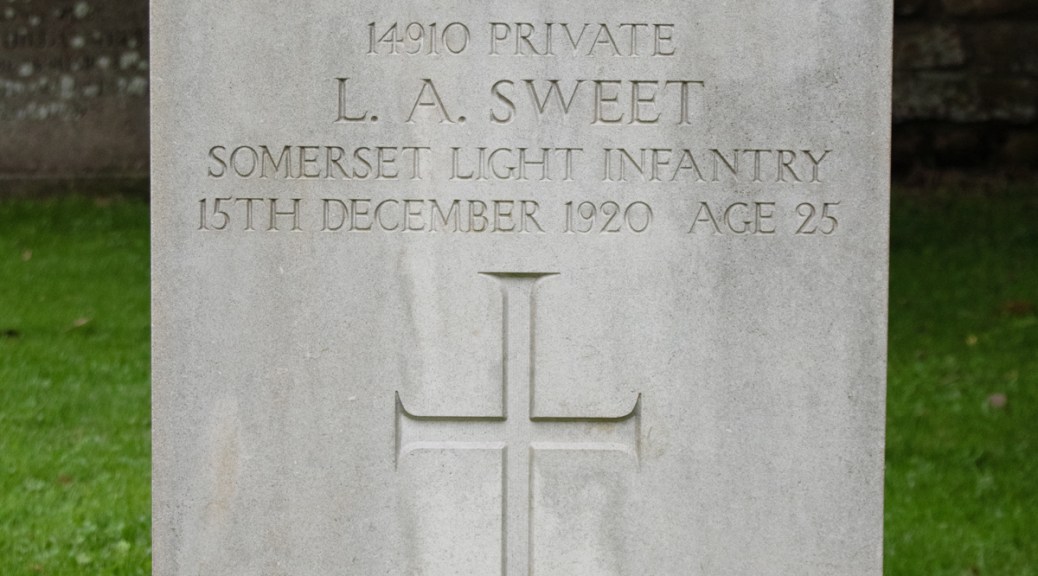
Private Lawrence Sweet

Private Lawrence Sweet

Lawrence Allen Sweet was born on 28th May 1895, one of fourteen children to Thomas and Caroline Sweet. Thomas was a farm labourer from Somerset, and the family were raised in the village of Norton-sub-Hamdon, near Yeovil.

Lawrence found work on the farm – the 1911 census shows him living with his now-widowed mother, where he was employed as an ‘improver to poultry house and building’. Three of his older brothers were also living there, and all were employed in farm work.

War was coming to Europe, and Lawrence played his part. Full details of his military service no longer remain, but those that remain confirm that he enlisted in the Somerset Light Infantry in the spring of 1915, and was assigned as a Private to the 6th (Service) Battalion of the Somerset Light Infantry.

Sent to France on 21st May, Private Sweet saw action on the Western Front. His regiment was involved in the Battles of the Somme, Arras and Ypres and he earned the Victory and British Medals and the 1915 Star for his service.

Towards the end of 1917, Lawrence contracted pleurisy; invalided home, he was ultimately discharged from the army on medical grounds the following January.

At this point, Private Sweet’s trail goes cold. The next document confirms that he passed away on 15th December 1920, at the age of 25 years old. No cause of death is evident, but is seems likely to have been connected to his previous lung condition.

Lawrence Allen Sweet was laid to rest in the graveyard of St Mary’s Church in his home village of Norton-sub-Hamdon.


Lawrence Sweet1
Lawrence Allen Sweet
(from ancestry.co.uk)

Private William Eglon

Private William Eglon

William Ernest Eglon (also known as Ernest William Eglon) was born in the Somerset village of Stoke-under-Ham (or Stoke-sub-Hamdon), in the spring of 1898. One of five children, his parents were stonemason Arthur Eglon and his glovemaker wife Sarah Elizabeth Eglon (who was better known as Bessie).

Unfortunately, little information on William’s early life remains documented. When war broke out, he was working at the Co-operative Bakery in the village. He was keen to do his bit, however, and enlisted in the Royal Army Service Corps as a Private not long after his eighteenth birthday.

Private Eglon was sent to serve in Essex, working as a baker in the Supply Section there. Within a couple of weeks of arriving, however, he was admitted to the Field Hospital in Chelmsford. He was suffering from an ear infection, and this turned out to be significant enough for him to be transferred to the Horton County of London War Hospital in Epsom.

William developed an abscess in the temporo sphenoidal region of his skull (in front of his right ear), which was operated on on the 27th May 1917. By this time meningitis had set in and, despite a second operation just over a week later, the conditions took hold.

Private Eglon passed away at 9:55am on 11th June 1917. He was just 19 years of age.

William Ernest Eglon’s body was brought back to Stoke-under-Ham for burial. He lies at rest in the family plot in the graveyard of St Mary’s Church in the village.


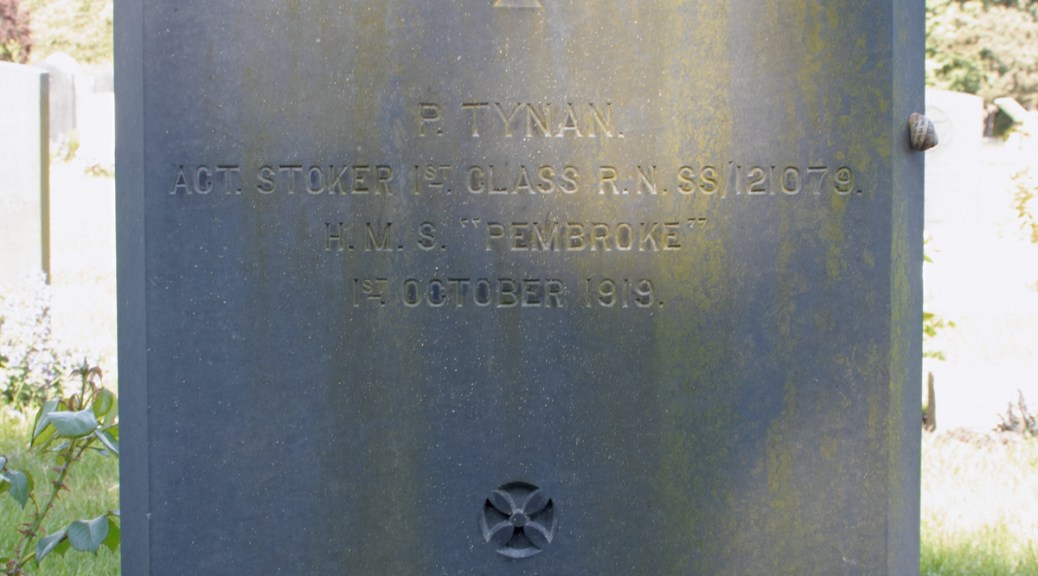
Stoker 1st Class Patrick Tynan

Stoker 1st Class Patrick Tynan

Patrick Tynan was born in Roscrea, Southern Ireland, on 9th June 1893. He was the eldest of four children to John and Anne Tynan, but sadly, there is no further information available for his early years.

Patrick’s story really picks up on 14th December 1915, when he joined the Royal Engineers as a Private. His service record states that he was living in Bangor, Gwynedd, and that he was a stall keeper at a fairground – a subsequent document noted his trade as a showman. He was noted to be 5ft 8ins (1.72m) tall, weighed 151lbs (68.5kg), and had numerous scars on his back.

Private Tynan did not stay in the UK for long. Assigned the new role of Driver, he was attached to the GHQ Signal Company and sailed from Devonport on 30th June 1916, bound for Mesopotamia. Arriving in Margil – the port connected to Basra – he was based here for more than a year, before moving north to Baghdad.

By this time, Patrick had risen to the rank of Lance Corporal, and was obviously a trustworthy member of the company. Towards the end of 1917, he had again been promoted, this time to Corporal.

During his time in modern day Iraq, Patrick was admitted to hospital a handful of times; there is little information on the conditions he suffered, but none appear to have been life threatening, as they were only for short periods. It’s also interesting to find that his service records confirm a month’s leave in May 1918, spent in India.

When the war came to a close, Corporal Tynan was still in the Middle East. Ready to be demobbed, his company moved to India and boarded the SS Chupra in Calcutta on 26th February 1919, bound for home.

Back in the UK, however, Patrick was not ready to give up the formal military life. Having returned to Gillingham in Kent, where the Royal Engineers were based, he initially found work as a tram conductor, but soon signed up for a five year term with the Royal Navy as a stoker.

He was based on HMS Pembroke II, the shore-based establishment at Chatham Dockyard, but sadly, his time in the navy was to be a short one. Admitted to the Royal Naval Hospital in the town with pneumonia, he passed away form the condition on 1st October 1919. He was just 26 years old.

Patrick Tynan was laid to rest in the Woodlands Cemetery in Gillingham. He had a short but full life, something his modest gravestone doesn’t begin to hint at.


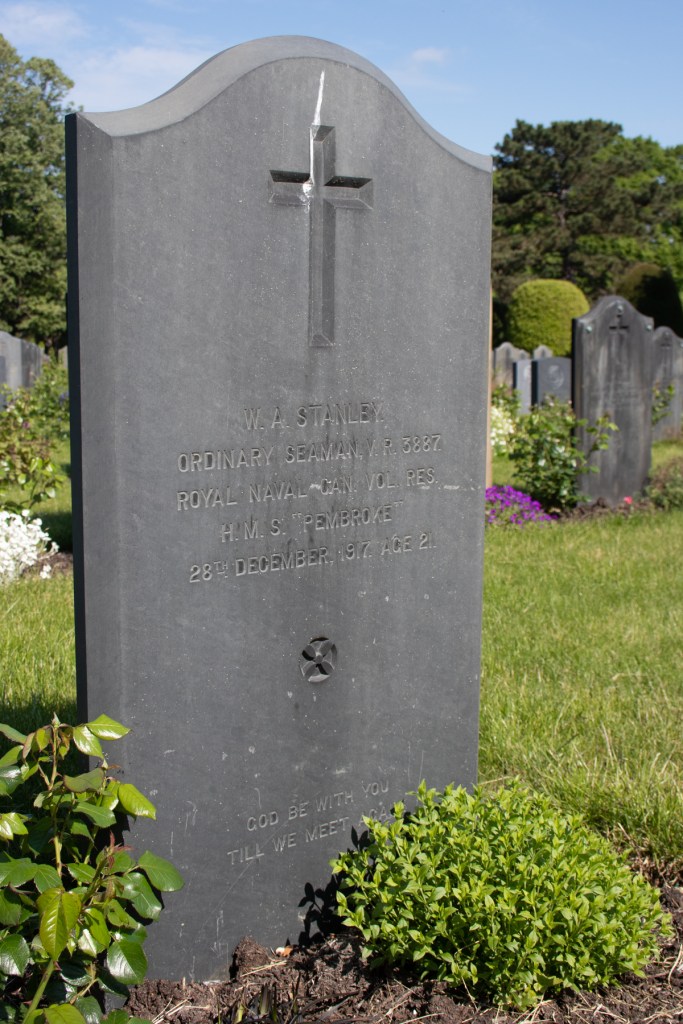
Ordinary Seaman William Stanley

Ordinary Seaman William Stanley

William Alfred Stanley is one of those names that seems destined to be lost to the annuls of time. Little documentation exists for his early life, but what there is gives some hints at a determined young man.

William was born in London to an Annie Stanley, who lived in the Kentish Town area of the city. At some point, he emigrated to Canada as, according to his wartime enlistment papers, he joined up in Ontario.

William enlisted in the Canadian Expeditionary Force on 5th November 1915, and was initially assigned to the 44th Battalion of the Canadian Infantry. His troop embarked for England in July 1916, and, on his arrival he was transferred to the 98th Battalion.

It was at this point that things too an unusual turn. With a few months, Private Stanley was again transferred, this time to the 19th Battalion, and then again to the 4th Reserve Battalion from where he was discharged from the Canadian Infantry in February 1917 for being underage.

At this point, William seems to have been undeterred.

The next record for him – in fact the memorial to him – is his headstone. This confirms that he had enlisted in the Royal Naval Canadian Voluntary Reserve as an Ordinary Seaman. He was based at HMS Pembroke, the shore establishment at Chatham Dockyard, but there is no other information for him.

Ordinary Seaman Stanley died on 28th December 1917, at the age of 21. (His previous military discharge might suggest that he was, in fact, younger than this, but that is conjecture on my part.) There is no record of a cause of death and nothing in contemporary newspapers to suggest anything out of the ordinary.

William Alfred Stanley was laid to rest in the Woodlands Cemetery in Gillingham, Kent, not far from the Naval Dockyard where he had been based.


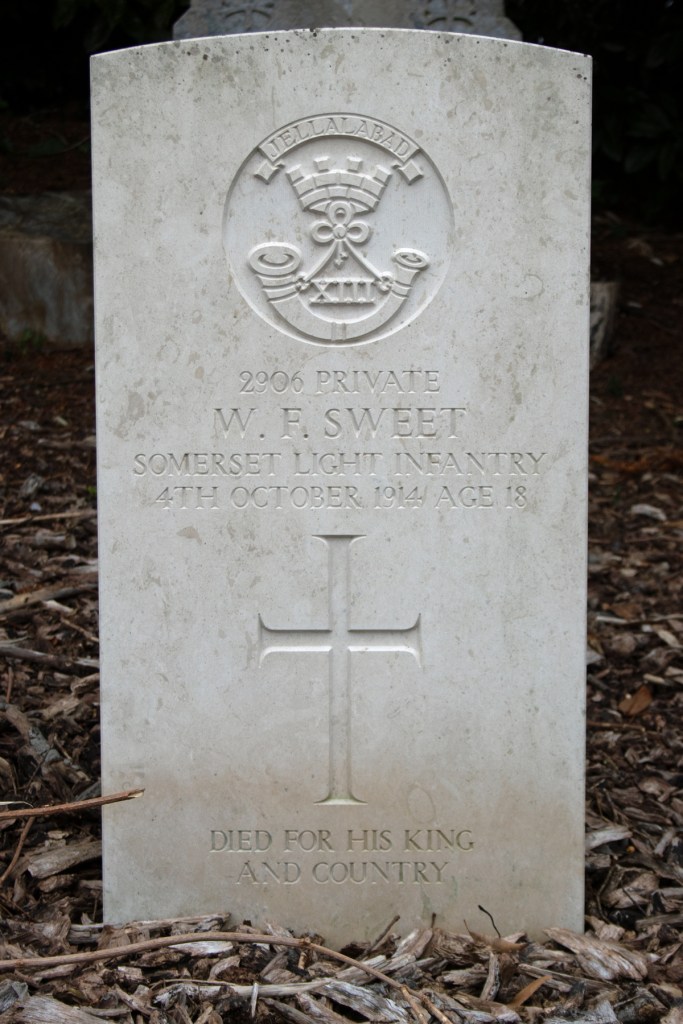
Private William Sweet

Private William Sweet

William Frank Sweet was born towards the end of 1897 and was the youngest of seven children. His father, Richard, was a groom and, together with his wife, Mary, he raised the family in the Somerset town of Yeovil.

When William left school, he found work as an errand boy for a tailor; by the time of the 1911 census, Richard was working as a coachman for a hotel, and the family were living in a house on the north side of the town.

There is very little other documentation on young William’s life. When war broke out, he enlisted in the Somerset Light Infantry, and was assigned to the 5th Battalion, who were based in Taunton.

Further information on Private Sweet is scarce; given when he died, it is likely that he enlisted as part of the first wave of voluntary recruiting. It is also likely that, when he was training at the Tidworth Barracks on Salisbury Plain, he came down with some illness, and it was this to which he succumbed.

William Frank Sweet died on 4th October 1914, at the age of just 17 years old. His body was brought back to Yeovil, and he was buried in the town’s cemetery on 10th October, the day after his Battalion set sail across the English Channel to join the onslaught.


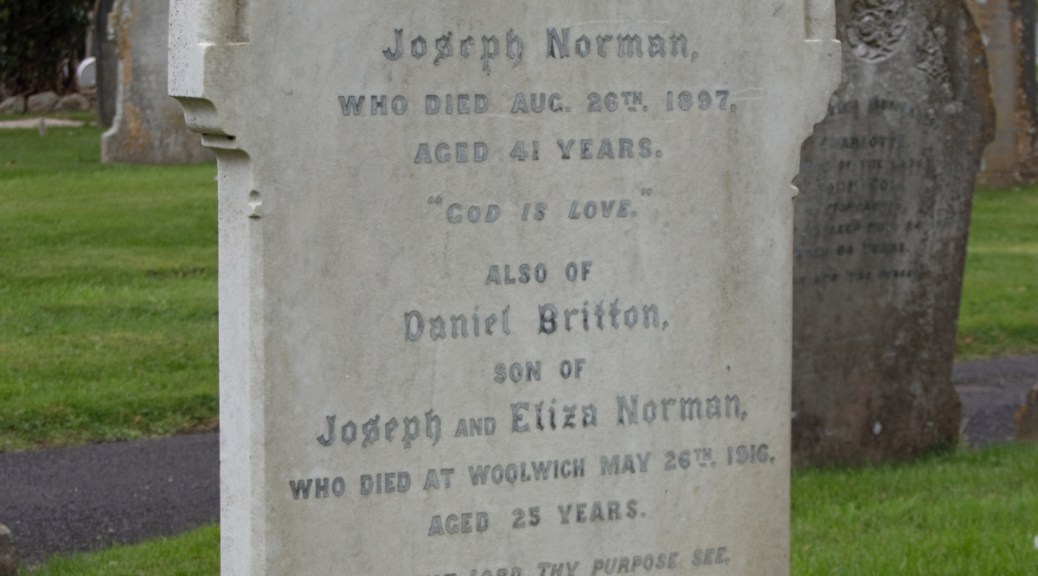
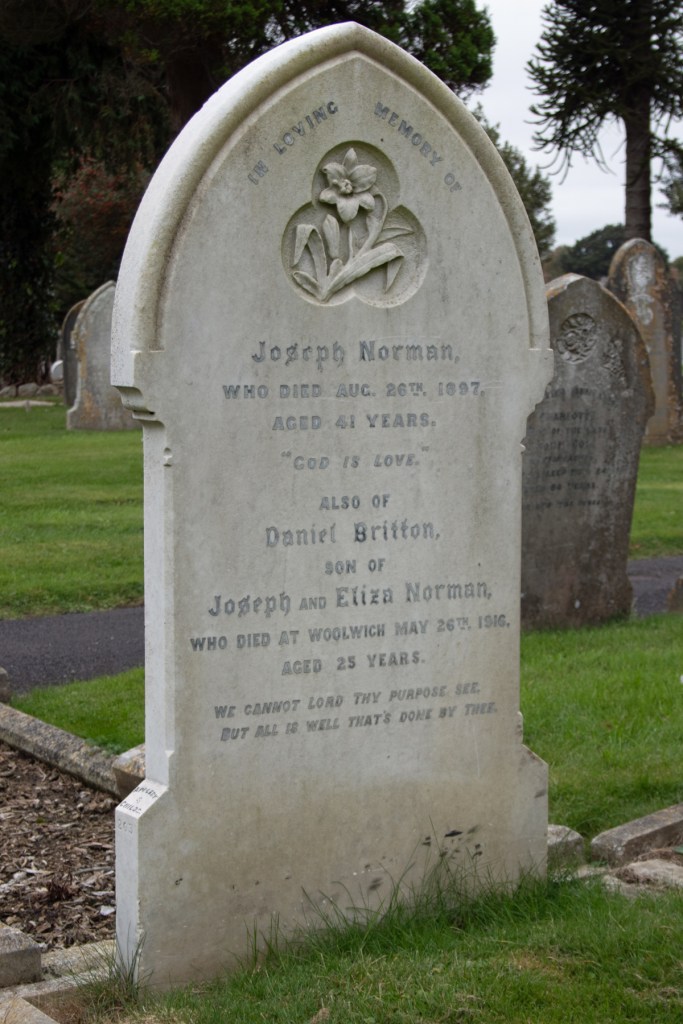
Private Daniel Norman

Private Daniel Norman

Daniel Britton Norman was born in Yeovil, Somerset, in early 1891, the youngest of four children. Joseph and Eliza Norman, Daniel’s parents, ran the Blue Ball Inn in the town centre, something Eliza took over when her husband died.

There is little information on Joseph’s passing, but a report in the local newspaper may allude to what led to his death:

On Friday [16th January 1891], Mr J Norman, of the Blue Ball Inn, was riding in a waggon through the Borough when he was jerked off onto the road. One of the wheels passed over his right leg, breaking a vein.

Western Chronicle: Friday 23rd January 1891

By the time of the 1911 census, Eliza too had given up the reins of the Blue Ball Inn. At the age of 59, she was living with her two sons in a house on the outskirts of the town; Daniel was listed as a motor mechanic, while his older brother Rowland was a cabinet maker.

War broke out and Daniel enlisted in April 1916. He joined the Royal Army Service Corps and was assigned to the Motor Transport Division. Based in London, Private Norman had received three weeks’ training, when he was taken ill.

Admitted to the Royal Herbert Hospital in Woolwich with cerebro-spinal meningitis, Private Norman quickly went downhill. He died in the hospital on 26th May 1916, aged just 26 years old.

Brought back to Yeovil, Daniel Britton Norman was buried in Yeovil Cemetery, alongside his father.


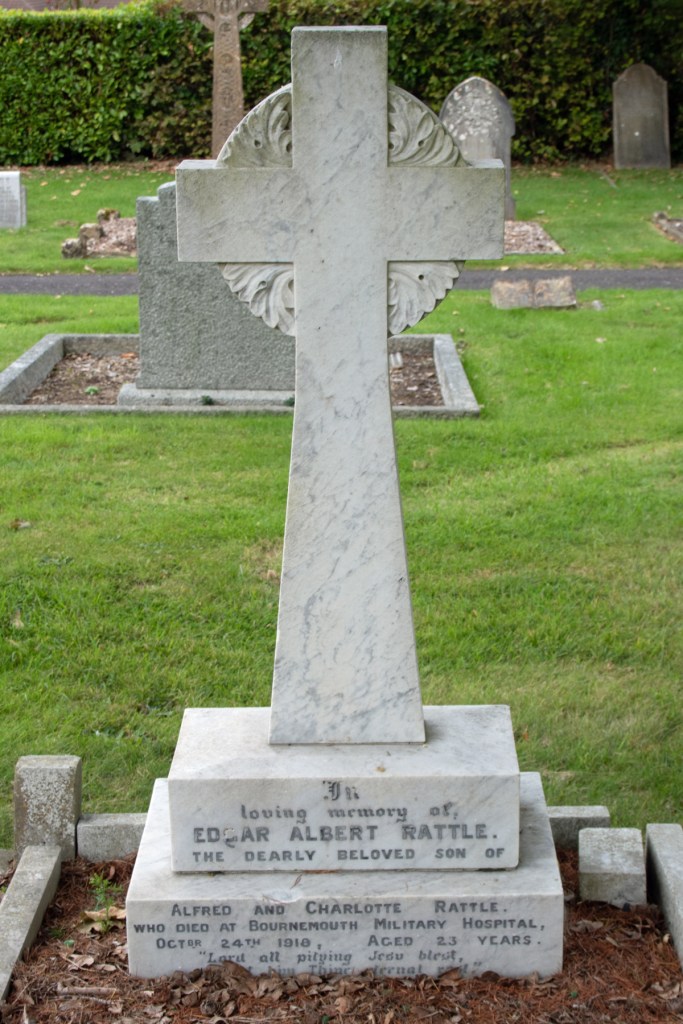
Private Edgar Rattle

Private Edgar Rattle

Edgar Albert Rattle was born in Yeovil, Somerset, in 1895, the youngest of three children to Alfred and Charlotte Rattle. Alfred was a railway porter from Yatton, who raised his family in a cottage near the centre of the town.

When he left school, Edgar found employment as an accounts clerk; by the time of the 1911 census, Alfred has moved from being a porter to collecting passengers’ tickets; the family lived in a terraced house next to the station where he worked.

War was on the horizon by now and, although Edgar’s full service records are no longer available, the documents that do remain give an indication as to his time in the army.

Private Rattle enlisted in the early stages of the war; he joined the Somerset Light Infantry in October 1914, although it is not clear which battalion he was assigned to. Later in the conflict, he had been attached to the Labour Corps, and spent some time working on a farm in Ilchester.

It was while in Ilchester in October 1918, that Edgar had some leave, and travelled to Dorset. He was taken down with pneumonia and admitted to the Bournemouth Military Hospital, but subsequently died, breathing his last on 24th October 1918. He was just 23 years of age.

Edgar Albert Rattle’s body was brought back to Yeovil for burial. He lies at rest in the town’s cemetery.


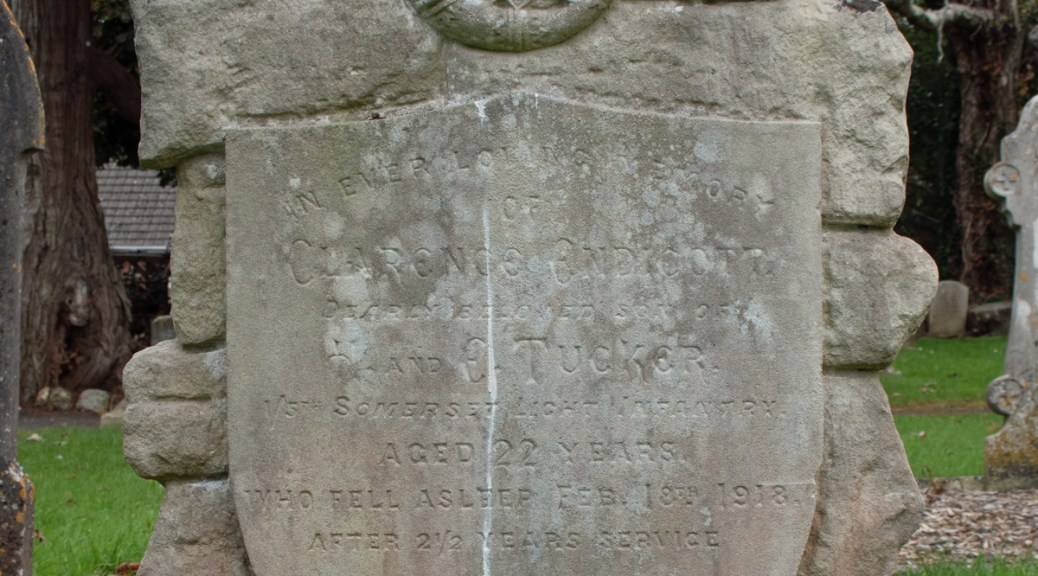
Private Clarence Tucker

Private Clarence Tucker

Clarence Endicott Tucker was born in the summer of 1895 and was the oldest of eight children (six of whom survived) to Samuel and Emma Tucker. Samuel was a sign writer from Axminster in Devon, although he had lived in Nottingham in the early 1890s, where he had met and married Emma, and this was where Clarence was subsequently born.

Within a couple of years, the family had moved to Yeovil, Somerset, where Clarence’s siblings were born and the family were raised. The 1911 census recorded the family as living in a house in the centre of town, the household comprising of Samuel, Emma, their six children and Samuel’s sister. Clarence, having left school, was working as a junior clerk for a cheese and butter merchant.

When war broke out, it was clear that Clarence was keen to play his part. He enlisted in September 1914 and joined the Somerset Light Infantry as a Private. It must has seemed an overwhelming experience as, within a month he was on board a ship headed for India.

Private Tucker spent more than two years serving with the 5th Battalion, before contracting tuberculosis. After six weeks in hospital, he was evacuated to Egypt and then back to England again. He was admitted to the Southern General Hospital in Bristol, where an assessment identified that he was no longer medically fit enough to serve in the army. He was discharged on 2nd April 1917, having served for three and a half years.

At this point Clarence’s trail goes cold. He died on 18th February 1918, at the age of 22 years old. There is no confirmation of the cause of his death, although it seems likely to have been related to the problems he had with his lungs.

Clarence Endicott Tucker lies at rest in the cemetery in the Somerset town he called home, Yeovil.


Private Cecil Sims

Private Cecil Sims

Cecil Frank Sims was born in the village of Manston, Dorset, towards the end of 1897. The youngest of six children, his parents were Henry and Ann Sims. Henry was a dairyman and, after his death in 1909, his wife continued in this line of the work.

Cecil was just 16 years old when war was declared, but he was keen to do his bit for King and Country as soon as he could. In May 1917, he joined the 2nd Battalion of the Royal Marine Light Infantry in Portsmouth.

Sadly, information on Private Sims dries up at this point. His service records no longer exist, and the only document that remains is his pension record. This confirms that he died on 11th February 1919 from ‘disease’, but there is no further information to be had. He was just 21 years of age.

Cecil Frank Sims was laid to rest in Yeovil Cemetery.


There is one other element that adds to Cecil’s family story. When researching the local newspapers for any reports on his funeral, an advert was posted just a few days before he passed:

Farmer’s son wanted: Willing to help on farm. Lodgings found close. Good place for willing chap, age 16 or 17 years preferred. SIMS, Poplars Farm, Yeovil Marsh.

Western Gazette: Friday 7th February 1919

It would seem that, if he was at home, Cecil’s health was weakening, and so extra support to manage the farm was being sought.


Private Joseph Dodge

Private Joseph Dodge

Joseph Dodge was born in the summer of 1883, and was one of twelve children, including eleven boys. His parents were David and Eliza Dodge, who raised their growing family in Stoke-sub-Hamdon, a few miles to the east of Yeovil, Somerset.

David was a mason and stone sawyer, but his children went into other roles when they left school; Joseph found work as an agricultural labourer.

In October 1903, Joseph married Elizabeth Ann Case – better known as Annie – who came from just over the Dorset border in the village of Corscombe. Setting up home in Yeovil itself, the couple went on to have two children – both boys – Walter and Norman.

War was coming to Europe, and Joseph was intent on doing his bit. Full service details are not available, but the documents that exist confirm that he enlisted as a Private in the Wiltshire Regiment. Initially assigned to the 1/4th Battalion (which served in Egypt), he transferred to the 2/4th Battalion (which served in India).

Sadly, there is no documentation to give service dates, it is impossible to establish when or if Joseph actually served in these locations. India seems likely, however, as he later transferred to the 1st Garrison Battalion of the East Yorkshire Regiment, which was based in Lucknow.

Private Dodge survived the war and came back to England, but seems to have contracted pneumonia on the journey home. Admitted to hospital in Liverpool, the condition sadly got the better of him. He passed away on 16th February 1919, at the age of 35 years old.

Joseph’s body was brought back to the county of his birth; he was laid to rest in Yeovil Cemetery.


Joseph came from a very patriotic family, and local newspapers early in the war highlighted that many of the Stoke-sub-Hamdon brothers had enlisted to serve King and Country.

At the time of the article, six had enlisted – Thomas, Arthur and Percy (all in the Somerset Light Infantry), Albert (West Somerset Yeomanry), Evan (Royal Navy) and David (Canadian Infantry).

Corporal David Dodge seems definitely to have distinguished himself. Having emigrated to Canada before the war, he returned to Europe when conflict broke out. An article in the Western Chronicle reported that he had “been awarded the Military Medal for conspicuous bravery on the field under heavy fire.[Western Chronicle: Friday 15th November 1918]

Amazingly, of the seven brothers who fought in the conflict, only Joseph perished.


An earlier series of articles tells the tragic story of another of Joseph’s siblings. Henry Dodge (known as William) had moved to Senghenydd, to the north of Cardiff, in 1910; mining work was plentiful there and he and a number of his fellow villagers had sought money from the black gold.

On the 14th October 1913, and explosion happened in the mine and together with the resulting fire and subsequent poisonous gas outpouring killed more than 430 miners. Initially reported missing, William was later confirmed dead; he was just twenty years old and left a widow and child.