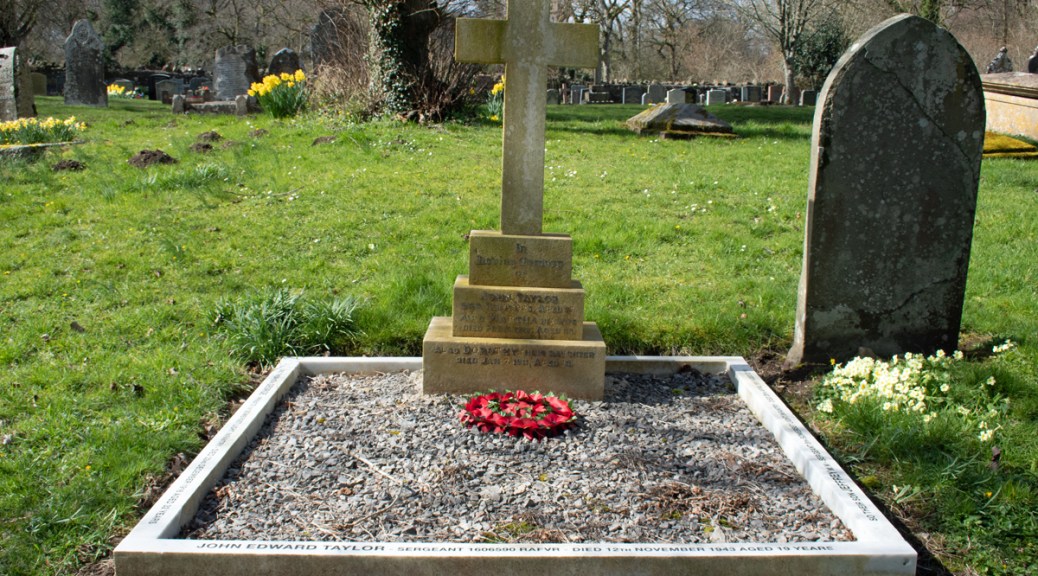
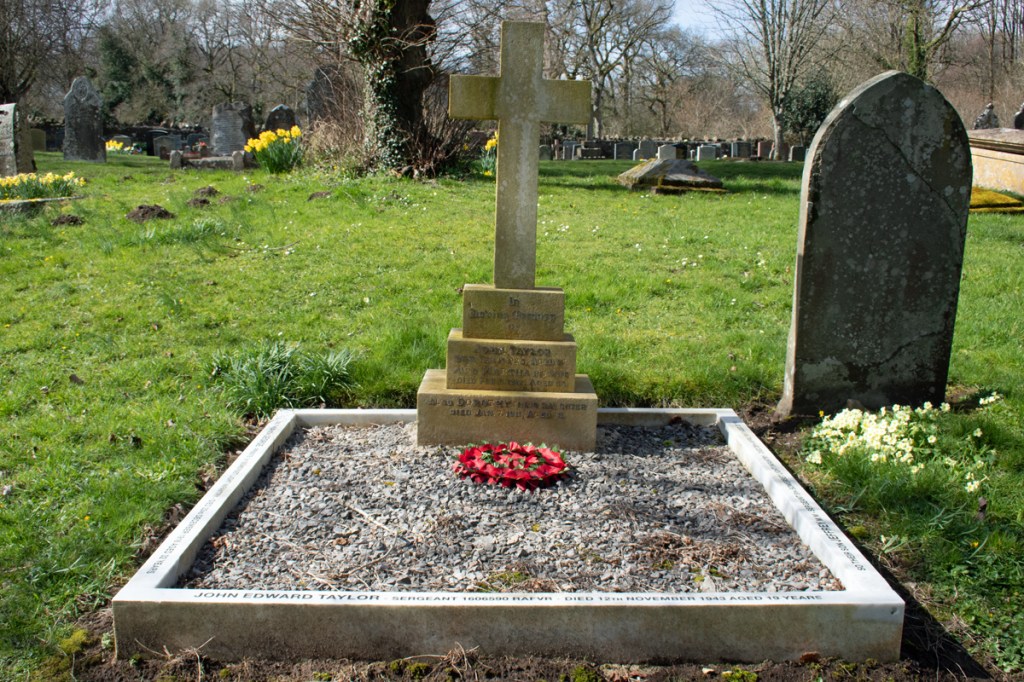
Tag Archives: 1916

Lieutenant Gilbert Rippon

Lieutenant Gilbert Rippon

Gilbert Harold Earle Rippon was born in Paddington, London, in the spring of 1887. The third of seven children, his parents were coal merchant Frederick Rippon and his wife, Eugenie.

When Gilbert left school, he found work as a clerk for a building firm. He was an ambitious young man, however, and, after his mother died in 1903 and his father a few years later, he took on work at a rubber plantation in Jementah, Malaysia.

When war broke out, “he came home on six months’ leave in order to enlist, having an exciting voyage owing to the activities of submarines. He was refused at first owing to a slight physical defect, but after an operation learnt to fly and was given a commission in the Royal Flying Corps.” [Somerset Guardian and Radstock Observer: Friday 9th June 1916]

Second Lieutenant Rippon gained his wings at Brooklands in Surrey on 16th January 1916. By the summer he was attached to a flying school in Gosport, Hampshire, and this is where he was based by the early summer of 1916.

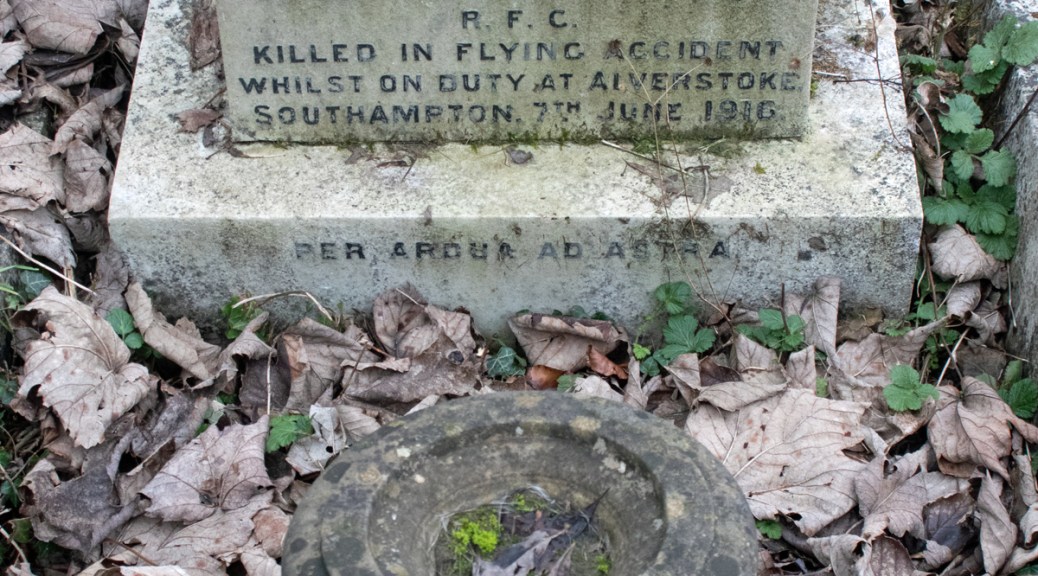
On 7th June, Gilbert was flying a de Havilland DH2 aircraft, when an accident occurred. According to a newspaper report: “Evidence showed that the machine, when 300 feet [91m] up, made a double turn, as though the aviator was trying to return. It then slipped and made a nose-dive to the ground, killing the pilot instantaneously. He had only been in the air three minutes. The previous evening the same monoplane had ascended 14,000 ft [4267m].” [Somerset Guardian and Radstock Observer: Friday 9th June 1916]

Second Lieutenant Rippon was 29 years of age. The same report confirmed that he was the older brother of two Bath and Somerset cricketers – twins Dudley and Sydney Rippon – and that his oldest brother, New York-based Secretary of the Board of Correction Frank Rippon, “had the unhappy experience of being in the aerodrome when the accident occurred, and saw his brother fall to the ground.”

Gilbert Harold Earle Rippon was laid to rest in the family plot St James Cemetery, Bath, Somerset. There seems to have been a family connection with the city: this is where both Frederick and Eugenie were buried, and where, after their parents’ deaths, the twins and the youngest Rippon son, Percy, were taken to live.


Private George Mason

Private George Mason

Much of George Mason’s life is destined to remain elusive, and much of the information comes from just a couple of documents.

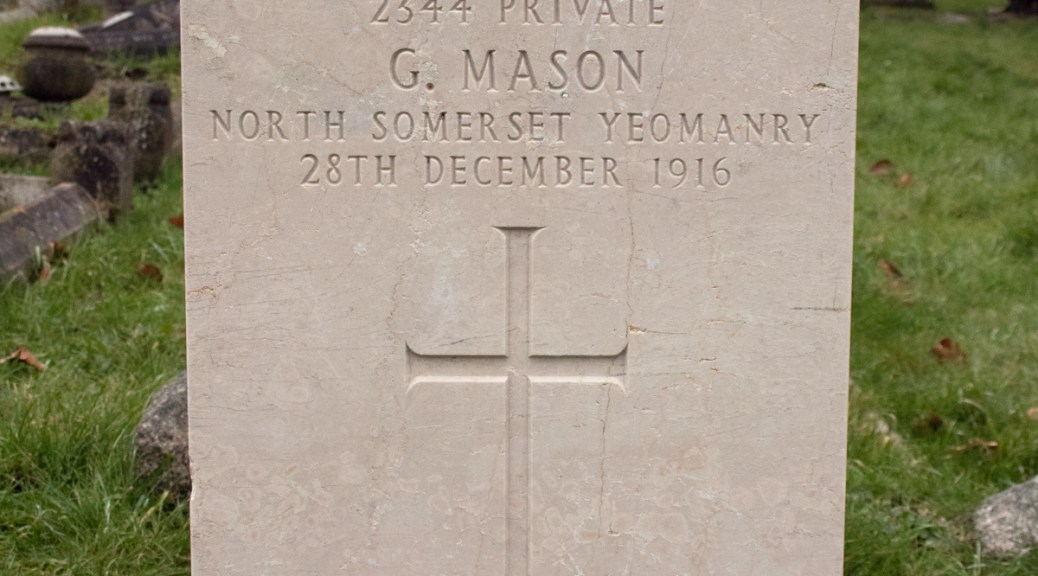
His Commonwealth War Grave headstone confirms that he was a Private in the North Somerset Yeomanry and that he died on 28th December 1916. Sadly, his service records no longer exist, but his pension records state that he ‘died of disease’ and give his mother as Harriet Mason.

There is only one census record for a Harriet Mason with a son called George. This dates from 1901, and give the head of the household – Harriet’s husband and George’s father – as bootmaker Albert Mason. It also gives George’s age as 9 years old, suggesting he was born in around 1892.

Further research brings nothing further to categorically link to the Mason family, and so it is impossible to add any further details to Private Mason’s life.

All that can be determined is that George Mason died of an illness on 28th December 1916, and that he was around 24 years of age. He was laid to rest in St James’ Cemetery in his home city of Bath.


Private Edgar Cox

Private Edgar Cox

Edgar Albert Cox was born in Wanstrow, Somerset, in the spring of 1897. The youngest of five children, his parents were railway packer Herbert Cox and his wife, Orpha.

When he left school, Edgar found employment as a live-in farm hand in Upton Noble, a mile from where his parents lived. When war came to Europe, however, he felt a pull to serve, and enlisted in the Somerset Light Infantry.

Full details of Private Cox’s military service are lost to time, but he was assigned to the 8th (Service) Battalion, and arrived in France towards the end of July 1915. He certainly saw action at the Somme, where his troop was involved in the battles of Bazentin Ridge, Flers-Courcelette and Morval.

It was in the battle of le Transloy, however, that Edgar was injured. His wounds were severe enough for him to be medically evacuated to Britain for treatment, and he was admitted to the 1st Southern General Hospital in King’s Norton, Birmingham. Sadly his wounds were too much for his body to bear: he passed away on 9th October 1916, at the age of just 19 years old.

The body of Edgar Albert Cox was brought back to Somerset for burial. He was laid to rest in the quiet graveyard of St Mary’s Church in his home village of Wanstrow.


Able Seaman Jesse Baber

Able Seaman Jesse Baber

Jesse Baber was born on 28th February 1889 and was the youngest of thirteen children to John and Jane Baber. John was a farm labourer from Westcombe in Somerset, and it was in this village that he and Jane raised their family.

Jesse chose not to follow his father and siblings into farm work and instead, on 6th October 1906, he enlisted in the Royal Navy. As he was underage for full service at the time, he was given the rank of Boy 2nd Class and sent to HMS Ganges, a training establishment on the outskirts of Ipswich, Suffolk. His service records confirm that he was 5ft 5.5ins (1.66m) tall at the time of joining. He was also noted as having dark brown hair, grey eyes and a fresh complexion, with a mole on his right cheek being highlighted as a distinguishing mark.

Boy Baber spent six months at HMS Ganges, and was promoted to Boy 1st Class for his commitment. He was then transferred to HMS London, a dreadnaught battleship for a further six months. During his time on board, Jesse came of age, and was formally enrolled in the Royal Navy with the rank of Ordinary Seaman.

Over the next eight years, Jesse served on eleven different vessels, sailing between his British base of HMS Vivid in Devonport and the East Indies. His service seems to have generally been very good – he was promoted to Able Seaman in February 1909 – although he did spend five days in the brig in July 1912 for reasons unrecorded.

When war broke out, the ships that Able Seaman Baber served on patrolled the waters of the Mediterranean. In the summer of 1916, while on board HMS Dartmouth, he contracted malaria. Jesse was admitted to a hospital in Malta, where he remained for six weeks, and was then sent on leave home to recover.

He arrived at Castle Cary [in Somerset] on the evening of the 23rd August, on a visit to his sister, in a very serious condition, being practically in a state of collapse. Medical attention was immediately obtained, but his condition was hopeless, and he lay in an unconscious condition until Friday September 1st, when he expired, death being due to meningitis, following malaria.

[Shepton Mallet Journal: Friday 15th September 1916]

Jesse Baber was 27 years old when he passed away. He was laid to rest in the quiet graveyard of St Mary’s Church in Batcombe, not far from where his mother, who was now 74 years old, was living.


Korporaal Paul Vandermersch

Korporaal Paul Vandermersch

The funeral took place on Friday last, at Bath, of Paul Vandermersch, second son of Paul Vandermersch, Divisional Chief, Provincial Administration, Western Flanders. Deceased passed away the previous Tuesday at 86, Shakespeare-avenue, Bath, at the early age of 22. He had served in the Belgian Army, but suffering from phthisis, he was invalided out.

Catholic Times and Catholic Opinion: Friday 14th January 1916

Paul Pierre Arnold Joseph Vandermersch was born on 11th April 1893 in Bruges, Belgium. Details of his early life are scarce, but it is clear that he was the son of Paul and Louise Vandermersch.

During the First World War, Paul served as a Korporaal (Corporal) in the Belgian Army, and was assigned to the 2 Linie 1/1 (second line). Full service records are not available, but having contracted tuberculosis, and with the influx of Belgian refugees to Britain during the conflict, it is likely that, having been medically discharged from the army, he was sent to Somerset to recuperate.

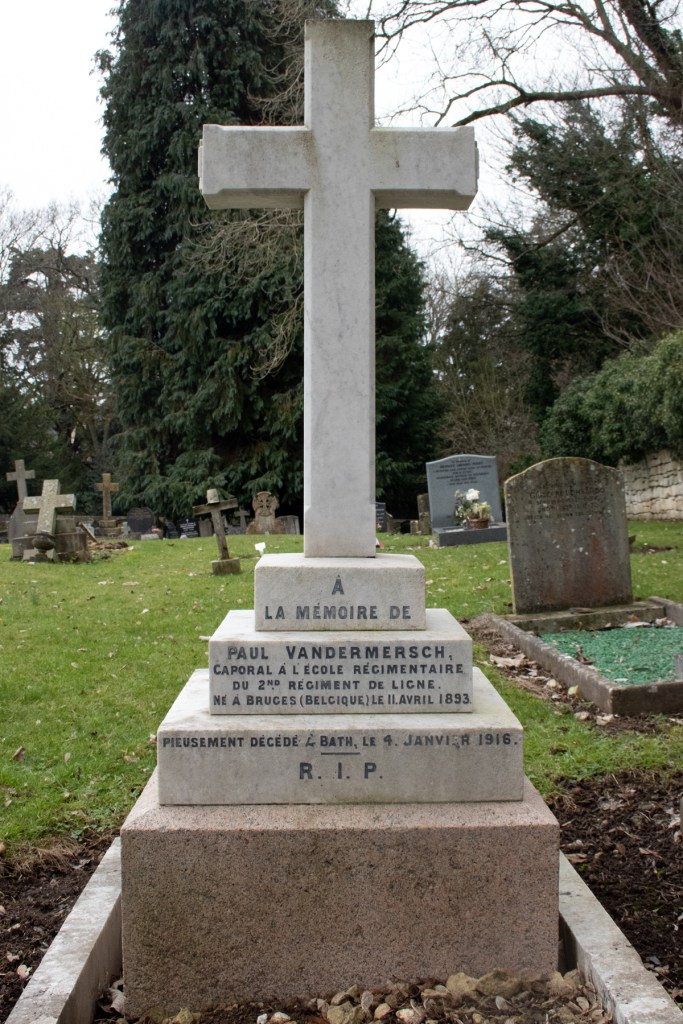
Korporaal Paul Pierre Arnold Joseph Vandermersch died on 4th January 1916, and was laid to rest in the Roman Catholic Cemetery in Bath.


Second Lieutenant Charles Hales

Second Lieutenant Charles Hales

Charles Edward Hoare Hales was born in Bournemouth, Dorset, in the summer of 1886. The fourth of five children, his parents were Arthur Hales – a Major General in the Royal Inniskilling Fusiliers – and his wife, Maria.

Arthur’s career stood the family in good stead: the 1891 census records the Hales living in a house in Crystal Palace Park, South London, with five servants supporting their – and their two visitors’ – every need. Arthur also believed in education for this two sons: Charles was dispatched to Hartwood House School in Hartley Wintney, Hampshire.

Arthur died in 1904 and at this point the Hales family disappears – there is no record for Maria or her five children in any of the 1911 census returns.

When war came to Europe, Charles and his older brother Arthur, stepped up to play their part. Both joined the Wiltshire Regiment, both being attached to the 1st Battalion. Sadly, neither of the brothers’ service records remain, so it is difficult to piece together their military careers.

Arthur achieved the rank of Captain, gained a Military Cross for his dedication and service. He was caught up in the Battle of Albert – one of the phases of the fighting at The Somme – in 1916. He was initially reported killed in action, then, to the elation of Maria, this was changed to missing. Tragically, he was subsequently confirmed as dead, having passed away on 6th July 1916, aged 34 years of age. He is commemorated on the Thiepval memorial in Northern France.

A further tragedy was to strike the Hales family the following year, when Charles, who had risen to the rank of Second Lieutenant, also passed away.

The internment took place in Bathwick Cemetery on Monday, of Mr Chas. Edward Hoare Hales, 2nd-Lieutenant Wiltshire Regiment, who died on Thursday, after a long illness contracted on active service. He was the last surviving son of the late Major-General A Hales, Royal Inniskilling Fusiliers, Commandant of the Straits Settlements, and of Mrs Hales… The young officer, whose body was brought from Buxton, was buried in the same grave where rest the remains of his father, who died in April 1904.

Bath Chronicle and Weekly Gazette: Saturday 1st December 1917

Details of Charles’ illness, from which he passed on 22nd November 1917, are unclear. He was 31 years old when he died. He left his estate – which amounted to £6524 18s 1d (the equivalent of £579,000 in today’s money) to his youngest sister, Sophia.


Maria Hales passed away in 1924, at the age of 74. She was buried in the family ploy, reunited with husband and younger son once more.


Second Lieutenant Charles Hales
(from findagrave.com)

Captain Arthur Hales
(from findagrave.com)

Private Frederick Dymond

Private Frederick Dymond

Frederick John Dymond was born in early 1888 in the Devon village of Dalwood. One of ten children, his parents were farmers Harry and Ellen Dymond. By the time of the 1911 census, the family had moved to Somerset and were running the Crock Street Farm near Ilminster.

When war came to Europe, Frederick was called upon to play his part. Full details of his military service are no longer available, but by the summer of 1916, he had joined the Middlesex Regiment.

Private Dymond was assigned to the 2nd/7th Battalion, which was a territorial force at that point in the conflict, based in Barham, Kent, midway between Dover and Canterbury.

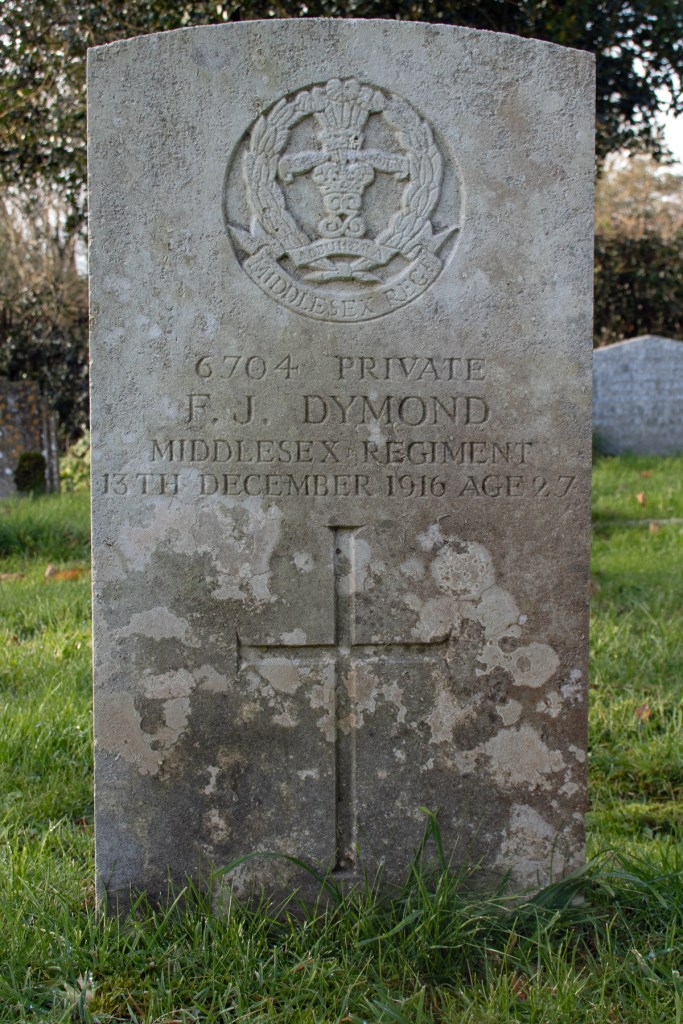
In the autumn of 1916, Private Dymond was taken to the Military Hospital in Canterbury, although the reason for his admission is not clear. Whatever the cause, it was too much for his body to bear: he passed away while in hospital, on 13th December 1916. He was just 28 years of age.

Frederick John Dymond was brought back to Somerset for burial. He was laid to rest in the graveyard of St George’s Church in Hinton St George – presumably because his family had moved to the area.


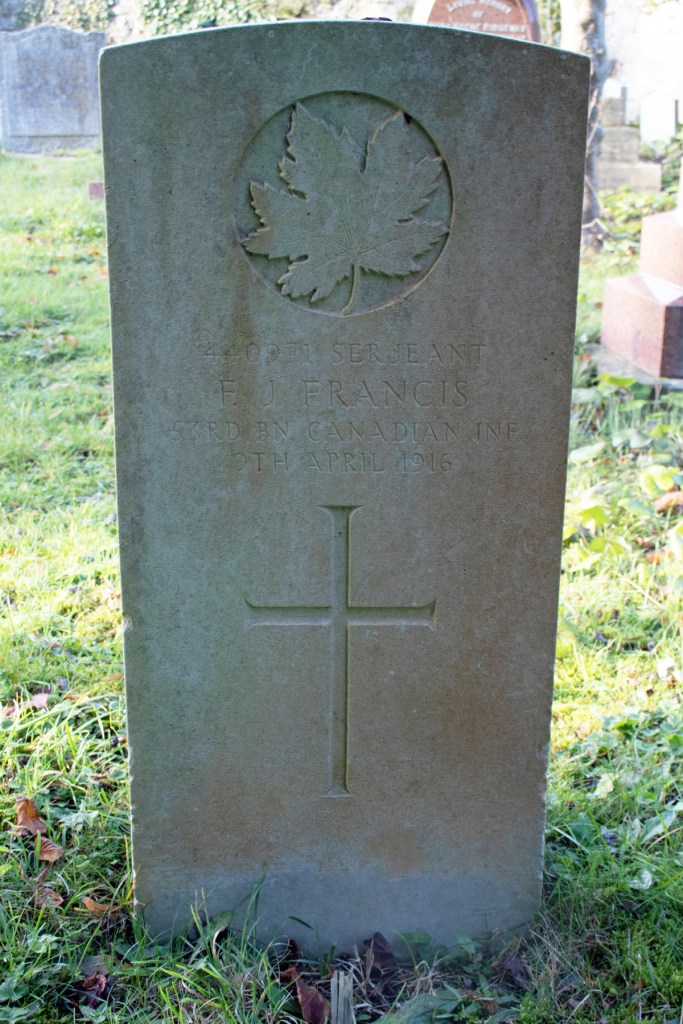
Serjeant Frederick Francis

Serjeant Frederick Francis

Frederick John Francis was born on 15th February 1893, to Henry and Mary Francis. One of nine children, the family lived in the Somerset village of Curry Rivel.

Henry was a labourer, but Frederick had his sights set on a new life and, at some point in his teens, he emigrated to Canada to work as a farmer. Details of his life in North America are scarce, but it is clear that he was in Manitoba when war broke out back in Europe.

Frederick stepped up to serve his King and Country, enlisting at Camp Sewell on 5th April 1915. His service records confirm that he was 5ft 5ins (1.65m) tall, and weighed 145lbs (65.8kg). He was assigned to the 53rd Battalion of the Canadian Infantry. His service papers also note that he was promoted to the rank of Sergeant on 30th April 1915, although whether the date is correct, or whether Frederick had previous military experience is unclear.

Sergeant Francis boarded the SS Empress of Britain to make the journey back to Europe, little knowing that he was not going to see his home again. On 9th April 1916, just one day from docking in Hampshire, he passed away from quinsy, or throat abscess. He was just 23 years of age.

The body of Frederick John Francis was brought back to Somerset for burial. He was laid to rest in the graveyard of St Andrew’s Church in the village of his birth, Curry Rivel.


Frederick’s younger brother, Charles, had also made a life in Canada. He enlisted at Camp Sewell just two months after his brother, joining the same battalion.

Charles, who had the rank of Private, arrived in Europe before Frederick and, and was sent to the front line in February 1916. In June, he was involved in the fighting at Mount Sorrel, on the Ypres Salient, and it was here, on 6th June 1916, that he lost his life. He was just 21 years of age.

Charles Arthur Francis is commemorated on the Menin Gate in Ypres. His parents had to mourn the loss of two sons within two months.


Boy 2nd Class Charles Hancock

Boy 2nd Class Charles Hancock

Charles Henry Hancock’s story underlines the innocence and exuberance of youth, and a life cut tragically short.

He was born on 9th July 1900 in Newton Abbot, Devon, the oldest of four children to Edward and Annie Hancock. Edward – who was also known by his middle name of Charles – was a jobbing gardener. By the time of the 1901 census, he had found employment as a groom and gardener with artist and sculptor Frederick Sturge in Tintagel, Cornwall. Annie was also employed by the family as a cook.

Edward passed away in June 1912, aged just 38 years old. Charles stepped up to help his mother, finding work as a farm labourer when he left school. War came to Europe, and while he was only 14 at the start of the conflict, he was drawn to play his part.

On 1st April 1916 Charles enlisted in the Royal Navy, either as a way to a permanent career to help bring in much needed money for his family, or because he was seeing his older peers going of to fight or King and Country. He was still underage, however, and was given the rank of Boy 2nd Class. Charles’ service records show that he was 5ft 2in (1.57m) tall, had fair hair, grey eyes and a fresh complexion.

Boy Hancock was sent to HMS Impregnable, the training ship based in Devonport, for his initial service. Tragically, this service was not to be a long one. Billeted in crowded barracks, he contracted measles and bronchial pneumonia, dying on 1st May 1916, while admitted to the Royal Naval Hospital in Plymouth, Devon. He was just 15 years of age, and had been in service for exactly one month.

Charles Henry Hancock was brought back to Cornwall for burial. He was laid to rest next to his father in the peaceful graveyard of St Materiana’s Church in Tintagel.


Rifleman Frederick Avards

Rifleman Frederick Avards

Frederick John Avards was born in Lamberhurst, Kent, in the summer of 1891. The oldest of three children, his parents were Frederick and Lucy Avards. Frederick Sr was a licenced publican and went on to run the Beckingford Arms in Tovil, near Maidstone.

Frederick Jr helped his father with the business, but when war came to Europe, he stepped up to play his part. He enlisted on 1st January 1915, joining the 7th (Service) Battalion of the King’s Royal Rifle Corps.

Rifleman Avards was sent to France on 19th May 1915 and very quickly found himself in the thick of things. Based on the Western Front, his regiment was involved in a number of skirmishes during the Battle of the Somme.

Last week [Rifleman Avards’] parents received a telegram stating that he was lying at the Royal Victoria Hospital, Netley, dangerously wounded. They at once proceeded to Netley but only to find that he had passed away.. Meanwhile his lieutenant, knowing he had been hit and thinking he had been killed on the battlefield, had written a feeling letter to the parents, saying his gallantly he had done his duty and that he had died a true rifleman’s death in the hour of victory, and worthily upheld the name of his regiment.

Kent Messenger & Gravesend Telegraph: Saturday 9th September 1916

Rifleman John Avards had passed away from his injuries on 3rd August 1916: he was just 24 years of age. His body was brought back to Kent for burial and he was laid to rest in the graveyard of St Peter & St Paul’s Church in Aylesford, Kent, not far from the Lower Bell public house, which his parents were then running.


Rifleman Frederick Avards
(from britishnewspaperarchive.co.uk)

While buried in the churchyard, the location of Frederick’s grave is not known. Instead, he is commemorated on a joint headstone in the First World War section of the graveyard.