James Walter Fone was born in Crewkerne, Somerset, late in 1878. The sixth of seven children, his parents were Edward and Emma Fone. Edward was an insurance agent who had moved the family to Yeovil by the mid-1880s.
When James left school, he found work as a clothier’s assistant. Emma died in 1906, and he moved to Bristol. By the time of the 1911 census, he was employed by, and boarding with, James Johnstone.
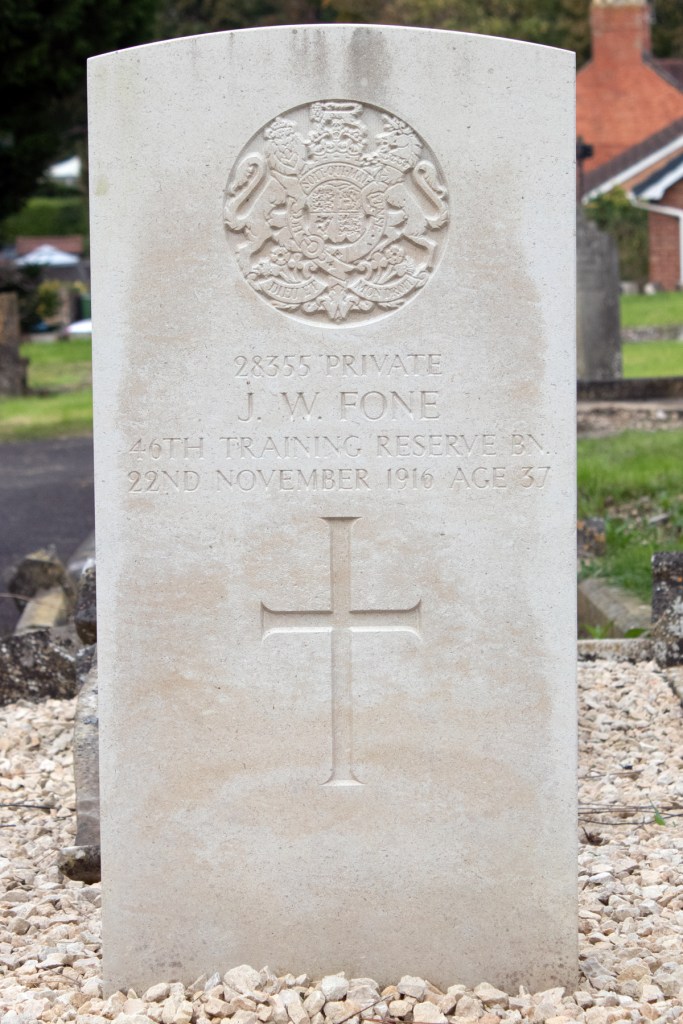
Details of James’ life become a bit sketchy from here on. He enlisted in the army when he received his call-up in the autumn of 1916. Joining the 46th Training Reserve Battalion, Private Fone was sent to a camp near Swanage in Dorset.
Barracks at this point in the war were tightly packed, and breeding grounds for illness and infections. James was not to be immune to this, and came down with cerebrospinal meningitis. He was admitted to the camp hospital, but died there on 22nd November 1916, at the age of 37 years old.
James Walter Fone’s body was brought back to Somerset for burial. He was laid to rest in Yeovil’s sweeping cemetery.
Louis Theobald was born on 27th January 1898 in Soho, Middlesex. There is little information available about his early life, and the only document that can be directly connected to him is his military service records.
Louis enlisted in the Royal Navy on 7th September 1915. He had been working as a miner at the time, and the document gives an insight into the man he was. He stood 5ft 5ins (1.65m) tall, had brown hair, brown eyes and a fresh complexion. The service records also confirm that he had a tattoo on his right arm.
Stoker 2nd Class Theobald was sent to HMS Pembroke, the Royal Naval Dockyard in Chatham, Kent, for his training. He spent three months there, before being given his first posting, on board the minesweeper HMS Alyssum. He remained on board for three months, before transferring to the cruiser HMS Wallington in February 1916.
Louis’ health was starting to be impacted by this point: he had developed bronchitis, probably exacerbated by heat and dust of the confined engine room he worked in. By April 1916 he was transferred back to HMS Pembroke, and within two months, he was medically discharged from service.
Stoker 2nd Class Theobald had been admitted to the Royal Naval Hospital in Chatham by this point, and his health began to deteriorate. He passed away from a combination of bronchitis and empyema on 15th September 1916: he was just eighteen years of age.
Louis Theobald was laid to rest in the Roman Catholic section of the Woodlands Cemetery in Gillingham, Kent, not far from the dockyard where he had been based.
Thomas Collins was born in the Blackfriars area of Glasgow on 12th March 1877. His was a common name, and it is a challenge to find identify much about his early life. He did, however, have a brother called Andrew, and, when he finished his schooling, he found work as a carpenter and joiner.
Thomas sought new opportunities and, on 21st January 1899, he enlisted in the Royal Navy. Working as a Carpenter’s Crew, he was initially assigned to HMS Vivid, the Royal Naval Barracks in Devonport, Devon. His service records show that he was 5ft 5ins (1,65m) tall, with dark brown hair, grey eyes and a dark complexion.
Devonport was to become Thomas’ base, but, over the twelve years of his initial navy contract, he went on to serve on eight separate vessels. He records suggest that he was good at what he did, and his moved up through the ranks as a result. However, he seemed to have another side to him, which occasionally revealed itself.
Thomas was promoted to Leading Carpenter’s Crew on 19th December 1901, but what had been noted as a very good character seemed to take a downturn at this point. He was committed to cells for two weeks in January/February 1903, while serving on HMS Highflyer, with an incident leading to his demotion to Carpenter’s Crew once more. This also appears to match with a drop in his character: noted as Very Good in his reviews of 1899 to 1901, he slipped to Good in 1902 and fair in 1903 and 1904.
His imprisonment seems to have been the shake up Thomas needed. From here on in, his character was consistently recorded as Very Good and, by August 1909, he had regained the rank of Leading Carpenter’s Crew. There was, however, a serious blip in this good behaviour, noted in his service records:
This man was tried for the manslaughter of Richard Ernest Bell, blacksmith, on [illegible date], who died from injuries received in a fight with Collins on HMS Cambridge. Verdict of Jury at Assizes: “Not guilty”. Judge in summing up stated that he considered Collins was technically guilty of manslaughter.
Thomas had been on the mess deck of HMS Cambridge on 26th August 1905, when he became embroiled in a fight with Petty Officer Bell. Medical evidence showed that Bell died as a result of a blow behind his ear, the punch delivered by Leading Carpenter’s Crew Collins. While it seems likely that he unintentionally caused the Petty Officer’s death, he was cleared by the jury, and remained assigned to HMS Cambridge until November 1905.
Thomas’ initial term of service came to an end on 20th January 1911, and he had no hesitation in re-enlisting. On board HMS St George at the time, his new contract brought with it the rank of Shipwright 2nd Class. Over the next five years, he served on four more ships, and rose a rank to Shipwright 1st Class.
On 8th January 1916, Thomas married Flora Peacock. Little information is available about here, although the wedding took place in Harwich, Essex. Thomas was serving on board the cruiser HMS Conquest by this point, and was based out of the Royal Naval Dockyard in Chatham, Kent.
On Tuesday evening, March 28th, a cutter belonging to HMS Conquest, which was taking forty liberty men off to the ship, was caught in a blizzard and nothing was seen or heard of her again till the morning, when she was found cast up on shore many miles away. All hands were drowned.
The cutter was being towed out by a steam-launch. The hawser broke and the boat drifted away ad capsized.
Westerham Herald: Saturday 8th April 1916
Shipwright 1st Class Thomas Collins was one of those lost from the cutter. He had not long turned 39 years of age. He was laid to rest in the Roman Catholic section of Woodlands Cemetery, Gillingham, not far from the dockyard at which he had been based.
Thomas’ headstone incorrectly gives his surname as Collings.
Charles McManus was born in Ballymena, County Antrim, in 1891. The middle of three children, his parents were John and Maryann McManus. John was a horse dealer: when they finished their schooling Charles’ older brother, John Jr, found work as a hawker.
Maryann died in 1907, aged just 47 years of age. The next census record, in 1911, found John Jr living with his wife and family in Ballymena, while John Sr was boarding with a fishmonger elsewhere in the town. Alexander, Charles’ younger brother, was a pupil at an industrial school in Dublin, but Charles himself is missing from the census return.
John Sr passed away in 1913, at the age of 53 years old. Charles was 22 years old and an orphan. The following year war was declared, and Charles was one of the first to step up and serve his country. He joined the Royal Inniskilling Fusiliers on 14th September 1914, and was attached to the 1st Battalion.
Full service records for Private McManus are lost to time. However, his unit was sent to Gallipoli in the spring of 1915, only to be evacuated from the region the following January. The 1st Battalion was then sent to France where it became entrenched at the Somme. For Private McManus and his colleagues, this must have felt like going from the frying pan into the fire, but this time he was not to emerge unscathed.
At some point Charles was wounded. He was medically evacuated to Britain for treatment, and admitted to the King George’s Hospital in London. Whatever his injuries, they were to prove too severe: he died on 24th July 1916, at the age of 25 years old.
Charles McManus’ body was taken back to Antrim for burial. He was laid to rest in the Crebilly Cemetery, overlooking his home town, Ballymena. His pension ledger suggests there was happiness in his life, beyond the killing fields. His next of kin is noted as Miss Mary Gordon of Ballymena, recorded as his unmarried wife.
Granville Horrocks was born in Heywood, Lancashire in around 1872. His early life is difficult to piece together, but by the time of the 1901 census, he was living with his widowed mother, Jane Horrocks, and his wife of a year, Mary.
The family were living in Rock Street, Oldham, where Granville was working as a labourer in an ironworks. Mary was also working, and was employed as a cotton reeler in one of the local mills.
Granville and Mary went on to have five children – Mary, Lilian, Ellen, Wilfred and Jessie. The 1911 census records the family living in two rooms in Bloom Street, Oldham. Granville was employed as an iron turner in the local factory, while Mary remained at home to look after the house and the family.
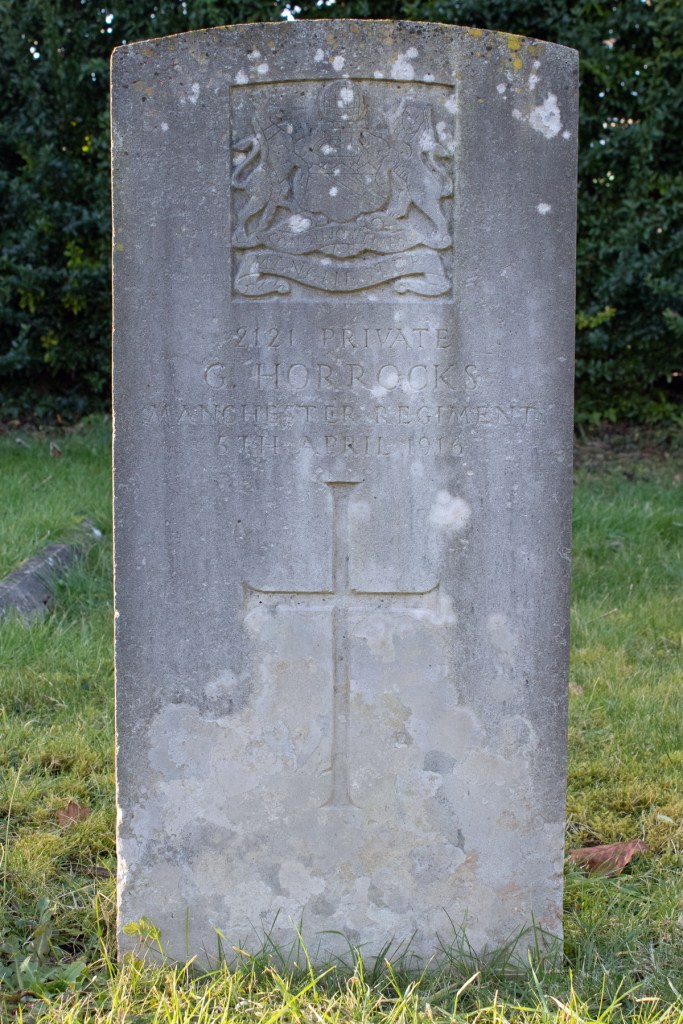
Conflict broke out in Europe in the summer of 1914, and Granville opted to serve his King and his Country. Sadly, full details of his service are lost to time, but it is clear that he had enlisted in the Manchester Regiment by the autumn of 1915. Private Horrocks was assigned to the 10th Battalion, which saw active service at Gallipoli, and it is likely that Granville spent time in that part of the Mediterranean.
Private Horrocks’ army pension ledger provides details of his passing. The date was 5th April 1916, and the cause given was “suicide by drowning whilst of unsound mind due to disease contracted on [active service].” Little additional information is available about the incident and, surprisingly, there is nothing reported in contemporary newspapers.
Granville was based near Wylye, Wiltshire, when he took his life. He was around 44 years old at the time. Finances must have limited Mary’s options regarding his burial: rather than being taken back to Oldham, he was laid to rest in the peaceful graveyard of St Mary’s Church in the village where he passed.
Herbert Griffith was born in the summer of 1883 in the Somerset village of Crowcombe. One of eight children, his parents were coachman James Griffith and his wife, Selina.
Herbert’s early life is a challenge to piece together. The 1901 census recorded him as living at Weacombe House, West Quantoxhead, where he was employed as a footman.
On 16th December 1909, Herbert married Selina May Davies. Also born in Crowcombe, she was the daughter of a tailor. The couple’s marriage certificate confirms the wedding was conducted at the village church. The couple went on to have two children, Dorothy in 1912, and Geoffrey four years later.
Herbert, at this point, was living in Farnborough, Warwickshire, where he was employed as a valet. (While no document remains to confirm this, it seems possible that this was actually Farnborough Hall, home to generations of the Holbech family.)
When war broke out, Herbert seemed keen to serve his country. He enlisted in the Royal Army Medical Corps, although his full service records no longer remain, so it is not possible to confirm whether he served on home soil or overseas.
The next record relating to Private Griffith is that of his passing. He died in Southampton, Hampshire, on 22nd February 1916, as a result of a combination of bronchitis, asthma and cardiac failure. He was 32 years of age, and would never get to meet his son, who was born two weeks later.
The body of Herbert Griffith was taken back to Somerset for burial. He was laid to rest in the peaceful surroundings of the Church of the Holy Ghost in his home village, Crowcombe.
George Bartraham was born in the autumn of 1868 in the Somerset village of Sampford Brett. One of seven children, his parents were George and Sarah Bartraham. George Sr was a farm labourer and, while his son initially followed suit, he sought a life of adventure in the wilder world.
George Jr had found work as a tailor, and was apprenticed to a Charles Taylor, who lived in the village. That bigger and better life was niggling away, however, and, on 11th June 1888, he enlisted in the Royal Engineers. His service records show that he was 5ft 5.5ins (1.66m) tall, with black hair, dark eyes and a fair complexion. Sapper Bartraham was also noted as having a scar on his left foot.
George initially signed up for seven years’ service, with an additional 5 years on reserve status once that was completed. The 1891 census recorded him as being based at Fort Blockhorse in Alverstoke, Hampshire. Early in 1894, he married Mary Bowden, in Portsmouth: the couple would go on to have two children, George and Albert. The following year, Sapper Bartraham opted to remain on full service with the Royal Engineers, partially, it is fair to assume, as the pay would be better to support his family than on reserve.
By 1901, George had been moved to barracks in Pembroke Docks, Wales. Mary and the children remained in Hampshire, living with her parents in Unicorn Street, close to the town’s naval base. Wales was not to be the last stop for George, however, and in October 1902, he was sent to Ceylon, where he remained for the next three years.
During his time in the army, George did not sit on his laurels. He received a certificate as a master tailor, became skilled in submarine mining, and also received a qualification in signalling. He was promoted to Lance Corporal in 1899, and full Corporal four years later.
George returned to Britain in January 1906, and seems to have returned to a base in Hampshire. It was here, on 28th December 1908, that an altercation led to him being convicted of assault. He was charged with ‘unlawfully and maliciously wounding one Albert Edward Bartraham, by stabbing him with a pair of scissors, at Aldershot… and counts for assault occasioning actual bodily harm and common assault’ [Calendar of Prisoners, 1868-1929]
Albert was George’s older brother, and he was convicted to six months’ hard labour for the assault. Corporal Bartraham returned to base on 6th June 1909, and was discharged a few days later, having completed 21 years’ service in the Royal Engineers.
The next census record, taken in 1911, found a family divided by work or circumstance. Mary and the children remained firmly ensconced in Portsmouth with her parents, while George was living in Aldershot, where he was employed as a tailor. His employer is noted as being the Government, so it seems likely that he was still connected to the army camp there.
When war came to Europe, George was called upon to play his part once more. Promoted to the rank of Serjeant, he was attached to the 136th Fortress Company of the Royal Engineers. He arrived in Egypt in June 1915, although it is unclear how long he remained overseas.
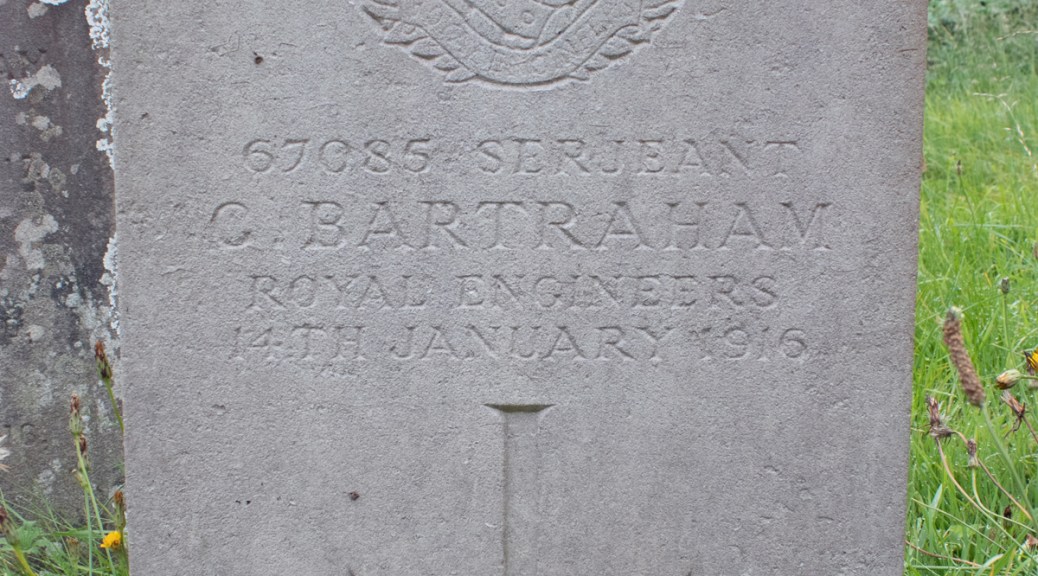
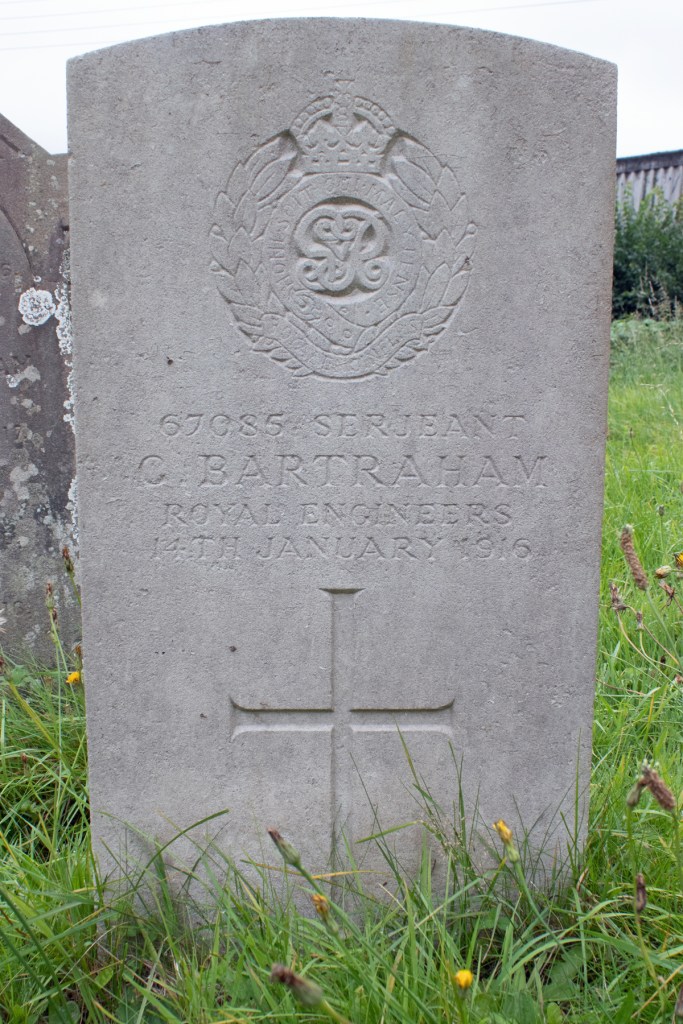
By the start of 1916, Serjeant Bartraham was back in Britain, primarily because of ill health. He had come down with nephritis, or inflamed kidneys. Admitted to hospital in South London, he died from the condition on 14th January 1916, at the age of 47 years old.
Brought back to Somerset, George Bartraham was laid to rest in the peaceful graveyard of St George’s Church in the village of his birth, Sampford Brett.
This was a time of tragedy for the Bartraham family.
George’s father, George, had died around the same time as his son, and was buried near him.
George and Mary’s son, George, had enlisted in the Hampshire Regiment when war was declared and, by the summer of 1916, was based in Iraq. He died on 23rd September 1916, through causes unclear, and was laid to rest in Baghdad War Cemetery.
Three generations of Bartrahams, all called George, had passed away within nine months.
In the summer of 1917, Sarah Bartraham also passed away. She was laid to rest with her husband and son in St George’s Churchyard.
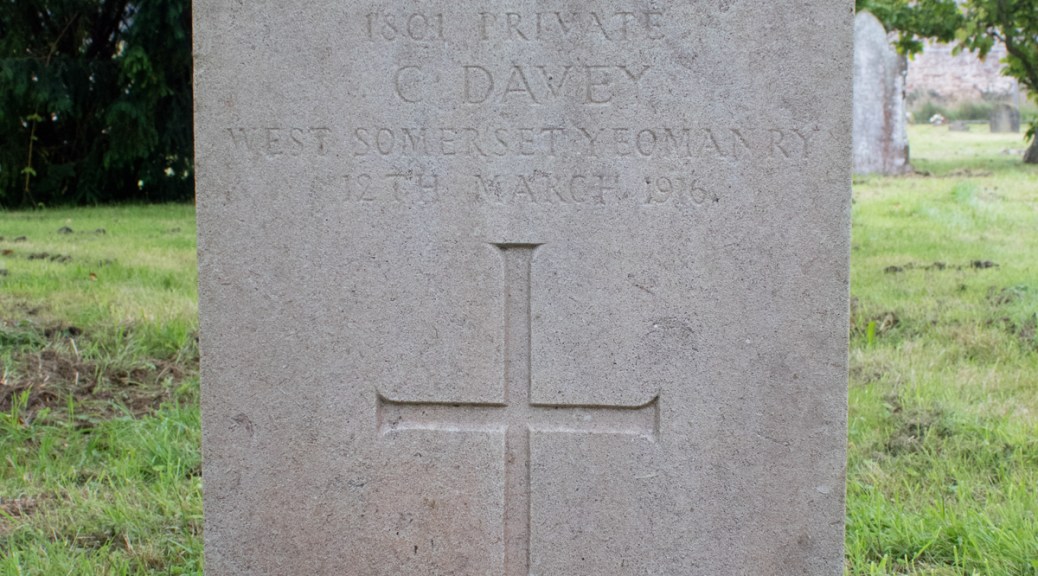
Charles Davey was born in Nether Stowey, Somerset, in the autumn of 1893. The second of six children, his parents were publican-turned-labourer Charles Davey and his wife, Mercy. The 1911 census found the family living in a four-roomed house, with Charles Sr and Jr and the younger Davey son, Walter, all employed in farm work.
When war came to Europe, Charles was called upon to play his part for King and Country. Sadly his service records have been lost to time, but it is clear that, by September 1915, he had enlisted in the West Somerset Yeomanry. Attached to the 3rd/1st Battalion, Private Davey would have been employed on home service. He was billeted at the Aliwal Barracks at Tidworth, Wiltshire.
The only other record relating to Private Davey is his entry in the Army Register of Soldiers’ Effects. This confirms that he passed away in Taunton, on 12th March 1916. The cause of his death is not recorded, but he just was 22 years of age.
The body of Charles Davey was taken back to Somerset for burial. He was laid to rest in the peaceful graveyard of St Mary’s Church in Nether Stowey.
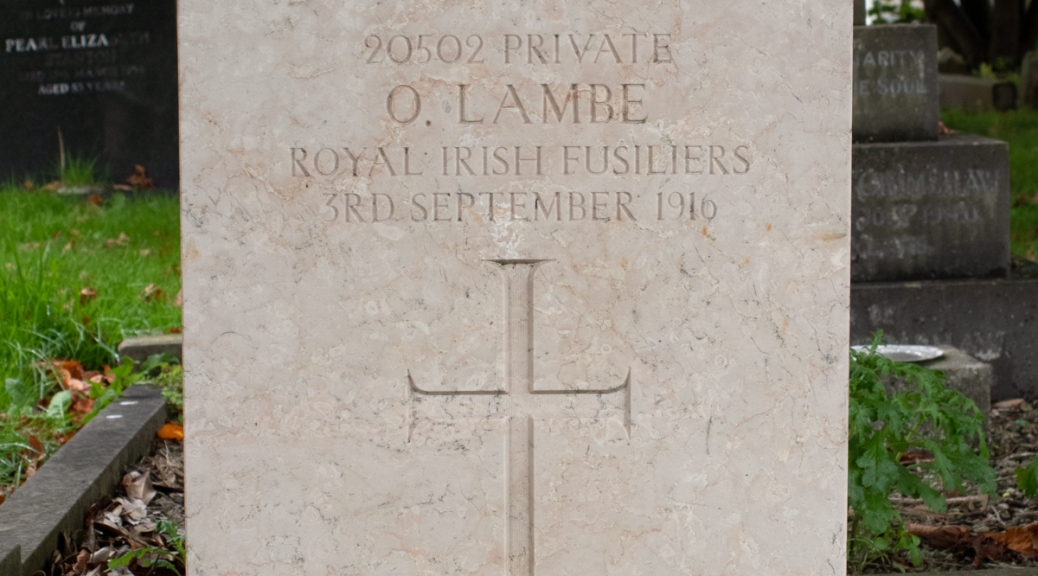
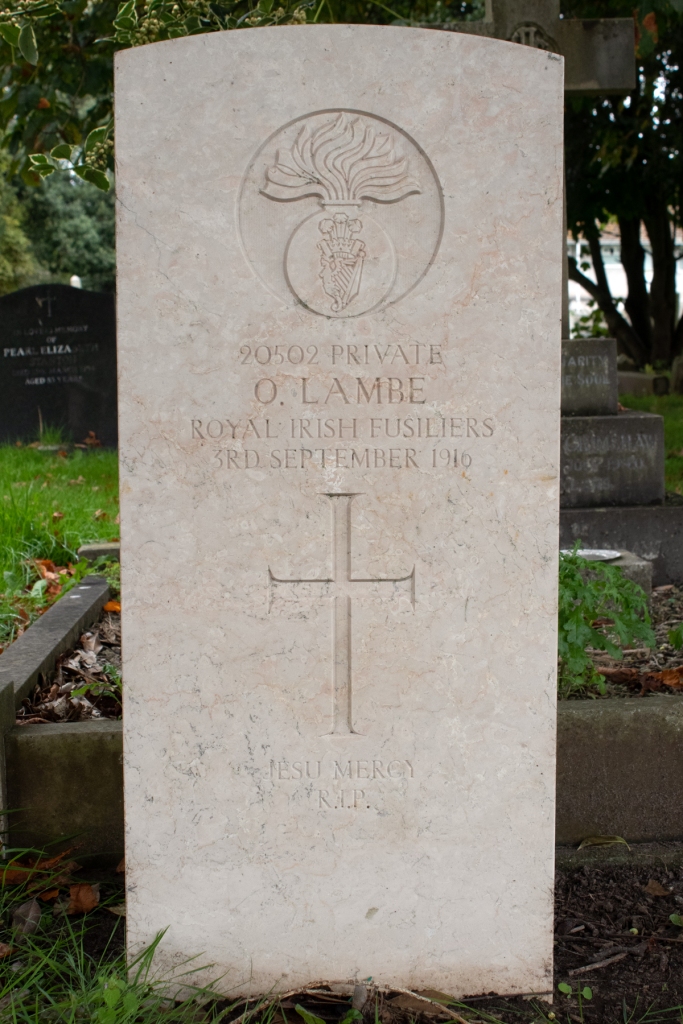
Owen Lambe was born in Drogheda, Co. Louth, Ireland, in November 1873. There is little information about his early life, but later documentation confirms that he was the son of John and Ellen Lambe, and that he had three brothers and one sister.
When Owen finished his schooling, he found work as a baker. He was also volunteering as a soldier in the 6th Battalion of the Royal Irish Rifles at the time, however, and this sparked a career move for him. On 7th May 1890, he formally enlisted: his medical report shows that he was 5ft 4ins (1.63m) tall, and weighed 128lbs (58kg). He was noted as having brown hair, grey eyes and a dark complexion.
Over the twelve years of his contract, Private Lambe saw a fair bit of the world. After eighteen months on home soil, he was sent to Malta, where he remained until November 1894. His battalion was then moved to India, where they remained for more than three years.
With seven years’ service under his belt, Owen returned to Britain. Put on reserve status, he was recalled to active duty in October 1899, as hostilities broke out in South Africa. He served in the Second Boer War for nearly three years, until, in July 1902, he returned home once more. By this point, he had completed his contract, and formally stepped down from the army on 31st August.
Owen’s trail goes cold at this point, and it is only possible to pick up details from later documents relating to his death. These confirm that he had re-enlisted by the spring of 1916, and that he joined the 8th (Service) Battalion of the Royal Irish Fusiliers. Based on his previous army experience, Private Lambe would have been sent to the Western Front fairly readily, and his battalion was certainly involved in the fighting at the Battle of the Somme.
It was here, on the front line, that Owen was injured. Again, details are sketchy, but he received gun shot wounds severe enough for him to me medically evacuated to Britain for treatment. He was taken to Somerset and admitted to the Volunteer Aid Detachment Hospital in Burnham-on-Sea for treatment. Private Lambe’s wounds were to prove too severe, however: he passed away from his injuries on 3rd September 1916, at the age of 42 years old.
Owen Lambe was laid to rest in the Roman Catholic section of Burnham Cemetery. His headstone was paid for by the local Catholic church.
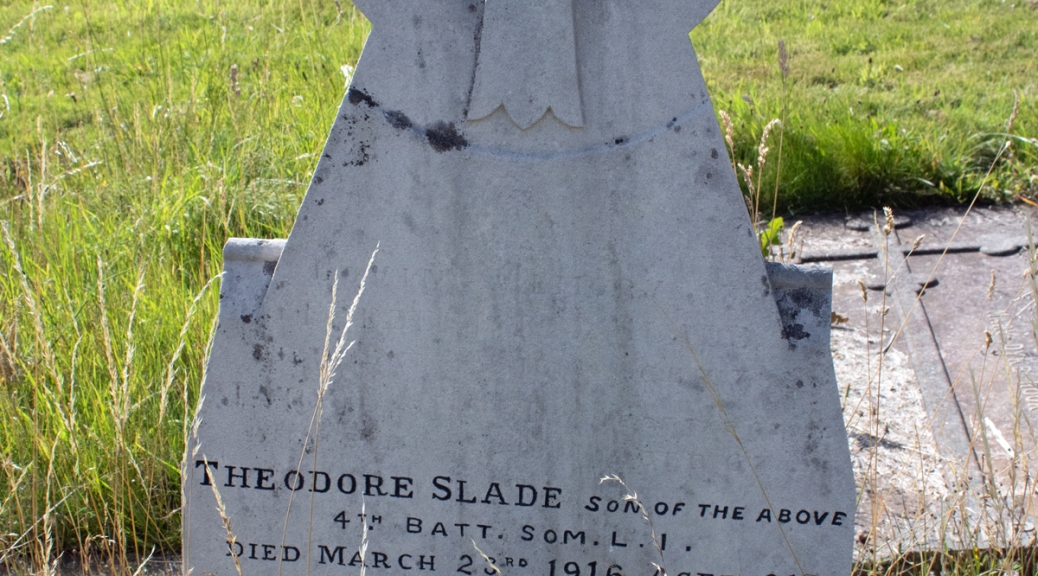
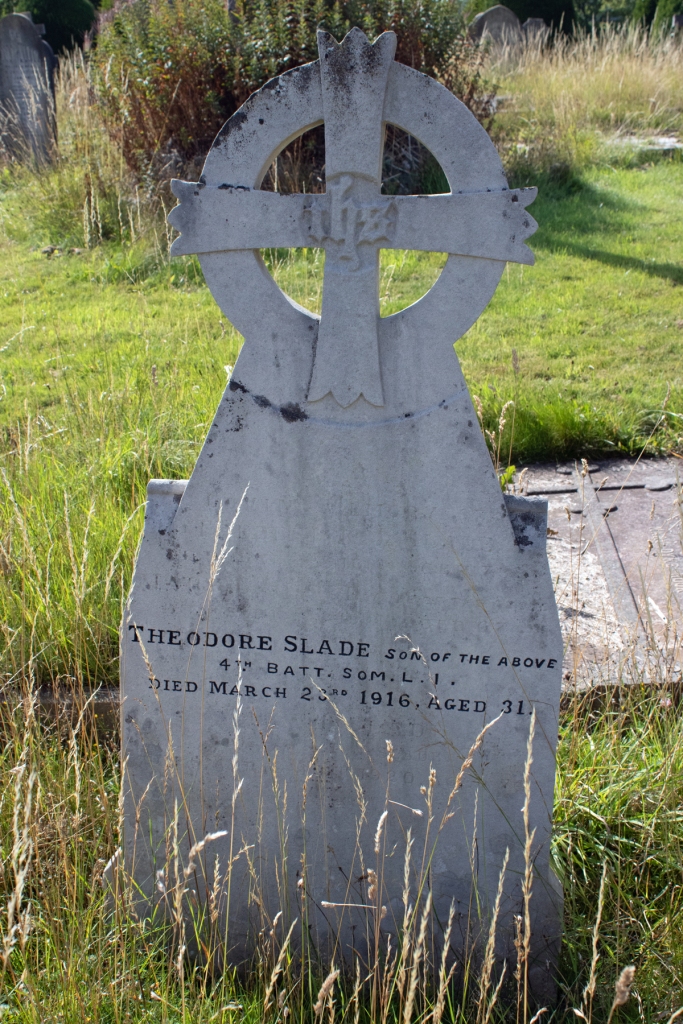
Theodore Slade was born early in 1885 in Buckfastleigh, Devon and was the second of two children to Frederick and Mary Slade. The 1891 census recorded the family four living with Frederick’s widowed mother and younger sister in Minehead, Somerset, where he had himself been born. Frederick was listed as a schoolmaster, while Mary was working as an organist.
Music definitely ran through the Slade family. The next census, in 1901, found Frederick now working as a gunsmith. Mary, meanwhile, was now noted as being a professor of music, while Theodore and his older brother, appropriately named Beethoven, were both employed as music teachers.
Ten years further on, and Beethoven had moved out of the family home, for a life with his wife and her widowed mother. Frederick was still working as a gunsmith, while Mary and Theodore were still teaching music. All three were self-employed, Theodore also working as an organist at St Andrew’s Church, Minehead, for more than a decade.
An interesting side note to the three document is how the census takers relied fully on the information they were given by residents. In 1891, Frederick gave his age as 41 and Mary 40; ten years later, Frederick was noted as being 56 and Mary 53; the 1911 census gave their ages as 71 and 63 respectively.
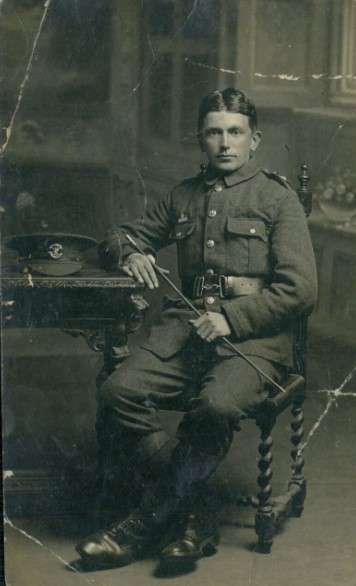
When war broke out, Theodore enlisted early on. He joined the Somerset Light Infantry, and was initially attached to the 4th (Reserve) Battalion. Private Slade was transferred across to the 1st Battalion, and soon found himself ensconced at Ypres.
Towards the end of 1915 Theodore came down with tuberculosis, and was medically evacuated to Britain for treatment. He was admitted to St John’s Hospital in Penarth, Glamorganshire, and remained in hospital over the winter months. His lungs weakened, he contracted pneumonia, passing away from the condition on 23rd March 1916, at the age of 31 years old.
Theodore Slade’s body was brought back to Somerset for burial. He was laid to rest in the family plot in the sweeping vista of Minehead Cemetery.







 Death and Service