Edward John Ham was born in Berrow, Somerset, in the spring of 1886. The second of seven children – all boys – his parents were Edward and Mary Ham. Edward Sr was a plasterer, but when he finished his schooling, his son found work as a jobbing gardener and nurseryman.
On 2nd October 1906, Edward married Annie Paddy. A carter’s daughter, three years older than her new husband, she was working as a domestic servant when the couple wed at St John the Evangelist’s Church in nearby Highbridge. They went on to have four children: Edward, Rose, Gladys and Horace.
The 1911 census recorded the family as living in Love Lane, Burnham-on-Sea, Edward continuing with his gardening work. War was on the horizon, though, and he was soon called upon to play his part.
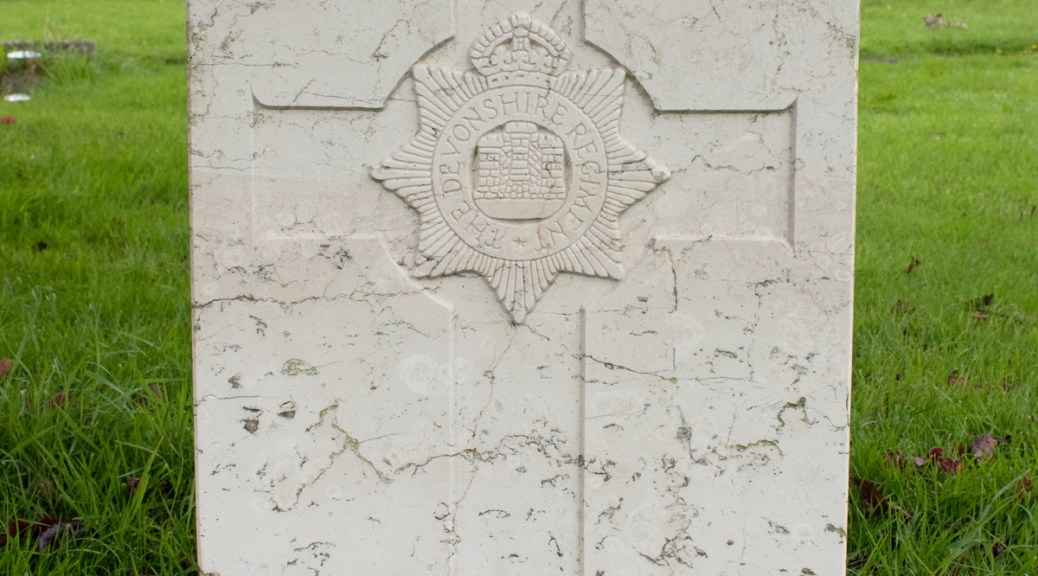
Full service records are not available for Edward, but he had enlisted by the summer of 1917. Private Ham initially joined the Devonshire Regiment, but at some point transferred across the to Labour Corps. Edward was attached to the 149th Company and was based in Enfield, Middlesex.
At this point, Private Ham’s trail starts to cool. He passed away on 25th December 1917 at the age of 31 years old. The cause of his death is unclear, but his body was brought back to Somerset for burial.
After a service in Burnham’s St Andrew’s Church, Edward John Ham was laid to rest in the town’s cemetery.
The death of Capt. James Wilson Pettinger has taken place in a military hospital at Aldershot. Captain Pettinger came to Kingsbridge [Devon] in 1903, entering into partnership with Dr D de Courcy Harston… He made a wide circle of friends, and was appreciated for his professional skill. Previously to coming to Kingsbridge, he was house surgeon at St George’s Hospital, London. In July 1915, Dr Pettinger volunteered for service in the Royal Army Medical Corps, being appointed Lieutenant to the Plymouth Military Hospital. He quickly gained promotion to captain, and was appointed to a hospital ship, and served in the Mediterranean for several months. He contracted blood poisoning in the arm, and was sent to Netley Hospital [Hampshire]. On recovery he was placed in charge of an infections hospital for several months at Salisbury. He was later ordered to France, and being taken ill was transferred to an Aldershot hospital, where he died from pneumonia. He leaves a widow and one son. Dr Pettinger was 43 years of age.
Western Times: Tuesday 16th October 1917
James Wilson Pettinger was born in the spring of 1874 in Moss Side, Lancashire. The youngest of four children, his parents were doctor and surgeon George Pettinger and his wife, Sarah.
James may have been a sickly child: the 1901 census recorded him as being a patient in community hospital in North Meols, near Southport, Lancashire. The oldest of only three patients, the facility was overseen by caretaker John Carr and his matron wife, Susan.
Having gone on to study at Cambridge University, James was carving a career for himself. By the time of the next census he was living in Shaftesbury, Dorset, he was recorded as being a medical practitioner, living on his own in a house near the centre of town.
As the Western Times was to report, James moved to Devon in 1903. On 8th January, he married Clara Risdon, a nursing sister seven years his senior. She came from the Somerset village of Old Cleeve, and the couple married in her local parish church. The couple set up home in Ewart House in Kingsbridge, and went on to have a son, Geoffrey, who was born that November.
James’ career continues to flourish. The 1910 medical directory noted that he was the Honourable Medical Officer for Kingsbridge & District Cottage Hospital, and noted that he had previously worked as an Honourable Physician, Honourable Surgeon, Ophthalmologist, Aural, Obstetric and Dental Assistant and Assistant Surgical Registrar at St George’s Hospital in London.
Little information relating to James’ time in the armed forces is available, and so it falls to his obituary in the Western Times to fill in the gaps. It would seem that Clara and Geoffrey moved to Minehead, Somerset, while James was serving overseas. The town was not far from where she had been born, and family connections may have helped with her husband’s absence.
When James Wilson Pettinger died, on 6th October 1917, his body was brought to Minehead for burial. He was laid to rest in the town’s sweeping cemetery, and was joined there by Clara when she passed away in 1945: a husband and wife reunited.
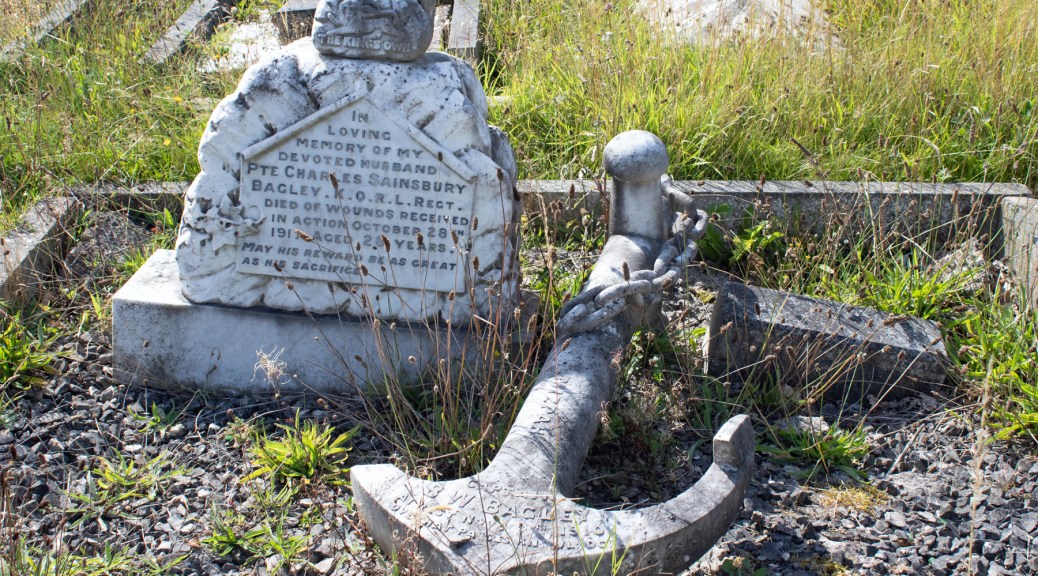
Charles Sainsbury Bagley was born in the autumn of 1889, one of eleven children to Benjamin and Jane Bagley. The couple’s early life was an intriguing one: they had both been born in Shoreham-by-Sea, West Sussex. The 1891 census recorded the couple living on board the barque Mizpah, with their three oldest children. Benjamin was the vessel’s master and there were ten other members of crew on board.
By the time Charles was born, the family had returned to shore and settled in Minehead, Somerset. By now Benjamin was working as a hairdresser and tobacconist on Park Street near the centre of the town.
Benjamin died in 1910, but left a thriving business to support Jane. At least three of the Bagley siblings went into hairdressing, while Charles’ older brother, Joseph, set up a bakery and confectioner’s in the town with his wife. Charles is absent from the 1911 census, although later records would suggest that he had moved to Lancashire, where he was also working as a hairdresser.
On 3rd July 1915, Charles married Celia Rogers in Lancaster. War was raging across Europe at this point and, in August 1916, he enlisted in the army. His service records confirm that he was 5ft 7.5ins (1.71m) tall and weighed 128lbs (58kg). Private Bagley joined the 5th Battalion of the King’s Own (Royal Lancaster Regiment) and by the end of the year he was on the Western Front, based around the Ypres salient.
The early part of 1917 proved relatively quiet for Private Bagley’s troop. At the end of July, however, he was caught up in the battle of Pilkem Ridge, and was shot in his left leg. Initially treated on site, the wound was severe enough for him to be medically evacuated to Britain for treatment.
Charles was admitted to the Royal Surrey County Hospital in Guildford, but his wounds were to prove to be too severe. He passed away on 28th October 1917, at the age of 27 years old.
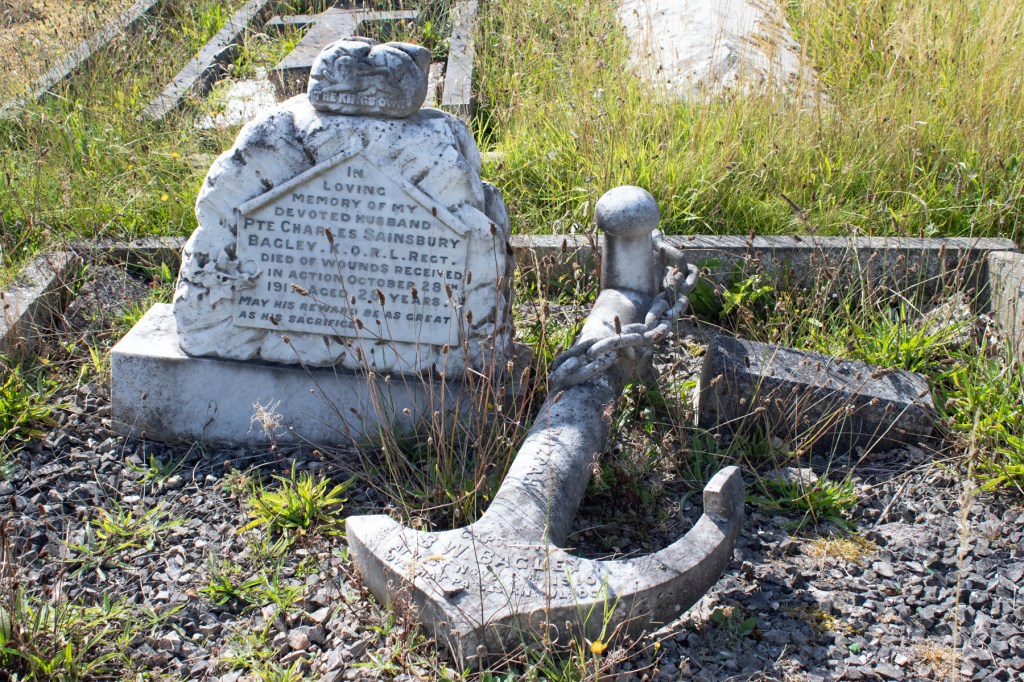
The body of Charles Sainsbury Bagley was taken back to Somerset for burial. He was laid to rest in the family plot in Minehead Cemetery, reunited with his parents, Jane having died at the beginning of 1917. The seafaring headstone paid homage to his father’s maritime service.
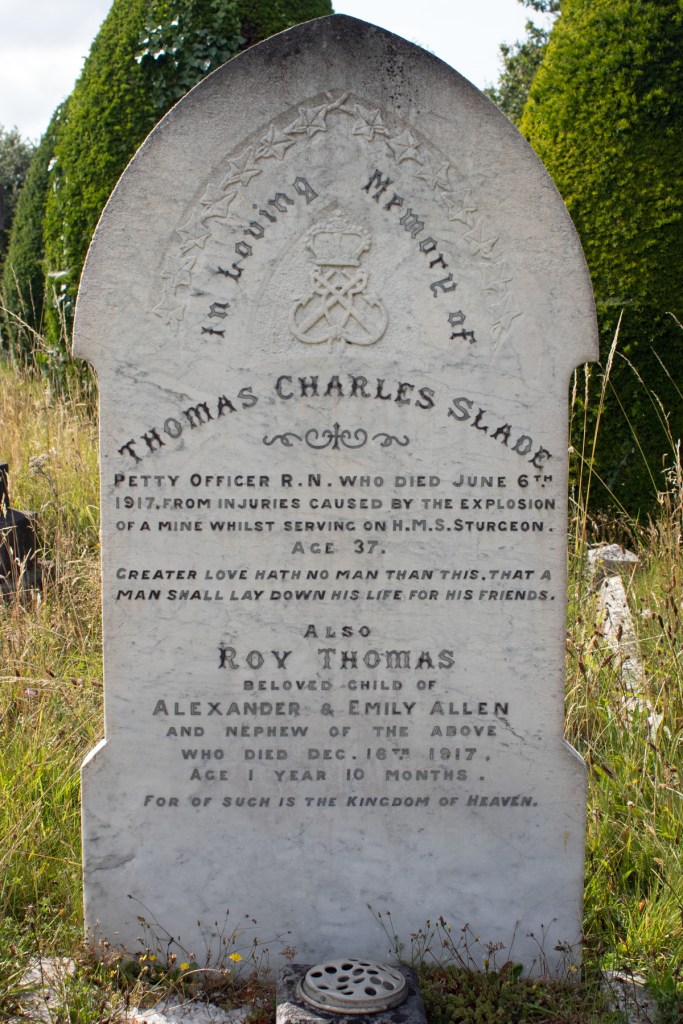
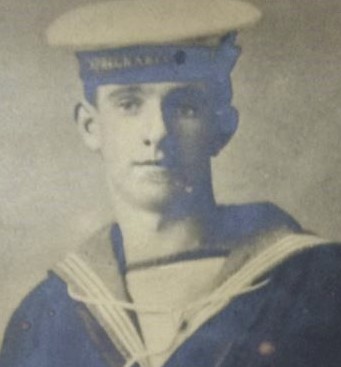
Thomas Charles Slade was born in Bristol, Gloucestershire, on 13th March 1880. One of twins, he and his sibling Ernest were two of nine children to Charles and Elizabeth Slade. Not long after the twins were born, the family had moved to Minehead, Somerset, where both Charles, who was a mason and bricklayer, and Elizabeth had hailed from.
Whilst Ernest seemed content to remain in Somerset – going on to become a poultry farmer – Thomas sought a life of adventure. Foregoing his gardening job, he enlisted in the Royal Navy, setting his sights on a life at sea.
Thomas’ service records show that he joined up on 12th November 1895. He stood just 5ft 2ins (1.57cm) tall, with brown hair, blue eyes and a ruddy complexion. As he was to young to formally join up, he was give the rank of Boy 2nd Class, and sent to HMS Impregnable, the shore-based training establishment in Devonport, Devon.
Boy Slade seemed to create a good impression. He was promoted to Boy 1st Class in July 1896, and the follow February was given his first posting, on board the battleship HMS Benbow. This was the ship he was serving on when he turned 18 and, having come of age, he was officially inducted into the navy, and given the rank of Ordinary Seaman.
And so began a glittering career for young Thomas. Over the twelve years of his contract, he served on nine different ships, returning to HMS Vivid – the Royal Naval Dockyard in Devonport – between voyages.
Small in stature, Thomas appears to have been a dedicated young man. His annual reviews noted his character was ‘very good’ every year, and his ability was either ‘very good’, ‘superior’, or ‘excellent’. He was promoted to Able Seaman in September 1898, just eighteen months after becoming an Ordinary Seaman. By June 1906 he rose in rank again, ending his initial term of service as a Leading Seaman.
Thomas was not done with the navy yet, however. He immediately re-enlisted and, over the ensuing years served on a further four vessels. He spent more and more time on board HMS Defiance, the torpedo and mining school ship in Devonport. Whether this was because he was being taught, or was supporting incoming students is unclear, but by September 1912, he had been promoted again.
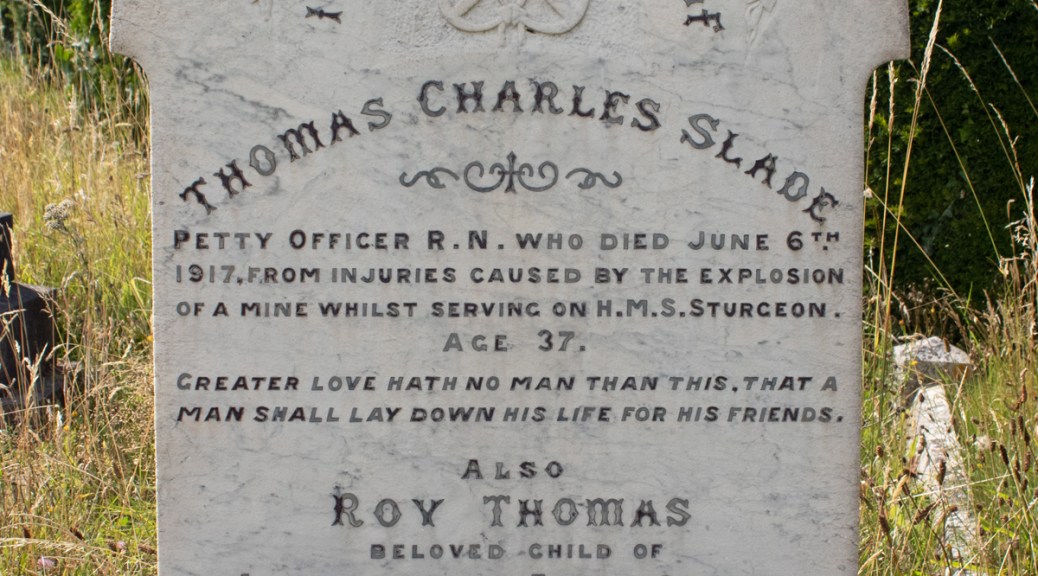
In November 1915, the now Petty Officer Slade had moved to the depot ship HMS Dido. His new posting supported the Tenth Destroyer Flotilla in the North Sea, patrolling the waters off the East Anglian coast. In February 1917 he moved to another of the support vessels, HMS Sturgeon.
In June 1917, a mine exploded on board, injuring a number of the crew, including Petty Officer Slade. The wounded were transferred to a hospital near Ipswich, and it was here that Thomas was to pass away. The only one of those caught up in the incident to die, he was 37 years of age.
Thomas Charles Slade was brought back to Somerset for burial. He was laid to rest in the sweeping Minehead Cemetery, close to the grave of his mother, Elizabeth, who had passed away nine years before.
Thomas’ headstone also includes an inscription to Roy Thomas Allen, who died six months after him. Roy was the young son of Thomas’ younger sister Emily: an uncle and nephew reunited.
Leonard Lionel Floyd (or Floyde) was born in the Somerset village of Watchet in 1898. The eldest of five children, his parents were journeyman tailor Thomas Floyde and his wife, Louise.
Interestingly, at the time of the two censuses in 1901 and 1911, Leonard was away from the family home: the earlier document recorded him living with his maternal grandparents on the outskirts of Minehead. Ten years later he was back in Watchet, residing with his mother’s brother and sister.
Little additional information is available to document Leonard’s young life. With war raging across Europe, he appears to have joined up as soon as he came of age. He was assigned to the 1st Battalion of the Princess Charlotte of Wales’ (Royal Berkshire Regiment) and sent to Portsmouth, Hampshire, for training.
Tragically, it seems that Private Floyd fell ill while billeted in the cramped barracks there. He was admitted to the 5th Southern General Hospital in the city, but died soon after. He breathed his last on 21st April 1917, aged just 18 years old.
Leonard Lionel Floyd’s body was brought back to Somerset for burial. He was laid to rest in the sweeping Minehead Cemetery, not far from where his parents lived, on the outskirts of the town.
Harold Cane was born in Minehead, Somerset, on 10th August 1898. One of nine children, his parents were Henry and Mary Cane. Henry was a stone mason from Minehead, but he was working in Ireland when he met his future wife. The couple married in 1891, only moving back to Somerset the mid-1890s, by which time they had two children, Harold’s oldest siblings.
The 1911 census recorded Henry and Mary living with their children at 3 Church Steps in Minehead, a short row of houses leading to St Michael’s Church. Henry was a mason and his oldest son, also called Henry, has working with him.
Harold, meanwhile, dreamed of a bigger and better life. When he finished his schooling, he joined the Royal Navy, looking for a life of adventure on the high seas. He signed up on 22nd September 1914, just a month after the declaration of war, and was sent to the shore-based training ship, HMS Impregnable, based in Devonport, Devon.
As he was just 16 years of age, Harold was given the rank of Boy 2nd Class. However, his commitment to the role was evident and led to a promotion – to Boy 1st Class – after just three months. In September 1915, Harold as assigned to the dreadnaught battleship HMS Iron Duke, where he served as an Ordinary Seaman. He spent just under a year on board, during which time the Iron Duke was caught up in the Battle of Jutland. She was involved in the sinking of the German destroyer SMS S35, after which she and the rest of the fleet moved on.
Ordinary Seaman Cane remained on board HMS Iron Duke until the summer 1916. He had fallen ill by this point, having contracted tuberculosis. The condition was enough for Harold to be invalided out of the navy, and he was stood down on 9th August 1916.
At this point, Harold’s trail goes cold. It seems that he returned home to Somerset, as this is where he passed away. He died on 14th November 1917, at the age of just 19 years old.
Harold Cane was laid to rest in the peaceful landscape of Minehead Cemetery.
Walter Stone was born at the start of 1880 in Lympsham, Somerset. The middle of three children, his parents were coal merchant George Stone and his wife, Ellen.
When he finished his schooling, Walter found work as a painter and plumber. In January 1902 he married Alice Charman. Eighteen years older than Walter, she was the widow of a milkman from Bristol, and had raised her son, Edgar, since her husband had passed away a few months before. The couple settled in the village of Brent Knoll, and went on to have three children of their own: Albert, Florence and Alice.
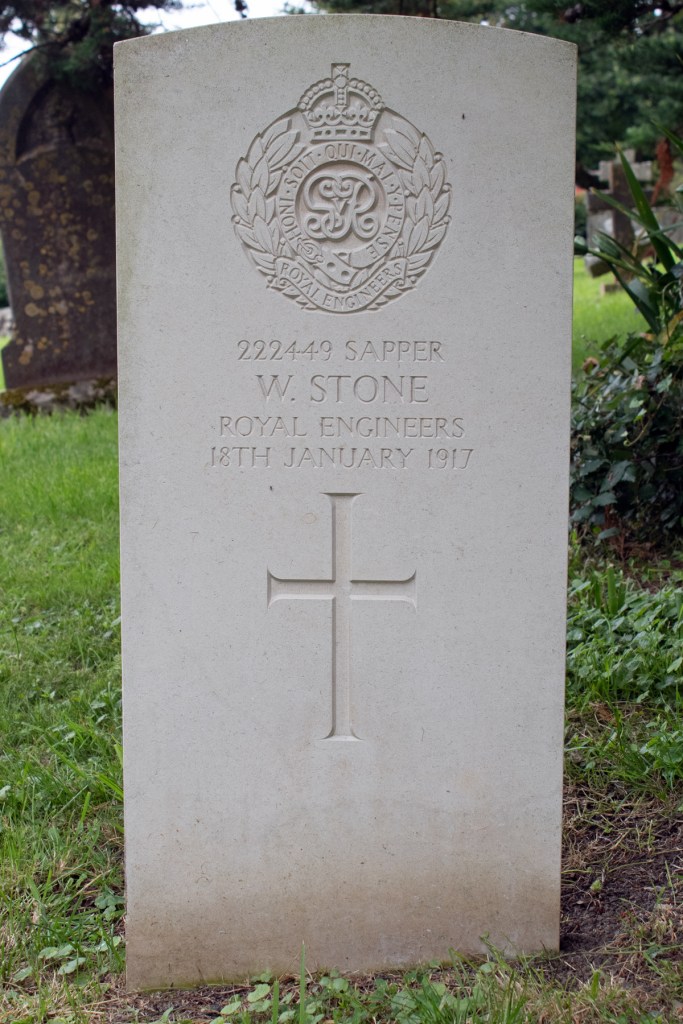
When war came to Europe, Walter was called upon to play his part. He enlisted after June 1916, and joined the Royal Engineers as a Sapper. He was attached to the Inland Waterways and Docks division, but, as no documentation remains to confirm his service, it is not possible to confirm whether he saw any action overseas
Sapper Stone’s time in the army was not to be a long one. The next record for him is that of his admission to a military hospital in Herne Bay, Kent. He was suffering from pneumonia, and this would take his life on 18th January 1917. He was 36 years of age.
Walter Stone’s body was brought back to Somerset for burial. He was laid to rest in the tranquil graveyard of St Michael’s Church in Brent Knoll.
Further tragedy was to strike Walter’s widow, Alice. Edgar, her son from her first marriage, enlisted in the Somerset Light Infantry when war broke out. Attached to the 7th (Service) Battalion, he found himself on the Front Line by the end of July 1915.
Private Stone is reported to have been accidentally killed on 1st May 1917. No other detail is given, but he was just 24 years of age when he passed. He was buried at the Thiepval Memorial at the Somme.
Alice had lost her husband and her oldest child within a matter of months.
Ernest John Badman was born in Wick St Lawrence, Somerset, on 28th September 1898. The second youngest of ten siblings, although only six survived childhood, his parents were farm labourer William Badman and his wife, Fanny.
There is little specific documentation for Ernest. War came to Europe in the summer of 1914, and he had enlisted in the Wiltshire Regiment by the winter of 1916.
Attached to the 4th (Reserve) Battalion, Private Badman seems to have been in his initial training period by the following spring. However, this was not to last long. He passed away while on home soil on 21st March 1917: he was just 19 years of age.
Ernest John Badman was brought back to his home village for burial. He was laid to rest in the sleepy graveyard of St Lawrence’s Church.
Joseph Frederick Staddon was born at the start of 1899, the oldest of seven children to John and Mary Ann Staddon. John was a farmer from Luccombe in Somerset, and it was in this small village that the family were born and raised.
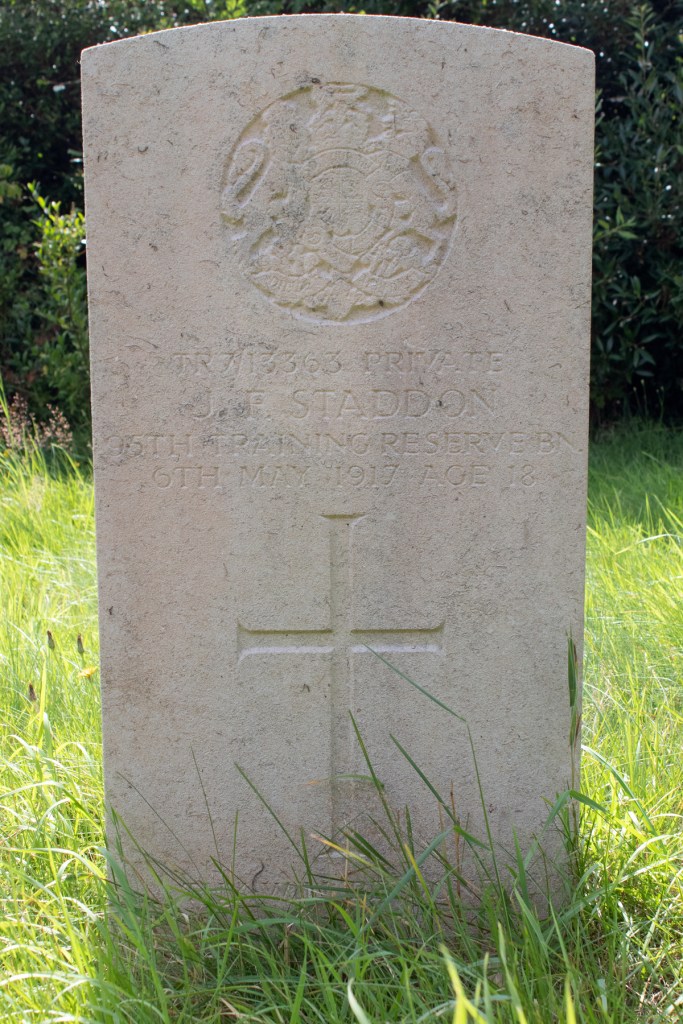
There is little documentation to expand on Joseph’s life. He enlisted in the Duke of Cornwall’s Light Infantry when he turned 18, and was initially attached to the 95th Training Reserve Battalion.
Private Staddon was barracked in Chiseldon, Wiltshire, but his time in service was not to be a lengthy one. Admitted to a military hospital near the camp, he passed away from what was probably an illness on 6th May 1917. He was just eighteen years of age.
Joseph Frederick Staddon’s body was brought back to Somerset for burial. He was laid to rest in the cemetery extension to St Mary’s Church, Luccombe.
Tragedy was to strike again when, ten months after his son’s passing, John also died. Mary was left picking up the pieces, while supporting her six remaining children, the youngest of whom, Dorothy, was not even two years old.
The family survived, Mary running the farm with her oldest boy, Edward. She passed away on 4th August 1937, at the age of 63 years old.
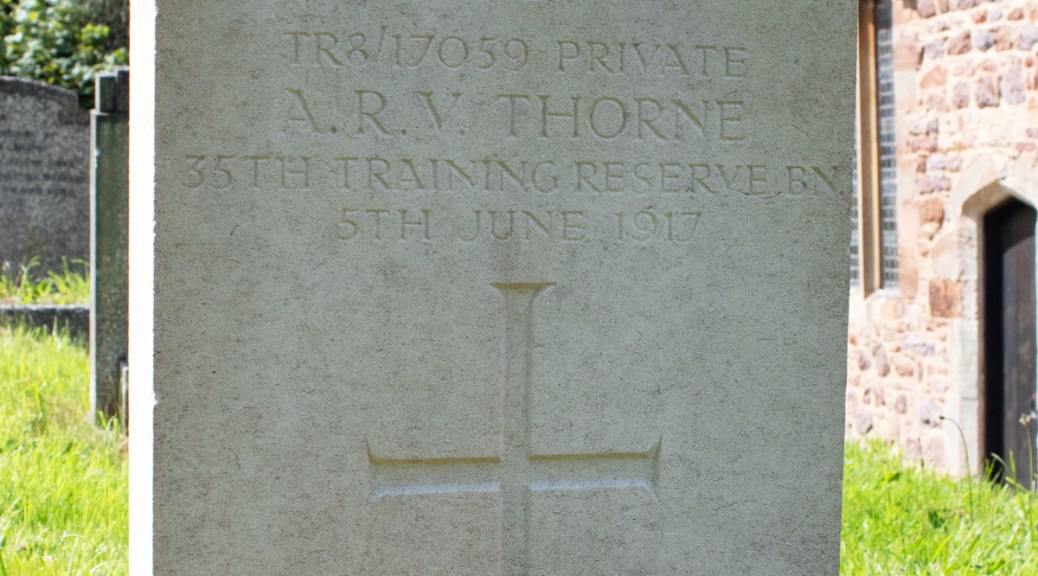
Arthur Reginald Vellacott Thorne was born at the start of 1899 in Bridgwater, Somerset. One of six children, his parents were Sidney and Bessie Thorne. Sidney was a butcher and, by the time of the 1901 census, the family had moved to Chichester, West Sussex, where he had found employment in a sausage factory.
The Thornes’ time on the south coast was not to last long: they had moved to Timberscombe, back in Somerset, by the time Sidney and Bessie’s youngest child, daughter Ivy, was born in March 1908. Tragically their happiness was not to last for long: Sidney passed away in October that year, aged just 35 years old.
With six children under the age of 12 to raise, times would have proved tough for Bessie. Her oldest child – Arthur’s older brother, Sidney – went to live with his paternal uncle’s family in Taunton, and began learning the butchering trade. Bessie took on the role of caretaker at Timberscombe School where her five younger children were being taught.
Being a butcher was not Sidney’s chosen career path. When he turned 17, in March 1914, he enlisted in the Coldstream Guards, lying about his age to do so. Six months later he was promoted to the rank of Lance Corporal and attached to the 3rd Battalion. With war having been declared in Europe, he soon found himself on the Front Line, fighting in the First Battle of Ypres.
Over the next couple of years, Lance Corporal Thorne remained on the Western Front. He was killed in fighting on 15th September 1916: he was just 19 years of age. Sidney’s body was never identified: he is commemorated on the Thiepval Memorial in Picardie.
Arthur’s trail had gone cold at this point, but when he turned 18 years old, his brother having passed just months before, he too was called up. Assigned as a Private in the 35th Training Reserve Battalion, he was sent to Bovington Army Camp in Dorset for his induction. While there, in the cramped conditions of the military barracks, he fell ill. He was admitted to the Salisbury and District Isolation Hospital, which treated infectious diseases, and this was to be where he passed away. Private Thorne was just 18 years of age, and Bessie had lost her two oldest boys.
While Sidney’s remains were never recovered, Arthur Reginald Vellacott Thorne was brought back to Somerset to be laid to rest. He was buried in the peaceful graveyard of St Petrock’s Church in Timberscombe, not far from his father.
Bessie was to our live four of her children. Her youngest two sons, Edwin and Cecil, were to die too young. Cecil passed away in Timberscombe in May 1922, when he was just 16. Edwin died in November 1929, at the age of 26 years old.
Bessie lived on until 1958, passing away in Minehead when she was 84 years of age.









 Death and Service