Tag Archives: 1917

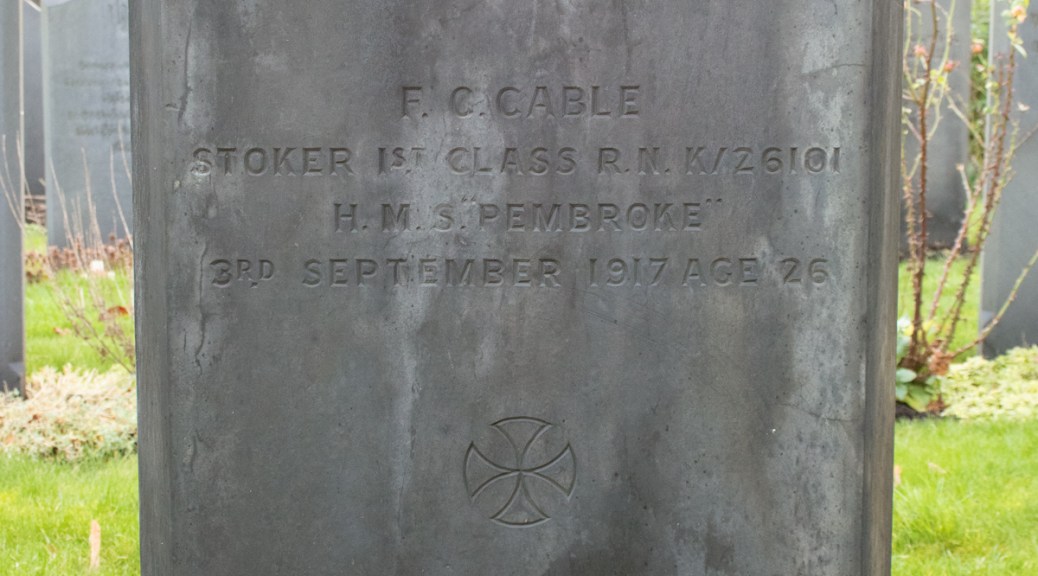
Stoker 1st Class Frederick Cable

Stoker 1st Class Frederick Cable

Frederick Charles Cable was born on 22nd November 1890 in Eastbourne, West Sussex. He was the younger of three children to John and Louisa Cable, and the family lived on one floor of a three-storey house in the middle of the town.

When Frederick was born, John was working as a billiard marker, but it seems that this was a poor way to scratch together a living for a young father. The 1901 census found the family in London, where John had been born, and where he was not employed as a hotel waiter.

Sadly, the new set-up was not to last long: John died in 1905, leaving Louisa to raise her boys on her own. The next census record, in 1911, records the two of them living a five-room terraced house in East Finchley. They were not alone, however, as they were sharing it with a widow – Elizbeth Hickinbottom – and her 34-year old son, George.

A year later, George and Louisa married, and went on to have a daughter, also called Louisa. Frederick, meanwhile, was to find love of his own, and, in the spring of 1914, while working as a milkman, he married Dorothy Ada Laurence. They would go on to have a son, who they named after his father, a year later.

By this point, war was raging in Europe, and Frederick was called to do his duty in May 1915. His records show that he was 5ft 7ins (1.70m) tall, had dark brown hair, brown eyes and a dark complexion and was given the rank of Stoker 2nd Class.

Over the next couple of years, Frederick served on two ships – HMS Actaeon and HMS Weymouth – and it was on board the latter that he was promoted to Stoker 1st Class in April 1916. The majority of his time, however, was spent on shore-based establishments: HMS Victory in Hampshire and HMS Pembroke in Kent.

The Royal Naval Dockyard in Chatham (HMS Pembroke) was where he spent most of his time, and was where he returned to in the summer of 1917. It was a particularly busy place at that point in the war and temporary accommodation was set up. Frederick found himself billeted at The Drill Hall, away from the main barracks.

On the night of 3rd September 1917, Chatham suddenly found itself in the firing line, as the German Air Force launched a bombing raid. One of the bombs landed squarely on the Drill Hall, and Stoker Cable was killed instantly. He was just 26 years old.

Ninety-eight servicemen perished during the Chatham Air Raid that night. They were buried in a mass funeral at the Woodlands Cemetery in nearby Gillingham. This, too, is where Frederick Charles Cable was laid to rest.


Frederick’s brother John Cable also fought in the First World War. He served as a Sergeant in the 21st Battalion Middlesex Regiment and was killed at the Battle of St Quentin on 25th March 1918. He was 28 years old and left a widow and three children. #

Serjeant John Cable is commemorated on the Arras Memorial in Northern France.
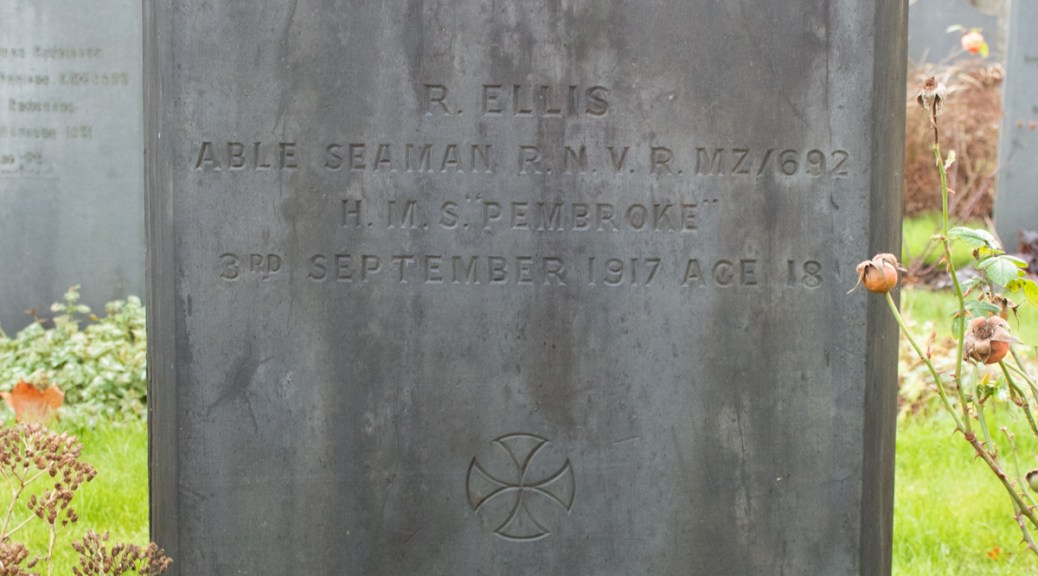

Able Seaman Raymond Ellis

Able Seaman Raymond Ellis

Raymond Ellis was born on 10th August 1898, the youngest of eleven children to Thomas and Elizabeth. Thomas was a former army officer from North Wales. He had met and married Elizabeth Moseley while living in Worcestershire in the 1870s, before moving the family to Oxfordshire ten years later. By the time Raymond was born, the family had moved back to Wales again, and were living in Llandygai, not far from Bangor in Caernarvonshire, where Thomas was working as slate quarry inspector.

By the time of the 1911 census, Thomas had found other employment, and was working as the caretaker for a telephone exchange. This is where one of his daughters was employed, and was also where Raymond himself found work when he left school.

War was coming to Europe by this point, however, and, on 23rd September 1915, Raymond enlisted in the Royal Navy Volunteer Reserve for a period of three years. His service records show that he was 5ft 4.5ins (1.64) tall, had red hair, blue eyes and a fresh complexion. He was given the rank of Able Seaman and, after a month at HMS Victory – the Naval Dockyard in Portsmouth, Hampshire – was given his first posting, on board HMS Wallington.

Able Seaman Ellis came on shore at HMS Pembroke, the Royal Naval Dockyard in Chatham, Kent, on 17th July 1917. The base was a particularly busy place at that point in the war and additional accommodation was desperately needed. Raymond found himself billeted at Chatham Drill Hall, away from the main barracks.

On the night of 3rd September 1917, Chatham suddenly found itself in the firing line, as the German Air Force launched a bombing raid. One of the bombs landed squarely on the Drill Hall, and Able Seaman Ellis was killed. He was just 18 years old.

Ninety-eight servicemen perished during the Chatham Air Raid that night. They were buried in a mass funeral at the Woodlands Cemetery in nearby Gillingham. This, too, is where Raymond Ellis was laid to rest.


Stoker 2nd Class Charles Cash

Stoker 2nd Class Charles Cash

Charles Cash was born on 8th August 1893 in Stepney, East London. He was one of seven children to Samuel and Clara Cash. The 1901 census gives Samuel’s trade as a fish porter, while his wife was recorded as a scrubber in a Sick Asylum.

Samuel died not long after the census was taken, and the family seems to have dissipated. Charles is recorded as having entered the local workhouse with his younger brother on 1st August 1906: the reason for admission being being deserted by their mother.

The next census record – taken in 1911 – raises some hope for Charles as it found him living with his mother’s sister and brother-in-law in Bow, where he was working as a labourer in a chemical works.

Things continued to look up for young Charles. On 1st August 1915 – nine years after entering the workhouse, he married Florence Elizabeth Ribbons, a labourer’s daughter from Poplar. The couple went on to have one child, a daughter named after her mother, in October 1916.

War was, by this point, raging across Europe and, despite having a new baby, Charles had to play his part. On 12th December 1916, he joined the Royal Navy as a Stoker 2nd Class, and, given his age, it is likely that he was drafted, rather than volunteering.

Stoker Cash’s service records show that he was 5th 7.5ins (1.71m) tall, he had dark brown hair, brown eyes and a fresh complexion. He was posted to HMS Pembroke, the Royal Naval Dockyard in Chatham, and it was here that he served for nine months.

The summer of 1917 was particularly busy for the base, and temporary accommodation was set up in the Drill Hall; this is where Charles found himself billeted.

On the night of 3rd September 1917, Chatham suddenly found itself in the firing line as a wave of German aircraft bombed the town. The Drill Hall received a direct hit, and Stoker Cash was amongst those to be instantly killed. He was just 24 years old.

Ninety-eight servicemen perished during the Chatham Air Raid that night. They were buried in a mass funeral at the Woodlands Cemetery in nearby Gillingham. This, too, is where Charles Cash was laid to rest.


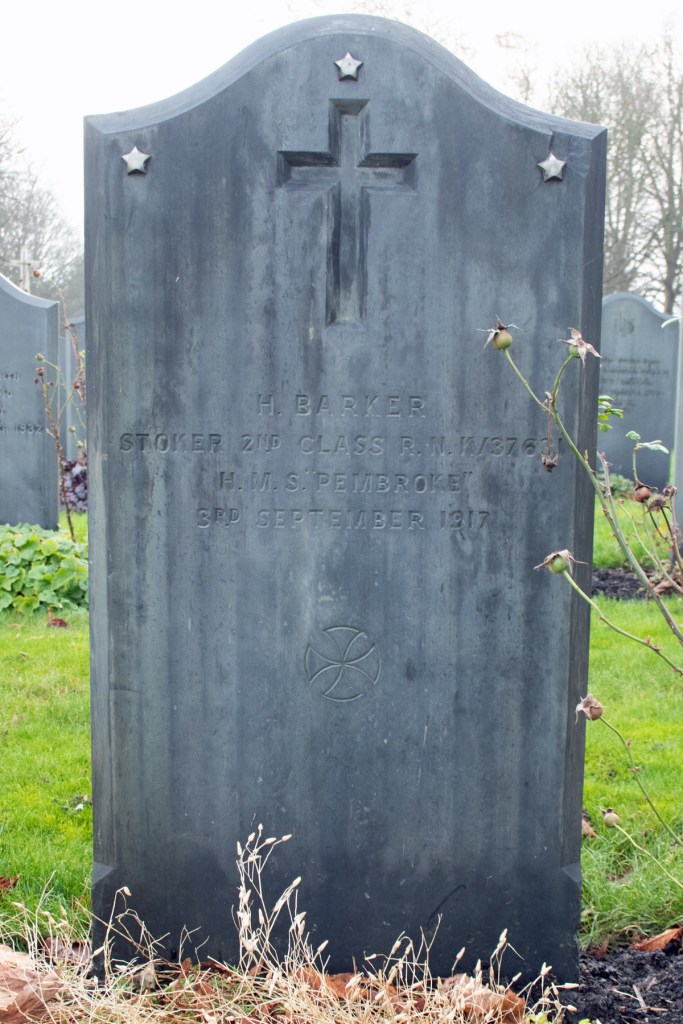
Stoker 2nd Class Harry Barker

Stoker 2nd Class Harry Barker

Harry Barker is one of those people whose lives are likely to remain lost to time as very little information remains that can be directly connected to him.

The only document that can be directly attributed to him is his Royal Navy service record. This confirms Harry’s date and place of birth as 5th January 1896 in West Dereham, Norfolk and confirms that he was a farm labourer before enlisting.

Census records confirm that, in 1901 there was a Harry Barker living in that village. He was residing with his grandparents – Robert and Elisabeth Barker – their son, Cornelius, and five more of their grandchildren.

One of the Barkers’ grandsons, Sidney, appears next to a Harry Barker on the 1911 census. Both were inmates at the Downham Union Workhouse, as does a Cornelius Barker. It seems likely, therefore, that the three are connected, and that this is the Harry Barker who appears on the service records five years later.

Harry’s records show that he enlisted in the Royal Navy as a Stoker 2nd Class on 27th October 1916. He was 5ft 8ins (1.73m) tall, had brown hair, brown eyes and a fresh complexion.

Stoker Barker was initially stationed at HMS Pembroke, the Royal Naval Dockyard in Chatham, Kent. After six months he received his first ocean-going post, aboard the dreadnought battleship HMS Hibernia. He spent five months on board, before returning to Chatham.

He was billeted in the Drill Hall, which had been set up with temporary accommodation during 1917, when the barracks themselves became overcrowded.

On the 3rd September 1917, the German Air Force carried out one of its first night-time air raids on England: Chatham was heavily bombed and the Drill Hall received a direct hit. Stoker Barker was amongst those killed instantly. He was just 20 years of age.

Harry Barker was laid to rest, along with the other victims of the Chatham Air Raid, in the Woodlands Cemetery, Gillingham.


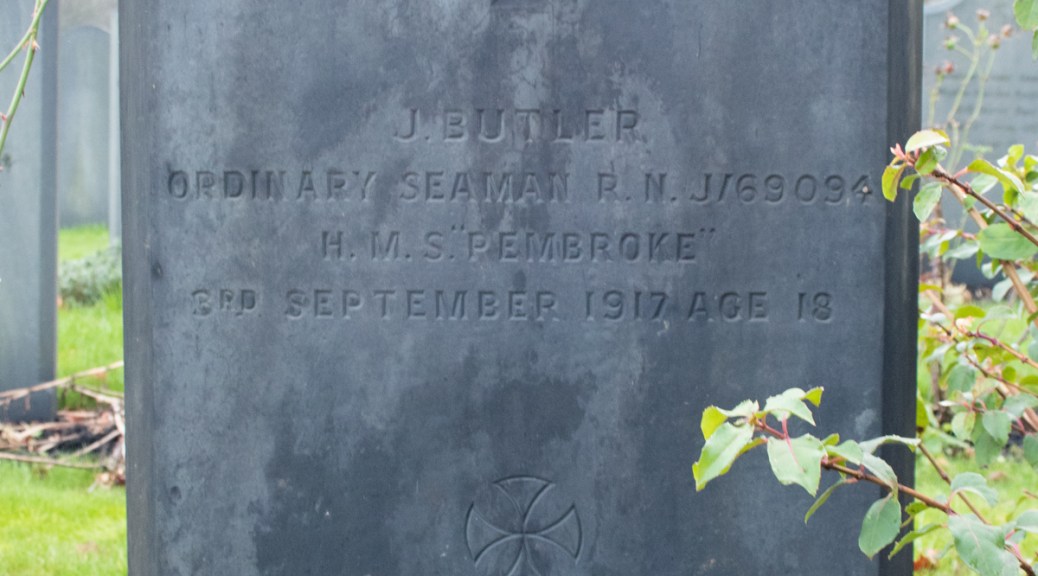
Ordinary Seaman George Butler

Ordinary Seaman George Butler

George Butler was born in Willesden, Middlesex, on 16th January 1899 and was the oldest of three children. His father, George Sr, was a bricklayer, while his mother, Sarah, worked as a laundress to help bring in some extra money.

Sadly, because of his age, there is little concrete information on George Jr’s early life. What can be confirmed is that, on 21st March 1917, having not long turned 18 years of age, and with the Great War well under way, he was keen to play his part for King and Country. He joined the Royal Navy for the duration of the conflict and was given the rank of Ordinary Seaman.

George’s service records show that he was 5ft 10ins (1.78m) tall, had brown hair, grey eyes and a fair complexion. It was also noted that he had a scar on his left leg. The document also confirms that he was employed as a bus washer.

Ordinary Seaman Butler was based at HMS Pembroke, the Royal Naval Dockyard in Chatham, Kent. It was a busy place that summer, and temporary accommodation was needed quickly. Chatham Drill Hall was brought into service, and George found himself billeted there.

On the 3rd September 1917, the German Air Force carried out its first night air raid: Chatham was heavily bombed and the Drill Hall received a direct hit; Ordinary Seaman Butler was among those killed instantly. He was just 18 years of age.

George Butler was laid to rest, alongside the other victims of the Chatham Air Raid, in the Woodlands Cemetery, Gillingham.


George’s headstone gives the incorrect initial, but the location is correct.


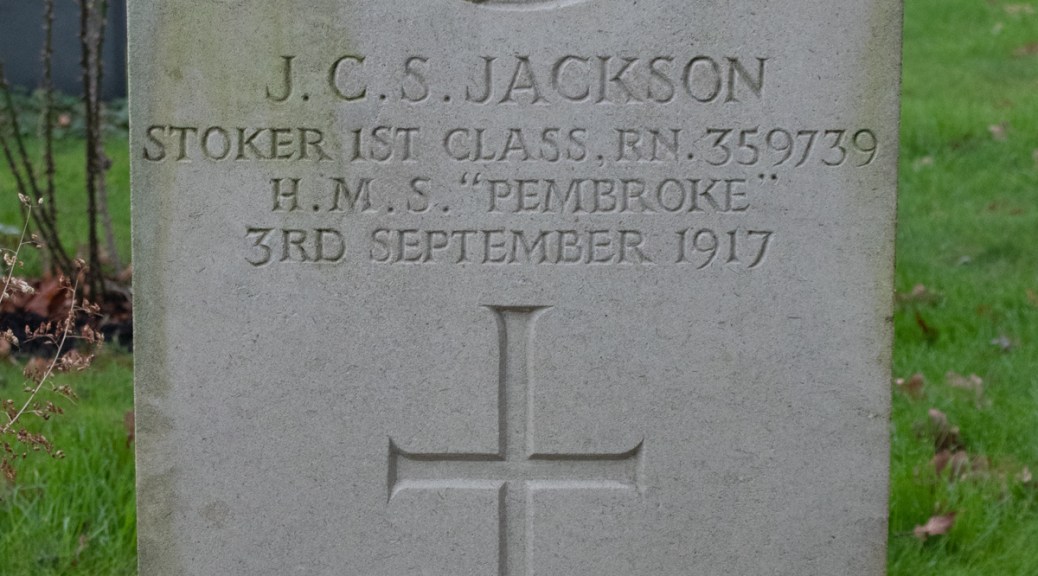
Stoker 1st Class Joseph Jackson

Stoker 1st Class Joseph Jackson

Joseph Charles Sackett Jackson was born in Rotherhithe, Surrey, on 4th May 1884, and was on of seven children. His father – post office worker Joseph Jackson Sr – died in 1895, leaving his mother, Eliza, to raise the family.

She soon married Matthew Newton, a widower himself, and the 1901 census found the couple living in Asylum Road, Peckham with eleven of their children and step-children. Joseph, who was 17 years old by this point, was one of only four of the household to be working, and was employed as a brass turner.

Keen to better himself, Joseph looked to a longer career and, in September 1901, he enlisted in the Royal Navy. His service records show that he was 5ft 3ins (1.6m) tall, had dark brown hair, brown eyes and a fresh complexion.

Initially underage, he served on the home front, Joseph was based at the shore establishments around the country – HMS President (London), HMS Pembroke (Chatham Dockyard, Kent) and HMS Victory (Portsmouth, Hampshire). In 1906, when he turned 23, he formally enlisted in the Royal Navy, and was given the rank of Stoker 2nd Class.

Over the next year, Joseph served on three vessels – HMS Hawke, HMS Dido and HMS Pathfinder – and was promoted to Stoker 1st Class. He continued his work at sea, but returned to HMS Pembroke in between voyages.

In the summer of 1913, Stoker Jackson was assigned to the battleship HMS Dominion, and it was here that he spent the next four years. He was promoted again, this time to Leading Stoker. He returned to HMS Pembroke in August 1917, although he was again given the rank of Stoker 1st Class.

Chatham Dockyard was particularly busy that summer, and the large number of extra servicemen meant that Joseph was billeted in temporary accommodation in Chatham Drill Hall.

On the 3rd September 1917, the first night air raid carried out by the German Air Force bombarded the town, and scored a direct hit on the Drill Hall; Stoker 1st Class Jackson was among those killed instantly. He was 33 years old.

Joseph Charles Sackett Jackson was laid to rest, along with the other victims of the Chatham Air Raid, in the Woodlands Cemetery, Gillingham.


Bombardier Thomas Greenslade

Bombardier Thomas Greenslade

Thomas Greenslade was born in Alcombe, on the outskirts of Dunster in Somerset, in the spring of 1894 and was one of ten children. His parents were Devon-born cab proprietor Richard, and his wife Emma, who passed away in 1905, aged 38 years old.

When he left school, Thomas helped his father with his business; the 1911 census recorded him and his older brother Charles as drivers, his younger two sisters as housekeepers for their father, and his youngest two siblings as still being at school.

Storm clouds were approaching Europe and, in the summer of 1915, Thomas signed up to play his part for King and Country. He joined the Royal Field Artillery, and was assigned as a Bombardier to C Battery of the 74th Brigade. His troop was one of the Howitzer Brigades, and it seems likely that his knowledge of horses stood him in good stead.

Little information on Bombardier Greenslade’s military service survives. His regiment saw conflict at Loos, the 1916 Battles of the Somme and the Third Battle of Ypres, and it is likely that he was involved in these skirmishes.

What can be confirmed is that, by July 1917, Thomas was in the War Hospital in Bristol. The reason for his admission is unclear, but it led to his demise. Bombardier Greenslade passed away on 11th July 1917: he was just 23 years of age.

Thomas Greenslade’s body was brought back to Dunster. He was laid to rest in a quiet corner of the village’s cemetery.


Colour Serjeant Major Frederick Davis

Colour Serjeant Major Frederick Davis

Frederick Davis was born in Street, near Glastonbury, in February 1876. One of four children, his parents were Frank and Ann. Frank was an agricultural labourer, while Ann worked as a shoe binder in the local Clark’s Factory.

By the 1891 census, Frederick had left school, and had also left home, boarding with a farmer in nearby Walton, where he also worked as a labourer on the farm. Ten years later, he was living with his paternal grandmother and his older brother in the village, with both brothers working as labourers.

During this time, it seems that Frederick had his sights on bigger and better things. Full details are not available, although it appears that he enlisted in the Army and served in India and South Africa between at least 1897 and 1902. He was awarded the Distinguished Conduct Medal in 1902 for his actions, although again little information around this survives.

Confirmation of his service overseas at this time appears on Frederick’s later military service records as, in January 1909, he again enlisted in the army. Frederick’s 1909 records show that his next of kin was his wife, Mrs AL Davis, although no marriage documents are apparent. He is also recorded as living in Castle Cary, just to the south of Glastonbury.

This time he was assigned to the 4th Battalion of the Somerset Light Infantry, serving for five years on home soil. During this time, he rose through the ranks from Private to Lance Corporal to Corporal to Sergeant.

When war was declared, the 4th Battalion was sent out to India. Sergeant Davis spent the next eighteen months there, before being moved to the Persian Gulf. He was obviously well thought of as, with the move came a further promotion, this time to Company Sergeant Major.

In June 1917, Frederick returned to England from overseas, and, at the end of his term of service two months later, he was demobbed. He returned home to Somerset, but, within a couple of months, on 2nd October 1917, he passed away. The cause of his death is not recorded, but he was 42 years of age.

Frederick Davis was laid to rest in the peaceful surrounds of the Castle Cary Cemetery.


Air Mechanic Walter Naish

Air Mechanic Walter Naish

Walter Matthias Naish was born in the autumn of 1896, and was one of of five children to agricultural labourer Matthias Naish and his wife, Sarah Ann. Born in Lovington, near Castle Cary, Somerset, this is where the family is recorded as living for the 1901 and 1911 censuses.

When he left school, Walter found work as a cabinet maker; war was on the horizon, however, and he enlisted on 28th February 1916. He was immediately put on reserve, however, and was only mobilised in January 1917, when he was assigned to the Royal Flying Corps as an Air Mechanic.

Tragically, Walter’s military career was not to be a long one. He was admitted to the Connaught Hospital in Aldershot with conditions unknown, and passed away on 3rd March 1917, just 51 days after leaving home. He was just 20 years old.

Walter Matthias Naish’s body was brought back to Somerset for burial. He lies at rest in the Castle Cary Cemetery, not far from his home.


Lieutenant Herbert Marshall

Lieutenant Herbert Marshall

Herbert William Hare Marshall was born in Ambala, India, on 19th August 1890. His father – Herbert Seymour Marshall – was a Colonel in the army, and was serving in India with his wife, Charlotte, when their children – Charlotte (known as Jessie) and Herbert Jr – were born.

The family were back in England by 1898, and had set up home in the Somerset seaside town of Weston-super-Mare. When Herbert Sr passed away that year, Charlotte was set up on a widow’s pension, and this allowed her to send her son to St Peter’s, a private boarding school in the town.

When her son’s schooling was complete, Charlotte took the family off to Canada. They settled in British Colombia, in Revelstoke, a mountain town halfway between Calgary and Vancouver. Here, Herbert found work as a bank clerk, but war came to Europe, and he felt a need to do his bit for King and Country.

Herbert enlisted in the Canadian Expeditionary Force (CEF) in November 1914; his service papers record him as being 5ft 8ins (1.73m) tall, 148lbs (67kg) in weight. He had black eyes, brown hair and a dark complexion – something that he may well have inherited through his mother’s genes.

Shipped to England, by August 1915, Private Marshall had been discharged from the CEF as part of a transfer to the New Army – also known as Kitchener’s Army, the volunteer British Army raised as a direct result of the outbreak of war.

Detailed information about Herbert’s military service is lacking, although it seems that he joined the 17th Battalion of the West Yorkshire Regiment, one of the regiments heavily involved during the Battle of the Somme.

By October 1916, however, the now Lieutenant Marshall had made another move, this time joining the Royal Flying Corps. On the afternoon of 26th August 1917, he was an observer on a flight at Marham, in Norfolk. The pilot, a Lieutenant Challington, was banking the aircraft, when it dived and crashed, killing both men. Lieutenant Marshall had turned 27 years old the week before.

Herbert William Hare Marshall’s body was brought back to his adopted home of Weston-super-Mare. He lies at rest alongside his father in the town’s Milton Road Cemetery.